In Limbo or Not? – A Timeless Day at the Castle of Gaasbeek

Picture @petervan

I went to the premiere exhibition of David Claerbout’s The Woodcarver and the Forest at the Castle of Gaasbeek. I went by bike, for me, a two-hour ride each way, on a warm sunny day through the Pajottenland, the region southwest of Brussels where I spent the first 25 years of my life. Cycling up and down its rolling hills stirred deep emotions and memories of my youth. This is the land of Bruegel, of Geuze and Lambic beer, of Remco Evenepoel. It is also, unmistakably, my land.

Before arriving at the castle, visitors walk about 15 minutes from the entrance through a carefully tended, forest-like domain. The path itself already feels like part of the experience, drawing you gradually into a slower, quieter, almost meditative state.

There is also a 2-hectare Museum Garden.

Picture © Fabrice Debatty

A top-level garden modelled on castle gardens from the 18th and 19th centuries. A strong example of living cultural heritage. Take a stroll through this magnificent Garden of Eden, with the old-model fruit repository, the beehives, and a wonderful view of Gaasbeek Castle and the Pajottenland.

I lingered in the garden for some time, sitting on a bench and gazing at another bench across the way, the two connected by a loofgang—a leafy tunnel formed by pear trees. I simply sat in silence, doing nothing. Eventually, I walked through the shaded passage to the other side, before making my way to the castle. In hindsight, the video I captured carries an unintended sense of suspense.

Once inside the castle, visitors are guided along a signposted route. Along the way, I captured this video of sunlight filtering through stained glass, casting vibrant patterns onto the wooden, carpeted floor.

The Claerbout installation awaits at the very end, rising three stories high beneath the roof.

From the brochure:

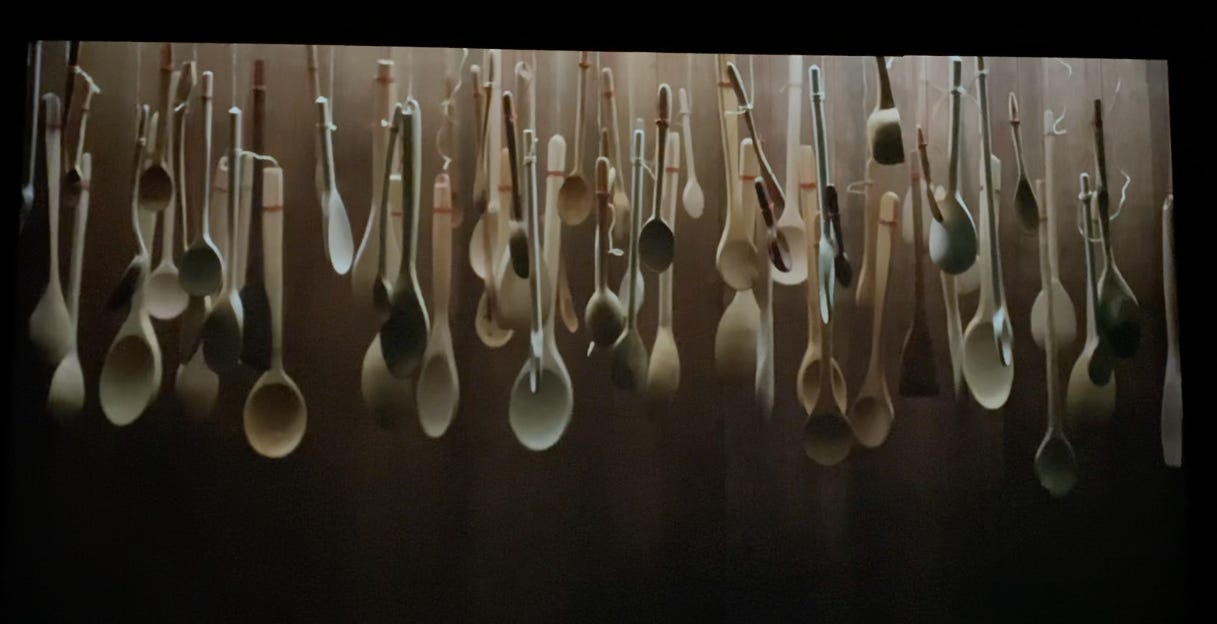
This work is Claerbout’s latest creation and presents itself as an intimate portrait of a reclusive young man. Do you feel the meditative effect of the slow, repetitive movements and their sound?

Specific audiovisual stimuli – such as soft sounds or rhythmic movements – can evoke feelings of relaxation and inner calm. This phenomenon is known as ASMR (Autonomous Sensory Meridian Response) and forms the foundation of this work

The Woodcarver and the Forest is an open film, which is completed using generative artificial intelligence. As a spectator, our experience also remains open and unfinished, partly due to the long duration of the work.

This reveals the dual nature of the film: an interplay between pleasure and sorrow, beauty and destruction.

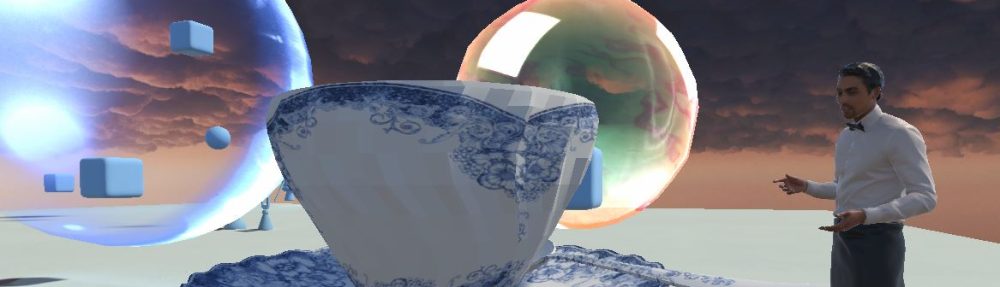
Still from Claerbout’s video installation – picture by @petervan

I sat in there for more than one hour. It put me in some state of limbo about my own work and where I want to go next. Following Google’s Gemini AI, it means “to be in an uncertain, undecided, or forgotten state where nothing can progress or be resolved, similar to being caught between two stages or places.”

I am a big fan of David Claerbout. See previous entries on this blog here. The Woodcarver gave me the chance to revisit some of Claerbout’s earlier works and conversations, while also helping me reconnect with the artistic drive within myself.

Here is a more recent talk by David Claerbout

Some interesting quotes

Change your mind-set ànd your eye-set, from inquisitive to open-ended

The Brain does not choose sides; it does not know how to

And around minute 18, he gets into a very interesting schema of “former” AI technologies. He really got me when he says “the camera is a profoundly liberal invention” and later “around the 2000s, we start to think of visual culture as a assemblage, the coordinate system is back, and a coordinate system knows exactly where you are it has exact points in space it can find you back and instead of a liberal body in a world that could be anything anywhere it changes into a pinpointing in a space that so we we get a gathering of coordinates and we’re no longer free” 

In closing, he shares reflections on recent readings that explore AI, vision, and the language of thought.

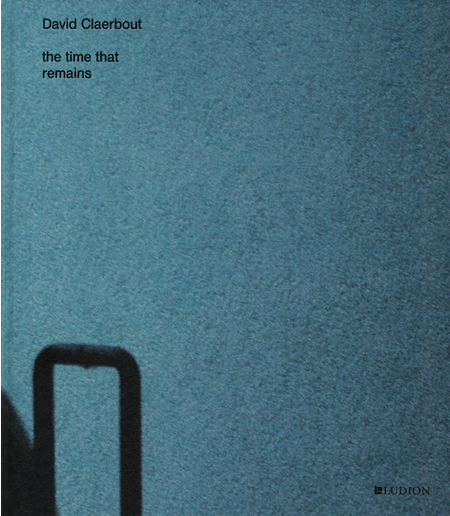
After watching the video, I visited the University of Ghent library—you can get a visitor’s pass as a non-student for €15 per year, granting access to all of the university’s libraries! There, I picked up the book The Time That Remains, a title that resonated with me on two levels: first, the concept of time, so ever-present in Claerbout’s work; and second, the realization that I am approaching my seventieth birthday, prompting me to reflect increasingly on the time I have left and how I want to spend it—especially in my artistic practice, if I can even call my tinkering that.

From the intro:

This publication marks the welcome collaboration between internationally acclaimed Belgian artist David Claerbout and two European institutions: Wiels, Brussels and Parasol unit, in London. The publication accompanies Claerbout’s exhibition opening at Parasol unit, on 30 May 2012; but it also provides a highly appreciated documentation for Wiels, which held a solo exhibition of Claerbout’s work, The Time that Remains, in 2011.

It’s from 2012, but the content is, well, timeless.

Some quotes/insights from that book.

I think the recent proliferation of black boxes for film and video-art is not just a practical solution to a problem of sound and light interference, but also reflects an incapability to coexist. This can become apparent in large group exhibitions, where media installations appear strong when they are shown by themselves in a small or large dark space, but they easily collapse when shown in a social space where people move about and interact. The black box is a social phenomenon, for me it is a problem.” Ulrichs, David, ‘David Claerbout. Q/A, in: Modern Painters, May 2011, pp. 64-66

+++

Time is invested into something that will prove to be valuable and productive. By consequence duration’ becomes increasingly expensive. But duration can only be free if it is unproductive.”

+++

Cinema, YouTube and film-festivals demand the prolonged physical immobility of the viewer. Music, exhibitions or a walk in the park don’t.

My sense of being in limbo stems from a hesitation: to move further into abstraction rather than figuration, toward longer forms rather than shorter ones, toward meditative sound and video landscapes rather than straightforward documentary. It also comes from my struggle to resist the banality of social media—where time is squandered on addictive, bite-sized fragments of content that ultimately feel useless.

I believe I know the answer, yet I dare not leap just yet.

Who will be the one to give me a gentle nudge?

Is this still needed?

Petervan’s Ride – July 2025

Petervan’s Musical Ride July 2025– 50+ songs. Recent releases include Rival Consoles, Ozark Henry, and Wet Leg. Oldies from Eric Clapton, Black Sabbath, and Grace Jones. Play in shuffle mode to increase the surprise factor. Enjoy!

Petervan’s Ride – June 2025

Petervan’s Musical Ride June 2025– 50 songs. Recent releases include Turnstile, Kathryn Joseph, and HAIM. Oldies from Soulwax, Roisin Murphy, and The Beach Boys. Play in shuffle mode to increase the surprise factor. Enjoy!

Petervan’s Delicacies – May-June 2025

“Delicacies” is my incoherent, irregular, unpredictable collection of interesting sparks I came across online. Handpicked by a human, no robots, no AI. A form of tripping, wandering, dérivé, with some loosely undefined theme holding them together. Delicacies have no fixed frequency: I hit the publish button when there is enough material. That can be after a week or after 3 months. No pressure, literally. Just click the image below. Enjoy!

Some highlights from this edition:

If you prefer the full firehose, check out the substack link: https://petervan.substack.com/p/petervan-delicacies-177

Petervan’s Ride – May 2025

Petervan’s Musical Ride May 2025– 50 songs. Recent releases include Kae Tempest, Froid Dub, and Saint Etienne. This time, there are many oldies, such as Roy Orbison, Cher, The Who, and many others. Play in shuffle mode to increase the surprise factor. Enjoy!

Petervan’s Delicacies – March-May 2025

“Delicacies” is my incoherent, irregular, unpredictable collection of interesting sparks I came across online. Handpicked by a human, no robots, no AI. A form of tripping, wandering, dérivé, with some loosely undefined theme holding them together. Delicacies have no fixed frequency: I hit the publish button when there is enough material. That can be after a week, or after 3 months. No pressure, literally. Just click the image below. Enjoy!

Some highlights from this edition:

If you prefer the full firehose, check out the substack link: https://petervan.substack.com/p/petervan-delicacies-176

Petervan’s Ride – April 2025

Petervan’s Musical Ride April 2025– 56 songs. Recent releases include Mauro Pawlowski, Pomrad, and Lorde > Oldies from Sly & Robbie, Alanis Morissette, and Netsky > Play in shuffle mode to increase the surprise factor. Enjoy!

PXL Immersive Music Day 24 Apr 2025 – Conference notes

As part of the research for my immersive projects and performances, I am trying to better understand the visual and audio aspects of XR experiences. In that context, I attended the Immersive Music Day at PXL in Hasselt, Belgium, organized by the PXL Music Research team. The full program, schedule, and lineup are here.

It is a relatively small-scale event (I guess about 100 PAX), which is great as it enables networking with the participants and the speakers. The event was held at a location with great immersive audio infrastructure (3 rooms with full 360 sound set-up). For the rest, it was a no-frills event with super-friendly staff and good food at breakfast and lunch.

Example of an immersive music room set-up

I was also pleasantly surprised by the mix of ages, ranging from fresh-faced high school students to seasoned audio veterans and legends, plus corporate fossils like myself. That kind of diversity usually signals that something truly interesting is about to unfold.

But the best part was the content and the speakers.

If there was an intended or unintended theme, it would be the subjective aspects of the immersive experience (how sound “feels”, or about the experiential coherence of auditive, visual, and spatial input) vs. the technological aspects of immersive sound (like precise localisation of sound in space). But I am sure that in some other sessions, the content was quite nerdy, up to the detailed coded and mathematical aspects of encoders/decoders.

Here are a few notes and reflections from the sessions I attended.

Immersive Space – An Agent for Creating and Experiencing Music

Speaker: Wieslaw Woszczyk, Director of the McGill Recording Studios and the Laboratory of Virtual Acoustics Technology at the Schulich School of Music of McGill University.

Program synopsis: Humans have sensory capabilities for recognizing their presence and immersion in space. Music ideally matches these capabilities by presenting dynamic, tonal, harmonic, and rhythmic structures in sound. Musicians use space to generate and blend sounds of ensemble, to hide and reveal musical voices, to dramatize perspectives, and to harness emotion in music making and listening. The talk explores immersive space as a modern technological tool for augmenting people’s experience of music

CIRMMT Dome with 32 speakers

Notes:

I had never considered immersive sound as a medium for live music performance—being physically present in one space while listening to live musicians through a 360° sound system that simulates the acoustics of an entirely different environment. Wieslaw talked about auditory “fingerprints” of spaces. This goes way beyond sound effects like reverb that simulate the reverb of a cathedral. No, this fingerprint captures the full acoustic character of a space—every corner, every height, every nuance. And there are plug-ins available that let you import this detailed acoustic profile directly into consumer-level digital audio workstations like Logic Pro and others.

This allows performing artists to shape and test their artistic expression for a specific space, like the San Francisco Cathedral, or lets the audience experience the music as if they were actually there, immersed in that very acoustic environment.

Altering the Immersive Potential: The Case of the Heilung Concert at Roskilde Festival

Speakers: Birgitte Folmann, Head of Research, Sonic College, and Lars Tirsbæk, Consultant in Sound & Emerging Technologies, Educator 3D audio, Sonic College

Program synopsis: Immersive concert experiences are often described as specific, emotionally moving, dynamic, and complex – qualities that require experimental and interdisciplinary methods to be meaningfully understood. In this talk, we explore the immersive and engaging potential of live concerts through the lens of the Heilung performance at Roskilde Festival. Drawing on anthropological fieldwork and insights into the technical systems that supported the experience, we discuss how a deeper understanding of immersion can inform both artistic and technological development to enhance future audience experiences 

Notes:

The talk was about the Heilung Concert at Roskilde Festival in 2024, in a festival tent holding about 17,000 people. Details about the technical set-up by Meyer Sound here.

What struck me was that the concert wasn’t branded as an “immersive” experience—there was no expectation set in advance. Yet, the immersion began the moment people entered the tent: birdsong filled the air, subtly blurring the line between environment and performance. It reminded me of my Innotribe days, where we also paid close attention to how people entered a space. After all, arrival and departure are integral parts of both the performance and the scenography.

The first part of the talk by Lars was about the technical challenges of delivering a 360 immersive sound experience in such a huge space. The second part by Birgitte was about the anthropological and subjective aesthetic experience of immersive music by the audience. Her slogan, “Aesthetics is a Verb” is great t-shirt material. They also talked about the “attunement” of the audience to the experience, and that you can’t fight the visuals: for example, when the drums play on the front stage, having the 360 sound coming from behind you does not work for the human brain.

Their team is now starting to document the findings of their field research. More to come.

Designing the Live Immersive Music Experience

Speaker: Paul Geluso, Music Assistant Professor, Director of the Music Technology Program – NYU Steinhardt University

Program synopsis: Paul Geluso’s work simultaneously encompasses theoretical, practical, and artistic dimensions of immersive sound recording and reproduction. His first book, “Immersive Sound: The Art and Science of Binaural and Multi-channel Audio,” published by Focal Press-Routledge, has become a standard textbook in its field. Geluso will share his research experience while providing exclusive previews of interviews and insights with featured immersive audio masters from his forthcoming book, “Immersive Sound II: the Design and Practice of Binaural and Multi-Channel Experiences” set to be published in fall of 2025. This presentation will also included discussions on his 3DCC microphone technique, a 3D Sound Object speaker design capable of holophonic sound playback, and his work on in-air sound synthesis and other site-specific immersive sound experience building techniques. 

Notes:

Paul Geluso is God. Some years ago, he published “Immersive Sound: The Art and Science of Binaural and Multi-channel Audio,” considered by audiophiles as “The Bible”. He is also good friends with Flanders’ best artist, Piet Goddaer aka Ozark Henry, who specializes in immersive sound and music.

Ozark Henry in his studio

Paul took us on a journey of his research on immersive recording (making custom made 3D microphones and codes) and playback (making his own “Ambi-Speaker Objects”.

Paul Geluso’s immersive 3D Sound Object (Ambi-Speaker)

This was more of a backdrop for his upcoming book. While his first book was more about the how – the technology to record and playback immersive music – his new book will focus on the why – in essence, about leading with the story and the artistic intent. He hopes the new book will be out in 2025.

I had the chance to have a short 1-1 conversation with Paul, who seemed interested in our immersive performance ideas, which was exciting to know.

Subjective Evaluation of Immersive Microphone Techniques for Drums

Speaker: Arthur Moelants, Researcher PXL-Music

Program synopsis: When presenting a group of listeners with four immersive microphone techniques in two songs, will they always choose the most objectively correct one? An experiment with drum recordings in different acoustics and musical contexts challenges the assumption that objective parameters like ICTD and ICLD should always determine the best choice. While non-coincident techniques often score better in these metrics, listener preferences can shift depending on the musical context, as other techniques offer different sonic and practical qualities that might benefit the production more.

A microphone set-up for drums

Notes:

Arthur is part of my team for our immersive performances, like The New New Babylon, where he acts as both a cinematographer and immersive music expert. He is a member of the PXL-Music Research team. I was curious to see how he’d handle public speaking and delivery, and he did not disappoint. I’m always impressed by how some young professionals manage to blend deep, almost nerd-level technical expertise with polished communication and presentation skills.

His talk was about his research on the subjective experience of drums, and how that experience differs depending on the recording technique and on the context of the drums as part of a song. I really like the simple graphics of his slides to explain some quite technical aspects of immersive music. Not an easy talk to deliver as he was also giving live demos on a 360 system to let us hear the subtle differences.

That’s it. Hope you enjoyed these notes

Warmest,

Petervan Studios – April 2025 Update

Head measuring device – seen in GUM Science Museum – Wunderkammer of Truth

General Status

Green Green Grass of Hope – Bicycle ride 26 Oct 2024

The Art Studio

Example of Ableton Live with Envelop for Live 3D Source Panner

An example of a simple VCV Rack set-up

Static example from Wave Unstable rule in CAPOW software by Rudy Rucker

Petervan Studios © 2025 – Seaside – Acryl on Canvas – 80x100cm

Crop from Curves work Anni Albers – Gouache on paper – ca 1955

Petervan Studios © 2025 – Braid Amulets – Chinese Ink on A4 printer paper

Petervan Studios © 2025 – Gnarly Curves – Chinese Ink on Steinbach A1 paper

Petervan Studios © 2025 – Gnarly Curves – Digital in Procreate iPad

Back to School

Summer of Protocols 2024 (SoP24)

Toolmaking for Spatial Intelligence

Masterclass XR in Industry

1) Unity Essentials

2) Enhanced reality use cases

3) Enabling remote expertise (remote assistance)

4) Augmented inspection (BIM/3D concept visualization)

5) Visualizing the unseen (IOT data visualization/digital twin)

6) Virtual control (interaction with machines/robots via XR)

Performances

Performance: Claim Your Cybernetic Word – 17 June 2024

Resulting world cloud

Performance: What Makes Us Human? – 28 August 2024

Trailer: 

Performance: New New Babylon

Performance Dream My Dream

Trailer

17 Minute Video simulation of the performance

Artistic Research Project: New New Babylon

  • A beta version of an Urbanistic Artistic Rendering VR Environment, inspired by an existing or planned City or Real Estate project
  • Artistic Performance (minimum Online, ideally IRL), see above
  • Art Book

Stealth

A theory of space/time dimensions

Concept drawing by Petervan Studios © 2025

Image generated by Gemini 2.0

Delicacies

Books

  • Geometry, Relativity and the 4th Dimension – by Rudy Rucker (1977)
  • Love & Math – by Edward Frenkl (2013)
  • Behave – by Robert Sapolsky (2017)
  • Mind in Motion – by Barbara Tversky (2019)
  • Soft City – by David Sim (2019)
  • and re-reading The Lifebox, the Seashell, and the Soul – by Rudy Rucker (second edition 2016)

For other books I am reading, see my GoodReads.

Exhibitions

SMAK – Ghent – Tarek Atoui

Sarah De Vos – detail – Galerie Sofie Van de Velde

What’s next?

  • The “Dream My Dream” performance 
  • The New New Babylon project
  • The Stealth Project
  • XR in the Industry Masterclass

Petervan’s Ride – March 2025

Petervan’s Musical Ride March 2025– 61 songs. Recent releases include Panda Bear, Kae Tempest, and Ozark Henry > Oldies from Madonna, Roy Ayers, and DJ Funk > Play in shuffle mode to increase the surprise factor. Enjoy!