Travelling without Moving – Pause

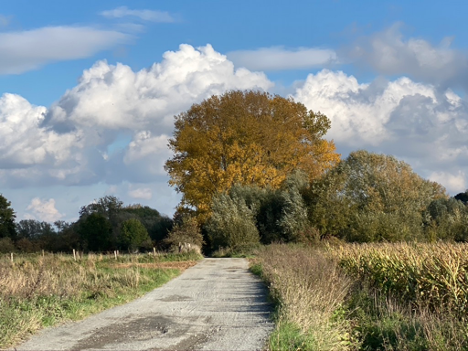
Alley entrance of the Gaasbeek Castle – Picture Petervan

This post is part of a series of essays bundled under “Travelling without Moving”.

Intro of that series can be found here.

After the Silence post of last week, we continue with Pause.

In “Silence”, I mentioned “Stop the clocks – Manifesto for a Slow Future”, Joke Hermsen’s book about Silencing the Time. Minutes after I published that post, I got a notification of a new book by Joke Hermsen

“Ogenblik & Eeuwigheid” or “Moment & Eternity” opens with Joke’s reflections on a Kairos/Chronos exhibition she curated in 2017 in the Gaasbeek Castle south of Brussels. Coincidence or not, but I happened to be there, and here is a video of one of the installations exhibited then.

I wrote about this exhibition in “About Time

“This is about that mysterious moment when our soul is unguarded and spreads out its wings. Kairos manoeuvres virtuoso between two worlds: the measurable and the immeasurable, the known and the un-known, backing out of our knowledge, covertly showing us a glimpse of the possible”

Her new book is once again about Chronos and Kairos and the potential of art to move us into the surplus of Kairos

Het surplus aan tijdservaring die de kunst voor ons in petto heeft verschilt aanzienlijk van het louter meten van tijd op de klok.

The surplus of time experience made available by art is quite different from the pure measurement of time

Artists covered/mentioned are:

Sean Scully

Virginia Woolf

Hilma Af Klint

Marlène Dumas

Thomas Mann

Mark Rothko

Hannah Arendt

Edmond Jabès

But this post was to be about Pause.

Robert Poynton wrote a book about it.

I highly recommend it.

Robert lives between Oxford and a remote Spanish town west of Madrid. In Spain, he lives off grid – literally and metaphorically.

His remote, hilltop house is even off the electricity grid.

It is also the place where he contemplates.

Intro https://www.robertpoynton.com/

Together with Josie Gibson from The Catalyst Network, we started some 1-1 calls to share what these books trigger for us and our communities. We decided to start a small experiment: we read a chapter of the book, schedule a 1-1 call to let flow our minds, record it, and share it with our communities.

Very down to earth, no tricks, no gimmicks, just a gentle and calm wandering and meandering of minds from two opposite sides of this earth. One person from Melbourne, Australia and one from Aalst, Belgium; one person in autumn, one in spring.

These are very calm conversations; so best is to take a pause, install yourself in a quiet corner and enjoy!

Episode-1 on “Why Pause?” is here.

Episode-2 on “What’s in a Pause” is here.

Episode-3 on “Habits” is here.

Episode-4 on “Design” is here.

Episode-5 on “Culture” is here.

Episode-6 on “Tools” is here.

Episode-7 on “Time to Pause” is here.

Episode-8 on “Afterword” is here.

“Everything is an offer”, Robert writes in Pause.

It is an invitation to calm and tranquility as powerful sources of vitality ànd relaxation.

Yes! They can go together.

But sometimes the rhythms of an ordinary day offer stillness as well.

Even the ticking of the Chronos clock as a background soundscape can bring me in a state of calm and stillness.

Like monks doing their miniatures.

I found this online clock that ticks for 12 hours.

It’s the only thing it does.

And in the meantime, I am drawing thousands of little bricks in brick bonds.

It’s useless, I know.

But it brings me in a Zen state, a state of deep calm and happiness.

I am literately and metaphorically losing my time.

In a recent newsletter update about “pottering” in his garden, Robert wrote:

“When I do what I am drawn to, I am absorbed by my surroundings – by what I see, or hear, or smell. My attention is open, soft, pliable. This stills something inside me and I find a kind of quiet calm.”
 
“This stillness is something that is given to me, not something I create. It is a gift; and one I cherish. It is settling, if not nourishing to be reminded that the worries and concerns that bother me so, are mostly of my own invention. And that moving around can help me to be still.”

I am attracted by Robert’s pause, his stillness as a gift.

A place where I want to hang-out, where I can lose my Chronos time.

In the meantime, I got many conversations with Robert. I shared with him my ideas on creating better gatherings, beyond “conferences” as entertainment, but more as learning experiences, resonating beyond the cognitive, and how we can do much better than just copying the analog.

(Not) to my surprise, Robert spent a lot of time as well on how learning can be done better, differently. And together with Alex Carabi, he created Yellow Learning. I mention it quickly here, as Yellow is one of the other keywords in this series Traveling without Moving.

Check it out:

https://www.yellowlearning.org/

I was part of the second cohort ending next week. Yellow is fee based. But worth its money, trust me. If you are interested, the call for the next groups Jan-June 2021 is open now.

Apply here: https://www.yellowlearning.org/apply-to-join

Next time, we’ll talk about “Play”

Hope you enjoy the series.

Warmest,
Premiere Petervan’s Pirate TV – Art-Tribe Edition

I am excited to announce the launch of one of my new channels: Petervan’s Pirate TV – Art-Tribe Edition

The first episode will premiere on YouTube on 1 Dec 2020 at 09:30am Los Angeles – 12:30pm New York – 6:30pm Brussels – 1:30am Hong Kong (next day)

The YouTube live chat will be open for feedback, critique and encouragements.

I suggest you set the YouTube reminder so you don’t miss the premiere and the live chat.

The video will remain available for viewing after the Premiere event

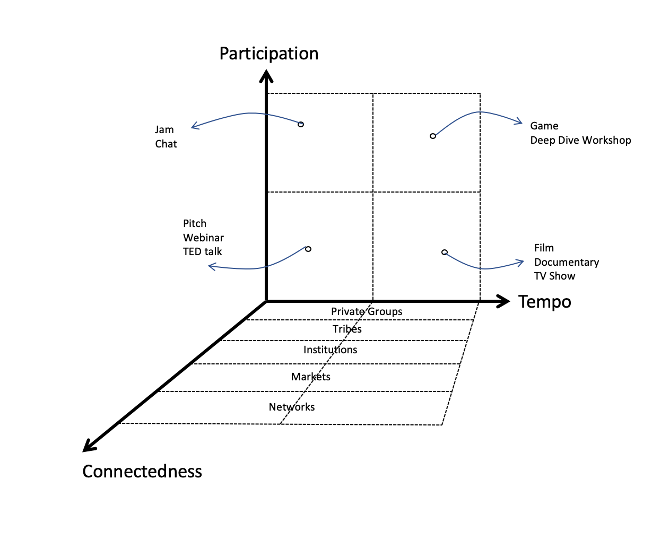
Virtual events ambition cube

Pirate TV is a new genre that sits somewhere between a vlogcast, documentary, film, and TV show. In the events ambition cube, this sits in the lower right quadrant for a tribe-connectedness.

Current plan is to have two editions: one more business related (the Biz-Tribe Edition), and one more artistic related (the Art-Tribe Edition).

The Art-Tribe Edition launches on 1 Dec 2020, the Biz-Tribe Edition will launch on 2 Feb 2021.

As I strongly believe that magic happens at the cross-section of artists, scientists, engineers, and business people, I expect that sooner or later the two editions will start to blend.

Art-Tribe Edition is intended as a platform for artists in conversation with Petervan.

The artist-in-residence for this first episode is Frank Poncelet.

Frank Poncelet is an independent Artist/Director/Producer who graduated from “The Academy for Visual Arts” in Ghent in 2017. While he has no intention of pursuing professional animation in the future, he enjoys the process and will continue to make animations and VFX shorts. After his Graduation film “A Night On Gor”. He worked for One year on an Animation Mashup “Bug’s Club” inspired by “Hell’s Club” from Antonio Maria Da Silva AMDSFILMS. In 2017/2018). Frank Also Produced his short sci-fi film “Alpha” in 2019. Currently Frank is working on video art using Neural Style Transfer techniques and on a sequel to “Alpha”.

I hope you will enjoy this first episode. Here is the trailer:

The soundtrack of the trailer is here:

If you are an artist, and you are interested to have your work shared and discussed on this channel, please contact me privately.

Warmest,

Petervan’s Delicacies – Nov 2020

delicacies

As usual, an incoherent, irregular, unpredictable collection of interesting sparks. Handpicked, no robots. Minimalism in curation. Enjoy!

  • Fantastic talk by “deep voice” Christian Mio Loclair about his art practice based on AI and neural networks. Just 2 weeks ago his team won the The 2020 BCS AI Award for his work “Helin”

If you can’t get enough of these and want more than 5 articles, you can hang on to the firehose, the extended version of Petervan’s Delicacies in REVUE. Also in this edition with loads of videos. Subscribe here: https://www.getrevue.co/profile/petervan

Travelling without moving – Silence

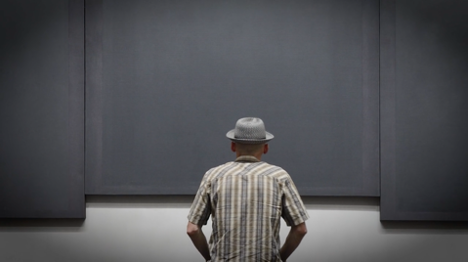
Still from Rhotko Chapel Video https://vimeo.com/127754629

This post is part of a series of essays bundled under “Travelling without moving”. Intro of that series can be found here.

My 2020 journey started with a Direct Message via Twitter from Mark Storm on Feb 8, 2020 a couple of weeks before the first formal lockdown in Belgium on 13 Mar 2020

Mark says “Maybe you will find this an interesting essay about Mark Rothko. Have a great Sunday, Mark”

Thanks for sharing, Mark! And yes, I found it interesting, in as much that I choose it as the start of this series 😉

Here is the direct link (Dutch only) to the Rothko essay (PDF) by Dutch philosopher Joke J. Hermsen. The essay is about the effect of stillness on an audience in front of a Rothko painting. It is an ode to Kairos (time as experience) as opposed to Chronos (time as clock-time).

Mark Rothko – Yellow Over Purple (1956).

Some highlight from the essay:

Het onmenselijke geweld van de oorlog bracht hem ertoe een laatste zoektocht naar de kern van menselijkheid te ondernemen: ‘Ik wil mensen daarheen brengen waar ze hun menselijkheid weer kunnen ervaren.’ En dat kan volgens hem alleen als een kunstwerk ‘tijdloze momenten schept’, die de mens tot een nieuwe ervaring van zichzelf en vervolgens tot een nieuw inzicht over de wereld kan inspireren.

The inhumane violence of the war had induced him into a last quest for the essence of humanity: “I want to lead people to a place where they can experience their humanity again”. And he believes that is only possible when a piece of art “creates timeless moments”, inspiring men to a new experience of himself and subsequently new insights about the world.

Er bestaan geen goede schilderijen die over niets gaan

There are no good painting that are about nothing

Om ‘te kunnen worden die je bent’, dienen de oude waarheden en inzichten als het ware opgeschort te worden. Het is een ervaring die door Nietzsche ook wel extatisch wordt genoemd, omdat het letterlijk een uitstaan naar is, kortom een zich openstellen voor en zich overgeven aan het onbekende. Rothko spreekt in dit geval van ‘transcendentale ervaringen’

In order “to be able to become who you are”, old truths and insights need to be postponed. Nietzsche labelled such experiences as ecstatic – literally standing-out – opening up to and surrendering to the unknown. Rothko speaks in this case of “transcendental experiences”

Deze ‘transcendentale ervaring’ wordt door Rothko een ‘tijdloos moment’ genoemd, omdat deze niet aan de klok gebonden tijd als het ware haaks staat op of inbreekt in de as van de lineaire tijd.

This “transcendental experience” is called a “timeless moment” by Rothko, because this non-clocked time is at odds with or breaks into the axis of linear time.

De identiteit van de toeschouwer wordt voor een moment doorbroken, waardoor hij de indruk heeft niet langer tegenover het werk te staan, maar er door omringd of opgezogen te worden

The spectator’s identity is momentarily broken, giving him the impression that he is no longer facing the work, but is surrounded or absorbed by it

The essay encouraged me to go and buy Joke Hermsen’s book “Stil De Tijd – Pleidooi voor een langzame toekomst”, as far as I know only available in Dutch.

The suggested translation for the title is “Stop the clocks – Manifesto for a Slow Future”, although I feel that “plea” is probably a better translation than “manifesto”, and I would have translated “Stil De Tijd” as “Silence the clocks”. I wrote about time in the past, and in this post from May 2018, I already mentioned Joke Hermsen.

Here are some of my notes/highlights/moods from the book.

Tijd schept ruimte

Time shapes space

Verlangen te realiseren wat er nog niet is.

Desire to realise what is not

Opnieuw zien we hier hoe zowel het wachten als het openlaten van de tijd en het opschorten van betekenisgeving aan de oorsprong staan van de creativiteit en het denken.

Again, we see how waiting as well as leaving space for time and the suspension of giving meaning are at the source of creativity and thinking

Het wachten (attente) is voor Blanchot dan ook het vrijleggen van een ander soort aandacht (attention), die zich niet op het reeds bekende van de verwachting richt, maar op het onbekende, het onverwachte, het nog niet ingevulde.

The waiting (attente) is for Blanchot the release of another sort of attention (attention), not pointing towards the known knows of the expectation, but towards the unknown, the unexpected, what has not yet been filled in.

Picasso: ‘Ik zoek niet – ik vind.’ Over dat onderscheid tussen zoeken en vinden, zegt Picasso: ‘Zoeken, dat is uitgaan van het oude in een willen vinden van het reeds bekende in het nieuwe. Vinden, dat is het volledig nieuwe. Alle wegen zijn open, en wat gevonden wordt, is onbekend. Het is een waagstuk, een avontuur.’

Picasso: “I don’t search – I find”. About that difference between searching and finding, Picasso says: “Searching is starting from the past, in an effort to find the already known in the future. Finding, that’s what’s completely new. Alle options are open, and what is being found, is unknown. It is a venture, an adventure”

Belangeloze aandacht

Disinterested attention

Last highlight:

Die creativiteit wordt aangewakkerd als we ons bij tijd en wijle aan het regime van de klok kunnen onttrekken en ons durven overgeven aan ervaringen die haaks staan op het gestaag voorttikken van de wijzers. Wachten, vervelen, luieren, mijmeren, nadenken en nietsdoen, zijn vormen van ontvankelijke passiviteit waarmee men in deze rusteloze, door de economie opgedreven tijden misschien weinig applaus zal oogsten, maar die in vrijwel alle hier opgenomen essays noodzakelijk bleken voor de mens en voor de wereld om niet te verstarren en te verharden.

That creativity is encouraged when we can detach us from time to time from the regime of the clock and dare to surrender to the experiences that are orthogonal to the ongoing ticking of the moving clock-hands. Waiting, being bored, idle, musing, reflecting and doing nothing, are all forms of receptive passivity that are not really appreciated by the inflated time of the economy, but that are essential in all essays of this publication, essential for the humans and the world in order not to fossilize, become rigid, petrify and harden.

I make similar reflections during my bike tours in nature, asking myself who is the real me, what is my original rhythm, finding my own rhythm, re-finding myself.

During one of those tours, I spotted a path to my right, with no signage, leading into some small woods and boskets. A small hesitation, but in a blink, I decided to turn right, right into the unknown.

Only a couple of minutes later, I found myself in an open space, in the middle of the green, in almost complete silence, and saw this snail sunbathing under a parasol of green leave.

The silence and nature had made me soft, with indeed a disinterested attention, but active attention anyway, not passive.

After years of – at times – hectic corporate life, and after a semi-pause of about four years, I realized it was only now that I started to cool down, to wind down. It was only now that I started to enjoy that state of detachment from Chronos time, detachment from anything, actually.

It should therefore not come as a surprise that my next essay in this series will be about… pause.

Travelling without moving – Intro

Travelling without Moving (TWM) is a series of essays documenting my mental and philosophical journey in 2020-2021.

The name came from an Arpeggiator Sound in Logic Pro that I was using in freewheeling a soundscape. It’s also a song by Jamiroquai from 1996

I felt the name fitted quite well with the troublesome year 2020 where – at least in Flanders – we already had two lockdowns and other less strict conditions throughout the year, basically discouraging contacts and travelling. But in my mind, I was still travelling, without physically moving.

The idea for TWM was triggered by an invitation from Jennifer Sertl who started StudioA3R, a weekly podcast dedicated to helping leaders navigate complexting by strengthening resilience, responsiveness and reflection.

Here is a link to the session we had in Aug 2020:

Jennifer’s podcasts are organised around four questions:

Where have you been?

What have you learned?

Where are you going?

What’s required?

In other words, documenting the journey, the voyage one makes. One can answer those questions from different perspectives:

Location: where have you physically been? Flanders, Italy, etc.

Activity: what have you done? Tasks, Deliverables, Products, etc.

Mentally: what were your ups and downs, etc.

Philosophically: from Plato to Kant to Kierkegaard to Sloterdijk, etc.

But there is also a way to answer these questions looking at where your mind has been. What have I learned? Where is my mind going, what is required? What steppingstones did I step on? Is there any coherence in all this?

That’s the plan/ambition with these TWM essays: to share where I have been, what I learned, where I am going, and what is required. And hopefully also offer some inspiration to my readers, and – who knows? – find some co-travelers along the way.

Each essay will start from a keyword. Each keyword hides a story. Some stories are inspired by an event (something that happened), others by something I read or experienced. Sometimes it was a happenstance framing of the camera.

The keywords are:

Silence

Pause

Play

Anxious

Unbound

Foam

Genre

(In)appropriate

Studios

Traveling Without Moving (TMW) is also somewhat related to Studio Oxygen (SOX) and Pirate TV (PTV). Some essays will be published in sync with the launch of new episodes of SOX and PTV. And for booklovers: there will be plenty of references to interesting books 😉

Every essay will have a link back to this overview/intro post, so that you can navigate your own way back into the voyage.

Hope you enjoy the ride as much as I did.

Warmest,