Augmented Reality: Sunday Techno Brunch

Just had a really lazy sunday morning brunch served in an a-typical techno fashion.

Fun found via Josh Spear’s Today and Tomorrow.

Link to the video here.

The comments (in dutch) are also funny: “it’s a strict-continental breakfast”, or “it’s all about solving problems, not about delivering a fantastic breakfast”.

This is a really good example where my boss would say: “Looks like toys for boys, Peter. But what business problem are you trying to solve ?

The Power of Choice

Great post on the confused of calcutta.

How consumerization of IT now really starts hitting the enterprise. Quite obvious, and i am sure you too use more and more external tools like Google Docs, iPhone Apps, Drop-It and other company external services to get your job done.

The article however is on something more profound that is emerging. The power of choice, and how companies need to plan to design services to be “choice-able”:

The more intriguing questions of choice come up when you look at how tasks and resources get allocated to each other within an enterprise. Firms exist at least partly because they serve to reduce transaction costs. They could borrow capital cheaply, obtain global reach and scale, attract and retain staff by the provision of pay and benefits. At least that was the theory; over the years those advantages have dwindled: enterprise credit ratings aren’t what they used to be, the internet lowers the barrier for global reach and scale, security of tenure is no longer to be assumed and benefits sometimes  become millstones around legacy operations. So yes, firms are changing.

Despite all that change, some things haven’t changed. Management structures exist to define and agree objectives, to prioritise activities in the context of those objectives, to allocate scarce resources to the completion of those objectives, to monitor feedback on performance and to intervene when and where appropriate, to fix problems, overcome obstacles, resolve conflicts.

and

People choosing what they do, when and how they do it, where they do it, what services and tools they need to do it, what devices they use. All possible. All being done now. But not holistically across the enterprise anywhere.

For that we need to architect our services differently. Which is where outside-in design comes in, designing for the customer, designing to provide that customer with choice. At a level of abstraction, everyone’s a customer. Your actual customers. Your trading partners. Your supply chain. And your staff.

Google Wave for Dummies

Apparently this video gets 1 billion hits per day ? Hardly can believe that. 1 billion is big number. Anyway, let me add 10-20 additional hits by linking to it from my blog 😉

This animation is cute, but does not add much to the content that was part of the May2009 Google IO Launch event.

Since Sep 30, 2009 Google has released 100,000 test accounts. The web is full these days of Wave enthusiasts.

There are believers and non-believers. I count myself to the believers. But there are some pretty solid non-believers. One of them is Robert Scoble. There an interesting discussion going on at Scobleizers blog.

His first blog “Google Wave crashes on beach of overhype” had a pretty hefty start.

But this service is way overhyped and as people start to use it they will realize it brings the worst of email and IM together: unproductivity.

Apparently his created such an avalanche of comments on his blog that he gave it a second try. He stays a non-believer. His Oct 3 post title is Google Wave’s unproductive email metaphors. His conclusion now is:

I took the day off and said “what if they are right?” and “is Google Wave a really great way to collaborate with other people?” On coming back to Google Wave with fresh eyes tonight and even after collaborating with people on a few things my answer is “no, they are not right” and “no, Google Wave is even less productive than email.”

What is really interesting is that Google Wave polarizes opinions. This is one of the key tenets of innovative things. They polarize.

You still can continue to use mail (one of Scobleizer’s arguments was “anyone can send mail”). It’s like one of the very nice Outlook add-ons i saw being demo’d at DEMO2009 from Liaise. Somewhere half-way the video, the presenter pauses for a second to point out that your counterparty does not need Liaise installed. But yourself, you benefit from the Liaise features.

Why i am a believer ? Besides all the cool features in the May2009 Google/IO video, for me the most important thing is that non only Google Wave will run a Google domain, but any enterprise can have Wave running in it’s own domain. It’s a paradox, but this is one of the reasons of success of e-mail. That an enterprise can run and manage its own email-server or domain. These days for small business more and more as a SaaS offering.

I believe the power of Google Wave is its potential for enterprise interoperability cross-domains. And why not have some vertical business anchors to run Google Wave as a SaaS offering for a vertical industry, even just to bootstrap that vertical community ?

It would probably offer a solution for the business problem of having secure and efficient collaboration processes, within and across the own corporate domain. And with a partner like Google that really can scale.

Scale, interoperability and open-API’s are for me the reasons why i believe Google Wave will be a big hit. Of course, in the current version there are plenty of bugs and inefficiencies as Scoble rightfully points out. But i am a believer that Google will fix these. And yes, me too I would like to get one of those beta accounts, please Google. Is the above good enough publicity to get one ?

Privacy is dead

This blog post is triggered by a start-up demonstration i saw at DEMOFall2009 some weeks ago.

The demo was about an iPhone application called “datecheck” aka “creepfinder”

You can find the video here.

Not that i am interested in on-line or real-life dating – i am happily married – but in essence the application allows me to do a check on my date. It basically crawls the internet, twitter, facebook, and  – in the US – public data such as your real-estate tax income and even criminal records.

The end-result is that i find data about criminal records about my future fiancée, full real-estate data about what house he/she lives in, family composition, real-estate tax-income etc

The US government also is getting quite open and transparent on its own data. Have a look at www.data.gov

image

And these days all these data are accessible via API’s to take data OUT of these systems. Some API’s like twitter, facebook etc also allow you to INPUT data via for example Tweetdeck, Seismic, and many others. I would love to have something that not only allows me to INPUT my Tweets, but also something that allows me to input and maintain my personal profile data, across services. See also at the end of this post.

For the US government data, you see start appearing end-consumer apps that let you search through this massive amount of for example government contractor’s data with quite advanced intelligence tools in the hand of the citizen.

In stead of FBI (Federal) it’s becoming

CBI (Citizen’s Bureau of Investigation).

It says “analysis for the people, by the people”. I would add “"about the people”

image

All this is sold as “transparency” and “democracy”, and those are of course very important values.

But – and I don’t know about you – I start more and more FEELING quite uncomfortable about all this. Not that i have to hide anything, or that i have a criminal record (at least not that I am aware of ;-), but I do FEEL all this is quite intrusive.

As most of you know, in my previous life i was quite close to the Belgian eID project (electronic identity card). The card also allows you to access the on-line government database, where I can look at my OWN data and check who in the government has accessed those data.

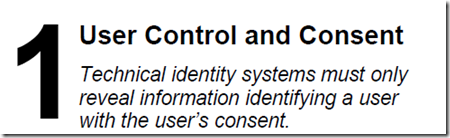
But i believe we should make a big plea for the appliance of Law #1 of Kim Cameron’s Laws of Identity:
image

That’s easy said, but how do you enforce that. I took the pain to look at the privacy policy of Twitter (see http://twitter.com/privacy). In essence – as a user – i have nothing to say. I have 2 choices: to use twitter and accept the privacy policy, or not use it. But how many of the many million Twitter users have ever read the privacy policy ? How many know what sort of deep intelligence engines are crawling all these data that i released to the net WITH A DIFFERENT PURPOSE ?

This is not Twitter specific. It applies to Facebook, Friendfeed, or any other form of social network or service.

In my opinion, i would like to have something where i can control what data about myself i want to release to what service and in what context. I update my information there once, and have also guarantee that my profile information is consistent across Twitter, Facebook or even event/conference sites that these days more and more use their own social media piece of technology.

Of course you would need a highly trusted party to deal with these data. I think i would even be prepared to pay a price for my privacy.

This concept of a central digital vault comes pretty close to eMe, the winner of the Innotribe idea-contest at Sibos 2009 some weeks ago. But they started from “mydata” and information and documents related to financial services. If you start thinking privacy and putting control of data back into the user’s hands, you get a much more powerful proposition.

I would like to hear the opinion of a number of identity and privacy experts that are following this blog

UPDATE: Can’t help it, but just at the same time as i published this post, Guy Kawasaki tweeted the following URL:

 http://holykaw.alltop.com/why-you-should-think-before-you-tweet

Peter Thiel and the Singularity

I am just back from the Singularity Summit that took place in NY during the week-end of 3-4 Oct 2009.

banner_125x125

I will make a separate report on the rest of the event, but i was completely blown away by the 30 min speech by Peter Thiel and following panel discussion with Venture Capitalists.

PeterThiel

Peter Thiel is president of Clarium, a global macro hedge fund. He is also the founder and chairman of Palantir Technologies, a national security software firm, and a founding investor and board member of Facebook, which serves more than 200 million active users. He helps launch many other new technology companies as a founder and partner of the Founders Fund. Previously, he was founder and CEO of PayPal, which manages more than 175 million financial accounts.

Peter Thiel has philosophy and law degrees from Stanford University, where he occasionally teaches on globalization and sovereignty and serves on the board of overseers of the Hoover Institution. He funds research in artificial intelligence and life extension technologies.

See for his other investments on the above link to Wikipedia. It also becomes very apparent what a fine crew must have been at the basis of PayPal. Many of the ex-PayPallers have created very successful companies.

Also his philanthropic endeavors in the Singularity Institute, the Methuselah Mouse Prize foundation (Michael Rose himself was also at the conference) and Dr. de Grey’s work on extending human life span are some examples where Thiel’s long term vision is. I will come back later in this blog post on “time horizons”

But back to his 30 min speech at the Singularity Summit.

First his appearance. He made me immediately think about Steve Ballmer: his eyes are hypnotizing. His body language shows "withhold energy”. His jaws and mouth tense. Ready to explode. Clearly fit and in top shape. Laser sharp attention when somebody asks a question. Always listening and answering with respect.

And he delivered his speech without any supporting slide, and – as far as i could see – without any notes nor an autocue or something like that. Wow !

The title of his speech last Sunday was “Macroeconomics and Singularity”.

He started his speech with letting the crowd choose between a number of catastrophe scenarios: from bio-terrorism, to nuclear war, global warming, and a couple more like that.

His thesis was that the biggest disaster that could happen would be that the Singularity does not happen quickly. It was the start of a staggering discourse on why innovation – and especially disruptive innovation – is key to the continuation of our society. And in a grandiose move, he interweaved the financial crisis in to all of this.

Credit only works against a background of growth. But if claims of the future (singularity is a good example) don’t realize, that has a big impact on credit, on to be expected returns (which he claims are way too high for non-risk taking investments), and on the basis (growth) of our society at large. Society would still be “functioning” by fixes such as working till the age of 80, or earn less, or have low returns on capital, but that’s not what we understand with progress.

Investing in “tech” firms like Microsoft, Oracle, IBM, and even Google is betting that they will churn their revenues and profits in the foreseeable future. In other words, this is betting that nothing disruptive is going to happen.

A lot of this is driven by short term return horizons. We seem to fix the short term problems, but are stuck with the chronic long term problems.

Having a longer time horizon may be the biggest Chinese advantage.

Some other interesting quotes from his speech and following panel discussion:

    • The short run becomes the long run
    • All experts are biased in a positive direction, especially when presenting their start-up to VC’s
    • The risk of the return of fascism is very underestimated (this is about the emergence of a totalitarian regime trying to control AGI (Artificial General Intelligence) in a (pre)-Singularity time-frame.
    • I tend to invest in companies that will loose money for a long time, and a look for disruption
    • For every dollar that the government invests in opera, art, etc i want to see a dollar go to technology
    • We need to dramatically re-invest in technology education, even at primary school
    • I don’t like Darwinism, i prefer guaranteed survival. I could not resist a smile as right after this panel discussion there was Dr. de Grey himself on the agenda.

And about companies to invest in:

    • I am mainly looking at the team. And the potential of the people in that team to stay together for the long run, before founders start to argue and have a “farm" shoot-out”
    • And whether this team is capable to attract excellence. (I personally love this one as a measure for running a successful company)
    • He took his investment in Palantir Technologies as an example for this, where hiring seems to be organized around these themes. Co-incidentally, i had a meeting with Palantir the day before the Singularity Summit. I have mentioned them already several times in my blog and i would like to get them to Innotribe at Sibos 2010.

The effect of his speech was obvious. Where all other speakers at the event got max 2 rows of 4 people queuing for asking questions, there was immediately a row of 15 people of the auditorium eager to ask questions. You could feel the electricity in the air with each response from Peter Thiel.

This guy is sharp. Has vision. Has cred. Has Clout. Is a super-entertaining speaker. Has a story to tell to the financial industry. Peter Thiel would be an ideal keynote speaker for next year’s Sibos in Amsterdam 25-29 Oct 2010. It’s the first thing on my list today: go and see the organizing committee for Sibos 2010.

Of course, he would be great as well for the first event next year of our little Think Tank on Long Term Future (see previous blog posts).

The age of the unthinkable

Some weeks ago, i had the opportunity to listen to a fantastic speech by Joshua Cooper Ramo, writer of the book “The Age of the Unthinkable: why the new world disorder constantly surprises us and what we can do about it”.

This is the sort of guy that when he takes the stage, you immediately know you’re in for something special.

Some personal notes on this great speech:

Our world has now more actors, more groupings. The unpredictability is part of the system. It will be a given part of our future. He talks about:

SHAPESHIFT

Our world offers more options. We have a spectrum choice between no options –> limited options –> unlimited options. You can’t predict what people are going to do with these unlimited options.

YOU CAN’T PREDICT

Our world is more networked. It also means it is easier to share and spread risk

So far the analysis. How can we manage this unpredictability ?

One eye-opener was a visual showing how differently western and eastern people look at a picture: western people mainly look at the object, eastern people mainly at the surrounding environment of that object. So, understanding of unpredictability has a lot to do with understanding the environment.

It will also require resilience. But not resilience as we know it from messaging networks like SWIFT. More a resilience deeply integrated in the ecosystem, a bit like Hezbollah integrates resilience in every little piece of its organization.

Periods of change are not the exception but the rule.

You have to surf the wave, not try to predict the wave, but

look at how the wave can help you.

It will be ever easier to disrupt. The question is how to empower people to disrupt for the good. This is really about innovation driven by a set of values. Oh boy, how close is all this to the ideas of our Think Tank on Long Term Future.

Innovation in big companies can NOT take the lead. They have NOT been instrumental in the shifts from magazines to online, from Microsoft desktops to web2.0 cloud, from Financial Institutions to… un-banked payment and financial solutions.

The speech was delivered as part of an Oracle conference. So, i found it a bit “cheap” to say that Oracle was innovative and Microsoft not. The rationale being that Oracle “buys and integrates” and Microsoft buys “tons” of innovation but does nothing with it, does not integrate. Was a bit too close to the Oracle conference message of acquire and integrate.

He then went further on the theme of personal responsibility (i am free to smoke) and the balance with a certain set of basic rights (for ex healthcare). And that in the USA, everything is about rights (and maintaining that state) not about personal responsibility and that that has to change.

About maintaining states: Twitter is all about maintaining state in a constant changing environment.

And that there is hope.

And that

FEAR is an easy commodity to sell when

people are confused

during disruptive change. And that in these circumstances simple answers are usually dangerous answers.

Or the closing topic: never invest in people older than 25 years, as they are not used to live in constant change.

The speech was great. The book reads “like a train”.


Just a pen and a camera

After all these weeks of technology extravaganza, time for some relaxation with a piece of music: “Doorways” by Dan Bull.

For those who like visualizations or have a role as Chief Executive Officer of Happiness, this will make your day 🙂

“Using a single sheet of paper and a bolex camera, Michel drew images a line at a time and photographed the progression so that when played back, the images looked like they were drawing themselves.”

Found via http://www.midasoracle.org/2009/09/28/dan-bull-safe/

Enjoy. Inspires to dream…

How Bill Gates destroyed the universe

The Singularity Summit is coming on 3-4 Oct 2009 in NYC. See the impressive list of speakers here.

One of the speakers is Ben Goertzel, who will speak about “Pathways to Beneficial Artificial General Intelligence: Virtual Pets, Robot Children, Artificial Bioscientists, and Beyond”.

BenGoertzel

When talking about Robot Children, i would not be surprised if he used the following video made by his 12 year old daughter. Found it via Accelerating Future.

Is this what a 12 year old is thinking about ?

  • Grand Pa’s dying, and let’s upload his brain onto the computer ?
  • It’s uploaded on a Windows computer… do kids care ?
  • Is Grand Pa dead together with all the files on my computer ?
  • A universe with Windows does not deserve to exist ?

If you can believe the credits at the end of the video, at least 12-year old Scheherazade Goertzel does.

image

In this case  – among many other things – Scheherazada’s father is the originator of the OpenCog open-source AGI framework, as well as the proprietary Novamente Cognition Engine AGI system.

Artificial General Intelligence (AGI) is an emerging field aiming at the building of "thinking machines", that is, general-purpose systems with intelligence comparable to the human mind. Good starting point to learn more about AGI is http://agi-network.org/

You see what happens when kids get this sort of ideas served with the mothermilk 😉 We recently presented another mothermilk example when we spoke about Aza Raskin, now Head of User Experience at Mozillla Labs. His father was Jeff Rasking, one of the big minds behind the Apple user interface.

Very curious to see what how this Generation-M will move up the ladders, and one day be our leaders. Any other wizkids you are aware of ?

Social Volume Knob

Also all hyped up by “The Wisdom of Crowds” and “We are smarter than Me” ?

wisdom-of-crowds

Time for some anti-dose 😉

Two articles about some recent studies done on this subject. One from ReadWriteWeb and one from MIT Technology Review. It’s again from Carnegie Mellon University (CMU). The author professor Vassilis Kostakos pokes a big hole in the prevailing wisdom that the "wisdom of crowds" is a trustworthy force on today’s web.

The articles speak for themselves, but what’s also interesting are the comments on the MIT article.

Some quotes:

I think that crowds are not wise and what we call Wisdom of Crowds is nothing else and not more than the Power of Diversity. This paper shows that it can be the Weakness of Diversity too.

OR

The true critic is NOT motivated by money or the subjective personal biases of the non-critic. A true critic is motivated by the objective enhancement of the human experience through careful and educated examination of the subject at hand.  We need more well-honed critical voices and less of the braying of the crowd. Crowd wisdom is built on a logical fallacy: just because a lot of people say it is so, doesn’t make it so.

Democractic Intelligence = FAIL.

OR this one is even better:

The conversation needs to be different when we are talking about social networks within an organization’s firewall. In that instance, it’s not about trusting the crowd’s wisdom. Rather, it’s about managing the community by knowing whose input should be trusted, along with managing and moderating the community. This must all be done in the context of how the community relates to business initiatives and the information assets of the organization. At our company, Inmagic, we call this the

"social volume knob."

As organizations roll out social technologies, they might want to start with the volume knob set "low" for certain classes of users. For example, some users might be allowed to tag one type of content, or other certain users can blog or comment.

Controversy ? Sure. What do you think ? Still 100% convinced of the Wisdom of Crowds ?

State of the Web Sep 2009

Over the last month there was an interesting series of articles on Read Write Web about the Top-5 trends on the web.

They now come all together here.

There is also a presentation on slideshare and you can download the whole thing also in PowerPoint.

The author covers the following 5 trends:

  1. Structured data
  2. Real-time web
  3. Personalisation
  4. Mobile Web / Augmented reality
  5. Internet of things

The sections on Real-Time web and Internet of things are a bit poor. I would definitely add a 6th trend: reputation and clout. Also semantic web could have some more meat around the bones. Not much left, huh ?

Coincidently, i found another one on slideshare addressing that same topic. It takes Boris about 30 slides to get up to speed, but he is bringing some interesting concepts such as “Robot Food”, Open Source licensing of data (our lawyers will go bananas), economic incentive to influence search, and community building.

However, i am not convinced by this deck either. Is there any better material around that would allow me to explain in layman’s terms why this is so important (you preach to the convinced).

In my opinion, there is a great role for standards organizations such a SWIFT to leverage and redefine their role as semantic ontology sources for vertical segments such as the financial industry. They must be able to leverage their standardization expertise into other domains than just standard “messages”. Now they could take the lead in standardizing ALL data: structured and non-structured. That would allow us to create powerful mash-up driven solutions that get us into intelligent pattern recognitions engines for the industry.