Innovation Traumas

Interesting blog post from James Gardner in Bankersvision a couple of days ago.

My Photo

Formerly Head of Innovation and CIO of Investment at Lloyds Banking Group in London, James Gardner is now Chief Technology Officer at the Department for Work and Pensions in the UK Government.

James has also written “Innovation and the Future Proof Bank”, a book that is on top of the pile of to-read books next to my “broken-foot-sofa”.
Anyway, the title of his last post was “When failure is not an option” (FNAO), a theme that i addressed many times before on this blog before:

The blog entry is triggered by the following question:

What are your thoughts on organizations were failure maybe is not an option. For example nuclear physics, NASA or a government organization that pays benefits. In these situations failure could be disastrous. What strategy would you recommend in these types of organizations?

James adds an interesting perspective: failure early in your project is better then close to delivery.

…the further you get into delivery, the more money you’ve spent. If you have to stop then, its very bad indeed. As innovators, you don’t want that situation occurring if you can help it. It leads to what academics call “innovation trauma” – the scenario where everyone is so burned by a failed innovation that no-one will ever sign up for anything new again.

And – what is scary if you are in your early days of an innovation program in an organization that has FNAO as one of its core assets:

Even one bad failure, though, can close down an innovation program. And clearly, in the cases that Malcolm mentions, that kind of failure has very dire consequences indeed.

One last point on this: “failure is not an option” is a mentality that leads to – you guessed it – failure. Trying new things is a process that requires lots of stops and starts. There will, inevitably, be more stops than starts, actually.  In an organization that doesn’t celebrate good failure, what you get is a scenario where nothing new starts at all.

That, clearly, is a very bad situation to be in, and is one of the main reasons people complain they “don’t have enough innovation”

It’s also via this post i discovered James Gardner’s “The Little Innovation Book”.

image

This little on-line experiment has absolutely great content for innovators. Every page adds a perspective to innovation that i was not familiar with. A recommendation. You can also comment on-line as James is writing this on-line innovation book.

Would you be interested to have James Gardner at Innotribe @ Sibos 2010 in Amsterdam (25-29 October 2010) ?

Let me know. We can invite him 😉 But would he accept ?

Great to Good: new value kit

Umair Hague did it again. He just published the Great to Good Manifesto.

He starts with “Pepsi‘s great at producing something that’s bad for you (sugar water)”. And goes on by stating that “Do no evil”  “Don’t do evil” is not the same as “Doing Good”.

Umair’s blog is in essence about an Ethical Re-Boot. We all feel that we cannot go on with the greed-economy. We cannot go on with killing our earth. We cannot go on with hurting other people.

It is about a new value kit for the 21st century. About old game vs. new game.

In the table below, you’ll find some other examples.

image

I made this table about 2 years ago during my Leading by Being adventure. In fact it even started before that. The trigger was the book “Cradle to Cradle: Remaking the way we make things” by by William McDonough (Author), Michael Braungart (Author)

The book is from 2003 (almost 10 years old !), and i bought it after seeing a BBC documentary on the work of William McDonough. The key insight that opened my eyes was when McDonough explained that

reducing waste

was not good enough

There is a better alternative, and that is producing products that do not generate (less) waste, but that add value, that add goodness.

This is the essence of Great to Good. The difference between “Do no evil” “Don’t do evil” and “Doing good”.

In that sense, also the famous TED one-liner “Ideas Worth Spreading” is not good-enough anymore. Better is “Ideas Worth Executing”.

This must become a huge PR issue for Google, who have surfed the wave of “do no evil” “Don’t do evil” for 10 years now. They are also more and more seen as the “Beast of Mountain View”. If you read the wave of protest following the release of Buzz and the resulting privacy issues, you’ll get a good feel why

“don’t do evil”

does not work anymore

Umair Hague proposes a number of new corporate principles:

  • First how, then who: “Do our people have the capacity to judge right and wrong, no matter how great they are?”
  • The Yoda/Hedgehog concept: “companies should only do what they can be great at, what makes tons of money, and what they’re passionate about.”
  • Ethical accelerators: “”transparency, openness, rules, and accountability. Most companies have not a single one of these”
  • A culture of meaning: “Production and consumption are meaningful when they actually yield durable, tangible benefits to people, communities, and society”
  • Confront reality:” Banks, for instance, confronted the “brutal fact” that selling toxic financial instruments was great for their bottom line. But they never confronted the simple reality that a classic asset bubble in housing was failing to do good.”

Umair asks the right questions:

  • How many of the principles are at work in your company, industry, or sector?
  • What would your company, country, or life look like if each of the principles was applied to it?
  • How would applying each principle disrupt “business as usual”?

Defining, building, evangelizing, and nurturing this

new value kit

for the next 10-20 years

is all what our Think Tank on Long Term Future is about.

Reblog this post [with Zemanta]

Hotel Mama

This blog post is a little tribute to my wife Mieke.

The picture above are home baked muffins. This is how i get treated during my 6 weeks stay home after my broken foot accident.

I am now 100% dependent on her. As walking on crutches usually requires using both hands, i can not help her in any way. Not even opening the fridge, or cleaning up some of the kid’s toys.

But it’s going to be better 😉 I had a check-up with the surgeon yesterday, and i am rid of the plaster. Hurray ! And i also will get a wheelchair, so that i can contribute a bit more to the daily small things to be done in our household.

But for the time being, the only thing i can do is laying in the sofa the whole day, with my right foot up in the air. I have my laptop and Kindle. So not completely contactless or inspiration-less.

The high (inter)-dependency makes me feel uncomfortable. But at the same time grateful for all the little and big things Mieke is managing.

A friendly colleague sent me a very nice mail on this saying: “it will confront you with yourself, and also will make you appreciate your wife’s dependency on you” (when you were 100% fit, and were so busy not noticing it).

It’s true. My broken foot accident helps me to re-calibrate. To see what really important.

In summary, my wife is everything in one: all CxO tasks combined, complemented by a absolute unbeatable care-factor. And my 4-year old daughter gives a lot of kisses to accelerate my healing. I am sure it works !

No place like home. It’s my personal personalized 5 stars Hotel Mama.

Thank you, mama !

Digital Identity Weavers

I have a job where i regularly meet fascinating people.

I recently had the opportunity to chat with Gary Thompson from CLOUD, Inc.

image

CLOUD Inc. is the Consortium for Local Ownership and Use of Data, a non-profit organization that has filed for 501(c)(6) status with the IRS and is open to people, companies, and other organizations. CLOUD has been formed to create standards to give people property rights in their personal information on the Web and in the cloud, including the right to decide how and when others might use personal information and whether others might be allowed to connect personal information with identifying information.

So all this is about your personal digital identity, and giving back control of these data to the user. Kim Cameron (Chief Architect Identity at Microsoft and the man behind www.identityblog.com will love this – and i am not cynical 😉

A couple of weeks ago, i had a fascinating chat on identity. How identity is all about context. Where you are, what you do, etc. During that conversation, Gary suddenly used a metaphor of what i would call “identity weavers”.

I found this metaphor really powerful. And i suggested Gary he should blog about it, and that i would offer him a guest post 😉

So, here is Gary with his post on Reweaving the Fabric of the Internet on his personal blog The End of Linearity. Peter Hinssen will love this story, as so closely related to the Explore the Limits story.

I just have cut&pasted some strong one-liners. For the full story, check out Gary’s blog.

From health to education to finance and beyond, the ability to bring together people, concepts, and ideas (threads) in new ways is an invigorating journey.  Our “weavers” of the future can design beautiful new fabrics from cures to cancer to dynamic global learning communities to rapidly evolving financial models.  When thread and fabric are unleashed, when weaver and woven can dynamically change places, when loom and head are released from the bonds of the physical, the Internet can take a vital step forward.  By applying an end of linearity to how we think about the Internet, we can see the true beauty of Vint Cerf and Bob Kahn’s creation. It is a connector of people, not of web pages, and it is at the heart of a new future, a rewoven future.

This compelling vision goes way beyond the web of pages, goes way beyond the early thinking on Semantic Web. It is in essence proposing an identity architecture for the Internet. Because the internet is broken. It was never designed with identity in mind.

By now, you will notice that Digital Identity is much more than distributing hardware tokens, or putting an PKI infrastructure in place.

Its about user control of personal data. It’s about context awareness. It’s about who i am, how i am, and what i do and intend to do in an on-line world.

Innotribe.com: a Lift-Off in perspective

Print

Today our team launched www.innotribe.com ! Different announcements on swift.com and on swiftcommunity.net here.

This is an important lift-off. At first sight, it may look like the launch of yet another tool or process. But this is much more. It is part of an overall Innovation Architecture based on the principles of Open Innovation.

In many industries, innovation is generally recognized as a critical ingredient for corporate suc­cess. Until relatively recent times, most companies used internal research and development as their only method of innovation. However, companies are now proactively considering all sources of innovation, both internal and external, to remain competitive. Usually this is referred to as “Open Innovation”, a term coined by Henry Chesbrough, Open Innovation: Researching a New Paradigm.

Idea Generation is an effort to uncover new and unexploited innovation opportunities. This is not about conducting traditional market research—that is, asking customers to go through a questionnaire, either on paper, online, or by phone. Neither is it about going out and directly asking customers what they want. Methods like these rarely yield the most useful customer insights. Typically, the answers they generate are the obvious suspects: “I want it cheap,” “It should be easy to buy and use,” and “Make it work really well, too.”

Innovation Idea Generation is about “serendipity”. Serendipity happens by understanding that innovation is largely a numbers game—it it takes a thousand ideas to find a hundred with enough commercial promise to merit a small-scale experiment. From those one hundred experiments, only ten projects will be judged worthy of pursuing seriously with a substantial financial commitment, and of those, only one or two will turn out to be unqualified successes.

SWIFT has been very successful in late 2008 and through 2009 in engaging community and staff in an “open” innovation model. Under the “Innotribe” label, SWIFT is encouraging individuals and companies to submit their ideas pertaining to SWIFT or the SWIFT eco-system.

The idea generation part of the process is thus focusing on engaging the community, through social networking (e.g. swiftcommunity.net) or specific events (such as Innotribe@Sibos) and tracking the resulting ideas in a transparent and open environment (innotribe.com).

Experience at SWIFT and the industry shows that this open approach does generate results (in terms of the number of ideas generated), The same experience shows that 1 or 2 ideas out of 10 prove to be successful ideas. So it is very important to establish a screening mechanism – the “innovation funnel”.

As ideas flow through the funnel, they can reach different “maturity levels”:

  • Discovery: the actual idea generation stage
  • Orient: document the ideas gathered and “orient” them in the SWIFT context. For example some ideas may give innovative insights for standards, for interfaces, for networking, etc
  • Evangelize: some ideas may need further evangelization to fully grasp the possible impact on SWIFT’s strategy and roadmap
  • Proof of Concept (POC). A way to make an idea more tangible. Can be a whitepaper as the outcome of a number of dedicated workshops, a mock-up prototype, an animation, or a fully working prototype.
  • Idea management: the stage where we decided whether an idea will go for internal or external development. The external route is usually the scope of “incubation”
  • Idea incubation: process to bring an idea from the concept stage to a first implementation (prototype, “beta” etc)
  • Implementation: anything beyond idea incubation

There are many ways to do idea generation:

  • Ideas from Staff, Partners, and Member companies: in the spirit of “open innovation”, we want to collect ideas from the SWIFT eco-system at large.
  • Innovation Challenges: mainly SWIFT internal challenges to collect ideas from staff.
  • Innovation Gardens: An Innovation Garden is 1-2 days of off-site meeting with 4-5 executives of the customer and a mixed team from SWIFT.
  • Innovation Labs: similar to gardens, Innovation Labs bring together multiple customers in an idea generation setting looking for ideas in a pre-defined focus area. Labs have been highly successful for example at Innotribe@Sibos 2009, SOFE, etc
  • Innotribe.com. The subject of the launch of today. Ideas above will be collected via the brand new Innotribe.com site, a sophisticated web-based idea management tool. The idea management process links seamlessly into the transversal product management process
  • Innotribe Events: Innotribe@Sibos was a huge success. We intend to run localized Innotribe events, and to participate and collaborate with other industry events where we aim at joined branding to enforce the SWIFT Innotribe brand as the innovation initiative for the financial industry
  • Scouting: many companies that are aggressively looking outside their walls for new technology are using Innovation Scouts, specialists tasked to identify new opportunities for partnership, co-devel­opment, licensing or acquisition.

All the above activities are related to the supply-side of idea management. However, the Innovation Architecture should be very specific on the demand-side of idea management. I already highlighted this topic in my previous post on “Innovation to the Core”. How we deal with that will be explored in a future post.

In the meantime, go to www.innotribe.com, look around, and start submitting loads of innovative ideas.

Reblog this post [with Zemanta]

Innovation to the Core

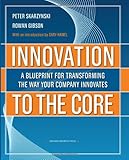
I just finished “Innovation to the Core” by by Peter Skarzynski (Author), Rowan Gibson (Author)

This is a modern, up-to-date, and indispensible book on Innovation.

More precisely on how to make Innovation a core capability of everything you do in your company.


Anybody who is deeply or remotely

involved with innovation

must read this book.


It’s a book that explains why radical innovation is the only option forward.

It’s a book that clearly explains the tension between efficiency and innovation, and what to do about it.

Both efficiency and innovation have value. More, they should be equal partners ! If you are serious about innovation, then you should spend at least as much on your innovation program as on your efficiency program. Check out how much resources you spent this and last year on efficiency. Take that amount and number of FTE’s and there is your budget for innovation for the next 2 years.

So it is not about being Lean OR Mean,


it’s about being Lean ànd Mean !


My biggest lessons learned from this book:

  • Dare to challenge everything, and especially your company “orthodoxies”, the taboos that have been taken for granted for the last 10-20 years.
  • Let the focus area of your innovation emerge bottom-up. Don’t define your innovation priorities in a leadership group. If you want everybody to be an innovator, you need input from everybody at all levels in your company when defining your innovation architecture. If not you end up with an impossible sell exercise towards the basis afterwards.
  • Make your executives and regional heads accountable for innovation. Some companies make 30% of the bonus dependent on innovation objectives.
  • There is an enormous responsibility for HR in getting the creative and innovation skills trained across the company at all levels.

But THE biggest lesson learned is probably about the difference between managing the supply and the demand for innovation ideas:

  • I believe most of us do a decent job on the supply side: we have plenty of initiatives and tools to gather, generate and follow-up on new ideas. That’s the supply side
  • But there remains a lot to be done on the demand side. I love the suggestions in the book that each division, region, product manager, etc is held accountable for at least picking-up 3-4 ideas coming from the supply side. Stronger: each of these groups has to reserve 10% or more of their existing budgets to spend on innovation projects. And this without changing the existing performance metrics.

Getting innovation into the objectives of managers is key. The book refers to this as the


“Management Process Make-Over”


Regular readers of this blog know that i have a strong opinions about:


Radical innovation vs. incremental innovation

The role HR has to play

Getting innovation deep into the DNA of your company, at ALL levels, all regions, all divisions.


This book only confirms and reinforces the thinking that i have previously shared in following posts on this blog:

Cubicle 3B23: Chief Happiness Officer

There is a great comments from Joe on one of the previous Cubicle 3B23 stories. It’s too good to be hidden in the comments section.

You are a CHO; now what?

Yesterday I was asked what was my title, and got a puzzled pair of raised eyebrows when I responded that my unofficial self-adopted title and vocation in life is Chief Happiness officer… It got me thinking – what exactly is a CHO? (And no, I’m not the corporate clown that everyone likes to pick on or that is famous for telling the best jokes – even though occasionally I find myself at the receiving end of a joke… :-) )


Happiness officer is a very serious and heavy responsibility – a temperature meter, detecting the health of an organization, noticing the first signs of trouble and trying to heal them. It is like the shaman of a tribe, the healer or the local witch.

A healthy organization is one that not just functions and produces but is energized, gives a feeling of belonging and meaning to all the people that make it. A happy organization is made of happy balanced people – happy not in the sense of joking around all the time, but in the sense of having a deep feeling of satisfaction.

It is like a healthy bee swarm. Even though the swarm is nearly a creature in its own right, with mind and memory of its own, it is made of little individual parts who influence greatly its health. The swarm is very resilient, but only if its bees are healthy. When they are not, the swarm falls apart. When all the workers leave the hive in despair, it doesn’t matter if the queen is still there and healthy. A queen alone does not make a swarm – it stars it, but does is not equal to it.

Bee doctors watch the behavior of the individual worker bees to know the health of the hive. It is the same with the Happiness officer… He watches for small tell-tale signs: more and more people who have the nagging thought that even though rationally speaking they should feel perfectly satisfied with their position in life, they are somehow not; more and more people with the uncomfortable feeling that there is something missing, a feeling which gradually grows into discomfort and distress.

And distress is a powerful force – a force that pushes you to change.

This is what the happiness officer watches for and helps – by encouragement, nudge, energy boost – helping people one by one find what makes them tick and nurturing their belief that it is worth going for.It is a fine balance between wild optimism and integrity

The ultimate success for a CHO? A company that does not need him; a company where everyone is their own CHO…

Joe – the CHO in Cubicle 3B21

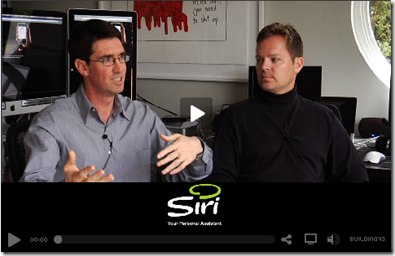
SIRI: your personal assistant in the cloud

Found via Scobleizer.

image

Watch the video till the very end. In the last 4 minutes or so there is a demo.

In essence its a free iPhone app with a fantastic voice recognition engine, that is orchestrating API’s in the cloud.

Normal – not geek – people ask me regularly: “But Peter, what do you mean with “cloud computing” and “semantic web ?”

SIRI is a wonderful example of what’s next. If you want to have an idea what semantic web means in practice, here you go. It’s location aware, it’s self learning, has some eMe elements like profile awareness, all of this in the privacy control of the owner of the profile data.

The dream of the personal butler coming true.

Why this is important ? In the words of Robert Scoble:

Don’t get confused by the awesome voice recognition engine that figures out your speech and what you want with pretty good accuracy. No, that’s not the really cool thing, although Microsoft and other companies have been working on natural language search for many years now and have been failing to come up with anything as useful as Siri.

No, the real secret sauce and huge impact on the future of the web is in the back end of this thing. A few months back the engineers at Siri gave me a secret look at how they stitch the APIs into the system. They’ve built a GUI that helps them hook up the APIs from, say, a new source like Foursquare, into the language recognition engine.

And listen to the two founders on how the back-end of this thing is working, and the other cool stuff they have in mind.

And now start thinking on what you could do with this in financial services:

  • Give me the best loan for car so and so
  • I want to buy this piece of art and need a credit line
  • Find me the cheapest routing for USD payment with cut-off time x
  • Get me to …

Would be very curious of guys like Richard Branson of Virgin Bank start to play with this. Or Sean Park with his view on software components in the cloud. How does this change our thinking on building an AppStore for Financial Services ?

I don’t have an iPhone (yet). But i know super-geeks Nick and PeterH have one. Nick, can you test this one, and let me know your candid feedback ?

Check out www.siri.com


Reblog this post [with Zemanta]

Sex, Money, Happiness, and Death

The title will give me probably the most hits this blog ever had. Before you read any further, this is a book about authenticity.

I found it via Fred Zimny’s blog.

In this book Kets de Vries says:

I realise the importance of authenticity in my own life and the lives of others.

I have seen how easy it is for someone

to follow a route to

self-deception and illusion.


Fooling ourselves, as many of us learn the hard way, isn’t sustainable in the long run.

He continues:

To me, being authentic implies being honest, truthful with myself and others, living … with my own values and principles, and experiencing a sense of meaning in what I’m doing.

Authenticity implies

a willingness to accept

what I am

and not attempt

to pass for something

or someone else

Authenticity means not only trusting my strengths but also my weaknesses and being patient with my imperfections. It has to do with having the courage to say how things are, to say no, to face the truth, and to do the right thing because it is right.

Sounds like a cool book. Not available on Kindle yet.

Looks to me like a Leading by Being program for CxO’s.

Hug my PAD

TEDxBerlin talk, discovered via Hutch Carpenter’s blog

image

View till the end.

It’s a bit funny at the end, and you can hear the audience laughing at this and not really taking the last bit seriously.

Think twice.

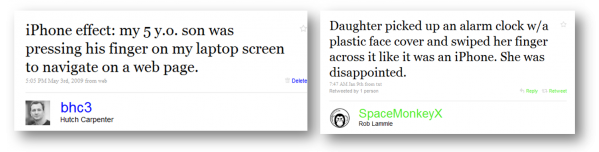
Think this one through ! In the same blog post, Hutch points at the real meaning of the iPAD.

Think it through. The keyword is digital intimacy. Your computer is not your computer anymore.

Think generation-M. Generation Meaning.

image

It’s your personal “pad”-device.

You can give it a pad.

You can hug it, it can hug you.

Try in your imagination to mix up iPhone, iPAD and those little house-robots that were so popular some years ago. I know my friend Nick has 2 in his apartment !

Nick Carr used the title “Hello iPAD, Goodbye PC”.

I think he’s right on.