The DJ with the Brainwave Helmet

Found this TED 2010 video via Kurt Vega’s tweets.

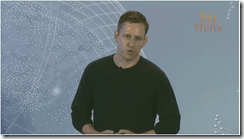
From the TED site: “Tan Le’s astonishing new computer interface reads its user’s brainwaves, making it possible to control virtual objects, and even physical electronics, with mere thoughts (and a little concentration). She demos the headset, and talks about its far-reaching applications.”

Out-of-the-box support for facial expressions and emotional experiences, with some sensitivity adjustments available for personalization.

The demo is focusing  on the “cognitive suite”: the ability to move virtual objects with your mind.

And it just costs only a few hundred dollars. Like an iPAD, but it’s a hPAH “head-PAD”

Start mixing this with the ongoing discussions on personal digital identity. As you will notice, the demo starts with making a personal profile for this headset owner. And tuning to a neutral signal, a signal where you’re doing nothing particular, your are relaxed, hanging-out: a but like my holidays at home where I basically don’t do anything particular other than hanging around.

It’s interesting to see that the test is about “pulling” an object forward instead of “pushing”. I may be too influenced by John Hagel’s latest book “The Power of Pull” 😉

The cool stuff starts when the helmet man starts visualizing something that does not exist in real life: making something disappear.

Applications are obvious in virtual reality games, domotica systems, all sort of gesture and thought based interactions, control an electric wheel-chair. In banking it would be nice is I could raise the balance on my account just by thinking about it.

What I do NOT like about it is that the “system” has some built-in leveling system. It makes me think of Jaron Renier’s fantastic rant / manifesto that I mentioned in my previous blog “you have to be somebody before you can share yourself”

Start mixing this up with some of the cool ideas like Mark Pesce’s Plexus which is a quite novel way of looking and using your social graph in a sort of

event driven pub-sub system

where you decide as a user

what you listen to and

who and what you want to share

with

Sometimes, I think of myself as a disc-jockey (which I was as a matter of fact for more than 15 years starting in the late 70’ies), and I very much like Ethan Zuckerberg’s description of a DJ in this also great TED 2010 video on our distorted world-views.

His talk is basically about

getting you out of your normal orbit, of stepping out of your usual “flock” of people you normally interact with (both on- and off-line).

Around min 15:30, he describes a DJ as a guide:

A skilled human curator, who knows what material is available to her, who is able to listen to the audience, and who is able to make a selection and push people forward in one fashion or another

Of course, I could now make jokes on Faithless “God is a DJ”, and/or refer to one of my previous posts called “We are as gods and might as well get good at it”, but I won’t do that.

Instead, I’d like to share with you the feeling of giving pleasure to my audience.

It’s something I feel while writing these blogs, and it’s a very similar feeling as being a DJ in front of an audience and pushing people forward.

Its has a same sort of stage-fright

when starting a gig,

and the same sort of excitement

when you see your crowd getting

excited

As a DJ, I was doing some quite big gigs for 3,000 people or so, and my following community is not that big yet. But the feeling is the same, and everyday there are some more folks following my tweets. Some more reacting to my blog. Some more getting inspired by what’s on these pages.

So, I just continue doing that, and hope to inspire you to dream and execute your dreams.

Innotribe @ Sibos 2010 : High-Level program

Cross-Posted on SwiftCommunity.net

Last week, Kosta kicked-off the next Innotribe @ Sibos2010.

Print

I am pleased and excited to complement Kosta’s introduction by sharing with you our high-level program for the Sibos week (25-29 October 2010).

High Level program

A good presentation/show has a fantastic start, and great core, and an exciting grand finale. That’s exactly how our Innotribe @ Sibos2010 program is organized 😉

We have a fantastic start: our “Innovation Opening Keynotes: the big tectonic shifts” on Monday 25th from 9am – 10:30

What a line-up of speakers ! We have now confirmed:

  • John Hagel (Author of THE business book of the year “Power of Pull”),
  • Peter Hinssen on “The New Normal” (also title of his new book),
  • Nova Spivack with a long-term technology forecast,
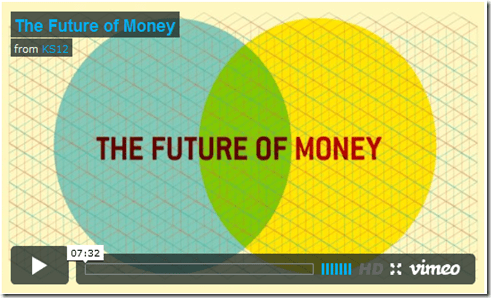
  • Venessa Miemis (28 year old GEN-Y Graduate Student from NYC) who will prepare a talk on the future of money,
  • and a still to be announced very senior banker on tectonic shifts in banking.

Both in content, quality of the speakers, and format of this session, this will be THE not-to-be-missed session on Sibos Monday. We are convinced it will set the bar for any session for the upcoming week.

We have a great core: We have 4 Themes. As last year, we have appointed Innotribe Leaders and VC-Coaches to each of these themes:

  • Cloud: following last year’s Labs, which were focused on the economics of cloud computing, this year focuses on the practical implementation, user experiences, and why it’s important for the financial industry. There will be a specific focus on hybrid cloud models and API’s.
    • Innotribe Leaders:Jacqui Taylor (ex-BACS) and now building Google Apps with FlyingBinary and Sungard
    • VC-Coach: Sean Park
  • Mobile: the emergence of mobile payments, especially in the worker’s remittances area, and the role of banks.
    • Innotribe Leaders: Jonathan Bye (RBS) and Ville Sointu (Tieto)
    • VC-Coach: Matthaus Krzykowski (Venture Beat)
  • Smart data: how to capitalise on the power of semantic web technologies to enable greater intelligence for financial institutions.
    • Innotribe Leaders: Wells Fargo and Nova Spivack
    • VC-Coach: Eghosa Omoigui (ex Intel Capital)
  • The Long Now: this series of interactive workshops will engage in long term scenario planning for the financial industry.
    • Innotribe Leaders: Chris Skinner and Sean Park

The line-up of speakers, face-to-face panel members and moderators is stronger than ever before. This will be the subject of subsequent Innotribe @ Sibos2010 blogs.

We just opened a Web-Storm on Innotribe.com to collect your idea on these 4 themes as we build up towards October. We will feed-back these ideas to the Innotribe Leaders before the actual Labs in Amsterdam. Check out www.innotribe.com

In addition, we will have 2 Masterclasses Innovation, we have invited the 5 leading software vendors for innovation management tools, and we’ll have an update on eMe (winner of last year).

We also teamed-up in a quite significant way with our colleagues from Standards and Technology. You will notice on the Sibos program a number of interactive sessions that have been co-designed with Innotribe.

The exciting grand finale: the best of the Innotribe week comes together on Thursday 28 October 2010.

  • We start with “Pitch your Innotribe Lab”, a competition between the best idea teams that were formed during the Labs throughout the week, in front of the buyer’s panel. 5 minutes pitches with Q&A by the SWIFT Buyer’s Panel, with input from our VC-Advisors. They compete for the Sibos2010 Innovation Award. Last year’s winner was eMe. Who will it be this year ?
  • Right after, we’ll have the “Open Innovation Best Practices”, with again a staggering line up of Heads of Innovation of Banks, and thought leaders from other industries on Open Innovation
  • To pump up your adrenaline levels, we’ll close with a real Start-Up Competition, where we have invited some of the start-ups and great idea teams we met throughout the year. They will pitch in front of a real VC-Panel.
  • And who knows: last year’s Innotribe made it to the final plenary closing of Sibos. We know this year’s Innotribe @ Sibos is even better and The Long Now seems to be positioned in pole-position.

Some elements to spice it all up:

  • All the Innotribe @ Sibos2010 sessions will be supported and facilitated by a team from The Value Web.
  • The Long Now and the Grand Finale will be supported with live streaming and interaction technologies (more news to come in the next weeks)
  • We will be at 3 locations:
    • The Innovation Opening Keynotes in Conference Room #1 aka “the box-ring”. We’ll make maximum use of the interactive features of this room;
    • The Interactive Workspace: a special built space in the middle of the exhibition centre that will host all the other Innotribe sessions; the design of that space is just awesome.
    • The special Innotribe corner on the SWIFT Stand that will host the R&D sessions, including the results of some SWIFT proof-of-concepts.

Let’s start the conversation:

Innotribe is organised by SWIFT Innovation with the support of financial institutions, vendors and innovation leaders.

In the true spirit of less push and more pull, we encourage you to engage in a true dialogue with the Innotribe team. We look forward to seeing you in Amsterdam.

The Innotribe team

www.sibos2010.com

www.innotribe.com

www.swiftcommunity.net/innotribe

innotribe@swift.com

innovate@swift.com

Twitter: http://twitter.com/innotribe

You have to be somebody before you can share yourself

It’s holiday time, and I have reduced significantly my blogging, reading RSS feeds, tweeting, mailing, etc

Time for hanging around, some biking, some good food, and… a good book. If you want to follow what I am reading, check-out my page on Goodreads.

For me, a good book is one that leaves you puzzled, that makes you think,


that re-calibrates your perspective,


that is a pleasant read, that has depth.

“You are not a gadget” by Jaron Larnier is such a book. I discovered it thanks to a tweet of my friend Paul, who reacted to one of my enthusiastic Singularity tweets. The title of this blog post “You have to be somebody before you can share yourself” is very early in the book, and captures its essence.

Jaron Larnier was listed on The 2010 TIME 100 in the Thinkers category. His Wikipedia entry is here.

It’s a great read if you are in your over-enthusiasm mode about  computationalism, the noosphere, the Singularity, web 2.0, the long tail, the hive mind, the global brain, crowdsourcing, collective intelligence and all the other buzzwords and trends and all the rest. It gives you some solid pushback and sound criticism.

I am not going to do a book review, but my experience of the book was like there were 3 stories interwoven:

  • How technology is limiting our potential and who we are on-line. This of course resonated a lot with my work on Digital Identity.
  • Our communication limitations. He has a great chapter on how cephalopods have the great ability to “morph” and how one could use “visual” communication and another dimension of communication, other than language. And how humans in virtual reality environments quickly adapt to a body with tentacles. Intriguing !
  • The notion of “neoteny”: humans are born as fetuses in air, and our brain is being developed during childhood. Lanier compares this to a newborn horse that can stand on its own and already possesses almost all the skills of an adult horse. Humans – in modern civilizations – have an artificial, protected space called “the classroom, the extended womb”.

Neoteny opens a window to the world before our brains can be developed under the sole influence of instinct.

A similar concept related to neoteny – “generativity” – comes back in another great read Firms of Endearment: How World-class Companies Profit from Passion and Purpose.


This is a book about

the pragmatic role of

love in business


It’s about the epochal change into the Age of Transcendence. The dictionary defines transcendence as a "state of excelling or surpassing or going beyond usual limits."


The second event is the aging of the population. For the first time in history, people 40 and older are the adult majority. This is driving deep systemic changes in the moral foundations of culture. Higher levels of psychological maturity mean greater influence on society of what Erik Erikson called "generativity"—the disposition of older people to help incoming generations prepare for their time of stewardship of the common good

The Firms of Endearment book in essence talks about a new form of capitalism that is not only focused on profit and shareholders’ value, but on value creation for all parties in a company’s stakeholders’ ecosystem.

Joran also has an opinion on capitalism when he says:

Visiting the offices of financial cloud engines (like high-tech hedge funds) feels like visiting the Googleplex. There are software engineers all around, but few of the sorts of topical experts and analysts who usually populate investment houses. These pioneers have brought capitalism into a new phase, and I don’t think it’s working… capitalism in a digital future will require a general acceptance of a social contract

He is also calling for “so-called AI techniques to create formal versions of certain complicated or innovative contracts that define financial instruments” and that setting standards for these could be facilitated by “a cooperative international body” that

would probably have specific requirements for the formal representation, but any individual application making use of it could be created by a government, a nongovernmental organization, an individual, a school, or a for-profit company. The formal transaction-representation format would be nonproprietary, but there would be a huge market for proprietary tools that make it useful. These tools would quickly become part of the standard practice of finance

What a great potential for my employer SWIFT ! We are indeed a full-blown cooperative international organization with our roots in financial services.

In essence, Jaron Laniers’ manifesto and rant is about “The deep meaning of personhood is being reduced by illusions of bits”.

That should make us reflect deeply on how we want to engage as human beings in an on-line world, how we define digital identity in the relative and the absolute, and be very vigilant that we don’t loose our potential in our technology enthusiasm.

For me, the prospect of an entirely different notion of communication is more thrilling than a construction like the Singularity. Any gadget, even a big one like the Singularity, gets boring after a while. But a deepening of meaning is the most intense potential kind of adventure available to us

Finally, I also found some consolation to deal with my 3/4 Life Crisis. The following quote always helps:

If you are young and childless, you can run around in a van to gigs, and you can promote those gigs online. You will make barely any money, but you can crash on couches and dine with fans you meet through the web. This is a good era for that kind of musical adventure. If I were in my twenties I would be doing it. But it is a youthiness career. Very few people can raise kids with that lifestyle. It’s treacherous in the long run, as youth fades.

My blog is my “adult” way of doing gigs online.

Milo: gesture based interfaces 2.0

image


Have a look at this stunning gesture based interface with character Milo. First of all, it is more than gesture based. Milo also reacts to voice intonation, movements, etc

It is difficult to assess how much of this is a word-by-word script, or how much real interaction is going on here.

The most stunning effects are:

  • The women trying to capture goggles that thrown by Milo
  • The women moving the water with her hands
  • The women handing over a piece of paper, that gets scanned and taken over by Milo

It gives a sense where we are heading. Imagine this on your iPAD. My conservative guess is this will be real within the next 5 years.

This is very similar to what Oblong is doing with gesture based interfaces. See my previous blog on Oblong here. John Underkoffler indeed also said 5 years before this hits any PC.

Oh yes, in case I forget, Oblong will be at Innotribe at Sibos 2010 in the Smart Data track.

His Purple Highness and Innovation

There has been a lot of coverage on the net about Prince’s statement “The Internet is Dead” and the responses “Prince is dead”. For me, Prince is never dead, as he left me with memories to the best concert I have ever seen during his Purple Rain tour, indeed quite some time ago ;-/

The master of funk – aka His Purple Highness – just has a new CD “20TEN”, and it seems to be a good one, and it is btw given away today for free with Newspapers in Europe.

I found this review of 20TEN in the Belgian Newspaper De Standaard. It’s in Dutch, but if you turn on Google translation, it’s quite readable in English.

Prince

I blog about it for the following (auto-translated) paragraphs:

We give Prince creative freedom and we understand that he does not want to live in the past. The most pressing question that loomed when we 20Ten in the CD-changer was explained: the album will be as good as Sign O The Times or Parade? Equally exciting as 1999 or as viciously as Controversy?

Well … (Drum roll) … No. Not really. More importantly, we find that bad? Because let’s be honest: you really expect the 52-year-old Prince a plate opinions so urgent, as controversial and as innovative as his work from the 1980s?

Maybe we should ask whether it is the responsibility of someone like Prince to remain the major role of innovator to take on. That role he has not already played out with fervor when it was needed? Charts when artists do not dare to take risks, but only when blacks were allowed to play funk and disco, when explicit sex or gay and bisexuality have been stashed away in the bright pop music?

The question – or statement if you want – was already raised by Guillaume Van der Stighelen during an interview with business TV Channel Kanaal-Z some years ago at the occasion of the launch of his book “Heldenmerk” (the brand as a hero) somewhere end 2008, begin 2009.

He said something along the lines that creativity (and innovation) should be left to the young generation, and that he – as a 50+ year old – should give room to the young generation where the real creativity sits, and that his role should be one of mentorship.

I am 50+, so that quite resonated with me. But I think he is right. Since then, I try to make others win, younger people than me, who still have to proof something.

It is actually fun to disappear backstage, and enjoy the show being delivered by others, and knowing you were a substantial part of getting it where it is right now.

That’s a different – and in my view “better” – type of satisfaction, fulfillment and motivation.

Intelligence Multipliers

Great book Multipliers: How the Best Leaders Make Everyone Smarter.

Summary here.


  • Multipliers are Talent Magnets: They look beyond their own capabilities to see the deep capabilities —or genius—of others. And then they utilize people at their highest point of contribution.
  • Multipliers are Liberators: They eradicate stress and fear from their organization and instead create an intense environment that requires people’s best thinking and work. They keep the pressure on but make it safe to make mistakes. The result is a climate that is intense without being tense.
  • Multipliers are Challengers: Instead of telling people what to do, they show them what they can do. They seed opportunities and let people discover needs for themselves. Then, they lay down challenges that cause people to stretch beyond what they thought was possible.
  • Multipliers are Debate Makers: Instead of making isolated decisions that leave others in the dark, they engage people in debating high-stakes decisions up front. This leads to decisions that people understand and can execute efficiently.
  • Multipliers are Investors: Instead of getting things done by micromanaging, they give other people the ownership for results and invest in their capability and success.

Management Innovation: Extreme Management Makeover

Stumbled upon this great blog post by Gary Hamel in the WSJ. Extremely relevant if your business is a service business run by first-level employees.

It’s based on the work of Vineet Nayar at HCL Technologies (HCLT).

It’s now all documented in this great book Employees First Customer Second: Turning Conventional Management Upside Down

If you thought I was sometime being a bit extreme in challenging existing ways of doing things, have a look at following recommendations:

  • We must destroy the concept of the CEO
  • Employees First, Customers second
  • Exalt those with hierarchical power rather than those who created customer value
  • Turn sober-suited executives into rabid management heretics
  • “reverse accountability.” Managers should be accountable to those in the value zone
  • Give every employee a detailed set of financial metrics for their own team and other teams across the company
  • A non-censored censored “U&I” site, taking also the dirty questions
  • Install a web-based “Smart Service Desk” and SLA’s with powerful corporate departments, like HR and finance, who often seem more interested in enforcing blanket policies than in making life easier for employees.
  • Rate the performance of any manager whose decisions impact their work lives, and to do so anonymously
  • Crowdsourced review of divisional business plans
  • Employee First Councils: to help employees connect with team members who shared similar interests and passions

The last two concluding paragraphs are enlightening:

The world has become too complex for the CEO to play the role of “visionary-in-chief.” Instead, the CEO must become a “management architect”—someone who continually asks, “What are the principles and processes that can help us surface the best ideas and unleash the talents of everyone who works here?” Today, as never before, the world needs leaders who refuse to be seduced by the fatal allure of the familiar.

It really is possible to change the management DNA in a large, established company. When you dig into “Employees First” you’ll learn that it’s possible to reinvent management without blowing up the existing management system, without having a detailed master plan at the outset and without taking inordinate risks. If you’re a would-be management renegade—this means you’ve just run out of excuses.

We are as gods and might as well get good at it

Check out Raw Dawson’s blog post of today with superb video

TURNING INTO GODS – ‘Concept Teaser’ from jason silva on Vimeo.

Indeed today it is entirely appropriate for us to be thinking in terms of human transformation, and the power we have at our disposal. The cycle has swung back, and once again there is the promise that we have what it takes to change who we are… for the better. Whether human nature will allow those changes to be fully positive we have yet to discover. But that promise is – once again – part of the zeitgeist.

Heretic Team Glue

Last week we had a great team off-site.

We arrived late afternoon in the fantastic location of Chateau de la Poste, close to Namur, Belgium. Built in 1895, the Château de la Poste was the residence, for more than forty years, of Princess Clementine, daughter of King Léopold II. It later was sold to the postal services, who used it as a vacation resort for the children of the employees of the Belgian Post (times have changed). It recently was refurbished completely by a French wine maker, and it houses now a wonderful hotel, meeting centre and quality restaurant.

The amazing landscape, the silence and the soft welcome on the summer terrace set us all in the right mood. We all felt our physical and mental muscles relaxing, winding down.

Don’t know where I read it anymore, but I recently found a quote: “If you are not able anymore to take some time out for an off-site team gathering, you’re cooked”

For once, we did NOT have a packed agenda, and plenty of time for  real Quality Time Sessions.

We even made an acronym for it (QTS) to joke a bit with the “acronymitis” of the lean methodology.

More seriously, we invented QTS because we felt that the pure lean method was too much focused on a problem-mindset, and not enough on an opportunity-mindset, opportunities to develop some deeper quality thinking on subjects relevant to our business and team.

One of the items on the agenda was about “how to tell bad news”. In the subsequent discussion, one team member reflected on some sort of “fear” and “If I do this, then this and that may happen, and then…” thinking. Being in the acronym mode, we had a good discussion on


FEAR = Fantasy Experienced As Real


and how such behavior leads to blocking, status-quo situations.

Almost “emergent by design” our team culture principles unfolded, and we articulated them along the themes of “old” and “new” game.


  • Old game = fear, tricks, manipulation, raising stinky fish, machiavelism, creating and maintaining negative energy in general

  • New game = solution oriented, integrity and authenticity, fast correction (like Guy Kawasaki used to say”churn baby churn” a variation on the famous 1976 disco song “Disco Inferno” by the The Tramps), the holy fire, positive energy, who is the owner of the idea, who cares ? It’s about focusing on believers, and investing heavily in those VIP followers that will help us create a viral innovation infection/storm, like a raging holy fire that cannot be stopped anymore. Burn baby Burn…


We replaced “raising stinky fish” by regular update and feedback sessions, focusing on polishing rough idea diamonds, focusing on what works vs. what does not work, focusing solutions vs. problems.


If you think deeply about it, all this is about

the major cultural shift

from pushing towards pulling your ideas,

it’s about a strengths based society and team,

it’s about connecting ideas

and excel in making them real.


Another correction we made to lean was our understanding of a skills matrix.

We were very inspired by Venessa Miemis’ blog post “Framework for a Strengths Based Society” that included following diagram.

We decided to add these skills to our existing lean skills matrix that was too focused on identifying and solving problems and tools mastery. “We are not the tools, the builders are us” is another quote from one of Venessa’s presentations.

The subtle nuance is that we did NOT implement these skills as comparative/ competitive skills of different team members but


in terms of personal areas of

strength and potential

for each team member individually.


Our little team is SWIFT’s “Innovation Team”. Some time ago, we shared the details of the mission here and in summary it goes like this:

Build the Skills , Tools , Processes, Metrics , Values , Network , required to support collaborative innovation and transform SWIFT in an agile company, able to succeed in a changing environment.

I often make reflections on how real our innovation work really is. And although we are having lots of fun and some sizeable impact on how the company little by little opens up for innovative behavior, I always seem to be in search for that little extra in life and work.

Too many of our innovation experiments and proof-of-concepts remain just that: proof-of-concepts and prototypes. They never get into production. Worse, some outcome are just ‘filed vertically” or even never get the any executive attention.

I would like to hear from other innovators what is the secret sauce to get beyond the prototype stage. Because staying in prototype stage sometimes makes me wonder if I am in some sort of “busyness” therapy.

And I have come at an age where I cannot content myself with busyness.

I could sit here till my pension, having a good pay, and living honestly speaking in a quite luxurious working environment. But I am in search for more. I am in search for


meaning and significance


With the couple of years still to go, I still have the arrogant (?) ambition that I want to leave a legacy. On a personal level in my family. On a professional level that my passing in this company has substantially changed something. It’s about a deep sense of motivation, beyond pay and perks.

There is something heroic, even heretic about all this. That’s why the title of this post is Heretic Team Glue.

See full size image

Heretics are the ones that were expulsed from the Catholic Church because they did not follow the rules and challenged faith and established dogmas.

There are several dictionary definitions of “heretic”. The one I have in mind here is “anyone who does not conform to an established attitude,doctrine, or principle”.

I think we in our team are all some sort of heretics in the castle. It’s something very special in our team, that creates a very strong bonding.

At times it even has some masochistic flavor. Why on earth do we keep on trying again and again ? Even if the odds are against us. Why are we prepared to go time after time through the innovation pains over and over again ?

I truly believe it is because we do it for the right reason. Not for the pay. Not for the glory.


Because we believe there is a chance

we can succeed 


And believe we can create a tribe of followers in the same belief. It’s for some of us the only reason why we stay !

Are the above reflections caused by my age and my 3/4 life contemplations ?  Don’t think so. We invited some GEN-Y colleagues to join our off-site. And see: they too are driven by honesty, they too want promises to be kept, they too look for meaning and fulfillment in their lives.

But it was shocking to hear how some of them have been seduced to join a company based on huge expectations and promises that they would work soon for 3 years in the US, and have rapid accelerated career paths, and deep young graduate immersion programs. It’s unacceptable to make such promises if you know you can’t realize them.

And this is their first contact with corporate life !

How can we ever correct this ? How on earth can we regain the trust of these young people ? Our generation has planted the seeds of suspicion in these long lives. Big mistake.

Me too I have been mislead several times in my life, and I recognize the power-less emotion of trust that was betrayed. Lessons of life ? Normal life injuries ? The way it is ? Why do we need to accept that ? Why do we repeat the same errors over and over again ? Sooner or later, these young people will present us the invoice.

These folks actually think. Think deeply. Some GEN-Y people are for example  insulted when calling them “GEN-Y”. Because they see themselves as individual human beings, with their own identities and values systems, not prepared to be tagged as a category. And they have great ideas. We organized some sort of Innotribe Lab with them: more than 20 ideas on how to improve quality of work came out. I am honored that I can channel these ideas into the People & Culture “movement” team of the company.

Last but not least, we had a great discussion about “reverse mentorship”.

Instead of older experienced professionals mentoring new young people joining the company, why not letting young people mentor the already older – sometimes (mis)formatted – generation, and teach them how to use new technologies and apply 21st value systems ?

We had a fierce debate: how can one say that the young generation is the future, and five minutes later challenge reverse mentorship by not accepting that one can learn an awful lot from these fresh and well trained minds.

Maybe that’s where my future is ? In being mentored by a GEN-Y ? It will ask of course an attitude of

vulnerability


It’s also part of a give-ànd-take culture that includes transparency and openness. Especially give. Like a gift, where you don’t expect something in return.


When is the last time you made a Gift ?


How can we create an environment where we encourage learning from each other (in normal and reverse mentoring mode) ? An environment where we celebrate confidence building on your own rhythm, dare to be vulnerable, asking for feedback that is clarifying, supporting, challenging.

I am convinced I can learn something from every human being. Especially young people who have a renewed and fresh sense of civic responsibility, transparency, honesty, openness.

I have committed to take the challenge and invite one of our GEN-Y’s to monitor me during 6 months and give me feedback on my behavior and to keep me honest.

So that I walk the talk. Every manager should do this.