Picture from Tomorrowland Music Festival, Boom, Belgium, by imgkid.com
During the last summer, there was a sort of house-festival organized in the small village where I live. A sort of Tomorrowland, but then very small scale and for the local youth only.
The organization looked professional, I had been listening to the soundchecks during the hot summer afternoon, and I decided to check it out, very much aware that at any moment one of the millennials may ask “hey granddaddy, what are you doing here?” 😉 That did not happen. More interestingly, I started to wonder what inspired these young folks here.
Maybe the weather had something to do with it. After a hot summer day, a thunderstorm had transformed the ground into a muddy spectacle. The moisture was still very much in the air and in the clothes of people, and I could smell a sickening mix of boredom, mud, booze, and a general lack of style and class.
Disappointed back home, I switched on the television set, and stopped zapping at an old Frank Zappa concert on Channel 12. In stark contrast with the boredom on the mud fest earlier that evening, I saw a concert full of technical mastery and pushing the bar in all aspects.
A delight for 2 hours of pleasantly (dis)ordered madness and artistry
And after concert, Frank Zappa back alone in his caravan, exhausted, but with a face full of satisfaction and pleasant mischief.
It made me dream away about work becoming an artistic performance, which is more and more the intention and ambition I have about work and contribution.
But many of us are hit with emptiness.
Not so long ago, I had a chat with an old acquaintance. I knew him for being sharp, original, and fresh, somebody who had found his freedom. Now his eyes were dim, faint and dull. He was a bit pale, and he said it was because of the year-end reflections after a heavy year. And he needed some headspace to think about what’s next.
But I sensed there was more.
He seemed to have become infected by the corporate viruses and antibodies against innovation and change in big dysfunctional organizations he was serving as a business.
There was a need for recalibration, a desire for seeking, a hunger for quality headspace, reaching out for a purification process for body and mind.
I met several folks the last couple of weeks who are all in search for deeper and more meaningful work. Not that we are unhappy and unfulfilled. Writing this makes me at times think it is just a luxury problem. Or is it?
The luxury that it’s more or less all there, but some dissatisfaction with the general flavor of our corporate contributions, goals and ambitions still being very tactical, a list of to do’s, with no or little intention, or what it enables…
Maybe that is a sort of language that is difficult to grasp for some more cognitive and tactical minds on our modern (sic) organizations.
But is still think such a quality language and narrative is important. The internal friction comes when I notice that I have come to a point that I don’t want to convince anymore the others of this new sort of language. I content myself to just use the words they use and understand, and live in an illusion that we are aligned. At least at the tactical level. But I can’t help myself thinking that is not good enough anymore.
We should invite each other to reflect and be self-critical – not necessarily about our individual contributions and the corporate reactions to them – but about our collective company culture in general:
Where do we want to stop or should we go the full way and really let others look into our soul?
We should be disappointed if we only get buy-in on a tactical list and not on the bigger “story”, or better “narrative”, that withstands the signs of the time of being fashionable and “street-cred” without credibility
I know, maybe that’s what the current short-attention-span-culture is able/unable to digest or even give attention. Nicolas Carr just wrote a whole book about it called “The Glass Cage”
I know, we may get comments about the need for being more pragmatic, not getting too philosophical, etc which is more or less the same as saying “shut up, I am not interested in your depth”
It is precisely that lack of depth, context and intention, looking for a higher ideal and potential, making something memorable and worthwhile, and even having the ambition of offering some moral compass that me and many others are deeply missing these days.
It makes me nervous: having so many ideas and the sensation of something really ambitious coming together in redefining myself. The sort of ambition of the Foo Fighters in putting together their last “Sonic Highways” album and documentary.
At 2:50 “the making of our most ambitious album”. That great spirit of making of your next gig the most ambitious thing you have ever done.
Daring to do complex things. Dare to do ambitious things.
Daring to dream big and kill mediocrity and simplistic goals.
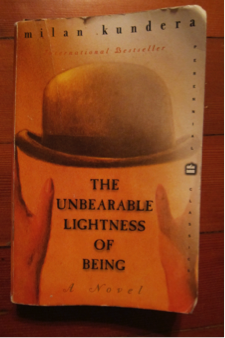
“Challenging Friedrich Nietzsche’s concept of eternal recurrence (the idea that the universe and its events have already occurred and will recur ad infinitum), the story’s thematic meditations posit the alternative: that each person has only one life to live and that which occurs in life occurs only once and never again — thus the “lightness” of being. In contrast, the concept of eternal recurrence imposes a “heaviness” on our lives and on the decisions we make (to borrow from Nietzsche’s metaphor, it gives them “weight”). Nietzsche believed this heaviness could be either a tremendous burden or great benefit depending on the individual’s perspective.”
I feel I am on a crossroads of doing something with this only-one-life. Unshake the bag of heaviness. To do something where I can leave my full and authentic Petervan “signature”.
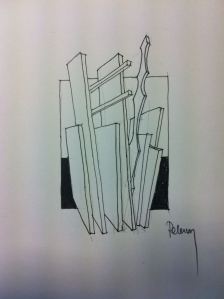
Own artwork, Black Ink on old book page
Away from the illusion of depth on/at/in the surface, where “It is all good” but where the fire of ambition extinguishes, quenches.
A place where we can play “freeform Jazz”, where nothing repeats or scales, a new operating model indeed. Away from the emptiness of scribed facilitations, away from the tricks, the manuals and the templates.
What if we would – for once – NOT try to facilitate our way out of a given problem.
What if our agenda is not one of facilitating a solution for a given problem?
What if our agenda is one of being in what Nilofer calls our “Only-Ness”, in my case my “Petervan-Ness”?
What if we would go beyond this Unbearable Lightness of Tactics?
Way back in the seventies, i studied architecture at Sint-Lucas School of Architecture in Brussels and Ghent. Apparently – after 150 years of existence – the school is since 2012/2013 part of the LUCA School of Arts in association with the Catholic University of Leuven as the “Faculty of Architecture”
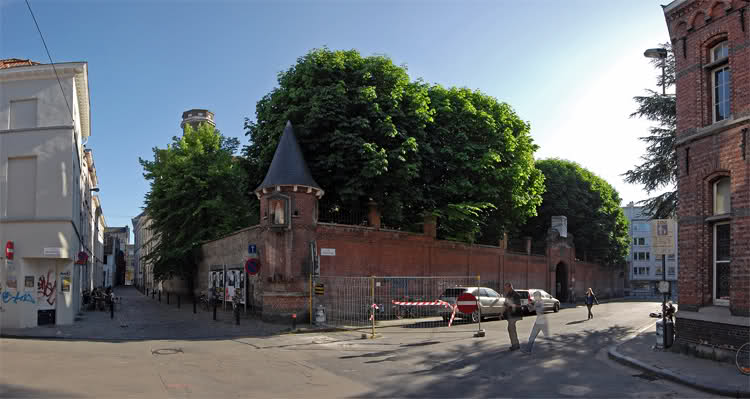
At the time the Ghent campus was located at the Zwarte Zusterstraat (picture) above, an intimate included safe zone between walls, trees in the middle the old city centre. I still remember the smell of paper and ink of the old attic where the architecture courses and practice labs took place.
Anyway, i dropped-out after 4 out of 5 years study, because i did not like the admin/legal part of the studies. I come from a normal middle class family, and paying for these studies was not just a tick-box for my parents. When i decided to quit, they were not happy and they “encouraged” me to find a job and an apartment and live as a big boy paying for his own cost and living.
Last year, after almost 35 years of professional career, and 7+ years fighting the battle for innovation at SWIFT, i felt physically and mentally exhausted, I requested a sabbatical leave for 6 months, which was kindly accepted by my employer – thank you.
I wanted to get in better contact with my other self, not the cognitive part, but the more un/sub-conscious part of myself. I wanted to inject other forms of expression in my work. One of the ambitions was to go back to Art School, to give some counterweight to that cognitive part of my professional life. Unfortunately by that time of the year, it was to late to get registered and i just messed around a bit on my own.
But this year, i was early and got registered early. So, i started Art School in Sep 2014 at the local but quite well equipped and staffed academy “BKO” (link Dutch only) of my home town Overijse.
It’s relatively intense: 9 hours practice per week on Tuesday morning, Wednesday evening and Saturday morning. For the Tuesday morning, i just take 1/2 days off. It’s practice, not theory. Not too much fuss, just try and experiment with materials, and some good honest coaching.
I still have architecture drawing and sketching in the fingers.
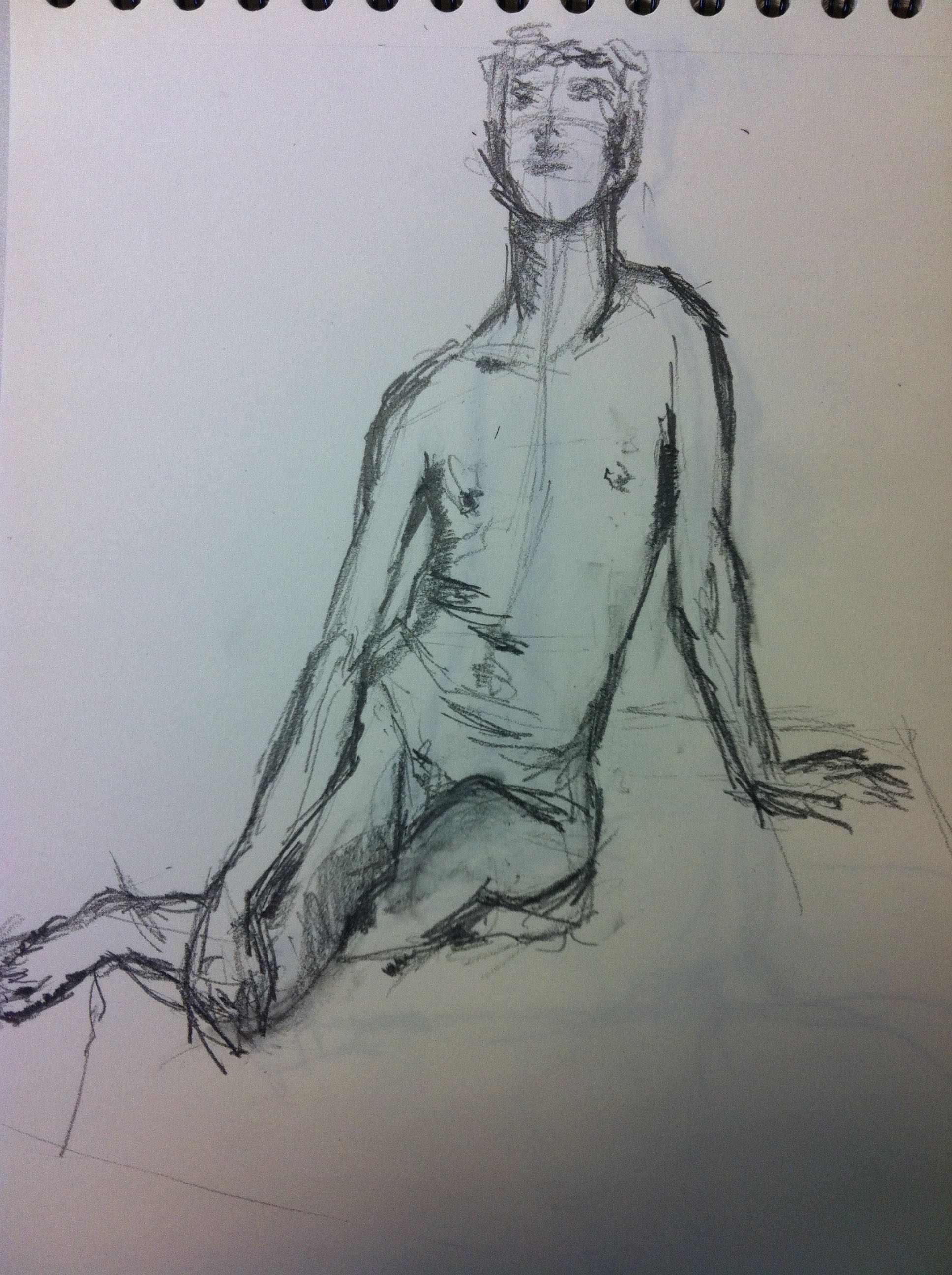
But that is about straight lines. I found it much harder to do curved lines. Of human bodies for example. It probably says more about how my brain is wired than i dare to admit.
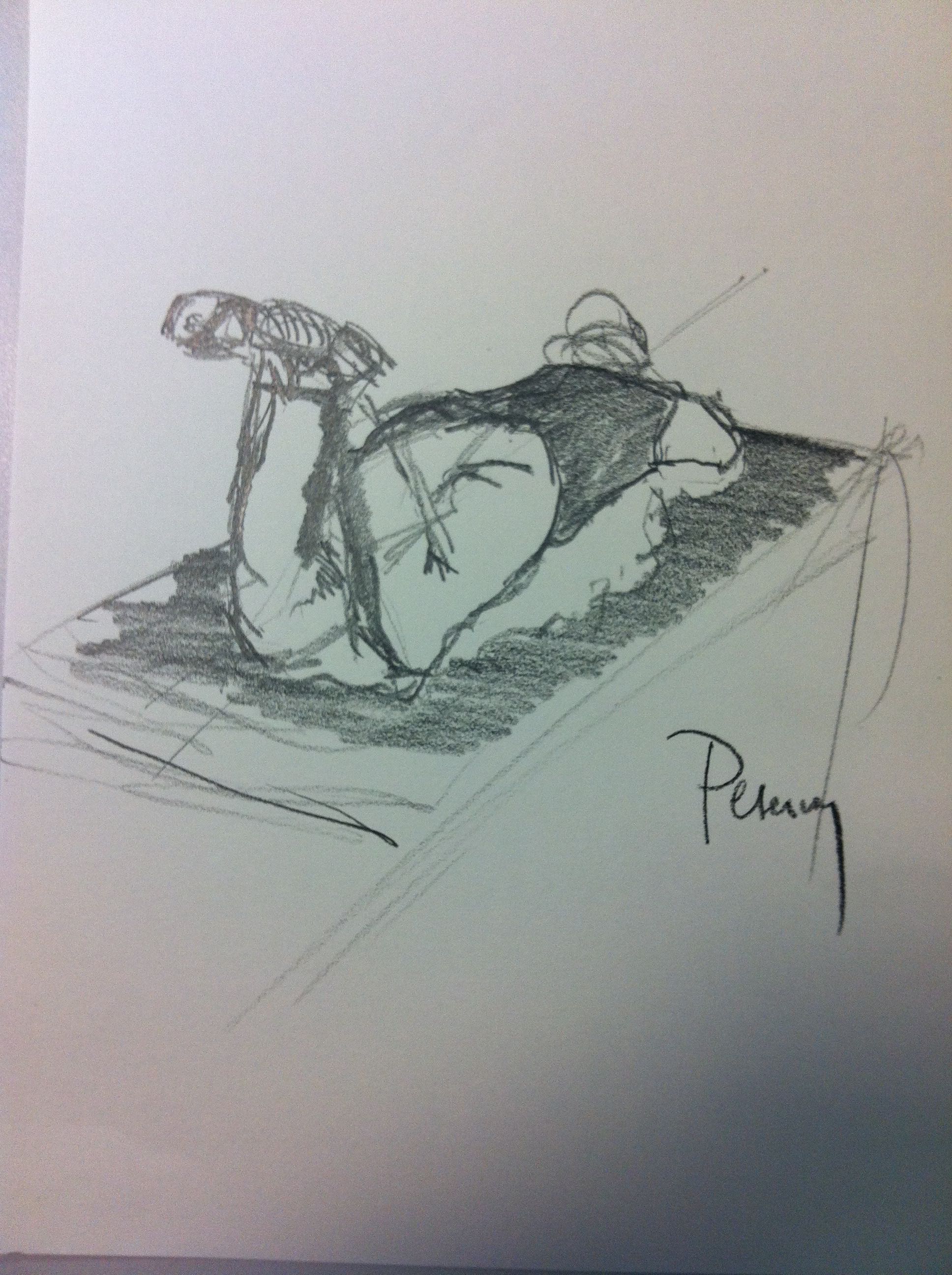
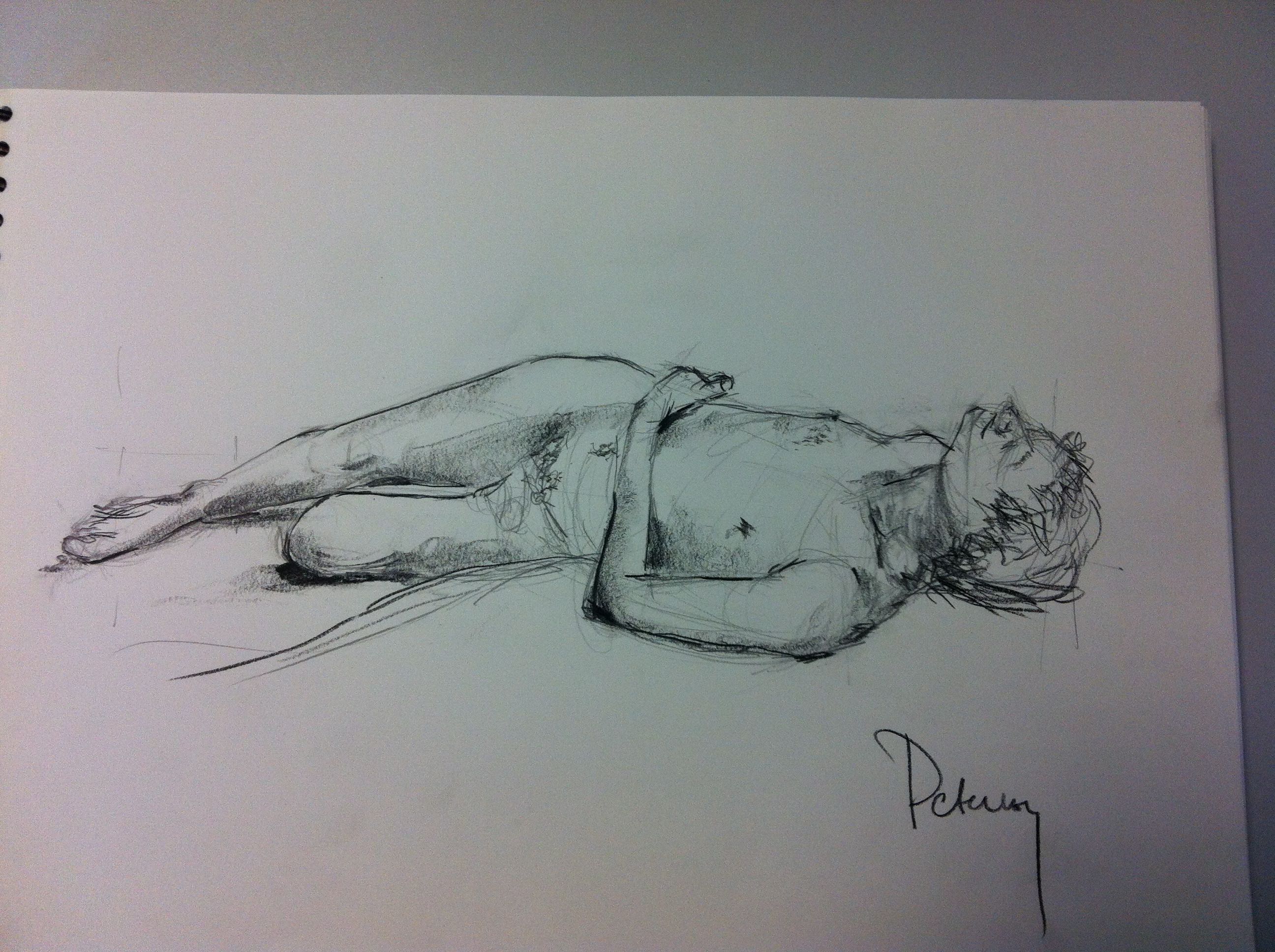
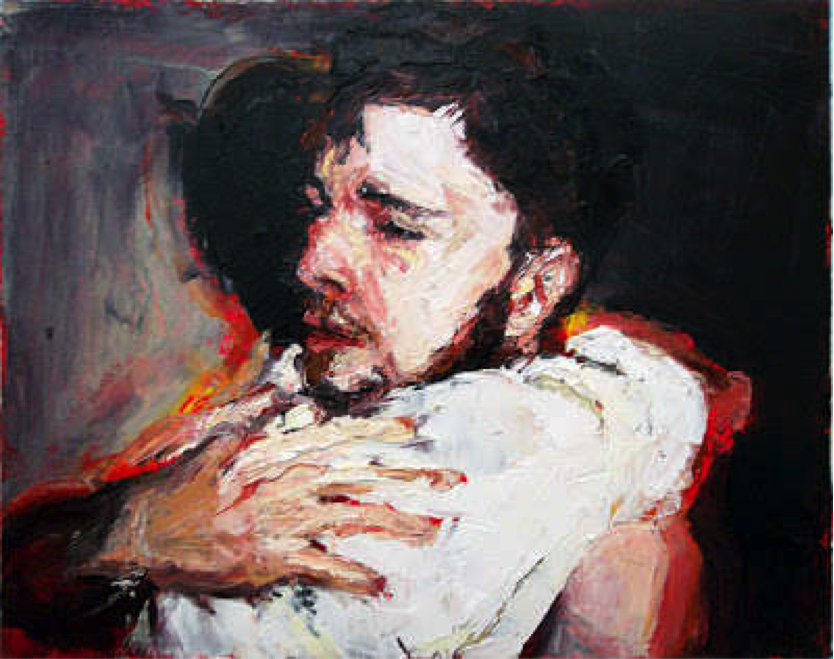
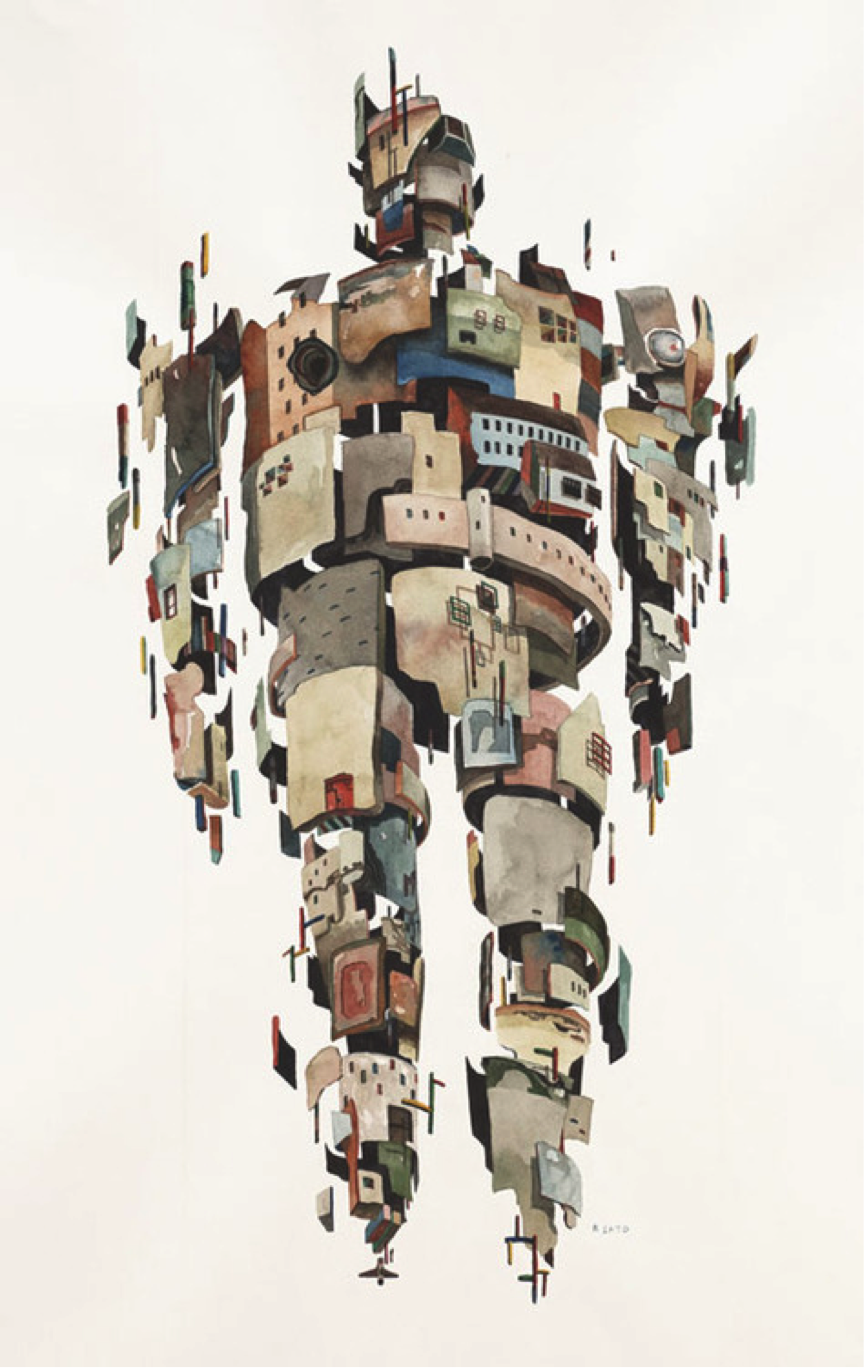
The coaches encouraged me to “let-go”. Here are some early experiments. Let me know what you think.
The above is all small format: A4 or A3. At a drawing table. It’s a bit hiding. We will soon start experimenting with big format, and working on easels. Did some early try-outs last week, and the big format and standing drawing position are so unnatural for me, it really pushes me out of my comfort zone.
This blog post is about beauty, about excellence and uniqueness in their battle against efficiency, scale and functional Lego bricks.
Oil Painting by Adam Brooks
It’s about my hunger for systems that add value to society versus systems and environments that only suck value out of society.
It probably all started many years ago with Cradle to Cradle, the 2002 pivotal non-fiction book by German chemist Michael Braungart and U.S. architect William McDonough. I learned how reducing waste is not good enough, because at the end of reducing waste, there is still waste left. What if we would design systems that are regenerative, and add value and not waste at the end of the process cycle.
And of course there is my all time favorite architect-author Christopher Alexander with “The Battle for the Life and Beauty of the Earth: A Struggle Between Two World-Systems”, and Daniel Kahneman’s “Thinking, Fast and Slow”, again about two world systems/views competing with each other.
I got my final kick when getting in to Brainpickings’ post on “Beauty, Quality, Poetry, and Integrity: Anaïs Nin Meets Frank Lloyd Wright, Jr. (1947)”, with some great insights in the world of art and role of the artist.
It was about architecture that had been taken over by businessmen, and artists not being allowed to carry out their rich hunger for beauty. A bit like Evgeny Morosov’s fight against “solutionism”, where the world is taken over by VCs and commerce in stead of asking the real big questions related to ethos and quality of life.
“Strength was obvious in him, but sensitivity and imagination were in his drawings. A universe of lyrical beauty in total opposition to the sterile, monotonous, unimaginative ‘box’-buildings now seen all over the world.”
“In Lloyd’s work there was space, invention, poetry, a restrained and effective use of the romantic, surprises always in the forms, new and imaginative use of structural parts, rooms, windows, and materials. He has a gift for involvement in many-leveled lives, for the variations, caprices, and nuances necessary to the human spirit. Every stone, every roof-tile, every window, every texture or material was designed for the consistent development of his building, its environment, and designed to elevate the quality of people’s lives. Uniformity and monotony kill individuality, dull the senses.
Lloyd designed his work to reinforce individuality with poetry, beauty, and integrity. It was planned to create a more beautiful and satisfying human environment. Architecture as poetry. …
If he sounds like a moralist, it is because beauty, quality, and ethics are inseparable. Beauty and integrity. And for them one has to be willing to make sacrifices.
Many months ago, I had a chat about this with REXpedition friend Tom LaForge (Global Director, Human & Cultural Insights at The Coca-Cola Company), in 2011 an Innotribe speaker at Sibos Toronto. He inspired me with contextualizing our preferred system-1 as one of “drawing, flow and music”, where one “drinks from the fire hose of beauty”.
What if we would found a new collective of inspired thinkers, creators and sensemakers, the collective of QWAN (Quality Without A Name)? Surfing on the idea of “standing in your onlyness” as coined by Nilofer Merchant. A collective where we could connect with the other nodes, create another sort resonance with other nodes, a QWAN cohort as a way to connect with other quality nodes in tune with our true selves, allowing ourselves to to loose ourselves: in stead of “collective” we may want to call it the “connective”…
Loosing yourself…. Here is Brian Eno about loosing yourself:
“Sex, drugs, art, and religion—those are all activities in which you deliberately lose yourself. You stop being you and you let yourself become part of something else. You surrender control. I think surrendering is a great gift that human beings have. One of the experiences of art is relearning and rehearsing surrender properly. And one of the values perhaps of immersing yourself in very long periods of time is losing the sense of yourself as a single focus of the universe and seeing yourself as one small dot on this long line reaching out to the edges of time in each direction.“
Steering away from “in-group mentality”, and nurturing the ability to flow in/out other groups, and creating “permeable barriers” between the inner and outer self/shell referring to Jung’s dualism. Building lives in currencies that matter: respect, dignity, and kindness. With exchange rates and markets for these value currencies.
Using un-words like music, art, performance and poetry to access access the true self, buying into something experiential, loosing yourself.
In architecture it’s about the battle for beauty, against the “commonplace, shoddy, temporary movie-set houses around him were painful to see. He called them ‘cracker boxes,’ shabby, thin, motel-type homes for robots”
Marc Andreessen, well know for the phrase “Software is eating the world” also made a plea for saying he did not believe that robots will eat all the jobs”.
“Since our basic needs are taken care of, all human time, labor, energy, ambition, and goals reorient to the intangibles: the big questions, the deep needs. Human nature expresses itself fully, for the first time in history. Without physical need constraints, we will be whoever we want to be.”
“The main fields of human endeavor will be culture, arts, sciences, creativity, philosophy, experimentation, exploration, and adventure.”
“A planet of slackers you say. Not at all. Rather than nothing to do, we would have everything to do. Curiosity, artistic and scientific creativity have full rein resulting in new forms of status-seeking (!).”
“Imagine 6 billion or 10 billion people doing nothing but arts and sciences, culture and exploring and learning. What a world that would be. The problem seems unlikely to be that we’ll get there too fast. The problem seems likely to be that we’ll get there too slow.”
All this is about – in my opinion a new quest for romanticism, also in business. I can’t wait for Tim Leberecht’s upcoming book “The Business Romantic, Give Everything, Quantify Nothing, and Create Something Greater Than Yourself”, scheduled for release in Jan 2015.
What if the future model would not be based on exponentially, speed, scale, and efficiency?
What if uniqueness becomes more important than functional Lego-bricks and efficiency?
What if beauty becomes more important than function?
Like art, where the primary objective is to make something that is beautiful and resonates deeply at a non-cognitive, sub-conscious level and created happiness and fulfillment at a whole different intensity and quality. Where we want to resonate at an emotional level with each other, with a well-measured level of sharing, beyond legality and morality, but at a level of human intimacy.
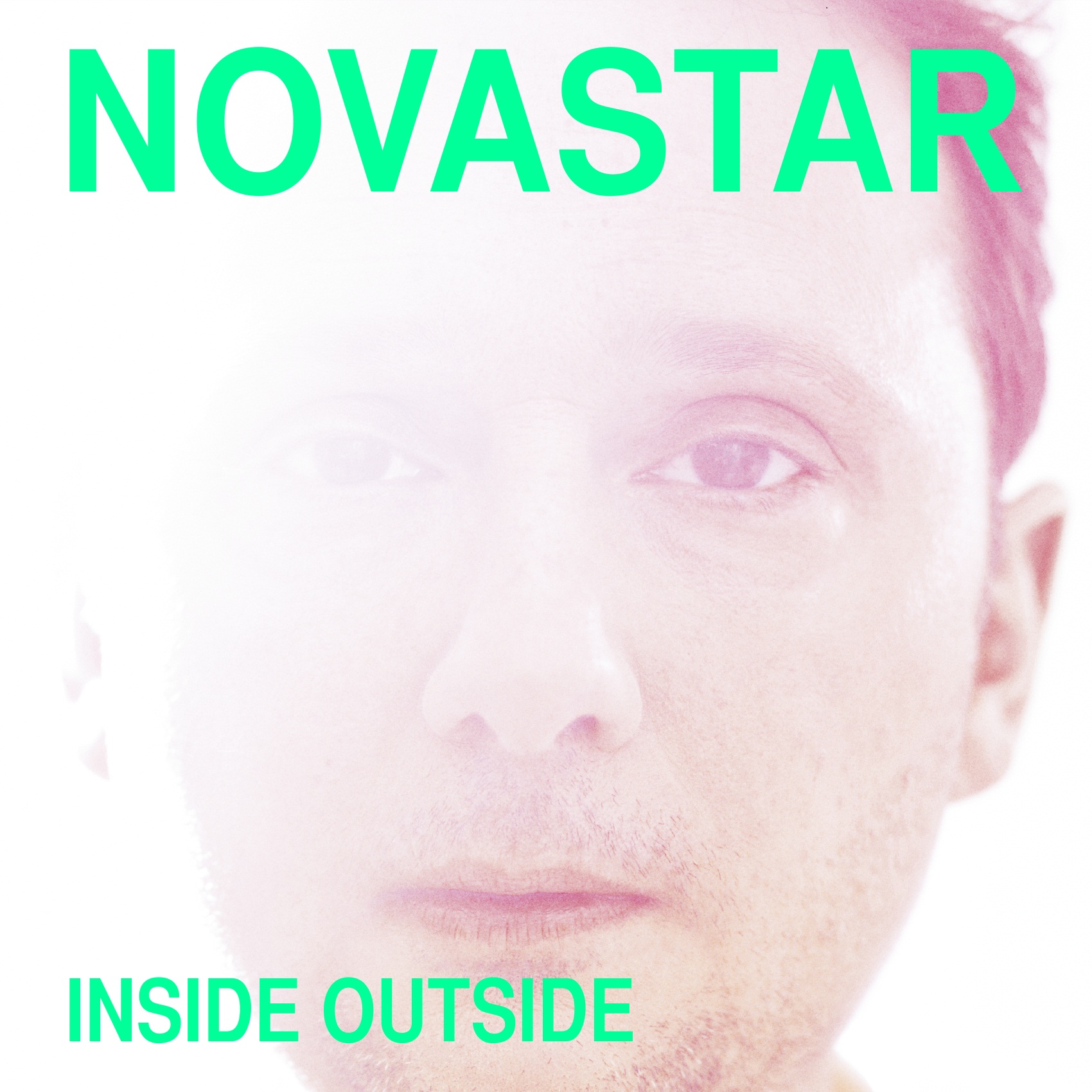
I just saw a very nice documentary on Belgian Television Channel CANVAS about the making of Novastar’s latest album ‘Inside Outside”, released in March 2014.
None other than John Leckie produced the album, the legendary producer who earned his spurs in the Abbey Road studios with Pink Floyd and George Harrison. Leckie was also behind the buttons for the monumental albums of The Verve, The Stone Roses and Radiohead.
The documentary reconstructs the musical influences, inspiration and obsessions of the bandleader Joost Zweegers, a quite intense Dutch-born Flemish guy who started as a street musician, and who perfected his style, and got noticed by Neil Young who invited him for his support act.
The program resonated strongly with me; I made some notes, and got in some sort of poetry mood…
Picture: Solsbury Hill via Barnflakes
Drone cameras,
Intensity of Solsbury Hill
The artist
With fascination, Mystique and Commitment
Get outside
For inside rest by solitude
His heart is in Belgium, and his fantasy in England
My heart comes from a Flemish Primitive, and my fantasy is in Spain
White page for content, space design and experience design
With performers, craftsmen and artists,
Reinventing once more
To unleash the unknown self in me
This is autumn,
Point of light in the depth
Creating intensities
Everything has to be perfect, rehearsed, must be right.
But leaving room for happenstance and personal emotion and interpretation in the moment,
“Right” like in Music: the art of getting all the notes out within the constraints of the right tempo and with my very personal interpretation
“Right” like in Poetry, just for the beauty of the language, the rhythm,
There is no usage for it…
No efficiency games, nor pragmatism, nor KPI’s
Just for the beauty of it.
Romanticism.
But music is without words
I am tempted to make another composition without words.
Having a week off, and found some time to look back into my dreams-book (see introduction to the concept in #Dream-1: Breakfast). Here is another dream, called “Flying”:
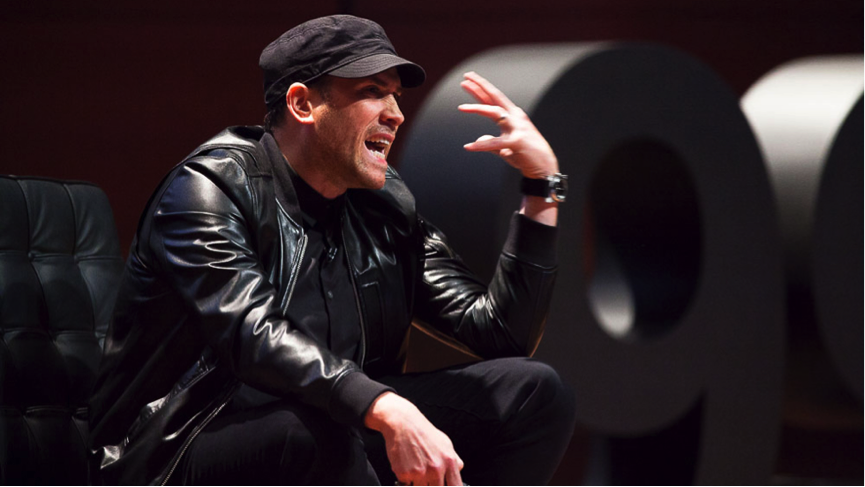
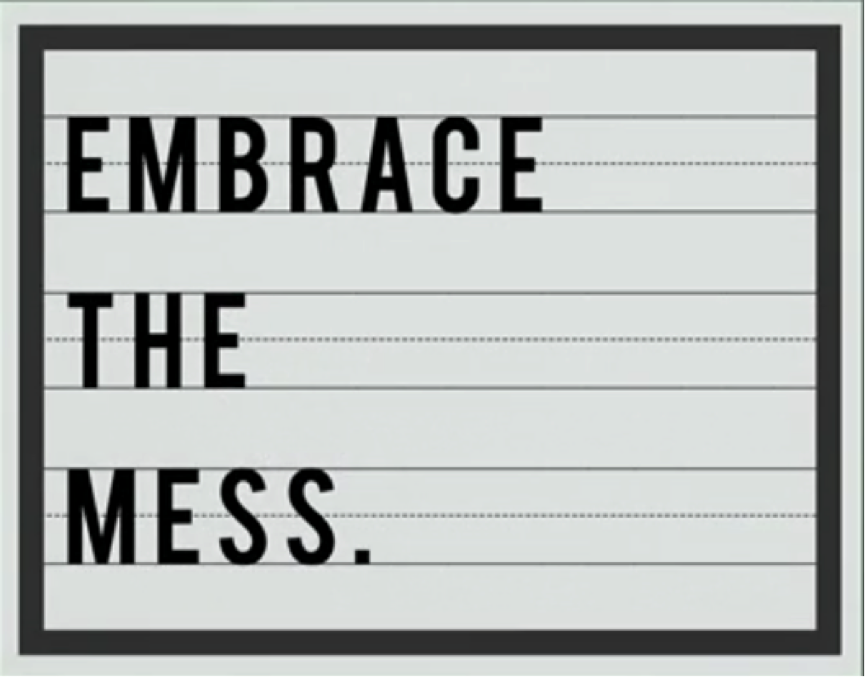
There is a fantastic talk on the 99u site by Mark Eckō titled “Embrace the mess”
Entrepreneur, media mogul, and designer Marc Eckō tell us that, if we’re not careful, we can let others label us and define our career, robbing us of our natural potential. The solution?
Stand up for yourself!
It’s a great talk, one of those that I listen to second by second, making lots of notes almost leading into a full transcript of the talk. Somewhere halfway the talk, it seems there is a book about this by Mark Eckō titled “Unlabel: Selling You Without Selling Out”. I bought it right away after this talk. I have no credits for any of the ideas in this blog post. It’s just a transcript. It’s just some re-ordering of somebody else’s great ideas.
Mark Eckō has 3 messages for you:
Embrace the mess
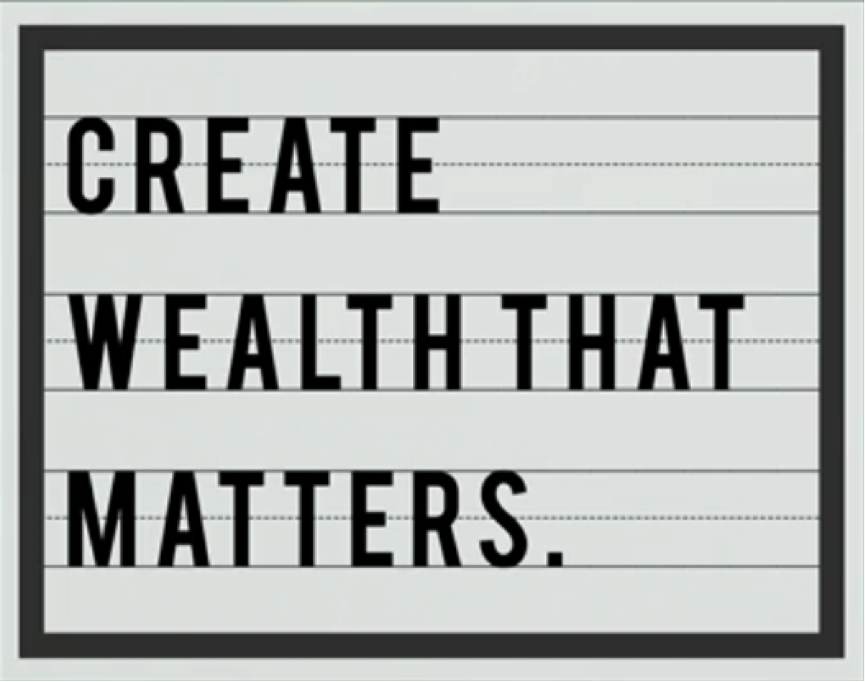
Create wealth that matters
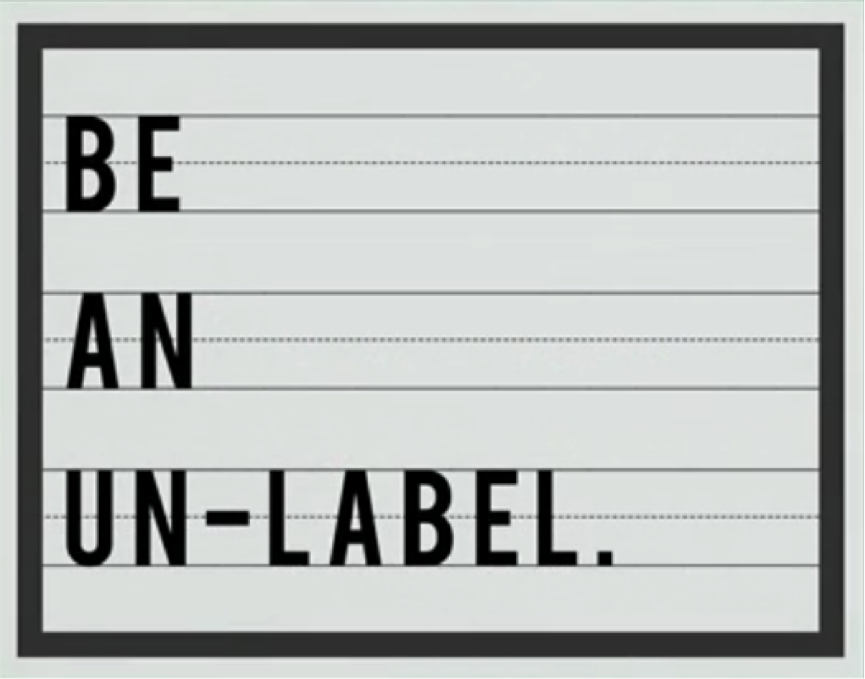
Be an Un-Label
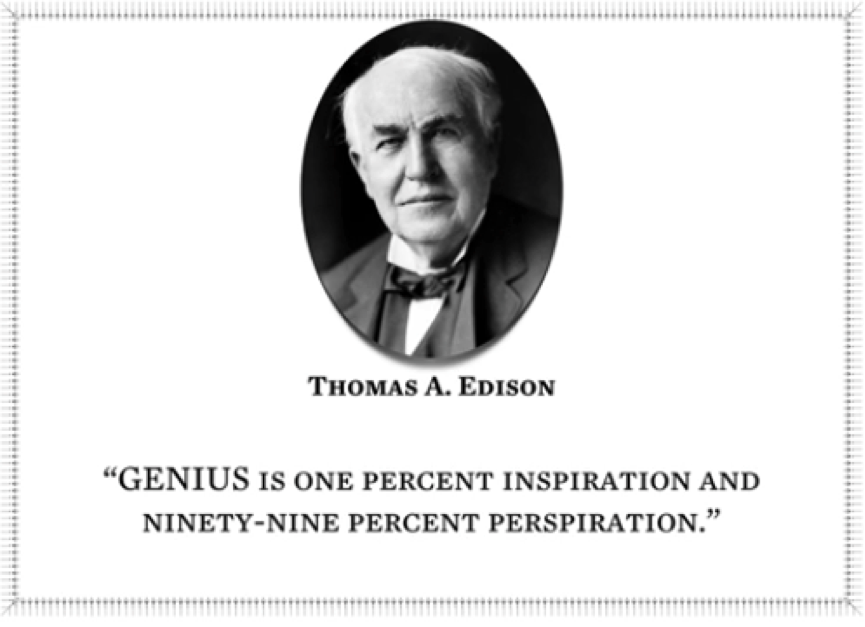
The talk starts with the famous quote by Thomas Edison “Genius is 1% inspiration and 99% perspiration”
99% perspiration as if
You manage the PAIN of the grind
You embrace the RIGOR
Your hard work is THE HEART of genius
1% inspiration as if
Inspiration needs to be dosed carefully
Inspiration is ROMANTIC and perhaps distracting
And IDEATION can be a rabbit hole
You are so busy
You are so busy grinding
You are so busy perspiring
That perhaps we have forgotten to imagine
Are you’re an entrepreneur, or a creator and an artist?
Sometimes we think being an artist/creator
Is indulgent
Self-indulgent
About self-philosophical people
That get dressed in all black
Lean back
And get moody,
And self-loathing
Sloppy and right brained
Or maybe this is just not for you?
Maybe you loose some of that swag or that freedom?
Where when you were in second grade
You would just raise your hand and say:
YES! I am an artist!
Some think that this notion of creator/artist is divine
And we struggle with that
We believe there are a holy war between creative and art and commerce
This inhibits us in our relationship with our art
So I challenge you folks who don’t necessarily fancy themselves as artists
That just because you can not manipulate paint, sculpture or music
Doesn’t mean you should not problem solve like an artists
Learn to embrace the messiness of creation
Give yourself more than the 1%, chill-on the dosing, ok?
Numbers don’t lie, but they don’t always tell the truth
We are obsessed with accounting,
Accounting for our money, our grades, our wins, losses, time, likes, followers, fucks, KPIs, the quarter, page views, etc
Count count count
Quit counting
Big data matters
But Being human even matters more
You can’t loose sight of the qualitative intent
Qualitative excellence cannot be hacked
Wealth that matters cannot be counted
One used to say “perception is reality, you have to control the room”
But no,
Reality is reality
We try to give a taxonomy to everything
The perceived versions of ourselves
We focus on the outside only
Attempting to remain in fashion
Hopefully from value to the skin
Instead of skin to the world
Fash-ion: group of people acting together
Fas-cism: a way of organizing a society rules by dictatorial controls, a very harsh control or authority
The gospel of streetwear
All these gatekeepers in my office
A BLIV-IT
I was so busy to round off my edges
I was so busy assigning so much value to this 3rd party infrastructure, these gatekeepers,
Divergent ideas breed independence
I was looking for their approval
And letting me frustrate by this
When you ask for change
It is going to be with friction
It’s going to be work
Perhaps you going to ask for enemies
Apologising for your square edges does not make sense
Gatekeepers breed groupthink
How much energy in my life did/will I give to those gatekeepers?
Don’t loose sight of the GOAL-keepers
Who care more about what you are making
Even care about how you make them FEEL
When you refuse to be labeled
Suddenly you play by your own rules
Not theirs
When rules start to look like BLIV-IT s
Defy them
Measure yourself up to your own standards
Versus the gatekeepers’
Abstract and often irrelevant compliance metrics
Just saying:
There are some compliance standards
That are rather old
And not really relevant anymore
No one has a monopoly on validation
It’s about your body of work
The talk resonates strongly with me.
Because it resonates with who I am deep inside.
I feel like the artist/creator in his atelier below.
I have been relatively silent on my blog, tweets and other social media. The reason is focus. Focus on preparing with the team another exciting experience at Innotribe Sibos, this year in Boston from 29 Sep till 2 Oct 2014.
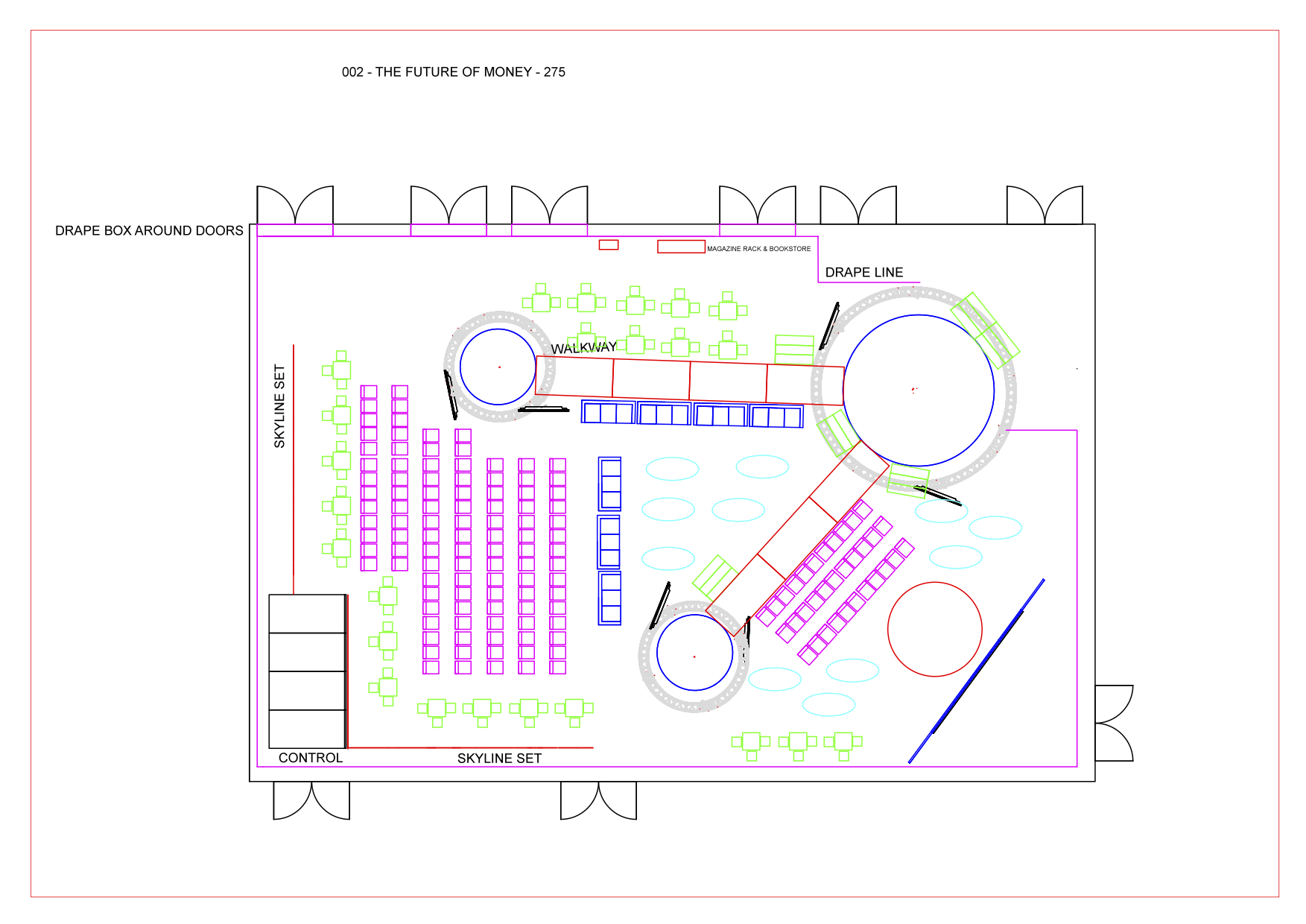
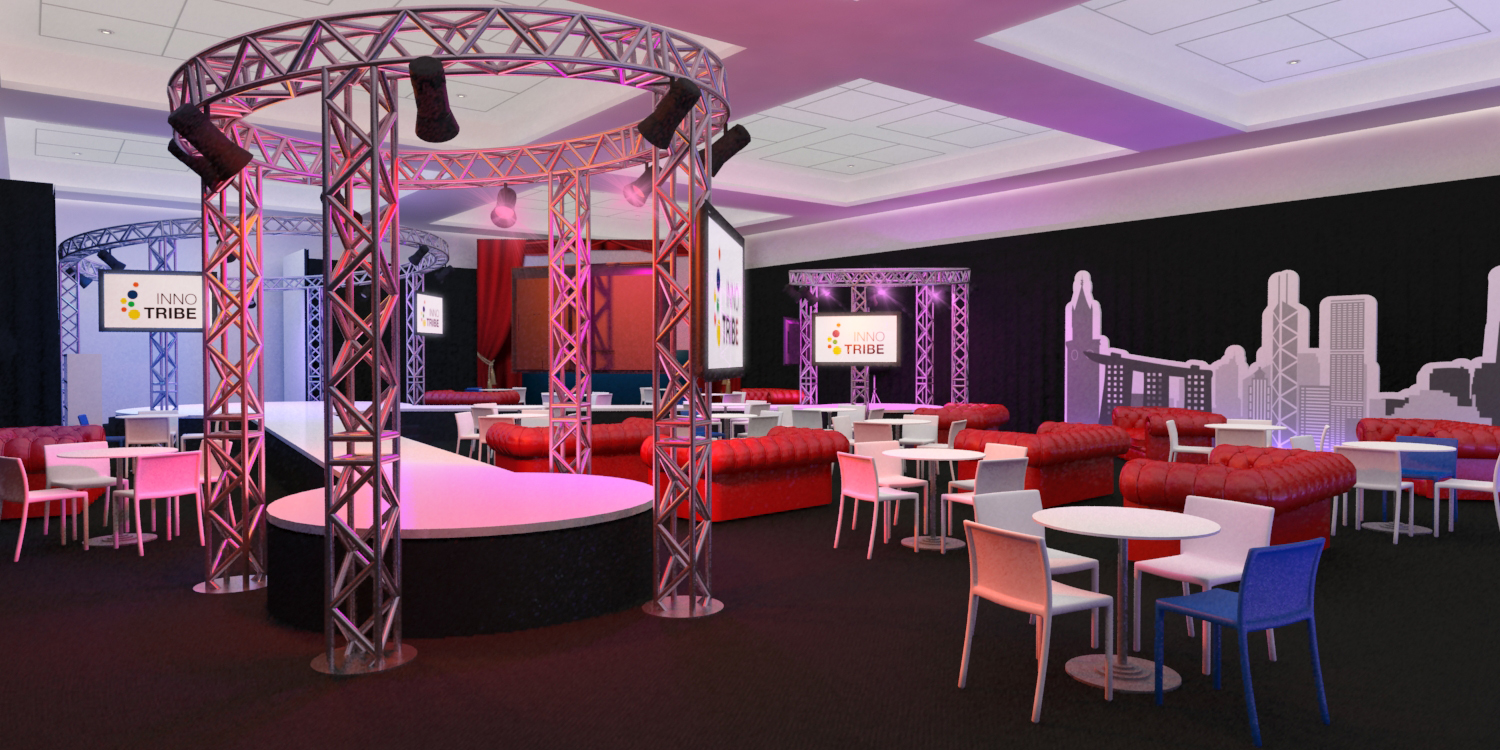
Less than 2 months from D-day, we are in full build up. We are in good shape, and preparations are in full swing. We are now at a stage where we have detailed minute-by-minute session scripts for all sessions, and are at a rate of several speaker preparation calls per week. And we have for each of our 17 sessions a detailed floor plan like this one:
And in addition, we are building bridges and sharing speakers with Technology Forum, Investment Management Forum, Markey Infrastructures Forum, Standards Forum.
Peter Thiel is always good for some controversy. Usually, I am a big fan of him, despite his libertarian opinions. But this time I have to disagree. Because it seems that he hates business suits, to a point that he does not want to invest on startup CEO wearing a suit. In Business Insider he says:
“Maybe we still would have avoided these bad investments if we had taken the time to evaluate each company’s technology in detail,” Thiel says in his book. “But the team insight — never invest in a tech CEO that wears a suit — got us to the truth a lot faster.”
But look at what he wears himself in that article!
Maybe it’s just a promotional stunt for Thiel’s new book, “Zero To One,” but even so, I believe it re-enforces polarization and avoids inclusion.
Indeed, what do vestimentairy aspects have to do with content? I even saw a post (hopefully jokingly) suggesting that at next FinTech innovation events no suites would be allowed. What a joke! I don’t think this works.
I am more and more convinced it is our responsibility to build bridges, and create inclusions instead of accentuating the differences.
I have heard similar vestimentairy comments about people within the FinTech innovation community saying things like: “he/she has not enough “streetcred” to be part of our community.”
What a crap, this whole “Streetcred” versus “Suites”!
The beauty is in the diversity and being able and willing to go beyond simplistic categorization of exclusion. Old world is about exclusion. New world is about inclusion. The new world is all about building bridges. About staying away from polarized positions. Because I believe the beauty is in between the extremes.
Somebody reacted to me: “but then you will end up with grey!” and I replied: “No, I don’t think so, I think we will end up with a rainbow of colours”.
At Innotribe Sibos 2014 in Boston (29 Sep – 2 Oct), our tagline is “Building Bridges”. In our facilitated sessions, we will use voting/scoring cards labeled “Ties” and “Tattoos”. But not to accentuate the differences, but to bring people together, help them understand each other’s point of view, and agreeing and documenting our intentions for progress.
The secret is in the inclusion of Ties and Tattoos
Just found this awesome 27 min talk by Joi Ito on the 9 principles of open innovation. They are not that new – first version appeared in 2012 – but they seem to have matured, like good wine in well kept cellars. Almost every sentence he speaks is tweetable 😉
To help me concentrate on the content, I usually make a lot of notes, and before knowing I almost made the transcript of this talk, so i can as well share my notes.
So, I have no credits on the content. I just did some mix and matching with some other material from others. Like Joi, I have been a DJ, and I have fun in mixing and weaving different themes into some form of new carpet. Highlights are mine.
Joi Ito is Director of the MIT Media Lab and many other things (check out this Wikipedia page).
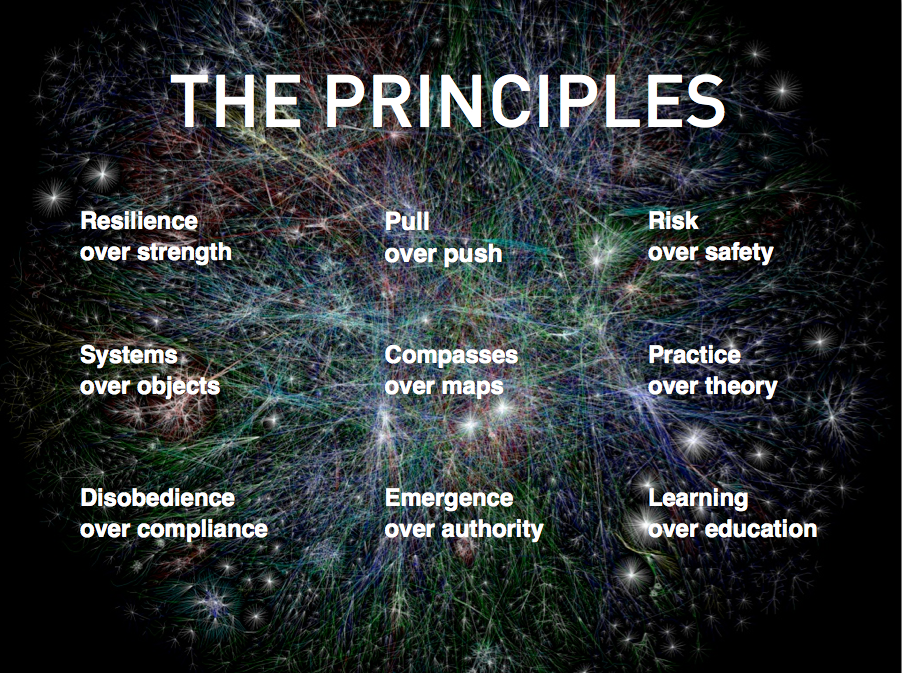
Here is the sort of transcript, more or less ordered around his 9 principles.
But in his intro, he says also loads of interesting things.
The MIT Media lab 30 years later: Media is plural for Medium, Medium is something in which you can express yourself. The Medium was hardware, screens, robots, etc. Now the medium is society, ecosystem, journalism,… Our work looks more like social science.
Before the Internet (BI) and Post the Internet (PI): Post the Internet, it is about participating responsibly in a system that you can’t predict and whose outcome to your intervention is almost random.
We are moving from “demo or die” to “deploy or die”. It just costs some “sweat equity” and some kids in a dorm room to get things done. Kids are competing with the incumbents. The innovation cost – the cost of trying something – went to nearly zero. Now you can innovate without asking permission, pushing innovation to the edges, and allow grassroots innovation.
Note: I believe “grassroots” innovation is very important in organizations. Last week I was on the judge panel of an internal innovation channel. I saw quite some things that our innovation team explored before, but never succeeded to get out there. With grassroots innovation, you have the buy-in from the fabric of the organization from day-1. It is very “swarmwise”.
Before, the guys who had the money had the power. Now, because the space of startups is so crowded, the VCs have to sell themselves.
Note: I heard something very similar recently in the context of innovation motivations: corporates looking for innovations have to sell themselves to startups.
Diminishing cost of innovation makes those having the money behave a little bit better. Who is thinking about those ideas that don’t start small? Thinking about it as a community. This is less about empowering the individual, more about empowering the community.
Note: “empowering the community”. Wow! Big ideas are usually shared ideas. In yesterday’s post, I mentioned the great Diego Miralles with his story of the Janssen Labs as a story of shared infrastructure. I believe the time is ripe – more than ever – for cooperative structures where we can form “coalitions of the willing” to solve the big community challenges.
Twitter was not a company, it was a feature. It only became useful when linked, when in a system. Can the ecosystem solve the big problems, a complex system with nobody really in charge? In stead of designing that one thing, in a system design is more like growing, giving birth to a child, you don’t know exactly where that child is going, it has your DNA, but hopefully turns into something that you are going to be proud of. Think of it like a gardener: the open internet is the water, the openness, the air that you need, and all of us are the organism that live in that system, to make this thing vibrant.
Then Joi started introducing and commenting some of the 9 principles.
A lot of people disagree with them, but I don’t care. I care about the arguments, I don’t care that they are disagreeing.
Pull over push
You pull from the network as you need it, rather than stocking it and centrally and control it. And agility is what comes out of that. If you have printing presses, and lines of code, and IP, those are all reasons not to shift course, to stick to your map, rather than the compass. All the things we think are assets are in fact liabilities, if you think about it from the perspective of agility.
Compasses over map
Often the map costs more to build than it is worth, because the complexity is so high and it is so unpredictable. Dependence on planning is a weakness.
Practice over theory
When I was looking for funding my first ISP, the investor spent 3M USD for consultants to advise not to invest 600K dollars. If it costs you more money to think about it than to do it, it’s better to do it. And if you do it, it turns out that you get a fact, not a theory. It is important to do things, especially if the cost of doing things is cheaper than talk about it. A lot of times it works in practice and not in theory, you can figure out the theory later. Most of the world deals with things that work in theory, but not in practice, and they try to discredit reality in order to fit with their theory. But “in theory” they say, “theory and practice are the same”
Disobedience over compliance
You don’t win a Nobel price by doing what you are told. You win a Nobel price by questioning authority and thinking for yourself. You want to build an organization that is resilient to disobedience
Emergence over authority
In communities, authority seems to be emergent. Open Source project leaders, tend to be somewhat quite people, with a lot of EQ, how are not naturally trying to grasp power, but end up in power because the followers (@petervan: I would say the fellowers) push them there. In an investment firm with a hierarchy that is based on function and title, you just need a stick to keep the troops aligned. But when you are in a system where you are paying to participate, then you want emerging authority.
Learning over education
Education is what people do to you, learning is what you do to yourself. About degrees and “finalizing my eduction”. I don’t want you to be at the media lab, because you want to get out.
Resilience over strength (part of the Q&A)
In stead of bulk-up and resist failure, invest the same money on recovery and resilience. You tend to try to minimize failure, rather than trying to work on resilience. It’s also kind of a Zen thing too. If you are extremely present and ready for anything, your are in an extremely resilient state. And it you are not present, you are always focused on the future, or the past, you try to build up walls and trying to make sure that you don’t get choved. And it is hard when you are surrounded by other planners in an institution like this (Knite Foundation) you tend to focus on structure, strength versus resilience, the structure vs this bounciness. Again on the Internet, a lot of the pieces are very resilient, when you are in an institution that uses a lot of planning; it is hard to create that interface
Also the Q&A part of this talk was interesting.
On how to share knowledge:
The conference model is a great system. A lot of people have experimented with ways to try to share knowledge, but it seems to be one of the hardest problems because everybody has a day-job, they are very busy, and people are talking sort of different languages, and when you are face to face you can coordinate your language in real-time
On how to you get people who are working on things coordinated?
At the Media Lab we have several approaches: we have this sort of big data, data mining, machine learning, predicting things through causalities and patterns vs something where people are more in charge and people are more active.
There is another version of this talk at TED talks:
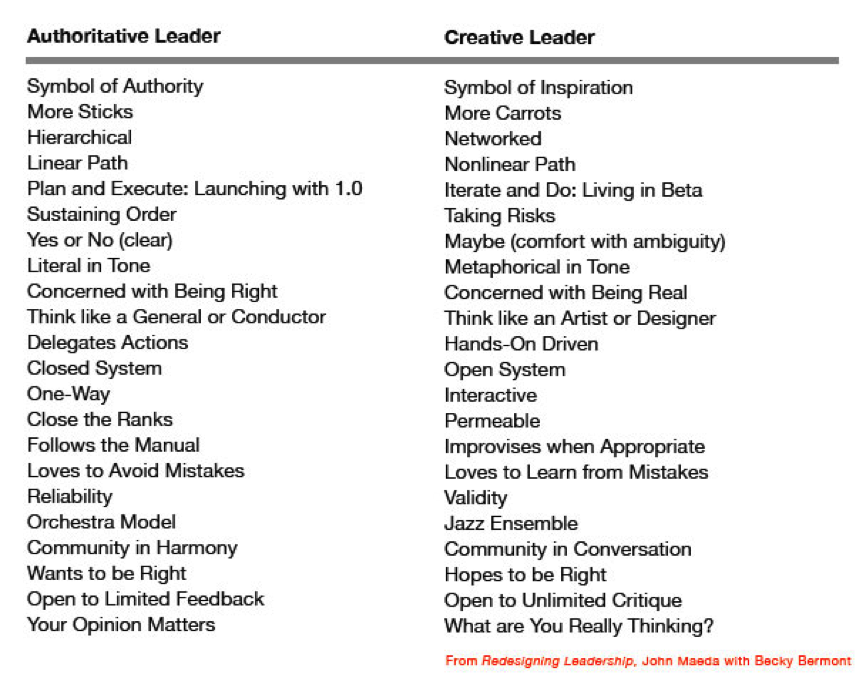
The more I listen to Joi, the more I become aware that he is talking about leadership features to navigate our companies in this more then ever unpredictable fast moving world. It was a pure coincidence; right after Joi’s talk, I spotted this great post from John Maeda, about Creative Leaders versus Authoritative Leaders. John Maeda was the President of the Rhode Island School of Design from 2008 to 2013. He is currently a Design Partner at Kleiner Perkins Caufield & Byers.
This chart represents a summary of the kind of creative leadership that is rising — and needed — in the face of our increasing interconnectedness due to global economies, mobile devices, and social media. In an age where anyone can “friend” the CEO, and where complexity and volatility are the only constants, what should leadership look like? I often say we are now operating within a “heterarchy” though I’ve also cleverly seen it called the “wirearchy.” In any case, it’s a world where I believe the natural perspective of artists and designers — who thrive in ambiguity, fail productively, and rebound naturally — will be become more and more useful in leadership contexts.
The chart was originally created for a workshop at the Davos World Economic Forum in 2009 and became the basis of my book Redesigning Leadership, written with Becky Bermont. In my own observation, there are authoritative leaders and creative leaders everywhere — it’s not something wholly determined by industry, generation, or position. And every leader will need, on any given day, a little bit of both types of leadership.
Makes me think about principles for Leadingship vs. Leadership. See also my post “The End of Leadership” of 1 ½ year ago. Like Joi’s talk makes us reflect on the openness of innovation, Maeda adds the openness of leadingship.
I have made two blog posts about this excellent study tour:
“Highlights Disruption Tour” with a sequential overview of highlights per company visited (that post)
“The Uberization of Everything”, a more holistic analysis and sensemaking effort of what I believe are the disruption understreams (this post)
The tour started in the Bay Area on Monday 2 June 2014 with a visit to Google and ended on Friday 6 June 2014 at Scripps Research in San Diego.
Hereafter 8 “clusters” of transversal insights, with my very personal subjective sensemaking for which I am the sole responsible 😉
Brand Identity and what the company stands for
We visited Tesla after Google. The Google campus of course looks great, but one starts to wonder whether all this is real. How much is theatre and drama? Somebody made the remark whether some of the folks on the campus were not hired as actors 😉
What was more striking are the much higher enthusiasm and true engagement of the Tesla folks. In comparison, the Google people felt tired and at time un-interested. The Tesla tribe was full of fire and energy.
The Google portfolio looks more and more like a patchwork of apps and acquisitions. Even the Google presenter acknowledged that he did not know anymore what their brand was standing for. Something similar happened at Singularity University, where the presenter did not believe the singularity was going to happen, at least not in one “big bang”.
Companies need a “Collective Coherent Corporate Consciousness”
ànd clarity in their intentions and associated narratives.
Relating this all back to financial services, one may ask what a bank stands for or not. “When is a bank not a bank?”. When we see Paypal making payments invisible and blurring the online/offline worlds, what is holding back a Walmart, Amazon, and vibrant startups of offering these services under-the-hood, and elevating what they stand for at a more ethical level?
What was new for me in this tour was the power shift towards “fan-base” and “peer-base”. And the difference between platform-thinking and peer-thinking.
In the Uber scenario, it was the taxi dispatching company that was the friction in the system. This opened opportunities for newcomers like Uber to create a platform (to quote @sanguit, a combination of “magnets”, “matchmaking”, and “tools” like APIs, to let producers and consumers of “seeds” interact directly. But there is still a platform owner, server, “siren-server” that holds the power in the system.
While many enterprises are hesitantly making their first moves into platform-thinking, trying to avoid the Uberization of their own business, we are already witnessing the appearance of full peer-to-peer networks, where the infrastructure and business frameworks are owned by the peers, by the commons.
Have a look at newcomers like Ripple and Ethereum, very early days of organization moving from “company” towards “Distributed movement orchestrators” where the power lies in the end points, the nodes of the grid. It will be very interesting to see how governance and regulation will evolve in these 100% distributed environments.
But maybe this vision of infrastructure owned by the end points – owned by the commons – is all just wishful thinking, ignoring the fact that more of that infrastructure lands in the hands of massive new private infrastructures, replacing public goods and services. Where the worker becomes an “entrepreneur,” and assumes the entrepreneur’s risk
“Such networks are in effect anti-communities, as Horning asserted with dystopic alarm, where users and independent contractors are pitted against one another, with the only unifying aspect being their use of digital technology to seek the best opportunity to exploit each other’s labor for the lowest rate. But at what cost?”
“I wish I could agree with your view of a distributed, decentralized future. But on the contrary I see many examples of a trend in the opposite direction:
Software defined networking moving to replace the decentralized routing of the Internet with centralized, top-down policy enforced by a “controller”.
Bitcoin is fundamentally at risk due to consolidation of mining resources in a single pool.
Peer-to-peer music sharing being replaced with streaming services hosted by mega-corporations.
The most cutting edge software running on massively parallel, closely integrated oceans of compute nodes hosted in giant data centers owned by those same mega-corporations.
Perhaps these trends can be reversed – more powerful microprocessors and storage returning cutting edge computing to individuals, private clouds that are not just affordable but easy to set up and maintain, the type of networks you describe here.”
Regulation:
Regulation came back many times in our conversations. We all have seen the protests of taxi drivers against Uber in Boston, London, Brussels, Paris, and many other cities around the world. Diego Morales (Global Head of Innovation at Janssen Lab, part of J&J) hit the nail when he said:
The regulator is not evolving:
too much focus on preventing harm vs. enabling progress.
I listened to the painful efforts of innovators like 23andMe, Scanadu during the tour, and reflected on the regulatory FUD (Fear, Uncertainty, Doubt) tactics with respect to crypto-currencies. The lesson learned in this tour is that innovators have to embrace the regulation but that you need deep pocketsto sustain that effort for several years.
Blending On-line and Off-line, and the risk of becoming invisible
On-line is not trying anymore to just mimic off-line. On-line is supporting off-line experiences. Being part of a stream starts blurring into the four walls of the shop. The best example was PayPal, showcasing some use cases in their showroom.
Suddenly commerce started feeling like streaming music.
I would call it the Spotify-cation of everything. But with sensors assisting you in your brick-and-mortar shopping experiences. We see the same happening in education, like at Coursera. Students are assumed to take responsibility, and hang on-line on the knowledge fire hose, while being assisted and coached in very 1-1 real world experiences by their educators. The knowledge flows are on-line, the coaching off-line.
We have to start thinking into intentions
“I want to bank” is not an intention. It’s a supporting function to commerce. “I want to buy something” or “I want to do commerce” is probably also not an intention. It’s more about satisfying immediately a need, with all the reflections I could make about commerce and advertising as propaganda and mass manipulation of the unconscious. The point I am trying to make is that horizontal functions like payment become invisible. Think about your business: can it be commoditized so much that it becomes invisible?
Data Ethical Companies
I have already written so much on my blog about the exploitation of personal data through big data, government and corporate mass surveillance. I condensed most of my thinking in my recent “The Revolution of the Data Slaves” post. What surprised me during this tour was the naivety, the indifference and the shoulder shrugging of most of the companies proposing apps and services that leverage personal data from their users, with comments like: “Yeah we all know it feels a bit creepy, but it is just a matter of time before you get used to it”.
All, except Palantir Technology, who starts to talk “beyond legal” and about the ethical role of the coders and designers. We start to become aware that we are developing an algorithmic bias defined by the developer and the designer without understanding their intentions or motivations. And @changist recently tweeted that we are seeing the appearance of “the slaves of the algorithm”, a play of words on Grace Jones famous 1987 hit.
Breathe to the rhythm,
Dance to the rhythm,
Work to the rhythm,
Live to the rhythm,
Love to the rhythm,
Slave to the rhythm.
The platitudes on the ethical debate are numerous. We seem to forget that ethical norms can be and are different (not right/wrong) in different countries. This is spot-on the subject of the book “Moral Tribes” where the author Joshua Green calls for a meta-morality, bridging norms of tribes and countries.
Societal Impact and Vested interests
Diego Miralles, Global Head Innovation at Janssen, blew me away with his holistic vision. I would like to get him one day in front of our banking audience at Innotribe, because there are so many parallels with the financial industry.
The story of the Janssen Labs is a story of shared infrastructure. In this need for infrastructure in a highly regulated industry, there are of course so many parallels with financial sector. Like healthcare, many businesses are in essence highly dysfunctional.
But the powers in these businesses will try at all means to keep the status quo. Like the traditional taxi companies, they are at best aware that their own institutions are the friction in the system, a friction that they exploit for their own benefit, by monopolizing the frictions, making sure that the barriers for entry for newcomers are very high.
These are the models that try to suck as much value out of the system for their own benefit, without giving back to society. These are the models that privatize the profits and share the deficits with the citizen.
These powers will pay lip service to innovation, and in reality try to fight it as much as possible newcomers to safeguard the monopoly.
To me this sounds like a lack of ambition. A good example in financial services would be the holding-on to the correspondent-banking model. The ambition could be to re-invent the model in a world of hyper-connectivity, as already suggested by Heidi Miller during her fantastic speech at Sibos 2004.
Existential questions don’t have ready answers. But how did we get to this point?
Despite the financial crisis, not much has changed in the levels of ambition and having the courage to ask and answer difficult existential questions. Many institutions seem to content themselves sustaining the current system and its related services fee model for as long as possible.
The current system of medicine is based on the healer having all the knowledge and the recipient almost none. This asymmetry is again valid in many industries, especially data exploitation services. But hyper-connectivity is changing that.
I would love to see these institutions embrace the phase change that is in front of them. A phase change of a new meta-morality and the phase change of the system where we have the ambition to create physical and mental spaces where people come alive.
What if exponentially and scale are not relevant?
All the companies and models we have seen are based on exponential growth, on creating economies of scale. We seem to take for granted that future models will be based on exponential growth, speed, scale, and efficiency. We seem to forget that the exponential growth also leads to and exponential decrease of price. This could be a dead end street, with prices trending to zero.
What if the future model would not be based on exponentially, speed, scale, and efficiency?
What if uniqueness becomes more important than functional lego-bricks and efficiency?
Like art, where the primary objective is to make something that is beautiful and resonates deeply at a non-cognitive, sub-conscious level and created happiness and fulfillment at a whole different intensity and quality. Where we want to resonate at an emotional level with each other, with a well-measured level of sharing, beyond legality and morality, but at a level of human intimacy.
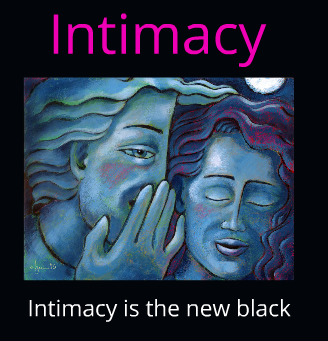
What if intimacy would be the new black?
Dreaming Away
At many moments during this tour, I became uncomfortable with the lack of critical conversations to balance of the over-glorification of technology. I became more and more hungry for depth and humanism in all this. And taking time to digest, reflect, synthesize and making sense.
I am on a quest for depth. My purpose is “To inspire other people to dream” (see many other posts on this blog). Move people from the depth of their oceans to the surface of the sea of insights.
In that context, I would like to close with this picture of one evening tour that week on a catamaran in San Francisco harbor.
Dreaming away… fog rolling in, when silence and critical self-reflection becomes more important than hollow words.
When mind goes beyond platitudes and copycatting like a parrot what other have written in books, TED talks, and beyond the abundance and exponentially of Singularity University.



















 Petervan Studios