Innotribe at Sibos 2010: Gen-Y and The Future of Money

Cross-posted on Swiftcommunity.net

Print

Matteo may have been a bit over-enthusiastic when he declared his session "probably the best session at Sibos 2010" . I guess he may have been unaware of something very special that is happening in the context of the Innovation Keynote Sessions of Monday 25 Oct 2010 at 9am .

What’s going on there is so unique , that i suggest you doublecheck your travel plans to ensure you can be there at 9am Monday morning !

What’s up ?

One of our keynote speakers is Venessa Miemis, a brilliant 28 year old Graduating pursuing a Masters in Media Studies at the New School in NYC. Venessa has a fantastic blog called Emergent by Design  and you can follow her tweets @venessamiemies  where she is leading us in a fascinating way through a collaborative effort to explore the emerging Network Culture and ways in which we can collaboratively build human intelligence and raise consciousness.

Some months ago, i asked Venessa to do a 15 min keynote on The Future of Money as seen through the eyes of Gen-Y. We occasionally kept contact via mail, twitter and skype, and in the spirit of her blog tag-line "emergent by design", and did not give and further instructions and trusted the process and the smartness of young people.

Great was my pleasant surprise when Venessa published her outline some weeks ago under the title "The Future of Money Begins !" .

futureofmoney

The keynote will be on "large scale shifts in cultural values and the impact they’re having on our relationship with money, our perceptions about ourselves as humanity, and how we are redefining what ‘true wealth’ means." For more details on the content, see the link/picture above.

What is really cool is not only the content of this keynote, but also they way how Gen-Y people like Venessa approach such task .

Without corporate structural constraints, Venessa told me very early in the process how she wanted to do something special: she wanted to produce a video as part of her keynote.

And in a true on-line collaboration Gen-Y way, she was going to produce this video with a company in… Berlin. For Gen-Y, they are truly no geographical boundaries anymore.

But to produce such video will require some money. No problem, how do Gen-Y approach this ? They ask their on-line communities for support.

So she launched the Future of Money Website  – and Emergence Collective "creating innovative momentum" with a fundraising via PayPal .

You can determine for yourself what degree of support you can muster to help. It starts at 5$ and can go up to 1,000$ if you want to be Executive Producer of this video.

At the time of this writing, the counter stands at 470$ ! I made a small calculation:

  • if each of the 10,000 readers of this swiftcommunity.net blog contribute 1$, will be able to make come true their full blown dream.
  • if each only 1% of the 10,000 readers donate 100$, same !

I don’t think it should be so difficult for our banks, partners, employees to find between 1-5$ to help support this really cool project.

  • For $5,000: They will create a beautiful and useful visualization of all the companies, initiatives and organizations we’ve been tracking in their research. Right now this research is a tangled mind map but with the skills in their team they have the ability to transform it into an informative and elegant visualization. This would include an overview of peer-to-peer lending platforms, open money protocols, emerging virtual currencies, microfinance platforms, and social currencies.
  • For $10,000: They’re going to be conducting a bunch of interviews very soon. Typically interviews will run between 10-30 minutes. However the video they’re producing will be between 3-5 minutes when it’s finished. Obviously they’re going to have to leave some stuff out. With this level of support they’ll be willing to edit each interview on its own and release it as its own video.

So let’s see what happens. The offer is made. The deadline is Venessa’s presentation on October 25, 2010. It’s up to you to decide if these expanded aspects of the project are worth your money and our time.

The result of this work – the video and the presentation – will be given away under a creative commons license.

Even just a small amount will go a long way towards helping us cover our time and expenses on this volunteer effort. And of course it couldn’t hurt to tell your friends   via your blogs and tweets.

To show the example, we just sent via PayPal some encouragement from the SWIFT Innovation budget to kick-start the process.

Very curious to see where this goes.

And Matteo, no offence, but i think this session will probably be the best attended session at Innotribe @ Sibos 2010

People and Culture: too wooly ?

Here is your deejay with the brainwave helmet again: look at the wide open eyes of Sam from Sam The Sham and the Pharaos with their 60’ies monster hit “Wooly Bully”. His eyes wide open. Uno, Duo, Très, Quatro ! Let’s have some fun here. And be a bit crazy !

image

I recently got somewhat involved in the People & Culture thinking of our company. Already at our first attempt during our fantastic off-site in April, we identified excitement as one of the components that need to be part of our culture.

We should all re-read that blog post titled “Get a Life and Get Alive”, as we seem to loose lots of the sharpness of our ideas when we start putting them through committees, and the whole thing seems to get watered down.

So, for 4 months+, we kept ongoing and had a good solid understream of ideas, depicted by different people in different ways, depending on their left or right brain orientations.

After a couple of weeks, this was my best effort:

image


It was a combination of keeping the best, improving drastically the mediocre, and getting rid of the worst. The most important in this slide were the


“quality lenses”


They reflect the deeper purpose that guides our transformation process and choices, and these lenses can be used as a compass to be sure we still navigate in the right direction.

The direction was an ambitious one, a radical one.

But most executives do not like the words “radical” or “disruptive”.

  • Does that mean we should adapt our packaging, our wording or worse our meaning and purpose to please our audience ?
  • What happens with ambition when filtered through endless reviews ?

By the end of last week, we had our seventh or so iteration of the slide deck to be presented to the executive committee.

I though we had quite an “acceptable” outcome in a culture of consensus.

As I write this, I notice how polluted I have become myself by the consensus-virus. In the end, one compromises so much that all you end up with is a grey mouse. 

Herman Van Rompuy arrives at the EU summit in Brussels on Thursday evening.   Photo AP

So, to hell with outcomes that are “acceptable”. We don’t want grey mouse. They don’t inspire.

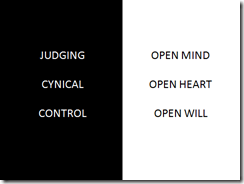
Nevertheless, I was surprised that version seven still included our famous words “Open Mind, Open Heart, Open Will”. You had to search for them (see the big fat arrow above), but they were there.

Too optimistic though.

Throughout the week, folks kept on saying this was “too wooly”

So we tried to put different words. In version eight, we ended up with some things like “Intrinsically motivated people” and “Co-creation with Customers”, etc. Not bad, but “acceptable” in my opinion.

What made me write this post was the following comment on exactly this part of that version:

This part is a bit too vague

and b-school jargonistic

for my taste

Can we turn that into our

company terminology ?

(the other parts already were in company-speak)


My answer: NO, absolutely NO !


As I wrote in back in April, the real root cause (to use some Lean terminology) was about the openness of our minds, hearts, and minds.

image

Some indeed call this “wooly” or “b-school”. I don’t know what is meant here.

There seems to be some negative connotation here:

  • “b-school” could mean several things. In the most optimistic case is stands for Business School, and then the wording may be perceived as too academic. In the worst case, it means b-grade school or even worst kindergarten or naivety. But I believe that many of our corporations would thrive well if they would resource themselves with some naivety of better

freshness and purity

like a young child

discover with eyes wide open

and without prejudices

  • “wooly” has something to do with a certain form of “softness”. I sense all sorts of touch points with New-Agism, or the Hippies 2.0 movementExecutives seem to have e a natural aversion to topics related to softness, philosophy, emotion, feeling, sensing, or anything that has to do with mind, heart, and will. It is probably exactly this that needs to change in many company cultures if we want to make our companies more “human”. Or as Jeff Bezos so eloquently said: “It’s harder to be kind than to be clever” Read every word and sentence of his Princeton speech here. Listen to the emotion in his voice. You sense here stands a man who embodies and believes what he says. You want to follow him. Maybe he is Hippies 2.0 ? Maybe. But he’s inspiring.

Leaders will be followed, not because they have dictated so or by hierarchical power, but because they are authentic in everything they do, because they are inspirational, because they are charismatic, because they are truly “at service” and not “in command”.

The new game is about new hierarchies, not based on ranks and power but based on true service value.


The hierarchical PYRAMID changes

into a collaboration and service SPHERE

where there is no upper or lower level

where the value comes

from the strong interdependency and

100% service mind to make the OTHER win

What we need is a culture based on a fundamental shift from Old Game thinking to New Game thinking. We will not succeed if we stay “acceptable”.

Our ambition level in this should be nothing but an extreme makeover, respecting our company’s financial, operational and reputational integrity.

You can use whatever words for it, but the messages and its wording must be fresh, inspiring, ambitious, rejuvenating. Not only on its messaging surface but especially in its deep culture core.

I don’t believe that you can capture your “culture” in one word. Culture is a complex thing. It’s a combination of tacit, implicit and explicit values, attitudes, and knowledge. Is combines the good positive heritage of the past with the vibrant youth-ness of the future. So, here are some words that “capture” that culture.

image


That’s also why Talent and Culture are so closely interwoven. Because culture is the result of the people you have on board. If you want to change the culture, there are basically two things you can do:

  • Try to change the people you have on board. Although this is very difficult, I believe we have enough cultural creatives to at least inspire more than 50% of the company to change gears. For the others, we’ll have to wait till the Hippie 1.0 generation is retired and made room for the new generation.
  • Bring on board new young people with fresh insights. We should be extremely aggressive about this. Hire “en-masse” young people. If possible younger than 20 years, as even some 25+ “don’t get it”

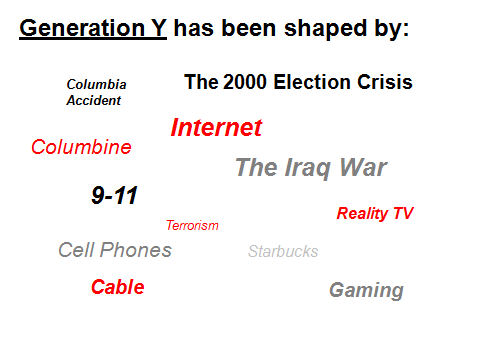
Both generations where shaped by different time and historical contexts:

image

image

With courtesy: NASA Generation-Y Perspectives. Full slidedeck here.

Of course, when implementing such aggressive plans, we need to make sure that these programs do not become the exclusivity labs for personal and professional development for the young only, and that everybody gets her chance to fully realize their potential, so that they don’t have to ask us


“and where do I play ?”


Like many things, I think you recognize an inspiring culture when you see it. When you see the people of that culture. They have sparkles in their eyes. When you interact with them. They go the extra mile.

We need word and spirit that reflects:

  • Excitement
  • Intrinsically motivated people, as mean by Daniel Pink in “Drive”
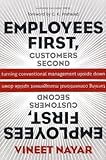
  • Extreme Management Make-Over and Employees First, as meant and intended by Vineet Nayar in his latest book, considered now as THE reference for modern HR

I was lucky to see Vineet deliver his message in person to the audience at Techonomy last week. The story goes like this:

  • The goal of our company is to deliver value to our customers
  • Where is that value created ? At the interfaces of our company.
  • Who is at those interfaces ? Our employees
  • Therefore the whole company should be organized to be “at the service” of the employees.

This is about a management extreme make-over.

  • From managers giving instructions to employees and measuring their efficiency
  • To managers at the service of employees

When I spoke to HR, my contact said: “Oh, that is what is called Service Management, I know about that”. When I asked whether he already proposed this as a management culture to the executives, he said


“Oh no !

That would be too radical

that’s a revolution !”


But I am afraid many of our corporations need nothing less than such a revolution, a fundamental make-over.

In the end

Culture = Company = People


People with a Life and Alive. Not wooly sheep following the dress code and complacent in being “acceptable”. People who share the “wooliness” of “kindness” vs. “cleverness”.

Our culture has to be provoking and inspiring. You should be able to rally your troops behind it. As soon as it becomes “acceptable” that won’t work.

In the song Sam sings about a “wooly saw”. What we need now is a very sharp saw.

To give the sharpness back to the Wooly Bully !

Techonomy: a new philosophy of progress

image

Last week, I had the privilege to attend the first edition of Techonomy, a fantastic new conference blurring technology and economy with an optimistic balance that technology in its broadest sense (not only IT, but also gnome sequencing, bio-fuels, big history, etc) can be the driving force for a better world.

First enjoy the announcing video below.

The conference was bringing together 3/4 of Silicon Valley’s leadership, including Eric Schmidt, Jeff Bezos, Bill Joy, Bill Gates, Steward Brand, Kevin Kelly, John Hagel, Deborah Hopkins (Chairman of Venture Capital Initiatives and Chief Innovation Officer Citi), Nicolas Negroponte, Sean Parker, Padmassree Warrior CTO Cisco), Jeff Weiner (CEO LinkedIn), and the list goes on, and only a couple of non-US leaders such as Nobuyuki Idea (Founder of CEO of Quantum Leaps Corporation, working on innovation, and previous CEO of Sony Corporation), Nellie Kroes (European Commissioner for Digital Agenda), Vineet Nayar (CEO HCL Technologies, India), and Ory Okolloh (Founder/Executive Director Ushahidi, South Africa).

How to describe Techonomy conference ? I would say “a super-TED with a technology focus and with an agenda”.

The agenda is “a new philosophy for progress”.

It’s a movement

Somebody asked “a movement against which enemy, against which barriers ?”.

I believe it is a movement FOR something.

For a better world. Finding techonomic solutions to tackle the global climate challenges, feeding the world, a better health for everybody, a new value kit for the current and next generation, not based on greed but on the concepts of creative capitalism as formulated some years ago by Bill Gates in the Bill and Melinda Gates Foudation.

In that sense, it should not surprise the regular reader of this blog how much this resonated with myself. Not only the personal inspiration, but especially how we with on organization like SWIFT can adopt and promote the techonomist values and objectives.

I also came across some leaders that could be subject of SWIFT’s CSR initiatives. Take Bill Drayton, Leadership Group Member Chair and CEO of Ashoka, the global association of the world’s leading social entrepreneurs, men and women with system changing solutions for the world’s most urgent social problems, encouraging everybody to be a changemaker.

It’s impossible to describe the intensity of the content and contacts of these 3 Techonomy days.

Some highlights:

  • Evolution is incremental. Revolution is disruptive movement
  • Collective learning is what makes us human
  • The physical economy is sensoring a second economy of conversational plumbing
  • As long as we draw boundaries (for ex US vs. China, we against them, etc) we will not be able to solve the world’s problems.
  • The economy is NOT recovering, consumer is running out of money
  • Governments do not understand globalisation, businesses do.
  • Employees first, customers second.
  • Promote younger people must faster
  • Building and tapping from tacit knowledge will become core skill
  • Markets are like gardens: they need tending
  • Innovation happens outside the regulated markets
  • Banks make money on spread and opacity. They are by definition against transparency
  • Currency is “the instrument of trust in a transaction”. Unfortunately the debate focused solely on the payment transaction and money as the trust element.
  • Health agenda: from illness fixing to personal health prediction and coaching
  • Some technomists are skeptical optimists that do not take progress for granted. One has to make progress. It does not happen.
  • Recalibrating our assumption that form our perceptions. For ex we learned that world population will NOT grow indefinitely and probably max around 9 billion, and then go down.
  • Innovation at Cisco: Looking at 30 ! adjacencies as a “portfolio” like a Venture Capitalist does.
  • Computer Associates CTO: “a lot of leading edge innovation comes from financial services”
  • Innovation requires a culture of taking risk and celebrating failure
  • Change happens when the DESIRE not to change is greater than the desire to change. The power struggle to make this balance change is based on societal needs.
  • Innovation requires 1) Money, 2) Desire, 3) Need
  • There is no value in the idea, there is value in its commercialization
  • We have a moral obligation of bringing less developed regions up.
  • Cities are “intensities” that have a critical mass of people
  • In a city-“OS”, no one single company can dominate. It has to be open source by definition.
  • Generation-Y or whatever: you need the backing of 18 year olds. That’s “youth”. 25 years+ does not quite get it.
  • Companies scale like biology, and in the end they die. Cities scale like networks, and do not die. The city is the framework model for the future.
  • In the developed world, a disruptive innovation is something that can create the biggest disruption. In the developing world, innovation is a technology that is simple, reliable, and that can function as an integrated unit.
  • Success in mobile in Afghanistan is because there was no legacy. They are willing to take the risk to jump to the next curve.
  • The future is for (techonomist) entrepreneurs that are willing to work together.

The conference is so good. It cries for a European and an Asian chapter. Any European Leader should not hesitate a second to be associated with and sponsor it.

I was dreaming of hosting a European chapter of Techonomy at the fantastic SWIFT Headquarters south of Brussels.

El Jefe, do you hear me ?

What choices will you make today ?

An emotional Jeff Bezos during graduation speech Princeton: “it is harder to be kind than clever”

Full transcript here

Every word is important and inspiring. Read and enjoy the full thing, but here are some extracts, mainly the grand-finale of his speech:

Tomorrow, in a very real sense, your life — the life you author from scratch on your own — begins.

How will you use your gifts? What choices will you make?

Will inertia be your guide, or will you follow your passions?

Will you follow dogma, or will you be original?

Will you choose a life of ease, or a life of service and adventure?

Will you wilt under criticism, or will you follow your convictions?

Will you bluff it out when you’re wrong, or will you apologize?

Will you guard your heart against rejection, or will you act when you fall in love?

Will you play it safe, or will you be a little bit swashbuckling?

When it’s tough, will you give up, or will you be relentless?

Will you be a cynic, or will you be a builder?

Will you be clever at the expense of others, or will you be kind?

You have to be somebody before you can share yourself

It’s holiday time, and I have reduced significantly my blogging, reading RSS feeds, tweeting, mailing, etc

Time for hanging around, some biking, some good food, and… a good book. If you want to follow what I am reading, check-out my page on Goodreads.

For me, a good book is one that leaves you puzzled, that makes you think,


that re-calibrates your perspective,


that is a pleasant read, that has depth.

“You are not a gadget” by Jaron Larnier is such a book. I discovered it thanks to a tweet of my friend Paul, who reacted to one of my enthusiastic Singularity tweets. The title of this blog post “You have to be somebody before you can share yourself” is very early in the book, and captures its essence.

Jaron Larnier was listed on The 2010 TIME 100 in the Thinkers category. His Wikipedia entry is here.

It’s a great read if you are in your over-enthusiasm mode about  computationalism, the noosphere, the Singularity, web 2.0, the long tail, the hive mind, the global brain, crowdsourcing, collective intelligence and all the other buzzwords and trends and all the rest. It gives you some solid pushback and sound criticism.

I am not going to do a book review, but my experience of the book was like there were 3 stories interwoven:

  • How technology is limiting our potential and who we are on-line. This of course resonated a lot with my work on Digital Identity.
  • Our communication limitations. He has a great chapter on how cephalopods have the great ability to “morph” and how one could use “visual” communication and another dimension of communication, other than language. And how humans in virtual reality environments quickly adapt to a body with tentacles. Intriguing !
  • The notion of “neoteny”: humans are born as fetuses in air, and our brain is being developed during childhood. Lanier compares this to a newborn horse that can stand on its own and already possesses almost all the skills of an adult horse. Humans – in modern civilizations – have an artificial, protected space called “the classroom, the extended womb”.

Neoteny opens a window to the world before our brains can be developed under the sole influence of instinct.

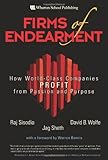
A similar concept related to neoteny – “generativity” – comes back in another great read Firms of Endearment: How World-class Companies Profit from Passion and Purpose.


This is a book about

the pragmatic role of

love in business


It’s about the epochal change into the Age of Transcendence. The dictionary defines transcendence as a "state of excelling or surpassing or going beyond usual limits."


The second event is the aging of the population. For the first time in history, people 40 and older are the adult majority. This is driving deep systemic changes in the moral foundations of culture. Higher levels of psychological maturity mean greater influence on society of what Erik Erikson called "generativity"—the disposition of older people to help incoming generations prepare for their time of stewardship of the common good

The Firms of Endearment book in essence talks about a new form of capitalism that is not only focused on profit and shareholders’ value, but on value creation for all parties in a company’s stakeholders’ ecosystem.

Joran also has an opinion on capitalism when he says:

Visiting the offices of financial cloud engines (like high-tech hedge funds) feels like visiting the Googleplex. There are software engineers all around, but few of the sorts of topical experts and analysts who usually populate investment houses. These pioneers have brought capitalism into a new phase, and I don’t think it’s working… capitalism in a digital future will require a general acceptance of a social contract

He is also calling for “so-called AI techniques to create formal versions of certain complicated or innovative contracts that define financial instruments” and that setting standards for these could be facilitated by “a cooperative international body” that

would probably have specific requirements for the formal representation, but any individual application making use of it could be created by a government, a nongovernmental organization, an individual, a school, or a for-profit company. The formal transaction-representation format would be nonproprietary, but there would be a huge market for proprietary tools that make it useful. These tools would quickly become part of the standard practice of finance

What a great potential for my employer SWIFT ! We are indeed a full-blown cooperative international organization with our roots in financial services.

In essence, Jaron Laniers’ manifesto and rant is about “The deep meaning of personhood is being reduced by illusions of bits”.

That should make us reflect deeply on how we want to engage as human beings in an on-line world, how we define digital identity in the relative and the absolute, and be very vigilant that we don’t loose our potential in our technology enthusiasm.

For me, the prospect of an entirely different notion of communication is more thrilling than a construction like the Singularity. Any gadget, even a big one like the Singularity, gets boring after a while. But a deepening of meaning is the most intense potential kind of adventure available to us

Finally, I also found some consolation to deal with my 3/4 Life Crisis. The following quote always helps:

If you are young and childless, you can run around in a van to gigs, and you can promote those gigs online. You will make barely any money, but you can crash on couches and dine with fans you meet through the web. This is a good era for that kind of musical adventure. If I were in my twenties I would be doing it. But it is a youthiness career. Very few people can raise kids with that lifestyle. It’s treacherous in the long run, as youth fades.

My blog is my “adult” way of doing gigs online.

We are as gods and might as well get good at it

Check out Raw Dawson’s blog post of today with superb video

TURNING INTO GODS – ‘Concept Teaser’ from jason silva on Vimeo.

Indeed today it is entirely appropriate for us to be thinking in terms of human transformation, and the power we have at our disposal. The cycle has swung back, and once again there is the promise that we have what it takes to change who we are… for the better. Whether human nature will allow those changes to be fully positive we have yet to discover. But that promise is – once again – part of the zeitgeist.

Heretic Team Glue

Last week we had a great team off-site.

We arrived late afternoon in the fantastic location of Chateau de la Poste, close to Namur, Belgium. Built in 1895, the Château de la Poste was the residence, for more than forty years, of Princess Clementine, daughter of King Léopold II. It later was sold to the postal services, who used it as a vacation resort for the children of the employees of the Belgian Post (times have changed). It recently was refurbished completely by a French wine maker, and it houses now a wonderful hotel, meeting centre and quality restaurant.

The amazing landscape, the silence and the soft welcome on the summer terrace set us all in the right mood. We all felt our physical and mental muscles relaxing, winding down.

Don’t know where I read it anymore, but I recently found a quote: “If you are not able anymore to take some time out for an off-site team gathering, you’re cooked”

For once, we did NOT have a packed agenda, and plenty of time for  real Quality Time Sessions.

We even made an acronym for it (QTS) to joke a bit with the “acronymitis” of the lean methodology.

More seriously, we invented QTS because we felt that the pure lean method was too much focused on a problem-mindset, and not enough on an opportunity-mindset, opportunities to develop some deeper quality thinking on subjects relevant to our business and team.

One of the items on the agenda was about “how to tell bad news”. In the subsequent discussion, one team member reflected on some sort of “fear” and “If I do this, then this and that may happen, and then…” thinking. Being in the acronym mode, we had a good discussion on


FEAR = Fantasy Experienced As Real


and how such behavior leads to blocking, status-quo situations.

Almost “emergent by design” our team culture principles unfolded, and we articulated them along the themes of “old” and “new” game.


  • Old game = fear, tricks, manipulation, raising stinky fish, machiavelism, creating and maintaining negative energy in general

  • New game = solution oriented, integrity and authenticity, fast correction (like Guy Kawasaki used to say”churn baby churn” a variation on the famous 1976 disco song “Disco Inferno” by the The Tramps), the holy fire, positive energy, who is the owner of the idea, who cares ? It’s about focusing on believers, and investing heavily in those VIP followers that will help us create a viral innovation infection/storm, like a raging holy fire that cannot be stopped anymore. Burn baby Burn…


We replaced “raising stinky fish” by regular update and feedback sessions, focusing on polishing rough idea diamonds, focusing on what works vs. what does not work, focusing solutions vs. problems.


If you think deeply about it, all this is about

the major cultural shift

from pushing towards pulling your ideas,

it’s about a strengths based society and team,

it’s about connecting ideas

and excel in making them real.


Another correction we made to lean was our understanding of a skills matrix.

We were very inspired by Venessa Miemis’ blog post “Framework for a Strengths Based Society” that included following diagram.

We decided to add these skills to our existing lean skills matrix that was too focused on identifying and solving problems and tools mastery. “We are not the tools, the builders are us” is another quote from one of Venessa’s presentations.

The subtle nuance is that we did NOT implement these skills as comparative/ competitive skills of different team members but


in terms of personal areas of

strength and potential

for each team member individually.


Our little team is SWIFT’s “Innovation Team”. Some time ago, we shared the details of the mission here and in summary it goes like this:

Build the Skills , Tools , Processes, Metrics , Values , Network , required to support collaborative innovation and transform SWIFT in an agile company, able to succeed in a changing environment.

I often make reflections on how real our innovation work really is. And although we are having lots of fun and some sizeable impact on how the company little by little opens up for innovative behavior, I always seem to be in search for that little extra in life and work.

Too many of our innovation experiments and proof-of-concepts remain just that: proof-of-concepts and prototypes. They never get into production. Worse, some outcome are just ‘filed vertically” or even never get the any executive attention.

I would like to hear from other innovators what is the secret sauce to get beyond the prototype stage. Because staying in prototype stage sometimes makes me wonder if I am in some sort of “busyness” therapy.

And I have come at an age where I cannot content myself with busyness.

I could sit here till my pension, having a good pay, and living honestly speaking in a quite luxurious working environment. But I am in search for more. I am in search for


meaning and significance


With the couple of years still to go, I still have the arrogant (?) ambition that I want to leave a legacy. On a personal level in my family. On a professional level that my passing in this company has substantially changed something. It’s about a deep sense of motivation, beyond pay and perks.

There is something heroic, even heretic about all this. That’s why the title of this post is Heretic Team Glue.
See full size image

Heretics are the ones that were expulsed from the Catholic Church because they did not follow the rules and challenged faith and established dogmas.

There are several dictionary definitions of “heretic”. The one I have in mind here is “anyone who does not conform to an established attitude,doctrine, or principle”.

I think we in our team are all some sort of heretics in the castle. It’s something very special in our team, that creates a very strong bonding.

At times it even has some masochistic flavor. Why on earth do we keep on trying again and again ? Even if the odds are against us. Why are we prepared to go time after time through the innovation pains over and over again ?

I truly believe it is because we do it for the right reason. Not for the pay. Not for the glory.


Because we believe there is a chance

we can succeed 


And believe we can create a tribe of followers in the same belief. It’s for some of us the only reason why we stay !

Are the above reflections caused by my age and my 3/4 life contemplations ?  Don’t think so. We invited some GEN-Y colleagues to join our off-site. And see: they too are driven by honesty, they too want promises to be kept, they too look for meaning and fulfillment in their lives.

But it was shocking to hear how some of them have been seduced to join a company based on huge expectations and promises that they would work soon for 3 years in the US, and have rapid accelerated career paths, and deep young graduate immersion programs. It’s unacceptable to make such promises if you know you can’t realize them.

And this is their first contact with corporate life !

How can we ever correct this ? How on earth can we regain the trust of these young people ? Our generation has planted the seeds of suspicion in these long lives. Big mistake.

Me too I have been mislead several times in my life, and I recognize the power-less emotion of trust that was betrayed. Lessons of life ? Normal life injuries ? The way it is ? Why do we need to accept that ? Why do we repeat the same errors over and over again ? Sooner or later, these young people will present us the invoice.

These folks actually think. Think deeply. Some GEN-Y people are for example  insulted when calling them “GEN-Y”. Because they see themselves as individual human beings, with their own identities and values systems, not prepared to be tagged as a category. And they have great ideas. We organized some sort of Innotribe Lab with them: more than 20 ideas on how to improve quality of work came out. I am honored that I can channel these ideas into the People & Culture “movement” team of the company.

Last but not least, we had a great discussion about “reverse mentorship”.

Instead of older experienced professionals mentoring new young people joining the company, why not letting young people mentor the already older – sometimes (mis)formatted – generation, and teach them how to use new technologies and apply 21st value systems ?

We had a fierce debate: how can one say that the young generation is the future, and five minutes later challenge reverse mentorship by not accepting that one can learn an awful lot from these fresh and well trained minds.

Maybe that’s where my future is ? In being mentored by a GEN-Y ? It will ask of course an attitude of

vulnerability


It’s also part of a give-ànd-take culture that includes transparency and openness. Especially give. Like a gift, where you don’t expect something in return.


When is the last time you made a Gift ?


How can we create an environment where we encourage learning from each other (in normal and reverse mentoring mode) ? An environment where we celebrate confidence building on your own rhythm, dare to be vulnerable, asking for feedback that is clarifying, supporting, challenging.

I am convinced I can learn something from every human being. Especially young people who have a renewed and fresh sense of civic responsibility, transparency, honesty, openness.

I have committed to take the challenge and invite one of our GEN-Y’s to monitor me during 6 months and give me feedback on my behavior and to keep me honest.

So that I walk the talk. Every manager should do this.

Social Currency: My Personal Identity

Recently came across this great site by Dan Robles.

image

One of his latest posts Will Social Capitalism Replace Market Capitalism? (Parts 1&2) included great video material on how social currency can change industries.

image

His forecasting example is the airline industry. And it’s even not so far fetched. What if you could “Time-Share” seats in private jets ?

It’s easy to think how this social currency model would apply to any other business and radically innovate by creative destruction.

It’s a very novel way to show how a number of trends come together:

  • The influence of gaming theories and practices in new business models
  • The value and tradability of my personal information
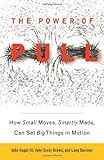
  • The power shift from Push to Pull that is so well described in John Hagel’s latest book “The Power of Pull” (I repeat it, in my opinion THE business book of 2010)

By the way, we recently had a face to face meeting with John exploring the possibility to have him with us at Innotribe at Sibos in Amsterdam, 25-29 October 2010.

image

We have asked John to consider a talk in our Innotribe Opening Keynotes, and to be part of our special Innotribe Lab on The long now in Financial Services.

To come back to the subject of the power of identity, I’d like to spend a bit more time on the tradability of my personal information.

The essence of the story is that some parts of my personal data have value and can be traded under the user’s control to get a better service.

It opens questions to:

  • How tradable is my personal identity ?
  • How tradable is my digital footprint ?
  • How tradable are my on and off-line relationships ?

I have been immersed in “personal digital identity” the last couple of weeks. Recently i attended the EEMA’s The European e-Identity Management Conference in London.

The week after i was the “tour guide” for a "Digital Identity Tour” we organized with some colleagues on the West-Coast”. I am preparing a set of blog posts on these conferences and 1-1 conversations with thought leaders in e-Identity space.

In this blog i will just simplify my summary thoughts with the statement that e-identity is much, much more that a certificate on a smart-card, or for sake of the argument any other form factor.

We are witnessing a power-shift:

In stead of the government (or the bank, or any other service offering entity) creating digital identities to give more value to the citizen, we see the emergence of  identities created by the user to give greater value to the government (or the bank, or any other service offering entity)

We have to carefully think this through, as identity – and relations between and with persons – is really a complex animal.

Have a look at this fantastic 210+ slides presentation “The Real Life Social Network V2” by a Google analyst @Padday aka Paul Adams, working for the UX team at Google. The essence of his story is that there is nothing such as a generic “Friends”. You have all sorts of friends and different depths in relations. Whether those relations are between people-people or people-companies.

It’s a great story, and all slides are annotated. As a teaser, here are his 3 summarizing slides:

image

image

image

It’s interesting how the words identity, privacy, care, relationships, collaboration, strong/week ties, Klout, etc are now all coming together. As a matter of fact, these are all attributes that make us truly human.

As a sherry on today’s cake, i’d like to link you once more to Venassa Miemis site “Emergent by Design” and the great recent blog post on Guidelines for Group Collaboration and Emergence, that is building on both her previous work on “Strenghts Based Society”, “”Skills for a 21st century connected world”, and her work on the open source collaborative tool “Junto”.


image

As we are preparing Innotribe at Sibos, i had the pleasure to talk to Venassa during a Skype session. We are discussing her participation at several levels of our Innotribe Program.

It is great to see how these novel ideas become “totally” relevant when you start thinking about their value for a “community” like SWIFT and an innitiative like Innotribe where “Enabling Collaborative Innovation” is our “Leifmotto”.

From the conversation with Venassa, i can tell you she “totally” got it, and she is preparing some material and levels of interactivity for Sibos that you even never dreamed of.

We are now 16 weeks from Sibos. The idea is to begin hosting a junto every week, invite different thinkers to discuss the future of money, record all conversations and develop a presentation based on them, but also make the videos available for the attendees of the conference to be able to watch whenever they want to see what those conversations were like.

If we think about the Long Now, will there still be currency as we know it? Or will social currency become central to our trade? And what impact does that have on banks ? Should be have personal data stores where we deposit our digital footprint and open personal accounts and do payments for services from there?

Feel free to jump in.

Chose the situation… and defer judgment

Guest post by Mariela.

Sometimes i get comments on this post that are too good to be hidden in the comments section. Here is one from Mariela on my previous post “Purpose Maximizers and Candies”

Some comments on Candy 2 (as the person who unearthed this particular post, I guess it is no wonder that I want to comment on it :-).

A very interesting point that the “Why your boss is programmed to be a dictator” implies, and which is something that I myself always wondered about, is why does it always seem that as soon as you become a boss you seem to fit this Dictatorship mold. Even people who to start with are democratic and liberal and open minded end up being dictators ( I must confess that my answer has always been that power somehow gets to their heads and makes them act like perfect bastards, but I always wondered would I have the moral stamina to be different… or would I also become a dictator like everyone else; I’ve been so much afraid to face the answer to this question, that I have very carefully and deliberately avoided being in  situations where I would have any hierarchical power what-so-ever).

Now, what this particular post talks about is two fold:

1), a lot of our behavior is determined by the situation (the example used is the simulated prison studies, where students acted the part of prison guards or prisoners, and were found to behave perfectly within the stereotypical roles, despite their initial character and personal convictions); so bosses behave as bosses, because our systems (organizations) force them to

2), the second thing is something known is psychology as Fundamental Attribution Error – which is the other side of the coin that Dhruve does not talk about, but you will find plenty on in the SWITCH book of Dan and Chip Heath (also referenced by Peter in previous blogs).  The fundamental attribution error is a bias that we all suffer from, which means that in any situation we are likely to attribute observed bad behavior as fundamental character flaw of the person, rather than attempt to check if the situation was not responsible; however when we ourselves exhibit the same behavior it is very clearly the fault of the situation (example – observing a driver passing a red light, causes us to usually call him names, while when we ourselves commit the same offense, it is… because we have a very good reason that excuses the behavior, of course).

Now what all that means to me, is that there is great hope for our bosses and organizations: all we have to do is change the situation and people will miraculously behave in a different way. Simple! 🙂

I know it sounds way too simplistic to be true, but I have been observing this change in people in my work, but never realized what caused it and how I could reproduce it predictably.

I have worked over the last few months with many colleagues with whom previously I had difficult relationships.

My current work usually involves situations when I offer to help them achieve a goal and facilitate collaborative meetings/ workshops for them. I have observed the most amazing changes happen to people in such workshops – they suddenly behave in very open, non-confrontational, collaborative, and creative ways. They get excited, they want to share, they value their colleagues and they appreciate their differences. And before I could have betted (if I was a betting person) that they could never ever behave like that, because they were not such type of people (attribution error again).

I’ve seen this magic happen over and over again in different situations with different people, and I could not explain it, so I just took it for granted. Until I came across the SWITCH book and the Fundamental Attribution Error. And then I realized that there was no magic.

People are people, they have good and bad sides, and they are mainly….well,  human. All you’ve got to do is chose the situation… and defer judgment:  Good situations bring out the best in people, bad situations…..

Mariela should start blogging herself. But maybe this is a situation where she feels some sort of hierarchy or being in a situation where she fears the answer on what would happen if she goes full public. There is only one way to find out.