Hug my PAD

TEDxBerlin talk, discovered via Hutch Carpenter’s blog

image

View till the end.

It’s a bit funny at the end, and you can hear the audience laughing at this and not really taking the last bit seriously.

Think twice.

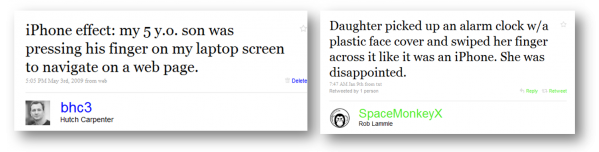
Think this one through ! In the same blog post, Hutch points at the real meaning of the iPAD.

Think it through. The keyword is digital intimacy. Your computer is not your computer anymore.

Think generation-M. Generation Meaning.

image

It’s your personal “pad”-device.

You can give it a pad.

You can hug it, it can hug you.

Try in your imagination to mix up iPhone, iPAD and those little house-robots that were so popular some years ago. I know my friend Nick has 2 in his apartment !

Nick Carr used the title “Hello iPAD, Goodbye PC”.

I think he’s right on.

Web Evolution: The network is the database

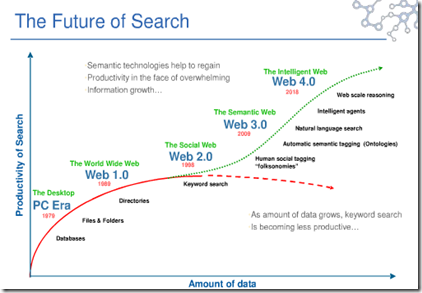
If you want to have a really good 23 slide summary of where the web is heading, check out Nova Spivack’s Web Evolution slide deck.

image

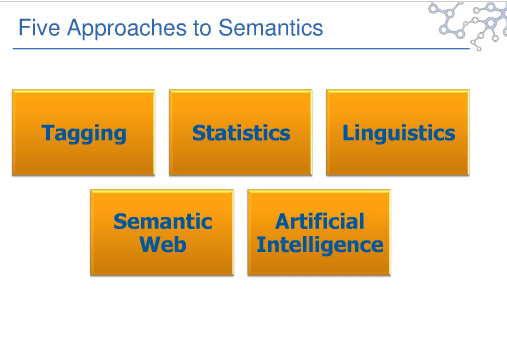
There are some really good positioning slides as from slide #9 and following, to get a feel for the difference between for ex Delicious, Google, Powerset (now Microsoft), Twine, and Wolfram Alpha.

image

I was quite lucky having a 1-1 with Nova Spivack during Web 2.0 Summit in October 2009. He showed me a much elaborated slide deck than this one, but I feel that since then he really condensed the subject to the essential.

Enjoy !

Print

PS: He was ok to join Innotribe @ Sibos 2010 in Amsterdam 😉

Reblog this post [with Zemanta]

Love and Hate Relationships


image

A good friend of mine commented on one of the blog post. It’s a comment that cuts deep. Knowing the person, i think it was quite a step to be this open on a public blog. So first of all, congrats for coming-out !

Here is the original comment:

I have spent some time reading through this and other blogs of yours. And they make me react strongly in a very controversial way: I love them and I hate them; I agree and fully reject their contents.
And, beyond the very valid and daring points you make, I’d like to reflect about the channel: speaking one’s true mind, yet doing so hiding behind a screen and sometimes even a fake name.
My fear is having my own children communicating with me via a blog.

You make me reflect, to the point of writing this reply. So I guess we should both be content as the blog has obviously achieved its goal…
But I dont know if I should be happy or sad about it. After all, I could have also called you!

With respect to the fake name, this was to protect. Not myself, but somebody else. I really would like to know on what content you agree or reject. Contact me.

In response to the strong point you make about the communication channel, I believe we have to let the future emerge (We don’t have a choice anyway ;-). We have to be in this world and evolve and adapt to survive. Or we can disconnect and go to a monastery, which is a valid choice of course.

My and your children consider e-mail as really very old-fashioned. And blogs are really for guys with grey hairs. So here we are. It’s 2010.

49 n02_21582623

Whether you like it or not, your and my children will communicate using Twitter, Facebook, Netlog, Foursquare etc or whatever will be applicable the next years. Like we used to send SMS’s, our kids will Tweet or whatever the channel will be.

special4

One thing is inevitable. The on-line communication channels move into real-time. Nova Spivack coined this “The Stream”. See my post on World Wide Web.

I have btw another blog post in preparation about about a very related subject: privacy.

We seem to have passed the tipping point where the default is NOT privacy, but Public. It will then be up to you to indicate what about yourself you want to keep private. I struggle with that too. It has a lot with digital identity. If you’re interested in digital identity, i can really recommend the blog of Kim Cameron: www.identityblog.com

I encourage anyone to get into discussion with me on the CONTENT of this blog. Via the comment link, via phone, mail, face-to-face.

When i started this blog, i had some blog-shyness. That over now. I feel more comfortable with this channel now.

Probably 10 years later than the early adopters, but who cares !

Sean Park’s Sixth Paradigm

As preparation of 2010, i very strongly recommend to get familiar with Sean Park’s The Sixth Paradigm post of 28 Dec 2009.

I am a big fan of Sean and his site the Park Paradigm. He was the guy who made the famous AmazonBay2015 video.

image

That was 2006.

Since a couple of days the video of his Oct 2009 presentation at Amsterdam eComm Europe is available on his post above and also the Prezi presentation is here.

The video of his presentation is 20 min. It’s worth your time.

Two extracts of this presentation should get your attention, and incentivize you to read on:

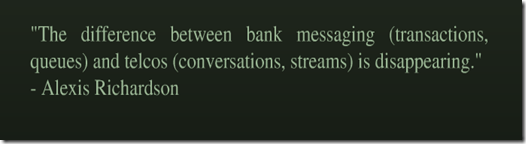
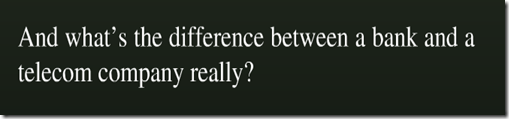
– What is the difference between a bank and a telecom company really ?

– The difference between bank messaging and telcos is disappearing.
image


image

I believe this presentation is VERY VERY relevant to financial services and concepts such a marketplaces for financial services.

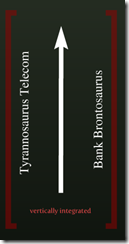
This presentation gives you an absolute macro-evolution view on why this is a bound to be happen, and why the inherent structures of our current – usually vertical integrated – behemoth companies will struggle very hard to get their arms around this if they even ever succeed it spotting this as a HUGE opportunity.


The essence of the story is that those

vertically integrated companies

will be replaced/challenged

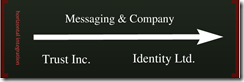
by horizontally connected entities

offering themselves

to the marketplace

via APIs


The innovation will happen

at the edges of the marketplace.

The marketplace is not even

innovative anymore.

It’s an essential piece of

the plumbing.

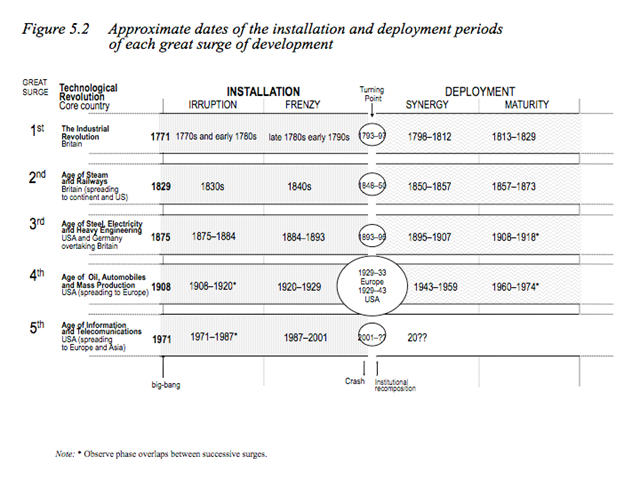
A lot of Sean’s thinking is based on the work of Carlota Perez and her book “Technological Revolutions and Financial Capital: The Dynamics of Bubbles and Golden Ages”

Professor Carlota Perez is a Venezuelan scholar and expert on technology and socio-economic development most famous for her concept of Techno-Economic Paradigm Shifts and her theory of great surges, a further development of the Kondratieff waves.
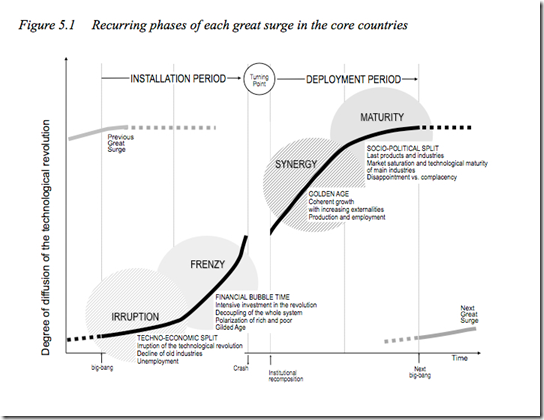
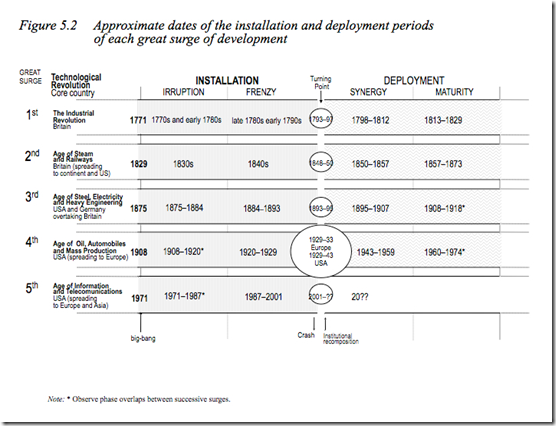
Carlota Perez Recurring Phases


Carlota Perez the 5 previous paradigms

Courtesy The Park Paradigm & Carlota Perez book.


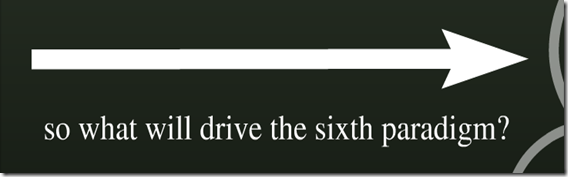
Sean Park’s claim is that we are  now getting into the 6th paradigm, and this is also a switching point between 2 phases.
 

image


Sean Park believes the drivers will be 3-fold:

1) Cloud computing, with EVERYTHING as a Service

2) Exchange Ubiquity. The marketplace as plumbing, i would call this

3) Digitization

The last one “Digitization” seems “obvious”, unless you push this to the limits, as Sean Park does:


image


He takes the example of ISBN numbers as one of the success factors of Amazon’s book shop. Sure, there is big logistical tail to the book shop, the the core of the Amazon model is digitized, i.e the ISBN is just an identifier, linked to plenty of content and metadata, that can be accessed by an eco-system through APIs.

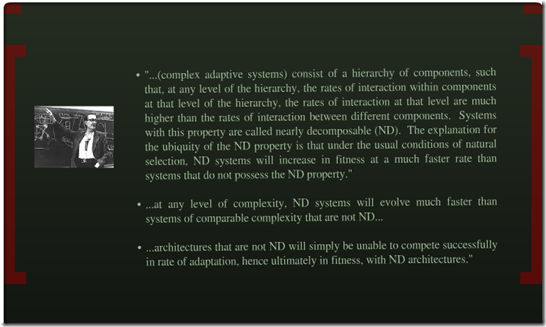
Where it even becomes more interesting, is where Sean mixes this up with theories of complex adaptive systems. It’s basically saying that


those horizontally integrated value chains

are chains of nearly decomposable services

And please read this in the context of nearly decomposable

financial services


And (traditional) vertically integrated companies (offering financial services) will not be able to compete successfully in rate of adaptation and fitness with these horizontally integrated “engines” or “eco-systems”.
 

image


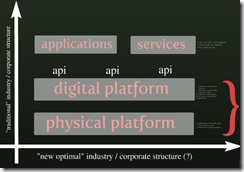
Sean asks the question:

Where is the AppStore for Financial Services ?

here is the digital platform + API’s for the financial industry ?

Where are the decomposable financial services that can thrive on such marketplace ?
 

image


Sean has some other great disruptive statements. Like this one:


image


Its about the shift


from

image   To

image


It looks like Sean’s company is looking to invest in companies that understand how to build and offer these decomposable services.


But who should invest in the marketplace,

the plumbing,

the “dumb” but highly secure pipes

for the financial industry ?


We could let every Bank behemoth have it’s chance at it. That may be great for lock in. But in the long term, we will need something that is highly interoperable.


With interoperability

built-in

into the DNA

of this Digital Platform.


That is run as a service for the community. And to be the “invisible engine” for financial services cloud computing.

Invisible Engines: How Software Platforms Drive Innovation and Transform Industries


It’s only a very personal opinion, but i believe SWIFT is quite uniquely positioned to play this role.

 

Print


We are already in full prep for our 2010 SWIFT Innovation activities. It should be obvious from the above that we have Sean Park on our list of speakers to be contacted for our Innotribe event series, and who know at Sibos 2010 in Amsterdam ?

Zemanta and the Semantic Web

image


If you want to have an idea what Semantic Web can mean for you and your business, have a look at www.zemanta.com.

It comes as a Google Chrome Extension, or a Firefox extension, or a IE Plug-in or Safari Bookmarklet.

I tested the Google Chrome extension on my PC. In this case a Mini-HP with Windows 7 installed. I also use Windows Live Writer to do my blogs. Zemanta also has a Live Writer Plug-in that i also installed.

This looks quite similar to the viewer of Open Calais that i commented on already way back in April 2009.

UPDATE: just today, there was an article on ReadWriteWeb referring back to Open Calais, Google and Wolfram Alpha. Note that “Semantic Web” is now renamed into “Structured Data”.

But is is way more user-friendly, and so well integrated with Live Writer. Anybody writing blogs should install this.

To get you an idea of the powerful stuff under the hood of this semantic engine, go to the home page and click on the try demo button.


image


You then get presented with an free-text box that you can fill with any text you want. In my case, i just cut and pasted the intro-section of our Think Tank document.

image

You just hit “Run Demo”, and what you get then is really unbelievable !

Your content gets enhanced with images. See example below.

image

Or you get links to related articles:

image


The beauty really comes and the end of the page of the demo:


image


Yep, you got it. It shows all in-text links, and all words that have automatically semantically tagged, based on the sources you have given during set-up (or later when logging into your personal account). And yes, it also looks into Twitter and Facebook.

When you install Zemanta for Live Writer, you are presented with a list of recommended articles while you are blogging. You can then select interesting and related articles to reference in your blogs posts with just a click of the mouse. The benefits of being included within our recommended content pool are: trackback links to your blog, discovery of your blog by new readers, and connecting topical blogs together.

Zemanta expands the author’s regular blogging dashboard, populating it on the fly with content suggestions relevant to the current text. It presents images, links, articles, tags in a simple interface. It encourages re-use and linking to other content with as little effort as possible – a single click.

Zemanta supports Blogger, WordPress, TypePad, Movable Type, Ning, Drupal, LiveJournal, Tumblr and email platforms Google Mail and Yahoo!Mail.

Here is a screenshot of my screen as i was making this blog, and how it automatically added in-text links to the word “Blogger” etc above…


image

Main features of Zemanta are:
● on the fly contextual suggestions of related articles, images, links and tags;
● affiliate linking support;
● re-blogging – cross-platform quoting for blogs;
● spam-free database of 10000 news sources and blogs;
● copyright filtering of suggested images.

Use cases for email include:
● Individualized personal “postcards” as you can easily add images from your Flickr collection or from others.
● Persuasive professional introductions with easy addition of personal images and links to social networks.
● Informative report-style mails with links to other points on Internet for further reading.

These are the use cases suggested on the Zemanta site and during the install procedure.

However, i strongly believe that these sort of technologies will change in a very disruptive way how we think about standards. In the context of my employer SWIFT, standards are one of the pillars of our value proposition. So far, we “only” looked at standards for message formats, but we could/should apply our 30+ years experience in semantics and ontologies for financial services into this new domain of semantics of … well, anything.

UPDATE: by renaming “Semantic Web” into “Structured Data”, it all becomes even more obvious what role SWIFT could play in this area. XBRL and CLOUD are already moving big way into this space.

BTW: the “REBLOG” button at the end of this posting was also added automatically by Zemanta.


Reblog this post [with Zemanta]

Cloud Security and other Cloudy observations

Another great article on Technology Review MIT, this time about cloud computing. Together with the 2 documents i posted earlier today on innotribe.com this should give the average IT literate reader a good overview of where we stand end 2009/begin 2010.

The clientele for Amazon’s cloud services now includes the New York Times and Pfizer. And Google’s browser and forthcoming operating system (both named Chrome) mean to provide easy access to cloud applications.

The focus of IT innovation has shifted from hardware to software applications

But not everyone is so sanguine. At a computer security conference last spring, John Chambers, the chairman of Cisco Systems, called cloud computing a "security nightmare" that "can’t be handled in traditional ways."

A similar viewpoint, if less colorfully expressed, animates a new effort by NIST to define just what cloud computing is and how its security can be assessed. "Everybody has confusion on this topic," says Peter Mell; NIST is on its 15th version of the document defining the term. "The typical cloud definition is vague enough that it encompasses all of existing modern IT,"

Given the industry’s rapid growth, the murkiness of its current security standards, and the anecdotal accounts of breakdowns, it’s not surprising that many companies still look askance at the idea of putting sensitive data in clouds. Though security is currently fairly good, cloud providers will have to prove their reliability over the long term

Cloud providers don’t yet have a virtual steel fence to sell you. But at a minimum, they can promise to keep your data on servers in, say, the United States or the European Union, for regulatory compliance or other reasons.

But fully ensuring the security of cloud computing will inevitably fall to the field of cryptography. Of course, cloud users can already encrypt data to protect it from being leaked, stolen, or–perhaps above all–released by a cloud provider facing a subpoena.

To find and retrieve encrypted documents, groups at Carnegie Mellon University, the University of California, Berkeley, and elsewhere are working on new search strategies that start by tagging encrypted cloud-based files with encrypted metadata.

"For me," Zittrain says, "the biggest issue in cloud security is not the Sidekick situation where Microsoft loses your data." More worrisome to him are "the increased ability for the government to get your stuff, and fewer constitutional protections against it; the increased ability for government to censor; and increased ability for a vendor or government to control innovation and squash truly disruptive things."

Innovations 2009: my Top-7

The full top-100 is published on POPSCI.

Here is my personal selection top-7 out of those 100 and my personal why. Why seven ? Because 7 is my lucky number. No, i just did not like cutting out one of these 😉


vue_0

Short description: It’s the ultimate plug-’n’-play nanny-cam. The Vue personal video network lets users place cordless cameras virtually anywhere and view video in real time on the Web.

Why: Dead of Privacy. At DEMO 2009, i saw another plug-and-play security camera for less than 199 USD. Why complain about all those public cameras in the UK, if any person can put one anywhere anytime ?


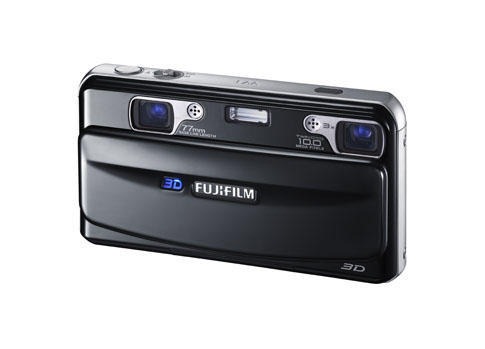
fujifilm

Short description: Fujifilm 3D Camera is the first 3-D digital point-and-shoot camera, with two separate lenses—and two image sensors—placed three inches apart. They snap either stills or videos in tandem, and a processor combines their images into a single file.

Why: This and the release of the 3D Movie Avatar will really put 3D in the mainstream in 2010.


 Planck satellite in  the Large Space Simulator at ESA's test centre in Noordwijk, the Netherlands.

Short description: Herschel Space Observatory, the European Space Agency’s Planck Observatory will study the radiation left over from the first 370,000 years after the big bang—known as the cosmic microwave background, or CMB—with three times the sharpness of previous satellites. Can detect temperature differences in the CMB as small as millionths of a degree (the equivalent of detecting the body heat of a rabbit on the moon, from Earth).

Why: i expect a breakthrough in 2010 in cosmic breakthrough research that will challenge our traditional thinking about time and space.


Short description: it’s about the headpiece, not the chair. The nonsurgical NeuroStar Transcranial Magnetic Stimulation system is as easy as a teeth cleaning. The patient sits in a chair as an electromagnetic coil pulses magnetic fields to his or her left prefrontal cortex, the part of the brain that regulates mood. This stimulates neurons to make more mood-enhancing dopamine. After 30 40-minute daily sessions, half of the patients in a clinical trial experienced significantly reduced symptoms; a third reported complete resolution. Last fall, it became the first TMS therapy to earn FDA approval.

Why: breakthroughs in brain research, implants and stimulation are just around the corner. At Singularity Summit 2009, i saw another example of light stimulation of very specific brain zones (up to the cell level !)


Short description: Nintendo Wii on steroids.  A prototype system dubbed Project Natal lets Xbox 360 games respond to anything from full-body lunges to subtle hand gestures, voice input and even facial expressions. Unlike the Wii, you don’t hold anything. Your movements and voice control the game.

Why: New forms of UI will we omnipresent in 2010. Expect this sort of stuff to be standard in any modern OS, tablet or PDA as from 2011.


Short description: The City Safety system of the 2010 Volvo XC60 can stop itself before you smack the stopped car in front of you. A laser sensor tracks the distance between you and the car ahead; approach too quickly, and the system hits the brakes.

Why: Computer assisted cars becoming mainstream. Also look at the loads of technology squeezed in the latest Opel Astra (standard model). Main reason: somehow my dream car, and i hope somebody from Volvo reads this and gives me one 🙂


Short description: Should be no surprise to anybody reading this blog. I am a big fan of Google Wave.

Why: 2010 will be Wave year. The criticasters of 2009 will cry and be ashamed once Google fixes this one.

Google Chrome: who is right and who is wrong?

All over the tech websites last week: Google previewing their Chrome OS and releasing it’s code to the open source community.

Planning, pre-viewing and releasing an OS is a big thing. Especially if everybody is looking at you as the provider of THE cloud OS.

It stroke me that some of the comments are so diverging. Some examples. Who is right and who is wrong ? With – as usual – some additional thoughts and spices by yours truly.

Negative

When the title says “Why Chrome OS will fail” you know what to expect.

However, it also inherits that platform’s (Linux) many warts, including spotty hardware compatibility.

It’s a move born of desperation. Google knows it can’t possibly establish a viable hardware ecosystem and still meet its self-imposed release deadline of "mid-2010”.

…no surprise that the primary interface to the Chrome OS is … Chrome, as in the Google browser. Unlike a traditional OS, there’s no desktop. The "applications" running under the Chrome OS are really just interactive Web pages,…

The bottom line is that while there is virtually nothing that you’ll be able to do with the Chrome OS that you won’t be able to do equally well with Windows, there are literally millions of things that you can do with Windows today that you’ll likely never be able to do with the Chrome OS.

It should come as no surprise that this is the article that is tweeted around Twitterspace with great and almost malicious pleasure by current Microsoft employees. Still loyal to their employer.

But think twice when you use the word loyalty in this context. See how fast the love can turn into competition when the company does not treat its ambassadors rightly (Don Dodges 180° love/hate turn around after being hired by Google)

See also James Gardner on the “Evidence of the (Microsoft) chip (in Microsoft employees)” and the introduction of a new term:

the Borgocrat

Fake Steve Jobs, one of my favourite blogs on the internet, summarised the whole thing very nicely I thought, in a post where he calls Don a Borgocrat (Fake Steve refers to everything Microsoft as the Borg), and compares previous posts Don has made with his new position on products for the company.

If this isn’t evidence that the “chip” still exists, I don’t know what is.

The more a read those opinions of some of head-in-the-sand Microsoft opinion makers , the more they are irritating and even not credible.

What to think of a Microsoftie making fun of Google Gmail being down, when their Hotmail has been down and hacked so many times.

But it’s a more general irritation.

What to think of traditional network vendors making fun of some cloud outages, knowing that their legacy technology is 30 years old, and the cloud players are doing relatively well, if you would add an adoption ratio of number of users and the incredible short time to market for users to take up.

That sort of arguments are so passé,

so old game

Neutral

Starting with a safe “Personally, I think it’s too early to tell.” The more interesting part in this posting is the effect that “geeks” can have on mainstream.

Yes, the "geek" audience is without a doubt a niche market. So it’s easy for Microsoft or Apple to write off Chrome OS. But that’s a mistake. As John Gruber wrote in his excellent piece, "Microsoft’s Long, Slow Decline":

People who love computers overwhelmingly prefer to use a Mac today. Microsoft’s core problem is that they have lost the hearts of computer enthusiasts. Regular people don’t think about their choice of computer platform in detail and with passion like nerds do because, duh, they are not nerds. But nerds are leading indicators.

Microsoft’s losses to Apple aren’t based on "regular people" choosing the Mac. Rather, these "regular people" were encouraged to do so by the geeks in their lives who had made the switch to a Mac years ago. Consumer technology vendors can ignore the alpha geek niche at their peril.

Positive

Louis Gray has a long term view.

Google’s preview of the Chrome OS was more than a product release. It was a milestone in a vision of a Web-centric world, one in which we are increasingly living.

For the vast majority of my own activity, I am online, not using software. I intentionally use some applications, like Microsoft’s Office suite or Adobe Photoshop, quickly, and then close them just as quickly, as to not slow down my computer’s performance. Google’s Chrome OS is the latest development in a vision that says our activity will be online, our data will be stored in the cloud, and applications that have traditionally been desktop software will make their way online.

Under no uncertain terms, I agree with their vision. This is happening and it is happening fast.

Robert Scoble (an ex-Microsoft himself) has as usual a more documented insight on his blog.

Google is playing a different game. Google Chrome OS is NOT about killing Microsoft or Apple.

What is it about? Developers, developers, developers, developers, developers.

This reminds me of the famous video where Steve Ballmer cheers up the developer’s audience in the good old days. It looks however – like pointed out in the neutral article above – that Microsoft has lost its’ “clout” with the developers at large.

It’s even getting worse: last week at PDC, Ray Ozzie was saying that apps won’t be a differentiating factor on smart phones. Sounds a bit arrogant to me when you know that iPhone Appstore has 100,000+ apps in store, and Android Marketplace building up fast.

Scobleizer continues:

I have not seen a single thing demonstrated on stage yet that won’t run on Google Chrome OS.

This is a winner, but on a new field

Web Squared for advanced

Very cool presentation on the impact of the web on the world. Web Wide World revisited so to speak. Enjoy.
View more documents from gloriagdiago.

Marketplace: a commodity

Here is force.com from Salesforce. As far as i am concerned, the way a marketplace should look like. Already more than 800 apps available, more than 70 of them are financial apps.

image

Also have a look at the US Government marketplace.

image

Everything’s up there. With pricing info, liability clauses, shopping basket, etc

Some believe building an application marketplace is something exotic, and if your not an Force.com, Apple, Google or the US Government it is something that is years away.

Reset your thinking. Picked up via ReadWriteWeb. Microsoft is going to offer application marketplace in SharePoint 2010. See the interview in the article on ReadWriteWeb.

What is even more interesting in this article is the video from Citrix Dazzle solution, embedded below:

Search for a financial application, make sure you get the right approval level for being allowed this app, mix and match online and offline apps, etc. It’s like an iTunes for apps, but then in an enterprise environment.

Can’t wait to see an out-of-the box offering that allows me to set up a marketplace of financial services in the cloud.