The initial title of this post was “Let’s upgrade the illusion”, but that’s what Apple just did with the announcement of the Vision Pro. And I mean that in the positive sense, not as a criticism.
The quote “Let’s upgrade the illusion” comes from a keynote by Deepak Chopra during the December 2022 retreat of Nishith Desai Associates (NDA), a leading Legal & Tax Consulting company from India, with offices worldwide. It is in itself interesting to see a Legal & Tax Consulting company exclusively focused on new technologies like AI, XR, Nano, Bio, etc.
The event was hosted in NDA’s gorgeous campus “The Imaginarium”, a true infrastructure for imagination, pitched by the CEO as a “private infrastructure for the public good”. How cool is that?
But back to that keynote titled “The nature of reality, what is real?” – We jump in after 2 min:
Deepak kicks off by stating that everything is real if you are truly immersed in it: whatever you experience is an illusion. If everything is an illusion anyway, let’s then upgrade the illusion. To do so, says Deepak, ideas have to manifest. Therefore we need imagination.
Imagination is about EVERY experience, all senses, not only visual, Deepak goes on. And then he really got me when he explained:
“That what imagineS is consciousness, awareness, soul. That what imagineS has no form, no location in time or space, no boundary, and therefore is infinite. That what is imagineD has form, has location.”
This opens a field of possibilities, or better, a field of what can be imagined.
I agree with Peter Hinssen when he says that the Vision Pro is not an iPhone moment but an Apple LISA moment:
“I don’t agree with those who say that the Apple Vision Pro launch is a new iPhone moment. I believe it’s an Apple Lisa moment. The Apple Lisa was a true milestone in the history of personal computing. Just like the Lisa, the Apple Vision Pro is a technological marvel that is too expensive (for now) to join the mainstream but is setting completely new standards for the industry.”
Back to Deepak. In a second talk at the same event about “The Future of Wellbeing”, he kindly notices that scientists measure experiences, and artists have experiences. That scientists identify with Quanta, and artists with Qualia. “Qualia is a unit of experience”.
What if we would measure the success of the Vision Pro on its potential to dramatically increase our units of experience, expanding our notions and understandings of what is real.
This reminds me of David Chalmers’ book “REALITY+”, a philosophical masterpiece that basically states that any good illusion is indistinguishable from real.
Let’s mix this with the insights of another philosopher Mark Coeckelbergh in his new book “Digital Technologies, Temporality, and the Politics of Co-Existence”, a mouthful, I know. Prof. Dr. Mark Coeckelbergh is a full Professor of Philosophy of Media and Technology at the Philosophy of Department of the University of Vienna.
In this book, Coeckelbergh makes a plea for process philosophy:
“Process philosophy shows a way out of what is today seen as overly deterministic thinking about technology and time, and clears the road for thinking about digital technologies and digital selves not as objects but as processes and becoming“
He also introduces the concepts of embodied technologies and “technoperformances.”
Performances emphasize the role of humans and the social but also bodily and kinetic character of our (co-)existence with digital technologies… As I have proposed in Moved by Machines and related work, the term performance can be used to conceptualize our dealings with technologies, including digital technologies. As we use digital technologies and are involved in technoperformances, we move and are choreographed, we act and are directed. To conceptualize the important role technologies and media play, we can say that we do not only use technologies in order to move, but that technologies also move us and direct us. The medium is not only the message but also the performance.
Andreea passionately talks about the potential of XR to instigate and discover emergent behaviours, about rubbery environments in continuous change, putting change at the heart of everything. And also about performance, like in art performance, a live creative process that takes you on an embodied, visceral journey with direct interaction with public. A process relational approach: me and the building (the environment) going dancing for a while. Love that – dancing with your spacial environment: where the end result is less important than the process, the experience itself.
Ken Bye has btw very deep thoughts about the impact of AR/VR/XR on presence, immersive storytelling, and experiential design. Watch his May 2022 Brussels talk on YouTube here. I encourage you to watch the whole thing, it will reset your assumptions about virtual reality.
The core of his talk is about this quadrant, looking at AR/VR/XR in terms of four types of presences.
One could also say the four types of “illusions” of what is real and what creates and influences your learnings and behaviors.
“Apple DID debut a killer app. It’s embodied interaction *done well*. It doesn’t matter how simple it is. Experiencing space smoothlessly react to you in any form is exhilarating, addictive magic. The killer app is spatial UX as its own content. The novelty resides at the neural level, where a tiny delay or flicker makes a world of difference in how information is processed, and when and how the feeling of magic and awe is released.”
Besides the fact that the Vision Pro and anything related to it is just a gorgeous piece of technological perfection – “you can lick it” would Steve Jobs say – it deeply integrates spacial vision and embodied experience. That’s why I belief Apple just upgraded the illusion.
Update: I added a link to @BrettKing’s The Futurist Podcast on the Apple Vision Pro with @missmetaverse @Scobleizer, and @BrianRoemmele . This Podcast gives you a really good sense of the revolutionary aspects of the Apple Vision Pro. Enjoy!
The last couple of weeks I have been aroused with many ideas and reflections on Personal Digital Assets and on Digital Assets in general.
The journey started some weeks ago with my prezi talk at TEDxNewWallStreet and included my participation to the WEF “tiger team” on Personal Data, where a group of 30 experts are looking at what is needed to make realize the vision of Personal data as a new economic “asset class”. Personal data created by and about people, touching all aspects of society. That group is stitching the pieces together for a framework of business, technical and legal elements that are needed to underpin this vision.
However, the following video from Kynetx was the big aha-moment during my 4-weeks tour on the subject.
I never thought of a Personal Data Store as a “Personal Event Network”.
This changes everything ™
indeed as Phil Windley (@windley), CTO of Kynetx says.
One years ago, there was this beautiful video animation by David Siegel (@pullnews), a great vision of distributed nodes of personal data content talking to each other through API’s.
In the meantime, there is a rich ecosystem of start-ups that are building something very similar as we speak.
Maybe not yet to its fullest grand vision, but definitely going way beyond the traditional concept of a “personal data store”.
Check out leading start-ups such as Personal.com. Btw I dream of one day seeing an integration of Personal.com with an on-line bank. Anybody needing a brokering service here ? 😉
What Kynetx is adding to the mix are three important things:
the “event” based thinking
the prototol for the data-web
Cloud Operating System
Event based thinking:
He really nailed it down for me last time I met him:
In the past we had RPC (Remote Procedure Calls), in essence fire and forget
Then came request/response: you ask for something, and you get it
Now there is the “event-signal”. It does not ask for something, it just says “something’s happened”, and any entity in the network can subscribe to the event and decide itself to do something with it.
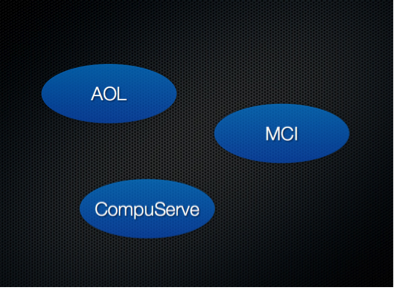
For those who remember, in the past we had silo-d email systems. AOL, Compuserve, etc. They did not interoperate. We got rid of those silos when there was a standard protocol, allowing competing commercial and open source servers to talk to each other in SMTP.
We now see the same with data, personal data, social graphs. We have data-silos (Facebook, Google, Bank systems, Health systems, Government systems, etc). What we need is a “Data-Server” and a “Protocol” that allows these data servers to be interoperable.
All this, Phil calls “The Live Web” (Amazon Associates link). He is so excited about this that he has written a book about it.
In other words, start thinking about your “Personal Data Locker” become a “Personal Event Cloud”: your personal data-server in the cloud that can talk and do things on your behalf, can make decisions, interpret rules, etc…
And it can talk to any entity, any node in the web (or at least nodes in any discoverable namespace). In real-time. In multiplexing mode (meaning the node can be both a server and a client).
It suddenly dawned to me that over the last years we have been hyping “The Programmable WEB”, and that if we are serious about customer centric identity or “customer centric” or “personal” whatever, we may wish to start with the “me”.
Suddenly it was flashing in my brain: “The Programmable Me”
“Me” is becoming a node in the grid. We are all nodes in the grid, sending and receiving signals. Like neurons passing an electrical or chemical signal to another cell. And start thinking “synapses” when you talk about the API’s of your Programmable Me.
From Wikipedia:
“Synapses are essential to neuronal function: neurons are cells that are specialized to pass signals to individual target cells, and synapses are the means by which they do so”
The APIs of your “Programmable Me”, of your Personal Event Cloud are indeed the means to make all these nodes interoperable.
Add to this the graph-thinking of Drummond Reed (@drummondreed), Co-Chair of the XDI/XRI Technical Committee of OASIS. Check-out http://wiki.oasis-open.org/xdi/XdiGraphModel and more specifically some of the Powerpoints out there:
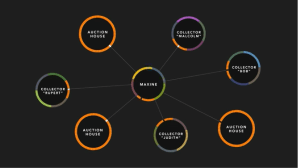
Each circle in this drawing represents a node in the grid. I really encourage you to look at this as a graph – this ensemble of inter-connected nodes – as something 3-dimensional, possibly multi-dimensional.
We have all been trained to think hierarchical. Flat files with a root, that sort of thing.
We have to learn to think in graph-models.
You can start anywhere in the galaxy. Every point can be the center of the universe. There is no root. At least, not in absolute terms. Yes, in relative terms with respect to the other nodes in the universe…
A grand vision starts to develop when you realize that the nodes can be any type of entities:
Humans (or their agents)
Circles (like Google Circles) of humans (entities without legal form)
Corporations, non-profits, governmental or educational institution (aka organizational constructs of humans with specific legal form)
We should also include less traditional forms of organizational constructs such as co-operatives, P2P communities, Commons,…
Programs (yes, software code), that perform tasks on behalf of the entities above or that operates as fully independent entities.
Each of these nodes/entities can participate in transactions – or better, “value dances”. “Dance” because the protocol is multiplexing, not one-way request-response.
Of course all these entities will require identity, in the broadest sense, not only URI or ID number, but in the sense of a spectrum, a graph that can be shared in context with other nodes/entities.
Sharing the spectrum becomes the essence of trade
What we are witnessing is a 180° turn in the power balance between client and server, slave and master, buyer and supplier, consumer and merchant.
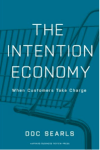
But look at the subtitle: “When Customers Take Charge”.
I like Doc a lot, but his subtitle may suggest that somebody else is in charge: the empowered customer. I am afraid that we may end-up with another un-balance, where the pendulum has swung the other side: where the customer has an unfair data-advantage versus the merchant. But let their be no doubt that today the merchant has the unfair data-advantage, and I read Doc’s book more like a plea for getting the balance right rather than a socialist rant against establishment represented by the “big boys”, the vendors, the merchants, the silos like Facebook and Google.
In all the discussions about the Empowered Customers, we see classic commerce use cases like buying a book, buying flowers for grandma, etc
But I would like to make the jump to truly balanced financial transactions and what “dances between equals” would mean in that space. I invite you to think about your bank as the merchant, the merchant of financial services, and the consumer as the retail or wholesale customer of the bank.
In such scenario, the fundamental shift in thinking already happens at the Point of Sale (POS). We even have the question the term “Point of Sale”. It stems from an old thinking where the merchant “owns” the customer.
YOU are the point of sale
YOU are the point of data integration!
In the past the POS was the master,
now it will be YOU who is in charge,
or your agent,
the “Programmable Me”.
What if we start thinking about banking where YOU are the point of data-integration? What if your bank would offer you a service that enables you to manage your Personal Event Cloud?
I don’t know how it would look like, but it probably would be something triggered from your mobile phone. It probably would look like one of the Next-Gen banks (Simple, Movenbank, Fidor) with a Personal Event Network out-of-the-box.
Some of these Next-Gen banks are already accepting the CRED of your Social Graph as a much richer (in all senses of the word) basis for “Know you Customer”. Although we probably also have to inverse that: from the captive notion of “know your customer” to the user-centric meaning of “know your bank”. Then we may come back to the “primitive” of the meaning of “bank”: a bench where two people meet to build a relationship of value.
So, the discussion is NOT about the next coolest thing for doing a copy-cat of existing money-transactions through the latest greatest gadget like NFC or Bump, or whatever.
“The thing to keep in mind here” says Crone, “is that NFC was developed more than 20 years ago. It was first deployed 10 years ago. 10 years ago, we didn’t have ubiquitous access to data plans. We didn’t have more smartphones in circulation than feature phones and we had to depend on an ‘offline’ connection for processing payments. But now, there are 124 million households that have more than one device connected to the internet. Typically, that’s a smartphone, but very quickly it’s becoming a tablet.”
Also Christopher Carfi (@ccarfi) starts thinking in this direction in his recent post “Musings in Small Data”. In there, he refers to a video of Jerry Michalski (@jerrymichalski) of the REXpedition doing a demo his “Personal Brain”. (Disclosure: I am member of the REXpedition). The video is titled “Gardening My Brain” and the talk was given at Personal Digital Archiving on February 22, 2012 in San Francisco.
It’s a pity that this talk is in the context of a personal digital archiving conference. Because, in my opinion, we have dramatically evolved from archiving to sharing.
Sharing of information and digital assets is becoming the new normal in this world of Abundance of information.
Christopher Carfi nails it when he says:
As these issues become more widely understood, more individuals will be tracking their own information. Perhaps it won’t be to the level that Jerry has done it in the video above, but it will be happening. This means that we, while wearing our business hats, will need to be developing real relationships with our customers. We need to listen to what they are saying, what they are asking for, and working collaboratively with them in order to help them fulfill their needs. In the best cases, we’ll have built up levels of trust with our customers and will have been given the explicit permission to access our customers’ personal data stores. In doing so, we’ll be able to actually take the guesswork out of the equation that was noted so clearly above in the Facebook example and will, instead, be able to connect directly with our customers’ intentions and deliver value on their terms.
Creating an economy based on the principles of relations is of course at the heart of the REXpedition. It is probably the next territory for competitive advantage beyond the mundane money transaction.
All this is about creating “Relationship Channels”, channels the vendor can tune into of the user has opened the channel.
All the above are of course very much related to our Innotribe incubation project “Digital Asset Grid” (DAG), which is about the sharing of any digital asset with any party.
The real question is then: “Where will value be created when all the connections between nodes have become frictionless?” Mark has some ideas on this, and he describes them as “irreducibles”
“No matter how ‘smooth’ and frictionless hyperconnected commerce becomes, certain frictions in the business world will persist. These represent both speed humps and opportunities. The businesses of the 21st century will find leverage and differentiation by identifying and exploiting them.”
What those “irreducibles” are, you will be able to discover at our upcoming Innotribe event in Bangkok on 26-27 April 2012, where together with Mark Pesce we will have some great interactive learning experiences. Be there, or read the report that we will make on this post-conference.
If you really want to take a meta-view on all this, I believe all the examples above illustrate our species being in search for a deeper meaning, a thicker value in everything we experience:
We are in search for a higher level of consciousness, a further evolution in Spiral Dynamics, in search for a richer value system, much richer than the pure transaction world that is the narrow lens of today
We start looking at companies being nodes in the grid, in fair-trade constellations of equals, trying to maximize the commons and contribution and giving back to society
We want to go beyond the “advertising” thinking of “let’s hit the target with an ad”. We are in search for a better world with more Thick value and less Thin value
We are starting to see the emergence of “The universe as a Computer” as wonderfully described by Nova Spivack (@novaspivack) in one of his milestone posts last month.
All the above is about defining, articulating, and living lives of greater meaning. With the “M” of meaning. Umair Hague (@umairh) already in 2009 called this “Generation-M”, which in essence is anchored in “constructive capitalism”
Generation M is more about what you do and who you are than when you were born. So the question is this: do you still belong to the 20th century – or the 21st?
What I liked about this book is that it encourages you to look at where you are in your life, and to look at it through the “M” lens. The lens of meaning.
I then discover that what I am writing today, what job I am doing, who I am married to, was probably all meant to be this way. Not “meant” in a deterministic way. No, “meant” as everything I have done, the decisions I have made, my architecture studies, my infection by the identity virus, my journey in Leading By Being, etc… all these things have made me who I am.
What if I could capture all this richness about me, and have a tool and an infrastructure to share that on my terms and conditions, in context, and with the parties or nodes in the grid that I choose to? What if I could share my meaning in a programmable way?
I would end up with something called “the programmable me”
Yesterday, i had the pleasure to be interviewed by Dan Marovitz, the founder of Buzzumi, a knowledge monetization platform, and a board member of rbidr, and the Professional Diversity Network. He is currently on sabbatical from Deutsche Bank where he was, until June of this year, Head of Product Management for Deutsche Bank’s Global Transaction Banking business.
The subject was digital identity, and the chat covered several subjects from privacy, KYC, user centric identity, and of course our latest incubation project the Digital Asset Grid.
We could have gone on for hours, as the subject is so rich. Buzzumi is a new kid in town for doing online webinars, a bit like WebEx or Skype, with the big difference you don’t have to install any client. The session yesterday was more or less flowless, with some small audio hick-ups (minor). But they are still in beta. I like the idea of “one click and on”.
It also learned me that i am in beta myself for this sort of on-line interviews. I have done some media interviews in the past, and we got here at SWIFT a proper media training, but this is different. You have to watch several inputs at the same time, the chat box is also a source of streaming info. The most important thing is that i need to be better prepared. Really walk through in advance the questions with the interviewer, prepare my key messages i want to convey, prepare content blobs (just keyword is enough) around certain themes that i can tap into at will as the conversation flows.
“Messaging” is fundamentally changing in nature. Video will be an integral component of it, and i can’t wait to see the first blending of this with Twitter and semantic video searching. On good track, Dan !
This blog post is Part-2 of a series that started as the ongoing thinking after our Digital Identity Tour in June 2010. In Part-1, I developed the idea of the Unpolished Diamond.
Today, I will entertain you on the concept of a Digital Identity Tuner, which in its own is also a further evolution of the Identity Rights System 3.0 post of March 2010.
It all started coming together when – during the tour – we visited PayPal.
This visit was at the end of the tour. We were welcomed by Eve Maler, Distinguished Engineer, Identity Services at PayPal, and Andrew Nash, Senior Director Identity Services at PayPal
These folks of PayPal basically told us to forget what we had seen earlier in the week. These are probably some of the smartest identity folks around, so you pay attention.
Indeed, I was amazed how much further ahead they were, not only in their conceptual thinking, but also in the pace at which they define and rapidly test new protocol standards.
The eye-opener for me was that there is no business in identity, but there is some significant potential when flipping the discussion to sharing and managing of user data.
It is not that much about identity,
but more about digital footprint.
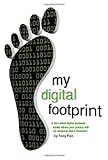
Happens that a couple of weeks later I read Tony Fish’s book My Digital Footprint, where the author explains razor sharp that there is a difference between digital identity and digital footprint.
At about the same time, I saw appearing on the internet all sorts of semantically tagged enabled viewers, like this one from Recorded Future.
Recorded Future lets you search and find for events, based on the WHAT, the WHO/WHERE and the WHEN.
What if we could do this
for a person’s digital footprint ?
Here is where my Digital Identity Tuner comes into the picture:
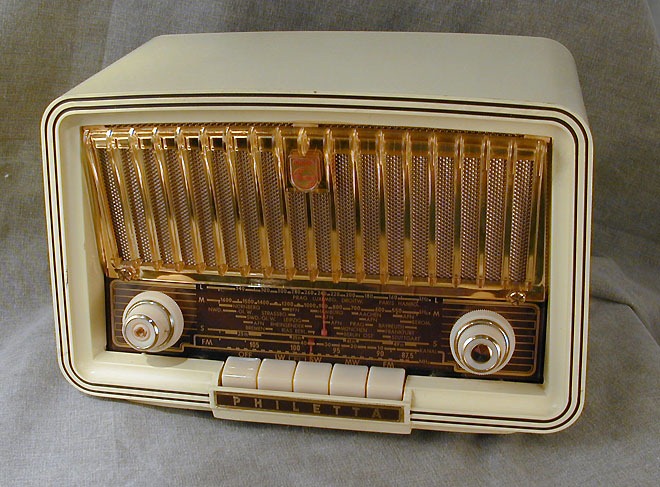
Remember those old radios ? You could “tune” into a radio channel, and there was a big button, and if you turned that button an arrow would move over a “map” of pre-defined radio stations.
What if we could do the same on your digital footprint ?
The spectrum above is my “Digital Persona” as generated recently by MIT’s Digital Personas project. Personas shows you how the internet sees you.
Every color in the spectrum is about a certain dimension of your digital footprint: books you read, education, political preferences, musical preferences, professional attributes, etc, etc…
What if you could make that spectrum “clickable” ? Not only via a browser, but also via API’s. What if you could zoom in/out that spectrum or certain aspects of it ?
So far, we have “tuned” in two dimensions:
On the horizontal axis, hovering over the different color dimensions
On the “depth” axis, zooming in/out to get more or less detail
Let me add the third dimension of Time.
I could tune into the past, but I could also tune into the future, as my digital footprint does not only contain past behavior, but also contains real-time data (such as devices that I may wear to beam my heartbeat-data to the Microsoft or Google or Wallgreens or whoevers Healthvault when running a couple of miles on my cloud enabled Nike shoes.
It also contains data about my future, as I keep my calendar in Google Calendar, for example. Or the event for which I bought tickets. Or even on-line streaming events for which I subscribed.
UPDATE-2: or check out this TED Video, on the Quantified Self, with Gary Wolf’s intriguing new pastime: using mobile apps and always-on gadgets to track and analyze your body, mood, diet, spending — just about everything in daily life you can measure — in gloriously geeky detail.
So, the third dimension is time.
What if I would have a sort of
“Remote Control”
that could let me navigate through my digital footprint on those three dimensions. It’s like steering a helicopter via remote control.
Or maybe more dimensions. You would end-up with something that navigates you through a fractal or so…
Of course, we don’t live alone on this planet.
We are part of tribes
of swarms
with leaders and followers
I love the metaphor of “SWARM”
Imagine that we have a similar digital tuner for navigating the swarm. For seeing links between the WHO’s in the swarm.
In essence, it shows the “swarm” of communities, leaders and followers and their relationships. And how germs, ideas, memes, etc spread in a community based on the same S-curves as innovations happen. Nicholas A. Christakis, MD, PhD, MPH, is an internist and social scientist at Harvard University who conducts research on social factors that affect health, health care, and longevity.
So far, we looked at “navigating”. But the system would also allow me to defineand manage who gets access to what parts of my digital footprint in what specific contexts or constraints. Not only “access”, but also “usage”.
For all that to happen, we need to fundamentally rethink how we deal with digital footprint.
We have to navigate away from identity systems that mimic our brick-and-mortar world, that are still based on the metaphor of identity cards, or passports, or electronic equivalents based on PKI systems and certificates.
No, we almost need a new semantic tagging language. Not to “tag” pages or servers, but to tag my digital footprint.
And not only “tag” it but allocate and manage “usage” rights to it. And I should be the owner of those data, whether they sit on my computer, in Facebook, or distributed open source models like Diaspora.
So that I end up with a collection of different “where’s” where data about me is kept. It may lead to some new form of DNS, but then a DNS of people. Not pages or servers.
There are two paths in spectrum: one for identity/categorization and the other for digital footprint / Trail / history/future (time dimension, recording, in the future,…)
The high road is concerned with extracting where objects are located and throws away the elements related to their identity. The low road, on the other hand, is concerned with identification and categorization, and less so with objects’ spatial locations
As Tony Fish so well articulated in his book: we have to separate identity an footprint.
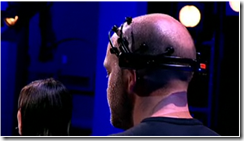
From the TED site: “Tan Le’s astonishing new computer interface reads its user’s brainwaves, making it possible to control virtual objects, and even physical electronics, with mere thoughts (and a little concentration). She demos the headset, and talks about its far-reaching applications.”
Out-of-the-box support for facial expressions and emotional experiences, with some sensitivity adjustments available for personalization.
The demo is focusing on the “cognitive suite”: the ability to move virtual objects with your mind.
And it just costs only a few hundred dollars. Like an iPAD, but it’s a hPAH “head-PAD”
Start mixing this with the ongoing discussions on personal digital identity. As you will notice, the demo starts with making a personal profile for this headset owner. And tuning to a neutral signal, a signal where you’re doing nothing particular, your are relaxed, hanging-out: a but like my holidays at home where I basically don’t do anything particular other than hanging around.
It’s interesting to see that the test is about “pulling” an object forward instead of “pushing”. I may be too influenced by John Hagel’s latest book “The Power of Pull” 😉
The cool stuff starts when the helmet man starts visualizing something that does not exist in real life: making something disappear.
Applications are obvious in virtual reality games, domotica systems, all sort of gesture and thought based interactions, control an electric wheel-chair. In banking it would be nice is I could raise the balance on my account just by thinking about it.
What I do NOT like about it is that the “system” has some built-in leveling system. It makes me think of Jaron Renier’s fantastic rant / manifesto that I mentioned in my previous blog “you have to be somebody before you can share yourself”
Start mixing this up with some of the cool ideas like Mark Pesce’s Plexus which is a quite novel way of looking and using your social graph in a sort of
getting you out of your normal orbit, of stepping out of your usual “flock” of people you normally interact with (both on- and off-line).
Around min 15:30, he describes a DJ as a guide:
A skilled human curator, who knows what material is available to her, who is able to listen to the audience, and who is able to make a selection and push people forward in one fashion or another
Instead, I’d like to share with you the feeling of giving pleasure to my audience.
It’s something I feel while writing these blogs, and it’s a very similar feeling as being a DJ in front of an audience and pushing people forward.
Its has a same sort of stage-fright
when starting a gig,
and the same sort of excitement
when you see your crowd getting
excited
As a DJ, I was doing some quite big gigs for 3,000 people or so, and my following community is not that big yet. But the feeling is the same, and everyday there are some more folks following my tweets. Some more reacting to my blog. Some more getting inspired by what’s on these pages.
So, I just continue doing that, and hope to inspire you to dream and execute your dreams.
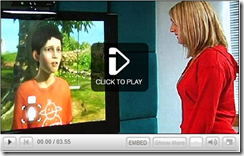
Have a look at this stunning gesture based interface with character Milo. First of all, it is more than gesture based. Milo also reacts to voice intonation, movements, etc
It is difficult to assess how much of this is a word-by-word script, or how much real interaction is going on here.
The most stunning effects are:
The women trying to capture goggles that thrown by Milo
The women moving the water with her hands
The women handing over a piece of paper, that gets scanned and taken over by Milo
It gives a sense where we are heading. Imagine this on your iPAD. My conservative guess is this will be real within the next 5 years.
This is very similar to what Oblong is doing with gesture based interfaces. See my previous blog on Oblong here. John Underkoffler indeed also said 5 years before this hits any PC.
Oh yes, in case I forget, Oblong will be at Innotribe at Sibos 2010 in the Smart Data track.
Stumbled upon this very well made video (make sure you look at the annotated version of it).
Found via Brainpickings. Great example on how many emerging technologies and concepts — including ubiquitous displays, crowdsourcing, pervasive sensor networks and adaptive user interfaces come together.
When you look at this, think iPAD 2.0, think Identity 3.0, think your office of tomorrow.
It’s a great agenda with presentations by European experts on eID, and also some of the smartest SWIFT folks on identity. For example, we’ll have Jacques Hagelstein, our Chief Architect, and we’ll also run an Innotribe Lab on day-2. Check out and download the PDF agenda here.
Hosting this sort of events is an interesting win-win model, where we at SWIFT can share our great meeting and auditorium facilities and at the same time dove-tail with important topics that are relevant in our industry.
Acting like this beyond our traditional boundaries nicely fits The Medici Effect that i described in my previous post, although i am not sure we at SWIFT apply this principle always with full consciousness and intent. It does not matter, the key thing is that it just happens, and i feel confident that on this intersection of worlds some new ideas will emerge naturally.
Thinking through how we deal with company and personal identities in an on-line world, and being able to deliver this on a world-wide, predictable, resilient and secure way is one of the key value propositions of SWIFT in the financial services eco-system. SWIFT has the advantage – it’s a deliberate choice – that we are a community based venture, and a lot of services we offer adhere to standards and rulebooks that have been subscribed to by our membership. Even then, delivering this is not a sinecure.
But in this post, i’d like to take you on a journey beyond SWIFT’s ecosystem and edges, and look at what is happening in terms of identity and privacy outside our safe community walls.
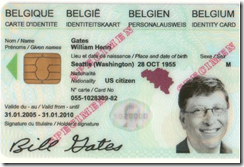
My first contacts with privacy related matters date back to my Microsoft period, where I was quite involved in the Belgian eID project.
Microsoft saw Belgium as a good test ground to see what happens when a country rolls-out in a mandatory way 8 million electronic identity cards to its citizens, what applications get developed, and what needed to be done at the level of Windows, Office, MSN Chat, etc to support an identity card issued by a third party, in this case a government. At that time, I experienced the Belgian Privacy Commission more as a pain in the neck, limiting us in doing ‘”real cool things” with on-line identity. But they surely planted in my head the first seeds of some “culture” of privacy. It’s only now that i start to fully appreciate the importance of privacy, and the role of Privacy commissions and alike.
Now the Belgian eID cards are rolled out, we even look at a second and third generation, but the number of applications that are really leveraging the eID on a day-to-day basis are disappointingly low.
Already when the first eID cards got rolled out, it appeared to me that the card was already a dated old-fashioned way of dealing with identities. It does not make a difference whether we talk here about a smart-card, a USB token, or whatever other hardware device.
The point i am trying to make is that
the model of an identity “card”
does not match anymore
the online realities of today
The “card” is an artifact of the physical world, and we try – in vain – to squeeze all sort of on-line concepts into an off-line model.
The next occasion where I felt something was wrong with our model, was when i saw the demo of Intelius Date Checker. See also my post on “privacy is dead” for more details on this application. I was shocked that nobody in the audience made any reflection on the huge privacy issues at stake here. It must have been American culture ?
Then a couple of months ago, there was the famous debate launched by Mark Zuckerberg of Facebook, where he basically suggested to change the paradigm with 180°: in stead of considering "private” as the default setting of personal data and letting the user decide what data he releases to whom, he suggested “public” as the default setting, forcing to “un-public” data the user did not want to make public and keep private. See also ReadWriteWeb coverage here. Unfortunately for Zuckerberg, there was around the same period an article about a Facebook employee revealing how much privacy data they have access to by for example super-admin passwords and alike.
And even ex-colleague Paul Shetler took the pain to scream out his frustration on why public as a default really does not make sense.
It all makes me feel very uncomfortable how much i have to believe from Mark Zucherberg or Eric Schmidt when they are behaving like the white-knights of privacy.
It looks to me that
privacy is out-of-control
and that they would like to officialise the dead of privacy by declaring “public” as the new norm. It looks to me as privacy has become
too complex to fix it
Via Facebook, Google Buzz, Twitter, etc, etc, there is already too much data out there. Fixing this taking into account regional and country laws and regulations must be a real nightmare for the Facebooks and alike.
It’s an interesting debate what should be the default: privacy or publicy. And Stowe Boyd rightly adds the dimension of “sociality”. Because you release some info about yourself consciously (when participating on social media, your really want people to know about yourself and your preferences) or passively (by accepting blindly the privacy notices on Facebook and alike. Some related info on sociality here.
This aspect of passive privacy is really well explained by David Birch. He recently wrote a whitepaper: “who do you want to be today ?” and “Kissing Phones”. Check-out here. And just a couple of weeks ago, David wrote this fantastic post about Moving to Privacy 3.0
And the big boys are feeling the pressure. A couple of years ago the audience at the Gartner IT Symposium in Cannes was still having fun with “The Great Google Hack” scenario. This session was part of an “Unconventional Thinking” set of sessions with following disclaimer from Gartner: “This research doesn’t have the full Gartner seal of approval (we call them Mavericks internally).” Today this is not just a scenario but getting very real. I am just picking one of the thousands of articles that have been written on the Google China hack described as the privacy breach of the year.
Let’s throw in some additional dimensions, so that you as novice reader on this subject really start feeling the pain.
What have you browsed ? Interesting reflections by Microsoft’s Chief Architect Identity on “browser fingerprints”. Btw, Kim is confirmed speaker at the eID Interoperability Conference next week.
Where have you been, and how your iPhone becomes a spy-phone here and here
Who have you slept with ? Given some’s willingness to post all their data online, and the rising casual nature of some behavior, this isn’t so far out of reach to be completely ridiculous.
Add to this things like Facesence MIT, about mind-reading
Bodyscanners about being “sniffed-out” by chemical noses.
Did you take your pil and when. In essence about “body-surfing” and RFID like tracking inside your body.
Please rob me, in essence about real-time location tracking
Some suggested solutions for all this go into the direction of
“gatekeepers”
Trusted entities that are the safe-harbor for keeping these personal data. Or even distributed models of “gatekeepers” certification.
The recent announcement at the March 2010 RSA Conference of the Open Identity Exchange (OIX) goes in this direction. Please note that this initiative is backed by industry leaders Google, PayPal,Equifax, VeriSign, Verizon, CA, and Booz Allen Hamilton.
However, I don’t think it will work, and i am not alone, although from a different perspective (see below on PETs). I think it won’t work, because in the open online world, it will not be acceptable that somebody or some company sits in the middle of all this identity hocus-pocus, and controls our world. The internet has just become way too distributed to accept this sort of models. Maybe this works in a closed community (vertical or other) where users subscribe to a common set of standards and rules), but not on the open internet.
One possible route are PETs (privacy enhancing technologies). For example, Stephan Engberg, one of the speakers at the European Commission’s December 2009 workshop talks about security (and privacy) “in context” and seems to be a big advocate of PETs. Check-out an interesting debate here.
The word “context” is very important here.
To come back to the beginning of this blog post, i believe we have to change the old eID model to a model where we acknowledge that the personal data are highly distributed on the net today and are dealt with “in context”.
Personal data sits everywhere, and you really can start imagining “data weavers” or “identity weavers” that combine these individual sets of personal data into new sets of relevant information, based on the context of usage.
I repeat myself by saying that this CLOUD vision goes way beyond the web of pages, goes way beyond the early thinking on Semantic Web. It is in essence proposing an identity architecture for the Internet. Because the internet is broken. It was never designed with identity in mind.
Its about user control of personal data.
It’s about context awareness.
It’s about who i am, how i am, and
what i do and intend to do in an on-line world.
But we all have problems in imagining how such standard and supporting system might work.
How it would look like ?
And then suddenly last night the pieces seemed to fall together. What if we start thinking about this in a way similar to “Information Right Management” (probably called something else today), something that Microsoft built as a feature in Microsoft Office, and basically put the user in control of what somebody could do with his documents. Mind you, this is about “USAGE” rights, not access-rights.
In Microsoft Office this was visualized by the “do not pass” sign.
By clicking on that icon, you – as the user – can control whether somebody can cut-and-paste from your document, whether they can print it, forward it, etc.
We need a standard that makes it possible to control/manage the usage-rights of the different pieces of our personal data that are distributed over the internet. And then we need to let play the competition on how this standard gets implemented in our day-to-day tools. Maybe by a clickable icon, maybe something else. Would be great to let Heads of User Experiences have a go at this.
But maybe it is too late. Maybe there is already so much data out there, that there is no way to 1) find where they are and 2) give back the control to the user/owner of the data. The breach already happened.
To conclude, get inspired by this NYT article “Redrawing the Route to Online Privacy”
So if the current model is broken, how can it be fixed? There are two broad answers: rules and tools.
“Getting this balance right is critical to the future of the Web, to foster innovation and economic growth,” Mr. Weitzner said.
Whatever the future of regulation, better digital tools are needed. Enhancing online privacy is a daunting research challenge that involves not only computing, but also human behavior and perception. So researchers nationwide are tackling the issue in new ways.
At Carnegie Mellon University, a group is working on what it calls “privacy nudges.” This approach taps computer science techniques like machine learning, natural language processing and text analysis, as well as disciplines like behavioral economics.
How would all this be relevant for our financial services industry ? One example would be to apply semantic web technologies to Corporate Actions. For folks at SWIFT it’s pretty obvious that we can apply our semantic knowledge to the data in the “messages” that are exchanged between parties of Corporate Actions.
What seems less obvious is to apply the same semantic tagging techniques to the personal data and attributes of the persons who participate in a Corporate Action transaction.
In essence this is about applying the CLOUD concepts. It’s about setting new standards and rules in this space. And are standards not one of the cornerstones of SWIFT.
It would be great to build an innovation prototype to educate our community on the power of semantic web.
I call this the “Identity Rights System 3.0”
UPDATE: apparently the subject is red-hot at SXSW in Austin this week. Check out Danah Boyd at SXSW “Privacy is not dead”
Re-think big screens. Really big screens in the sky. Think swarms.
MIT’s Flyfire project uses a swarm of miniature helicopters with embedded LED lights to act as ’smart pixels’ as they fly through the air. Acting in concert they will be able to form complex three dimensional shapes – digital displays that will awe you more than exploding chemicals ever could. Not only will the pixels change color, the 3D dynamic movement will create an immersive experience that you can view from any angle.
Have a look at the video animation below:
I was just reading a Trends Magazine article about the new CEO of Barco, once – and to be honest still – of the pearls of the Flemish tech industry.
Have a look at their history here. They started in 1934 as a company specializing in the assembly of radios with parts from the United States. Hence the name, "Belgian American Radio Corporation" or Barco.
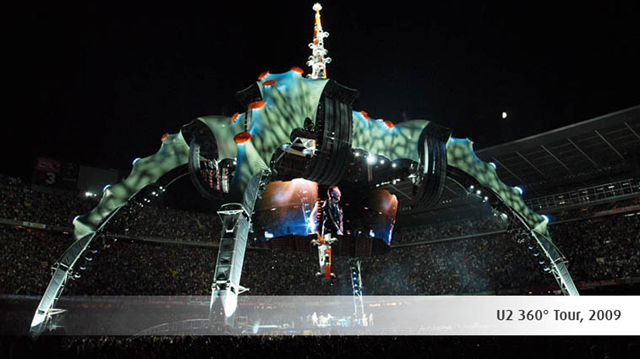
Now, in 2010, they are a global leader designing and developing visualization solutions for a variety of selected professional markets. They are big in events and shows: The world’s major bands use Barco lighting, projection and LED technology, e.g. U2, Depeche Mode, Bloc Party, Coldplay or The Prodigy
Imagine Barco implementing this new MIT Flyswarm technology and scale it so that it can be used as a massive projection-in-the-sky for the next U2-tour !
Miniature helicopters turning the U2-sky into a Digital Screen.






















 Petervan Studios