Is SWIFT a Railway station ?

Recently had a good discussion with Tony Fish, author of My Digital Footprint, and entrepreneur/investor with AMFventures. The discussion was in the context of our digital identity incubation project (more about that project in an upcoming blog post).

clip_image001

Not sure who invented it, but he came up with a really good metaphor based on the railway systems, that we could use very well in a lot of our discussions on innovation and how we have to position new services on top of or adjacent to our core messaging infrastructure.


“Infrastructure”

There we have it


With credits to Tony, a classic railway system is made up from:

  • Infrastructure (rails, connection);
  • Enablers (signaling and control);
  • Ticketing (collection of money, the market place/ exchange);
  • Platforms (access – something to get customers in and out the service), and;
  • Trains (the service – what I am actually paying for in the mind of the customer).

SWIFT in this model already delivers critical parts of the international payments infrastructure.

  • From an innovation point of view, I believe the core of our innovation focus should be to extent our current remit to offer industry wide services that will enable Banks and Corporates to offer new services to its customers (signaling and control)
  • The Banks will provide the services (ticketing, platforms and trains)

In that sense, the SWIFT 2015 strategy is spot on by stating there is still enough juice and room for innovation in the core.

But I believe a lot of thinking in the industry about innovation at SWIFT is “limited” to the messaging paradigm, and anything that goes beyond messaging seems to make some of our shareholders nervous, as it may be the space where they compete for business with each other.

The railway system metaphor is in my opinion a great help to get rid of the pure emotions in this debate, and to well articulate the roles of the different players in a “system”.

In other words

to do some system-thinking


And metaphors always help in system thinking.

Another metaphor is the operator of a horse-track: you offer the infrastructure, and the horses (or rather the horse owners) compete on the horse-track.

 

clip_image003


The worst thing the horse-track operator can do is to have horses of his own and put them in the race in competition with the other horses.

Better is to think of the horse-track as something exciting with lots of new enabling services giving horses a better experience, and enabling new merchants to offer new services to the horse-owners. And the ticketing: you can run it yourself, or outsource it.

Just one more thought. Railways make me think of old, messy, noisy, rusty environments and coaches.

 

clip_image005


Unless you take the Thalys/Eurostars in First class, or Shanghai Maglev train that propels you forward at 431 Km/hour.

I’d prefer something that “smells” like the infrastructure and ecosystem described in the book “Aerotropolis” by John D. Kasandra. (Amazon Affiliate link)


clip_image007


Most of my readers are probably familiar with my addiction to cities. Because they never die. They create “intencities”. Platforms of intensities where ideas can flow freely.

Now

we add the city transportation

to the mix,

and how that can be

a real catalyst

for systemic growth


Some quotes from the Aerotropolis book:


“Look for yesterday’s busiest train terminals and you will find today’s great urban centers. Look for today’s busiest airports and you will find the great urban centers of tomorrow.”

“Cities are always created around whatever the state-of-the-art transportation device is at the time.”

“The shapes and fates of cities have always been defined by transportation. Today, this means air travel”.

 

clip_image009


Aerotropolis. It’s just sounds so much better than railway station or infrastructure:


Modern

Fresh

Fast

Convenient

Transparent


So, is SWIFT a Railway Station ? You should be able to cook up the answer yourself now.

Future of Money and/or Value

If you’re interested in discounted tickets for one of the coolest Future of Money conferences of Q1 2011, bear with me and read till the end of this post.

Print

As most of you will remember, SWIFT’s innovation initiative “Innotribe” was one of the Executive Sponsors of Future of Money video production.

image

The Future of Money from KS12 on Vimeo.

The video is in my opinion a milestone. Not only for it’s content and the way it was produced (co-funding), but the whole movement that followed.

It is only now that it became clear to me that the event – in this case Sibos – is not the end-point in a process, but the middle. The post-event discussions and dynamics are at least as important, if not more important. Just check-out for example the animated discussion on Chris Skinner’s blog in November 2010 on “Why banks and socials agree to disagree”.

“Social” – as in Social tools, Social Currencies and Social Capitalism – is in my opinion a very strong force to take into account in our long-term thinking about financial services. It is one of the suggested topics we have in mind for Innotribe at Sibos 2011.

  • I am preparing another blog post “The Long Direction” on this subject and some other deep understreams that are going to change fundamentally how we think about corporations, banks and economy and corporate culture in general.
  • With Innotribe will sponsor a new research on Social Cognition by Stowe Boyd, the most important Social Philosopher and Webthropologist at this moment.

The Future Of Money crew produced post-event the following interesting infographic. I love the sharpness and detail of their analysis. In one view, you see how Creation, Storage and Access of VALUE intersect and how these intersections are each interesting opportunities to be taken up by start-ups or modern capitalists. Some indeed have taken their chances already: see the bottom of the chart with a number of start-ups in this space.

I would like to emphasize that the intersections in the infographic do NOT talk about the Future of MONEY, but about the Future of VALUE. More about this as well in the upcoming “The Long Direction” post. At this stage it’s enough to point you to Umair Hague’s latest book “The New Capitalist Manifesto: Building a Disruptively Better Business” (AmazonAssociates Link).

But I divert… Here is the Future of Money infographic (you can also download a nice PDF version of this by clicking on the graph below).

FOM_infographic_540x764

What an impressive list of start-ups and new contacts ! Indeed,  one of the biggest wins of our Innotribe initiative is the network of people we connect with.

This network is a very powerful force. Here is another example of this network-effect:

Given our work on Future of Money at Sibos, Mike Sigal  – Founder and CEO of Guidewire Group and part of our start-up judge panel at Sibos – introduced me recently to Brian Zisk, founder and organizer of the Future of Money and Technology conference in San-Francisco on 28 Feb 2011.

image

When looking at the conference program and the list of confirmed speakers, I thought “Wow” and two days later I was on a confcall with Brian. Besides being the Executive Producer of this Future of Money & Technology conference, Brian Zisk is a serial entrepreneur and technology industry consultant specializing in digital media, web broadcasting and distribution technologies.

brianzisk

Brian wanted us to speak about Innotribe and Future of Money at Sibos 2010, but unfortunately, given to some other commitments and plans, none of our team could make it to San Francisco on that day.

But we both quickly spotted the possible synergies – wouldn’t it be great to get a subset of these speakers to Sibos into the Innotribe stream for example – and we came to the following pragmatic agreement.

  • I was going to write a blog about his event, and in return my readers could get some discounted tickets for his show. And he would promote our Mumbai and Toronto events later that year. Yes, it can be that dead-easy. No strings attached, pragmatic. Piece of cake if you share the same passion. If you want such a discounted ticket, see the end of this post.
  • But we kept on talking… It suddenly crossed my mind that only 2 weeks later, SWIFT was organizing its SWIFT Operational Forum Americas on 8-9 March 2011 (SOFA). As we had an Innovation slot in the Special Session on day-2 of that event, why not ask Brian to come over and give a wrap-up of his conference ? Btw, watch this space on the Innotribe activities at SOFA: we are working on an impressive list of speakers for this Innovation Slot on 9 March 2011. Will be subject of another post.
  • And why not continue in this direction and see what we can do together for the first stand-alone Innotribe event in Mumbai, later this year on 1-2 June 2011 ? This event – hopefully a first in a long series, will be titled “Unpacked” and this Mumbai edition will focus on Mobile Payments. More on that later as well.
  • And then let the whole movement culminate to a climax at Sibos Toronto from 19-23 Sep 2011 ? I have a first meeting with the Sibos 2011 organizing committee in 2 weeks. Yes, we start early °-)

So how to get a discounted ticket for the Future of Money & Technology conference on 28 Feb 2011 in San-Francisco ?

Enhanced by Zemanta

iPAD what’s next ? Oblong !

oblong-logo.JPG

Seen at many blogs and feeds during the last week. Of all, i like most the post of MG Siegler of Techcrunch.

MG Siegler writes:

The demo I saw a couple years ago was stunning, but it was still just a video. Apparently, at TED, the audience got to see it in action. NYT’s Bits blog detailed some of it in a post yesterday. For those not at TED, Oblong has also made a few demo videos in the past, which I’ll embed below. Again, this is Minority Report.

Oblong’s coming out party couldn’t come at a better time. Following the unveiling of Apple’s iPad, there has been a lot of talk about the future of computing at a fundamental level. That is to say, after decades of dominance by the keyboard and mouse, we’re finally talking about other, more natural, methods of input. The iPad is one step to a multi-touch gesture system (as is this 10/GUI awesome demo), but this Oblong system is the next step beyond that.

TED2010_18647_D31_5144_1280

So how does it look like ? I found 2 videos, and waiting for the video of Underkoffler when he unveils the interface, called the g-speak Spatial Operating Environment, at Friday’s annual TED conference.

g-speak overview 1828121108 from john underkoffler on Vimeo.

and

oblong’s tamper system 1801011309 from john underkoffler on Vimeo.

More cool stuff from Oblong on their home page.

Reblog this post [with Zemanta]

Web Squared for advanced

Very cool presentation on the impact of the web on the world. Web Wide World revisited so to speak. Enjoy.
View more documents from gloriagdiago.

The Whuffie Bank: values and reputation

Now that Innotribe @ Sibos is over, back to the real purpose of this blog: “Inspire others to dream”. For a recap, see the very first post of this blog, back in April 2009.

There is something fascinating and very profound that is going on with on-line reputation. This post is  about values in the on-line world. It is very much related to the upcoming Think Tank on Long Term Future, where we want to deeply thing about the value kit needed in a transhumanistic and singularity type of world. It also relates to our on-line identity and its evolution, a theme that i often have addresses on this blog.

As Chief Executive Mixer of ideas, i would like to mix the following memes:

  1. The Whuffie Bank presentation at last week’s Techcrunch50
  2. Seth Gondin’s blog on “ClouT” (yes with a “t” and not a “d”) of a couple of weeks ago
  3. The Trust-Score idea presented by the crowdsourcing team at last week’s Sibos and Innotribe
  4. Matteo’s idea for Mindtagger

First, The Whuffie Bank. Nothing better than watching yourself the TC50 Video and comments here. Also the second part of the video is interesting: the debate and feedback session: the most important comments was that reputation is contextual. I maybe interested in the ideas of a couple of on-line friends only. My own tribe so to speak. But even in my own tribe, i may appreciate the techie knowledge of Nick for example, but not at all be interested in his political ideas or preferences.

Or have a look at The Whuffie Bank website.

The Whuffie Bank from The Whuffie Bank on Vimeo.

It is very profound what these guys are saying:

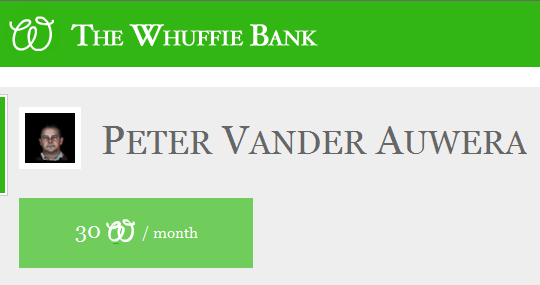
The Whuffie Bank is a nonprofit organization dedicated to building a new currency based on reputation that could be redeemed for real and virtual products and services.

The higher your reputation, the wealthier you are.

It’s in the same spirit of Creative Commons, an organization that’s changing the contract between our ideas and us; we want to build an open organization that aims to measure and enable the exchange of online reputation.

The Whuffie bank also has some crazy ideas on how they could you beyond the web into the brick & mortar world, by for ex printing money or having credit cards with whuffies on it.

I tried myself. I do NOT tweet or RT very much, but do have a Whuffie balance:

image

More interesting is to see where my “Whuffies” come from, and what triggers reputation changes and endorsement ranking.

image

image

It’s all in the same spirit Creative Commons, where fundamental re-thinking was done on the relationship we have with ideas and the copyright contract.

Now we are re-thinking the relationship we have between our values and the money contract.

The Whuffie bank is based on 4 principles

  1. Endorses public endorsement
  2. Based on degree of influence on other people: if you retweet often your influence on others will be greater
  3. Considers existing reputation of each member: it’s different to get an endorsement from the president of the USA, than from me for  example
  4. The message content is analyzed. If a tweet has a link, the link is more important than the couple of words before it.

Second, one of Seth Godin’s latest posts. Seth is the author of “Tribes” and the name Innotribe was based on the title of his book.

The web knows something, but it’s not telling us, at least not yet.

The web knows how many followers you have on Twitter, how many friends you have on Facebook, how many people read your blog.

It also knows how often those people retweet, amplify and spread your ideas.

It also knows how many followers your followers have…

So, what if, Google-style, someone took all this data and figured out who has clout.

Which of your readers is the one capable of making an idea break through the noise and spread? Bloggers don’t have impact because they have a lot of readers, they have a lot of impact because of who their readers are (my readers, of course, are the most sophisticated and cloutful on the entire web).

If you knew which of your followers had clout, you could invest more time and energy in personal attention. If we knew where big ideas were starting, that would be neat, and even more useful would be understanding who the key people were in bringing those new ideas to the rest of the world.

Back in the old days, we had no idea, so we defaulted to big newspapers, or magazines or the TV networks. But now we know. We just need to surface the data in a way that is useful.

So, it is really about how impactful your

followers

are.

That’s pretty profound.

Thirdly, at last week’s Innotribe @ Sibos, the crowdsourcing team pitched the idea of “Trust-Score”. What a pity this one did not get a better pitch :-/ Because it’s also really about trust-reputation. But then in the real-world of money. And how one could spot patterns in somebody’s online money behavior and how deviations from the measured average could lead to fraud detection algorithms and alike.


Or, fourth, what would happen if we mix all the above with my colleague Matteo Rizzi’s “Mindtagger”. At this stage “just” a searchable repository of people as mind-skills, but what if we throw reputation on top of it ? And Whuffies, based on how much good somebody does for the community. And Clout to see who is helping spread our ideas ?

Maybe at next year’s Innotribe @ Sibos2010, we should have a theme on “Clout” in stead of “Cloud”. Wouldn’t it be great to tribe together smart people to brainstorm on ideas that could add value through reputation mechanism to the SWIFT eco-system. As a matter of fact,

why wait till next year ?

Who is interested ? Please comment to this posting. We’ll feed it into the Think Tank for the value bit and into Innotribe for the project bit.

Pamphlet

I started this blog on 7 April 2009. It may look as a very diverse set of blog-posts, but there is plan behind all this.

As a teaser, i am publishing today my Pamphlet. More to follow in the days/weeks to follow. Let me know what you think.

“Over the last 20 years we have witnessed a fantastic growth of wealth and technologies. ICT technologies have started permeating our daily lives. Medical sciences and biotechnologies have increased the average age significantly. Other technologies (Nanotechnologies, AI, Robotics, etc) have kick-started. “

But, since the last couple of years, we witness the breakdown of a number of core systems:

– Our worldwide Financial system is going through a “meltdown”. The old game of greed is coming to an end. Trust is becoming value number 1.

– Ecological, ethnological and demographical shocks are turning our systems upside-down. Green and Energy are now in the mainstream

– The East/West shock: economic powers shifting from the Western world to the new economies of APAC and BRIC+ countries.

– New forms of communication via the internet (blogs, wikis, social networks such as Facebook, Twitter, Netlog, etc) propose a new paradigm with respect of privacy.

“All this fundamental changes give us a feeling of discomfort, disorientation, confusion, loss of control. Although our “collective intelligence” indicates that our old models do not apply anymore, our “hardware” seems not to have followed. We have not adapted the way how we are organized hierarchically, how we look at governance. Our traditional “system”-thinking got stuck and did not follow our “collective intelligence”

On the other hand a set of new systems and tools are building up:

– Barack Obama describes it as the ‘audacity of hope’; innovators, planners, academics and authors are referring to dreamtelligence as a new, vital, and visionary way to use play, fantasy, dream-thinking and innovation to kick-start ideas and stimulate community engagement.

– A fantastic call for and revival of authenticity for ourselves and our leaders. Having true leaders: with charisma, attraction, integrity, and authenticity.

– The Net.Generation (now young adults between 15-30 years old) have grown up as digital natives. They will be tomorrow’s leaders. What THEY think will co-form our future. Future will not be invented by today’s generation. This Net-Generation lives differently. They are “wired” differently. For them multitasking (multi-window chatting, gaming at the same time while listening music, looking up information on the internet, being mobile, etc are very common. They also think differently (deeper and more authentic): they have a very strong sense of the common good and of collective and civic responsibility

– Our technological revolution has just started.

o Today our technologists are capable of breeding a human ear in their labs. We are now in a position to create and grow cells, tissues and bodies.

o Artificial Intelligence is back: by 2030 our computers will be able to think, be self-learning, self-healing , some will be able to have a consciousness.

o Self-learning robots will soon go mainstream. Mercedes and BMW have already now cars in the pipeline for 2012 that can drive fully automatically, better than a human being

o The emergence of Google and the “Global Brain”. The internet today is already a tremendous source of information. Today’s search experience will pale compared to the mechanisms we’ll have in 20 years. All knowledge will be available anywhere, anytime, wireless, via brain-implants.

o Social networking is already revolutionalizing the way people and companies are communicating. Interesting to note that these Technologies let us evolve again from a system-to-system communication towards human-human communication.

o Today you can order your personal DNA Gnome sequence in the USA for only 399$. The company doing this is a Google backed start-up. Think DNA in the cloud, with DNA comparisons between ancestors, relationships, etc.

o Brain-wave helmets and chip-implants will give humans better sensors. By 2030 we will see the emergence of “superhumans”. In such dramatically changed context, what will make us “human” ?

o A lot of these future scenarios are described in Ray Kurzweil’s “Singularity” concept. This is the moment when man and machine will truly blend. Kurzweil claims this will happen around the year 2030.

And the pace of all these technological innovations just goes on in a very exponential way. In the next 20 years we will witness technology breakthroughs that will mean the tenfold of what we have seen the last 20 years.

“All these evolutions call for a re-thinking of our value-compass for the future. We must carefully analyze and think-through on how all this will influence the way we will and want to live and work in the future. What sort of life-quality we aim for. What the socio-economic impact of all this may be. How we want education to be organized. Where we still can and want to influence. “

Old Game – New Game April 2009

As a start of a new series, i will regularly post examples of old-new game economy.

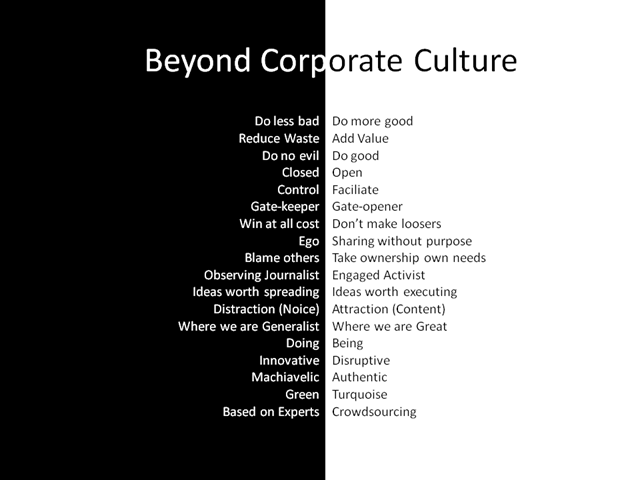
As a starter, a slide i once made as input to my Leading by Being Coming-Out. For more info on Leading by Being, please go to my very first post on this blog.

On the left the “old” culture, on the right the “new” culture.

LBB Coming-Out V8 - Beyond Corporate Culture slide

Today, i saw a perfect example of Old Game when looking at the chaos at the Fortis General Assembly. The attitude of lawyer Mondrikamen was appalling, and it was very disappointing to see a man of that caliber and education misbehaving and playing populist techniques.

Old Game of today: Modrikamen at the Fortis General Assembly on 28 April 2009

logoFB

http://www.holding.fortis.com/shareholders/webcast.asp or in the meantime the news-site of Belgian (Flemish) Television. Use this link, and start somewhere half-way the video.

New Game of today: also in banking. The new release of Mint.com, a company introducing innovation week after week for the interest and added value of its customers:

mint_white

And it is their own CEO delivering the demos. Have a peek at it and let me know when we’re going to have this sort of bank-service from one of our European banks.