Great to Good: new value kit

Umair Hague did it again. He just published the Great to Good Manifesto.

He starts with “Pepsi‘s great at producing something that’s bad for you (sugar water)”. And goes on by stating that “Do no evil”  “Don’t do evil” is not the same as “Doing Good”.

Umair’s blog is in essence about an Ethical Re-Boot. We all feel that we cannot go on with the greed-economy. We cannot go on with killing our earth. We cannot go on with hurting other people.

It is about a new value kit for the 21st century. About old game vs. new game.

In the table below, you’ll find some other examples.

image

I made this table about 2 years ago during my Leading by Being adventure. In fact it even started before that. The trigger was the book “Cradle to Cradle: Remaking the way we make things” by by William McDonough (Author), Michael Braungart (Author)

The book is from 2003 (almost 10 years old !), and i bought it after seeing a BBC documentary on the work of William McDonough. The key insight that opened my eyes was when McDonough explained that

reducing waste

was not good enough

There is a better alternative, and that is producing products that do not generate (less) waste, but that add value, that add goodness.

This is the essence of Great to Good. The difference between “Do no evil” “Don’t do evil” and “Doing good”.

In that sense, also the famous TED one-liner “Ideas Worth Spreading” is not good-enough anymore. Better is “Ideas Worth Executing”.

This must become a huge PR issue for Google, who have surfed the wave of “do no evil” “Don’t do evil” for 10 years now. They are also more and more seen as the “Beast of Mountain View”. If you read the wave of protest following the release of Buzz and the resulting privacy issues, you’ll get a good feel why

“don’t do evil”

does not work anymore

Umair Hague proposes a number of new corporate principles:

  • First how, then who: “Do our people have the capacity to judge right and wrong, no matter how great they are?”
  • The Yoda/Hedgehog concept: “companies should only do what they can be great at, what makes tons of money, and what they’re passionate about.”
  • Ethical accelerators: “”transparency, openness, rules, and accountability. Most companies have not a single one of these”
  • A culture of meaning: “Production and consumption are meaningful when they actually yield durable, tangible benefits to people, communities, and society”
  • Confront reality:” Banks, for instance, confronted the “brutal fact” that selling toxic financial instruments was great for their bottom line. But they never confronted the simple reality that a classic asset bubble in housing was failing to do good.”

Umair asks the right questions:

  • How many of the principles are at work in your company, industry, or sector?
  • What would your company, country, or life look like if each of the principles was applied to it?
  • How would applying each principle disrupt “business as usual”?

Defining, building, evangelizing, and nurturing this

new value kit

for the next 10-20 years

is all what our Think Tank on Long Term Future is about.

Reblog this post [with Zemanta]

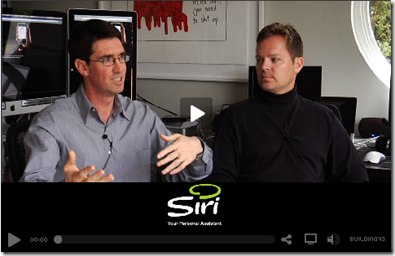
SIRI: your personal assistant in the cloud

Found via Scobleizer.

image

Watch the video till the very end. In the last 4 minutes or so there is a demo.

In essence its a free iPhone app with a fantastic voice recognition engine, that is orchestrating API’s in the cloud.

Normal – not geek – people ask me regularly: “But Peter, what do you mean with “cloud computing” and “semantic web ?”

SIRI is a wonderful example of what’s next. If you want to have an idea what semantic web means in practice, here you go. It’s location aware, it’s self learning, has some eMe elements like profile awareness, all of this in the privacy control of the owner of the profile data.

The dream of the personal butler coming true.

Why this is important ? In the words of Robert Scoble:

Don’t get confused by the awesome voice recognition engine that figures out your speech and what you want with pretty good accuracy. No, that’s not the really cool thing, although Microsoft and other companies have been working on natural language search for many years now and have been failing to come up with anything as useful as Siri.

No, the real secret sauce and huge impact on the future of the web is in the back end of this thing. A few months back the engineers at Siri gave me a secret look at how they stitch the APIs into the system. They’ve built a GUI that helps them hook up the APIs from, say, a new source like Foursquare, into the language recognition engine.

And listen to the two founders on how the back-end of this thing is working, and the other cool stuff they have in mind.

And now start thinking on what you could do with this in financial services:

  • Give me the best loan for car so and so
  • I want to buy this piece of art and need a credit line
  • Find me the cheapest routing for USD payment with cut-off time x
  • Get me to …

Would be very curious of guys like Richard Branson of Virgin Bank start to play with this. Or Sean Park with his view on software components in the cloud. How does this change our thinking on building an AppStore for Financial Services ?

I don’t have an iPhone (yet). But i know super-geeks Nick and PeterH have one. Nick, can you test this one, and let me know your candid feedback ?

Check out www.siri.com


Reblog this post [with Zemanta]

Cubicle 3B23: Let me entertain you


The idea for this blog post emerged when a colleague visited my cubicle.

I will from now on refer to my cubicle as “cubicle 3B23”. The idea developed to write regular post under the title “Cubicle 3B23”, reporting about the good, the bad and the ugly of corporate life. This is the first in a series. Maybe it’s the first and only one. But i thought the idea was “cute” to try it out, to see where it goes and to let the future emerge.

The initial idea was to do a one-off under a different title (go the the very end of the blog to find out), but a friend told me that “Let me entertain you” makes you want to read on. So here we go.

Sometimes people come to cubicle 3B23 for some good fun brainstorming: “Do you have 5 minutes, I want to pick your brain ?”. Others put their head into cubicle 3B23 and say something like “Oh, i see you’re busy, i will come back later”. The latter usually have something “sad” in their eyes.

These are the moments to connect. In both cases i know this connection will make somehow a difference.

The other day, Joe was the one with sad eyes.

He was doubting himself, and wondering whether he should do his own thing, or continue to shut-up and play the game of being mister nice-guy.

samrt-swine-flu-mask-4 

Joe was responsible for a program incentivizing staff to think out of the box. At TEDx Brussels, i heard a better expression for that: “burn the box”.

 

image

In the planning for the new year, he was asked to run the program again. But he felt it was just not right. He felt he would be cheating the people joining the program. He was doubting whether it really mattered. He felt that he would not be able to look those folks in the eyes at the end of the program as the expectations created were just over the top. It’s a bit like the subtle difference between lying and not fully telling the truth. Both don’t feel right, and appeal to your ethical compass.

He was tired. In search for his real purpose in life. Fed up with playing games.

We had a long chat. He kept on complaining about the artificial aspects in corporate life. Somewhere 1/2 way in our discussion, i asked Joe what really kept him going. What was giving him energy. In what circumstances he felt he could be his true self. Not the self that you construct/imagine to be in synch with the big bad world out there. No, the self that silently is waiting inside you to be discovered. To be stumbled upon is probably a better way to say this.

Joe gave it a long thought, and said: “when i can inspire other people, and make them happy”. (it was another answer, but then i would reveal too much about that person).

There was a short silence, and went to my PC, searched my music collection, started a song and said: “This is you, Joe !”

The song was right on. I could see the emotional impact on Joe. The song was “Let me entertain you” by Robbie Williams.

Robbie Williams' 'You Know Me' Music Video Debuted

I am an all-time fan of Robbie Williams. He is a great performer – once saw a concert of him in Wembley stadium – and you can love or hate him, but for me he is really authentic. Even if he puts on his rabbit/bunny head on. But i deviate. Although, this post is mainly about authenticity.

“Let me entertain you” is a high tempo energizing pop/rock song, but the real secret in Williams’ are often the lyrics.

Hell is gone and heaven’s here
There’s nothing left for you to fear
Shake your arse come over here
Now scream
I’m a burning effigy
Of everything I used to be
You’re my rock of empathy, my dear
So come on let me entertain you
Let me entertain you

I could see the sparkles in Joe’s eyes. “Yes, that’s what i want !” he said. “I want to entertain people ! Make them happy. Make them move/shake their arse.”

I have to say, me too.

But for me it translates into having this strange connection with “stage”
album_large_2215503

When i was young (…), i used to be a quite successful DJ. I organized rock concerts. I was on one of the first free-radio stations (end seventies). I even was singer :-/ in a rock-band.

I was always attracted by “stage”. The good buddies feeling with the roadies. The equipment being set-up. A great show. The after party.

Also today, when we do “events”, i love being close to the stage. I love to put together a program like Innotribe, and see how that resonates with the audience. Maybe we should do a TEDx @ Sibos 😉

I love to have and to apply authentically that soft “power” to move people emotionally. I even have that “stage” feeling when i try to do a good presentation in PowerPoint, Prezi, Adobe or whatever. Always in search for some good metaphors, good supporting images, have some “rhythm”, add some music to it.

But the last couple of weeks, it started smelling “like a trick”.
24_09092008ikugtf

It has become “too easy” to put a presentation together that is “different” than the average.

On my blog, i often experiment a very little with fonts, font colors and sizes, left/right indents etc. But it all starts smelling like a “trick”. Starts smelling like on auto-pilot. That’s why in this blog post no “tricks” with fonts. I don’t feel that way today.

I once was told that one recognizes the best the feelings of others when you recognize them with yourself. For ex if you easily spot arrogant people, that’s probably because you’re arrogant yourself. Projection that is called, i believe.

That’s why i feel a bit like Joe. I recognize the feeling. I can do more with my skills. I am in search for that something extra. Like Joe, I am not happy anymore with just well executing a job.

I want to make a difference. Not just a ripple but a wave.

My wife sometimes asks me: “Peter, why don’t you settle down ? Look at the others. They don’t worry that much.” But i can’t. And i doubt. Is this my true self ? Is this who i really am ? Or is this the image that i’d like people to have from me ?

By now you probably get a feel of the initial title of this blog post. It was “doubting my impact”. Doubting my impact when working for this or that particular company. For this or that particular audience. Not doubting my skills or my added value.

I know i have the holy fire and can ignite others.

But doubting my added value and whether at the end of the day it’s all worth it. Whether at the end of the day it all made a difference. Whether at the end of the day there is some new meat on the bone. Whether it really matters.

lov-story

This blog is often walking a thin balance between telling from the field, and packaging/romanticizing the story a bit that it just triggers the intelligent reader to do something with it but without going in “full contact”. The thin balance between private and public when you go public with a blog.

One of my bosses used to say “Management is a full contact sport”.

Ouch !

Do i want to be there ? Not in the way he meant it.

But yes, i want to go “full contact” in the connection. In keeping the doors of cubicle 3B23 open. To pick my brain or to share your pain.

Who feels the same ? Who wants to share his story ? Who wants to follow ?

Need for a new currency based on abundancy

Thanks to my subscription to Fredzimmy’s blog, I found this wonderful blog from Esko Kilpi.

image

I really recommend you to explore this site from A to Z.

  • Look at the wonderful slidedeck on Slideshare
  • Have a look at the Flickr photos
  • Have a look at the Bookmarks

image

MIT Media Lab Human Dynamics Group, Howard Rheingold (one of the first ever “internet”-books i ever bought,…, Barbarian Blog.

Yummy, Yummy. This is great stuff for a Sunday afternoon. So inspiring. Delicious 😉

This way, i discovered the FANTASTIC Web 2.0 Expo speech of Douglas Rushkoff about Radical Abundance.

It is a 15 min video, and worth every minute:

Not sure if the video embed worked, so in any case you can find it here by clicking the below image.

image


Some mind-blowing quotes (in 140 characters ;-):

  • The operating system for money is obsolete…
  • Abundance based currencies and monopoly based currencies…
  • Central Bank Monarch imprinted currencies are scarcity based currencies…
  • The money we use today was created so that rich people to stay rich by being rich (and lending) rather than doing anything…


google-coin

  • Our economy is based on the growth of interest
  • The people lending money get richer, the people creating value are getting poorer
  • But, what happens if you get something that’s abundant ? That you can’t make scarce.
  • The computers and networks change the “centrality” of value creation
  • You are now able to exchange value directly between one another rather than through a centralized currency
  • Optimize human beings to technology
  • Technology is more compatible with the values of efficiency than with all the other human values
  • Now you’re open and free to Google-Ads
  • Web³ will be won by the power of those who can index and aggregate. Is that what we want ?
  • Open Source and Crowdsourcing are not the same things
  • This notion of “free” leads to a society of copying, to no creativity, to no originality, to DJ’ing of culture
  • The abundance of genuinely creative output is declining
  • What we need is the development of a digital culture that respects the labor of individuals
  • What we need is the creation of new modes of currency based on abundance rather than scarcity.
  • I am talking about the original PayPal dream before banks asked them to be regulated like… banks
  • The next BIG thing are from people who will create genuine alternative electronic currencies and P2P exchange that do not involve cash.
  • I am talking about primitive local currencies such as Timebanks, Itex, Superfluid’s Quids
  • Cash has already lost its utility value, as it has been sucked out into investment capital, in the speculative marketplace
  • The only real competition against a Google universe (and their ideas of openness – see last weeks Google Blog post about openness btw) would be peer to peer exchange
  • We are not suffering from an abundance of creativity, just from an abundance of productivity, efficiency and openness.
  • If Web² leads to aggregation and indexers, then genuine P2P will lead to bottom-up value creation.
  • The next era is not about scaling-up anymore, it’s about figuring out how to exchange value, in stead of extracting value.
  • We are at a crossroads: right now we have the opportunity to optimize our systems, technologies, currencies to humans in stead of optimizing humans to them.


Reblog this post [with Zemanta]

Education, Elites and Bologna

I was watching this morning a television program with Christine Van Den Wyngaert.

christine

The program was in essence about her views and role in the Criminal Tribunal for the former Yugoslavia, but mu attention was triggered by something she said in the introductory part of the interview.

She was referring to the dramatic decrease of the quality of our education, mainly due to the Bologna Treaty. Just have a look at the Wikipedia link or do a google on Bologna Treaty. Or have a look at the Europa site. The first sentence on that site reads:

The Bologna process aims inter alia at making divergent higher education systems converge towards a more transparent system by 2010, based on three cycles: Degree/Bachelor – Master – Doctorate.

I always get irritated when people talk about “convergence” or “consensus” or “compromise”. For me these terms have a built-in notion of quality-loss.

Indeed, Christine Van Den Wyngaert explains that “thanks” to this treaty it was not possible anymore – no, even forbidden – to offer education with the same high quality standards as we used to have.

All this in the name of democratization of education and to give everybody access to higher education.


She went on by stating that many base foundation courses of general knowledge were being reduced to the level of “kindergarten”.

And that for some professions – definitely for a judge or a lawyer – good solid foundation education about history, society, etc are quite fundamental for doing the profession.

It is getting pedantic in a sense that even talking about creating an “elite” of scientists, judges, of whatever profession starts being banned straight-away.


I do not want my child being educated in mediocrity.


It made me think of the book “The Five Minds of the Future” by Howard Gardner.

21E fDecyLL._SL160_AA115_

I am reading it on my Kindle as we speak.

In that book, Howard Gardner arguments that education should not only be based on memorizing lots of information, but that education (whether at school or at home) should more focus on some essential skills that will be needed in the future (of real-time, high-information-based-society).

He calls these the 5 “minds” for the future. They are:

  • The disciplined mind
  • The Synthesizing mind
  • The Creating mind
  • The Respectful mind
  • The Ethical mind

About these “minds”, Gardner says:

Any individual with a deep understanding of a topic or method can think about it in a variety of ways. Conversely, an individual exhibits her current limitations when she can only conceptualize her topic in a single way.

This is very similar to having a very limited palette of ways to express yourself. Sometimes you hear somebody saying “I cannot dance on this or that sort of music. If i have to dance to that music, i cannot be myself (in an authentic way")”.

That’s pretty poor, if you ask me.

The art is to expand your palette of ways of being yourself in different situations.

Having the right to (the old) high standards of education, being trained in the 5 minds of the future, learning to be authentic in many different ways: all this should be part of the educational package of any young person having some ambitions for the longer term future.

I have come to a point where i do NOT believe anymore that our politicians and the whole system of lobby groups will help us getting there.

I was making the same reflection some weeks ago, when we were having our meeting of the Think Tank on Long Term Future, when i heard my friends complaining on how bad is it is getting in Flanders with respect to getting innovation on the political or any other agenda.


The innovation and education and

cultural agenda

get drowned into a political swamp

of consensus and power games


The end result is often or nothing, or something very grey (because of the consensus), or something very Kafkaesque.


I am getting convinced we have to do it


ourselves

Bring together some smart people in our think tank, and get private funding for the innovation, education and cultural development of the Generation-M.

Because they are looking for the things that really matter.


Reblog this post [with Zemanta]

Brain Chips

image


All images courtesy of www.gigaom.com. found via my subscription to the fantastic spacecollective.org site. Full link here.

I somehow like #2, but get discouraged when i read the description: “The technology is basically the same as that used to treat Parkinson’s disease.”

Seriously, it’s a great post, and indicated that brain chips are getting real and that the singularity is getting nearer and nearer.

Every morning I wake up angry

crash

It was triggered in me for the first time when I was watching the movie “Crash” featuring Sandra Bullock. She plays a rich wealthy healthy good looking woman that has everything. Has a great job, good family, fancies the better restaurants and clubs.

But she is spoiled and disconnected with the real world. She lives in an ivory tower.

It gets as bad as her saying during a morning breakfast discussion:

“Every morning I wake up angry”.


Angry

That emotion that was so present during (and after) the 18 month personal development program Leading by Being that a ended about a year ago now. The 23 Feb 2009 coming-out of that program also resulted in this blog.

My angriness this morning is basically triggered by an argument I has last night with my lovely wife about something really stupid. Nothing spectacular, but the feeling remained during the night. So, i had a bad night.

The trigger is pulled when i recognize that feeling of not living my full potential. When i feel swimming in syrup. What i feel i don’t progress anymore. Status-quo. It’s protest. It’s rebellion. It’s Anger.

In one of my previous posts i was writing about the holy fire. This time it’s maybe the devil’s fire.

This fire is also burning like hell, but the burning is one like

acid


It’s a lot of negative energy. It’s the devil inside me. The Hannibal Lector with his own (melo)-drama, showing himself as the complex persons as that suits him well, and does not force him to show his true (empty) self.

image

I went back to my notes of Leading by Being, “refreshing” what caused my angriness. This is what i found back:

image

It’s this feeling that i can do so much more but am standing in my own status-quo. Since the coming-out on 23 Feb 2009, there is not much i have done with all the nice resolutions i wrote down at that time.

It’s the feeling that you know very well what to do/change in your life to be your true self and not the self that you imagined for yourself. And being angry for not applying in any way all the great lessons you have learned in this program or in all the great books you have been reading in your life-time.

And feeling deep inside that something “big” is on your life-path, and that you seem to have missed it consistently or avoided it on purpose. The thing that Huge McLeod calls “You have to find your own shtick”

It was the fact that somehow playing around with something new, suddenly they found they were able to put their entire selves into it. Only the did it become their “shtick”, their true voice, etc. That’s what people responded to. The humanity, not the form. The voice, not the form". Put your whole self into it, and you will find your true voice. Hold back and you won’t. It’s that simple.

I have also been reflecting on this blog. I read quite a lot. Books. And I spent quite some time reading postings via my Google Reader. 2 hours per day is not uncommon (my wife loves me for this).

It really would not be difficult to post 3-4 new posts per day linking to other stuff i found interesting. And i discovered the trick that if my blog post title contains “Google”, or “Android” or… I get a lot more hits. But do those hits also mean impact ?

If so, it’s mere quantitative, not qualitative. And even when that happens, what does that do ? Make myself interesting and exposing how smart i think i am ? It is not satisfying. Anymore. Like others, I am in search for more

depth


I enjoyed much more the postings like holy fire. They’re more “authentic”. I know it is a big word. Maybe i should now share what stuff i am reading at this moment. Puts it all more in context.

I am in 4-5 books at the same time: re-read Seth Godin’s “Tribes”, devastated by Hugh McLeod’s “Ignore Everybody”, the disappointing Nick Carr’s “The Big Switch”, Howard Gardner’s “Five Minds for the Future”, Joel Garreau’s “Radical Evolution” and – in Dutch – Rik Torfs “Wie gaat er dan de wereld redden ?”  (translated: “And who is then going to save the world "?).

Those guys really inspire me.

I am inspired by what Howard Man, entrepreneur and the author of Your
Business Brickyard, has to say:

I’m continually amazed by the number of people on Twitter and on blogs, and the growth of people (and brands) on Facebook. But I’m also amazed by how so many of us are spending our time. The echo chamber we’re building is getting larger and louder.

More megaphones don’t equal a better dialogue. We’ve become slaves to our mobile devices and the glow of our screens. It used to be much more simple and, somewhere, simple turned into slow.

We walk the streets with our heads down staring into 3-inch screens while the world whisks by doing the same. And yet we’re convinced we are more connected to each other than ever before.

Multi-tasking has become a badge of honor. I want to know why.

I don’t have all the answers to these questions but I find myself thinking about them more and more.

In between tweets, blog posts and Facebook updates.

That’s why I’d like to write more about the real life. My life. Yours. My colleagues.

And not to show fear but

vulnerability


And to inspire others to dream.

What matters now

This is the time of New Year resolutions.

If you need some inspiration for your resolutions, I can recommend Seth Godin’s latest free e-book ‘”What Matters Now”

image

You can download it here.

It’s a collection of wonderful one-pagers written by smart friends of Seth Godin about noble themes such as Generosity, Fear, Passion, Compassion, etc

It also has a couple of advertisements for a fund-raising campaign for “Room to Read”, a program for providing books and education to children in developing countries.

image

In the collection of one-pages, the one that attracted immediately my attention and that really resonated with me was …

image


Have you ever wondered who’s behind that little voice in your head that tells you, “you’re in this by yourself, one person doesn’t make a difference, so why even try?” His name is Fear. Fear plays the role of antagonist in the story of your life. You must rid yourself of him using all necessary means.

We’re often impressed by those who appear to be fearless. The people who fly to the moon. Chase tornadoes. Enter dangerous war zones. Skydive. Speak in front of thousands of people. Stand up to cancer. Raise money and adopt a child that isn’t their flesh and blood.

So, why are we so inspired by them? Because deep down, we are them. We all share the same characteristics. We’re all divinely human. Until Fear is gone, (and realize he may never completely leave) make the decision to be courageous.

The world needs your story in order to be complete

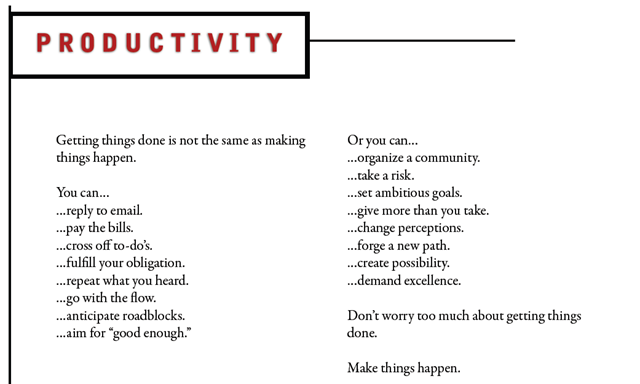
Or about Productivity:

image


Or about Gumption:

image

I want to be fear-less

I want to be productive

I want to make things happen


I am hungry


Want to flap my wings


I want it now

Web Squared for advanced

Very cool presentation on the impact of the web on the world. Web Wide World revisited so to speak. Enjoy.
View more documents from gloriagdiago.

Web Wide World


“The web is transforming society”

m04_20979625

“Web Squared: how the web transforms the world”

web2009_websquared-cover

“Web Wide World” transforming “World Wide Web”

image

Several very interesting publications and postings over the last couple of weeks, all confirming that something very profound is happening with our core systems, our core values, and how the collective intelligence of the web is gradually but surely transforming our value kit for the nearby and long term future.

First, i would like to point to 2 very rich and profound postings by Nova Spivack.

250px-Nova_spivack

On Nov 4, Nova posted The Web Wide World — The Web Spreads Into the Physical World.

A world in which every physical object, everything we do, and eventually perhaps our every thought and action is recorded, augmented, and possibly shared. What will the world be like when it’s all connected? When all our bodies and brains are connected together — when even our physical spaces, furniture, products, tools, and even our natural environments, are all online? Beyond just a Global Brain,

we are really building a Global Body

Even more profound and more elaborated is his posting What after the Real Time Web ? This supposes that you already have an idea what Real Time Web is all about. It’s a very long posting, but worth every minute/word of it. Some highlights/bullets with some personal comments:

About Web Attention Deficit Disorder: You can experience this every day if you are a Twitter, Facebook, Google Reader user. It’s about having tools to filter out the noice and focus on the essence

About Web Intention Deficit Disorder. Great “bridge” from attention to intention. I was thinking in terms of moving from “Crowd-Sourcing” towards “Crowd-Targeting

About Messaging. Messaging as we know it for 20 years is going to change 180°. In these days it is somewhat insane that we still send messages from A to B, whereas with today’s technology it’s more about having something stored centrally and collaboratively participate to this "information object in the cloud”. Google Wave is a powerful trendsetter.

About Semantics. What can i say. It should be clear by now for any semantic standards setting organization like SWIFT, like GS1, like… that their knowledge to deal with semantics in “messages” can now have a ten-fold impact in a “semantic web” world, where we now can automatically semantically tag any form of information, whether that information is already structured, or not (like in Word, PDF, images, digital information footprints, etc)

About Attenuation. About helping someone focus their finite attention more efficiently on the things they care about most. This makes me think of Generation-M (see elsewhere on this blog). The generation that cares about things that Matter.

About The WebOS.  I like Nova’s statement that “the winning WebOS is probably not going to come from Google, Microsoft or Amazon — rather it will probably come from someone neutral, with the best interests of developers as the primary goal.”

About Decentralization. “By this time the Web will be far too vast and complex and rapidly changing for any centralized system to index and search it”. It becomes increasingly clear that “central control” or “central policing” does not work in this Web Wide World. Definitely not if you don’t add value in the middle.

The intelligence is moving

to the edges

About Socialization. There is no escape. No hiding possible anymore. The future is for those who can share. That will be rewarded in new “currencies”. See elsewhere on this blog about the Whuffie Bank.

About Augmentation. Just today i was reading another post about augmented reality eye-lenses. And about Google Latitude now offering historical tracking on your whereabouts. Nova is mainly talking about real-time augmentation. Adding the historical tracker to all of this is pretty exciting.

About Collective Intelligence. Just quoting here: “This collective mind is not just comprised of humans, but also of software and computers and information, all interlinked into one unimaginably complex system: A system that senses the universe and itself, that thinks, feels, and does things, on a planetary scale.”

About Social Evolution. “Existing and established social, political and economic structures are going to either evolve or be overturned and replaced.” This has been my thesis since the beginning of my blogging. Stronger, it’s the raison d’être for my blog. If all this happens, what is the 2020-2030 impact on our core systems, on our core corporate and personal values. How will our companies, countries, world systems going to be organized and how can we prepare for the day when “Top-down beaurocratic control systems are simply not going to be able to keep up or function effectively in this new world of distributed, omnidirectional collective intelligence.”

About Physical Evolution. In essence, Nova describes the age of the Singularity, when our human brains will  be complemented by the collective and give leeway to a different type of human being.

The environment we will live in will be a constantly changing sea of collective thought in which nothing and nobody will be isolated. We will be more interdependent than ever before. Interdependence leads to symbiosis, and eventually to the loss of generality and increasing specialization.

This must sound as music in the ears to my friend and coach André Pelgrims, who is fighting the sort of societal and corporate change management that is often not more than a big illusion, because the company has been focusing on aligning (not event fusing) of departmental silos, and was not able to descend to the level of person-to-person connection and enlightenment.

These are just some of the changes that are likely to occur as a result of the things we’re working on today. The Web and the emerging Real-Time Web are just a prelude of things to come.

The last element i’d like to ask your attention for is the existence and activities of the Web Science Trust.

image

The Web is the largest human information construct in history. The Web is transforming society. In order to understand what the Web is, engineer its future and ensure its social benefit we need a new interdisciplinary field that we call Web Science.

Have a look at some of the big names behind the Web Science Trust: Tim Berners-Lee, etc. Also very good to see that some European (UK) universities are starting to take the lead.

Most interesting is to look at the Research Roadmap. Just look at the research perspectives, and it gives you an idea of the deep profound impact of the Web Wide World:

  • Computational perspective
  • Mathematical perspective
  • Social Science perspective
  • Economic perspective
  • Legal perspective

And the integrative research themes:

  • Collective Intelligence
  • Openness of the Web
  • Dynamics of the Web
  • Security, Privacy and Trust
  • Inference

I took the effort to download one of the students research reports. Oh boy, how interesting how these young people study, research, reflect, analyze. I’d love to be back at university 🙂

Here is one sentence about the WebSci’09: Society On-Line Conference:

Thanks to the support of the Web Science exchange bursary, I had also the opportunity to participate in the WebSci’09: Society On-Line Conference, which was held in Athens, Greece from 18th to 20th March 2009. The conference was actually a very special one, as it was the first conference I have ever been to where I had the chance to exchange ideas with not only computer scientists but and legal studies.

I believe it is key that

we start building companies

made of the “hybrids”

Not only computer-scientists, but people with cross-fertilizing expertise. Like “experts of other areas including social science, humanities and legal studies” and bio-engineering and nanotechnology.

All the above is very close to the suggested scope of our Think Tank on Long Term Future.