From time to time I get a mail with encouragements for my work at SWIFT and my work on the edges like “Rebels”. Today was one of those days. This is why I keep doing what i do. Below a letter from an anonymous reader of my blogs and tweets; a nice wrap-up of some of my latest work and efforts. At least it paid off for one person. I reproduced the mail without changing one letter. I just added the links where appropriate.
Peter,
Thanks for sharing your world in the links you provided.
I like the high energy style and content on your curated page on scoop.it (here and here)
Also looked at the Prezi presentations. Outstanding. I particularly liked the digital asset grid and the notion of a spectrum. I think the digital identity element coupled with a digital asset perspective is key to the next stage of digital development. I also like the services model you present at the end — like the perspective of both an enterprise and a customer or individual perspective and call for action on it and suggest some solutions. I too came to a similar conclusion that the power of identity is key and that it can be viewed as an exchange between the individual and other parties. Great work, Peter. I have attached two papers that I wrote with colleagues some time ago that explore what we called pervasive personal identity and a second paper on alternative security viewpoints (atomistic view — which is really an asset view). Totally agree with your From To perspective on security.
Also very intrigued with notion of SWIFT playing a role in this space. We need some trusted players in this space that are not simply motivated by big data and commercial interests (e.g. Facebook, Google etc. “Everybody wants to replace me with my data. Your experience in Belgium also, in my opinion, can provide a leadership role on the global scene. I would like to see more told about that story.
And I would say the soul of innovation is a tour de force. Uplifting, emotive and a powerful message. I very much like the juxtapositions of art, science, psych, esthetic, and experience. Also a fan of B. Fuller.
Bottom line: Important, inspirational and incisive message(s)…
Thanks for sharing. Made my day. You also gave me additional motivation to get on Prezi.
Have a great time and much success in Bangkok and Sydney.
(x) name known
Thank you (x) from deep in my heart. You know who you are. It gives me a boost of energy for next weeks Innotribe in Bangkok.
The last couple of weeks I have been aroused with many ideas and reflections on Personal Digital Assets and on Digital Assets in general.
The journey started some weeks ago with my prezi talk at TEDxNewWallStreet and included my participation to the WEF “tiger team” on Personal Data, where a group of 30 experts are looking at what is needed to make realize the vision of Personal data as a new economic “asset class”. Personal data created by and about people, touching all aspects of society. That group is stitching the pieces together for a framework of business, technical and legal elements that are needed to underpin this vision.
However, the following video from Kynetx was the big aha-moment during my 4-weeks tour on the subject.
I never thought of a Personal Data Store as a “Personal Event Network”.
This changes everything ™
indeed as Phil Windley (@windley), CTO of Kynetx says.
One years ago, there was this beautiful video animation by David Siegel (@pullnews), a great vision of distributed nodes of personal data content talking to each other through API’s.
In the meantime, there is a rich ecosystem of start-ups that are building something very similar as we speak.
Maybe not yet to its fullest grand vision, but definitely going way beyond the traditional concept of a “personal data store”.
Check out leading start-ups such as Personal.com. Btw I dream of one day seeing an integration of Personal.com with an on-line bank. Anybody needing a brokering service here ? 😉
What Kynetx is adding to the mix are three important things:
the “event” based thinking
the prototol for the data-web
Cloud Operating System
Event based thinking:
He really nailed it down for me last time I met him:
In the past we had RPC (Remote Procedure Calls), in essence fire and forget
Then came request/response: you ask for something, and you get it
Now there is the “event-signal”. It does not ask for something, it just says “something’s happened”, and any entity in the network can subscribe to the event and decide itself to do something with it.
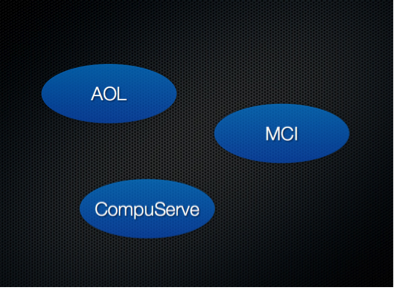
For those who remember, in the past we had silo-d email systems. AOL, Compuserve, etc. They did not interoperate. We got rid of those silos when there was a standard protocol, allowing competing commercial and open source servers to talk to each other in SMTP.
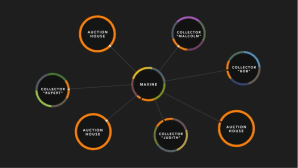
We now see the same with data, personal data, social graphs. We have data-silos (Facebook, Google, Bank systems, Health systems, Government systems, etc). What we need is a “Data-Server” and a “Protocol” that allows these data servers to be interoperable.
All this, Phil calls “The Live Web” (Amazon Associates link). He is so excited about this that he has written a book about it.
In other words, start thinking about your “Personal Data Locker” become a “Personal Event Cloud”: your personal data-server in the cloud that can talk and do things on your behalf, can make decisions, interpret rules, etc…
And it can talk to any entity, any node in the web (or at least nodes in any discoverable namespace). In real-time. In multiplexing mode (meaning the node can be both a server and a client).
It suddenly dawned to me that over the last years we have been hyping “The Programmable WEB”, and that if we are serious about customer centric identity or “customer centric” or “personal” whatever, we may wish to start with the “me”.
Suddenly it was flashing in my brain: “The Programmable Me”
“Me” is becoming a node in the grid. We are all nodes in the grid, sending and receiving signals. Like neurons passing an electrical or chemical signal to another cell. And start thinking “synapses” when you talk about the API’s of your Programmable Me.
From Wikipedia:
“Synapses are essential to neuronal function: neurons are cells that are specialized to pass signals to individual target cells, and synapses are the means by which they do so”
The APIs of your “Programmable Me”, of your Personal Event Cloud are indeed the means to make all these nodes interoperable.
Add to this the graph-thinking of Drummond Reed (@drummondreed), Co-Chair of the XDI/XRI Technical Committee of OASIS. Check-out http://wiki.oasis-open.org/xdi/XdiGraphModel and more specifically some of the Powerpoints out there:
Each circle in this drawing represents a node in the grid. I really encourage you to look at this as a graph – this ensemble of inter-connected nodes – as something 3-dimensional, possibly multi-dimensional.
We have all been trained to think hierarchical. Flat files with a root, that sort of thing.
We have to learn to think in graph-models.
You can start anywhere in the galaxy. Every point can be the center of the universe. There is no root. At least, not in absolute terms. Yes, in relative terms with respect to the other nodes in the universe…
A grand vision starts to develop when you realize that the nodes can be any type of entities:
Humans (or their agents)
Circles (like Google Circles) of humans (entities without legal form)
Corporations, non-profits, governmental or educational institution (aka organizational constructs of humans with specific legal form)
We should also include less traditional forms of organizational constructs such as co-operatives, P2P communities, Commons,…
Programs (yes, software code), that perform tasks on behalf of the entities above or that operates as fully independent entities.
Each of these nodes/entities can participate in transactions – or better, “value dances”. “Dance” because the protocol is multiplexing, not one-way request-response.
Of course all these entities will require identity, in the broadest sense, not only URI or ID number, but in the sense of a spectrum, a graph that can be shared in context with other nodes/entities.
Sharing the spectrum becomes the essence of trade
What we are witnessing is a 180° turn in the power balance between client and server, slave and master, buyer and supplier, consumer and merchant.
But look at the subtitle: “When Customers Take Charge”.
I like Doc a lot, but his subtitle may suggest that somebody else is in charge: the empowered customer. I am afraid that we may end-up with another un-balance, where the pendulum has swung the other side: where the customer has an unfair data-advantage versus the merchant. But let their be no doubt that today the merchant has the unfair data-advantage, and I read Doc’s book more like a plea for getting the balance right rather than a socialist rant against establishment represented by the “big boys”, the vendors, the merchants, the silos like Facebook and Google.
In all the discussions about the Empowered Customers, we see classic commerce use cases like buying a book, buying flowers for grandma, etc
But I would like to make the jump to truly balanced financial transactions and what “dances between equals” would mean in that space. I invite you to think about your bank as the merchant, the merchant of financial services, and the consumer as the retail or wholesale customer of the bank.
In such scenario, the fundamental shift in thinking already happens at the Point of Sale (POS). We even have the question the term “Point of Sale”. It stems from an old thinking where the merchant “owns” the customer.
YOU are the point of sale
YOU are the point of data integration!
In the past the POS was the master,
now it will be YOU who is in charge,
or your agent,
the “Programmable Me”.
What if we start thinking about banking where YOU are the point of data-integration? What if your bank would offer you a service that enables you to manage your Personal Event Cloud?
I don’t know how it would look like, but it probably would be something triggered from your mobile phone. It probably would look like one of the Next-Gen banks (Simple, Movenbank, Fidor) with a Personal Event Network out-of-the-box.
Some of these Next-Gen banks are already accepting the CRED of your Social Graph as a much richer (in all senses of the word) basis for “Know you Customer”. Although we probably also have to inverse that: from the captive notion of “know your customer” to the user-centric meaning of “know your bank”. Then we may come back to the “primitive” of the meaning of “bank”: a bench where two people meet to build a relationship of value.
So, the discussion is NOT about the next coolest thing for doing a copy-cat of existing money-transactions through the latest greatest gadget like NFC or Bump, or whatever.
“The thing to keep in mind here” says Crone, “is that NFC was developed more than 20 years ago. It was first deployed 10 years ago. 10 years ago, we didn’t have ubiquitous access to data plans. We didn’t have more smartphones in circulation than feature phones and we had to depend on an ‘offline’ connection for processing payments. But now, there are 124 million households that have more than one device connected to the internet. Typically, that’s a smartphone, but very quickly it’s becoming a tablet.”
Also Christopher Carfi (@ccarfi) starts thinking in this direction in his recent post “Musings in Small Data”. In there, he refers to a video of Jerry Michalski (@jerrymichalski) of the REXpedition doing a demo his “Personal Brain”. (Disclosure: I am member of the REXpedition). The video is titled “Gardening My Brain” and the talk was given at Personal Digital Archiving on February 22, 2012 in San Francisco.
It’s a pity that this talk is in the context of a personal digital archiving conference. Because, in my opinion, we have dramatically evolved from archiving to sharing.
Sharing of information and digital assets is becoming the new normal in this world of Abundance of information.
Christopher Carfi nails it when he says:
As these issues become more widely understood, more individuals will be tracking their own information. Perhaps it won’t be to the level that Jerry has done it in the video above, but it will be happening. This means that we, while wearing our business hats, will need to be developing real relationships with our customers. We need to listen to what they are saying, what they are asking for, and working collaboratively with them in order to help them fulfill their needs. In the best cases, we’ll have built up levels of trust with our customers and will have been given the explicit permission to access our customers’ personal data stores. In doing so, we’ll be able to actually take the guesswork out of the equation that was noted so clearly above in the Facebook example and will, instead, be able to connect directly with our customers’ intentions and deliver value on their terms.
Creating an economy based on the principles of relations is of course at the heart of the REXpedition. It is probably the next territory for competitive advantage beyond the mundane money transaction.
All this is about creating “Relationship Channels”, channels the vendor can tune into of the user has opened the channel.
All the above are of course very much related to our Innotribe incubation project “Digital Asset Grid” (DAG), which is about the sharing of any digital asset with any party.
The real question is then: “Where will value be created when all the connections between nodes have become frictionless?” Mark has some ideas on this, and he describes them as “irreducibles”
“No matter how ‘smooth’ and frictionless hyperconnected commerce becomes, certain frictions in the business world will persist. These represent both speed humps and opportunities. The businesses of the 21st century will find leverage and differentiation by identifying and exploiting them.”
What those “irreducibles” are, you will be able to discover at our upcoming Innotribe event in Bangkok on 26-27 April 2012, where together with Mark Pesce we will have some great interactive learning experiences. Be there, or read the report that we will make on this post-conference.
If you really want to take a meta-view on all this, I believe all the examples above illustrate our species being in search for a deeper meaning, a thicker value in everything we experience:
We are in search for a higher level of consciousness, a further evolution in Spiral Dynamics, in search for a richer value system, much richer than the pure transaction world that is the narrow lens of today
We start looking at companies being nodes in the grid, in fair-trade constellations of equals, trying to maximize the commons and contribution and giving back to society
We want to go beyond the “advertising” thinking of “let’s hit the target with an ad”. We are in search for a better world with more Thick value and less Thin value
We are starting to see the emergence of “The universe as a Computer” as wonderfully described by Nova Spivack (@novaspivack) in one of his milestone posts last month.
All the above is about defining, articulating, and living lives of greater meaning. With the “M” of meaning. Umair Hague (@umairh) already in 2009 called this “Generation-M”, which in essence is anchored in “constructive capitalism”
Generation M is more about what you do and who you are than when you were born. So the question is this: do you still belong to the 20th century – or the 21st?
What I liked about this book is that it encourages you to look at where you are in your life, and to look at it through the “M” lens. The lens of meaning.
I then discover that what I am writing today, what job I am doing, who I am married to, was probably all meant to be this way. Not “meant” in a deterministic way. No, “meant” as everything I have done, the decisions I have made, my architecture studies, my infection by the identity virus, my journey in Leading By Being, etc… all these things have made me who I am.
What if I could capture all this richness about me, and have a tool and an infrastructure to share that on my terms and conditions, in context, and with the parties or nodes in the grid that I choose to? What if I could share my meaning in a programmable way?
I would end up with something called “the programmable me”
We are all – or should be – familiar with Clayton Christensen’s work on The Innovator’s Dilemma, where he articulated the principles of disruptive innovation. It’s a great business book about innovation.
This is a book about “…how market-leading companies have missed game-changing transformations in industry after industry…not because of ‘bad’ management, but because they followed the dictates of ‘good’ management. They listened closely to their customers. They carefully studied market trends. They allocated capital to the innovations that promised the largest returns. And in the process, they missed disruptive innovations that opened up new customers and markets for lower-margin, blockbuster products.”
For innovation to happen in a company, the principles of Christensen’s books are definitely great advice. There are several other innovation business books that are recommended reading. Check out my GoodReads page.
But since a couple of months now, I believe there is something else we need to look into: something else that is the ticking heart of innovation, something about people, about humans, that makes the difference between thin and thick value creation.
I don’t believe anymore in big corporate change programs that are rolled-out top-down in a military drill. Whether those change programs are focused on efficiency (Lean, Six Sigma, …) or on creating new value (Innovation) does not matter for the argument here.
Real change happens from within the organization. Bottom-up. Virally.
What I want to talk about is the other innovator’s dilemma: the human dilemma, the Innovators Personal dilemma.
This personal dilemma post is about joy versus pain, passion versus suffocation, freedom versus slavery, excitement versus illusion. It is part of saying the unsaid. It is a cry for freedom, a cry for unleashing the energy of the hidden pearls in our organizations, a cry for supporting and encouraging those who really want to create positive viral change from within our organizations.
There is so much positive energy in our organizations that we could tap into, but that energy gets blocked by the corporate “machinery”, by best (or worst) practices, by power games, and in some cases by plain sick people or organizations.
With Corporate Rebels United, we gathered a really great cross-industry sample of innovators, instigators and protagonists that work in bigger and smaller organizations worldwide. We came across a number of real-life stories that give a glimpse of what sort of human dramas sometimes happen deep in the fabric of our corporate organizations, and that are a absolute barrier to innovation.
The great advantage of working as a group is that we now can see some patterns cross-industry. They are not specific to one or the other organization. They are universal. And I want to put them on the table. I want to create awareness.
But most of all, I want to create a soundboard so that we increase our sensitivity and awareness for the symptoms, so that we can prevent human dramas and turn the pain into something positive, an unstoppable wave of change that will transform our corporations from deep within.
Innovation only happens when somebody steps out of the blueprint
And that means taking a risk. That means going for your own beliefs, against the flow, against the current practices of “this is how we do business here”
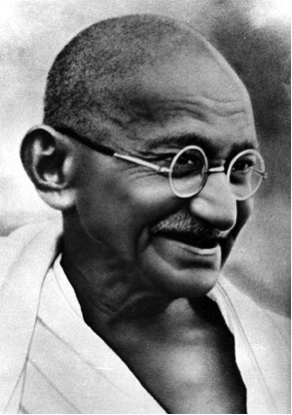
Ghandi: “First they ignore you, then they ridicule you, then they fight you, then you win”
It takes guts to try to change the corporation. Many people try. They will laugh at you. Many get hurt as well. Sometimes minor scarves. Sometimes it results in deep wounds of self-esteem. I collected some stories to illustration the innovator’s dilemma.
There are some common themes in these stories:
– I want to jump, but I have a family to feed
– I am surrounded by sick people
– The employee as a resource
– The fear of being punished
– I want to innovate but my manager does not let me
– Leading by Being does not get recognized
– Not good for your career
I want to jump, but I have a family to feed
Some of the reactions to my “The Myth of Innovation Incentives” post made me more aware of the “luxury pedestal” I am preaching from. By being part of an innovation team, I get by definition much more freedom than those who are deep in the trenches. In my personal life, I have reached some level of personal wellbeing and stability. But many of my friends out there are at the beginning of their career.
Here is one reaction I received from Jonathan to our invite to join corporate rebels. Jonathan works in the pharma industry:
I have to say that my current employee is a really, really conservative corporation. Quite frankly speaking, we are in dire need of a lot of corporate rebels – but I strongly believe that joining your “club” would get me into serious trouble – if my boss or our corporate communications department ever found out (and they would never, never ever supply me with any resources in that matter). And since I´m going to be a father for the first time this year, trouble with my employer is something I´d rather avoid if possible.
The personal dilemma: “Stand up for who I am, or give in to the power of the corporation”
My answer is one of empathy. I have been there as well. And I regret not having spoken earlier in my life. I do cannot force a person to jump off the springboard. I can only give a gentle nudge. Encourage you despite everything to go for the unknown. Opting for uncertainty and doing something scary (or not) is a deep innovators dilemma. Because you know: if you are not scared of what you’re doing, it’s probably not innovative enough. It’s not disruptive enough. It’s a deep human dilemma, going back to daring to be great. Daring to live and act from your belly. Liberated from the chains of captivity. Leading by being from your true self.
My answer is also that making the jump does not always have to include dramatic live changing decisions. You can start small. And getting addicted by small doses of adrenaline when you stand for who you are. And then a bit more, and a bit more. Makes me think of “Love is the drug” from Roxy Music.
I am surrounded by sick people
I got the following message from Françoise, a 33 year energetic woman, working in an energy utility company:
In our company we have a culture of public humiliation. Mocking publicly about people’s achievements during town hall meetings, that sort of things. For a person who has worked his fingers to the bones, despite all odds, being humiliated publicly was devastating. The way things work in our team is “man eat man”. They put you in an arena, let you fight it out and silently watch. Whoever wins is right. Blame is the name of the game. Everyone dreads that. If you fail, you will be publicly mocked. Whiteboard and town halls are the new place for mocking failures. I remember such treatment in school. For heavens sake, we are adults. They took me off the project I loved. I was “promoted” to a new project. The new project was boring as hell. I could not motivate myself to do any of the work they assigned. Writing this mail is painful beyond my imagination. They were so manipulative beyond words. The crime they commit has no facts. The torture I have endured has no records.
It makes me think of a recent case in public service in Belgium. A woman working for the city hall in a small village was disturbing because she said the unsaid. She was “promoted” to a new function. Her new office was a dirty back room of a side building. She got a computer, but one without connection. She did not get a phone. She was not allowed to meet people. All this with the excuse that her new job required her to focus. She had the courage to go to court. She won.
The Personal Dilemma: coming up for your rights, or let your company by run by sick people
I have heard many stories like the above from many companies cross-industry. These stories illustrate plain criminal behavior by sick people. There are no excuses for this. That’s why companies have “persons of trust”. Let there be no mistake. Go and find your person of trust and open a case. Whenever you can, put on the table these sorts of practices, so they and the people responsible for them get eradicated from our organizations. To grow healthy plants, you must first sanitize and fertilize the land.
The employee as a resource
Doc Searls (@dsearls) describes the relationship between a vendor and a customer as a Client/Server one (at times trending to slavery) where the customer calf is drinking the cookie milk from the vendor cow.
What he describes in buyer/supplier relationships is equally applicable in employer/employee relationships. The proposed solutions for “getting the cattle human” is by proposing them tools to take control of their own abundant information.
Replace vendors by employers in the slide below:
Extract presentation Doc Searls at New Digital Economies 27 Mar 2012
Whether employees are seen as cattle or just resource also quickly becomes apparent in all sorts of employee surveys and result discussions involving “benchmarks”:
Here is Anthony from a Financial Institution, reporting on one of their latest employee surveys on corporate culture:
The results of the survey indicated that we were doing quite well compared to the rest of the industry. I could not match that outcome with the generalized quantified results that less than 40% of the employees felt engaged. What if “the industry in general” was crap and a standard for mediocrity? What if the expectations of the staff set the bar way higher than the benchmark? What if we benchmarked against the wrong standard? These old surveys do not take into account that the environment has fundamentally changed. Due to abundance of information, social media and P2P communication, the employees have a richer and more precise data set available. We laugh at those “official” benchmark cheering results
The fear for being punished
Something very similar pops up, when companies try to define KPI’s for innovation. Check out this great post from Drew Boyd (@drewboyd)
Measure innovation alternatives, not just the current program. When assessing the impact of an initiative, always ask, “Compared to what?” Don’t fall into the trap of measuring only what the company is doing today. Rather, measure it against the next best alternative. For example, if you are using a ideation methodology like S.I.T., be sure to measure the effectiveness of using S.I.T. versus another ideation method. Understand why you are using one method over another by forecasting results from the alternative. This re-frames the question from “does this method work?” to “does this method work better than this alternative?
and:
Measure novelty, not impact. Senior leaders want to know the “bottom line” impact of innovation. When they see ideation results, they respond with, “Yes, but how many of these actually made it into the marketplace, and what revenues were generated?” This is a trap because so much of the impact is dependent internal and external factors. Holding employees accountable for impact will cause them to avoid the truly novel and game-changing ideas. They fear being punished for pushing great ideas that fall outside their category. To manage this dilemma, managers need to think more in terms of finding the “innovation sweet spot,” that place somewhere between disruptive and incremental. The right balance between risk and reward is more likely to occur here.
I want to innovate but my manager does not let me
I silently helped without getting any credit. Then I saw your post about Corporate Rebels. I sat there and was thinking, here I am really doing a rebel activity and suffering and no one is paying attention. At that point everything started looking fake to me… Pain is deep and buried. It takes lot of time to vent it all out. My point is, don’t lose me. I am of lot of value to my company because I genuinely care about the company and its people. My friends do too. Some of us get fired for stepping out of the blueprint. Don’t let this happen again and again. Please use your power and contacts with powerful people to do something good and to fight against injustice.
Leading by Being does not get recognized
If Chris is rocking, it is because of the way I nudged him to do it. If Laura is jumping up and down with ideas, it is because she got inspired by what I was doing. I have inspired many souls at our company. Inspiration can only happen if someone is speaking from his or her soul. Inspiration is language of soul. I have earned respect from lot of people at in the company because of who I was. I have the attitude to make people take action. But I got fired. Because real change disturbs and challenges the status quo. My death was so silent. They did not even give me a chance to say good-bye. It is fishy and please don’t let this happen to anyone else.
Not good for your career
And also heard the following so many times: being innovative is hampering your career.
Kathleen just joined a telco company:
In our company we have a Young Grads Program. But when postulating for the innovations positions, we are kindly taken aside, and somebody whispers in my ear “being part of the innovation team is bad for your career as a manager”.
That’s a really bad story. It’s the story that lets you immediately recognize corporations where innovation is just window-dressing. Even the young people, full of healthy innovation energy don’t get a chance. What a disaster if you have joined such a company. Getting suffocated in your ambitions and drive from day one!
Any CEO with her innovation heart in the right place should mandate – yes mandate – that all newcomers and GEN-Y’s first get immersed in the innovation team. What people are allowed to do there is not the worst possible scenario; it is the best possible starting point for doing much-much more, to instigate real and viral and tidal change throughout the company.
Conclusion
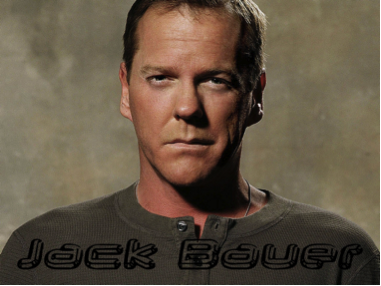
All the above are REAL circumstances in REAL companies. Yes, innovation in these circumstances is hard. You have to go against the wind. And find the balance between a good/bad rebels. Sometimes you will be seen as subversive. And to be honest, some healthy dose of subversiveness is needed. Sometimes you need to act like McGyver. Sometimes you need to be Jack Bauer. One company told me they were acting like the “agency of subversions”
But I can’t expect everybody to be on that extreme end. I would already be so happy if with our Corporate Rebels United movement we can unleash the change-energy of every individual in our corporations.
That each of you have the courage to stand up, to come up for your ideas, to start small and make little changes, or to be very hungry and go for the big visible changes. One could refer to introvert and extrovert changes. Both are equally important to make true and viral change happen.
But we can’t have subversion or anarchy. This is not the way we as Corporate Rebels United want to go. We do not want to provoke for provocation sake. And we do not like to be like the Cacaphonists. Nor do we plan to start flash mob activities who share some ideas with Cacophony, as well as groups like Improv Everywhere and movements like Discordianism.
What we want is change
Viral change from within the fabric of our corporations
We want to change our corporations, not by complaining and blame-is-the-name-of-the-game, but by showing the right behavior, by encouraging each other, by uncovering the hidden pearls of our organizations. But for sure as well furiously fighting and making visible injustice, sick or plain criminal behavior.
We want to change, not by focusing on the things that make innovation hard and only looking for self-esteem, but by focusing both on our dreams and on other people in our lives.
We want to change by daring to be great.
In small and big things/actions.
It feels like somebody should start writing the first chapter of the human book for innovation. Maybe that somebody can use some testimonials of this post. Maybe Whitney Johnson (@johnsonwhitney) is the one? She is preparing a book titled “Dare, Dream, Do”. It’s planned to come out in May 2012. Maybe she addresses the human aspects that are not covered in business books.
Daring to dare is the personal dilemma of corporate innovators
If you feel inspired, join Corporate Rebels United, by leaving an “I join” comment on that or this blog post.
People call you an instigator, a protagonist, a renegade, a pirate, a mercenary, a rebel, or an empowered employee. We know you for what you really are: a change agent who sees speed, change and innovation as the new corporate norm. We know because we are you. We know the challenges – and the excitement – of driving change in an incumbent or start-up company. We know what it means to go for “The Innovator’s Risk”
We call ourselves “Corporate Rebels United”.
The concept of Corporate Rebels is not new. Many people have written about or have alluded to it:
The key answer that defines the post-digital enterprise is to shift attention from the cost side to the value side. Rather than treating employees as cost items that need to be managed wherever possible, why not view them as assets capable of delivering ever-increasing value to the marketplace? This is a profound shift in focus. For one thing, it moves us from a game of diminishing returns to an opportunity for increasing returns. There is little, if any, limit to the additional value that people can deliver if given the appropriate tools and skill development.
and
The post-digital divide will force them to choose sides – on the side of employee empowerment, or on the side of tactical cost cutting, job cutting, and diminishing returns. If not, the divide will choose for them.
But a Corporate Rebel has something extra. It is about daring to stick out your neck. It is about taking personal leadership.
So perhaps we could use a more neutral word: protagonist. A protagonist is a principal champion of a cause or program or action. The protagonist does not wait for permission to lead, innovate, or strategize. They do what is right for the firm, without regard to status. Their goal is to do what’s good for the whole.
Lois Kelly (@loiskelly) from Foghound and Mike Maney (@the_spinmd) from Alcatel-Lucent also discussed recently whether the word “rebel” is not too negative. Mike made some very deep reflections why the hard dividing line between good and bad rebels does not always make sense.
Argument aside, we believe that – positioned well – the word “corporate rebel” exactly reflects who we are.
The aim of “Corporate Rebels United” is to create a global community of extraordinary corporate change agents. It is not an academic exercise or research effort. It’s something deeply actionable.
Our mission is to build the most amazing community of corporate rebels worldwide to ensure that true change and innovation happens virally
The initial idea for Corporate Rebels United emerged when innovation teams of Alcatel-Lucent and Swift met and worked closely in the context of Swift’s Innotribe program. We were excited by the exchange of ideas and energy that emerged when like-minded folks came together. And that got us thinking about some big “what if’s”:
What if we could create a tribe of the best and most exceptional corporate rebels worldwide – people like us, people like you?
What if we could start leveraging each other’s ideas, energy and best practices?
What if we could design a movement to support each other when the going gets tough?
What if we could cross-fertilize and infect our organizations with the change-virus from within?
We want to identify exceptional people worldwide that already have an impressive impact on change and innovation in their corporations, no matter in what field or industry. The movers and the shakers. The do-ers of today. The ones who take initiative. Who create deep change from within. People who energize their organizations by leading from their true selves. The crazy ones. The rebels. The troublemakers. The ones who see things differently, and who are crazy enough to think they can change the world. People like you.
Our plan is to start small – 15 founding rebels cross-industry – because we want to ensure quality and resilience in the initial starters group. We’d like to get the spirit right from the start. We have scheduled a kickoff call on March 30, 2012 with 15 founding rebels. We will follow that call with an off-site meeting where we’ll jointly build a set of agreed upon principles and a longer-term action plan to open and expand Corporate Rebels United to a wider audience.
A lot of “getting the spirit right” was already included in one of my latest prezi’s on the “Soul of Innovation”. Without any publicity, this prezi already generated more than 3,000 hits in less than one month. We seem to have touched something that resonates. Some of it was withheld for my TEDxNewWallStreet talk last week in Mountain-View. Innovation is more than a set of tools and processes. Innovation is an attitude with tribal energy!
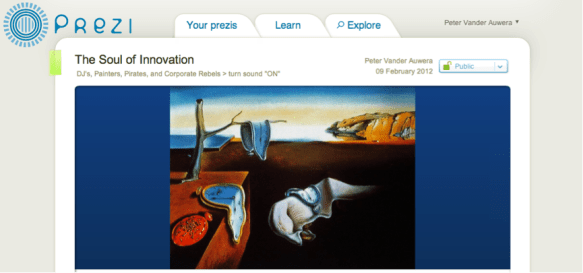
For viewing this prezi, turn audio “on”, as I experimented a lot with sound and visual landscapes.
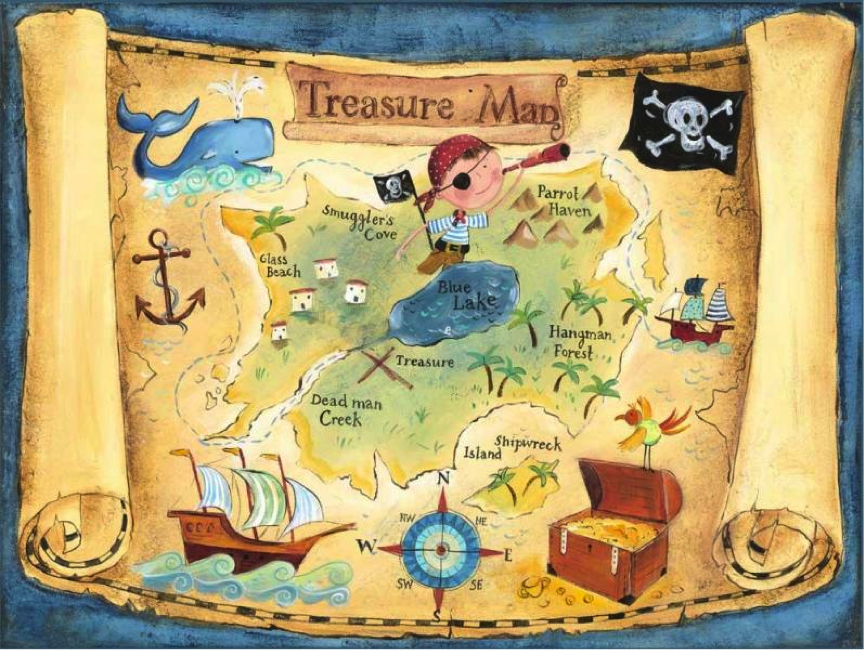
Somewhere halfway in that prezi, you will discover the Rebels Manifesto in the Pirates Treasure Map
Rebels Manifesto
Relentlessly
Challenging the status quo
Breaking the rules
Saying the unsaid
Spreading the innovation virus
Seeding Tribal energy
With No fear
With a cause to do good
Leading by Being from our True Selves
Going after the un-named quality
Relentlessly
What exactly Corporate Rebels United will do is the essence of our discussion at our kick-off call and event. Initial ideas include:
We want to build an action-driven community.
We want to create an incredible energy bomb of corporate change.
We aim for a very high level of integrity and authenticity. We want this to be morally, intellectually, and artistically right
We want to re-enforce the energy of known rebels in a non-zero sum community.
We want to identify and unleash the energy from the hidden rebels and the hidden pearls in our organizations and give them a voice
We want to create exchange programs between our corporations
We want to have deep positive business impact on the corporations and organizations that host and pay our salaries.
We want to create a culture in our corporations where change is the norm.
We want to measure the progress and propulsionwe make/create:
Individually
The folks we influence
The corporate change heartbeat
We want to evolve our corporations into places of constant change, resilience, responsiveness, reflection and vibrant energy.
We want to create a place for play, fun, rock, and rich personal expression
At the start, Corporate Rebels United will be a closed community: we’re looking for atypical people who make us go WOW!
Because they act from their true self and without fear, and make amazing change happen within their organizations and the ecosystems they are part of.
People with a moral, architectural, almost artistic integrity. People with a BIG innovation heart in the right place.
We’re looking for people who inspire us as human beings. With open mind, open heart, and open will.
We plan to go full-steam as from our Kick-Off call on 30 March 2012, right after the start of the 2012 spring. Our ambition is to be able to shine and radiate as a strong community with first results by end October – Mid November, not co-incidentally the busy conference season with Innotribe at Sibos, Techonomy, Defrag and Blur.
Like Bill Gates wanted to see a PC on every desktop, and Eric Schmidt wants to see an (Android) mobile in every pocket, we want to see a corporate rebel in every company. That’s a lot of corporate rebels 😉
Of course, I am not Bill Gates, nor Eric Schmidt. But there is still enough room for a normal human being like me to create significant impact. And although I am 55 years old now, I still want to change the world. And yes – at 55 – I still would like to instigate a Corporate Spring. There is no age for Corporate Rebels.
We jump and want to feel the daily adrenaline of being and coaching Corporate Rebels every day of our life.
If you are interested to join Corporate Rebels United, leave a note and some argumentation on why you’d like to join in the comments section of this blog post. And/or let us know what you can bring to the table to make this a big success.
Let’s 21 March 2012 be the start of our Corporate Spring! Because we believe it matters to infect our organizations with “change-as-the-norm” from the bottom-up!
Every now and then people ask me what incentives we have in place for encouraging innovative behavior.
The short answer is: there are no incentives other than recognition and self-esteem when your idea happens for real. For people with a specific innovation role – such as our “Megaphones” – we do have their innovation objectives as 10-15% of their NORMAL objectives. But no special deals, bonuses, etc.
From the start of Innotribe, we had this discussion about getting 20% time like Google (Btw, that myth of the 20% has been challenged and discussed already many times on the internet. For example here and here. It even leads to big failures).
Many other ways exist in other environments than SWIFT to incentivize innovation like special bonuses, shares in projects that can be turned in real bucks once the project gets critical mass and generates revenues, and much more.
From very early on in our innovation endeavors, we got a clear “no” from our top management.
We do not want a culture
where working on innovation
lead to some sort of “entitlement”
for x% of time or any other resource
In the beginning, i found this a bit harsh, but with hindsight, i think they were right. Personally, I have done some introspection on all this and have come to the conclusion that:
I truly believe that the true innovators manifest themselves, and that any request for incentives to innovate just says a lot about the person requesting.
What we need is people daring to stick out there neck, and acting from their true selves.
As many of you know, I am deep believer of viral infection of the company. That will not happen through incentives.
It will happen when we unleash the deep energy of the many hidden change-makers in this company.
Let me develop that thought a little bit.
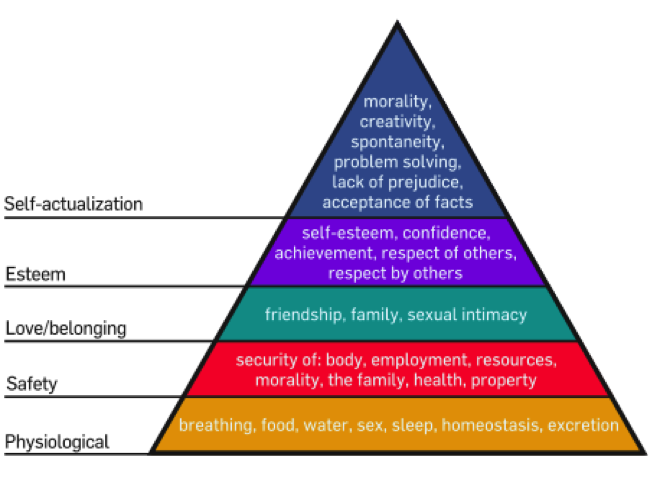
It all has to do with the Maslow’s hierarchy of needs – where self-esteem and self-actualization are on the top of the pyramid.
In our luxury world, most of us already have reached at least some level of self-esteem or self-actualisation.
I believe there is a lot to say to go beyond self-esteem, where the personal transformation fundamentally changes the focus from the “self” to the “others”.
This is where Richard Barrett has evolved the thinking of Maslow. Or where Don Beck did brilliant work with Spiral Dynamics, whose initial thinking was inspired by Clare W Graves who already in sixties/seventies said:
“Briefly, what I am proposing is that the psychology of the mature human being is an unfolding, emergent, oscillating, spiraling process, marked by progressive subordination of older, lower-order behavior systems to newer, higher-order systems as man’s existential problems change.”
“… me too big fan John Hagel, Geoffrey West, Brian Arthur. I love how you squeeze in Mihaly Czikszentmihalyi at the end, as I agree that organization starts more and more looking like an organism in search for flow. If you push the idea, you could add Maslow, as the organization is probably also looking for self-esteem in all its nodes (its people). Even pushing it further and beyond self-esteem, a similar flow “dynamic” is also embedded in Don Becks “Spiral Dynamics”…. the next area of competitive differentiation is in the higher layers of Spiral Dynamics, more or less the space of relationships, the space the Jerry Michalski’s REXpedition is exploring.”
JP responded:
“I am more of a fan of Nohria and Lawrence than I am of Maslow. Parallel not serial, networked not hierarchical”
I wrote about JP and Nohria, when trying to do a transcript of in my post “JP on Gamification, Lipstick and Pigs”. So I won’t repeat myself on that topic, and summarize JP as: The 4 drivers of motivation: the drive to acquire, the drive to defend, the drive to bond, and the drive to learn
In my opinion, it is about discovering your true self in the full context of all its relationships (family, work, company, country, culture, world, cosmos). As Marti Spiegelman recently said during a REXpedition call:
Awareness of the context creates meaning
And meaning creates value
Do you really believe that people will start innovating more if they get an extra bonus of 2% ? Only when people act from the power of their true self and experience meaning in what they do, only then real motivation kicks in.
I am deeply convinced that innovation and culture change will NOT happen through rolling out huge top-down innovation programs. On the contrary, I am a strong believer in “viral” innovation, where you seed the people that act from their true self throughout the company.
They will act as they believe they should act, and because their environment will feel inspired by this real motivation, they will inspire and infect others, form natural tribes with their own team dynamics and influence, become self-organizing teams that create their own meaning and value, and change the company from within.
Forever. Unstoppable. That is how real change happens.
Discovering and nurturing the hidden pearls in your organization that have the mindset to do this is the real challenge. It’s about finding the people who want to move, to challenge the status quo, dare to stick out their neck, etc and do so not because the incentive program has framed them that way, but because their true self boosts them towards the others with unlimited and eternal energy.
In the end it is about creating meaning in YOUR life.
Am I dreaming? Maybe. Am I ambitious? Maybe. Will it work? Maybe. But at least this way you know that’s where I have put the bar. So next time you see me, don’t ask for incentives, but tell we about what you want to achieve, and let’s see how I can help you.
Steven Pinker shows us how the mind turns the finite building blocks of language into infinite meanings.
But I looked at this animation and was triggered by how much this relates to how our economies, companies, teams, ourselves and even exchange of value between these entities are fueled by the relationship mechanisms described in this animation.
In essence, Steven Pinker describes 3 relationship types:
Dominance relationships. Pretty self-explanatory and what used to be used by primates, but still existing in some companies
Communality relationships. The mode is “You share and I share alike”, for example in a couple or between friends
Reciprocity relationships. Business like tit for tat exchanges of goods or services that characterizes reciprocal altruism. This is what we do in commerce. Exchanging money or to a larger extent exchanging of value.
But by not saying the things as they are, and mixing up the conventions that apply to each of these relationships, you end of with…
awkwardness
Awkwardness in the relation, in the team culture, in the team dynamics and illusions of friendship and love. In dating – see my prezi on how to make babies – this awkwardness leads to “the anxieties of dating”.
And it really feels awkward when the confused give a tap on the shoulder or hold an arm, skimming the borderlines of trust.
But saying things “as they are”
also means
taking risk,
getting naked with no defense
or fall-back position
in case it goes wrong
That’s why you best do these things with the guidance of an experimented coach. Somebody who can guide and learn you to take personal leadership, daring to step forward, and daring to take care of expressing our own needs. It’s carving in the underlying energy streams under the table, where emotions such as anger, joy, hate, rejection, love, etc live. To discover and get rid of the hidden agreements and closed circles of the past. Nobody likes being rejected or worse being ignored.
Instead of “getting used to it”, we could develop an emotionally intellectual language for expressing our needs. Something like:
Trigger: “this specific behavior causes an emotion with myself”
Emotion: “it makes me sad” or “I feel hurt”
Underlying need that is not fulfilled: “the need to fully contribute value” or “the need for a unique learning experience” or “the need to be respected” or “the need of not being ignored” etc, etc
And attaching to this need a “request”, an “invitation”: like “I invite you to fully include me next time”
All this in full authenticity, without manipulation, hidden agendas, power games, and other sorts of obfuscation of the reality.
But something fundamental can change when people meet, when they group in crowds. When they can look each other in the eyes. On a broader scale, think Egypt, Tunesia, Bahrein, etc: when people get together at one place, everyone in that crowd knows that everybody knows that everybody knows.
It leads to the collective power
to challenge
the authority
of the dictator
It’s the story of the emperor’s cloths. And explicit language is an excellent way of creating mutual knowledge.
What if we would start applying
these relationship principles
to our connected economy,
to our connected companies,
to our connected teams,
to our connected self,
or even to our connected value?
This would btw be a great way to organize and thinking and collaborations for Innotribe at Sibos 2011 on 19-23 September 2011 in Toronto.
Using the theme of the connected “something”, we could bring in technology topics like Digital Identity, Social Cognition, Big Data.
We could also experiment with some non-technology trends related to Social Capitalism, Future of Money/Value, Corporate culture, Where companies invest long term.
But to come back to the main flow of this post: the Egypt principle of mutual knowledge in a crowd also plays at a smaller level like a team.
But here is the paradox and at the same time the risk and opportunity:
No mutual knowledge
=
maintaining the fiction
of friendship and love.
However, with mutual knowledge and using an overt language you create the potential of having true team-ship and love. But using overt language also means you can’t take it back when it is out there. We don’t have a fall-back position, we are vulnerable.
But sometimes, one needs to pull a tooth. Pulling the tooth hurts, but you’re happy when it’s gone. Likewise, tapping blood may show black blood, and the tapping may hurt, but once the blood had been rinsed, you’re fit again.
When you let go the masks,
show your authentic self,
only and only then
will we be able
to realize
the full team potential
That’s why next week, our team goes on off-site to work on team dynamics. To discover and become fully aware and conscious of relationship types and dynamics, and to double-check whether here or there we don’t need to pull a tooth or to let go some black blood. We probably won’t find anything, but who knows ;^)
Have a look at a couple of the excellent videos on this wrap-up site about Farsight2011.
I could spent days and days in this space. All my favorites, including Hedge Fund Manager and PayPal co-founder Peter Thiel, Recorded Future co-founder and CEO Chris Ahlberg, journalist entrepreneur Esther Dyson, and many more in one big long session about long term future. Yammy – Yammy !
Search is no longer the simple act of typing words into a text box. New user interfaces and mobile devices are expanding the web into all aspects of daily life, and even changing the way we think. An explosion of innovation has allowed us to dream big about the role of robotics and Artificial Intelligence. And yet the future of search is fraught with challenges. The stakes can’t be higher. Is the search industry locked in a race to the bottom or are conditions ripe for a breakthrough? This question took center stage at a gathering in San Francisco on February 1, 2011 which was streamed live on BigThink.com.
Computing is getting exponentially faster, smaller, cheaper, better
Our assumption is that these new technologies can scale at global level
Turning our lives more and more into an information property
From Discover to Aggregate to Process
Retrospective vs. Prospective search
Quantified self, Health Data, Sensor Networks, Internet of Things
Total explosion of information
About total explosion of information: I also invite you to watch the video of Hasan Elahi’s talk at the Lift11 Conference this Feb 2011 in Geneva, at about the same time as this BigThink Farsight 2011 Summit. The title of his talk is “Giving away your privacy to escape the US Terrorist watch list”;
he is in essence explaining that
by releasing
an explosion of information
about his where-abouts
he makes it impossible
for these authorities
to make sense
out of this massive set of data
The intro is a bit long (but worthwhile to set the scene) but if you are short in time, jump in as from minute 8’30…
To be formally cleared, you need to be formally charged
A very unbalanced relationship: I give and I give and I give, and I don’t get anything in return
They have the ultimate authority, I knew who was in power, and you turn to very animal primal instincts of survival
And in my case, survival meant co-operate
And I decided to put everything public
Here is where the video gets mind-blowing: as from minute 12’30
I wrote a little code that would track me all the time
It’s kinda bizar seeying yourself as a pixel
Every flight I have been on since birth
I am ok with giving you every bit of my data, but you have to do some work to digest it
My financial records are public
All my calls
There is an independent party (bank, phone company, etc) that is verifying that yes indeed I was there…
I have taken this to a level of absurdity, of detail, that I leave such level of detail about my life, that I live a rather private life.
After you do the analysis of all this detail, you actually get very little in return.
Having a little information about somebody is very dangerous as it can be mis-contextualized
You can’t delete, but you can bury it in an explosion of information
Next year’s edition BIF-7 dates will be 21-22 Sep 2011, unfortunately the same week as Sibos 2011 in Toronto. Wonder if we can not do something together with BIF that week at Sibos, if only sharing some of the 2011 speakers? I will give a call to Saul Kaplan. Look at the confirmed dream-list of already confirmed speakers: Danah Boyd, Lisa Gansky, John Hagel, Dan Pink, etc. Wow ! What a start, and still almost a year to go!
From this year’s edition, I suggest you take some time to go through my personal top-5:
SY Partners chairman Keith Yamashita dares us all in this moving video story crafted as a metaphor from the Charles and Ray Eames video “Powers of Ten.” It’s a remarkable tale that reminds us that the future is here for us to create and it starts one collaborative duo at a time.
It’s worth every of it’s 25 minutes, and it’s a fantastic story about how “twins” in teams are the fuel of great teams.
It’s about doing great things like landing the Eagle in the moon, and “turning a bunch of folks blue” back home
It’s about having the house full of diagrams
It’s about when you start to believe that anything is possible
It’s about kids being born with greatness
It’s about being fully aware and fully alive
Trusting so deeply you can create together remarkable things
Duo-ships are about great invitations
Going actively after the status quo
About systems thinking + creativity
Building different type of organizations
That there is a better optimum than just the first choice
About having deep conversations on how to get smarter
To tackle things at a societal level
About finite/infinite resource and infinite/no possibility
About “then” (pre-crash), and “tomorrow”: finite resource + infinite possibility
About saying
“I trust you implicitly
to do a brilliant job,
and come back
with what you learned”
About
Ending the tyranny
of false trade-offs
Who is Keith Yamashita ? All the quoted text below comes straight from the BIF site, but I have added my usual color and typographic emphasis:
When Keith Yamashita looks at the world, he sees complexity—a beautiful and rich one, if we can visualize our place within it.
As chairman of SYPartners , a consultancy that has worked with leaders at IBM, Apple, Facebook, Target, Blackstone, Target Financial Services, Bloomberg, Starbucks and The Coca-Cola Company, Yamashita is a master at helping people define themselves against the backdrop of a profoundly shifting business landscape. The task requires tremendous empathy, he says, a singular understanding of what clients need and want.
“The biggest fallacy of business is that it’s only rational,” he says. “All business is personal and all business is human.” Yamashita is intensely curious about what makes people tick. Who are they? What are their deep aspirations? What do they need to be successful? What’s holding them back?
Ambition
Love
Fear
The human component of consulting goes deep. “We hope for people what they wish for themselves,” Yamashita says. “I’d like to think that when we show up in a room, we authentically care about the people in that room and that they sense that.”
Still, it is not enough to simply identify a dream, Yamashita tells his clients. The only way to stand out is to be fully aware of how you fit into a wider spectrum, to figure out what unique part you play, given the circumstances around you.
“Because we live in a world that is more interconnected than it’s ever been, we are particularly susceptible to the dynamics at play,” Yamashita says. “People feel overwhelmed—it’s a natural outcome of the world we live in. There are more systems problems that require creativity than there are creative people in the world.”
To minimize the potential fallout from system shifts and to maximize the positive impact we can have on the world, Yamashita urges a return to authenticity. He says it’s a question of unlearning bad habits and relearning what comes naturally:
“I do believe
that people enter this world
with a certain amount of
greatness
So many people,
through the pressures
of society
or the way we’re educated,
unlearn that greatness.
They fritter it away.
They start limiting themselves.
It’s really about
reclaiming that greatness
people learning about
how to be just themselves,
fully alive and aware.”
The positive exponential effect of all this self-awareness arises when individuals begin working together. Yamashita encourages his clients to build “powerful duo relationships” that require one of the trickiest human emotions: trust. “The duo is the smallest atomic unit where trust is built,” he points out. “If there’s only two people, you can’t shovel blame.”
With competent, self-aware individuals who relate to others on the basis of that trust, an organization has the potential to expand by the power of ten, just as in the Eames film. Zooming out, Yamashita sees a universe where companies design their own destinies by connecting purposefully to a wider array of players in order to work on a tougher set of problems.
Other remarkable stories came from:
John Hagel, with an even more personal version of his Sibos2010 talk on “The Power of Pull” and the role of passion in high-performance organizations,
Carmen Medina, on how one can innovate in a conservative castle like the CIA,
Jigar Shah, talking about scale in our Global Warming initiatives, and why everybody buying a Prius is really a drop in the ocean.
Kim Scheinberg (no video available yet), who also was interviewed in the FutureofMoney video. She’s an ex-gambler and now a new wave angel investor,
Gerard van Grinsven, (no video available yet), a former Ritz-Carlton executive, who became CEO of a hospital where it is all about health-care and not sick-care.
All these speakers indeed confirm, inspire and motivate it is really worth daring to be great.
That it is worth everyday to re-question yourself, and there to re-invent yourself to keep the greatness-bar high, very high.
And greatness is
not good enough anymore.
A program is not good enough anymore. What we need is an agenda.
“For a better world” for example.
Idealistic? Maybe.
Ambitious? Sure.
It is so easy to copy-cat last year’s success formula. But it does not satisfy myself. I believe you – readers, followers, innotribers – you expect more. You want us to surprise you, year after year.
I hope these principles will also guide us when articulating our Innotribe 2011 initiatives.
UPDATE: the Prezi version of the SOFA presentation mentioned at the end of this post is now available here.
Sibos 2010 is over! It was one of the best ever. After that week I felt completely exhausted. Empty. Because I gave my full self. Went deep. Gave and received loads of energy.
This week, it’s time for reflection. For chilling-out. Took some days off: late breakfast, some power naps. A walk here and there. Still lots of reading. Lots of tinkering. Some up-moments, some down-moments. Flowing.
And the future starts to emerge again.
Soon we have to go back to the salt-mine. Soon the treadmill starts all over again. But it does not have to be a copy-cat.
Soon we have SOFE (SWIFT’s Operations Forum Europe), running from 13-15 December 2010 in Conference Center “Dolce” in our home town La Hulpe (close to Brussels).
I have been asked to organize the Innovation Plenary on 14 December. So, here we go again!
He was one of our VC-coaches and Innotribe Leaders for Cloud at Sibos. He will do a keynote during the plenary (a great Prezi presentation on “Platforms, Markets, and Bytes”) and a viewing of his trailer video on “Financial Reformation”. And he will help us run an Innotribe Lab on Cloud computing. Yammy !
Also for me it’s a great opportunity to refresh/reboot. I will do the second part of the innovation plenary armed with
a brand new presentation titled
“How to make babies”
It will be one of those presentations that have been breeding in my head from some while, and suddenly materialize. Like a painting on a canvas. Like poetry on a sheet of paper. Like joy and harmony in music. Suddenly, it’s there!
“How to make babies” will bring together numerous thoughts collected during many conferences visited this year and ideas distilled from the books I have been reading recently. If you are interested in the books I am reading, I am inviting you to subscribe to my GoodReads.
In essence my story will start with the collision of two ideas.
The first idea was seeded in my brain by Geoffrey West (Distinguished Professor at the The Santa Fe Institute) in a presentation titled “The Secrets of Scale” delivered during the Techonomy conference in June of this year.
Geoffrey West is a theoretical physicist whose primary interests include elementary particles and their cosmological implications; the theory of companies, cities and global sustainability; and biology, including metabolism, aging and sleep. He served as the Santa Fe Institute’s (SFI) President from 2005 to 2009.
It happens that the folks at Techonomy just put up all the videos, including Geoffrey West’s presentation:
At Sibos, we reflected on the Long Now. In the first chapter of “where ideas come from”, Steven Johnson talks about that vantage point the long zoom.
It can be imagined as a kind of hourglass:
Several years ago, the theoretical physicist Geoffrey West decided to investigate whether Kleiber’s law applied to one of life’s largest creations: the superorganisms of human-built cities
And
the quarter-power law governing innovation was positive, not negative. A city that was ten times larger than its neighbor wasn’t ten times more innovative; it was seventeen times more innovative. A metropolis fifty times bigger than a town was 130 times more innovative.
The essence of Geoffrey West’s story is that cities are intensities. That cities never die. That cities are the ideal womb for idea generation, incubation and execution. That innovation scales differently than the size of the city.
Because
the information and the ideas
flow freely and in high intensity.
But how does one create a culture of intensity, of innovation? How does one create the vibrancies of cities within the walls of a castle?
Here is some additional video material featuring Steven Johnson’s ‘”Where do ideas come from”.
And a TED talk on the same subject:
It brings me to the second idea in the collision: the one of incubators.
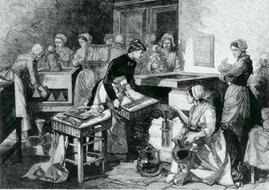
Incubators at the Maternity Hospital, Port Royal, Paris (Maternité de Paris, Port-Royal). An engraving by Eugene Froment (1844-1900) from the Illustrated London News, 1884.
Incubators were invented by Stéphane Tarnier in 1880, and documented by Auvard in the historic 1883 article De La Couveuse Pour Enfants. Incubators help us grow babies. Physical babies. What I am talking about are ideas. Baby ideas that need to be prototyped. And then incubated. Many incubator models for ideas and start-ups exist.
Probably one of the more famous ones is MIT Building 20. Building 20 was designed differently. With flexibility in mind. A bit like the Value Web walls that allow you to create spaces of intensities. And when the job is done, you disperse and build new spaces, new teams. Disperse and re-group. A different composition for each new project. Get rid of the one size fits all.
Old Building 20, Vassar Street facade, 1997.
New Building 20 at MIT
The point I am trying to make here is that physical environment is equally important to have a free flow ideas. Ideas will not flow in a castle with long corridors and closed offices.
Once incubated, you need to scale. Which brings us back to Geoffrey West and “The Secrets of Scale”. You need to create intensities. As I already mentioned in a previous post:
Intensities and intentions. City intensities. Platforms of intensities. Physical or virtual. Almost requires an architectural purism and surroundings to make it work. Has to be physical.
I want to create these environments. Where small groups of intense people can meet. Can radiate. Can nurture and inspire each other. Where one hunch leads to another, and ideas cross-fertilize. Where we play the Medici-Effect for 100%.
We need to build some sort of city, some platform of intensities, some sort of campus. Not a “chalet” next to the castle.
Think big
Think scale
Think city
Embedded in the social and economic fabric of our industry. Where experts can meet and weave the next generation solutions.
Where we not only have a fertile environment for funding “only”, but where we also thought about physical housing, novel resourcing models like dedicated teams combined with shared staff from the castle. Or in-residence programs as another way to resource and bring fresh blood.
Where we have a shared infrastructure for support, project management and IT. And where we nurture a culture of experimentation. Where we have reverse-mentorship of our bankers BY the Gen-Y generation.
Venessa Miemis hit us all hard in the face at Sibos:
There is a class of young, intelligent, creative people who are disillusioned with the debt-based monetary system, and are busy building the infrastructures for a commons-based economy, which is emerging, right now, in parallel to what currently exists. The foundation of this economy is built on trust… and transparency…. and the ability of distributed networks to self organize. And using the Web as a grounds for experimentation, we’re learning more effective ways to link unmet needs with unused resources, innovate, generate wealth, and build resilient communities.
This is the prototype of the future. This is where the opportunities are.
I hope that during the Innotribe sessions the remainder of the week, we can explore ways to create bridges between these two worlds and ways of thinking, and co-evolve the next global economy.”
Venessa & friends already followed up post-Sibos with the idea of an in-residence program for bankers. To understand and connect with the new class of young, intelligent, creative people. To learn their language and adapt their values. Yes, you got it right: the bankers get mentored by Gen-Y.
I think it’s a fantastic idea. To think wealth instead of money.
With trust as the currency
of the 21st century
Where we create bridges in a strengths-based society instead of a problem mindset.
We are in a different Zeitgeist,
and most of our bankers
haven’t noticed yet.
The realization that most senior executives in finance (or elsewhere for that matter) would be completely at a loss – “sans moyens” – faced with an articulate and intelligent Gen-Y as personified by Venessa.
Things like this residence program idea: that’s the sort of babies we need to create. That’s the sort of family harbor we want for our children. And when babies become adolescents and adults, when those ideas have matured into successful companies in their own strength, keep thinking about our off-spring. As it never stops.
And despite big hopes from the singularity movement, there is a fair chance that all who read this in 2010 will die sometime. But as Geoffrey West pointed out and proved mathematically:
Biological beings die
Cities never die
The big “contours” of my SOFE presentation are drawn. This post-Sibos holiday & chilling season is ideal to let it mature. To perfect the visuals. To come to the essence. To get to its full purity. To be different by less not more. So that you can feel the full intensity. So that each of you can realize his full potential.
This session is the culminating point of the all the work that will have happened in the Innotribe Labs throughout the Sibos week.
We will open with a 20 min update and reflections on the Long Now Lab by Paul Saffo, who will also be the keynote speaker in the Sibos closing plenary later that day.
After that, we’ll have a “Pitch your Lab” competition. The best ideas from the cloud, mobile, and smart data labs will be pitched to a jury who will select the winner of this year’s SWIFT Innovation Awards.
Listen to Kosta Peric who explains what this "Pitch your Lab" session is all about. It is your chance to win the SWIFT 2010 Innovation Award !
Here are the members of our extraordinary jury, also referred as our Buyer’s Panel:
Paul Saffo, Professor, Stanford University
Jo Van de Velde, Managing Director, Head of Product Management, Euroclear SA/NV
Wilco Dado, Head of Global Payments, Royal Bank of Scotland
Gary Greenwald, Chief Innovation Officer, Global Transaction Services, Citi
Lázaro Campos, CEO, SWIFT
Ian Johnston, Chief Executive, Asia Pacific, SWIFT
Gottfried Leibbrandt, Head of Marketing, SWIFT
Alain Raes, Chief Executive EMEA, SWIFT
Kosta Peric, Head of Innovation, SWIFT
The jury will be assisted and advised by a VC (Venture Capitalist) Advisor’s Panel. These VC’s were part of the Innotribe Labs during the week. Here are the members of the VC Advisor’s Panel:
Oren Michels, CEO, Mashery (Cloud Lab)
Sean Park, Managing Director & Founder, Anthemis Group (Cloud Lab)
Eghosa D. Omoigui, Founder & Managing Partner, EchoVC (Smart Data Lab)
Nova Spivack, CEO, Lucid Ventures (Smart Data Lab)
Jennifer L. Schenker, Founder and Editor-in-Chief, Informilo (Mobile Lab)
Matthaus Krzykowski, Mobile Expert, VentureBeat (Mobile Lab)
Each team will have 5 minutes to pitch their Lab-idea to the jury. After each pitch, we will ask the advice of the VC’s.
Then there will be a short Q&A with the judges, and a voice-of-the-public using our latest “high-tech” applause meter.
The winner of this “Pitch your Lab” competition will be announced during the Sibos Closing Plenary at 16:00 later that day.
We run this competition for the second time this year. Last year this session was referred to as “the best session of Sibos 2009”. We have done everything to match last year’s success. We have invested heavily in a solid design of the labs, and have armed the teams with fantastic facilitators from The Value Web, Innotribe Leaders from the business and the technology eco-systems, and matter expert VC’s.
In the true spirit of less push and more pull, we encourage you to engage in a true dialogue with the Innotribe team and the Pitch your Lab finalists. We look forward to seeing you in Amsterdam.

























 Petervan Studios