HR and Innovation

In my previous blog “Brand, Workforce and Innovation”, i started making a case for a leadership role for HR in Innovation.

I wrote:

I’d love to see more HR in a true leadership role. Leadership as opposite to management in its narrow definition of executing a course set out by somebody else. See also below the very important message about the role for HR in creating the eminence of our workforce.

Checkout my previous post on what is meant with “eminence of our workforce”.

Rowan-blue-background124

I would like to mix this with some thoughts from Rowan Gibson recently on Blogging Innovation. His full posting can be found here but i will explore some key findings below. Rowan Gibson is the author of “Innovation to the Core”.

UPDATE: what a co-incidence. Just today, Rowan Gibson did a new post in essence giving a one-page summary of his book. Here is the link to “Do you have a Corporate Innovation System?”


Innovation to the core” is about putting

radical innovation in the core of

your organization 


and is not to be confused with the discussing

Innovation in the core or beyond the core

of your product portfolio

UPDATE: “Beyond the Core” is a book by Chris Zook, and is based on the principle of adjacencies. It seems to be the bible for anybody not wanting to do anything beyond the core. It dates back from begin 2005, and is in my opinion completely outdated as a guide for innovation.

Rowan says in his blog:

In essence, that means developing a particular mix of resources, processes and values that makes it hard for rivals to match what the company does.

This has to do – amongst others – to create this eminence in the work-force.

But it is much more.

Lastly, i was attending one of our company meetings, and our CEO was doing a pitch on the focus of innovation in 2010. Great to have your CEO on board to get innovation rolling ! Really, it makes a big difference. But at the same time, the company runs a 2-year lean-program to build greater efficiencies in the company processes.

In French, we call this “Le grand écart”.

kim

It’s difficult, but not impossible if you’re fit and trained.

People do not understand this, cannot digest, don’t see the big picture, as the efficiency programs are much closer to their daily lives and – most of all – their jobs.

You could see the glaze in the eyes of some folks when we were talking innovation after having explained the lean-part.


As long as we do not succeed as positioning innovation as “buying our future”, as essential to building the greatest workforce on earth and giving the people the possibility of being part of that – with reward mechanisms – we won’t succeed in those apparent conflicting objectives.


Rowan Gibson goes on:

Making innovation a systemic organizational capability is a complex and multifaceted challenge. It simply cannot be solved with some Band-Aid or silver bullet. Instead, it requires deep and enduring changes to leadership focus, performance metrics, organization charts, management processes, IT systems, training programs, incentive and reward structures, cultural environment and values.

It’s not “good enough” to have your CEO on board. You need the full buy-in of your full Executive Committee, and – in a more complex co-operative organization like SWIFT – the buy-in of your Members, represented by the Board. We still have a lot of work to do, but i believe we are getting there. Innovation is now getting at the agenda of those deciding constituencies.

What i have not yet seen is a focus on how HR can help and be instrumental for innovation.

What companies need is not merely a pro-innovation mindset, or better brainstorming techniques, or "hot teams". It’s about making innovation a new organizational way of life; something that permeates everything a company does, in every corner of its business, every single day. It’s about infusing the entire lifeblood of an organization with the tools, skills, methods and processes of radical innovation. That’s the true imperative for rethinking the role of Human Resources. As soon as we recognize the strategic value and the immense organizational transition that’s involved in building a corporate-wide innovation capability, HR automatically moves to center stage.

And what would be the role of HR in such an Innovation context ?

Who else but HR leaders would be capable of turning a company’s strategic intent with regard to innovation into tangible everyday action? Who else could make the necessary changes to executive roles and goals, political infrastructures, recruitment strategy, broad-based training, performance appraisals, awards and incentives, employee contribution and commitment, value systems, and so on? Who else could build and foster the cultural and constitutional conditions – such as a discretionary time allowance for innovation projects, maximum diversity in the composition of innovation teams, and rampant connection and conversation across the organization – that serve as catalysts for breakthrough innovation? Who else could ensure that each employee understands the link between his or her own performance (as well as compensation) and the attainment of the company’s innovation strategy?

In short, who else but HR

leaders could create a company

where everyone, everywhere,

is responsible for innovation

every day whether as an

innovator, mentor, manager, or

team member?


I have become a big believer that companies need an innovation system where


everybody in the company

becomes an innovator


It’s almost a human right of any employee in a company, i would even venture it is a moral obligation for any employee in a company to be an innovator himself. It is NOT the sole privilege of the innovation team to come up with ideas, on the contrary. See in this context my previous blog on The Holy Fire.

Rowan Gibson has a great closing in his blog post:

The sad reality is that too many CEOs overlook HR’s potential in this regard. They still think of HR solely in terms of regulatory compliance, hiring and firing, employee comfort, compensation and benefits. Notably, Jack Welch, illustrious ex-CEO of GE and arguably one of the greatest corporate leaders of our times, sees things differently. In a recent column in BusinessWeek, he writes that


"every CEO should elevate his

head of HR to the same stature

as the CFO."


Hope somebody reads this.

Need for a new currency based on abundancy

Thanks to my subscription to Fredzimmy’s blog, I found this wonderful blog from Esko Kilpi.

image

I really recommend you to explore this site from A to Z.

  • Look at the wonderful slidedeck on Slideshare
  • Have a look at the Flickr photos
  • Have a look at the Bookmarks

image

MIT Media Lab Human Dynamics Group, Howard Rheingold (one of the first ever “internet”-books i ever bought,…, Barbarian Blog.

Yummy, Yummy. This is great stuff for a Sunday afternoon. So inspiring. Delicious 😉

This way, i discovered the FANTASTIC Web 2.0 Expo speech of Douglas Rushkoff about Radical Abundance.

It is a 15 min video, and worth every minute:

Not sure if the video embed worked, so in any case you can find it here by clicking the below image.

image


Some mind-blowing quotes (in 140 characters ;-):

  • The operating system for money is obsolete…
  • Abundance based currencies and monopoly based currencies…
  • Central Bank Monarch imprinted currencies are scarcity based currencies…
  • The money we use today was created so that rich people to stay rich by being rich (and lending) rather than doing anything…


google-coin

  • Our economy is based on the growth of interest
  • The people lending money get richer, the people creating value are getting poorer
  • But, what happens if you get something that’s abundant ? That you can’t make scarce.
  • The computers and networks change the “centrality” of value creation
  • You are now able to exchange value directly between one another rather than through a centralized currency
  • Optimize human beings to technology
  • Technology is more compatible with the values of efficiency than with all the other human values
  • Now you’re open and free to Google-Ads
  • Web³ will be won by the power of those who can index and aggregate. Is that what we want ?
  • Open Source and Crowdsourcing are not the same things
  • This notion of “free” leads to a society of copying, to no creativity, to no originality, to DJ’ing of culture
  • The abundance of genuinely creative output is declining
  • What we need is the development of a digital culture that respects the labor of individuals
  • What we need is the creation of new modes of currency based on abundance rather than scarcity.
  • I am talking about the original PayPal dream before banks asked them to be regulated like… banks
  • The next BIG thing are from people who will create genuine alternative electronic currencies and P2P exchange that do not involve cash.
  • I am talking about primitive local currencies such as Timebanks, Itex, Superfluid’s Quids
  • Cash has already lost its utility value, as it has been sucked out into investment capital, in the speculative marketplace
  • The only real competition against a Google universe (and their ideas of openness – see last weeks Google Blog post about openness btw) would be peer to peer exchange
  • We are not suffering from an abundance of creativity, just from an abundance of productivity, efficiency and openness.
  • If Web² leads to aggregation and indexers, then genuine P2P will lead to bottom-up value creation.
  • The next era is not about scaling-up anymore, it’s about figuring out how to exchange value, in stead of extracting value.
  • We are at a crossroads: right now we have the opportunity to optimize our systems, technologies, currencies to humans in stead of optimizing humans to them.


Reblog this post [with Zemanta]

Education, Elites and Bologna

I was watching this morning a television program with Christine Van Den Wyngaert.

christine

The program was in essence about her views and role in the Criminal Tribunal for the former Yugoslavia, but mu attention was triggered by something she said in the introductory part of the interview.

She was referring to the dramatic decrease of the quality of our education, mainly due to the Bologna Treaty. Just have a look at the Wikipedia link or do a google on Bologna Treaty. Or have a look at the Europa site. The first sentence on that site reads:

The Bologna process aims inter alia at making divergent higher education systems converge towards a more transparent system by 2010, based on three cycles: Degree/Bachelor – Master – Doctorate.

I always get irritated when people talk about “convergence” or “consensus” or “compromise”. For me these terms have a built-in notion of quality-loss.

Indeed, Christine Van Den Wyngaert explains that “thanks” to this treaty it was not possible anymore – no, even forbidden – to offer education with the same high quality standards as we used to have.

All this in the name of democratization of education and to give everybody access to higher education.


She went on by stating that many base foundation courses of general knowledge were being reduced to the level of “kindergarten”.

And that for some professions – definitely for a judge or a lawyer – good solid foundation education about history, society, etc are quite fundamental for doing the profession.

It is getting pedantic in a sense that even talking about creating an “elite” of scientists, judges, of whatever profession starts being banned straight-away.


I do not want my child being educated in mediocrity.


It made me think of the book “The Five Minds of the Future” by Howard Gardner.

21E fDecyLL._SL160_AA115_

I am reading it on my Kindle as we speak.

In that book, Howard Gardner arguments that education should not only be based on memorizing lots of information, but that education (whether at school or at home) should more focus on some essential skills that will be needed in the future (of real-time, high-information-based-society).

He calls these the 5 “minds” for the future. They are:

  • The disciplined mind
  • The Synthesizing mind
  • The Creating mind
  • The Respectful mind
  • The Ethical mind

About these “minds”, Gardner says:

Any individual with a deep understanding of a topic or method can think about it in a variety of ways. Conversely, an individual exhibits her current limitations when she can only conceptualize her topic in a single way.

This is very similar to having a very limited palette of ways to express yourself. Sometimes you hear somebody saying “I cannot dance on this or that sort of music. If i have to dance to that music, i cannot be myself (in an authentic way")”.

That’s pretty poor, if you ask me.

The art is to expand your palette of ways of being yourself in different situations.

Having the right to (the old) high standards of education, being trained in the 5 minds of the future, learning to be authentic in many different ways: all this should be part of the educational package of any young person having some ambitions for the longer term future.

I have come to a point where i do NOT believe anymore that our politicians and the whole system of lobby groups will help us getting there.

I was making the same reflection some weeks ago, when we were having our meeting of the Think Tank on Long Term Future, when i heard my friends complaining on how bad is it is getting in Flanders with respect to getting innovation on the political or any other agenda.


The innovation and education and

cultural agenda

get drowned into a political swamp

of consensus and power games


The end result is often or nothing, or something very grey (because of the consensus), or something very Kafkaesque.


I am getting convinced we have to do it


ourselves

Bring together some smart people in our think tank, and get private funding for the innovation, education and cultural development of the Generation-M.

Because they are looking for the things that really matter.


Reblog this post [with Zemanta]

Zemanta and the Semantic Web

image


If you want to have an idea what Semantic Web can mean for you and your business, have a look at www.zemanta.com.

It comes as a Google Chrome Extension, or a Firefox extension, or a IE Plug-in or Safari Bookmarklet.

I tested the Google Chrome extension on my PC. In this case a Mini-HP with Windows 7 installed. I also use Windows Live Writer to do my blogs. Zemanta also has a Live Writer Plug-in that i also installed.

This looks quite similar to the viewer of Open Calais that i commented on already way back in April 2009.

UPDATE: just today, there was an article on ReadWriteWeb referring back to Open Calais, Google and Wolfram Alpha. Note that “Semantic Web” is now renamed into “Structured Data”.

But is is way more user-friendly, and so well integrated with Live Writer. Anybody writing blogs should install this.

To get you an idea of the powerful stuff under the hood of this semantic engine, go to the home page and click on the try demo button.


image


You then get presented with an free-text box that you can fill with any text you want. In my case, i just cut and pasted the intro-section of our Think Tank document.

image

You just hit “Run Demo”, and what you get then is really unbelievable !

Your content gets enhanced with images. See example below.

image

Or you get links to related articles:

image


The beauty really comes and the end of the page of the demo:


image


Yep, you got it. It shows all in-text links, and all words that have automatically semantically tagged, based on the sources you have given during set-up (or later when logging into your personal account). And yes, it also looks into Twitter and Facebook.

When you install Zemanta for Live Writer, you are presented with a list of recommended articles while you are blogging. You can then select interesting and related articles to reference in your blogs posts with just a click of the mouse. The benefits of being included within our recommended content pool are: trackback links to your blog, discovery of your blog by new readers, and connecting topical blogs together.

Zemanta expands the author’s regular blogging dashboard, populating it on the fly with content suggestions relevant to the current text. It presents images, links, articles, tags in a simple interface. It encourages re-use and linking to other content with as little effort as possible – a single click.

Zemanta supports Blogger, WordPress, TypePad, Movable Type, Ning, Drupal, LiveJournal, Tumblr and email platforms Google Mail and Yahoo!Mail.

Here is a screenshot of my screen as i was making this blog, and how it automatically added in-text links to the word “Blogger” etc above…


image

Main features of Zemanta are:
● on the fly contextual suggestions of related articles, images, links and tags;
● affiliate linking support;
● re-blogging – cross-platform quoting for blogs;
● spam-free database of 10000 news sources and blogs;
● copyright filtering of suggested images.

Use cases for email include:
● Individualized personal “postcards” as you can easily add images from your Flickr collection or from others.
● Persuasive professional introductions with easy addition of personal images and links to social networks.
● Informative report-style mails with links to other points on Internet for further reading.

These are the use cases suggested on the Zemanta site and during the install procedure.

However, i strongly believe that these sort of technologies will change in a very disruptive way how we think about standards. In the context of my employer SWIFT, standards are one of the pillars of our value proposition. So far, we “only” looked at standards for message formats, but we could/should apply our 30+ years experience in semantics and ontologies for financial services into this new domain of semantics of … well, anything.

UPDATE: by renaming “Semantic Web” into “Structured Data”, it all becomes even more obvious what role SWIFT could play in this area. XBRL and CLOUD are already moving big way into this space.

BTW: the “REBLOG” button at the end of this posting was also added automatically by Zemanta.


Reblog this post [with Zemanta]

Cloud Security and other Cloudy observations

Another great article on Technology Review MIT, this time about cloud computing. Together with the 2 documents i posted earlier today on innotribe.com this should give the average IT literate reader a good overview of where we stand end 2009/begin 2010.

The clientele for Amazon’s cloud services now includes the New York Times and Pfizer. And Google’s browser and forthcoming operating system (both named Chrome) mean to provide easy access to cloud applications.

The focus of IT innovation has shifted from hardware to software applications

But not everyone is so sanguine. At a computer security conference last spring, John Chambers, the chairman of Cisco Systems, called cloud computing a "security nightmare" that "can’t be handled in traditional ways."

A similar viewpoint, if less colorfully expressed, animates a new effort by NIST to define just what cloud computing is and how its security can be assessed. "Everybody has confusion on this topic," says Peter Mell; NIST is on its 15th version of the document defining the term. "The typical cloud definition is vague enough that it encompasses all of existing modern IT,"

Given the industry’s rapid growth, the murkiness of its current security standards, and the anecdotal accounts of breakdowns, it’s not surprising that many companies still look askance at the idea of putting sensitive data in clouds. Though security is currently fairly good, cloud providers will have to prove their reliability over the long term

Cloud providers don’t yet have a virtual steel fence to sell you. But at a minimum, they can promise to keep your data on servers in, say, the United States or the European Union, for regulatory compliance or other reasons.

But fully ensuring the security of cloud computing will inevitably fall to the field of cryptography. Of course, cloud users can already encrypt data to protect it from being leaked, stolen, or–perhaps above all–released by a cloud provider facing a subpoena.

To find and retrieve encrypted documents, groups at Carnegie Mellon University, the University of California, Berkeley, and elsewhere are working on new search strategies that start by tagging encrypted cloud-based files with encrypted metadata.

"For me," Zittrain says, "the biggest issue in cloud security is not the Sidekick situation where Microsoft loses your data." More worrisome to him are "the increased ability for the government to get your stuff, and fewer constitutional protections against it; the increased ability for government to censor; and increased ability for a vendor or government to control innovation and squash truly disruptive things."

Real-Time Trade

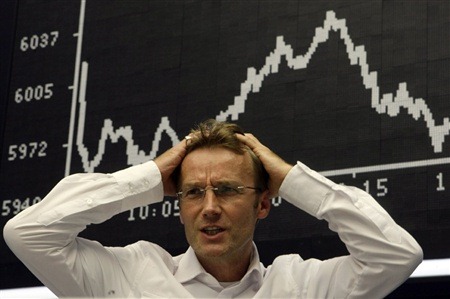
Fascinating article on how stock market is getting completely automated in a matter of seconds. Who was saying something about real-time.

04_traderfaces

Article found on MIT Technology Review. 5 pager can be found here.

Some extracts:

The profits go to the company with the fastest hardware and the best algorithms–advantages that enable it to spot and exploit subtle market patterns ahead of everyone else

TheTabb Group, a consultancy based in Westborough, MA, estimates that high-frequency automated trading now accounts for 61 percent of the more than 10 billion shares traded daily across the numerous exchanges that make up the U.S. market.

Trading is now essentially a virtual art, and its practitioners put such a premium on speed that NASDAQ has considered issuing equal 100-foot lengths of cable to the brokers who send orders to its exchange servers.

Hardware used at the facility will operate at a 40-gigabyte-per-second standard, enabling it to handle as many as a million messages a second.

New York City-based Lime Brokerage, wrote the SEC in 2009 to voice concerns over the proliferation of brokers who allow major clients to engage in high-frequency trading without validating their margins–that is to say, without making sure they actually have enough money to back a trade

Jacobs regularly sees algorithms executing more than 1,000 orders a second. At that rate, one algorithm trading the wrong way could execute 120,000 orders in two minutes. At 1,000 shares per order and an average price of, say, $20 a share, that’s $2.4 billion inunintended trades in 2 … SECONDS.

Institutional traders like Fidelity, which buy large blocks of shares for their mutual funds, use algorithmic trading to split their enormous orders into blocks of 100 to 300 shares so that other traders don’t recognize the true demand and take advantage of that knowledge for their own profit.

These are big numbers. And it happens every day. Scary.

Innovations 2009: my Top-7

The full top-100 is published on POPSCI.

Here is my personal selection top-7 out of those 100 and my personal why. Why seven ? Because 7 is my lucky number. No, i just did not like cutting out one of these 😉


vue_0

Short description: It’s the ultimate plug-’n’-play nanny-cam. The Vue personal video network lets users place cordless cameras virtually anywhere and view video in real time on the Web.

Why: Dead of Privacy. At DEMO 2009, i saw another plug-and-play security camera for less than 199 USD. Why complain about all those public cameras in the UK, if any person can put one anywhere anytime ?


fujifilm

Short description: Fujifilm 3D Camera is the first 3-D digital point-and-shoot camera, with two separate lenses—and two image sensors—placed three inches apart. They snap either stills or videos in tandem, and a processor combines their images into a single file.

Why: This and the release of the 3D Movie Avatar will really put 3D in the mainstream in 2010.


 Planck satellite in  the Large Space Simulator at ESA's test centre in Noordwijk, the Netherlands.

Short description: Herschel Space Observatory, the European Space Agency’s Planck Observatory will study the radiation left over from the first 370,000 years after the big bang—known as the cosmic microwave background, or CMB—with three times the sharpness of previous satellites. Can detect temperature differences in the CMB as small as millionths of a degree (the equivalent of detecting the body heat of a rabbit on the moon, from Earth).

Why: i expect a breakthrough in 2010 in cosmic breakthrough research that will challenge our traditional thinking about time and space.


Short description: it’s about the headpiece, not the chair. The nonsurgical NeuroStar Transcranial Magnetic Stimulation system is as easy as a teeth cleaning. The patient sits in a chair as an electromagnetic coil pulses magnetic fields to his or her left prefrontal cortex, the part of the brain that regulates mood. This stimulates neurons to make more mood-enhancing dopamine. After 30 40-minute daily sessions, half of the patients in a clinical trial experienced significantly reduced symptoms; a third reported complete resolution. Last fall, it became the first TMS therapy to earn FDA approval.

Why: breakthroughs in brain research, implants and stimulation are just around the corner. At Singularity Summit 2009, i saw another example of light stimulation of very specific brain zones (up to the cell level !)


Short description: Nintendo Wii on steroids.  A prototype system dubbed Project Natal lets Xbox 360 games respond to anything from full-body lunges to subtle hand gestures, voice input and even facial expressions. Unlike the Wii, you don’t hold anything. Your movements and voice control the game.

Why: New forms of UI will we omnipresent in 2010. Expect this sort of stuff to be standard in any modern OS, tablet or PDA as from 2011.


Short description: The City Safety system of the 2010 Volvo XC60 can stop itself before you smack the stopped car in front of you. A laser sensor tracks the distance between you and the car ahead; approach too quickly, and the system hits the brakes.

Why: Computer assisted cars becoming mainstream. Also look at the loads of technology squeezed in the latest Opel Astra (standard model). Main reason: somehow my dream car, and i hope somebody from Volvo reads this and gives me one 🙂


Short description: Should be no surprise to anybody reading this blog. I am a big fan of Google Wave.

Why: 2010 will be Wave year. The criticasters of 2009 will cry and be ashamed once Google fixes this one.

Brand, Workforce and Innovation

If you’re interested in Innovation, you have to subscribe to Blogging Innovation. All posts are just worthwhile reading.

image

They also have a group on LinkedIn.

Today’s article typically resonated with me. It’s titled: “Combining Brand Management with Workforce Enablement”.

IBM-718954

It’s about the speech by Jon Iwata, SVP of communications and marketing at IBM on the future of the communications profession at the November 4th 2009 Institute for Public Relations Distinguished Lecture Series at the Yale Club in New York City. Full text of the speech is here.

Iwata says:

"One day soon, every employee, every retiree, every customer, every business partner, every investor and every neighbor associated with every company will be able to share an opinion about that company with everyone in the world, based on firsthand experience. The only way we can be comfortable in that world is if every employee of the company is truly grounded in what their company values and stands for."

IBM has developed an IBM Brand “System”:

Picture a framework with five columns. From left to right the columns are labeled what it means to look like IBM, to sound like IBM, to think like IBM, to perform like IBM and ultimately to be IBM. Simple enough. You could in 30 seconds create the same frame for J&J, Chevron or Ketchum. But of course it would — and should — take you much longer to fill in the details. Every word, every phrase and description in that framework would be painstakingly chosen. Because this is your corporate genome. It describes what makes your company unique. Developing the framework is hard work, but it’s only the foundation. Because, like a genome, the real work — and value — are in bringing it to life.

and also:

For example, we are now collaborating with our colleagues in HR to redesign IBM’s leadership competencies for the first time in many years. If this is ultimately approved by the CEO – and we’ll know in a few weeks – it will mark the first time in my 25-year career that the foundational elements of HR will not only be aligned with our brand and workforce strategies, they will be essentially the same.

I would like to see some examples on how this works in an environment where efficiency programs are run in parallel with innovation programs and (re)branding programs. What is the ideal role of HR in all of this ? Will HR be degraded to a “management” machine to deal with lay-offs only ?

I’d love to see more HR in a true leadership role. Leadership as opposite to management in its narrow definition of executing a course set out by somebody else. See also below the very important message about the role for HR in creating the eminence of our workforce.

About this, Iwata says:

But the building of constituency goes beyond the reaching of audiences. It gets to how a company establishes shared attraction and shared values: how it shapes not just common ground, but a deeper, enduring, shared idea.

They weren’t simply sending messages to audiences. They were creating audiences.

They weren’t shaping relationships with existing constituents. They were creating constituencies.

This is the basis of our Smarter Planet strategy. We are specifically and deliberately working to validate and stoke the optimism of forward-thinkers. We are saying to them – because we really believe it ourselves: “Your hopes for your industry, your city, your environment, your community are now within your grasp. This isn’t a metaphor. We can actually build a smarter planet.”

Our work of late tries to get at the real substance of change, the real issues on the table. The work is long-form. It’s argued, not pitched. It doesn’t focus on our products and services.

It purposefully invites people to

 think


Wow !


And lastly about Building the eminence of our workforce.

I believe that 2010 will be the year that corporations grapple with and ultimately accept that their employees are engaging with – and must engage with – social media. We’ll certainly go through a necessary period when people raise all sorts of objections.

The CFO worries about financial disclosure. The General Counsel fears intellectual property leakage. HR will say we’re helping competitors recruit our people. And everyone will be nervous about criticism of management. These are all legitimate.

So the answer to all this may be another set of policies and guidelines for using social media. My employer has indeed such a set of policies. They are difficult to find, but they exist. But are another set of policies and guidelines a solution. Will the fact that each employee has to sign-off the blogging policy or any other code of conduct really change our actual behavior ?

I doubt it.

Let’s say we actually do that. Then what? Policies and guidelines may keep individuals and their companies out of trouble but, by themselves, they won’t create business value.

The key is to build the eminence of our workforce.


What do I mean by “eminence”? No matter what their industry, their profession, their discipline or their job, people with eminence are acknowledged by others as expert. It’s not simply to know a lot about Tuscan villas, digital cameras or banking. You need to be recognized as an expert. And when you show up – in person, or online; in writing, or in conversation – you are both knowledgeable and persuasive. Because being an expert and being good at communications aren’t the same thing, as we all know.

Which is why


we need to make the creation

of this kind of workforce

an intentional act,

a new discipline in our function

Yes, we need guidelines and policy – but also training, resources and support for broad networks of experts.

Related to this, i found just a couple of days ago a great post from Hugh McLeod’s site titled: If your boss tells you, “our brand must speak with one voice”, quit.

I once had a boss who didn’t like the fact that I had a blog. Especially when I blogged about stuff that was relative to our industry. Yeah, “Our brand must speak with one voice” was his idea. Yes. I know.

Actually, the reality was, HE wanted to be “The One Voice”. He wanted all the credit, and all the rewards. He didn’t mind me put ting words into his mouth– stuff I had writ­ten– so long as the outside world gave him all the credit. But he didn’t want me in any other role, other than subservient, nowheresville wage slave. He fought tooth and nail to keep me from ever becoming a rainmaker inside the company, something he wanted all for himself.

And back to the end of the speech by Iwata:

To me, this is what “values” are about… and what “authenticity” means. This is about consciously choosing a unique identity. And it’s about actually being that unique thing you have chosen to be.

In other words:

Leading by Being

Brain Chips

image


All images courtesy of www.gigaom.com. found via my subscription to the fantastic spacecollective.org site. Full link here.

I somehow like #2, but get discouraged when i read the description: “The technology is basically the same as that used to treat Parkinson’s disease.”

Seriously, it’s a great post, and indicated that brain chips are getting real and that the singularity is getting nearer and nearer.

Change your worldview

My absolute #1 Book recommendation from 2009 is “The Age of the Unthinkable” from Joshua Cooper Ramo.

The essence of the book is that to be able to cope with the new game future, one has to change his worldview and look at the whole and not only the pieces.

Below is a good – completely unrelated video – that gives you an aha experience on changing your (world) views.

Nothing is what it seems to be…

Enjoy.

image

CHOP CUP from :weareom: on Vimeo.