Innovation Traumas

Interesting blog post from James Gardner in Bankersvision a couple of days ago.

My Photo

Formerly Head of Innovation and CIO of Investment at Lloyds Banking Group in London, James Gardner is now Chief Technology Officer at the Department for Work and Pensions in the UK Government.

James has also written “Innovation and the Future Proof Bank”, a book that is on top of the pile of to-read books next to my “broken-foot-sofa”.

Anyway, the title of his last post was “When failure is not an option” (FNAO), a theme that i addressed many times before on this blog before:

The blog entry is triggered by the following question:

What are your thoughts on organizations were failure maybe is not an option. For example nuclear physics, NASA or a government organization that pays benefits. In these situations failure could be disastrous. What strategy would you recommend in these types of organizations?

James adds an interesting perspective: failure early in your project is better then close to delivery.

…the further you get into delivery, the more money you’ve spent. If you have to stop then, its very bad indeed. As innovators, you don’t want that situation occurring if you can help it. It leads to what academics call “innovation trauma” – the scenario where everyone is so burned by a failed innovation that no-one will ever sign up for anything new again.

And – what is scary if you are in your early days of an innovation program in an organization that has FNAO as one of its core assets:

Even one bad failure, though, can close down an innovation program. And clearly, in the cases that Malcolm mentions, that kind of failure has very dire consequences indeed.

One last point on this: “failure is not an option” is a mentality that leads to – you guessed it – failure. Trying new things is a process that requires lots of stops and starts. There will, inevitably, be more stops than starts, actually.  In an organization that doesn’t celebrate good failure, what you get is a scenario where nothing new starts at all.

That, clearly, is a very bad situation to be in, and is one of the main reasons people complain they “don’t have enough innovation”

It’s also via this post i discovered James Gardner’s “The Little Innovation Book”.

image

This little on-line experiment has absolutely great content for innovators. Every page adds a perspective to innovation that i was not familiar with. A recommendation. You can also comment on-line as James is writing this on-line innovation book.

Would you be interested to have James Gardner at Innotribe @ Sibos 2010 in Amsterdam (25-29 October 2010) ?

Let me know. We can invite him 😉 But would he accept ?

Great to Good: new value kit

Umair Hague did it again. He just published the Great to Good Manifesto.

He starts with “Pepsi‘s great at producing something that’s bad for you (sugar water)”. And goes on by stating that “Do no evil”  “Don’t do evil” is not the same as “Doing Good”.

Umair’s blog is in essence about an Ethical Re-Boot. We all feel that we cannot go on with the greed-economy. We cannot go on with killing our earth. We cannot go on with hurting other people.

It is about a new value kit for the 21st century. About old game vs. new game.

In the table below, you’ll find some other examples.

image

I made this table about 2 years ago during my Leading by Being adventure. In fact it even started before that. The trigger was the book “Cradle to Cradle: Remaking the way we make things” by by William McDonough (Author), Michael Braungart (Author)

The book is from 2003 (almost 10 years old !), and i bought it after seeing a BBC documentary on the work of William McDonough. The key insight that opened my eyes was when McDonough explained that

reducing waste

was not good enough

There is a better alternative, and that is producing products that do not generate (less) waste, but that add value, that add goodness.

This is the essence of Great to Good. The difference between “Do no evil” “Don’t do evil” and “Doing good”.

In that sense, also the famous TED one-liner “Ideas Worth Spreading” is not good-enough anymore. Better is “Ideas Worth Executing”.

This must become a huge PR issue for Google, who have surfed the wave of “do no evil” “Don’t do evil” for 10 years now. They are also more and more seen as the “Beast of Mountain View”. If you read the wave of protest following the release of Buzz and the resulting privacy issues, you’ll get a good feel why

“don’t do evil”

does not work anymore

Umair Hague proposes a number of new corporate principles:

  • First how, then who: “Do our people have the capacity to judge right and wrong, no matter how great they are?”
  • The Yoda/Hedgehog concept: “companies should only do what they can be great at, what makes tons of money, and what they’re passionate about.”
  • Ethical accelerators: “”transparency, openness, rules, and accountability. Most companies have not a single one of these”
  • A culture of meaning: “Production and consumption are meaningful when they actually yield durable, tangible benefits to people, communities, and society”
  • Confront reality:” Banks, for instance, confronted the “brutal fact” that selling toxic financial instruments was great for their bottom line. But they never confronted the simple reality that a classic asset bubble in housing was failing to do good.”

Umair asks the right questions:

  • How many of the principles are at work in your company, industry, or sector?
  • What would your company, country, or life look like if each of the principles was applied to it?
  • How would applying each principle disrupt “business as usual”?

Defining, building, evangelizing, and nurturing this

new value kit

for the next 10-20 years

is all what our Think Tank on Long Term Future is about.

Reblog this post [with Zemanta]

Innovation to the Core

I just finished “Innovation to the Core” by by Peter Skarzynski (Author), Rowan Gibson (Author)

This is a modern, up-to-date, and indispensible book on Innovation.

More precisely on how to make Innovation a core capability of everything you do in your company.


Anybody who is deeply or remotely

involved with innovation

must read this book.


It’s a book that explains why radical innovation is the only option forward.

It’s a book that clearly explains the tension between efficiency and innovation, and what to do about it.

Both efficiency and innovation have value. More, they should be equal partners ! If you are serious about innovation, then you should spend at least as much on your innovation program as on your efficiency program. Check out how much resources you spent this and last year on efficiency. Take that amount and number of FTE’s and there is your budget for innovation for the next 2 years.

So it is not about being Lean OR Mean,


it’s about being Lean ànd Mean !


My biggest lessons learned from this book:

  • Dare to challenge everything, and especially your company “orthodoxies”, the taboos that have been taken for granted for the last 10-20 years.
  • Let the focus area of your innovation emerge bottom-up. Don’t define your innovation priorities in a leadership group. If you want everybody to be an innovator, you need input from everybody at all levels in your company when defining your innovation architecture. If not you end up with an impossible sell exercise towards the basis afterwards.
  • Make your executives and regional heads accountable for innovation. Some companies make 30% of the bonus dependent on innovation objectives.
  • There is an enormous responsibility for HR in getting the creative and innovation skills trained across the company at all levels.

But THE biggest lesson learned is probably about the difference between managing the supply and the demand for innovation ideas:

  • I believe most of us do a decent job on the supply side: we have plenty of initiatives and tools to gather, generate and follow-up on new ideas. That’s the supply side
  • But there remains a lot to be done on the demand side. I love the suggestions in the book that each division, region, product manager, etc is held accountable for at least picking-up 3-4 ideas coming from the supply side. Stronger: each of these groups has to reserve 10% or more of their existing budgets to spend on innovation projects. And this without changing the existing performance metrics.

Getting innovation into the objectives of managers is key. The book refers to this as the


“Management Process Make-Over”


Regular readers of this blog know that i have a strong opinions about:


Radical innovation vs. incremental innovation

The role HR has to play

Getting innovation deep into the DNA of your company, at ALL levels, all regions, all divisions.


This book only confirms and reinforces the thinking that i have previously shared in following posts on this blog:

Hug my PAD

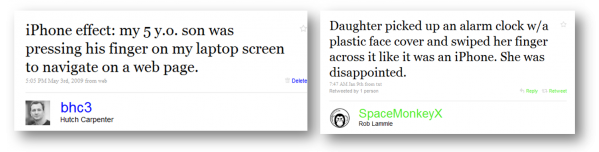
TEDxBerlin talk, discovered via Hutch Carpenter’s blog

image

View till the end.

It’s a bit funny at the end, and you can hear the audience laughing at this and not really taking the last bit seriously.

Think twice.

Think this one through ! In the same blog post, Hutch points at the real meaning of the iPAD.

Think it through. The keyword is digital intimacy. Your computer is not your computer anymore.

Think generation-M. Generation Meaning.

image

It’s your personal “pad”-device.

You can give it a pad.

You can hug it, it can hug you.

Try in your imagination to mix up iPhone, iPAD and those little house-robots that were so popular some years ago. I know my friend Nick has 2 in his apartment !

Nick Carr used the title “Hello iPAD, Goodbye PC”.

I think he’s right on.

Body Part Maker

In the current economic climate, one restructuring follows the other. In my country there are some notable examples like AB Inbev, Opel (GM) Antwerp, HP, etc.

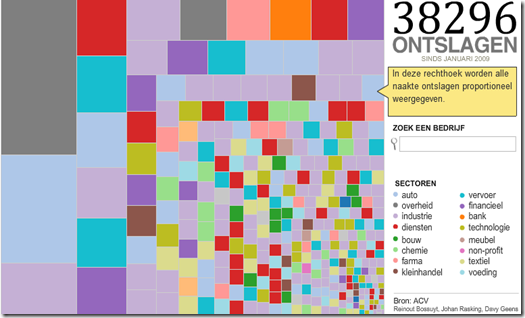
At the time of writing this post, the counter of lost jobs in Belgium since January 2009 stood at


38,296


lost jobs


And this is “only” from structured and collective redundancies. The following table comes from quality newspaper De Standaard. The visualization also represents what sectors “contribute” most to these redundancies.
image

It’s therefore “normal” that i see/meet/mail more and more friends and (now ex-) colleagues being hit by the recession, crisis, or whatever you prefer to call the current economic climate and resulting restructuring or transformation programs. It happens everywhere. Except at the one employer i ever had that still today shows double digit growth.

However, some of these friends were living in Golden Cages for years but were bored to hell. The shame is that they let this happen over them. Others indulged all sorts of manipulations, political maneuvers, and other techniques that did not take them for full or were just ignoring them and their ideas. Others just had the courage of sticking out there neck, but not being appreciated by the blueprint and/or differing too much with the “normal way of doing things here”.

Indeed, it seems recurring many companies that diversity in thoughts is not always welcome, despite all the window dressing about values etc. That is of course a pity, because this diversity in thoughts and ideas is fundamental to being innovative.

And it happens everywhere. Except at that one record retailer. They seem to be some kind of Tribe. Have always been since the 60’ies, with self-development programs and alike. They also continuously innovate. With green IT and own windmills etc already 10 years ago. “Cradle-To-Cradle – Remaking the Way We Make Things” applied before the book was written.


So it’s all about sustainability, made possible through R&D and Innovation in new sciences and technologies. And being part of a tribe that has innovation in its DNA. See also later in this post when we discuss the jobs and trends of the future: science and technology are at the heart of the sustainable development debate.

However, if you’re not part of such a tribe, and you get fired where you were bored, then there is light at the end of the tunnel. Getting fired could really be a fresh start of your professional life, although somebody else made the decision for you.

Have a read at “The Living Dead: Switched Off, Zoned Out – The Shocking Thruth about Office Life” by David Bolchover.
Joe read the book and here is his review:

This book is about – the millions of talented and bored to tears people rotting away in large offices, completely disconnected, disenchanted, disengaged, shuffling papers away, staring at screens, writing memos and Powerpoints, sitting in meetings deliberating in jargon that means nothing, and generating serious pretend-work….

and how our world and organizations have made this a taboo topic, refuse to recognize its existence and aggravate this problem through inadequate structure and processes (specialized business jargon, office politics, hierarchy, etc).
image


This is one of the most blunt books I’ve ever read – a Dilbert with the sharp facts substantiated! And you will not find one business jargon word that can qualify for a b-sh**t bingo in there.

The most interesting part is that the book is written already 5 years ago – and looking at Peter Van’s blog and the book gives a clear indication of a very alarming trend. Not for the weak-hearted! Contains some seriously ego-busting words on our Great Leaders ( the big companies CEOs) and Even Greater Gurus (the Management book writers).

What would you do if you got fired ? What would be the one thing that you would like to do for free for the next 10 years ?


Could give you a real good indication

of where your true

passion and purpose is.


But where to look first ? The report FastFuture.com report “The Shape of Jobs to Come” (Final Version January 2010, you can download the PDF here) would be a good starting point.

image

The report lists the 100 most likely jobs to emerge and be successful by 2030. Some of these jobs will already see the light as soon as this year 2010.

And if you have the luxury to take first take a couple of months sabbatical, then the report has in Appendix-3 an excellent time-line on what will happen when, what skills you need to master by when, and what the most probable and most looked after jobs of the future may be.

The outcome may be that you may want to follow some course on NIBC convergence technologies. (NIBC = nanotechnology-biotechnology-information technology-cognitive science) or to study Chinese, Spanish and Portuguese if you want to mean anything in the economies of growth of 2015.

Some extracts with – as usual – some personal comments.

For the longer term, the centrality of science and technology in helping to tackle the most pressing planetary challenges from poverty to clean water, environment to human health, climate change to energy supply and housing to transport are ensuring that science and technology are at the heart of the sustainable development debate

Finally they are expected to help us survive and thrive in the cyber world, whether through legal protection, counseling or management of our virtual data and ‘personal brand image‘. As a result, the survey suggests that many of these roles will be popular, well-rewarded and aspirational.

The ten key patterns of change identified in the report are:

1. Demographic Shifts

2. Economic Turbulence

3. Politics Gets Complex

4. Business 3.0 – An Expanding Agenda

5. Science and Technology go Mainstream

6. Generational Crossroads

7. Rethinking Talent, Education and Training

8. Global Expansion of Electronic Media

9. A Society in Transition

0. Natural Resource Challenges


Looks like the list we suggested for our Think Tank on Long Term Future 😉

Under “economic turbulence, we find:

Further economic turbulence and potential downturns between 2010 – 2020, followed by a more stable period to 2030 as excessive risks have been removed from the financial markets and most economies have repaired their finances

Out of the list of 100 future jobs, i personally liked very much: the body part maker, the teleportation specialist, the currency designer, the non-military defense specialist, the director of responsible investments, the mind reading specialist,

Take the Body Part Maker (possible emergence as a profession: 2020, that’s only 10 years from now !):

Due to the huge advances being made in bio-tissues, robotics and plastics, the creation of high performing body parts – from organs to limbs – will soon be possible, requiring body part makers, body part stores and body part repair shops.

While a typical organ such as a liver or kidney might be grown, other parts such as an arm would involve the complex integration of a nano-engineered skeleton, high performance robotic joints, fibre-optic nerves, artificially grown skin, synthetic flesh and muscles.

Or the Memory Augmentation Surgeon (emerging profession in 2030). It really reads like Ray Kurzweil’s “The Singularity is Near” (book written in 2005 !)

This is a new category of surgeons whose role is to add extra memory to people who want to increase their memory capacity. A key service would be helping those who have literally been overloaded with information in the course of their life and simply can no longer take on any more data – thus leading to


sensory shutdown


Although the job descriptions are somewhat funny and even “cute”, the real value of the report is in its Appendices: they hide a wealth of trends for 2030.

Truly amazing. If only 10% of this becomes true, the world in 2030 will look quite different from 2010. Especially Appendix-2 is a summary of all things you should be aware of as 2015 approaches. Appendix-3 shows a very comprehensive timeline per trend.

It is in these Appendices that you can learn for example about Generational Cross-Roads:

The challenge for employers will be to create an environment where each group can feel valued and be effective. Indeed, a Randstad USA survey found that 51% of baby boomers and 66% of the generation that preceded them reported having little to no interaction with colleagues from Generation Y.

What is your company doing to get these young generations

deeply into your workforce’s DNA ?

And about Society in Transition:

Higher ethical standards and a sense of the greater good are two of these evolving trends. Increasing expectations are concurrent with a decline in trust of key institutions.

“Higher ethical standards…”  See also my previous blog post on Ethical Re-Boot.

About Evolving Technological Ecosystem, the appendices reveal that:

Handheld devices expected to become the control centre of a rapidly expanding personal ecosystem – where projection / pullout screens and keyboards could accelerate laptop replacement. Key enablers include augmented reality, intuitive interfaces, semantic computing and the increasing embedding of intelligence in a range of devices – often known as ambient intelligence or IP Everywhere.

What is your company doing to get these technologies

deeply into your innovation DNA ?

And about Quantum Cryptography that:

In “traditional cryptography” the data itself is encrypted using complicated mathematical functions. In “quantum encrypted communications”, a key is sent by beaming a string of photons, representing a code, from the source to the target. If it gets to the other end and matches what the target expects, then the data gets unencrypted. The Guardian notes that if anyone tries to intercept or break it, thanks to the laws of quantum physics, the mere act of observing the stream of photons changes it – and so it fails

If you company is doing something related to internet security

your strategy for the next 5-10 years

should have some bullets and focus on this.


And it is not always about throwing another GUI at your application. Have a look at this article that suggest that Mind and Square are NOT innovative and the true meaning of innovation in financial services lies in the plumbing, not the UI.

Remember my discourse about Innovation at the Core vs. Innovation beyond the Core ?

And then there is a section on R&D and Innovation trends. Most countries and regions seem to invest more in Innovation:

R&D Takes Centre Stage: Germany is investing EUR900M by 2010 to fund R&D projects commissioned by medium-sized business and EUR65M to expand and develop research infrastructure. Norway is set to increase its Research and Innovation Fund capital by EUR685M and create over 200 new research positions each with EUR90,000 funding. France is committing EUR731M in 2009-10 to refurbish universities and research institutions. China’s 10Tn Yuan 2009-11stimulus package includes major investments in science and technology, including "key research projects related to enlarging the domestic market.‖ (University World News).

And where is Flanders ? The Flemish Government decided to REDUCE the budgets for Innovation and R&D for the next couple of years ! And some companies plan to do the same in reaction to the economic climate.


Reducing your innovation budgets

means the beginning of the end

It means that you don’t believe

in the future

of your region, company or project.


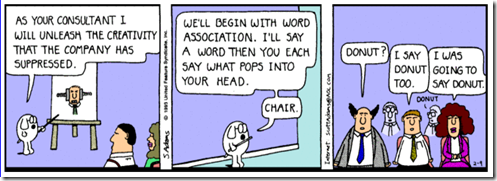
Calling in a bus of consultants to tell you how to innovate will not work. First check out How real your Innovation is. And start from there. Especially if your company has a culture of incremental innovation.
image

We have to invest now. As mentioned before, i believe this requires a private (non-public) initiative. Many public – government driven – initiatives seem to lead to lots of consensus and compromise, often leading to a watered down vision, or no vision at all.

I was – and still am – hoping that our Think Tank on Long Term future can kick-start this private process.

Let’s also watch-out for the Belgian Presidency of the EU for the second half of 2010. I heard they bring on board some really smart people that can make the difference. Hopefully we get in the news because we really could make that difference, rather than through scandals about drunk MP’s.

If not, we may have to start imagining a miserable future in 2030 where we will be feeling like in 2010 without Internet (kicked into our lives around 1995 for most of us).

So, if you are/get fired, the next best thing to do is probably to look into the direction of your purpose and to surround you by the people of the right tribe. Those that make you live longer not shorter. Those that truly bind not seek conflict. Those that want you to succeed, not fail. Those that are capable of saying yes, and have not been trained to find the “no”.

For further inspiration about being mentally healthy and finding the right tribe, have a look at this TED talk by Dan Buettner on “How to live to be 100+”. With thanks to the friends in Iceland for spotting this one.

Or you may just not even make it to 2030 !
image


Reblog this post [with Zemanta]

Web Evolution: The network is the database

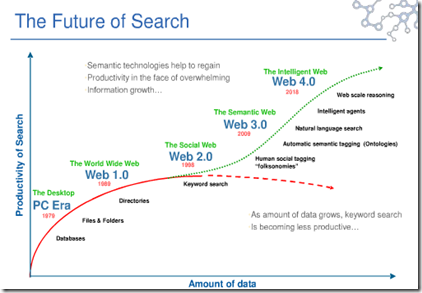
If you want to have a really good 23 slide summary of where the web is heading, check out Nova Spivack’s Web Evolution slide deck.

image

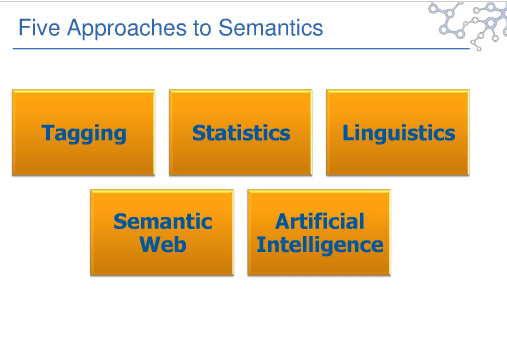
There are some really good positioning slides as from slide #9 and following, to get a feel for the difference between for ex Delicious, Google, Powerset (now Microsoft), Twine, and Wolfram Alpha.

image

I was quite lucky having a 1-1 with Nova Spivack during Web 2.0 Summit in October 2009. He showed me a much elaborated slide deck than this one, but I feel that since then he really condensed the subject to the essential.

Enjoy !

Print

PS: He was ok to join Innotribe @ Sibos 2010 in Amsterdam 😉

Reblog this post [with Zemanta]

Ethical Re-boot

UPDATE: Cool ! It seems that my site has been blocked from Myanmar 2 hours after posting this article. Now i really feel what freedom of speech means.

UPDATE-2: added some other interesting links at the end of this post.

I fully agree with Robert Scoble that Google’s threat to withdraw from China is a world changer. A huge milestone.

chinagoogle

Image courtesy WSJ

I believe that – when we will look back some years from now – this move will be seen as the “tipping point” in Corporate Ethical Re-Boot.

In this post, is will share some of my personal views on the Google-China event, and some other ethical old game/new game type of events i observed recently in my country.

There is a tsunami of responses to Google’s position. Some good recent blogs on the subject can be found here: Wall Street Journal’s overview and clearing up the confusion/myths, Scoble’s push/pull article, Kara Swisher’s China’s Internet Behavior, and John Paczkowski U.S. State Department to complain article.

UPDATE-3: another interesting one is from Christopher Meyer “Why is Google doing Government’s Job ?”

Walter Wriston (CEO of Citicorp in the 1970s) , in his 1992 book The Twilight of Sovereignty, predicted that business institutions would take over many of the roles of the state. He had a front-row seat — maybe the whole front row — as private financial institutions became more powerful than every central bank in the world save the US Fed (until now, at least). Governments’ power in shaping world affairs wanes as access to information broadens. As another affirmation of this, Carne Ross, a former UK diplomat, now does business as an "Independent Diplomat," offering professional-class diplomacy to state and non-state actors.

A new thesis by Miranda Meyer of the University of Chicago (umm…yes, relation) asserts that non-sovereign organizations like Hamas and Hezbollah belong to a class of actors that have important impacts but are not recognized in the Political Science literature.

Miranda Meyer’s thinking is very much in line with Joshua Cooper Ramo’s book “The age of the unthinkable”

Back in 1993, Wriston’s subtitle was "How the Information Revolution is Transforming Our World." Indeed, 17 years on, who can doubt that it has? One of his favorite observations was that "information about money is more important than money itself." Google’s influence is a sign that information about information may be more powerful still.

I found two other blog posts remarkably interesting.

First there was Fred Destin’s blog on Communist China, the misbehaving superpower.

The global outcome of a fast-growing command economy has been the government-determined explosion of asset bubbles all over the world – not because China is growing, the cause assumed by most economists, but because the government is buying resources (and their future options) on the global market, forward for 5-20 years. The result: instant commodity asset bubbles, worldwide, and further destabilization for non-Chinese consumers of these commodities. Of course, if the Chinese play the bubbles wrong, they will lose even more as prices collapse.

Could the Chinese create a global catastrophe by commanding all of this leverage into the wrong assets at the wrong time, by deflating the value of high-IP goods, by forcing global competition against unsustainable cost bases, and destroying non-Chinese business infrastructure? Sure. In fact, this is almost a “when,” and not an “if,” question.


What could possibly be more

dangerous to the world than a

command economic system run

on a global scale?


This is one view, a bit driven by


FEAR


Fear is also coming into the picture when you see that US Government is starting to take position, with all it’s possible impact on the US-China relations, the world economy and the quite fragile balance in world peace (at least between the super-powers).

But there is also the view driven by the opposite of fear:


LOVE


Translated into hope for an ethical reveille, beautifully articulated in Umair Hague’s MUST READ post “Google, China, and the new High Ground of Advantage” and you start seeing a pattern:

But the high ground has shifted. The new high ground is an ethical edge. It’s not about having more; it’s about doing better. It’s not about protecting exports, pressuring buyers and suppliers, price discriminating against the powerless, and programming consumers to buy, buy, buy — it’s about making people, communities, and society authentically better off. It’s not about caring less — but caring more. It’s not about ruthlessness. It’s about mindfulness.

The 20th century high ground might let China build a few dozen Microsofts, Fords, and Gaps: industrial-era companies that make industrial-era stuff — and play by industrial-era rules. Yawn. We know how that story ends, because we’re living it: an economy, polity, society, and natural world in stagnation and decline. Dear Wen Jiabao: want fries with that Zombieconomy?

The only way to step past the industrial era’s zombified endgame is the new high ground, because only an ethical edge can do all the good stuff above. The old high ground was built for 20th century economics: sell more junk, earn more profit, "grow" — and then crash. An ethical edge operates at a higher economic level.

It is concerned with

what we sell,

how profits are earned, and

which authentic, human benefits "grow."


It’s a concept built for the economics of an interdependent world.

Ethical edge is advantage reconceived for the 21st century. It’s an institutional innovation: the institution of "advantage" rebuilt for a threadbare, fraying, global economy. It’s a radical new definition of "advantage" that blows past the stale, tired idea of competitive advantage.

For me personally, i am on the hope side, and what’s going on here is really opening the Ethical Firehose.

I have always been inspired by the work of Peter Singer, especially his books “One World” and “Writings on Ethical Life”, but had somehow lost hope due to being confronted with the sad and disappointing realities of corporate life. I guess we all got our wounds as we lived our professional lives.

Umair Hague already pointed at it: one of the cultivated behaviors in corporate life is cynicism. As i have mentioned at several occasions before, cynicism is applied by folks who have lost the ability of "opening their heart”.

The other corporate disease is “Machiavellian" behavior. I have met recently professionals who even seem to be proud of their Machiavellian “skills”.


I think it’s wrong, very wrong


I looked up in some dictionaries what Machiavellian really means.

Being or acting in accordance with the principles of government analyzed in Machiavelli’s The Prince, in which political expediency is placed above morality and the use of craft and deceit to maintain the authority and carry out the policies of a ruler is described. Characterized by subtle or unscrupulous cunning, deception, expediency, or dishonesty: He resorted to Machiavellian tactics in order to get ahead.

And in the Business Dictionary, i found:

Conduct or philosophy based on (or one who adopts) the cynical beliefs of Niccolò Machiavelli (1469-1527) whose name (in popular perception) is synonymous with deception and duplicity in management and statecraft. Born in Florence (Italy), Machiavelli was its second chancellor and (in 1531) wrote the book ‘The Prince’ that discusses ways in which the rulers of a nation state can gain and control power. Although The Prince contains some keen and practical insights into human behavior, it also displays a pessimistic view of human nature and condones opportunistic and unethical ways of manipulating people. One of its suggestions reads, "Whoever desires to found a state and give it laws, must start with assuming that all men are bad and ever ready to display their vicious nature."

It’s fundamentally about dishonesty and manipulation. It’s about trust (or the lack of it) . Would you be able to trust Machiavellians ? Do you trust your leaders if they don’t apply the basic ethical principles ?

Some shocking examples come from my own country.

Last week we had our Minister of Pensions Michel Daerden showing up drunk in Parliament. It even made BBC News. I am so proud of our leaders (hmmm. this is cynicism again).

Or our ex-prime minister Jean-Luc Dehaene whose famous arrogant answer to journalists was usually “no comments”: he is now on the board of AB Inbev as “independent” advisor. We have in Belgium an “ethical code of conduct” called the “Code Lippens”. 

The Corporate Governance Committee was established on 22 January 2004. Maurice Lippens was appointed chairman. The Committee was created at the initiative of the Banking, Finance and Insurance Commission, the Federation of Enterprises in Belgium and Euronext Brussels.The Committee issued a single reference code for listed Belgian companies. The Code is to set out principles of good governance and transparency, which will contribute to the development of companies and to the quality of their image among investors and the general public.

Guess what ? based on the information in Belgian quality newspaper De Standaard, Directors of the Board get a yearly fixed compensation of 70,000 to 80,000 EUR plus a variable compensation, let’s say a bonus. How can you be an independent advisor to the board in these circumstances ?


Who does still trust these people ?


Getting closer to the business of financial services i am working in – and the importance of trust in this new decade – there was this related article in the Confused of Calcutta titled Musing about Trust.

There’s something very human about trust. Something more related to the Age of Biology rather than the Age of Physics. We’ve seen what happens when we rely on mathematics for ratings and values and decisions. Last time round it was called the Credit Crunch. A decade earlier it was called LTCM. Whatever.

Some of us believe passionately in the power of what’s happening today, in terms of democratized tools and access and community-based approaches to many things, from home to work to government and beyond. In fact, I’m personally somewhat at a loss as to why no one has really put together the right community-based vehicle for “climate change”, built as an open and transparent platform, on open source principles and in a global inclusive manner.

Trust is about covenant relationships, not about contract relationships. In a contract you await breach and effect recourse. The question answered is “who pays?” In a covenant the question that’s answered is “how do we fix it?”

I think we’re going to spend a lot of time in 2010 learning about covenant relationships and their role in society. At home. In the community. At work. As a nation. As the world.

Which brings me to Michael Moore’s recent film “Capitalism: a love story”.

michael-moore.jpg

I was chatting with a colleague in Cubicle 3B23 about this.

The person’s reaction was:

I am ashamed to work

for this industry

I think i am going to watch the movie too. Because, somewhere somehow it all starts feeling wrong and not in line with my true compass.

Other related articles

Reblog this post [with Zemanta]

Love and Hate Relationships


image

A good friend of mine commented on one of the blog post. It’s a comment that cuts deep. Knowing the person, i think it was quite a step to be this open on a public blog. So first of all, congrats for coming-out !

Here is the original comment:

I have spent some time reading through this and other blogs of yours. And they make me react strongly in a very controversial way: I love them and I hate them; I agree and fully reject their contents.
And, beyond the very valid and daring points you make, I’d like to reflect about the channel: speaking one’s true mind, yet doing so hiding behind a screen and sometimes even a fake name.
My fear is having my own children communicating with me via a blog.

You make me reflect, to the point of writing this reply. So I guess we should both be content as the blog has obviously achieved its goal…
But I dont know if I should be happy or sad about it. After all, I could have also called you!

With respect to the fake name, this was to protect. Not myself, but somebody else. I really would like to know on what content you agree or reject. Contact me.

In response to the strong point you make about the communication channel, I believe we have to let the future emerge (We don’t have a choice anyway ;-). We have to be in this world and evolve and adapt to survive. Or we can disconnect and go to a monastery, which is a valid choice of course.

My and your children consider e-mail as really very old-fashioned. And blogs are really for guys with grey hairs. So here we are. It’s 2010.

49 n02_21582623

Whether you like it or not, your and my children will communicate using Twitter, Facebook, Netlog, Foursquare etc or whatever will be applicable the next years. Like we used to send SMS’s, our kids will Tweet or whatever the channel will be.

special4

One thing is inevitable. The on-line communication channels move into real-time. Nova Spivack coined this “The Stream”. See my post on World Wide Web.

I have btw another blog post in preparation about about a very related subject: privacy.

We seem to have passed the tipping point where the default is NOT privacy, but Public. It will then be up to you to indicate what about yourself you want to keep private. I struggle with that too. It has a lot with digital identity. If you’re interested in digital identity, i can really recommend the blog of Kim Cameron: www.identityblog.com

I encourage anyone to get into discussion with me on the CONTENT of this blog. Via the comment link, via phone, mail, face-to-face.

When i started this blog, i had some blog-shyness. That over now. I feel more comfortable with this channel now.

Probably 10 years later than the early adopters, but who cares !

Emotional Zombies

Great post on “Who needs employees anyway ?”. Discovered via Fred Zimny’s Blog.

This is based on a recent “Global Workforce Survey” conducted by Towers Perrin, an HR consultancy. In an attempt to measure the extent of employee engagement around the world, the company polled more than 90,000 workers in 18 countries. The survey covered many of the key factors that determine workplace engagement, including: the ability to participate in decision-making, the encouragement given for innovative thinking, the availability of skill-enhancing job assignments and the interest shown by senior executives in employee well-being.

Barely 21%

of employees are truly engaged in their work, in the sense that they would “go the extra mile” for their employer.


Nearly 38%

are mostly or entirely disengaged, while the rest are in the tepid middle.


Surprisingly, 86%

of the employees in the Towers Perrin study said they loved or liked their job.


So, next time you evaluate your yearly employee satisfaction survey, beware of the numbers saying that the majority of employees is happy. Even if you sense in every office, corridor and corner that is not true.


Anyway, why these rather shocking results ? The article suggests a number of reasons:


Ignorance

It may be that managers don’t actually realize that most of their employees are emotional zombies

Indifference

Another explanation: managers know that a lot of employees are flatlining at work, but maybe they simply don’t care

Impotence

It could be that managers do care, but can’t imagine how they could change things for the better. After all, a lot of jobs are just plain boring.

Reputation

The company’s reputation and its commitment to making a difference in the world—is this a company that deserves the best efforts of its people;

Leaders’ Trust

Are the behaviors and values of the organization’s leaders—are they people employees respect and want to follow?


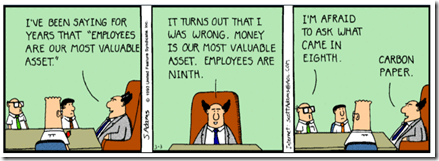
Anybody who has ever read a Dilbert strip knows that cynicism and passivity are endemic in large organizations.


image


However – in my opinion – we too easily get away with joking about cynicism. In my opinion, it is the cancer of today’s organizations that seem great at the outside, but grim at the inside. They look like golden cages. They offer all the perks possible, but they ignore 3 basic attitudes for any human being to function well.

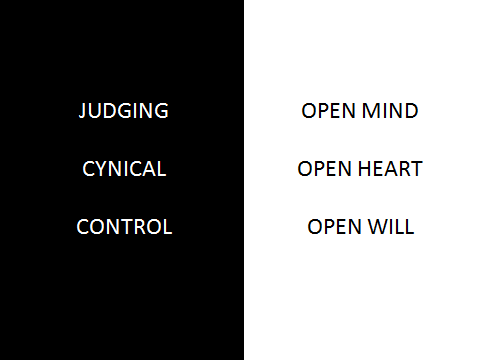
#1: To have an open mind. Companies/People who do not have an open mind tend to retract into highly judgmental.

#2: To have an open heart. The next level is that of the heart. People who do not have an open heart have developed cynicism as a defense. They have learned NOT to show their heart.

#3: To have an open will. Last but not least, when there is no room for open will, we become control freaks.

In today’s society, driven more and more by openness and transparency, these “tricks” of judging, being cynical and control don’t work anymore.

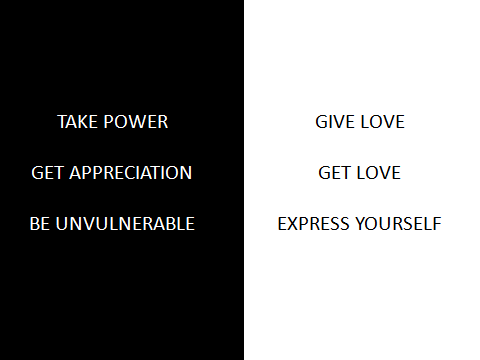
It all boils down to 3 fundamental needs for every human being:


image


People who are not able to express themselves (anymore), position themselves as “invulnerable”. In stead of being able to receive love, they compromise on getting appreciation. And in stead of giving love, the defense mechanism becomes one of taking power. As long as we have power games between the silos, the CEO can shout “change” and “innovation” as long as he wants, at the bottom of the pyramid nothing will change.

Surprisingly, the origins of these needs – and their fulfillment or not – is formed during the first 1-3 years of your life. In other words beyond the control of the organization you work for today.

But organizations should be conscious about these facts, and offer their employees probably the most interesting perk they can give: to follow a personal development program that lets the employee explore it’s true self.

  • Who am I ?
  • Who am I in a group ?
  • Who am I in the world ?
  • Finding your true passion.
  • Finding your true purpose in life.

And hopefully finding (or founding) a company that welcomes you respectfully as an employee, and gives you the chances to develop your true potential in line with your purpose.

It reminds me of Jim Collins and a 2003 blog post found back earlier today.

The start of the New Year is a perfect time to start a stop doing list and to make this the cornerstone of your New Year resolutions, be it for your company, your family or yourself. It also is a perfect time to clarify your three circles, mirroring at a personal level the three questions asked by Smith:

1) What are you deeply passionate about?
2) What are you are genetically encoded for — what activities do you feel just "made to do"?
3) What makes economic sense — what can you make a living at?

Those fortunate enough to find or create a practical intersection of the three circles have the basis for a great work life.

An to come back to the Global Workforce Survey:

  • In every industry, there are huge swathes of critical knowledge that have been commoditized—and what hasn’t yet been commoditized soon will be.
  • Given that, we have to wave goodbye to the “knowledge economy” and say hello to the “creative economy.”
  • What matters today is how fast a company can generate new insights and build new knowledge—of the sort that enhances customer value.
  • To escape the curse of commoditization, a company has to be a game-changer, and that requires employees who are proactive, inventive and zealous.
  • Problem is, you can’t command people to be enthusiastic, creative and passionate.
  • These critical ingredients for success in the creative economy are gifts that people will bring to work each day only if they’re truly engaged. (Eric Raymond made this point way back in 2001 when he argued that in the new economy, “enjoyment predicts productivity.”)

For passionate readers, i can recommend in this context Eric Raymond’s book The Cathedral and the Bazaar.

Or a bit an older – but still very relevant book – “The Cultural Creatives


Must be that I am some sort of +


positive guy when i turn a title like Emotional Zombies” into something positive like “The cultural creatives”

As Seth Godin was saying in his today’s blog:


One of the most common things I hear is, "I’d like to do something remarkable like that, but my xyz won’t let me." Where xyz = my boss, my publisher, my partner, my licensor, my franchisor, etc.

Well, you can fail by going along with that and not doing it, or you can do it, cause a ruckus and work things out later.

In my experience, once it’s clear you’re willing (not just willing, but itching, moving, and yes, implementing) without them, things start to happen. People are rarely willing to step up and stop you, and often just waiting to follow someone crazy enough to actually do something.

I’m going

Come along if you like


Reblog this post [with Zemanta]

Sean Park’s Sixth Paradigm

As preparation of 2010, i very strongly recommend to get familiar with Sean Park’s The Sixth Paradigm post of 28 Dec 2009.

I am a big fan of Sean and his site the Park Paradigm. He was the guy who made the famous AmazonBay2015 video.

image

That was 2006.

Since a couple of days the video of his Oct 2009 presentation at Amsterdam eComm Europe is available on his post above and also the Prezi presentation is here.

The video of his presentation is 20 min. It’s worth your time.

Two extracts of this presentation should get your attention, and incentivize you to read on:

– What is the difference between a bank and a telecom company really ?

– The difference between bank messaging and telcos is disappearing.

image


image

I believe this presentation is VERY VERY relevant to financial services and concepts such a marketplaces for financial services.

This presentation gives you an absolute macro-evolution view on why this is a bound to be happen, and why the inherent structures of our current – usually vertical integrated – behemoth companies will struggle very hard to get their arms around this if they even ever succeed it spotting this as a HUGE opportunity.


The essence of the story is that those

vertically integrated companies

will be replaced/challenged

by horizontally connected entities

offering themselves

to the marketplace

via APIs


The innovation will happen

at the edges of the marketplace.

The marketplace is not even

innovative anymore.

It’s an essential piece of

the plumbing.

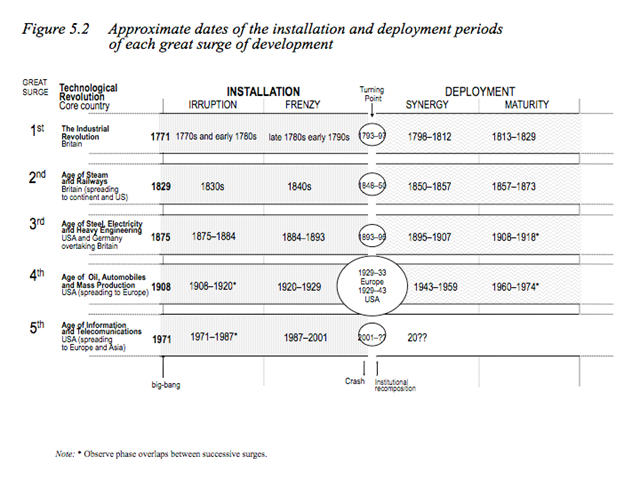
A lot of Sean’s thinking is based on the work of Carlota Perez and her book “Technological Revolutions and Financial Capital: The Dynamics of Bubbles and Golden Ages”

Professor Carlota Perez is a Venezuelan scholar and expert on technology and socio-economic development most famous for her concept of Techno-Economic Paradigm Shifts and her theory of great surges, a further development of the Kondratieff waves.

Carlota Perez Recurring Phases


Carlota Perez the 5 previous paradigms

Courtesy The Park Paradigm & Carlota Perez book.


Sean Park’s claim is that we are  now getting into the 6th paradigm, and this is also a switching point between 2 phases.


image


Sean Park believes the drivers will be 3-fold:

1) Cloud computing, with EVERYTHING as a Service

2) Exchange Ubiquity. The marketplace as plumbing, i would call this

3) Digitization

The last one “Digitization” seems “obvious”, unless you push this to the limits, as Sean Park does:


image


He takes the example of ISBN numbers as one of the success factors of Amazon’s book shop. Sure, there is big logistical tail to the book shop, the the core of the Amazon model is digitized, i.e the ISBN is just an identifier, linked to plenty of content and metadata, that can be accessed by an eco-system through APIs.

Where it even becomes more interesting, is where Sean mixes this up with theories of complex adaptive systems. It’s basically saying that


those horizontally integrated value chains

are chains of nearly decomposable services

And please read this in the context of nearly decomposable

financial services


And (traditional) vertically integrated companies (offering financial services) will not be able to compete successfully in rate of adaptation and fitness with these horizontally integrated “engines” or “eco-systems”.


image


Sean asks the question:

Where is the AppStore for Financial Services ?

here is the digital platform + API’s for the financial industry ?

Where are the decomposable financial services that can thrive on such marketplace ?


image


Sean has some other great disruptive statements. Like this one:


image


Its about the shift


from

image   To

image


It looks like Sean’s company is looking to invest in companies that understand how to build and offer these decomposable services.


But who should invest in the marketplace,

the plumbing,

the “dumb” but highly secure pipes

for the financial industry ?


We could let every Bank behemoth have it’s chance at it. That may be great for lock in. But in the long term, we will need something that is highly interoperable.


With interoperability

built-in

into the DNA

of this Digital Platform.


That is run as a service for the community. And to be the “invisible engine” for financial services cloud computing.

Invisible Engines: How Software Platforms Drive Innovation and Transform Industries


It’s only a very personal opinion, but i believe SWIFT is quite uniquely positioned to play this role.


Print


We are already in full prep for our 2010 SWIFT Innovation activities. It should be obvious from the above that we have Sean Park on our list of speakers to be contacted for our Innotribe event series, and who know at Sibos 2010 in Amsterdam ?