Love and Hate Relationships


image

A good friend of mine commented on one of the blog post. It’s a comment that cuts deep. Knowing the person, i think it was quite a step to be this open on a public blog. So first of all, congrats for coming-out !

Here is the original comment:

I have spent some time reading through this and other blogs of yours. And they make me react strongly in a very controversial way: I love them and I hate them; I agree and fully reject their contents.
And, beyond the very valid and daring points you make, I’d like to reflect about the channel: speaking one’s true mind, yet doing so hiding behind a screen and sometimes even a fake name.
My fear is having my own children communicating with me via a blog.

You make me reflect, to the point of writing this reply. So I guess we should both be content as the blog has obviously achieved its goal…
But I dont know if I should be happy or sad about it. After all, I could have also called you!

With respect to the fake name, this was to protect. Not myself, but somebody else. I really would like to know on what content you agree or reject. Contact me.

In response to the strong point you make about the communication channel, I believe we have to let the future emerge (We don’t have a choice anyway ;-). We have to be in this world and evolve and adapt to survive. Or we can disconnect and go to a monastery, which is a valid choice of course.

My and your children consider e-mail as really very old-fashioned. And blogs are really for guys with grey hairs. So here we are. It’s 2010.

49 n02_21582623

Whether you like it or not, your and my children will communicate using Twitter, Facebook, Netlog, Foursquare etc or whatever will be applicable the next years. Like we used to send SMS’s, our kids will Tweet or whatever the channel will be.

special4

One thing is inevitable. The on-line communication channels move into real-time. Nova Spivack coined this “The Stream”. See my post on World Wide Web.

I have btw another blog post in preparation about about a very related subject: privacy.

We seem to have passed the tipping point where the default is NOT privacy, but Public. It will then be up to you to indicate what about yourself you want to keep private. I struggle with that too. It has a lot with digital identity. If you’re interested in digital identity, i can really recommend the blog of Kim Cameron: www.identityblog.com

I encourage anyone to get into discussion with me on the CONTENT of this blog. Via the comment link, via phone, mail, face-to-face.

When i started this blog, i had some blog-shyness. That over now. I feel more comfortable with this channel now.

Probably 10 years later than the early adopters, but who cares !

Avatar

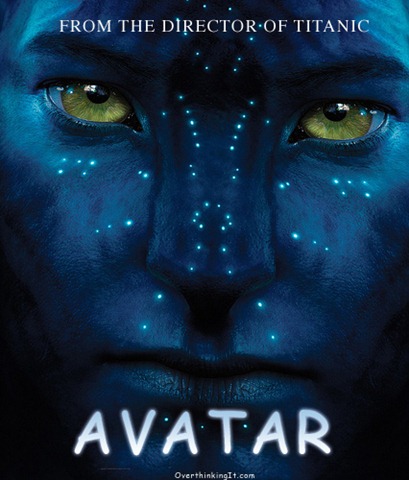
Went to see Avatar this afternoon. Here is the link to the official website, which is an experience on itself: put the audio ON please. Have also a look at the Wikipedia site about the film.

avatar-poster

And i was lucky to see it in 3D. What an experience! First of all, it was quite some time since i ever went to the “cinéma”, and this was also my first 3D movie ever. I was absolutely surprised by the quality of it.

For me, this movie had the same impact as 1968 ! movie “2001: A Space Odyssey”

Without telling too much about the story and the plot, how i would like to fly that chopper !

And how i’d wish that the tablet PC in the movie is what Apple is going to release in Jan 2010 ! Or to have one of those fantastic displays 😉

You will also recognize music that makes you think of the final sequence of Titanic.

It’s mind-blowing. In the beginning of the film, you feel really surprised how real the characters, and the fauna and flora are. That’s ok for 5 min, but then you start realizing this goes on for about 2 hours, and the makers of the film immerse you in some semi-real environment, and you feel as being part of it, and you feel part of the story and engaged. A masterpiece.

You have to see it. Don’t compromise on a non-3D version.

And stay till the end, and have a look at the credits. An endless list of specialists that have contributed to the movie. A true 2010 Enterprise.

And to close, here is a quiz: at the end of the film, the main character Jake Sully does his last “videolog”. What is the exact date that is shown on the videolog display ?

Brain Chips

image


All images courtesy of www.gigaom.com. found via my subscription to the fantastic spacecollective.org site. Full link here.

I somehow like #2, but get discouraged when i read the description: “The technology is basically the same as that used to treat Parkinson’s disease.”

Seriously, it’s a great post, and indicated that brain chips are getting real and that the singularity is getting nearer and nearer.

Web Squared for advanced

Very cool presentation on the impact of the web on the world. Web Wide World revisited so to speak. Enjoy.
View more documents from gloriagdiago.

Web Wide World


“The web is transforming society”

m04_20979625

“Web Squared: how the web transforms the world”

web2009_websquared-cover

“Web Wide World” transforming “World Wide Web”

image

Several very interesting publications and postings over the last couple of weeks, all confirming that something very profound is happening with our core systems, our core values, and how the collective intelligence of the web is gradually but surely transforming our value kit for the nearby and long term future.

First, i would like to point to 2 very rich and profound postings by Nova Spivack.

250px-Nova_spivack

On Nov 4, Nova posted The Web Wide World — The Web Spreads Into the Physical World.

A world in which every physical object, everything we do, and eventually perhaps our every thought and action is recorded, augmented, and possibly shared. What will the world be like when it’s all connected? When all our bodies and brains are connected together — when even our physical spaces, furniture, products, tools, and even our natural environments, are all online? Beyond just a Global Brain,

we are really building a Global Body

Even more profound and more elaborated is his posting What after the Real Time Web ? This supposes that you already have an idea what Real Time Web is all about. It’s a very long posting, but worth every minute/word of it. Some highlights/bullets with some personal comments:

About Web Attention Deficit Disorder: You can experience this every day if you are a Twitter, Facebook, Google Reader user. It’s about having tools to filter out the noice and focus on the essence

About Web Intention Deficit Disorder. Great “bridge” from attention to intention. I was thinking in terms of moving from “Crowd-Sourcing” towards “Crowd-Targeting

About Messaging. Messaging as we know it for 20 years is going to change 180°. In these days it is somewhat insane that we still send messages from A to B, whereas with today’s technology it’s more about having something stored centrally and collaboratively participate to this "information object in the cloud”. Google Wave is a powerful trendsetter.

About Semantics. What can i say. It should be clear by now for any semantic standards setting organization like SWIFT, like GS1, like… that their knowledge to deal with semantics in “messages” can now have a ten-fold impact in a “semantic web” world, where we now can automatically semantically tag any form of information, whether that information is already structured, or not (like in Word, PDF, images, digital information footprints, etc)

About Attenuation. About helping someone focus their finite attention more efficiently on the things they care about most. This makes me think of Generation-M (see elsewhere on this blog). The generation that cares about things that Matter.

About The WebOS.  I like Nova’s statement that “the winning WebOS is probably not going to come from Google, Microsoft or Amazon — rather it will probably come from someone neutral, with the best interests of developers as the primary goal.”

About Decentralization. “By this time the Web will be far too vast and complex and rapidly changing for any centralized system to index and search it”. It becomes increasingly clear that “central control” or “central policing” does not work in this Web Wide World. Definitely not if you don’t add value in the middle.

The intelligence is moving

to the edges

About Socialization. There is no escape. No hiding possible anymore. The future is for those who can share. That will be rewarded in new “currencies”. See elsewhere on this blog about the Whuffie Bank.

About Augmentation. Just today i was reading another post about augmented reality eye-lenses. And about Google Latitude now offering historical tracking on your whereabouts. Nova is mainly talking about real-time augmentation. Adding the historical tracker to all of this is pretty exciting.

About Collective Intelligence. Just quoting here: “This collective mind is not just comprised of humans, but also of software and computers and information, all interlinked into one unimaginably complex system: A system that senses the universe and itself, that thinks, feels, and does things, on a planetary scale.”

About Social Evolution. “Existing and established social, political and economic structures are going to either evolve or be overturned and replaced.” This has been my thesis since the beginning of my blogging. Stronger, it’s the raison d’être for my blog. If all this happens, what is the 2020-2030 impact on our core systems, on our core corporate and personal values. How will our companies, countries, world systems going to be organized and how can we prepare for the day when “Top-down beaurocratic control systems are simply not going to be able to keep up or function effectively in this new world of distributed, omnidirectional collective intelligence.”

About Physical Evolution. In essence, Nova describes the age of the Singularity, when our human brains will  be complemented by the collective and give leeway to a different type of human being.

The environment we will live in will be a constantly changing sea of collective thought in which nothing and nobody will be isolated. We will be more interdependent than ever before. Interdependence leads to symbiosis, and eventually to the loss of generality and increasing specialization.

This must sound as music in the ears to my friend and coach André Pelgrims, who is fighting the sort of societal and corporate change management that is often not more than a big illusion, because the company has been focusing on aligning (not event fusing) of departmental silos, and was not able to descend to the level of person-to-person connection and enlightenment.

These are just some of the changes that are likely to occur as a result of the things we’re working on today. The Web and the emerging Real-Time Web are just a prelude of things to come.

The last element i’d like to ask your attention for is the existence and activities of the Web Science Trust.

image

The Web is the largest human information construct in history. The Web is transforming society. In order to understand what the Web is, engineer its future and ensure its social benefit we need a new interdisciplinary field that we call Web Science.

Have a look at some of the big names behind the Web Science Trust: Tim Berners-Lee, etc. Also very good to see that some European (UK) universities are starting to take the lead.

Most interesting is to look at the Research Roadmap. Just look at the research perspectives, and it gives you an idea of the deep profound impact of the Web Wide World:

  • Computational perspective
  • Mathematical perspective
  • Social Science perspective
  • Economic perspective
  • Legal perspective

And the integrative research themes:

  • Collective Intelligence
  • Openness of the Web
  • Dynamics of the Web
  • Security, Privacy and Trust
  • Inference

I took the effort to download one of the students research reports. Oh boy, how interesting how these young people study, research, reflect, analyze. I’d love to be back at university 🙂

Here is one sentence about the WebSci’09: Society On-Line Conference:

Thanks to the support of the Web Science exchange bursary, I had also the opportunity to participate in the WebSci’09: Society On-Line Conference, which was held in Athens, Greece from 18th to 20th March 2009. The conference was actually a very special one, as it was the first conference I have ever been to where I had the chance to exchange ideas with not only computer scientists but and legal studies.

I believe it is key that

we start building companies

made of the “hybrids”

Not only computer-scientists, but people with cross-fertilizing expertise. Like “experts of other areas including social science, humanities and legal studies” and bio-engineering and nanotechnology.

All the above is very close to the suggested scope of our Think Tank on Long Term Future.
The Algorithmic Principle Behind Curiosity and Creativity

One of the very best presentations at last month’s Singularity Summit. And it comes from a European 😉

Lots of inspirarational slides and ideas, and – as a bonus – Jürgen is quite funny as well when presenting.

70,000 Feet

Via Nova Spivacks Twitter account: “See this video of flight in U2 to 70,000 feet. I went to nearly 90,000 in 1999. This gives a good feel for it. http://bit.ly/14WdGJ

Space flights will be quite ordinary in 2025. That’s a little more than 15 years from now. I may still live then.

For our think tank long term future.

Peter Thiel and the Singularity

I am just back from the Singularity Summit that took place in NY during the week-end of 3-4 Oct 2009.

banner_125x125

I will make a separate report on the rest of the event, but i was completely blown away by the 30 min speech by Peter Thiel and following panel discussion with Venture Capitalists.

PeterThiel

Peter Thiel is president of Clarium, a global macro hedge fund. He is also the founder and chairman of Palantir Technologies, a national security software firm, and a founding investor and board member of Facebook, which serves more than 200 million active users. He helps launch many other new technology companies as a founder and partner of the Founders Fund. Previously, he was founder and CEO of PayPal, which manages more than 175 million financial accounts.

Peter Thiel has philosophy and law degrees from Stanford University, where he occasionally teaches on globalization and sovereignty and serves on the board of overseers of the Hoover Institution. He funds research in artificial intelligence and life extension technologies.

See for his other investments on the above link to Wikipedia. It also becomes very apparent what a fine crew must have been at the basis of PayPal. Many of the ex-PayPallers have created very successful companies.

Also his philanthropic endeavors in the Singularity Institute, the Methuselah Mouse Prize foundation (Michael Rose himself was also at the conference) and Dr. de Grey’s work on extending human life span are some examples where Thiel’s long term vision is. I will come back later in this blog post on “time horizons”

But back to his 30 min speech at the Singularity Summit.

First his appearance. He made me immediately think about Steve Ballmer: his eyes are hypnotizing. His body language shows "withhold energy”. His jaws and mouth tense. Ready to explode. Clearly fit and in top shape. Laser sharp attention when somebody asks a question. Always listening and answering with respect.

And he delivered his speech without any supporting slide, and – as far as i could see – without any notes nor an autocue or something like that. Wow !

The title of his speech last Sunday was “Macroeconomics and Singularity”.

He started his speech with letting the crowd choose between a number of catastrophe scenarios: from bio-terrorism, to nuclear war, global warming, and a couple more like that.

His thesis was that the biggest disaster that could happen would be that the Singularity does not happen quickly. It was the start of a staggering discourse on why innovation – and especially disruptive innovation – is key to the continuation of our society. And in a grandiose move, he interweaved the financial crisis in to all of this.

Credit only works against a background of growth. But if claims of the future (singularity is a good example) don’t realize, that has a big impact on credit, on to be expected returns (which he claims are way too high for non-risk taking investments), and on the basis (growth) of our society at large. Society would still be “functioning” by fixes such as working till the age of 80, or earn less, or have low returns on capital, but that’s not what we understand with progress.

Investing in “tech” firms like Microsoft, Oracle, IBM, and even Google is betting that they will churn their revenues and profits in the foreseeable future. In other words, this is betting that nothing disruptive is going to happen.

A lot of this is driven by short term return horizons. We seem to fix the short term problems, but are stuck with the chronic long term problems.

Having a longer time horizon may be the biggest Chinese advantage.

Some other interesting quotes from his speech and following panel discussion:

    • The short run becomes the long run
    • All experts are biased in a positive direction, especially when presenting their start-up to VC’s
    • The risk of the return of fascism is very underestimated (this is about the emergence of a totalitarian regime trying to control AGI (Artificial General Intelligence) in a (pre)-Singularity time-frame.
    • I tend to invest in companies that will loose money for a long time, and a look for disruption
    • For every dollar that the government invests in opera, art, etc i want to see a dollar go to technology
    • We need to dramatically re-invest in technology education, even at primary school
    • I don’t like Darwinism, i prefer guaranteed survival. I could not resist a smile as right after this panel discussion there was Dr. de Grey himself on the agenda.

And about companies to invest in:

    • I am mainly looking at the team. And the potential of the people in that team to stay together for the long run, before founders start to argue and have a “farm" shoot-out”
    • And whether this team is capable to attract excellence. (I personally love this one as a measure for running a successful company)
    • He took his investment in Palantir Technologies as an example for this, where hiring seems to be organized around these themes. Co-incidentally, i had a meeting with Palantir the day before the Singularity Summit. I have mentioned them already several times in my blog and i would like to get them to Innotribe at Sibos 2010.

The effect of his speech was obvious. Where all other speakers at the event got max 2 rows of 4 people queuing for asking questions, there was immediately a row of 15 people of the auditorium eager to ask questions. You could feel the electricity in the air with each response from Peter Thiel.

This guy is sharp. Has vision. Has cred. Has Clout. Is a super-entertaining speaker. Has a story to tell to the financial industry. Peter Thiel would be an ideal keynote speaker for next year’s Sibos in Amsterdam 25-29 Oct 2010. It’s the first thing on my list today: go and see the organizing committee for Sibos 2010.

Of course, he would be great as well for the first event next year of our little Think Tank on Long Term Future (see previous blog posts).

How Bill Gates destroyed the universe

The Singularity Summit is coming on 3-4 Oct 2009 in NYC. See the impressive list of speakers here.

One of the speakers is Ben Goertzel, who will speak about “Pathways to Beneficial Artificial General Intelligence: Virtual Pets, Robot Children, Artificial Bioscientists, and Beyond”.

BenGoertzel

When talking about Robot Children, i would not be surprised if he used the following video made by his 12 year old daughter. Found it via Accelerating Future.

Is this what a 12 year old is thinking about ?

  • Grand Pa’s dying, and let’s upload his brain onto the computer ?
  • It’s uploaded on a Windows computer… do kids care ?
  • Is Grand Pa dead together with all the files on my computer ?
  • A universe with Windows does not deserve to exist ?

If you can believe the credits at the end of the video, at least 12-year old Scheherazade Goertzel does.

image

In this case  – among many other things – Scheherazada’s father is the originator of the OpenCog open-source AGI framework, as well as the proprietary Novamente Cognition Engine AGI system.

Artificial General Intelligence (AGI) is an emerging field aiming at the building of "thinking machines", that is, general-purpose systems with intelligence comparable to the human mind. Good starting point to learn more about AGI is http://agi-network.org/

You see what happens when kids get this sort of ideas served with the mothermilk 😉 We recently presented another mothermilk example when we spoke about Aza Raskin, now Head of User Experience at Mozillla Labs. His father was Jeff Rasking, one of the big minds behind the Apple user interface.

Very curious to see what how this Generation-M will move up the ladders, and one day be our leaders. Any other wizkids you are aware of ?