Zemanta and the Semantic Web

image


If you want to have an idea what Semantic Web can mean for you and your business, have a look at www.zemanta.com.

It comes as a Google Chrome Extension, or a Firefox extension, or a IE Plug-in or Safari Bookmarklet.

I tested the Google Chrome extension on my PC. In this case a Mini-HP with Windows 7 installed. I also use Windows Live Writer to do my blogs. Zemanta also has a Live Writer Plug-in that i also installed.

This looks quite similar to the viewer of Open Calais that i commented on already way back in April 2009.

UPDATE: just today, there was an article on ReadWriteWeb referring back to Open Calais, Google and Wolfram Alpha. Note that “Semantic Web” is now renamed into “Structured Data”.

But is is way more user-friendly, and so well integrated with Live Writer. Anybody writing blogs should install this.

To get you an idea of the powerful stuff under the hood of this semantic engine, go to the home page and click on the try demo button.


image


You then get presented with an free-text box that you can fill with any text you want. In my case, i just cut and pasted the intro-section of our Think Tank document.

image

You just hit “Run Demo”, and what you get then is really unbelievable !

Your content gets enhanced with images. See example below.

image

Or you get links to related articles:

image


The beauty really comes and the end of the page of the demo:


image


Yep, you got it. It shows all in-text links, and all words that have automatically semantically tagged, based on the sources you have given during set-up (or later when logging into your personal account). And yes, it also looks into Twitter and Facebook.

When you install Zemanta for Live Writer, you are presented with a list of recommended articles while you are blogging. You can then select interesting and related articles to reference in your blogs posts with just a click of the mouse. The benefits of being included within our recommended content pool are: trackback links to your blog, discovery of your blog by new readers, and connecting topical blogs together.

Zemanta expands the author’s regular blogging dashboard, populating it on the fly with content suggestions relevant to the current text. It presents images, links, articles, tags in a simple interface. It encourages re-use and linking to other content with as little effort as possible – a single click.

Zemanta supports Blogger, WordPress, TypePad, Movable Type, Ning, Drupal, LiveJournal, Tumblr and email platforms Google Mail and Yahoo!Mail.

Here is a screenshot of my screen as i was making this blog, and how it automatically added in-text links to the word “Blogger” etc above…


image

Main features of Zemanta are:
● on the fly contextual suggestions of related articles, images, links and tags;
● affiliate linking support;
● re-blogging – cross-platform quoting for blogs;
● spam-free database of 10000 news sources and blogs;
● copyright filtering of suggested images.

Use cases for email include:
● Individualized personal “postcards” as you can easily add images from your Flickr collection or from others.
● Persuasive professional introductions with easy addition of personal images and links to social networks.
● Informative report-style mails with links to other points on Internet for further reading.

These are the use cases suggested on the Zemanta site and during the install procedure.

However, i strongly believe that these sort of technologies will change in a very disruptive way how we think about standards. In the context of my employer SWIFT, standards are one of the pillars of our value proposition. So far, we “only” looked at standards for message formats, but we could/should apply our 30+ years experience in semantics and ontologies for financial services into this new domain of semantics of … well, anything.

UPDATE: by renaming “Semantic Web” into “Structured Data”, it all becomes even more obvious what role SWIFT could play in this area. XBRL and CLOUD are already moving big way into this space.

BTW: the “REBLOG” button at the end of this posting was also added automatically by Zemanta.


Reblog this post [with Zemanta]

Cloud Security and other Cloudy observations

Another great article on Technology Review MIT, this time about cloud computing. Together with the 2 documents i posted earlier today on innotribe.com this should give the average IT literate reader a good overview of where we stand end 2009/begin 2010.

The clientele for Amazon’s cloud services now includes the New York Times and Pfizer. And Google’s browser and forthcoming operating system (both named Chrome) mean to provide easy access to cloud applications.

The focus of IT innovation has shifted from hardware to software applications

But not everyone is so sanguine. At a computer security conference last spring, John Chambers, the chairman of Cisco Systems, called cloud computing a "security nightmare" that "can’t be handled in traditional ways."

A similar viewpoint, if less colorfully expressed, animates a new effort by NIST to define just what cloud computing is and how its security can be assessed. "Everybody has confusion on this topic," says Peter Mell; NIST is on its 15th version of the document defining the term. "The typical cloud definition is vague enough that it encompasses all of existing modern IT,"

Given the industry’s rapid growth, the murkiness of its current security standards, and the anecdotal accounts of breakdowns, it’s not surprising that many companies still look askance at the idea of putting sensitive data in clouds. Though security is currently fairly good, cloud providers will have to prove their reliability over the long term

Cloud providers don’t yet have a virtual steel fence to sell you. But at a minimum, they can promise to keep your data on servers in, say, the United States or the European Union, for regulatory compliance or other reasons.

But fully ensuring the security of cloud computing will inevitably fall to the field of cryptography. Of course, cloud users can already encrypt data to protect it from being leaked, stolen, or–perhaps above all–released by a cloud provider facing a subpoena.

To find and retrieve encrypted documents, groups at Carnegie Mellon University, the University of California, Berkeley, and elsewhere are working on new search strategies that start by tagging encrypted cloud-based files with encrypted metadata.

"For me," Zittrain says, "the biggest issue in cloud security is not the Sidekick situation where Microsoft loses your data." More worrisome to him are "the increased ability for the government to get your stuff, and fewer constitutional protections against it; the increased ability for government to censor; and increased ability for a vendor or government to control innovation and squash truly disruptive things."

Web Wide World


“The web is transforming society”

m04_20979625

“Web Squared: how the web transforms the world”

web2009_websquared-cover

“Web Wide World” transforming “World Wide Web”

image

Several very interesting publications and postings over the last couple of weeks, all confirming that something very profound is happening with our core systems, our core values, and how the collective intelligence of the web is gradually but surely transforming our value kit for the nearby and long term future.

First, i would like to point to 2 very rich and profound postings by Nova Spivack.

250px-Nova_spivack

On Nov 4, Nova posted The Web Wide World — The Web Spreads Into the Physical World.

A world in which every physical object, everything we do, and eventually perhaps our every thought and action is recorded, augmented, and possibly shared. What will the world be like when it’s all connected? When all our bodies and brains are connected together — when even our physical spaces, furniture, products, tools, and even our natural environments, are all online? Beyond just a Global Brain,

we are really building a Global Body

Even more profound and more elaborated is his posting What after the Real Time Web ? This supposes that you already have an idea what Real Time Web is all about. It’s a very long posting, but worth every minute/word of it. Some highlights/bullets with some personal comments:

About Web Attention Deficit Disorder: You can experience this every day if you are a Twitter, Facebook, Google Reader user. It’s about having tools to filter out the noice and focus on the essence

About Web Intention Deficit Disorder. Great “bridge” from attention to intention. I was thinking in terms of moving from “Crowd-Sourcing” towards “Crowd-Targeting

About Messaging. Messaging as we know it for 20 years is going to change 180°. In these days it is somewhat insane that we still send messages from A to B, whereas with today’s technology it’s more about having something stored centrally and collaboratively participate to this "information object in the cloud”. Google Wave is a powerful trendsetter.

About Semantics. What can i say. It should be clear by now for any semantic standards setting organization like SWIFT, like GS1, like… that their knowledge to deal with semantics in “messages” can now have a ten-fold impact in a “semantic web” world, where we now can automatically semantically tag any form of information, whether that information is already structured, or not (like in Word, PDF, images, digital information footprints, etc)

About Attenuation. About helping someone focus their finite attention more efficiently on the things they care about most. This makes me think of Generation-M (see elsewhere on this blog). The generation that cares about things that Matter.

About The WebOS.  I like Nova’s statement that “the winning WebOS is probably not going to come from Google, Microsoft or Amazon — rather it will probably come from someone neutral, with the best interests of developers as the primary goal.”

About Decentralization. “By this time the Web will be far too vast and complex and rapidly changing for any centralized system to index and search it”. It becomes increasingly clear that “central control” or “central policing” does not work in this Web Wide World. Definitely not if you don’t add value in the middle.

The intelligence is moving

to the edges

About Socialization. There is no escape. No hiding possible anymore. The future is for those who can share. That will be rewarded in new “currencies”. See elsewhere on this blog about the Whuffie Bank.

About Augmentation. Just today i was reading another post about augmented reality eye-lenses. And about Google Latitude now offering historical tracking on your whereabouts. Nova is mainly talking about real-time augmentation. Adding the historical tracker to all of this is pretty exciting.

About Collective Intelligence. Just quoting here: “This collective mind is not just comprised of humans, but also of software and computers and information, all interlinked into one unimaginably complex system: A system that senses the universe and itself, that thinks, feels, and does things, on a planetary scale.”

About Social Evolution. “Existing and established social, political and economic structures are going to either evolve or be overturned and replaced.” This has been my thesis since the beginning of my blogging. Stronger, it’s the raison d’être for my blog. If all this happens, what is the 2020-2030 impact on our core systems, on our core corporate and personal values. How will our companies, countries, world systems going to be organized and how can we prepare for the day when “Top-down beaurocratic control systems are simply not going to be able to keep up or function effectively in this new world of distributed, omnidirectional collective intelligence.”

About Physical Evolution. In essence, Nova describes the age of the Singularity, when our human brains will  be complemented by the collective and give leeway to a different type of human being.

The environment we will live in will be a constantly changing sea of collective thought in which nothing and nobody will be isolated. We will be more interdependent than ever before. Interdependence leads to symbiosis, and eventually to the loss of generality and increasing specialization.

This must sound as music in the ears to my friend and coach André Pelgrims, who is fighting the sort of societal and corporate change management that is often not more than a big illusion, because the company has been focusing on aligning (not event fusing) of departmental silos, and was not able to descend to the level of person-to-person connection and enlightenment.

These are just some of the changes that are likely to occur as a result of the things we’re working on today. The Web and the emerging Real-Time Web are just a prelude of things to come.

The last element i’d like to ask your attention for is the existence and activities of the Web Science Trust.

image

The Web is the largest human information construct in history. The Web is transforming society. In order to understand what the Web is, engineer its future and ensure its social benefit we need a new interdisciplinary field that we call Web Science.

Have a look at some of the big names behind the Web Science Trust: Tim Berners-Lee, etc. Also very good to see that some European (UK) universities are starting to take the lead.

Most interesting is to look at the Research Roadmap. Just look at the research perspectives, and it gives you an idea of the deep profound impact of the Web Wide World:

  • Computational perspective
  • Mathematical perspective
  • Social Science perspective
  • Economic perspective
  • Legal perspective

And the integrative research themes:

  • Collective Intelligence
  • Openness of the Web
  • Dynamics of the Web
  • Security, Privacy and Trust
  • Inference

I took the effort to download one of the students research reports. Oh boy, how interesting how these young people study, research, reflect, analyze. I’d love to be back at university 🙂

Here is one sentence about the WebSci’09: Society On-Line Conference:

Thanks to the support of the Web Science exchange bursary, I had also the opportunity to participate in the WebSci’09: Society On-Line Conference, which was held in Athens, Greece from 18th to 20th March 2009. The conference was actually a very special one, as it was the first conference I have ever been to where I had the chance to exchange ideas with not only computer scientists but and legal studies.

I believe it is key that

we start building companies

made of the “hybrids”

Not only computer-scientists, but people with cross-fertilizing expertise. Like “experts of other areas including social science, humanities and legal studies” and bio-engineering and nanotechnology.

All the above is very close to the suggested scope of our Think Tank on Long Term Future.

Wikipedia for Data

My colleague Mariela popped into my office the other day: “Peter, when we talk cloud computing we should highlight something fundamental: it’s about making DATA more accessible/interoperable, more than making applications interoperable”.

In essence, she saw that Cloud computing is in essence about

OPEN DATA

Mariela is right on.

This is btw one of the big beliefs as well of Russell Daniels from HP, who was a speaker at our Innotribe @ Sibos. Short video interview with Russ below right after the cloud panel discussion:

Over the last couple of days, i found some more evidence on several blogs.

image

There are positive ways to proceed. Google, for example, a leader in cloud computing, has recently launched a specific project — The Data Liberation Front — explicitly including as a key facet the goal of making sure that users can quickly and easily export data from Google products. This ambitious and extremely important effort should be a model for the rest of the cloud computing industry.

See also Wolfram Alpha API to be released later today and the actual release page

image

And also the release of the WolframAlpha iPhone app:

image

My friend Peter Hinssen installed the iPhone app and tweeted yesterday this is the COOLEST thing he has ever seen.

Lots of writers have compared Alpha to Google, but I think that’s a mistake. it’s a data source, not a search engine, and that’s a significant difference. What matters with a data source is the ability to ask a question, get an answer back, and use it as easily as possible. An API minimizes the impedance mismatch: you can do computing directly with Alpha’s curated data.

But there’s another comparison that’s even more relevant: Twitter. What has made Twitter success isn’t so much the web application that lives at twitter.com. What has made Twitter valuable is the huge ecosystem that has grown up around that application: alternate clients for all sorts of platforms, web sites for searching, slicing, dicing, and remixing. Those have all been enabled by a simple and well-thought-out API for dealing with Twitter programmatically. The web isn’t about web pages; it’s about interactions between data sources.

Some other newcomers on the scene:

 image

Good Data raises $2.5M for business intelligence by Andreessen Horowitz, the firm run by Netscape billionaire Mark Andreessen. Btw the same firm is one of the candidates for acquiring Skype, but the Skype founders don’t seem to like it very much. Have a look at the great video on Gooddata’s homepage.

image

There is Factual.

image

Factual wants to be the center of the web’s open data. Not a minor detail: Elbaz, who co-founded Applied Semantics and sold it to Google, has self-funded the company. Well-known technology commentator and investor Esther Dyson recently joined Factual’s advisory board. Also Nova Spivack blogged about Factual here. Nova Spivack and Ester Dyson are two of the smartest people when it comes to semantic web and new technologies

250px-Nova_spivack 200px-Esther_Dyson-20050316

And Techcrunch Erik Schonfeld had a blog as well last week. With a link to a great video:

This is like Wikipedia but then for structured data ! It not about mashing-up user interfaces anymore. The next web is about being able to source good data sources and mash them up.

Imagine if we would start using this for all sort of financial services.

Semantic data/web will definitely be a topic for Innotribe @ Sibos 2010 in Amsterdam. Book already the dates in your calendars: 25-29 Oct 2010.

Privacy is dead

This blog post is triggered by a start-up demonstration i saw at DEMOFall2009 some weeks ago.

The demo was about an iPhone application called “datecheck” aka “creepfinder”

You can find the video here.

Not that i am interested in on-line or real-life dating – i am happily married – but in essence the application allows me to do a check on my date. It basically crawls the internet, twitter, facebook, and  – in the US – public data such as your real-estate tax income and even criminal records.

The end-result is that i find data about criminal records about my future fiancée, full real-estate data about what house he/she lives in, family composition, real-estate tax-income etc

The US government also is getting quite open and transparent on its own data. Have a look at www.data.gov

image

And these days all these data are accessible via API’s to take data OUT of these systems. Some API’s like twitter, facebook etc also allow you to INPUT data via for example Tweetdeck, Seismic, and many others. I would love to have something that not only allows me to INPUT my Tweets, but also something that allows me to input and maintain my personal profile data, across services. See also at the end of this post.

For the US government data, you see start appearing end-consumer apps that let you search through this massive amount of for example government contractor’s data with quite advanced intelligence tools in the hand of the citizen.

In stead of FBI (Federal) it’s becoming

CBI (Citizen’s Bureau of Investigation).

It says “analysis for the people, by the people”. I would add “"about the people”

image

All this is sold as “transparency” and “democracy”, and those are of course very important values.

But – and I don’t know about you – I start more and more FEELING quite uncomfortable about all this. Not that i have to hide anything, or that i have a criminal record (at least not that I am aware of ;-), but I do FEEL all this is quite intrusive.

As most of you know, in my previous life i was quite close to the Belgian eID project (electronic identity card). The card also allows you to access the on-line government database, where I can look at my OWN data and check who in the government has accessed those data.

But i believe we should make a big plea for the appliance of Law #1 of Kim Cameron’s Laws of Identity:

image

That’s easy said, but how do you enforce that. I took the pain to look at the privacy policy of Twitter (see http://twitter.com/privacy). In essence – as a user – i have nothing to say. I have 2 choices: to use twitter and accept the privacy policy, or not use it. But how many of the many million Twitter users have ever read the privacy policy ? How many know what sort of deep intelligence engines are crawling all these data that i released to the net WITH A DIFFERENT PURPOSE ?

This is not Twitter specific. It applies to Facebook, Friendfeed, or any other form of social network or service.

In my opinion, i would like to have something where i can control what data about myself i want to release to what service and in what context. I update my information there once, and have also guarantee that my profile information is consistent across Twitter, Facebook or even event/conference sites that these days more and more use their own social media piece of technology.

Of course you would need a highly trusted party to deal with these data. I think i would even be prepared to pay a price for my privacy.

This concept of a central digital vault comes pretty close to eMe, the winner of the Innotribe idea-contest at Sibos 2009 some weeks ago. But they started from “mydata” and information and documents related to financial services. If you start thinking privacy and putting control of data back into the user’s hands, you get a much more powerful proposition.

I would like to hear the opinion of a number of identity and privacy experts that are following this blog

UPDATE: Can’t help it, but just at the same time as i published this post, Guy Kawasaki tweeted the following URL:

 http://holykaw.alltop.com/why-you-should-think-before-you-tweet

State of the Web Sep 2009

Over the last month there was an interesting series of articles on Read Write Web about the Top-5 trends on the web.

They now come all together here.

There is also a presentation on slideshare and you can download the whole thing also in PowerPoint.

The author covers the following 5 trends:

  1. Structured data
  2. Real-time web
  3. Personalisation
  4. Mobile Web / Augmented reality
  5. Internet of things

The sections on Real-Time web and Internet of things are a bit poor. I would definitely add a 6th trend: reputation and clout. Also semantic web could have some more meat around the bones. Not much left, huh ?

Coincidently, i found another one on slideshare addressing that same topic. It takes Boris about 30 slides to get up to speed, but he is bringing some interesting concepts such as “Robot Food”, Open Source licensing of data (our lawyers will go bananas), economic incentive to influence search, and community building.

However, i am not convinced by this deck either. Is there any better material around that would allow me to explain in layman’s terms why this is so important (you preach to the convinced).

In my opinion, there is a great role for standards organizations such a SWIFT to leverage and redefine their role as semantic ontology sources for vertical segments such as the financial industry. They must be able to leverage their standardization expertise into other domains than just standard “messages”. Now they could take the lead in standardizing ALL data: structured and non-structured. That would allow us to create powerful mash-up driven solutions that get us into intelligent pattern recognitions engines for the industry.

SOA for Human Brains ?

thumbnail

SOA stands for Service Oriented Architecture. Services can be assembled together to form news (composed) services. Most of the time this terminology is used in the back-end. The same way, but then more on the user interface side (the front-end), we talk about mash-ups, which is in essence a service oriented componentization of the user-interface, where one can combine (mash-up) different information sources into new user experiences.

In interesting article in the breakthrough section of Forbes online makes a similar “SOA” like metaphor for the human brains.

0824_michael-l-anderson_170x170

Michael Anderson talks about the “Brain Economy” and how Diffusion Tensor Imaging (DTI) lets us delve deeper into the workings of the cortex.

Psychology generally approaches the study of the mind by starting with behavior, and trying to infer the hidden mechanisms that produce it.

Neuroscience, in contrast, begins by examining the smallest, deepest parts of the mechanism–genes and neurons–and tries to determine which behaviors these help produce.

DTI allows you to see where nerve fibers lead and to map the fiber bundles wiring together various parts of the cortex. Such a map is called a

connectome.


The brain has just such an economy, where the raw materials of perception are gathered, processed, transformed and distributed in accordance with the dictates of a complex network of business and consumer relations. The brain’s transportation and distribution network is the connectome. Combining information on activity and information about the topographic features of this network gives us our most powerful tool yet to pinpoint what this mental economy produces and how it does it.

Compared to IT SOA, the connectome is like the information “bus”, containing connectors and adaptors to the different underlying components of brain functions. The semantic backbone of such connectomes makes it possible to make sense out of structured and non-structured information. By combining these information, we create “mask-ups” and new data patterns.

The human mind is great at pattern recognition, and relatively poor when it comes to pure processing power (at least compared to what your average PC/Mac can do, and certainly to what your average PC/Mac will be able to do in 20 years from now).

With the emergence of powerful semantic tagging engines and pattern recognition software,

we are entering a new era of the

Global Brain


What does all this mean for the sciences of the mind? It likely means that the brain isn’t organized quite the way we once thought, with each area dedicated to specialized cognitive domains like vision, language and decision-making.

Rather, just as in a real economy, the output of each factory is used in distinctive ways that depend on who the business partners or consumers are. In the brain, too, every local product is put to many uses, and so patterns of cooperation between "producers" and "consumers" govern cognitive outcomes. Our intelligence is largely powered by borrowing and re-organizing our existing resources to deal with ever-changing situations.

In a service oriented marketplace, the “producers” are called the “service providers” and the “consumers” are called the “service consumers”.

This is a lot of similarities to be a co-incidence. In this new hype of semantic web, we are seeing this a lot of modeling techniques and conventions that we’ve seen 25 years ago when people started talking seriously about relational databases and object oriented programming.

It looks like this time it’s going to be made real. In my opinion because we now have true distributed architectures and clouds, because we have now this massive computing, search and semantic power from Google, AWS, Microsoft, Apple, etc.

A Global Mind coming true. Such a big trend that most of use just don’t see the trend.

Human Evolution Future

Found a really interesting post today on Accelerating Future blog of Michael Anissimov.

He refers to the technology optimism of Kevin Kelly (KK). If you’re not familiar with KK, you should and definitely to his blog.

Kevin Kelly’s Panglossian optimism is exactly the type criticized in Nick Bostrom’s paper “The Future of Human Evolution”. The PDF version of this paper can be found here.

I read the paper and was blown away by some strong starting points, assumptions, statements and conclusions.

Some teasing extracts to further encourage you to download the paper and – more importantly – read and consume it.

The past few hundred years have seen enormous improvements in human life‐span, labor productivity, scientific knowledge, and social and political organization, which have enabled billions of people to enjoy unprecedented opportunities for enjoyment and personal development. On a historical as well as on a geological timescale, the big picture shows an overarching trend towards increasing levels of complexity, knowledge, consciousness, and coordinated goal‐directed organization, a trend which, not to put too fine a point on it, we may label

 “progress”.

… this past record of success gives us good grounds for thinking that evolution (whether biological, memetic, or technological) will continue to lead in desirable directions. This view, however, can be criticized on at least two grounds.

First, because we have no reason to think that all this past progress was in any sense inevitable‒‐much of it may, for aught we know, have been due to luck.

And second, because even if the past progress were to some extent inevitable, there is no guarantee that the melioristic trend will continue into the indefinite future.

then the only way we could avoid long‐term existential disaster is by

taking control of our

own evolution.

Doing this, I shall further argue, would require the development of a “singleton,” a world order in which at the highest level of organization there is only one independent decision‐making power (which may be, but need not be, a world government).

Second, new methods of reliably communicating information about oneself might be available to technologically mature creatures, methods that do not rely on flamboyant display. Even today, professional lenders tend to rely more on ownership certificates, bank statements, and the like, than on costly displays such as designer suits and Rolex watches. In the future, it might be possible to employ auditing firms that can

verify through direct inspection that a client possesses a claimed attribute.

Signaling one’s qualities by such auditing may be much more efficient than signaling via flamboyant display. Such a professionally mediated signal would still be costly to fake (this is of course the essential feature that makes the signal reliable), but the signal could be much cheaper to transmit than a flamboyantly communicated one when it is

truthful

… not all possible costly or “flamboyant” displays are ones which we should regard as intrinsically valuable…

Just as current human beings benefit from other species, which pose no serious threat to the human species, so too may technologically more advanced agents benefit from the existence of an ecology of non‐eudaemonic agents

Moreover, by contrast to current human political competition, where alliances shift over time, it might be possible for more advanced life forms verifiably to commit themselves permanently to a particular alliance (perhaps using

mind‐scanning techniques

and

technologies for controlling motivation

All this makes me think about Kosta Peric’s posting on www.innotribe.com on developing a vision for 2020. Initial posting and debate can be found here.

Back from the future – tell your story

Consider the following "thought experiment" – imagine yourself in the future (let’s say somewhere in the 2020’s) and describe how the world looks like – and also how we got there. Something like this:

http://idorosen.com/mirrors/robinsloan.com/epic/

Some predictions are off and some are … quite close and still unfolding. In fact as we speak there are examples of newspapers attacking google or the internet in general.

(There is another movie applying the same trick for the financial industry known as "amazonbay"  but unfortunately all the links to it on the web are all off)

As a matter of fact that video is here:

image

I find this type of thinking very useful and creative – you can drop all constraints and just let the imagination loose!
Any candidates for visionary story telling?

If you look at the stories posted, they are just lacking a bit of imagination on what’s going to happen by 2020 or 2030. Most of the the things posted there are already possible today !

I have a couple of days off and will try to write some sort of trailer on  what i believe is going to happen based on the singularity principles of Ray Kurzweil, and other great thinkers like Kevin Kelly and Nick Bostrom.

Stay tuned for some amateur SiFi.

3 weeks from SIBOS 2009

More info on http://www.swift.com/sibos2009/

Our innovation team proudly presents:

Print

Idea generation at www.innotribe.com

MIT Personas Project

Spotted via Techcrunch and my always reliable source “xstof”:

MIT Personas Project.

It gives you an idea on how the internet sees you. A quite better version of Google your own name.

Personas is a component of the Metropath(ologies) exhibit, currently on display at the MIT Museum by the Sociable Media Group from the MIT Media Lab. It uses sophisticated natural language processing and the Internet to create a data portrait of one’s aggregated online identity. In short, Personas shows you how the Internet sees you.

Enter your name, and Personas scours the web for information and attempts to characterize the person – to fit them to a predetermined set of categories that an algorithmic process created from a massive corpus of data. The computational process is visualized with each stage of the analysis, finally resulting in the presentation of a seemingly authoritative personal profile.

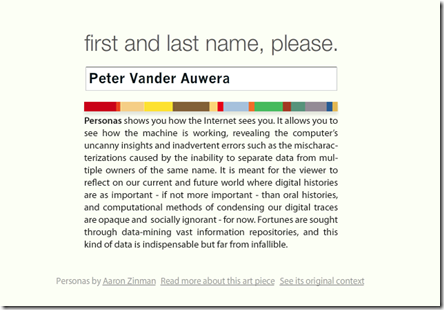
Have a look here and enter your full name and allow MIT to determine your online profile or the associations they’re able to make based upon your name.

image

First, this thing starts scanning your information shadow on the internet:

image

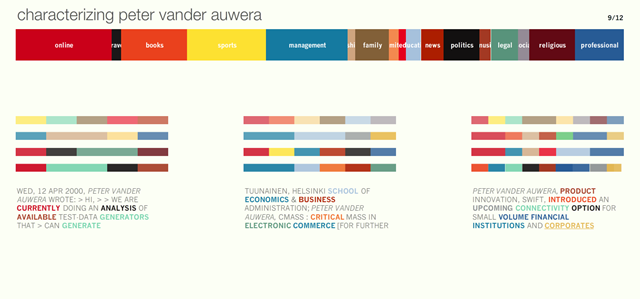
At the end you get:

image

Doing this live is much more impressive !

This is a very good example of what i meant in earlier posts on your Information Shadow on the internet, and how that is leading to your unique identity “footprint” or DNA. Just start imagining that the colored bar above is your own unique personal spectrum analysis. Just like they do for spectrum analysis of substances or stars.