Innotribe Sibos 2010: Cloud Computing

Cross-posted at swiftcommunity.net

Print

Last time, we shared our high-level Innotribe program for the Sibos week (25-29 October 2010) . This week we’ll zoom into the details of our Cloud program, one of the 4 themes of this year’s Innotribe.

Cloud was already on the program last year. Our main ambition then was to introduce you to some basic concepts of Cloud Computing, such as Infrastructure-as-a-Service (IaaS), Platform-as-a-Service (PaaS) and Software-as-a-Service (SaaS).

This year we want to go beyond that basic definition stage. Following last year’s Labs, which were focused on the economics of cloud computing, this year focuses on the practical implementation, user experiences, and why it’s important for the financial industry. There will be a specific focus on hybrid cloud models and APIs.

As always in Innotribe @ Sibos, also this Cloud theme is supported by Keynotes, Face-to-Face discussions, interactive workshops (Innotribe Labs) and R&D demonstrations.

Cloud computing keynotes: “Towards new models and APIs”
on Monday 25 October from 11:00 – 12:30 in the Interactive Workspace
We have a great line of speakers. Confirmed at the time of this writing are:

  • Sean Kelly, Global CIO for Deutsche Asset Management, Deutsche Bank. Sean is also elected Chairman of ECLC (Enterprise Cloud Leadership Council) a key banking cloud initiative including participation of Bank of America and Commonwealth Bank of Australia.
  • Subhra Bose, CTO for alternative investments, Credit Suisse. He will share the experiences of Credit Suisse in implementing cloud in alternative investments.
  • Jacqui Taylor, Founder of Flying Binary. In a previous life, Jacqui was Design Manager at BACS. She will talk about a Google Apps application supporting the Payments Services Directive.
  • Paula Richards, Cloud Computing Initiatives Executive, IBM
  • Oren Michels, CEO, Mashery. He will give an amazing speech on how API’s are now offered as-a-Service, including a compelling demo of their developer’s portal. Oren is sharing his enthusiasm for the Cloud theme in following YouTube video

Face-to-Face discussion: “Appstore for financial services – dream or reality?”
on Monday 25 October from 12:30 – 14:00 in the Interactive Workspace, right after the Cloud keynotes.

The Face-to-Face discussion will be kicked-off by a provoking presentation by Sean Park (CEO, Nauiokaspark) on the need for a neutral platform for cloud applications for the financial services.

Peter Hinssen, CEO, A-Cross Technologies will again be our skilled moderator for the Cloud Face-to-Face discussions. Last year he managed a panel of 11 participants. The feedback indicated that such a big panel was maybe a bit over the top. So this year, we have a slightly smaller panel. Confirmed so far are:

  • All the Cloud keynote presenters above, complemented with
  • Amir Halfon, Senior Director & Global Lead Architecture and Technology, Oracle
  • Sean Park, CEO, Nauiokaspark
  • Abbie Barbir, VP Senior Architect, Bank of America
  • Keith Saxton, Director, of Banking & Financial Markets IBM Global Financial Services
  • Mary Knox, Research Director, Banking and Investment Services, Gartner Research

Innotribe Labs

We are repeating the highly successful format of Innotribe Labs. One or more Cloud Idea generation teams will be formed on the spot, and over the course of the 3 days they will prepare a professional pitch to be delivered on Thursday during the “Pitch your Lab competition, in front of the public and a very skilled Buyer’s Panel.

The Cloud Innotribe Lab team will be supported by following professionals:

  • Innotribe Leaders Business: Jacqui Taylor (ex-BACS) and now Founder of FlyingBinary
  • Innotribe Leader Technology: Sungard (to be advised)
  • VC-Coach: Sean Park
  • Professional facilitators from The Value Web
  • Your’s truly, as SWIFT representative

R&D Demonstrations:

We’ll have this year a beautiful Innotribe corner integrated in the main SWIFT Stand. We’ll have a packed program here as well. We are still looking at the many candidates, and will do a separate blog on all the presentations scheduled throughout the week.

Let’s start the conversation:

We just opened a Web-Storm on Innotribe.com to collect your idea on this Cloud theme and the other 3 themes as we build up towards October. We will feed-back these ideas to the Innotribe Leaders before the actual Labs in Amsterdam. Check out www.innotribe.com

Innotribe is organised by SWIFT Innovation with the support of financial institutions, vendors and innovation leaders.

In the true spirit of less push and more pull, we encourage you to engage in a true dialogue with the Innotribe team. We look forward to seeing you in Amsterdam.

The Innotribe team

www.sibos2010.com

www.innotribe.com
www.swiftcommunity.net/innotribe
innotribe@swift.com
Twitter: http://twitter.com/innotribe

Cisco explains semantic enterprise

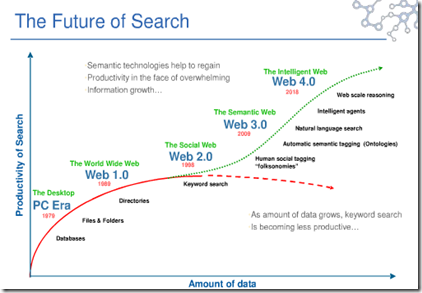
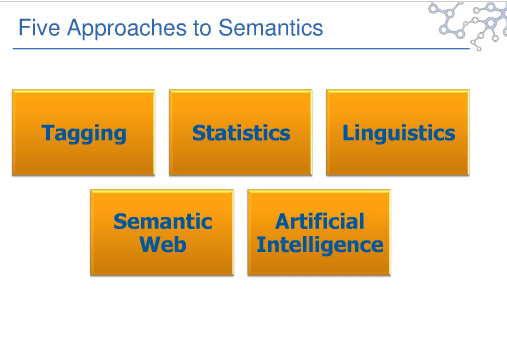
At this year’s Innotribe at Sibos (25-29 Oct 2010), we have a whole track on “Smart Data” aka “Semantic Web”.

We decided to call it Smart Data is – at least in our industry – the words “semantic web” have ironically little meaning.

I am a big believer of Semantic Web, and always on the look for good education material to help me explain what it is and why it is important.

Here is a video made by Cisco, by their IBSG group (Internet Business Solutions Group). I had the pleasure of recently working with IBSG folks, and I can tell you these guys are NOT the router guys. They are very knowledgeable. I also recently discovered they had a whole practice on digital federated identity and now this one on semantic web.


Some highlights in this video:

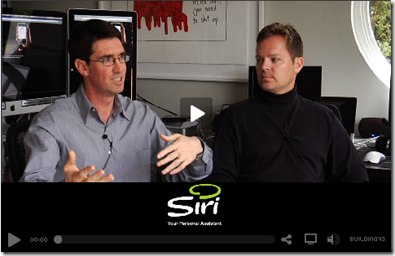
Starting (!) from the iPhone App Siri (Siri was acquired by Apple in April 2010), to WiseWindow, the video gives you some teasers on what this technology can do for you, and then moves into a really good and quick tutorial on the standards underpinning semantic web.


The Siri application is about understanding natural language and giving intentional feedback and information back to the user. Watch the detailed video above.

image

WiseWindows looks into

  • assessing your competitive position
  • most desired features, discovering patterns in conversations and buzz, influencers, etc
  • market sentiment

The speaker also emphasizes the importance of onthologies. Highly relevant in a SWIFT Standards context. With the ISO20022 Standards, SWIFT is already at the core of THE semantic onthology for the financial industry. Fore Semantic web, an untapped goldmine for the emerging future of SWIFT.

The ability to understand natural language and reason about data could improve business intelligence for financial services. In essence, today SWIFT already tags semantically the fields of the standard SWIFT messages. Tomorrow – with our onthology – we could tag ANY information, including non-structured information hidden in PDF’s or Word documents, overlay that information with existing other structured data sources, and offer pattern recognition services leading to deeper intelligence about our and our customers’ data.

What I want to make clear is that this is not only related to the social web. On the contrary.

It’s about data-integration within and across organizations.

Was that not the purpose of EAI (Enterprise Application Integration) and EDI (Electronic Data Interchange) ? The difference is that the above systems are often messaging based: sending (standardized) structured messages from one system to another.

I believe that we are witnessing a paradigm shift

from “sending messages from A to B”

to “publishing linked data”

into centralized or distributed data repositories.

From “sending and storing messages”

to “publishing and subscribing

to linked-data repositories”


The key challenge in all this is to be able to (automatically) tag data semantically. Who else than SWIFT would be better placed to be that semantic quality anchor for the financial industry ?

The video closes with 5 messages for our leaders:

  1. Look for value both inside and outside your core by tapping also into public data sources
  2. Experiment and Scale success. Your innovation team should do proof-of-concepts on this, even if this is not yet foreseen in your product roadmaps
  3. Build semantic skillsets as these are competitive differentiators
  4. Lay the foundation for semantical enablement of unstructured data, like PDF’s, but also images, audio and video sources
  5. Look now at what semantics can do to transform business

I have seen recently from Cisco how they do live-streaming-and-tagging of video for their internal portal. Maybe we should invite somebody from the Cisco IBSG-team to our Smart Data stream at Sibos ?

photo

BTW: Guido Jouret from Cisco will speak at Innotribe at Sibos in the Open Innovation Best Practices session on Thursday 28 Oct 2010. Guido Jouret is Chief Technology Officer (CTO) of Cisco’s Emerging Markets Technology Group (EMTG), which is responsible for incubating Cisco’s future billion-dollar businesses.

Innotribe @ Sibos 2010 : High-Level program

Cross-Posted on SwiftCommunity.net

Last week, Kosta kicked-off the next Innotribe @ Sibos2010.

Print

I am pleased and excited to complement Kosta’s introduction by sharing with you our high-level program for the Sibos week (25-29 October 2010).

High Level program

A good presentation/show has a fantastic start, and great core, and an exciting grand finale. That’s exactly how our Innotribe @ Sibos2010 program is organized 😉

We have a fantastic start: our “Innovation Opening Keynotes: the big tectonic shifts” on Monday 25th from 9am – 10:30

What a line-up of speakers ! We have now confirmed:

  • John Hagel (Author of THE business book of the year “Power of Pull”),
  • Peter Hinssen on “The New Normal” (also title of his new book),
  • Nova Spivack with a long-term technology forecast,
  • Venessa Miemis (28 year old GEN-Y Graduate Student from NYC) who will prepare a talk on the future of money,
  • and a still to be announced very senior banker on tectonic shifts in banking.

Both in content, quality of the speakers, and format of this session, this will be THE not-to-be-missed session on Sibos Monday. We are convinced it will set the bar for any session for the upcoming week.

We have a great core: We have 4 Themes. As last year, we have appointed Innotribe Leaders and VC-Coaches to each of these themes:

  • Cloud: following last year’s Labs, which were focused on the economics of cloud computing, this year focuses on the practical implementation, user experiences, and why it’s important for the financial industry. There will be a specific focus on hybrid cloud models and API’s.
    • Innotribe Leaders:Jacqui Taylor (ex-BACS) and now building Google Apps with FlyingBinary and Sungard
    • VC-Coach: Sean Park
  • Mobile: the emergence of mobile payments, especially in the worker’s remittances area, and the role of banks.
    • Innotribe Leaders: Jonathan Bye (RBS) and Ville Sointu (Tieto)
    • VC-Coach: Matthaus Krzykowski (Venture Beat)
  • Smart data: how to capitalise on the power of semantic web technologies to enable greater intelligence for financial institutions.
    • Innotribe Leaders: Wells Fargo and Nova Spivack
    • VC-Coach: Eghosa Omoigui (ex Intel Capital)
  • The Long Now: this series of interactive workshops will engage in long term scenario planning for the financial industry.
    • Innotribe Leaders: Chris Skinner and Sean Park

The line-up of speakers, face-to-face panel members and moderators is stronger than ever before. This will be the subject of subsequent Innotribe @ Sibos2010 blogs.

We just opened a Web-Storm on Innotribe.com to collect your idea on these 4 themes as we build up towards October. We will feed-back these ideas to the Innotribe Leaders before the actual Labs in Amsterdam. Check out www.innotribe.com

In addition, we will have 2 Masterclasses Innovation, we have invited the 5 leading software vendors for innovation management tools, and we’ll have an update on eMe (winner of last year).

We also teamed-up in a quite significant way with our colleagues from Standards and Technology. You will notice on the Sibos program a number of interactive sessions that have been co-designed with Innotribe.

The exciting grand finale: the best of the Innotribe week comes together on Thursday 28 October 2010.

  • We start with “Pitch your Innotribe Lab”, a competition between the best idea teams that were formed during the Labs throughout the week, in front of the buyer’s panel. 5 minutes pitches with Q&A by the SWIFT Buyer’s Panel, with input from our VC-Advisors. They compete for the Sibos2010 Innovation Award. Last year’s winner was eMe. Who will it be this year ?
  • Right after, we’ll have the “Open Innovation Best Practices”, with again a staggering line up of Heads of Innovation of Banks, and thought leaders from other industries on Open Innovation
  • To pump up your adrenaline levels, we’ll close with a real Start-Up Competition, where we have invited some of the start-ups and great idea teams we met throughout the year. They will pitch in front of a real VC-Panel.
  • And who knows: last year’s Innotribe made it to the final plenary closing of Sibos. We know this year’s Innotribe @ Sibos is even better and The Long Now seems to be positioned in pole-position.

Some elements to spice it all up:

  • All the Innotribe @ Sibos2010 sessions will be supported and facilitated by a team from The Value Web.
  • The Long Now and the Grand Finale will be supported with live streaming and interaction technologies (more news to come in the next weeks)
  • We will be at 3 locations:
    • The Innovation Opening Keynotes in Conference Room #1 aka “the box-ring”. We’ll make maximum use of the interactive features of this room;
    • The Interactive Workspace: a special built space in the middle of the exhibition centre that will host all the other Innotribe sessions; the design of that space is just awesome.
    • The special Innotribe corner on the SWIFT Stand that will host the R&D sessions, including the results of some SWIFT proof-of-concepts.

Let’s start the conversation:

Innotribe is organised by SWIFT Innovation with the support of financial institutions, vendors and innovation leaders.

In the true spirit of less push and more pull, we encourage you to engage in a true dialogue with the Innotribe team. We look forward to seeing you in Amsterdam.

The Innotribe team

www.sibos2010.com

www.innotribe.com

www.swiftcommunity.net/innotribe

innotribe@swift.com

innovate@swift.com

Twitter: http://twitter.com/innotribe

Let’s Prepare the Future !

image

This article is a cross-post of an essay that i prepared for The Fifth Conference and that was published this week.


image


The Fifth Conference is a forum for vision. Part publisher and part conference, The Fifth Conference tackles the ‘big issues’, the factors that drive our future. Think ten, twenty, even fifty years ahead and try to imagine how we will live and work. What will this world look like? How will we have solved the economic, social and environmental challenges that we confront today? To answer those questions we talk to entrepreneurs, policy makers and experts. We analyse the facts, the forecasts and the arguments. And most importantly, we collect vision.

As mentioned in my previous blog post “No more collateral damage”, this is so close to my idea of the Think Tank for Long Term Future that it was for me a no-brainer to passionately accept the invitation of Frank Boermeester (co-founder of The Fifth Conference) to draft an essay on Technology, with a focus on Technology Readiness in our region, and being conscientious aware of the “understream” that is driving all the changes and evolutions in Growth, Mobility, Green, Technology, Health. So here is the article:


Over the past 20 years we have witnessed a fantastic growth in and wealth of technologies. ICT technologies have started permeating our daily lives. Medical science and biotechnologies have increased longevity significantly. Other technologies (Nanotechnology, AI, Robotics, etc.) have kick-started.

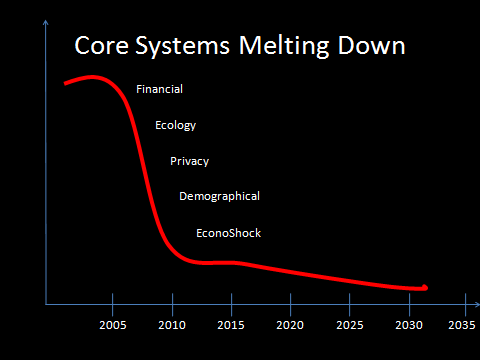
However, in the last couple of years, we have witnessed the breakdown of a number of core systems:

image

  • Our worldwide financial system is going through a “meltdown”. The old game of greed is being replaced by an all important requirement: trust.
  • Ecological, ethnological and demographical shocks (see also Geert Noels, author of Econoshock) are turning our systems upside-down: Green and Energy conservation thinking are now the mainstream.

image

  • The East-West shock: economic power is shifting from the Western world to the new economies of APAC and BRIC+ countries.
  • New forms of communication via the internet (blogs, wikis, social networks such as Facebook, Twitter, Netlog, etc.) propose a new paradigm in respect to privacy.

All these fundamental changes give us feelings of discomfort, disorientation, confusion and loss of control. Although our “collective intelligence” indicates that our old models do not apply anymore, our “hardware” seems not to have caught on. We have not adapted the way we are organized hierarchically; how we look at governance. Our traditional ‘system thinking’ got stuck and did not follow our ‘collective intelligence’.

On the other hand a new set of systems and tools are emerging:

image

  • Barack Obama describes it as the ‘audacity of hope’; innovators, planners, academics and authors are referring to ‘dreamtelligence’ as a new, vital, and visionary way to use play, fantasy, dream-thinking and innovation to kick-start ideas and stimulate community engagement.
  • A fantastic call for and revival of authenticity for ourselves and our leaders. Furthermore, having true leaders; with charisma, the power to attract, integrity and authenticity.
  • The Net-Generation (now young adults, 15-30 years old) have grown up as ‘digital natives’. They will be tomorrow’s leaders. What THEY think will co-form our future. The future will not be invented by today’s generation. This Net-Generation lives differently. They are “wired” differently. For them multitasking (multi-window chatting, gaming at the same time as listening to music, looking up information on the internet, being mobile, etc.) is very common. They also think differently (deeper and more authentically), and have a very strong sense of the common good and of collective and civic responsibility.

image

image

Our technological revolution has just started. To illustrate:

  • Today our technologists are capable of crafting a human ear in their labs. We are now in a position to create and grow cells, tissues and even bodies.
  • Artificial Intelligence is back: by 2030 our computers will be able to think, be self-learning, self-healing – some will even be able to have a consciousness.
  • Self-learning robots will soon be mainstream technology. Mercedes and BMW already have cars in the pipeline for 2012 that can drive entirely automatically, better than a human counterpart.
  • The emergence of Google brings forth the concept of the “Global Brain”. The internet today is already a tremendous source of information. Today’s search experience will pale in comparison to the mechanisms we’ll have in 20 years. All knowledge will be available anywhere, anytime, wirelessly via brain-implants.
  • Social networking is already revolutionizing the way people and companies are communicating. It is interesting to note that these technologies let us evolve from a system-to-system communication paradigm towards a human-to-human one.
  • Today you can order your personal DNA genome sequence in the USA for only $399. The company doing this is a Google backed start-up. Think of DNA in the ‘cloud’, with DNA comparisons between ancestors, relationships, etc …
  • Brain-wave helmets and chip-implants will give humans better sensory perception. By 2030 we will see the emergence of “super-humans”. In such a dramatically changed context, what will make us “human”?

A lot of these future scenarios are described by Ray Kurzweil’s “Singularity” concept. This is the moment when man and machine truly blend. Kurzweil claims this will happen around the year 2030.

And the pace of all these technological innovations is just increasing exponentially. In the next 20 years we will witness technological breakthroughs tenfold those of the same previous span of time.

All this evolution calls for a re-thinking of our value-compass for the future: We must carefully re- think how all this will influence the way we will work and live. What sort of quality of life should we aim for? What will be the socio-economic impact of all this? How will we want education to be structured? What areas of society will we still want (and be able to) influence?


How are we going to ensure that the

Technical and Value ‘Readiness’

of our region

are competitive in this new era?


Will we lead the change, as opposed to being mediocre followers? I believe it is time for action.

image

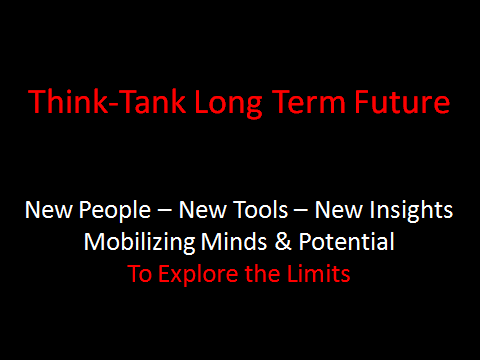
I believe The Fifth Conference and its organic network of inspiring leaders has deep within itself the embryo for a sort of “think-tank/foundation” addressing the long term future:


A movement and an energy

that prepares our Net-Generation

for the next 20 years,

with an emphasis on

our technical and value readiness


A place where “smart people” can meet. Where experts from different technological domains share their insights for 2030, cross-pollinating each other’s disciplines. Indeed, “savants” from different contexts & worldviews can act as our “eyes” and offer a perspective on how we will live and work in 2030.

image

How our education is best organized will also be addressed. We will investigate what our ideal value kit for that era should be, beyond traditional corporate culture. Moreover, with a culture of sharing and exploring – where we live committed to teams, groups, communities, regions and countries –a deep respect for the participating individual humanistic identities will nevertheless be maintained.

We don’t have to wait until our politicians have made up their minds as to whether or not they should invest more in innovation.


We can do this ourselves


I cannot accept that it would not be possible to raise private funding for such an organization/movement/tribe.

The resulting new models and scenarios will demand speed, creativity, dynamism, perseverance, courage, knowledge and working together in a multi-cultural context. This new society makes a plea for the respect for individuality, freedom, mobility and quality of life.

This paradigm is all about designing, exploring and organizing change, learning and fine-tuning as we go. Giving guidance to teams, organizations and leaders on how to surf these waves is part and parcel with this. Missing the first technology wave of speed and creativity will result in loss of economic relevance. Missing the wave of the new value kit will result in losing our Net-Generation; our brains for the future.

This is about preparing ourselves and our region for 2030.

image

Who wants to join the tribe? Who is a believer? Let’s debate this idea on- and off-line for a couple of weeks. If there is enough interest, let’s meet and make this happen.

Identity Rights System 3.0

Next week, SWIFT Innotribe will be hosting the European eID Interoperability Conference 2010.

It’s a great agenda with presentations by European experts on eID, and also some of the smartest SWIFT folks on identity. For example, we’ll have Jacques Hagelstein, our Chief Architect, and we’ll also run an Innotribe Lab on day-2. Check out and download the PDF agenda here.

Hosting this sort of events is an interesting win-win model, where we at SWIFT can share our great meeting and auditorium facilities and at the same time dove-tail with important topics that are relevant in our industry.

Acting like this beyond our traditional boundaries nicely fits The Medici Effect that i described in my previous post, although i am not sure we at SWIFT apply this principle always with full consciousness and intent. It does not matter, the key thing is that it just happens, and i feel confident that on this intersection of worlds some new ideas will emerge naturally.

Thinking through how we deal with company and personal identities in an on-line world, and being able to deliver this on a world-wide, predictable, resilient and secure way is one of the key value propositions of SWIFT in the financial services eco-system. SWIFT has the advantage – it’s a deliberate choice – that we are a community based venture, and a lot of services we offer adhere to standards and rulebooks that have been subscribed to by our membership. Even then, delivering this is not a sinecure.

But in this post, i’d like to take you on a journey beyond SWIFT’s ecosystem and edges, and look at what is happening in terms of identity and privacy outside our safe community walls.

My first contacts with privacy related matters date back to my Microsoft period, where I was quite involved in the Belgian eID project.
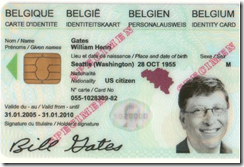
image

Microsoft saw Belgium as a good test ground to see what happens when a country rolls-out in a mandatory way 8 million electronic identity cards to its citizens, what applications get developed, and what needed to be done at the level of Windows, Office, MSN Chat, etc to support an identity card issued by a third party, in this case a government. At that time, I experienced the Belgian Privacy Commission more as a pain in the neck, limiting us in doing ‘”real cool things” with on-line identity. But they surely planted in my head the first seeds of some “culture” of privacy. It’s only now that i start to fully appreciate the importance of privacy, and the role of Privacy commissions and alike.

Now the Belgian eID cards are rolled out, we even look at a second and third generation, but the number of applications that are really leveraging the eID on a day-to-day basis are disappointingly low.

Already when the first eID cards got rolled out, it appeared to me that the card was already a dated old-fashioned way of dealing with identities. It does not make a difference whether we talk here about a smart-card, a USB token, or whatever other hardware device.

The point i am trying to make is that

the model of an identity “card”

does not match anymore

the online realities of today

The “card” is an artifact of the physical world, and we try – in vain – to squeeze all sort of on-line concepts into an off-line model.

The next occasion where I felt something was wrong with our model, was when i saw the demo of Intelius Date Checker. See also my post on “privacy is dead” for more details on this application. I was shocked that nobody in the audience made any reflection on the huge privacy issues at stake here. It must have been American culture ?

Then a couple of months ago, there was the famous debate launched by Mark Zuckerberg of Facebook, where he basically suggested to change the paradigm with 180°: in stead of considering "private” as the default setting of personal data and letting the user decide what data he releases to whom, he suggested “public” as the default setting, forcing to “un-public” data the user did not want to make public and keep private. See also ReadWriteWeb coverage here. Unfortunately for Zuckerberg, there was around the same period an article about a Facebook employee revealing how much privacy data they have access to by for example super-admin passwords and alike.

And even ex-colleague Paul Shetler took the pain to scream out his frustration on why public as a default really does not make sense.

It all makes me feel very uncomfortable how much i have to believe from Mark Zucherberg or Eric Schmidt when they are behaving like the white-knights of privacy.

It looks to me that

privacy is out-of-control


and that they would like to officialise the dead of privacy by declaring “public” as the new norm. It looks to me as privacy has become


too complex to fix it


Via Facebook, Google Buzz, Twitter, etc, etc, there is already too much data out there. Fixing this taking into account regional and country laws and regulations must be a real nightmare for the Facebooks and alike.

It’s an interesting debate what should be the default: privacy or publicy. And Stowe Boyd rightly adds the dimension of “sociality”. Because you release some info about yourself consciously (when participating on social media, your really want people to know about yourself and your preferences) or passively (by accepting blindly the privacy notices on Facebook and alike. Some related info on sociality here.

This aspect of passive privacy is really well explained by David Birch. He recently wrote a whitepaper: “who do you want to be today ?” and “Kissing Phones”. Check-out here. And just a couple of weeks ago, David wrote this fantastic post about Moving to Privacy 3.0

And the big boys are feeling the pressure. A couple of years ago the audience at the Gartner IT Symposium in Cannes was still having fun with “The Great Google Hack” scenario. This session was part of an “Unconventional Thinking” set of sessions with following disclaimer from Gartner: “This research doesn’t have the full Gartner seal of approval (we call them Mavericks internally).” Today this is not just a scenario but getting very real. I am just picking one of the thousands of articles that have been written on the Google China hack described as the privacy breach of the year.

Let’s throw in some additional dimensions, so that you as novice reader on this subject really start feeling the pain.

  • What have you browsed ? Interesting reflections by Microsoft’s Chief Architect Identity on “browser fingerprints”. Btw, Kim is confirmed speaker at the eID Interoperability Conference next week.
  • Where have you been, and how your iPhone becomes a spy-phone here and here
  • What have you bought recently ? How you can let a service like Blippy stream your purchases online.
  • Who have you slept with ? Given some’s willingness to post all their data online, and the rising casual nature of some behavior, this isn’t so far out of reach to be completely ridiculous.
  • Add to this things like Facesence MIT, about mind-reading
  • Bodyscanners about being “sniffed-out” by chemical noses.
  • Did you take your pil and when. In essence about “body-surfing” and RFID like tracking inside your body.
  • Please rob me, in essence about real-time location tracking

Some suggested solutions for all this go into the direction of


“gatekeepers”


Trusted entities that are the safe-harbor for keeping these personal data. Or even distributed models of “gatekeepers” certification.

image

The recent announcement at the March 2010 RSA Conference of the Open Identity Exchange (OIX) goes in this direction. Please note that this initiative is backed by industry leaders Google, PayPal,Equifax, VeriSign, Verizon, CA, and Booz Allen Hamilton.

However, I don’t think it will work, and i am not alone, although from a different perspective (see below on PETs). I think it won’t work, because in the open online world, it will not be acceptable that somebody or some company sits in the middle of all this identity hocus-pocus, and controls our world. The internet has just become way too distributed to accept this sort of models. Maybe this works in a closed community (vertical or other) where users subscribe to a common set of standards and rules), but not on the open internet.

One possible route are PETs (privacy enhancing technologies).  For example, Stephan Engberg, one of the speakers at the European Commission’s December 2009 workshop talks about security (and privacy) “in context” and seems to be a big advocate of PETs. Check-out an interesting debate here.

The word “context” is very important here.

To come back to the beginning of this blog post, i believe we have to change the old eID model to a model where we acknowledge that the personal data are highly distributed on the net today and are dealt with “in context”.

Personal data sits everywhere, and you really can start imagining “data weavers” or “identity weavers” that combine these individual sets of personal data into new sets of relevant information, based on the context of usage.

The concept of data-weavers was already introduced in my guest blog “Digital Identity Weavers” by Gary Thompson from CLOUD, Inc.

image

I repeat myself by saying that this CLOUD vision goes way beyond the web of pages, goes way beyond the early thinking on Semantic Web. It is in essence proposing an identity architecture for the Internet. Because the internet is broken. It was never designed with identity in mind.

Its about user control of personal data.

It’s about context awareness.

It’s about who i am, how i am, and

what i do and intend to do in an on-line world.

But we all have problems in imagining how such standard and supporting system might work.

How it would look like ?


And then suddenly last night the pieces seemed to fall together. What if we start thinking about this in a way similar to “Information Right Management” (probably called something else today), something that Microsoft built as a feature in Microsoft Office, and basically put the user in control of what somebody could do with his documents. Mind you, this is about “USAGE” rights, not access-rights.

In Microsoft Office this was visualized by the “do not pass” sign.

By clicking on that icon, you – as the user – can control whether somebody can cut-and-paste from your document, whether they can print it, forward it, etc.

We need a standard that makes it possible to control/manage the usage-rights of the different pieces of our personal data that are distributed over the internet. And then we need to let play the competition on how this standard gets implemented in our day-to-day tools. Maybe by a clickable icon, maybe something else. Would be great to let Heads of User Experiences have a go at this.

But maybe it is too late. Maybe there is already so much data out there, that there is no way to 1) find where they are and 2) give back the control to the user/owner of the data. The breach already happened.

To conclude, get inspired by this NYT article “Redrawing the Route to Online Privacy”

So if the current model is broken, how can it be fixed? There are two broad answers: rules and tools.

“Getting this balance right is critical to the future of the Web, to foster innovation and economic growth,” Mr. Weitzner said.

Whatever the future of regulation, better digital tools are needed. Enhancing online privacy is a daunting research challenge that involves not only computing, but also human behavior and perception. So researchers nationwide are tackling the issue in new ways.

At Carnegie Mellon University, a group is working on what it calls “privacy nudges.” This approach taps computer science techniques like machine learning, natural language processing and text analysis, as well as disciplines like behavioral economics.

How would all this be relevant for our financial services industry ? One example would be to apply semantic web technologies to Corporate Actions. For folks at SWIFT it’s pretty obvious that we can apply our semantic knowledge to the data in the “messages” that are exchanged between parties of Corporate Actions.

What seems less obvious is to apply the same semantic tagging techniques to the personal data and attributes of the persons who participate in a Corporate Action transaction.

In essence this is about applying the CLOUD concepts. It’s about setting new standards and rules in this space. And are standards not one of the cornerstones of SWIFT.

It would be great to build an innovation prototype to educate our community on the power of semantic web.

I call this the “Identity Rights System 3.0”

UPDATE: apparently the subject is red-hot at SXSW in Austin this week. Check out Danah Boyd at SXSW “Privacy is not dead”

Digital Identity Weavers

I have a job where i regularly meet fascinating people.

I recently had the opportunity to chat with Gary Thompson from CLOUD, Inc.

image

CLOUD Inc. is the Consortium for Local Ownership and Use of Data, a non-profit organization that has filed for 501(c)(6) status with the IRS and is open to people, companies, and other organizations. CLOUD has been formed to create standards to give people property rights in their personal information on the Web and in the cloud, including the right to decide how and when others might use personal information and whether others might be allowed to connect personal information with identifying information.

So all this is about your personal digital identity, and giving back control of these data to the user. Kim Cameron (Chief Architect Identity at Microsoft and the man behind www.identityblog.com will love this – and i am not cynical 😉

A couple of weeks ago, i had a fascinating chat on identity. How identity is all about context. Where you are, what you do, etc. During that conversation, Gary suddenly used a metaphor of what i would call “identity weavers”.

I found this metaphor really powerful. And i suggested Gary he should blog about it, and that i would offer him a guest post 😉

So, here is Gary with his post on Reweaving the Fabric of the Internet on his personal blog The End of Linearity. Peter Hinssen will love this story, as so closely related to the Explore the Limits story.

I just have cut&pasted some strong one-liners. For the full story, check out Gary’s blog.

From health to education to finance and beyond, the ability to bring together people, concepts, and ideas (threads) in new ways is an invigorating journey.  Our “weavers” of the future can design beautiful new fabrics from cures to cancer to dynamic global learning communities to rapidly evolving financial models.  When thread and fabric are unleashed, when weaver and woven can dynamically change places, when loom and head are released from the bonds of the physical, the Internet can take a vital step forward.  By applying an end of linearity to how we think about the Internet, we can see the true beauty of Vint Cerf and Bob Kahn’s creation. It is a connector of people, not of web pages, and it is at the heart of a new future, a rewoven future.

This compelling vision goes way beyond the web of pages, goes way beyond the early thinking on Semantic Web. It is in essence proposing an identity architecture for the Internet. Because the internet is broken. It was never designed with identity in mind.

By now, you will notice that Digital Identity is much more than distributing hardware tokens, or putting an PKI infrastructure in place.

Its about user control of personal data. It’s about context awareness. It’s about who i am, how i am, and what i do and intend to do in an on-line world.

SIRI: your personal assistant in the cloud

Found via Scobleizer.

image

Watch the video till the very end. In the last 4 minutes or so there is a demo.

In essence its a free iPhone app with a fantastic voice recognition engine, that is orchestrating API’s in the cloud.

Normal – not geek – people ask me regularly: “But Peter, what do you mean with “cloud computing” and “semantic web ?”

SIRI is a wonderful example of what’s next. If you want to have an idea what semantic web means in practice, here you go. It’s location aware, it’s self learning, has some eMe elements like profile awareness, all of this in the privacy control of the owner of the profile data.

The dream of the personal butler coming true.

Why this is important ? In the words of Robert Scoble:

Don’t get confused by the awesome voice recognition engine that figures out your speech and what you want with pretty good accuracy. No, that’s not the really cool thing, although Microsoft and other companies have been working on natural language search for many years now and have been failing to come up with anything as useful as Siri.

No, the real secret sauce and huge impact on the future of the web is in the back end of this thing. A few months back the engineers at Siri gave me a secret look at how they stitch the APIs into the system. They’ve built a GUI that helps them hook up the APIs from, say, a new source like Foursquare, into the language recognition engine.

And listen to the two founders on how the back-end of this thing is working, and the other cool stuff they have in mind.

And now start thinking on what you could do with this in financial services:

  • Give me the best loan for car so and so
  • I want to buy this piece of art and need a credit line
  • Find me the cheapest routing for USD payment with cut-off time x
  • Get me to …

Would be very curious of guys like Richard Branson of Virgin Bank start to play with this. Or Sean Park with his view on software components in the cloud. How does this change our thinking on building an AppStore for Financial Services ?

I don’t have an iPhone (yet). But i know super-geeks Nick and PeterH have one. Nick, can you test this one, and let me know your candid feedback ?

Check out www.siri.com


Reblog this post [with Zemanta]

Web Evolution: The network is the database

If you want to have a really good 23 slide summary of where the web is heading, check out Nova Spivack’s Web Evolution slide deck.

image

There are some really good positioning slides as from slide #9 and following, to get a feel for the difference between for ex Delicious, Google, Powerset (now Microsoft), Twine, and Wolfram Alpha.

image

I was quite lucky having a 1-1 with Nova Spivack during Web 2.0 Summit in October 2009. He showed me a much elaborated slide deck than this one, but I feel that since then he really condensed the subject to the essential.

Enjoy !

Print

PS: He was ok to join Innotribe @ Sibos 2010 in Amsterdam 😉

Reblog this post [with Zemanta]

Sean Park’s Sixth Paradigm

As preparation of 2010, i very strongly recommend to get familiar with Sean Park’s The Sixth Paradigm post of 28 Dec 2009.

I am a big fan of Sean and his site the Park Paradigm. He was the guy who made the famous AmazonBay2015 video.

image

That was 2006.

Since a couple of days the video of his Oct 2009 presentation at Amsterdam eComm Europe is available on his post above and also the Prezi presentation is here.

The video of his presentation is 20 min. It’s worth your time.

Two extracts of this presentation should get your attention, and incentivize you to read on:

– What is the difference between a bank and a telecom company really ?

– The difference between bank messaging and telcos is disappearing.

image


image

I believe this presentation is VERY VERY relevant to financial services and concepts such a marketplaces for financial services.

This presentation gives you an absolute macro-evolution view on why this is a bound to be happen, and why the inherent structures of our current – usually vertical integrated – behemoth companies will struggle very hard to get their arms around this if they even ever succeed it spotting this as a HUGE opportunity.


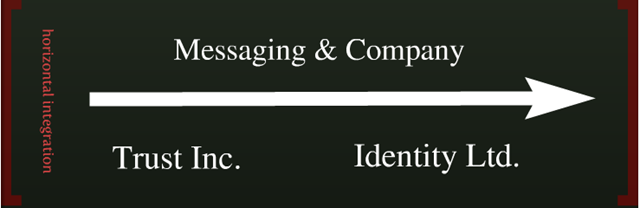
The essence of the story is that those

vertically integrated companies

will be replaced/challenged

by horizontally connected entities

offering themselves

to the marketplace

via APIs


The innovation will happen

at the edges of the marketplace.

The marketplace is not even

innovative anymore.

It’s an essential piece of

the plumbing.

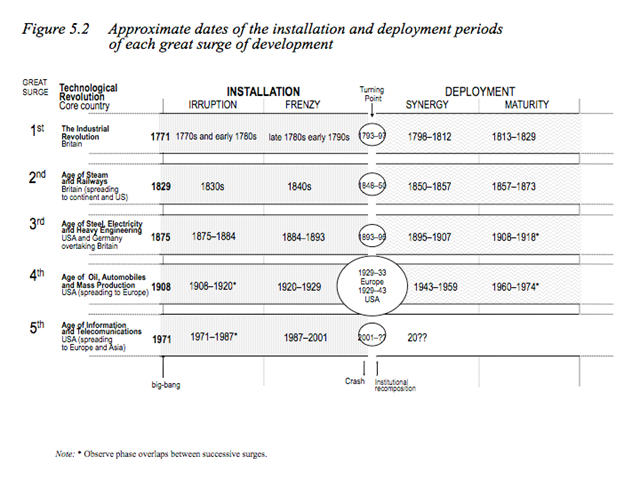
A lot of Sean’s thinking is based on the work of Carlota Perez and her book “Technological Revolutions and Financial Capital: The Dynamics of Bubbles and Golden Ages”

Professor Carlota Perez is a Venezuelan scholar and expert on technology and socio-economic development most famous for her concept of Techno-Economic Paradigm Shifts and her theory of great surges, a further development of the Kondratieff waves.

Carlota Perez Recurring Phases


Carlota Perez the 5 previous paradigms

Courtesy The Park Paradigm & Carlota Perez book.


Sean Park’s claim is that we are  now getting into the 6th paradigm, and this is also a switching point between 2 phases.


image


Sean Park believes the drivers will be 3-fold:

1) Cloud computing, with EVERYTHING as a Service

2) Exchange Ubiquity. The marketplace as plumbing, i would call this

3) Digitization

The last one “Digitization” seems “obvious”, unless you push this to the limits, as Sean Park does:


image


He takes the example of ISBN numbers as one of the success factors of Amazon’s book shop. Sure, there is big logistical tail to the book shop, the the core of the Amazon model is digitized, i.e the ISBN is just an identifier, linked to plenty of content and metadata, that can be accessed by an eco-system through APIs.

Where it even becomes more interesting, is where Sean mixes this up with theories of complex adaptive systems. It’s basically saying that


those horizontally integrated value chains

are chains of nearly decomposable services

And please read this in the context of nearly decomposable

financial services


And (traditional) vertically integrated companies (offering financial services) will not be able to compete successfully in rate of adaptation and fitness with these horizontally integrated “engines” or “eco-systems”.


image


Sean asks the question:

Where is the AppStore for Financial Services ?

here is the digital platform + API’s for the financial industry ?

Where are the decomposable financial services that can thrive on such marketplace ?


image


Sean has some other great disruptive statements. Like this one:


image


Its about the shift


from

image   To

image


It looks like Sean’s company is looking to invest in companies that understand how to build and offer these decomposable services.


But who should invest in the marketplace,

the plumbing,

the “dumb” but highly secure pipes

for the financial industry ?


We could let every Bank behemoth have it’s chance at it. That may be great for lock in. But in the long term, we will need something that is highly interoperable.


With interoperability

built-in

into the DNA

of this Digital Platform.


That is run as a service for the community. And to be the “invisible engine” for financial services cloud computing.

Invisible Engines: How Software Platforms Drive Innovation and Transform Industries


It’s only a very personal opinion, but i believe SWIFT is quite uniquely positioned to play this role.


Print


We are already in full prep for our 2010 SWIFT Innovation activities. It should be obvious from the above that we have Sean Park on our list of speakers to be contacted for our Innotribe event series, and who know at Sibos 2010 in Amsterdam ?

Zemanta – Part 2 – The API

My previous post on Zemanta got quite some traction 😉

image

I even got a comment from Jim Hirshfield, VP of Biz Dev at Zemanta. He sent me a link to a demo of their API. Here is what he sent me:

Peter – What a great write up on Zemanta. Thanks.

If you’re interested in the underlying technology of Zemanta and structured data, then I think you might find this demonstration interesting as well:

http://test.infoblow.zemanta.com/infoblow/galaxy/

This shows what can be done with our API when combined with other players in the space.

Regards,
Jim Hirshfield
VP of Biz Dev at Zemanta

So, obviously, i had to try it out… If you click the link above, you get this:

image

And Hudson River leads you here:

image

Yep, we get close to real-time object modeling.

For those who do not know what this is about, here is once more the video animation of what happened.

image

Have fun !