Real-Time Trade

Fascinating article on how stock market is getting completely automated in a matter of seconds. Who was saying something about real-time.

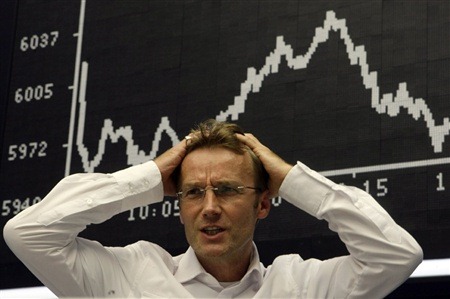
04_traderfaces

Article found on MIT Technology Review. 5 pager can be found here.

Some extracts:

The profits go to the company with the fastest hardware and the best algorithms–advantages that enable it to spot and exploit subtle market patterns ahead of everyone else

TheTabb Group, a consultancy based in Westborough, MA, estimates that high-frequency automated trading now accounts for 61 percent of the more than 10 billion shares traded daily across the numerous exchanges that make up the U.S. market.

Trading is now essentially a virtual art, and its practitioners put such a premium on speed that NASDAQ has considered issuing equal 100-foot lengths of cable to the brokers who send orders to its exchange servers.

Hardware used at the facility will operate at a 40-gigabyte-per-second standard, enabling it to handle as many as a million messages a second.

New York City-based Lime Brokerage, wrote the SEC in 2009 to voice concerns over the proliferation of brokers who allow major clients to engage in high-frequency trading without validating their margins–that is to say, without making sure they actually have enough money to back a trade

Jacobs regularly sees algorithms executing more than 1,000 orders a second. At that rate, one algorithm trading the wrong way could execute 120,000 orders in two minutes. At 1,000 shares per order and an average price of, say, $20 a share, that’s $2.4 billion inunintended trades in 2 … SECONDS.

Institutional traders like Fidelity, which buy large blocks of shares for their mutual funds, use algorithmic trading to split their enormous orders into blocks of 100 to 300 shares so that other traders don’t recognize the true demand and take advantage of that knowledge for their own profit.

These are big numbers. And it happens every day. Scary.

Brain Chips

image


All images courtesy of www.gigaom.com. found via my subscription to the fantastic spacecollective.org site. Full link here.

I somehow like #2, but get discouraged when i read the description: “The technology is basically the same as that used to treat Parkinson’s disease.”

Seriously, it’s a great post, and indicated that brain chips are getting real and that the singularity is getting nearer and nearer.

Privacy is dead

This blog post is triggered by a start-up demonstration i saw at DEMOFall2009 some weeks ago.

The demo was about an iPhone application called “datecheck” aka “creepfinder”

You can find the video here.

Not that i am interested in on-line or real-life dating – i am happily married – but in essence the application allows me to do a check on my date. It basically crawls the internet, twitter, facebook, and  – in the US – public data such as your real-estate tax income and even criminal records.

The end-result is that i find data about criminal records about my future fiancée, full real-estate data about what house he/she lives in, family composition, real-estate tax-income etc

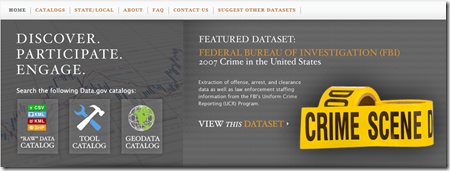
The US government also is getting quite open and transparent on its own data. Have a look at www.data.gov

image

And these days all these data are accessible via API’s to take data OUT of these systems. Some API’s like twitter, facebook etc also allow you to INPUT data via for example Tweetdeck, Seismic, and many others. I would love to have something that not only allows me to INPUT my Tweets, but also something that allows me to input and maintain my personal profile data, across services. See also at the end of this post.

For the US government data, you see start appearing end-consumer apps that let you search through this massive amount of for example government contractor’s data with quite advanced intelligence tools in the hand of the citizen.

In stead of FBI (Federal) it’s becoming

CBI (Citizen’s Bureau of Investigation).

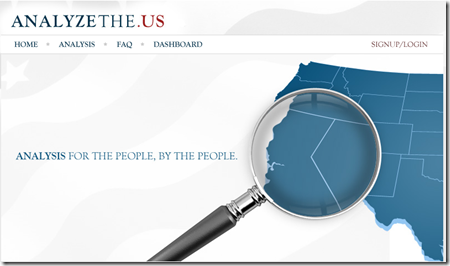
It says “analysis for the people, by the people”. I would add “"about the people”

image

All this is sold as “transparency” and “democracy”, and those are of course very important values.

But – and I don’t know about you – I start more and more FEELING quite uncomfortable about all this. Not that i have to hide anything, or that i have a criminal record (at least not that I am aware of ;-), but I do FEEL all this is quite intrusive.

As most of you know, in my previous life i was quite close to the Belgian eID project (electronic identity card). The card also allows you to access the on-line government database, where I can look at my OWN data and check who in the government has accessed those data.

But i believe we should make a big plea for the appliance of Law #1 of Kim Cameron’s Laws of Identity:

image

That’s easy said, but how do you enforce that. I took the pain to look at the privacy policy of Twitter (see http://twitter.com/privacy). In essence – as a user – i have nothing to say. I have 2 choices: to use twitter and accept the privacy policy, or not use it. But how many of the many million Twitter users have ever read the privacy policy ? How many know what sort of deep intelligence engines are crawling all these data that i released to the net WITH A DIFFERENT PURPOSE ?

This is not Twitter specific. It applies to Facebook, Friendfeed, or any other form of social network or service.

In my opinion, i would like to have something where i can control what data about myself i want to release to what service and in what context. I update my information there once, and have also guarantee that my profile information is consistent across Twitter, Facebook or even event/conference sites that these days more and more use their own social media piece of technology.

Of course you would need a highly trusted party to deal with these data. I think i would even be prepared to pay a price for my privacy.

This concept of a central digital vault comes pretty close to eMe, the winner of the Innotribe idea-contest at Sibos 2009 some weeks ago. But they started from “mydata” and information and documents related to financial services. If you start thinking privacy and putting control of data back into the user’s hands, you get a much more powerful proposition.

I would like to hear the opinion of a number of identity and privacy experts that are following this blog

UPDATE: Can’t help it, but just at the same time as i published this post, Guy Kawasaki tweeted the following URL:

 http://holykaw.alltop.com/why-you-should-think-before-you-tweet

How Bill Gates destroyed the universe

The Singularity Summit is coming on 3-4 Oct 2009 in NYC. See the impressive list of speakers here.

One of the speakers is Ben Goertzel, who will speak about “Pathways to Beneficial Artificial General Intelligence: Virtual Pets, Robot Children, Artificial Bioscientists, and Beyond”.

BenGoertzel

When talking about Robot Children, i would not be surprised if he used the following video made by his 12 year old daughter. Found it via Accelerating Future.

Is this what a 12 year old is thinking about ?

  • Grand Pa’s dying, and let’s upload his brain onto the computer ?
  • It’s uploaded on a Windows computer… do kids care ?
  • Is Grand Pa dead together with all the files on my computer ?
  • A universe with Windows does not deserve to exist ?

If you can believe the credits at the end of the video, at least 12-year old Scheherazade Goertzel does.

image

In this case  – among many other things – Scheherazada’s father is the originator of the OpenCog open-source AGI framework, as well as the proprietary Novamente Cognition Engine AGI system.

Artificial General Intelligence (AGI) is an emerging field aiming at the building of "thinking machines", that is, general-purpose systems with intelligence comparable to the human mind. Good starting point to learn more about AGI is http://agi-network.org/

You see what happens when kids get this sort of ideas served with the mothermilk 😉 We recently presented another mothermilk example when we spoke about Aza Raskin, now Head of User Experience at Mozillla Labs. His father was Jeff Rasking, one of the big minds behind the Apple user interface.

Very curious to see what how this Generation-M will move up the ladders, and one day be our leaders. Any other wizkids you are aware of ?

Robonomics

3838440758_2143b4757b

Really great post by Jamais Caisco on FastCompany blog.

Very much in line with my last posts on massive manias, booms and busts. I have not added much here: just mixing some different sources. But some folks told me i am not that bad in mashing-up stuff 😉

Think you can’t be replaced by a machine? Think again.

Definitely read this article in more depth. Key passage in ‘Think Again”:

Structural Shifts

The issue of a future in which there are large parts of the economy that are underemployed, unemployed, or unemployable is a serious issue. And the data already suggests this:

(source) Notice how after the last recession in 2001 the number shifted upwards. The boom year of 2006 have an additional 5% long-term unemployed than the boom years of 1998. If you go back even further in that graph, to the 1960s, you see an even larger structural shifts upwards. Here’s University of Chicago Economist Kevin Murphy thinking through this issue.

Robots are becoming more dextrous, able to do a growing number of tasks requiring precision and strength, and computer systems are becoming smarter, able to tackle jobs needing pattern-matching and creative skills.

Humans are still cheaper, for now, but this puts downward pressure on wages–and the old rule that new technology opens up entirely new fields of human labor won’t hold true forever. Smarter, more capable machines will snap up those jobs, too.

Robonomics: If robots and digital systems can do everything, let them–but let human society skim value from the result. This becomes a technologically-driven version of the Basic Income Guarantee model, where citizens are given a basic above-poverty income guarantee and are free to explore education, entrepreneurship, or even a life of indolence. Or they can get one of the remaining human jobs, jobs that may pay much more than they do now in order to attract people who otherwise wouldn’t want the work.

Picture Credits:
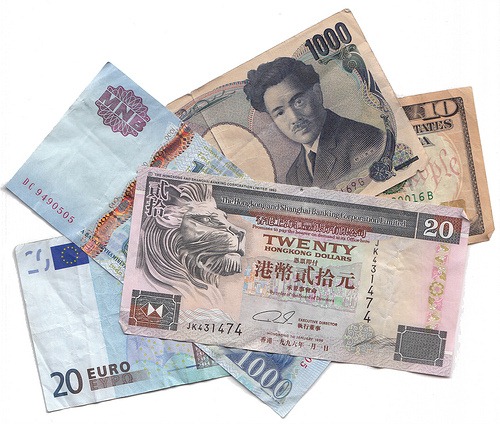
Money, courtesy Jamais Cascio, Creative-Commons Licensed

SOA for Human Brains ?

thumbnail

SOA stands for Service Oriented Architecture. Services can be assembled together to form news (composed) services. Most of the time this terminology is used in the back-end. The same way, but then more on the user interface side (the front-end), we talk about mash-ups, which is in essence a service oriented componentization of the user-interface, where one can combine (mash-up) different information sources into new user experiences.

In interesting article in the breakthrough section of Forbes online makes a similar “SOA” like metaphor for the human brains.

0824_michael-l-anderson_170x170

Michael Anderson talks about the “Brain Economy” and how Diffusion Tensor Imaging (DTI) lets us delve deeper into the workings of the cortex.

Psychology generally approaches the study of the mind by starting with behavior, and trying to infer the hidden mechanisms that produce it.

Neuroscience, in contrast, begins by examining the smallest, deepest parts of the mechanism–genes and neurons–and tries to determine which behaviors these help produce.

DTI allows you to see where nerve fibers lead and to map the fiber bundles wiring together various parts of the cortex. Such a map is called a

connectome.


The brain has just such an economy, where the raw materials of perception are gathered, processed, transformed and distributed in accordance with the dictates of a complex network of business and consumer relations. The brain’s transportation and distribution network is the connectome. Combining information on activity and information about the topographic features of this network gives us our most powerful tool yet to pinpoint what this mental economy produces and how it does it.

Compared to IT SOA, the connectome is like the information “bus”, containing connectors and adaptors to the different underlying components of brain functions. The semantic backbone of such connectomes makes it possible to make sense out of structured and non-structured information. By combining these information, we create “mask-ups” and new data patterns.

The human mind is great at pattern recognition, and relatively poor when it comes to pure processing power (at least compared to what your average PC/Mac can do, and certainly to what your average PC/Mac will be able to do in 20 years from now).

With the emergence of powerful semantic tagging engines and pattern recognition software,

we are entering a new era of the

Global Brain


What does all this mean for the sciences of the mind? It likely means that the brain isn’t organized quite the way we once thought, with each area dedicated to specialized cognitive domains like vision, language and decision-making.

Rather, just as in a real economy, the output of each factory is used in distinctive ways that depend on who the business partners or consumers are. In the brain, too, every local product is put to many uses, and so patterns of cooperation between "producers" and "consumers" govern cognitive outcomes. Our intelligence is largely powered by borrowing and re-organizing our existing resources to deal with ever-changing situations.

In a service oriented marketplace, the “producers” are called the “service providers” and the “consumers” are called the “service consumers”.

This is a lot of similarities to be a co-incidence. In this new hype of semantic web, we are seeing this a lot of modeling techniques and conventions that we’ve seen 25 years ago when people started talking seriously about relational databases and object oriented programming.

It looks like this time it’s going to be made real. In my opinion because we now have true distributed architectures and clouds, because we have now this massive computing, search and semantic power from Google, AWS, Microsoft, Apple, etc.

A Global Mind coming true. Such a big trend that most of use just don’t see the trend.

Computer better than human ? Starts with Hand

Check this out. With only 3 finger, it can:

  1. Throw: Kim Clijsters has a new sparring partner !
  2. Dribble
  3. Pen spinning
  4. Knotting a rope
  5. Taking a rice-grain with a pincet
  6. Regrasping.

Amazing !

And all this with tactile control in milliseconds. Imagine 2 hands of 5 fingers, or 10 hands of 7 fingers for the matter.

From Japanese Ishikawa Komuro Lab. More info here.