You don’t have to suffer

Have you also noticed ? How many people you see dragging themselves through the office, through their lives ? They seem to have lost sense of engagement.

5131778313_fb1c97decd_z

It makes me so sad. Such a shame not to enjoy life.

Sad in the sense of empathy, and the feeling there is little I can do about it. Maybe just write a blog and hope that some of my readers will get inspired and re-find that spark that makes yourself worthy.

We all know what caused this feeling of uncompleted, not being worthy, being imperfect.

It’s caused by the disconnect between the soft/hardware of your company and the world outside there.

  • The software is what is between your ears. But  even more so about the fine sensors you have in your whole body. This is not about “mind”, this is about “heart” and “feeling”. Deep feeling.
  • The hardware is about how your company is structured. The hierarchies. The power games. The team dynamics. The motivational models. The focus on the optimization engine with efficiency programs like Lean and SixSigma that such the soul out of great companies. At the end there is only efficiency and no soul.

That’s why people are “dragging” their feet. They just FEEL its not right. And they have lost the energy to fight. The hope to regain their souls.

But of course there is something you, we, all of us can do about it.


We can start a movement


From within. Find the peers who care about people, about life, about soul.

And of course we can ask help. Outside help if needed.

Check out the site of TeamPelgrims:

image

The NEW ECONOMY demands speed, creativity, dynamism, perseverance, courage, knowledge and the ability to work with others on a multicultural basis.

The NEW SOCIETY, prompted by the Human Interest movement, demands respect for individuality, freedom, mobility and quality of life

The last thing a fish can see is the water he is in… It’s very difficult to understand the “cultural mechanisms” in which we live and breath. Leaders should be made aware that they are “trapped” in cultural viruses. We see in too many occasions that cultural viruses are multiplying and contaminating substantial parts of the organization or company. Be accountable to manage and master this non-transparent but very present dimension in the engine of the organization.

It brings me to the topic of team dynamics.

album_large_3884809

I am very lucky to be part of a great team.

But due to the stress of the last months, we seem to regress a bit as a team. Just a little bit. In the sense that we start to grow more individualistic.

Luckily some of us have good “consciousness” antennas, and the team is strong enough to 1) bring this to the table and 2) openly discuss them.

My alarm-bell went off when a new team member joined, and I witnessed myself not 100% caring for the newcomer. I said something like “Throw him in the water, and he will learn to swim”. That’s not fair. Because there are so many new things to learn, so many unwritten conventions, rules, habits, cultures.


The problem was

that I did not have any time left

to give quality time to each other


  • Luckily our team is great, and we are working on great inspirational topics.
  • Luckily the newcomer is outspoken and has the courage to send invitations for feedback.

But I can imagine if you are not in such a team, if your have not this courage, if you have lost some of your closest colleagues is the latest restructuring, and you can’t work with your new boss and the new efficiency rules, that you get dragged.

We should not let this happen. We have to redefine, revive the company culture from within. Push it to the next level. Be viral. Infect he company, as it will not work by a top down approach or rolling out a big program.

Live the spark, the energy, the enthusiasm. And hope – be sure – that it will have a rippling effect – no, an unstoppable wave – within your team, spreading out to other teams, to other departments, to other regions, to other companies, to everybody you meet everyday.

n06_freddy-cerdeira

Enthusiasm is contagious.

And don’t be afraid to ask for help. And to offer help. Probably one of the best ways I can offer help is by transferring authority to others. To hold the bike saddle and then let go. But WITH transfer of authority.

Be not afraid to show vulnerability. Create safe harbors for vulnerability. These harbors become like the womb for the fetus.

iStock_000004280142Small

Your team could be a womb.

And especially:

be nice to yourself


It’s ok to be imperfect.

I am excelling in being imperfect by NOT being nice to myself. It has to do with the word “mildness”. Be “mild” for yourself. For yourself first. I used to say to others: “apply mildness to the 3rd degree”. But it did not come across as authentic. As I was not able to be nice for myself. People, human beings just “feel” when you’re not authentic.

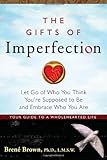
Brené Brown has written a whole book about this.

Brené Brown, Ph.D., LMSW is a research professor at the University of Houston Graduate College of Social Work. She has spent the past ten years studying vulnerability, courage, authenticity, and shame. Brené spent the first five years of her decade-long study focusing on shame and empathy, and is now using that work to explore a concept that she calls Wholeheartedness.

Ordinary Courage

Have a look at the “look” of her website. The illustrations have something “round”. The site creates some feeling of safety. Of roundness. Of “womb”-ness. It has a feminine softness/roundness that we seem to have lost in our company hard- and software.

I was very touched and moved by her TEDxHouston talk of June 2010.

The video is a 20 min summary of her book: The Gifts of Imperfection: Let Go of Who You Think You’re Supposed to Be and Embrace Who You Are
The video has subtitles, so the words have more impact. Without trying to make a transcript of her talk, here are some lines that resonated very strong with me:

  • Shame as the fear of disconnection
  • Don’t try to outsmart vulnerability
  • Do you believe YOU are worthy of love and belonging ?
  • Courage, compassion, connection.. who you are with all your heart
  • The courage to be imperfect
  • Be kind to yourself first
  • Connection as the result of authenticity
  • Let go who you think you should be
  • What makes me vulnerable makes me beautiful
  • Do something where there are no guarantees
  • Research is about control and predict
  • You know who you are when you think you need help
  • See a therapist who sees therapists: no family, no childhood shit, I just need some strategies
  • Vulnerability is the care of shame and fear and your struggle for worthiness
  • But also source and birthplace of joy, creativity, belonging, love
  • Vulnerability and tenderness are important
  • We “numb” the vulnerability. We “numb” everything
  • Blame is a way to discharge pain and discomfort
  • But then there is no conversation, discourse
  • We try to perfect our children, but babies are hardwired for struggle
  • We pretend that what we do does not have an effect on people
  • Let ourselves be seen, deeply seen, vulnerably seen
  • “I am enough”

Suddenly it became clear to me:

The difference is in

the (lack of) indifference

It’s about the capability

to be able

to relate to this


I am playing with the idea of building into Innotribe at Sibos 2011 in Toronto a topic on “New Corporate Culture” or “Towards a new corporate culture of difference”. Where we would invite people like Brené Brown, Vineet Nayar, Andre Pelgrims, Keith Yamashita, Marc Dowds and others ?

Something else than technology. Something else than payments. Something that touches our lives everyday. Probably more hours at work than at home. To feel happy, fulfilled, and worthy should resonate with all of us, no ? Or are you not afraid of becoming one of these “dragging” people ?

Let’s put back the “juice” in our companies.

What do you think ? Sibos ? About new corporate culture ? You really don’t have to suffer alone !

Is it really worth daring to be great?

In September this year, I was attending the BIF-6 Summit, in Providence, RI.

Why only report about it now ? Because they finally released the videos of the stories that were told at this year’s edition of BIF.

Next year’s edition BIF-7 dates will be 21-22 Sep 2011, unfortunately the same week as Sibos 2011 in Toronto. Wonder if we can not do something together with BIF that week at Sibos, if only sharing some of the 2011 speakers? I will give a call to Saul Kaplan. Look at the confirmed dream-list of already confirmed speakers: Danah Boyd, Lisa Gansky, John Hagel, Dan Pink, etc. Wow ! What a start, and still almost a year to go!

From this year’s edition, I suggest you take some time to go through my personal top-5:

Absolute topper, world-class, inspiring, moving, energizing, whatever talk came from Keith Yamashita.

Is it really worth daring to be great?

SY Partners chairman Keith Yamashita dares us all in this moving video story crafted as a metaphor from the Charles and Ray Eames video “Powers of Ten.” It’s a remarkable tale that reminds us that the future is here for us to create and it starts one collaborative duo at a time.

It’s worth every of it’s 25 minutes, and it’s a fantastic story about how “twins” in teams are the fuel of great teams.

  • It’s about doing great things like landing the Eagle in the moon, and “turning a bunch of folks blue” back home
  • It’s about having the house full of diagrams
  • It’s about when you start to believe that anything is possible
  • It’s about kids being born with greatness
  • It’s about being fully aware and fully alive
  • Trusting so deeply you can create together remarkable things
  • Duo-ships are about great invitations
  • Going actively after the status quo
  • About systems thinking + creativity
  • Building different type of organizations
  • That there is a better optimum than just the first choice
  • About having deep conversations on how to get smarter
  • To tackle things at a societal level
  • About finite/infinite resource and infinite/no possibility
  • About “then” (pre-crash), and “tomorrow”: finite resource + infinite possibility


About saying

“I trust you implicitly

to do a brilliant job,

and come back

with what  you learned”


About

Ending the tyranny

of false trade-offs


Who is Keith Yamashita ? All the quoted text below comes straight from the BIF site, but I have added my usual color and typographic emphasis:


When Keith Yamashita looks at the world, he sees complexity—a beautiful and rich one, if we can visualize our place within it.

As chairman of SYPartners , a consultancy that has worked with leaders at IBM, Apple, Facebook, Target, Blackstone, Target Financial Services, Bloomberg, Starbucks and The Coca-Cola Company, Yamashita is a master at helping people define themselves against the backdrop of a profoundly shifting business landscape. The task requires tremendous empathy, he says, a singular understanding of what clients need and want.

“The biggest fallacy of business is that it’s only rational,” he says. “All business is personal and all business is human.” Yamashita is intensely curious about what makes people tick. Who are they? What are their deep aspirations? What do they need to be successful? What’s holding them back?


Ambition

Love

Fear

The human component of consulting goes deep. “We hope for people what they wish for themselves,” Yamashita says. “I’d like to think that when we show up in a room, we authentically care about the people in that room and that they sense that.”

Still, it is not enough to simply identify a dream, Yamashita tells his clients. The only way to stand out is to be fully aware of how you fit into a wider spectrum, to figure out what unique part you play, given the circumstances around you.

“Because we live in a world that is more interconnected than it’s ever been, we are particularly susceptible to the dynamics at play,” Yamashita says. “People feel overwhelmed—it’s a natural outcome of the world we live in. There are more systems problems that require creativity than there are creative people in the world.”

To minimize the potential fallout from system shifts and to maximize the positive impact we can have on the world, Yamashita urges a return to authenticity. He says it’s a question of unlearning bad habits and relearning what comes naturally:

I do believe

that people enter this world

with a certain amount of

greatness

So many people,

through the pressures

of society

or the way we’re educated,

unlearn that greatness.

They fritter it away.

They start limiting themselves.

It’s really about

reclaiming that greatness

people learning about

how to be just themselves,

fully alive and aware.”


The positive exponential effect of all this self-awareness arises when individuals begin working together. Yamashita encourages his clients to build “powerful duo relationships” that require one of the trickiest human emotions: trust. “The duo is the smallest atomic unit where trust is built,” he points out. “If there’s only two people, you can’t shovel blame.”

With competent, self-aware individuals who relate to others on the basis of that trust, an organization has the potential to expand by the power of ten, just as in the Eames film. Zooming out, Yamashita sees a universe where companies design their own destinies by connecting purposefully to a wider array of players in order to work on a tougher set of problems.

Other remarkable stories came from:

  • John Hagel, with an even more personal version of his Sibos2010 talk on “The Power of Pull” and the role of passion in high-performance organizations,
  • Carmen Medina, on how one can innovate in a conservative castle like the CIA,
  • Jigar Shah, talking about scale in our Global Warming initiatives, and why everybody buying a Prius is really a drop in the ocean.
  • Kim Scheinberg (no video available yet), who also was interviewed in the FutureofMoney video. She’s an ex-gambler and now a new wave angel investor,
  • Gerard van Grinsven, (no video available yet), a former Ritz-Carlton executive, who became CEO of a hospital where it is all about health-care and not sick-care.

All these speakers indeed confirm, inspire and motivate it is really worth daring to be great.

That it is worth everyday to re-question yourself, and there to re-invent yourself to keep the greatness-bar high, very high.


And greatness is

not good enough anymore.


A program is not good enough anymore. What we need is an agenda.

“For a better world” for example.


Idealistic? Maybe.


Ambitious? Sure.


It is so easy to copy-cat last year’s success formula. But it does not satisfy myself. I believe you – readers, followers, innotribers – you expect more. You want us to surprise you, year after year.

I hope these principles will also guide us when articulating our Innotribe 2011 initiatives.

How to make babies ?

UPDATE: the Prezi version of the SOFA presentation mentioned at the end of this post is now available here.


image


Sibos 2010 is over! It was one of the best ever. After that week I felt completely exhausted. Empty. Because I gave my full self. Went deep. Gave and received loads of energy.

This week, it’s time for reflection. For chilling-out. Took some days off: late breakfast, some power naps. A walk here and there. Still lots of reading. Lots of tinkering. Some up-moments, some down-moments. Flowing.

And the future starts to emerge again.

Soon we have to go back to the salt-mine. Soon the treadmill starts all over again. But it does not have to be a copy-cat.

Soon we have SOFE (SWIFT’s Operations Forum Europe), running from 13-15 December 2010 in Conference Center “Dolce” in our home town La Hulpe (close to Brussels).

I have been asked to organize the Innovation Plenary on 14 December. So, here we go again!

Sean Park from the Anthemis Group will be there as well.

He was one of our VC-coaches and Innotribe Leaders for Cloud at Sibos. He will do a keynote during the plenary (a great Prezi presentation on “Platforms, Markets, and Bytes”) and a viewing of his trailer video on “Financial Reformation”. And he will help us run an Innotribe Lab on Cloud computing. Yammy !

Also for me it’s a great opportunity to refresh/reboot. I will do the second part of the innovation plenary armed with


a brand new presentation titled

 “How to make babies”


It will be one of those presentations that have been breeding in my head from some while, and suddenly materialize. Like a painting on a canvas. Like poetry on a sheet of paper. Like joy and harmony in music. Suddenly, it’s there!


clip_image002


“How to make babies” will bring together numerous thoughts collected during many conferences visited this year and ideas distilled from the books I have been reading recently. If you are interested in the books I am reading, I am inviting you to subscribe to my GoodReads.

In essence my story will start with the collision of two ideas.

The first idea was seeded in my brain by Geoffrey West (Distinguished Professor at the The Santa Fe Institute) in a presentation titled “The Secrets of Scale” delivered during the Techonomy conference in June of this year.


clip_image003

Geoffrey West is a theoretical physicist whose primary interests include elementary particles and their cosmological implications; the theory of companies, cities and global sustainability; and biology, including metabolism, aging and sleep. He served as the Santa Fe Institute’s (SFI) President from 2005 to 2009.

It happens that the folks at Techonomy just put up all the videos, including Geoffrey West’s presentation:

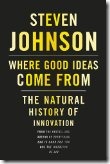
It also happens to be the story that opens chapter one of one of the latest books that made a great impression on me: “Where Good Ideas Come From” by Steven Johnston.

clip_image004

At Sibos, we reflected on the Long Now. In the first chapter of “where ideas come from”, Steven Johnson talks about that vantage point the long zoom.

It can be imagined as a kind of hourglass:


clip_image006

Several years ago, the theoretical physicist Geoffrey West decided to investigate whether Kleiber’s law applied to one of life’s largest creations: the superorganisms of human-built cities

And

the quarter-power law governing innovation was positive, not negative. A city that was ten times larger than its neighbor wasn’t ten times more innovative; it was seventeen times more innovative. A metropolis fifty times bigger than a town was 130 times more innovative.

The essence of Geoffrey West’s story is that cities are intensities. That cities never die. That cities are the ideal womb for idea generation, incubation and execution. That innovation scales differently than the size of the city.


Because

the information and the ideas

flow freely and in high intensity.


But how does one create a culture of intensity, of innovation? How does one create the vibrancies of cities within the walls of a castle?

Here is some additional video material featuring Steven Johnson’s ‘”Where do ideas come from”.

And a TED talk on the same subject:


It brings me to the second idea in the collision: the one of incubators.

clip_image008

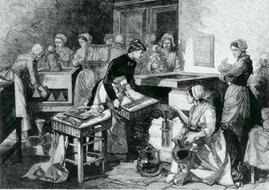
Incubators at the Maternity Hospital, Port Royal, Paris (Maternité de Paris, Port-Royal). An engraving by Eugene Froment (1844-1900) from the Illustrated London News, 1884.

Incubators were invented by Stéphane Tarnier in 1880, and documented by Auvard in the historic 1883 article De La Couveuse Pour Enfants. Incubators help us grow babies. Physical babies. What I am talking about are ideas. Baby ideas that need to be prototyped. And then incubated. Many incubator models for ideas and start-ups exist.

Probably one of the more famous ones is MIT Building 20. Building 20 was designed differently. With flexibility in mind. A bit like the Value Web walls that allow you to create spaces of intensities. And when the job is done, you disperse and build new spaces, new teams. Disperse and re-group. A different composition for each new project. Get rid of the one size fits all.


clip_image010

Old Building 20, Vassar Street facade, 1997.

clip_image011

New Building 20 at MIT

The point I am trying to make here is that physical environment is equally important to have a free flow ideas. Ideas will not flow in a castle with long corridors and closed offices.

Once incubated, you need to scale. Which brings us back to Geoffrey West and “The Secrets of Scale”. You need to create intensities. As I already mentioned in a previous post:

Intensities and intentions. City intensities. Platforms of intensities. Physical or virtual. Almost requires an architectural purism and surroundings to make it work. Has to be physical.

I want to create these environments. Where small groups of intense people can meet. Can radiate. Can nurture and inspire each other. Where one hunch leads to another, and ideas cross-fertilize. Where we play the Medici-Effect for 100%.

We need to build some sort of city, some platform of intensities, some sort of campus. Not a “chalet” next to the castle.


Think big

Think scale

Think city

Embedded in the social and economic fabric of our industry. Where experts can meet and weave the next generation solutions.

Where we not only have a fertile environment for funding “only”, but where we also thought about physical housing, novel resourcing models like dedicated teams combined with shared staff from the castle. Or in-residence programs as another way to resource and bring fresh blood.

Where we have a shared infrastructure for support, project management and IT. And where we nurture a culture of experimentation. Where we have reverse-mentorship of our bankers BY the Gen-Y generation.

Venessa Miemis hit us all hard in the face at Sibos:

There is a class of young, intelligent, creative people who are disillusioned with the debt-based monetary system, and are busy building the infrastructures for a commons-based economy, which is emerging, right now, in parallel to what currently exists. The foundation of this economy is built on trust… and transparency…. and the ability of distributed networks to self organize. And using the Web as a grounds for experimentation, we’re learning more effective ways to link unmet needs with unused resources, innovate, generate wealth, and build resilient communities.

This is the prototype of the future. This is where the opportunities are.

I hope that during the Innotribe sessions the remainder of the week, we can explore ways to create bridges between these two worlds and ways of thinking, and co-evolve the next global economy.”

Venessa & friends already followed up post-Sibos with the idea of an in-residence program for bankers. To understand and connect with the new class of young, intelligent, creative people. To learn their language and adapt their values. Yes, you got it right: the bankers get mentored by Gen-Y.

I think it’s a fantastic idea. To think wealth instead of money.


With trust as the currency

of the 21st century


Where we create bridges in a strengths-based society instead of a problem mindset.


We are in a different Zeitgeist,

and most of our bankers

haven’t noticed yet.

The realization that most senior executives in finance (or elsewhere for that matter) would be completely at a loss – “sans moyens” – faced with an articulate and intelligent Gen-Y as personified by Venessa.

Things like this residence program idea: that’s the sort of babies we need to create. That’s the sort of family harbor we want for our children. And when babies become adolescents and adults, when those ideas have matured into successful companies in their own strength, keep thinking about our off-spring. As it never stops.

And despite big hopes from the singularity movement, there is a fair chance that all who read this in 2010 will die sometime. But as Geoffrey West pointed out and proved mathematically:


Biological beings die

Cities never die


The big “contours” of my SOFE presentation are drawn. This post-Sibos holiday & chilling season is ideal to let it mature. To perfect the visuals. To come to the essence. To get to its full purity. To be different by less not more. So that you can feel the full intensity. So that each of you can realize his full potential.

Let’s practice making babies !

Digital Identity Tour: the unpolished diamond part-1

Summer is coming to an end.

I had some good times off, disconnected with lots of reading, biking, and hanging around. Also the best way to let new ideas emerge.

g10_24056801

Lately, i have been immersed in digital identity. First, I attended the EEMA European e-Identity Management Conference in London . The week after, I was the “tour guide” for a study week on the subject with 4 other colleagues.

We discovered a rich subject – in full (r)evolution – and we met really very smart people who were extremely knowledgeable about the subject.

Since then, I have been reading and thinking a lot about the subject.

This blog post – in different parts – is a detailed report of those conversations, reflections, interpreted in a very personal way. In other words, this is my very personal consolidation and internalization on the subject.

The subtitle of the blog is “the unpolished diamond”. Indeed, what I will present here is a multifaceted subject. It’s like a rough diamond, which still needs to be polished into a beautiful multifaceted shiny precious diamond.

The different facets of the diamond are organized in “chapters”. I feel like this can become the basis of a more in-depth whitepaper, or – time and ambition permitting – a book at some day. Please let me know and/or encourage me if you want me to go ahead with this crazy idea of a book.

I will come up with some other metaphores in subsequent posts. The one on “Digital Identity Tuner 7.0” is in the making, where I will really push the identity envelope.

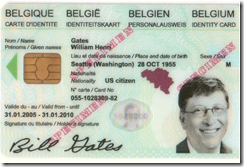
Anyway, my identity story starts in 2001 or so. That’s when I got infected by the identity-virus: I was working for Microsoft (2001-2005) on the Belgian e-Identity Card (eID) project.

image13

This was a once-in-a-life project, sponsored by Bill Gates himself, who saw the advent of 8 million eID citizen cards being distributed in a mandatory way to the Belgian citizens over a period of 5 years as a ideal test/pilot market. (BTW: Belgium is already renewing the first cards that were issued at the time; this means this has to be looked at as an infrastructure thing, that needs to be maintained for several generations)

We wanted to discover how citizens reacted to such eID card, assess what sort of applications were being build that consume this eID card, and what would be needed to support this sort of card in Microsoft products. This was far reaching, as we looked across the board at Windows OS, Microsoft Office, MSN (Safe chat for children), workflow, audit and regulatory requirements, and last but not least privacy.

My role was one of Business Development Manager, not so much in a sales mode, but rather in a research and discovery mode.

It was during this time that I met Kim Cameron (Microsoft’s Chief Architect Identity), just at a moment when Kim had published his seminal whitepapers “Laws of Identity” and “Towards an e-identity meta-system”.

Kim has become a friend since then, and I highly recommend his blog www.identityblog.com.

I was permeated with the early concepts of claims based identities, and ever since, I felt a natural attraction towards anything that was related to identity, not only e-identity but also identity in it’s philosophical and existential sense “who am I really ?”

Already at that time (2001),

I felt that the eID card

(a smart card with certificates issued

by the Belgian government)

was an anachronism.


We seemed to use

concepts of a physical world,

and tried to use them

in an on-line world

fundamentally different because

hyper-distributed and

highly interconnected


In addition one can question today whether the government (or a bank, or another “trusted” party should be the originator of the identity).

It’s like maintaining a 2D view on a world that has since long moved to 3D. It’s like looking at the sunset in 2D: what you see is a circle that gets smaller and smaller until it’s a dot and then finally disappears.

But in this 2D view, one has lost the 3D dimension of our planetary system, and the highly dynamic and interdependent set of moving parts.

This view is shared by David Birch, who runs a very interest Digital Identity Blog when he says:

The analog-digital comparison does not work when thinking about 21st century e-identity

There are indeed some novel views that


instead of having “an e-identity

issued by the government

to offer value to the citizens”,

it would not be better to have “an e-identity

issued and managed by the citizens

to offer value to the government”


This view is highly related to a tectonic shift of power back to the owner of the data, or more in general the revolution from “Push to Pull” business models that are so well described in John Hagel’s seminal book “The Power of Pull”, in my opinion THE business book of 2010 (although not shortlisted in FT’s 2010 best business books –> FT is wrong 😉

In the next editions of the “unpolished digital identity series”, I will tackle following “chapters”:

  • Digital identity in Cloud computing
  • Digital Identity Tuner 7.0
  • Privacy
  • Business case/model
  • Architectural perspectives
  • The role of a registration authority (if any)
  • Claims based identity: more than PKI
  • Personal data sharing
  • The “pile” of standards
  • Vendor readiness
  • User comfort
  • Mental reference framework for SWIFT
  • Trust Frameworks
  • Form factors
  • Liability
  • Developer perspective
  • Digital identity and Digital footprint
  • Social currency
  • Semantic tagging of the WHO

Hmmm… it starts indeed looking like a book. Any input and suggestions welcome.

Student Summer Job: making meaning and sense

A couple of weeks ago, I was taking a short break and chatting with a new young guy I never had seen before at the company.

We had some chit-chat discussions about the weather and other small talk, until i asked him in what group he was working. "I am a summer student and i am working in the A-department”.

"And what are you doing there ?", I asked.

Student: "I am filling spreadsheets. They document the discussions of the daily whiteboard discussions, and that is needed to report back to the different management layers in the company."

Me: "And that keeps you busy for the whole day ?" I replied.

S: "Yep, sort of"

"And do you think that’s useful ?"

S: "No, not at all, but it is just a summer student job for a month, but

it pays well

and with the money I will be able to afford a holiday trip to Australia."

A couple of observations here:

  • how many times do you/we do things we profoundly think are useless, but still do them as "it pays well" and we are not prepared to go through the pain of challenging THAT status-quo ?
  • how many of these useless things have anything to do with adding value to the customer, and have all to do with internal policies ?
  • when is the last time you did something that really made a positive difference to your customer ?

We can have all sorts of theoretical debates about company culture, but as long as we don’t start focusing exclusively on the value zone – there where value is created at the interfaces of our company – all these efforts will only continue to add to the numerous sets of policies and initiatives.

These keep on existing and having a life of their own, even long after the crowdsourced intelligence of your company has acknowledged they have been bypassed by the events and only are alive because some senior manager identified him/herself so much with the initiative that giving-in would cause irreparable damage to his/her ego.

When are we going to stop and refuse doing things that don’t make sense anymore, only because the circumstances when these practices were created have changed dramatically ? Or even worse, have proven to have has counterproductive effect ?

Keep on searching for meaning and sense in everything you do. Refuse to do useless tasks.

People and Culture: too wooly ?

Here is your deejay with the brainwave helmet again: look at the wide open eyes of Sam from Sam The Sham and the Pharaos with their 60’ies monster hit “Wooly Bully”. His eyes wide open. Uno, Duo, Très, Quatro ! Let’s have some fun here. And be a bit crazy !

image

I recently got somewhat involved in the People & Culture thinking of our company. Already at our first attempt during our fantastic off-site in April, we identified excitement as one of the components that need to be part of our culture.

We should all re-read that blog post titled “Get a Life and Get Alive”, as we seem to loose lots of the sharpness of our ideas when we start putting them through committees, and the whole thing seems to get watered down.

So, for 4 months+, we kept ongoing and had a good solid understream of ideas, depicted by different people in different ways, depending on their left or right brain orientations.

After a couple of weeks, this was my best effort:

image


It was a combination of keeping the best, improving drastically the mediocre, and getting rid of the worst. The most important in this slide were the


“quality lenses”


They reflect the deeper purpose that guides our transformation process and choices, and these lenses can be used as a compass to be sure we still navigate in the right direction.

The direction was an ambitious one, a radical one.

But most executives do not like the words “radical” or “disruptive”.

  • Does that mean we should adapt our packaging, our wording or worse our meaning and purpose to please our audience ?
  • What happens with ambition when filtered through endless reviews ?

By the end of last week, we had our seventh or so iteration of the slide deck to be presented to the executive committee.

I though we had quite an “acceptable” outcome in a culture of consensus.

As I write this, I notice how polluted I have become myself by the consensus-virus. In the end, one compromises so much that all you end up with is a grey mouse. 

Herman Van Rompuy arrives at the EU summit in Brussels on Thursday evening.   Photo AP

So, to hell with outcomes that are “acceptable”. We don’t want grey mouse. They don’t inspire.

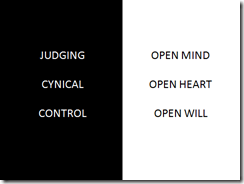
Nevertheless, I was surprised that version seven still included our famous words “Open Mind, Open Heart, Open Will”. You had to search for them (see the big fat arrow above), but they were there.

Too optimistic though.

Throughout the week, folks kept on saying this was “too wooly”

So we tried to put different words. In version eight, we ended up with some things like “Intrinsically motivated people” and “Co-creation with Customers”, etc. Not bad, but “acceptable” in my opinion.

What made me write this post was the following comment on exactly this part of that version:

This part is a bit too vague

and b-school jargonistic

for my taste

Can we turn that into our

company terminology ?

(the other parts already were in company-speak)


My answer: NO, absolutely NO !


As I wrote in back in April, the real root cause (to use some Lean terminology) was about the openness of our minds, hearts, and minds.

image

Some indeed call this “wooly” or “b-school”. I don’t know what is meant here.

There seems to be some negative connotation here:

  • “b-school” could mean several things. In the most optimistic case is stands for Business School, and then the wording may be perceived as too academic. In the worst case, it means b-grade school or even worst kindergarten or naivety. But I believe that many of our corporations would thrive well if they would resource themselves with some naivety of better

freshness and purity

like a young child

discover with eyes wide open

and without prejudices

  • “wooly” has something to do with a certain form of “softness”. I sense all sorts of touch points with New-Agism, or the Hippies 2.0 movementExecutives seem to have e a natural aversion to topics related to softness, philosophy, emotion, feeling, sensing, or anything that has to do with mind, heart, and will. It is probably exactly this that needs to change in many company cultures if we want to make our companies more “human”. Or as Jeff Bezos so eloquently said: “It’s harder to be kind than to be clever” Read every word and sentence of his Princeton speech here. Listen to the emotion in his voice. You sense here stands a man who embodies and believes what he says. You want to follow him. Maybe he is Hippies 2.0 ? Maybe. But he’s inspiring.

Leaders will be followed, not because they have dictated so or by hierarchical power, but because they are authentic in everything they do, because they are inspirational, because they are charismatic, because they are truly “at service” and not “in command”.

The new game is about new hierarchies, not based on ranks and power but based on true service value.


The hierarchical PYRAMID changes

into a collaboration and service SPHERE

where there is no upper or lower level

where the value comes

from the strong interdependency and

100% service mind to make the OTHER win

What we need is a culture based on a fundamental shift from Old Game thinking to New Game thinking. We will not succeed if we stay “acceptable”.

Our ambition level in this should be nothing but an extreme makeover, respecting our company’s financial, operational and reputational integrity.

You can use whatever words for it, but the messages and its wording must be fresh, inspiring, ambitious, rejuvenating. Not only on its messaging surface but especially in its deep culture core.

I don’t believe that you can capture your “culture” in one word. Culture is a complex thing. It’s a combination of tacit, implicit and explicit values, attitudes, and knowledge. Is combines the good positive heritage of the past with the vibrant youth-ness of the future. So, here are some words that “capture” that culture.

image


That’s also why Talent and Culture are so closely interwoven. Because culture is the result of the people you have on board. If you want to change the culture, there are basically two things you can do:

  • Try to change the people you have on board. Although this is very difficult, I believe we have enough cultural creatives to at least inspire more than 50% of the company to change gears. For the others, we’ll have to wait till the Hippie 1.0 generation is retired and made room for the new generation.
  • Bring on board new young people with fresh insights. We should be extremely aggressive about this. Hire “en-masse” young people. If possible younger than 20 years, as even some 25+ “don’t get it”

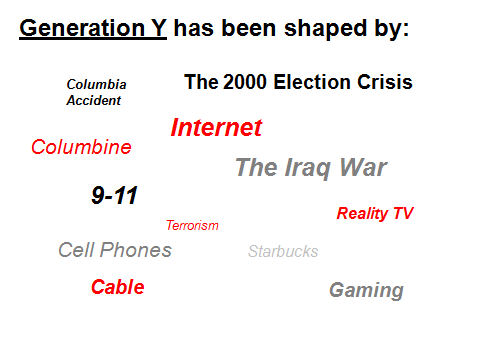
Both generations where shaped by different time and historical contexts:

image

image

With courtesy: NASA Generation-Y Perspectives. Full slidedeck here.

Of course, when implementing such aggressive plans, we need to make sure that these programs do not become the exclusivity labs for personal and professional development for the young only, and that everybody gets her chance to fully realize their potential, so that they don’t have to ask us


“and where do I play ?”


Like many things, I think you recognize an inspiring culture when you see it. When you see the people of that culture. They have sparkles in their eyes. When you interact with them. They go the extra mile.

We need word and spirit that reflects:

  • Excitement
  • Intrinsically motivated people, as mean by Daniel Pink in “Drive”
  • Extreme Management Make-Over and Employees First, as meant and intended by Vineet Nayar in his latest book, considered now as THE reference for modern HR

I was lucky to see Vineet deliver his message in person to the audience at Techonomy last week. The story goes like this:

  • The goal of our company is to deliver value to our customers
  • Where is that value created ? At the interfaces of our company.
  • Who is at those interfaces ? Our employees
  • Therefore the whole company should be organized to be “at the service” of the employees.

This is about a management extreme make-over.

  • From managers giving instructions to employees and measuring their efficiency
  • To managers at the service of employees

When I spoke to HR, my contact said: “Oh, that is what is called Service Management, I know about that”. When I asked whether he already proposed this as a management culture to the executives, he said


“Oh no !

That would be too radical

that’s a revolution !”


But I am afraid many of our corporations need nothing less than such a revolution, a fundamental make-over.

In the end

Culture = Company = People


People with a Life and Alive. Not wooly sheep following the dress code and complacent in being “acceptable”. People who share the “wooliness” of “kindness” vs. “cleverness”.

Our culture has to be provoking and inspiring. You should be able to rally your troops behind it. As soon as it becomes “acceptable” that won’t work.

In the song Sam sings about a “wooly saw”. What we need now is a very sharp saw.

To give the sharpness back to the Wooly Bully !

Techonomy: a new philosophy of progress

image

Last week, I had the privilege to attend the first edition of Techonomy, a fantastic new conference blurring technology and economy with an optimistic balance that technology in its broadest sense (not only IT, but also gnome sequencing, bio-fuels, big history, etc) can be the driving force for a better world.

First enjoy the announcing video below.

The conference was bringing together 3/4 of Silicon Valley’s leadership, including Eric Schmidt, Jeff Bezos, Bill Joy, Bill Gates, Steward Brand, Kevin Kelly, John Hagel, Deborah Hopkins (Chairman of Venture Capital Initiatives and Chief Innovation Officer Citi), Nicolas Negroponte, Sean Parker, Padmassree Warrior CTO Cisco), Jeff Weiner (CEO LinkedIn), and the list goes on, and only a couple of non-US leaders such as Nobuyuki Idea (Founder of CEO of Quantum Leaps Corporation, working on innovation, and previous CEO of Sony Corporation), Nellie Kroes (European Commissioner for Digital Agenda), Vineet Nayar (CEO HCL Technologies, India), and Ory Okolloh (Founder/Executive Director Ushahidi, South Africa).

How to describe Techonomy conference ? I would say “a super-TED with a technology focus and with an agenda”.

The agenda is “a new philosophy for progress”.

It’s a movement

Somebody asked “a movement against which enemy, against which barriers ?”.

I believe it is a movement FOR something.

For a better world. Finding techonomic solutions to tackle the global climate challenges, feeding the world, a better health for everybody, a new value kit for the current and next generation, not based on greed but on the concepts of creative capitalism as formulated some years ago by Bill Gates in the Bill and Melinda Gates Foudation.

In that sense, it should not surprise the regular reader of this blog how much this resonated with myself. Not only the personal inspiration, but especially how we with on organization like SWIFT can adopt and promote the techonomist values and objectives.

I also came across some leaders that could be subject of SWIFT’s CSR initiatives. Take Bill Drayton, Leadership Group Member Chair and CEO of Ashoka, the global association of the world’s leading social entrepreneurs, men and women with system changing solutions for the world’s most urgent social problems, encouraging everybody to be a changemaker.

It’s impossible to describe the intensity of the content and contacts of these 3 Techonomy days.

Some highlights:

  • Evolution is incremental. Revolution is disruptive movement
  • Collective learning is what makes us human
  • The physical economy is sensoring a second economy of conversational plumbing
  • As long as we draw boundaries (for ex US vs. China, we against them, etc) we will not be able to solve the world’s problems.
  • The economy is NOT recovering, consumer is running out of money
  • Governments do not understand globalisation, businesses do.
  • Employees first, customers second.
  • Promote younger people must faster
  • Building and tapping from tacit knowledge will become core skill
  • Markets are like gardens: they need tending
  • Innovation happens outside the regulated markets
  • Banks make money on spread and opacity. They are by definition against transparency
  • Currency is “the instrument of trust in a transaction”. Unfortunately the debate focused solely on the payment transaction and money as the trust element.
  • Health agenda: from illness fixing to personal health prediction and coaching
  • Some technomists are skeptical optimists that do not take progress for granted. One has to make progress. It does not happen.
  • Recalibrating our assumption that form our perceptions. For ex we learned that world population will NOT grow indefinitely and probably max around 9 billion, and then go down.
  • Innovation at Cisco: Looking at 30 ! adjacencies as a “portfolio” like a Venture Capitalist does.
  • Computer Associates CTO: “a lot of leading edge innovation comes from financial services”
  • Innovation requires a culture of taking risk and celebrating failure
  • Change happens when the DESIRE not to change is greater than the desire to change. The power struggle to make this balance change is based on societal needs.
  • Innovation requires 1) Money, 2) Desire, 3) Need
  • There is no value in the idea, there is value in its commercialization
  • We have a moral obligation of bringing less developed regions up.
  • Cities are “intensities” that have a critical mass of people
  • In a city-“OS”, no one single company can dominate. It has to be open source by definition.
  • Generation-Y or whatever: you need the backing of 18 year olds. That’s “youth”. 25 years+ does not quite get it.
  • Companies scale like biology, and in the end they die. Cities scale like networks, and do not die. The city is the framework model for the future.
  • In the developed world, a disruptive innovation is something that can create the biggest disruption. In the developing world, innovation is a technology that is simple, reliable, and that can function as an integrated unit.
  • Success in mobile in Afghanistan is because there was no legacy. They are willing to take the risk to jump to the next curve.
  • The future is for (techonomist) entrepreneurs that are willing to work together.

The conference is so good. It cries for a European and an Asian chapter. Any European Leader should not hesitate a second to be associated with and sponsor it.

I was dreaming of hosting a European chapter of Techonomy at the fantastic SWIFT Headquarters south of Brussels.

El Jefe, do you hear me ?

What choices will you make today ?

An emotional Jeff Bezos during graduation speech Princeton: “it is harder to be kind than clever”

Full transcript here

Every word is important and inspiring. Read and enjoy the full thing, but here are some extracts, mainly the grand-finale of his speech:

Tomorrow, in a very real sense, your life — the life you author from scratch on your own — begins.

How will you use your gifts? What choices will you make?

Will inertia be your guide, or will you follow your passions?

Will you follow dogma, or will you be original?

Will you choose a life of ease, or a life of service and adventure?

Will you wilt under criticism, or will you follow your convictions?

Will you bluff it out when you’re wrong, or will you apologize?

Will you guard your heart against rejection, or will you act when you fall in love?

Will you play it safe, or will you be a little bit swashbuckling?

When it’s tough, will you give up, or will you be relentless?

Will you be a cynic, or will you be a builder?

Will you be clever at the expense of others, or will you be kind?

The Value of Your Social Graph

image

If you have the time, please watch this presentation" How not to be seen” by futurist Mark Pesce. I mentioned it already yesterday in my post “The DJ with the Brainwave Helmet”, but now I took the time to watch the +/- 1 hour presentation.


Do it


It profoundly explains what’s going on in our ever more connected world.

It makes so clear that your social graph is your most important possession”

No need to further quote, as the full transcript is here.

This guy is super-smart. Follow him on twitter and on his blogs.

Social Graph is also about Sibos 2009 winning project “eMe”, but then on steroids.

Completely revised. Definitely in the vision of Mark Pesce.

With privacy and user control seen in a distributed internet world. NOT one single digital vault, or even several digital vaults. Whether they are “owned” and “controlled” by Governments, Banks, FaceBooks, Googles and alike.

Completely revising the “business model”. Where the value flows to the users, the owners of their social graph. Not to banks. Not to governments. Not to some controlling party in the middle.

The is no “where”, no “middle” on the internet. That’s where we got eMe wrong.

No, we have to revisit the whole concept of eMe along the open Plexus lines that Marc Pesce is describing in his “How not to be seen” presentation.

I will talk to Peter Hinssen, when he’s back from down under. So that we have something to say about eMe at Innotribe at Sibos 2010 in Amsterdam.

Oh, and if you like this sort of stuff, here is another presentation “Dense and Thick” by Mark Pesce at Webstock2010.  As a matter of fact, this presentation is even better, as Mark does a fabulous job in giving us a perspective of the current state of the web, how we got here and where this might lead us. Not just by throwing boring statistical data at us, but with deep insights and with a speaker’s passion that is difficult to match.

Without really mentioning (ok, only once), Mark Pesce is describing a vision of the semantic web that is not push-oriented like Tim Berners Lee, but truly “pulling” us – human beings – in this super-exciting world where meaning becomes explicit and exploitable and can be manipulated (hopefully in the positive sense of the word).

The summary of his talk goes like this:

It may be hard to believe, but we’re only just at the very beginnings of the web revolution. In the first fifteen years (1994-2009), the human world of culture and civilization was sucked into the black hole of cyberspace. Now the real world is poised to follow. Augmented Reality (AR) shows that when we peer through a portal, and look upon the world, it’s almost embarrassingly empty of our annotations. That data is there – the world is the database of itself – but it can’t be brought immediately to hand with a search or a gesture. That’s the next place we will go: we will build a virtual body for the real world, a dense database of everything, both natural and artificial. In fifteen years’ time, we’ll wonder how we got along without it.

This means that the clock has been reset. Everything we thought we knew about how the Web works, what the Web does for us, and who controls the Web is up for grabs, once again. We will see bright shining stars – and sudden, brief supernovas – just as we did in the Web’s early years. The opportunities are breathtaking, the innovations will be flying fast and thick. All of this is now within our grasp.

This guy is a real discovery for me, and hopefully to you as well.

I will ping Mark to check whether he is interested in the eMe update and hopefully lively ensuing debate at Innotribe at Sibos2010 in October.

Might be a challenge, as his intellect humbles me deeply, and maybe he is just not interested in such a mundane conference.

You have to be somebody before you can share yourself

It’s holiday time, and I have reduced significantly my blogging, reading RSS feeds, tweeting, mailing, etc

Time for hanging around, some biking, some good food, and… a good book. If you want to follow what I am reading, check-out my page on Goodreads.

For me, a good book is one that leaves you puzzled, that makes you think,


that re-calibrates your perspective,


that is a pleasant read, that has depth.

“You are not a gadget” by Jaron Larnier is such a book. I discovered it thanks to a tweet of my friend Paul, who reacted to one of my enthusiastic Singularity tweets. The title of this blog post “You have to be somebody before you can share yourself” is very early in the book, and captures its essence.

Jaron Larnier was listed on The 2010 TIME 100 in the Thinkers category. His Wikipedia entry is here.

It’s a great read if you are in your over-enthusiasm mode about  computationalism, the noosphere, the Singularity, web 2.0, the long tail, the hive mind, the global brain, crowdsourcing, collective intelligence and all the other buzzwords and trends and all the rest. It gives you some solid pushback and sound criticism.

I am not going to do a book review, but my experience of the book was like there were 3 stories interwoven:

  • How technology is limiting our potential and who we are on-line. This of course resonated a lot with my work on Digital Identity.
  • Our communication limitations. He has a great chapter on how cephalopods have the great ability to “morph” and how one could use “visual” communication and another dimension of communication, other than language. And how humans in virtual reality environments quickly adapt to a body with tentacles. Intriguing !
  • The notion of “neoteny”: humans are born as fetuses in air, and our brain is being developed during childhood. Lanier compares this to a newborn horse that can stand on its own and already possesses almost all the skills of an adult horse. Humans – in modern civilizations – have an artificial, protected space called “the classroom, the extended womb”.

Neoteny opens a window to the world before our brains can be developed under the sole influence of instinct.

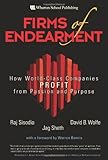
A similar concept related to neoteny – “generativity” – comes back in another great read Firms of Endearment: How World-class Companies Profit from Passion and Purpose.


This is a book about

the pragmatic role of

love in business


It’s about the epochal change into the Age of Transcendence. The dictionary defines transcendence as a "state of excelling or surpassing or going beyond usual limits."


The second event is the aging of the population. For the first time in history, people 40 and older are the adult majority. This is driving deep systemic changes in the moral foundations of culture. Higher levels of psychological maturity mean greater influence on society of what Erik Erikson called "generativity"—the disposition of older people to help incoming generations prepare for their time of stewardship of the common good

The Firms of Endearment book in essence talks about a new form of capitalism that is not only focused on profit and shareholders’ value, but on value creation for all parties in a company’s stakeholders’ ecosystem.

Joran also has an opinion on capitalism when he says:

Visiting the offices of financial cloud engines (like high-tech hedge funds) feels like visiting the Googleplex. There are software engineers all around, but few of the sorts of topical experts and analysts who usually populate investment houses. These pioneers have brought capitalism into a new phase, and I don’t think it’s working… capitalism in a digital future will require a general acceptance of a social contract

He is also calling for “so-called AI techniques to create formal versions of certain complicated or innovative contracts that define financial instruments” and that setting standards for these could be facilitated by “a cooperative international body” that

would probably have specific requirements for the formal representation, but any individual application making use of it could be created by a government, a nongovernmental organization, an individual, a school, or a for-profit company. The formal transaction-representation format would be nonproprietary, but there would be a huge market for proprietary tools that make it useful. These tools would quickly become part of the standard practice of finance

What a great potential for my employer SWIFT ! We are indeed a full-blown cooperative international organization with our roots in financial services.

In essence, Jaron Laniers’ manifesto and rant is about “The deep meaning of personhood is being reduced by illusions of bits”.

That should make us reflect deeply on how we want to engage as human beings in an on-line world, how we define digital identity in the relative and the absolute, and be very vigilant that we don’t loose our potential in our technology enthusiasm.

For me, the prospect of an entirely different notion of communication is more thrilling than a construction like the Singularity. Any gadget, even a big one like the Singularity, gets boring after a while. But a deepening of meaning is the most intense potential kind of adventure available to us

Finally, I also found some consolation to deal with my 3/4 Life Crisis. The following quote always helps:

If you are young and childless, you can run around in a van to gigs, and you can promote those gigs online. You will make barely any money, but you can crash on couches and dine with fans you meet through the web. This is a good era for that kind of musical adventure. If I were in my twenties I would be doing it. But it is a youthiness career. Very few people can raise kids with that lifestyle. It’s treacherous in the long run, as youth fades.

My blog is my “adult” way of doing gigs online.