Retaining our identities

Thanks to xstof (again ;-), I discovered daily galaxy site.

Two really interesting blog entries related to our Long Term Think Tank ambitions:

The first about robots developing at warp speed.

Hans Moravec,  pioneer in mobile robot research and founder of Carnegie Mellon University’s Robotics Institute. Yes, again that Carnegie Mellon University.

robota_3_3_2

Whilst today, these robots are barely at the lower range of vertebrate complexity, they could catch up with us within a half century."

  1. 2010: A first generation of broadly-capable "universal robots".
  2. 2015: Utility robots host programs for several tasks.
  3. 2020: Universal robots host programs for most simple chores.
  4. 2030: Robot competence will become comparable to larger mammals.

In the decades following the first universal robots, a second generation with mammallike brainpower and cognitive ability will emerge. They will have a conditioned learning mechanism, and steer among alternative paths in their application programs on the basis of past experience, gradually adapting to their special circumstances. A third generation will think like small primates and maintain physical, cultural and psychological models of their world to mentally rehearse and optimize tasks before physically performing them. A fourth, humanlike, generation will abstract and reason from the world model.

Others believe that it is humans who will evolve into advanced “robots”. Their belief is that with futuristic technologies being developed in multiple fields, human intelligence may eventually be able to “escape its ensnarement in biological tissue” and be able to move freely across boundaries that can’t support flesh and blood—while still retaining our identities

Many more video material from Carnegie here.

One is about identities, privacy and social security numbers. I am sure my friends from the Belgian eID project will have a sort of déja-vu when watching the following video:

But in essence, it’s all about the changing nature our own real and perceived identity in a digital world. I should drop the word “digital”, as young people see this as “old-mans-wording”. They not talk about a “digital” camera. It’s just a camera. It’s our “world”.

The other article is about Project Blue Brain.
6a00d8341bf7f753ef011572290e9c970b-500wi

A bit scary is the statement: ""We cannot keep on doing animal experiments forever," That is Mr. Markram during this month’s TED Global Conference at Oxford, England.

… a simulation that recreates the activity of a human brain may produce ethical concerns.  Technically a computer that recreates a rat brain would raise similar issues but, as you’re about to see, these guys don’t have any sympathy for rats.

And not that innocent at all:

With the ability to simulate the effects of rewiring, drugs or external electric fields at an individual neuron level we can investigate enhancements (such as new senses, new cognitive modes or neuroelectric interfaces) without all the inconvenient "human rights violations" and "Crimes against humanity" such research normally entails.  We could improve our own minds – and since we’ll have just invented a silicon model operating at computer speeds in a bulletproof shell, we’ll have to.

Again, this is one of the key purposes of our Think Tank: what if all this (technological evolutionary exponential explosion) happens, what are the consequences for our value kit for the future ? For our personal and corporate values, for our ethical context, for the way we want to be human ?

And also, how do we prepare the future generation of leaders for this radically different world ?

By coincidence, one of the links on the home page of Carnegie Mellon University’s Next-Generation Computing faculty points to project Alice 3.0

Alice is an innovative 3D programming environment that makes it easy to create an animation for telling a story, playing an interactive game, or a video to share on the web. Alice is a teaching tool for introductory computing. It uses 3D graphics and a drag-and-drop interface to facilitate a more engaging, less frustrating first programming experience.

(btw, also note that the classrooms are packed with Mac’s not PC’s)

Again, it’s again about “doing things that matter”

Why can we from Europe not set-up this sort of stimulating initiatives for our Net Generation (or Generation Y or Generation M) to prepare the next generation of leaders to be ready for 2030 ?

Beyond Artificial Intelligence

Something is going on at Carnegie Mellon University. Just a couple of days ago, my friend xstof twittered about claytronics research at Carnergie.

It’s about programmable matter. Not really sure what to image ? Have a look at the following video.

image

This model car is made of programmable matter !

Today the New York Times (this is not what you call the average newspaper, i can tell you) had an article about the February 2009 private Asilomar Conference. The title says: “Association’s Presidential Panel on Long-Term AI Futures”

On reflecting about the long term, panelists will review expectations and uncertainties about the development of increasingly competent machine intelligences, including the prospect that computational systems will achieve “human-level” abilities along a variety of dimensions, or surpass human intelligence in a variety of ways. The panel will appraise societal and technical issues that would likely come to the fore with the rise of competent machine intelligence. For example, how might AI successes in multiple realms and venues lead to significant or perhaps even disruptive societal changes?

The focus groups are on:

  • Pace, Concerns, Control, Guidelines
  • Potentially Disruptive Advances: Nature and timing
  • Ethical and Legal Challenges

  • The researchers — leading computer scientists, artificial intelligence researchers and roboticists who met at the Asilomar Conference Grounds on Monterey Bay in California — generally discounted the possibility of highly centralized superintelligences and the idea that intelligence might spring spontaneously from the Internet. But they agreed that robots that can kill autonomously are either already here or will be soon.

    Also in this context, the AI lab of the Carnegie Mellon University was mentioned.

    Tom Mitchell, a professor of artificial intelligence and machine learning at Carnegie Mellon University, said the February meeting had changed his thinking. “I went in very optimistic about the future of A.I. and thinking that Bill Joy and Ray Kurzweil were far off in their predictions,” he said. But, he added, “The meeting made me want to be more outspoken about these issues and in particular be outspoken about the vast amounts of data collected about our personal lives.”

    From killing to empathy is only a small step in the NYT article. Here is a robot showing empathy when you have diarrhea.

    image

    If you want some more serious stuff on this subject, i can really recommend the book “Beyond AI – Creating the conscience of the machine” by J.Storrs Hall, PhD.

    xhuman

    He talks about different “Kind of Minds”: Hypohumans, Diahumans, Epihumans, Hyperhumans.

    See also Ray Kurzweil.Net

    Manifesto: Generation M

    Wow !

    This thing hit me in my face. It’s so right-on. So much in line with what i believe we should do about our value kit to survive the huge changes that will be caused by exponential technology progress.

    This is the Generation M manifesto !

    I just will cut & paste the first sentences to wet your appetite. Here we go…

    Dear Old People Who Run the World,

    My generation would like to break up with you.

    Everyday, I see a widening gap in how you and we understand the world — and what we want from it. I think we have irreconcilable differences.

    You wanted big, fat, lazy "business." We want small, responsive, micro-scale commerce.

    You turned politics into a dirty word. We want authentic, deep democracy — everywhere.

    You wanted financial fundamentalism. We want an economics that makes sense for people — not just banks.

    You wanted shareholder value — built by tough-guy CEOs. We want real value, built by people with character, dignity, and courage.

    You wanted an invisible hand — it became a digital hand. Today’s markets are those where the majority of trades are done literally robotically. We want a visible handshake: to trust and to be trusted.

    You wanted growth — faster. We want to slow down — so we can become better.

    You didn’t care which communities were capsized, or which lives were sunk. We want a rising tide that lifts all boats.

    You wanted to biggie size life: McMansions, Hummers, and McFood. We want to humanize life.

    You wanted exurbs, sprawl, and gated anti-communities. We want a society built on authentic community.

    You wanted more money, credit and leverage — to consume ravenously. We want to be great at doing stuff that matters.

    Go and read the full manifesto !

    All this comes from a really smart guy. Umair Haque. He is Director of the Havas Media Lab, a new kind of strategic advisor that helps investors, entrepreneurs, and firms experiment with, craft, and drive radical management, business model, and strategic innovation.

    Prior to Havas, Umair founded Bubblegeneration, an agenda-setting advisory boutique that helped shape the strategies of investors, entrepreneurs, and blue chip companies across media and consumer industries. Bubblegeneration’s work has been recognized by publications like Wired, The Red Herring, Business 2.0, and BusinessWeek, and in Chris Anderson’s Long Tail, to which Umair was a contributor.

    Umair plans to open-crowdsource the manifesto. It already started here.

    Something is going on. This is a movement that swells in power.

    It’s irresistible.

    It’s a drug.

    It’s life.

    It’s the free mind.

    It’s about doing stuff that matters.

    Think Tank – Inspiration


    Some interesting sources of inspiration, with thanks to xstof.

    1) Fantastic on-line magazine H+ (Human +), and transhumanistic inpired: http://hplusmagazine.com/magazine

    ad-omg-read-hplus

    In the intro by the editor of the Summer 2009 issue of the H+ Magazine, there is a wonderful setting-the-scene statement that we can also apply to our Think Tank on Long Term Future:

    Watching the news as we do, we witness incredible breakthroughs nearly every week. These are stories that would have been the “story of the year” if they had happened just a decade ago. But these days, they are quickly swept aside by the next breaking science story. They seem to come at ever increasing speeds. In this sense, we are becoming ever more aware of the implications of moore’s Law being played out in the “NBIC” (Nano, Bio, Info & Cogno) “Information science” fields.

    We hope that (among other things) we can inspire young people to study and get involved in the emerging “NBIC” sciences and technologies so as to help us transcend our genetic/biological limitations. We’re hoping that future generations will be able to live incredibly long and healthy life spans without disease, enjoy higher intelligences (perhaps augmented by computers through braincomputer interfaces), and generally be more productive and happy.

    In the Spring 2009 Issue, there was also a really cool article about the state of Nanotechnology.

    Excerpt from that article:

    If nanotechnology follows Moore’s law (transistors on a chip double every 18 months), this level of nanotechnology could occur in the next 15 years or less. The vision includes:

    • Precisely targeted agents for cancer therapy
    • Efficient solar photovoltaic cells
    • Efficient, high-power-density fuel cells
    • Single molecule and single electron sensors
    • Biomedical sensors (in vitro and in vivo)
    • High-density computer memory
    • Molecular-scale computer circuits
    • Selectively permeable membranes
    • Highly selective catalysts
    • Display and lighting systems
    • Responsive (“smart”) materials
    • Ultra-high-performance materials
    • Nanosystems for APM.

    It also includes numerous links to the coolest sites on that subject, including a link to Eric Drexler’s Nanotechnology Roadmap, dated 2007, and translated in Russian June 2009 (Elie, how is your scientific Russian ? 🙂

    2) A Web² PDF Whitepaper that is published at the occasion of the upcoming Web 2.0 Summit scheduled for 20-22 October 2009 in San-Francisco.

    The whitepaper can be found here.

    Some salient extracts, that really inspire me and the folks at our Think Tank:

    Collective intelligence applications depend on managing, understanding, and responding to massive amounts of user-generated data in real time. The "subsystems" of the emerging internet operating system are increasingly data subsystems: location, identity (of people, products, and places), and the skeins of meaning that tie them together. This leads to new levers of competitive advantage: Data is the "Intel Inside" of the next generation of computer applications.

    Today, we realize that these insights were not only directionally right, but are being applied in areas we only imagined in 2004. The smartphone revolution has moved the Web from our desks to our pockets. Collective intelligence applications are no longer being driven solely by humans typing on keyboards but, increasingly, by sensors. Our phones and cameras are being turned into eyes and ears for applications; motion and location sensors tell where we are, what we’re looking at, and how fast we’re moving. Data is being collected, presented, and acted upon in real time. The scale of participation has increased by orders of magnitude.

    With more users and sensors feeding more applications and platforms, developers are able to tackle serious real-world problems. As a result, the Web opportunity is no longer growing arithmetically; it’s growing exponentially. Hence our theme for this year: Web Squared. 1990-2004 was the match being struck; 2005-2009 was the fuse; and 2010 will be the explosion.

    Ever since we first introduced the term "Web 2.0," people have been asking, "What’s next?" Assuming that Web 2.0 was meant to be a kind of software version number (rather than a statement about the second coming of the Web after the dotcom bust), we’re constantly asked about "Web 3.0." Is it the semantic web? The sentient web? Is it the social web? The mobile web? Is it some form of virtual reality?

    It is all of those, and more.

    The Web is no longer a collection of static pages of HTML that describe something in the world. Increasingly, the Web is the world – everything and everyone in the world casts an "information shadow," an aura of data which, when captured and processed intelligently, offers extraordinary opportunity and mind bending implications. Web Squared is our way of exploring this phenomenon and giving it a name.

    The whitepaper tackles Web² from following angles:

    – Redefining Collective Intelligence: New Sensory Input

    – Cooperating Data Subsystems

    – How the Web Learns: Explicit vs. Implicit Meaning

    – Web Meets World: The "Information Shadow" and the Internet of Things

    – Photosynth, Gigapixel Photography, and Infinite Images (example)

    – The Rise of Real Time: A Collective Mind

    Thrilling is the thinking on identity and information shadows of objects:

    For instance, a book has information shadows on Amazon, on Google Book Search, on Goodreads, Shelfari, and LibraryThing, on eBay and on BookMooch, on Twitter, and in a thousand blogs.

    A song has information shadows on iTunes, on Amazon, on Rhapsody, on MySpace, or Facebook.

    A person has information shadows in a host of emails, instant messages, phone calls, tweets, blog postings, photographs, videos, and government documents.

    A product on the supermarket shelf, a car on a dealer’s lot, a pallet of newly mined boron sitting on a loading dock, a storefront on a small town’s main street — all have information shadows now.

    In many cases, these information shadows are linked with their real world analogues by unique identifiers: an ISBN or ASIN, a part number, or getting more individual, a social security number, a vehicle identification number, or a serial number. Other identifiers are looser, but identity can be triangulated: a name plus an address or phone number, a name plus a photograph, a phone call from a particular location undermining what once would have been a rock-solid alibi.

    This puts a completely different perspective on the thinking about for example the Belgian Electronic Identity Card (eID) which is based on information in the government central database and referred to by the Belgian Social Security Number.

    Why do we still need numbers ? See also my earlier post on “Do we still need identity numbers?”.

    There is also a fantastic reference to Jeff Jonas work on Identity.

    Jonas’ work included building a database of known US persons from various sources. His database grew to about 630 million "identities" before the system had enough information to identify all the variations. But at a certain point, his database began to learn, and then to shrink. Each new load of data made the database smaller, not bigger. 630 million plus 30 million became 600 million, as the subtle calculus of recognition by "context accumulation" worked its magic.

    The last paragraphs are even more stimulating:

    But 2009 marks a pivot point in the history of the Web. It’s time to leverage the true power of the platform we’ve built. The Web is no longer an industry unto itself – the Web is now the world.

    And the world needs our help.

    If we are going to solve the world’s most pressing problems, we must put the power of the Web to work – its technologies, its business models, and perhaps most importantly, its philosophies of openness, collective intelligence, and transparency. And to do that, we must take the Web to another level. We can’t afford incremental evolution anymore.

    It’s time for the Web to engage the real world. Web meets World – that’s Web Squared.

    3) A recent interview with Ray Kurzweil at the occasion of the real start of his Singularity University.

    It little less exciting – at least of you have read his book “The Singularity is Near” – but always inspiring.

    http://www.voanews.com/english/2009-06-26-Inventing-the-Future.cfm

    Let the future emerge !

    Think Tank


    The title of my very first post in April was inspired by an personal development course i followed in 2007-2009. The course was titled “Leading by Being”. For myself, i discovered my purpose in life as “Inspiring other people to dream”.

    I can do this in many different authentic ways: in my family, at work, with friends, in communities, on-line.

    Based on some initial ideas created during Leading by Being, i started putting together some ideas on what is little by little becoming a think tank looking at long term future.

    My Pamphlet posting of last month was basically the first part of the executive summary for this think tank.

    image

    Since then, we have been sitting together last month with 10 captains of industry of the Flanders region, where the idea was floated and generated a lot of interest. We will have a follow-up meeting after the summer holidays, where we will invite co-thinkers and enthusiasts.

    I would like to go faster, but would like things happen at their natural pace, as the subtitle of this blog suggests: “Let the future emerge”.

    I will keep you updated as this project/movement emerges.

    To keep the subject warm, I am happy to share the 2nd part of the executive summary in its original form, hopefully to generate some on-line discussion:

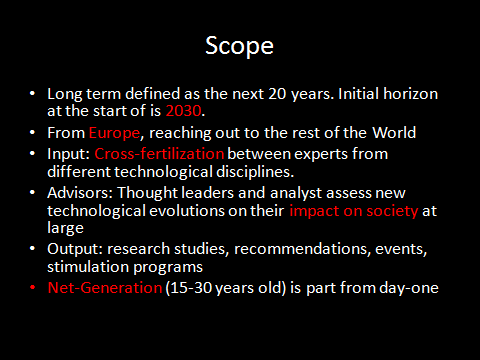
    We want to create a “think-tank/foundation” on long term future. Long term defined as 2030. A place where “smart people” can meet. Where experts from different technological domains share their insights for 2030. Cross-fertilizing each other’s disciplines. With “smart people” from different contexts & worldviews that can act as our “eyes” and offer a perspective on how we will live, work in 2030. On how our education is best organized. On what our ideal value kit for that era should be, beyond traditional corporate culture. A culture of sharing and exploring, where we live intensely in teams, groups, regions, countries and communities and with deep respect for the individual humanistic identity of all those forming part of it.

    Similar think-tanks of course already exist. But many look at these subjects from an US-perspective only. Or only bringing together technology experts. Few or none do this from our cultural rich and diverse European heritage.

    We believe that from Flanders we can make a difference. Flanders is ideally placed: it’s highly appreciated and most productive multilingual multi-cultural workforce is operating from the cross-road of Europe and fleeing out to all countries in the world. As our interdependency from other countries, regions and continents will become even more important in the years ahead, we believe we have a unique opportunity to forecast together these exciting future scenarios and possibly even lead several of these technological revolutions.

    We also want to make a difference by the inclusion up-front of the Net-Generation in our thinking. We want to give the opportunity to high-potential young adults between 15-30 years to co-create this future. Mentored by those who were part of the Internet revolution 20 years ago, and who are now 35-45 years old. Vice-Versa, we also want to offer reverse-mentorship by Net-Generation high-potentials.

    image

    These new models and scenarios will demand speed, creativity, dynamism, perseverance, courage, knowledge and working together in a multi-cultural context. This new society is – together with the movement of TransHumanists – making a plea for respect for individuality, freedom, mobility and quality of life.

    This work and endeavor is all about designing, exploring and organizing change, learning and fine-tuning as we go. Giving guidance to teams, organizations and leaders on how to surf these waves. Missing the first technology wave of speed and creativity will result in loss of economic relevance. Missing the wave of the new value kit will result in losing our Net-Generation, our brains for the future.

    Who wants to join this movement ?

    Pamphlet

    I started this blog on 7 April 2009. It may look as a very diverse set of blog-posts, but there is plan behind all this.

    As a teaser, i am publishing today my Pamphlet. More to follow in the days/weeks to follow. Let me know what you think.

    “Over the last 20 years we have witnessed a fantastic growth of wealth and technologies. ICT technologies have started permeating our daily lives. Medical sciences and biotechnologies have increased the average age significantly. Other technologies (Nanotechnologies, AI, Robotics, etc) have kick-started. “

    But, since the last couple of years, we witness the breakdown of a number of core systems:

    – Our worldwide Financial system is going through a “meltdown”. The old game of greed is coming to an end. Trust is becoming value number 1.

    – Ecological, ethnological and demographical shocks are turning our systems upside-down. Green and Energy are now in the mainstream

    – The East/West shock: economic powers shifting from the Western world to the new economies of APAC and BRIC+ countries.

    – New forms of communication via the internet (blogs, wikis, social networks such as Facebook, Twitter, Netlog, etc) propose a new paradigm with respect of privacy.

    “All this fundamental changes give us a feeling of discomfort, disorientation, confusion, loss of control. Although our “collective intelligence” indicates that our old models do not apply anymore, our “hardware” seems not to have followed. We have not adapted the way how we are organized hierarchically, how we look at governance. Our traditional “system”-thinking got stuck and did not follow our “collective intelligence”

    On the other hand a set of new systems and tools are building up:

    – Barack Obama describes it as the ‘audacity of hope’; innovators, planners, academics and authors are referring to dreamtelligence as a new, vital, and visionary way to use play, fantasy, dream-thinking and innovation to kick-start ideas and stimulate community engagement.

    – A fantastic call for and revival of authenticity for ourselves and our leaders. Having true leaders: with charisma, attraction, integrity, and authenticity.

    – The Net.Generation (now young adults between 15-30 years old) have grown up as digital natives. They will be tomorrow’s leaders. What THEY think will co-form our future. Future will not be invented by today’s generation. This Net-Generation lives differently. They are “wired” differently. For them multitasking (multi-window chatting, gaming at the same time while listening music, looking up information on the internet, being mobile, etc are very common. They also think differently (deeper and more authentic): they have a very strong sense of the common good and of collective and civic responsibility

    – Our technological revolution has just started.

    o Today our technologists are capable of breeding a human ear in their labs. We are now in a position to create and grow cells, tissues and bodies.

    o Artificial Intelligence is back: by 2030 our computers will be able to think, be self-learning, self-healing , some will be able to have a consciousness.

    o Self-learning robots will soon go mainstream. Mercedes and BMW have already now cars in the pipeline for 2012 that can drive fully automatically, better than a human being

    o The emergence of Google and the “Global Brain”. The internet today is already a tremendous source of information. Today’s search experience will pale compared to the mechanisms we’ll have in 20 years. All knowledge will be available anywhere, anytime, wireless, via brain-implants.

    o Social networking is already revolutionalizing the way people and companies are communicating. Interesting to note that these Technologies let us evolve again from a system-to-system communication towards human-human communication.

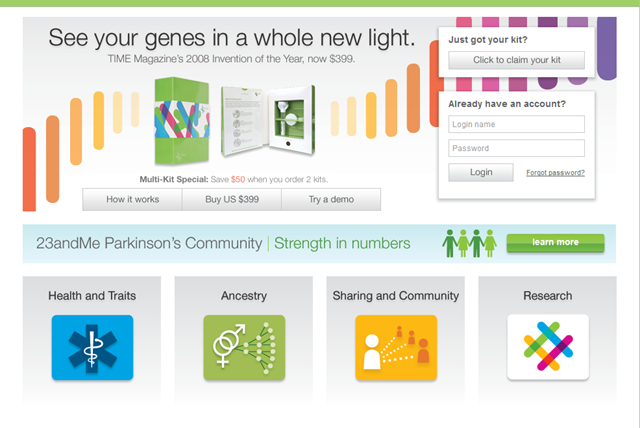
    o Today you can order your personal DNA Gnome sequence in the USA for only 399$. The company doing this is a Google backed start-up. Think DNA in the cloud, with DNA comparisons between ancestors, relationships, etc.

    o Brain-wave helmets and chip-implants will give humans better sensors. By 2030 we will see the emergence of “superhumans”. In such dramatically changed context, what will make us “human” ?

    o A lot of these future scenarios are described in Ray Kurzweil’s “Singularity” concept. This is the moment when man and machine will truly blend. Kurzweil claims this will happen around the year 2030.

    And the pace of all these technological innovations just goes on in a very exponential way. In the next 20 years we will witness technology breakthroughs that will mean the tenfold of what we have seen the last 20 years.

    “All these evolutions call for a re-thinking of our value-compass for the future. We must carefully analyze and think-through on how all this will influence the way we will and want to live and work in the future. What sort of life-quality we aim for. What the socio-economic impact of all this may be. How we want education to be organized. Where we still can and want to influence. “

    Consumer Genetics Show


    Found this link about the Consumer Genetics Show via a tweet from Tom Hague of the Open Calais project. Tom tweets that he never expected to see the words “Genetics”, “Consumer”, and “Show” to come together.

    Coincidently, at about the same time, i am reading the following paragraph in chapter XV – Time Warp in the book “As the future catches you” by Juan Enriquez.

    “Almost any species can be cloned today…

    “In the United States, it is illegal to use federal funds to clone humans…

    “But it is not illegal to clone a human… (except in California, Louisiana, Michigan, and Rhode Island.)

    “Nor is it illegal in Singapore, Russia, Brazil, China.

    “And if you combine desperate customers…

    “Rapidly evolving and highly decentralized technology…

    “And the moniker of “the first scientist to clone a human”…

    “The incentives are too great to stop this from happening.

    Juan Enriquez also had a great speech at TED 2009:

    I am a big believer that we will see the biggest breakthroughs and innovations on the cross-roads of ICT and Bio-engineering.

    And i would like to add one more dimension to it: the Global Brain or the Semantic Web.

    Example ?

    One of the companies mentioned in the article on the Consumer Genetics Show is 23andMe.

    image

    A customer of the Web-based service 23andMe sends in a sample of spit and receives a genome-wide analysis of nearly 600,000 genetic variations. The results include an estimate of genetic risk for various diseases, along with other personal information, such as where the customer’s ancient ancestors might have come from. Price tag ? 399$

    Sergey Brin, the billionaire co-founder of Google plans to contribute money and his DNA to a large study intended to reveal the genetic underpinnings of Parkinson’s disease. See also this article in the New Your Times dated March 2009.

    23andMe is co-founded and co-managed by Mr. Brin’s wife, Anne Wojcicki. The company offers a personal genomics service, in which it scans the DNA submitted by its customers and provides information on their health risks, ancestry and other traits. Esther Dyson is a Board member.

    Start thinking DNA and gnome in the cloud.

    “Getting a genome sequence has never been an end … just a start” -  Craig Venter

    Wolfram/Alpha vs Google: 0-1

    There has been a lot of fuss going on lately regarding Stephen Wolfram’s ambitious project to create a comprehensive "computational knowledge engine." called Wolfram/Alpha.

    UPDATE: Stephan Wolfram now also started a blog at http://blog.wolframalpha.com/

    The Berkman Center for Internet & Society at Harvard University hosted yesterday 27 April 2009 a sneak preview of the Wolfram|Alpha system.

    This was a full 2 hours webcast, with no screenshots (at least not during the webcast), just a talking head for 2 hours and Q&A from the audience.

    I finally got hold of a screenshot via Techcrunch:

    wolfram

    There is already some good coverage on this by Larry Dignan, Editor in Chief of ZDNet, on his blog here.

    Larry summarizes well:

    “Four big pieces are behind Wolfram/Alpha:

    • Curated data: Free, licensed and feed data. Running through human and automated process to verify the data and make sure it’s “clean and curatable.” At some point, you need a human domain expert. 
    • Algorithms: Wolfram/Alpha uses a bevy of algorithms including 5 million to 6 million of mathematical code.
    • Linguistics: The goal is to interpret free-form language processing. Wolfram said Wolfram/Alpha uses various components and techniques to figure out what people are actually asking. Part of that process is filtering out fluff.  ”We’ve been pretty good at removing linguistic fluff,” said Wolfram, he said people eventually get to the point where they speak as if they were talking to an expert. “People quickly begin to just type in concepts as they come to them.”
    • Presentation: Algorithms try to pick out what’s important to the searcher. Again, Wolfram noted that human-aided algorithms are needed.

    Instead of delivering up a bunch of links, the Wolfram/Alpha search engine tries to put a narrative around a user’s question and allow them to drill down. Indeed, the result presentation features graphics and other computational features. Think part calculator, part search engine. “

    Interesting to see that Google upgraded and announced some new features during the Wolfram demo – and thereby taken all the attention away from Wolfram back to Google, and Wolfram fires back a couple of minutes/hours later. Some other coverage about this here and here and on Techcrunch.

    The webcast itself was pretty boring. After 43 min of monologue, Stephen Wolfram opens the floor for questions. And the first question was right on.

    A journalist from O’Reilly wanted to know more about the consistency of data, and whether you can trust the algorythm this much. Answer; what we are doing is creating an (or the ?) authoritative source of data. Mechanism for people to contribute data. And Wolfram to “audit” that data. Source identification is the key challenge in all this. All this makes me think of Ken Steel BSR (Basic Semantic Repository) Beacon project in the mid 90’ies, where he would be THE owner of the semantic repository that’s going to keep all tags and semantic meanings of date being carried around in XML-like tagged data.

    Then David Weinberger asked if and when this will be opened up (see also my yesterday’s post on “think big – think open”. His question was in fact 3-fold. Open through:

    1. API’s: 3 levels of API’s: presentation, underlying XML, and symbolic expressions of underlying Mathematica source data.
    2. Metadata: when they open-up, plan is to expose some of the ontology through RDF.
    3. Upload personal data to the system: intention to have a professional version of Wolfram/Alpha, subscription based.

    David Bermaste: what with questions/answers were scientists have difference in opinion, such as “Are certain classes of PCB’s human cancerogeneous ?” or in other words “who has the real truth ?”

    Who is this for ? Kids or scientists ? Answer: “To make expert knowledge available to anybody, anywhere, anytime.” Wow. That’s ambitious.

    What in case the question does not make sense ? For example “what is the 300th biggest state in Europe ?”. At this stage and in this version Wolfram/Alpha does not return you a result.

    The challenge also seems to be how you keep the info and the universes of knowledge up to date. Today this project has +/- 100 people working on it (last period maybe 250), but what army of people do you need when this really goes live big way ? Answer: it’s probably going to end up with a 1,000 people. Sounds a bit underestimated to me if you ask.

    In essence, all this is about Knowledge Management. And i know quite some companies that would be interested in throwing all their unstructured data and have an engine that can make meaning out of all that data. So the professional version may be up to something. But in it’s current state for the public in general to compete head to head with Google ? No, i don’t think so.

    I suggest you also have a look at Mendeley, a start-up (initially from Germany, but now based in London), use parse and discover patterns in university research papers, but just think how this could be applied to basically any type of information. One of their VC’s is an ex Last.fm and ex-Skype (and also a professor or even a doctor in Economics at the University of Hamburg) and it’s interesting to see how these young net-generation guys are capable of telling their story in less then 2 minutes, with monetization topic included, and still leave you with a hunger and curiosity to want to know more.

    I never got this thrill/feeling of “want to know more” during the 2 hour Wolfram webcast. I felt bored, and was asking myself all the time the question “what have i missed here ?” and a sort of compassion and respect for somebody’s lifework of the last 25-30 years.  I was also somewhat disturbed by what i consider a form of self-complacency, bit out of the ivory tower type of discourse, not really accessible for non-experts.

    This Stephen is definitely a very smart and wise man, and it’s clear he is passionate about his work and is in search of “intellectual satisfaction”, but i am afraid he won’t be up to the power and sexiness of Google and many other newcomers on this stage.

    But does this withstand what i would call the  “Jeff Jarvis’ Google Test” about new types of relationship, architecture, publicness, elegant organization, new economy and business reality, new attitude, ethics and last but not least speed ?

    NUI, XUI, TUI ?

    No, this is not the name of the latest song i have been teaching to my 3 1/2 year old daughter.

    I am just going completely crazy these days about touch-driven devices, and found some new acronyms in this space:

    1. NUI: Natural User Interface. Examples are Surface and Jeff Han’s touch interfaces
    2. XUI: XML User Interface

    So, i decided to invent my own. TUI: “Touch User Interfaces”, but a check in Wikipedia revealed somebody else already coined that acronym. I just wanted to add more touch or even no-touch as in gestures.

    As i have some days off this week, I have some extra time to introduce the topic with some parodies on well know advertisements. This will also please my readers who ask me questions such as “why do we need all these computers ?”

    Please enjoy the advantages of the Mac Air:

    Why spent 300 € on a Wii Fit, if 3 € would give you the real thing ?

    Surface on its best:

    Or this one: Put a Surface in your pocket:

    But seriously, how could these devices used in Business ? Let’s have a look at what Barclays is doing with it:

    Or at Identity Mine: a Touch-catalogue and Blackberry becomes check-out for Elektra, a big electro-shop in South-America (sorry did not succeed to embed that video).

    Or let’s throw in some “gestures” at GestureTek:

    And from the same GestureTek: full body Avatar control. Check out this link with plenty of other demos.

    But what if real and virtual get really mixed together. Have a look at the concept videos below:

    XUI/NUI/TUI at Home

    XUI/NUI/YUI at Work:

    Or get completely immersed. Check out how EonReality is pushing the limits. Here on their homepage and here in this video. It’s getting so real that you almost get sea-sick.

    Amazing 3D immersion technology from IDEO Labs on Vimeo.

    Who said that singularity (the moment man & machine truly blend together) will happen in 2030 ?

    I think it will be much sooner.

    In 2030, having a brain implant will be as cool as having an iPhone today. Who in his right mind would have predicted in 1990 more than one cell phone per person ? That’s also only 20 years ago.

    Pizzled: 1 Brain = 1 Dollar

    There is a great presentation by Nova Spivack on the future of the web, the emergence of collective intelligence and the global brain.

    Nova Spivack has been in space, has a great blog/news site, and has recently created Twine.com. I strongly recommend you to subscribe to Twine. It’s one of my great sources of information.

    Nova is also a Tibetan Buddhist, which is not irrelevant in this context.

    The presentation he delivered at the Singularity Summit Dec 2008 gives a longer term perspective beyond Web 2.0. Btw: all the key presentations of that Summit are now online.

    Just to set the scene: by 2030 you will be able to buy the power of the human brain for 1 dollar. By 2040, machine intelligence will be one billion TIMES greater than all human intelligence together.

    The presentation starts with a list of great thinkers: first of all this is a very humbling experience, and secondly a great shopping list for my next pile of books. It makes me so hungry to know more, which illustrates my oral character structure.

    Quiz: in that list of great thinkers, Nova mentions 2 Flemish researchers/thinkers: if you spot their names, let me know via the comment of this post.  Prize ? Eternal Fame in my blog.

    Then he leads you through concepts such as Web 4.0, the Web Wide World (not the World Wide Web), the evolution of crowds, groups, and meta-selves. This would be a great subject for my friend André Pelgrims, who specializes in group dynamics of people in flesh & blood (people like you and me 😉 and to see whether André’s model on group evolution with 4 phases would apply to the online world as well. The 4 phases André defines are:

    1. Forming & dependency. The individual is part of the group but with loss of his identity
    2. Storming & counter-dependency: scapegoating and the innocent gets all the shit.
    3. Independency. Expansion of the individual, helping/caring for others takes central stage
    4. Inter-Dependency: blend in the group without loss of identity. Genuinely sharing is key, nothings needs care or help.

    You can find Nova’s presentation here. Enjoy.

    This of course raises a lot of questions on our personal and corporate value kit for the future, and what it will mean to be a human, when indeed machine intelligence will be dramatically more powerful then our collective intelligence.

    As some sort of counterbalance, i would also like to point you to a older (2007) TED presentation by Daniel Coleman (Emotional Intelligence) on Compassion by Daniel Coleman 2007. Thanks to my friend Sven for sharing this one.

    All this technological evolutions still make us search & reach for REAL contact between people. Coleman describes the feeling of NOT getting attention when somebody uses his Blackberry/iPhone/whatever during a meeting or conversation: you feel “pizzled”, a combination of puzzled and pissed-off.

    That’s because the other person does not give you real attention.

    Coleman’s recommendation is to turn off your PDA’s, close your laptop, end your daydreams, and pay full attention to the other. And about the art of balancing between the self and the other selves, and the meta-selves of Nova Spivack. And so we are back to the Tibetan Buddhist.