One of the very best presentations at last month’s Singularity Summit. And it comes from a European 😉
Lots of inspirarational slides and ideas, and – as a bonus – Jürgen is quite funny as well when presenting.

One of the very best presentations at last month’s Singularity Summit. And it comes from a European 😉
Lots of inspirarational slides and ideas, and – as a bonus – Jürgen is quite funny as well when presenting.
Fantastic blog by Hutch Carpenter about The Passionate Creatives. His blog is always quality. Always new content. Feeling deeply the pulse of the Enterprise 2.0 wave.

A lot in Hutch’s blog post reminded me about the book – The Cultural Creatives – How 50 million people are changing the world. By Paul H. Ray & Cherry Ruth Anderson.

In his recent blog entry, Hutch talks about “Passionate Creatives”.
Especially about passionate creatives at the edges.
Passionate creatives are everywhere among us, but they are not evenly distributed. They tend to gather on the edges where unmet needs intersect with unexploited capabilities. Edges are fertile seedbeds for innovation.
Or also
Companies are best-served by allowing employees who are attracted to these changes to pursue innovative ways to address them. Why?
They get energy
They get an experimenter’s mentality. They get a happier workforce. Let employees exercise some form of self-organization to accomplish this.
The alternative may be incumbent staffers who have fallen into routines, or
have reason to protect
the status quo
This does not help companies address rising levels of volatility. Free the passionate creatives!
Makes me think of Red Monkey story by Jef Staes. I use it a lot. In every presentation about innovation. It’s where my audience does NOT loose me on my trip to the future.

Let me make another connection here. Just like Hutch, i would like to refer to A Labor Day Manifesto for a New World by John Hagel.
John Hagel founded the Deloitte Center for Edge Innovation. And is having a fantastic blog The Big Shift. I had the honor of meeting John Hagel in person during the last Web 2.0 Summit. We had a brief chat on his possible participation to next years Innotribe @ Sibos 2010 in Amsterdam.
Have a look at the whole Labor Day Manifesto, and more specifically at the last paragraph:
Stop and think about the last truly great person who left your organization. First think about what made that employee great. We bet you name such characteristics as action-oriented, driven, passionate, fun, and genuine.
Now think about where that worker went. Chances are, to a position with a perceived promise of putting his or her talents to better use—moving into a role with greater challenges and opportunities to learn and make a difference. It wasn’t about money.
What a great test for each organization !
And there is also the interesting innovation blog from Stefan Lindegaard. In his 5 oct post Job Opening- Senior Innovation Manager he describes how difficult it is to find a senior innovation job:
I am sad to say this is just not the time to seek such a job. I see this in the networks I facilitate where many innovation leaders have lost their jobs in the past year. I have been in touch with several of them discussing their options and trying to help them move on. Actually, last year some of them got a new job pretty fast, but this is not happening now. It takes longer – if at all.
Just to give you an idea of how bad the job situation looks like: There are less than 20 companies on Monster.com in the U.S looking for senior innovation managers and offering interesting challenges.
Somewhere in the middle there is a great advice for people wanting to work with innovation:
So my advice to all the people working with innovation right now is this: If you really want to work with innovation, then
your current job
is most likely the best chance to do this.
My dream scenario is that – in these times of crisis, with efficiency programs cutting out the best when focusing solely on efficiency and allowing managers to settle old bills with team members that took the risk to innovate – that the group of passionate creatives on the edges of every company will stand-up, claim their space, and fight to destruct the cynicism that reigns in some many companies.
The root cause for this unbearable cynicism are usually power-games between silos. These power games are putting a major barrier to success to any CEO shouting “change” at the top, as the change – or desire thereto – does not permeate into the lower echelons of the organization, and therefore remains nothing more than
a big illusion
This is the difference between old and new game.
In the new game, we don’t shoot at Red Monkeys, we don’t fire the guys who have the courage to take risk. On the contrary,
we protect them,
expose care, and
channel the energy
for the better of the company
I met a couple of those passionate creatives recently:
what an energy !
If only we could turn the negative cynicism energy into a positive creative energy.
Who feels energized by this ? Let’s join forces. Let me know who you and where you are.
This blog post is triggered by a start-up demonstration i saw at DEMOFall2009 some weeks ago.
The demo was about an iPhone application called “datecheck” aka “creepfinder”
You can find the video here.
Not that i am interested in on-line or real-life dating – i am happily married – but in essence the application allows me to do a check on my date. It basically crawls the internet, twitter, facebook, and – in the US – public data such as your real-estate tax income and even criminal records.
The end-result is that i find data about criminal records about my future fiancée, full real-estate data about what house he/she lives in, family composition, real-estate tax-income etc
The US government also is getting quite open and transparent on its own data. Have a look at www.data.gov

And these days all these data are accessible via API’s to take data OUT of these systems. Some API’s like twitter, facebook etc also allow you to INPUT data via for example Tweetdeck, Seismic, and many others. I would love to have something that not only allows me to INPUT my Tweets, but also something that allows me to input and maintain my personal profile data, across services. See also at the end of this post.
For the US government data, you see start appearing end-consumer apps that let you search through this massive amount of for example government contractor’s data with quite advanced intelligence tools in the hand of the citizen.
In stead of FBI (Federal) it’s becoming
CBI (Citizen’s Bureau of Investigation).
It says “analysis for the people, by the people”. I would add “"about the people”

All this is sold as “transparency” and “democracy”, and those are of course very important values.
But – and I don’t know about you – I start more and more FEELING quite uncomfortable about all this. Not that i have to hide anything, or that i have a criminal record (at least not that I am aware of ;-), but I do FEEL all this is quite intrusive.
As most of you know, in my previous life i was quite close to the Belgian eID project (electronic identity card). The card also allows you to access the on-line government database, where I can look at my OWN data and check who in the government has accessed those data.
But i believe we should make a big plea for the appliance of Law #1 of Kim Cameron’s Laws of Identity:

That’s easy said, but how do you enforce that. I took the pain to look at the privacy policy of Twitter (see http://twitter.com/privacy). In essence – as a user – i have nothing to say. I have 2 choices: to use twitter and accept the privacy policy, or not use it. But how many of the many million Twitter users have ever read the privacy policy ? How many know what sort of deep intelligence engines are crawling all these data that i released to the net WITH A DIFFERENT PURPOSE ?
This is not Twitter specific. It applies to Facebook, Friendfeed, or any other form of social network or service.
In my opinion, i would like to have something where i can control what data about myself i want to release to what service and in what context. I update my information there once, and have also guarantee that my profile information is consistent across Twitter, Facebook or even event/conference sites that these days more and more use their own social media piece of technology.
Of course you would need a highly trusted party to deal with these data. I think i would even be prepared to pay a price for my privacy.
This concept of a central digital vault comes pretty close to eMe, the winner of the Innotribe idea-contest at Sibos 2009 some weeks ago. But they started from “mydata” and information and documents related to financial services. If you start thinking privacy and putting control of data back into the user’s hands, you get a much more powerful proposition.
I would like to hear the opinion of a number of identity and privacy experts that are following this blog
UPDATE: Can’t help it, but just at the same time as i published this post, Guy Kawasaki tweeted the following URL:
http://holykaw.alltop.com/why-you-should-think-before-you-tweet
Some weeks ago, i had the opportunity to listen to a fantastic speech by Joshua Cooper Ramo, writer of the book “The Age of the Unthinkable: why the new world disorder constantly surprises us and what we can do about it”.
This is the sort of guy that when he takes the stage, you immediately know you’re in for something special.
Some personal notes on this great speech:
Our world has now more actors, more groupings. The unpredictability is part of the system. It will be a given part of our future. He talks about:
SHAPESHIFT
Our world offers more options. We have a spectrum choice between no options –> limited options –> unlimited options. You can’t predict what people are going to do with these unlimited options.
YOU CAN’T PREDICT
Our world is more networked. It also means it is easier to share and spread risk
So far the analysis. How can we manage this unpredictability ?
One eye-opener was a visual showing how differently western and eastern people look at a picture: western people mainly look at the object, eastern people mainly at the surrounding environment of that object. So, understanding of unpredictability has a lot to do with understanding the environment.
It will also require resilience. But not resilience as we know it from messaging networks like SWIFT. More a resilience deeply integrated in the ecosystem, a bit like Hezbollah integrates resilience in every little piece of its organization.
Periods of change are not the exception but the rule.
You have to surf the wave, not try to predict the wave, but
look at how the wave can help you.
It will be ever easier to disrupt. The question is how to empower people to disrupt for the good. This is really about innovation driven by a set of values. Oh boy, how close is all this to the ideas of our Think Tank on Long Term Future.
Innovation in big companies can NOT take the lead. They have NOT been instrumental in the shifts from magazines to online, from Microsoft desktops to web2.0 cloud, from Financial Institutions to… un-banked payment and financial solutions.
The speech was delivered as part of an Oracle conference. So, i found it a bit “cheap” to say that Oracle was innovative and Microsoft not. The rationale being that Oracle “buys and integrates” and Microsoft buys “tons” of innovation but does nothing with it, does not integrate. Was a bit too close to the Oracle conference message of acquire and integrate.
He then went further on the theme of personal responsibility (i am free to smoke) and the balance with a certain set of basic rights (for ex healthcare). And that in the USA, everything is about rights (and maintaining that state) not about personal responsibility and that that has to change.
About maintaining states: Twitter is all about maintaining state in a constant changing environment.
And that there is hope.
And that
FEAR is an easy commodity to sell when
people are confused
during disruptive change. And that in these circumstances simple answers are usually dangerous answers.
Or the closing topic: never invest in people older than 25 years, as they are not used to live in constant change.
The speech was great. The book reads “like a train”.
The Singularity Summit is coming on 3-4 Oct 2009 in NYC. See the impressive list of speakers here.
One of the speakers is Ben Goertzel, who will speak about “Pathways to Beneficial Artificial General Intelligence: Virtual Pets, Robot Children, Artificial Bioscientists, and Beyond”.

When talking about Robot Children, i would not be surprised if he used the following video made by his 12 year old daughter. Found it via Accelerating Future.
Is this what a 12 year old is thinking about ?
If you can believe the credits at the end of the video, at least 12-year old Scheherazade Goertzel does.

In this case – among many other things – Scheherazada’s father is the originator of the OpenCog open-source AGI framework, as well as the proprietary Novamente Cognition Engine AGI system.
Artificial General Intelligence (AGI) is an emerging field aiming at the building of "thinking machines", that is, general-purpose systems with intelligence comparable to the human mind. Good starting point to learn more about AGI is http://agi-network.org/
You see what happens when kids get this sort of ideas served with the mothermilk 😉 We recently presented another mothermilk example when we spoke about Aza Raskin, now Head of User Experience at Mozillla Labs. His father was Jeff Rasking, one of the big minds behind the Apple user interface.
Very curious to see what how this Generation-M will move up the ladders, and one day be our leaders. Any other wizkids you are aware of ?
We all know that userid’s and passwords are not good enough anymore.
That’s why more and more companies move to two-factor authentication, using those little contact-less “calculators” that generate one-time password, or contact-ful solutions like smartcards, USB-tokens, etc or other concepts such as OpenID or Microsoft’s CardSpace (i still prefer the old name “InfoCard”).
Only a couple of days ago there was a whitepaper on Open Government published by the OpenID Foundation and The Information Card Foundation.
In one of my previous life, i was involved in the Belgian Electronic Identity (eID) project, that uses a smartcard containing 2 certificates issued and certified by the Belgian government. One for signing and one for authentication.
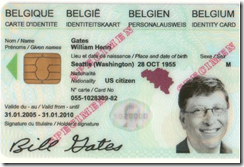
For a latest on Belgian eiD have a look at:http://welcome-to-e-belgium.be/.

The Belgian eID has now been rolled out to roughly 8 million citizens over a period of about 5 years.
But, the card requires a card-reader and a driver.
But what about mobile ? Yesterday, i shared the post about teenagers online behavior. 99% have a mobile. Also, there are roughly 4 times more mobiles in the world than bank-accounts !
And yes, i have seen those card reader “sliders” for some PDA’s. Then you have a slick PDA, and now you need a slider that’s twice the size of your PDA.
There must be a better way !
What about one of the contesters of TechCrunch Japan Tokyo Camp ?


Universal Robot’s (JP) compact mobile vein authentication software (40KB core module) can be installed on cell phones, for example, and uses the camera to scan your wrist vein for identification. The technology seems to have many advantages: It works fast (I tried it myself), it’s completely software-based, compatible to a variety of CPUs and operating systems, usable for persons doing hard manual labor (who can’t use fingerprints), and most importantly extremely accurate (the company speaks of a false accept ratio of 0.001% and of a false reject ratio of less than 0.1%). The award-winning software works even with cameras with a 1MP sensor or lower.
Some good identity blogs are Kim Cameron’s www.identityblog.com and Dave Birche’s Digital Identity Forum. To get a broader perspective on identity based on information shadows, see also my recent post on MIT Personas Project.
Digital Identity will become the cornerstone of our online experiences. That’s why identity should be one of the key research areas of our Think Tank on Long Term Future. We have the experience in Belgium of having rolled out the first generation, let’s now also be leaders in defining and rolling out the next generation.
From the Andy Kessler blog of 20 July 2009 with my choice of extracts and highlights…
The 70s were a smog-filled haze. Upward mobility was a pipedream. Stock markets stagnated and all the moon-walking Space Age dreams of the 60s were shattered with layoffs and plant closings and Rust Belts and urban unrest.
You were told to do well in school and maybe you could get an entry level job at a big company and wear a white short-sleeved shirt and work your way up over twenty or so years, so you could buy that little house in the suburbs and squeeze out 2.3 kids and afford a station wagon and … well, that’s the way it is.
Someone else has all the money and you don’t.
That’s the way it is.
Unknown forces control your life.
That’s the way it is.
Governments are corrupt.
That’s the way it is.
Society is divided into classes, and you’re stuck in yours.
That’s the way it is.
Instead, what it took was a few little microchips (Ted Hoff at Intel), and a couple of funky pieces of code (Bill Gates at Microsoft) and a few smart people (Steve Jobs at Apple and Larry Ellison at Oracle and thousands of others), who weren’t content working for The Man. Each of them dislodged "the way it is" and got a few people asking "why is it this way?" and declaring "think different" and "eat my dust," and
bang,
the status quo crumbled.
You could create your own future. Power shifted out of the hands of conglomerates like Gulf & Western and Engulf and Devour and away from centralized bureaucrats running faceless government operations. Instead, power ended up in your hands, my hands, all of our hands. To do what we wanted.
To change the world, for the better, increase the size of the pie, bring the rest of the world onto our wealth grid. And not by building huts in Costa Rica but by taking down those obstructing progress, those leeching off the rest of us, holding us back, milking the present for their own benefit rather than standing aside and letting wealth-creating innovation increase everyone’s living standard.
Those "that’s the way it is" types needed to move over.
But they didn’t move on their own, so we either had to wait for them to die or just destroy them. Seek and Destroy. Music companies. Travel agents. Insurance brokers. And we’re not done–the hard work has just started.
It took me a long time, well into my life, to get Cronkite’s words out of my head and realize that not only is anything possible (thank you Kevin Garnett), but that I was the one that had to make it happen. There were no gifts, no trailblazers to follow.
We all have to invent the future
by destroying the past.
Sadly, the old mentality is back.
Citibank is too big to fail.
That’s the way it is.
The government needs to bail out the automakers.
That’s the way it is.
Taxes are going up.
That’s the way it is.
Carbon dioxide will boil the oceans so we need to live in cities and walk to work.
That’s the way it is.
Elites like Robert Reich and Paul Krugman and Al Gore will tell you what you’ll be paid, how much health care you’ll get, how much risk you can take, what kind of car you can drive, how much water you can use to flush your toilet, because …
That’s The Way It Is.
It does NOT have to be that way.
Inspire people to dream,
and to realize their dreams.
Not that recent anymore: Morgan Stanley Research Europe published mid July 2009 a report on Media & Internet “How Teenagers Consume Media”.

What’s cool is they asked a 15 year old summer work intern, Matthew Robson, to describe how he and his friends consume media.
There is a lot to do about this report, as Twitter co-founder Stone does not care that teens are NOT interested in Twitter.

Also the New-York Times jumped on the bandwagon and said:
As the Web grows up, so do its users, and for many analysts, Twitter’s success represents a new model for Internet success. The notion that children are essential to a new technology’s success has proved to be largely a myth.
Adults have driven the growth of many perennially popular Web services. YouTube attracted young adults and then senior citizens before teenagers piled on. Blogger’s early user base was adults and LinkedIn has built a successful social network with professionals as its target.
That’s interesting, especially in the context of the Think Tank for Long Term Future we are putting together – starting up later this year from Flanders: in that Think Tank we want to include upfront young people between 15-25 years old today, who will be our future leaders in 20 years from now (2030 timeframe).
So what is all the fuss about in the Morgan Stanley report ? I took the pain to download the report and read it myself to have an unbiased opinion and share it with you.
I found the report via the site of the Financial Times. Download here.
First, it is important to understand that the report does not have any representation or statistical accuracy, as it is just the opinion of one 15 year old. It is also very UK centric referring to BBC services and Virgin Media as provider.
The paragraph where all the fuss is about is the following:
Most teenagers are heavily active on a combination of social networking sites. Facebook is the most common, with nearly everyone with an internet connection registered and visiting >4 times a week. Facebook is popular as one can interact with friends on a wide scale. On the other hand, teenagers do not use twitter. Most have signed up to the service, but then just leave it as they release that they are not going to update it (mostly because texting twitter uses up credit, and they would rather text friends with that credit). In addition, they realise that no one is viewing their profile, so their ‘tweets’ are pointless.
No wonder that Stone does not care very much. A lot to do about nothing.
The report contained however some other interesting elements. I am just picking a couple that surprised myself. I don’t have a 15 year old at home. My daughter is 3 1/2, so i guess all this is coming my way big time :-). Also, when reading those statements, i feel 15 again as sharing the same feelings. But for my age you have to invert the digits 
My personal top-10:
The summary of the report says it all:
What is Hot?
•Anything with a touch screen is desirable.
•Mobile phones with large capacities for music.
•Portable devices that can connect to the internet (iPhones)
•Really big tellies
What Is Not?
•Anything with wires
•Phones with black and white screens
•Clunky ‘brick’ phones
•Devices with less than ten-hour battery life
…
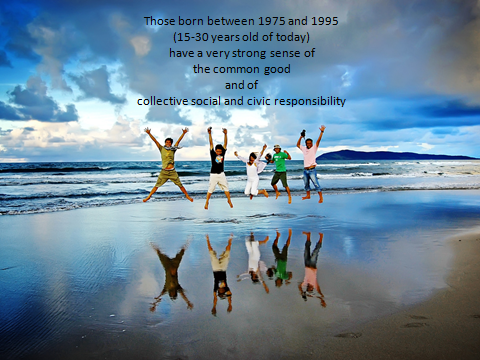
I really would be interested to find recent and statistically relevant sources of information on 15-25 years old internet behavior, and more importantly on the typical value kit of teenagers, if anything as such exists. Or are we now talking about Generation-M ?
Sometimes you hit a site and you’re blown away. Here is one like that:
It’s like finding your home.
This thing exists for 10 years now.
And nobody hinted me to hit. Never heard about it. It feels like having missed some cultural and existential dimension in my life.

I feel so inspired by this. It also brings me very close to the purpose of this bog. See very first blog entry on
“Inspire others to dream”.
Or the “elevator rap”
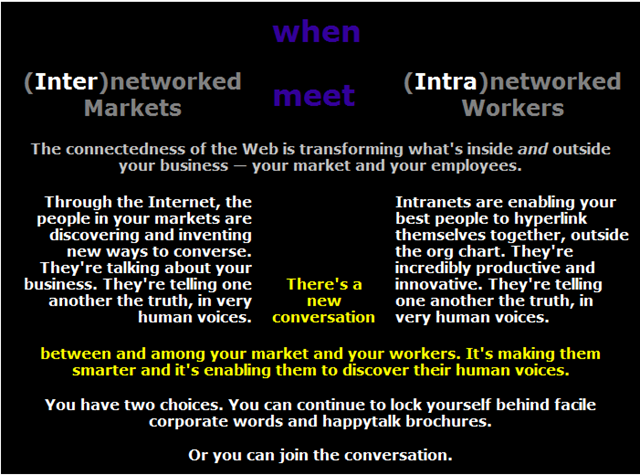
There is a new conversation !
Or some of the 95 themes, just some examples here:
2) Markets consist of human beings, not demographic sectors.
14) Corporations do not speak in the same voice as these new networked conversations. To their intended online audiences, companies sound hollow, flat, literally inhuman.
29) Elvis said it best: "We can’t go on together with suspicious minds."
41) Companies make a religion of security, but this is largely a red herring. Most are protecting less against competitors than against their own market and workforce.
50) Today, the org chart is hyperlinked, not hierarchical. Respect for hands-on knowledge wins over respect for abstract authority.
78) You want us to pay? We want you to pay attention.
84) We know some people from your company. They’re pretty cool online. Do you have any more like that you’re hiding? Can they come out and play?
Who are those pretty cool people online that want to come out and play ?
90) Even at its worst, our newfound conversation is more interesting than most trade shows, more entertaining than any TV sitcom, and certainly more true-to-life than the corporate web sites we’ve been seeing.
95) We are waking up and linking to each other. We are watching. But we are not waiting.
Damn. And this is 10 years old. And i thought being quite up-to-date.
Who can help me getting up to speed on this interesting movement ?
Yes. Movement.
That is what this is.

Really great post by Jamais Caisco on FastCompany blog.
Very much in line with my last posts on massive manias, booms and busts. I have not added much here: just mixing some different sources. But some folks told me i am not that bad in mashing-up stuff 😉
Think you can’t be replaced by a machine? Think again.
Definitely read this article in more depth. Key passage in ‘Think Again”:
Structural Shifts
The issue of a future in which there are large parts of the economy that are underemployed, unemployed, or unemployable is a serious issue. And the data already suggests this:
(source) Notice how after the last recession in 2001 the number shifted upwards. The boom year of 2006 have an additional 5% long-term unemployed than the boom years of 1998. If you go back even further in that graph, to the 1960s, you see an even larger structural shifts upwards. Here’s University of Chicago Economist Kevin Murphy thinking through this issue.
Robots are becoming more dextrous, able to do a growing number of tasks requiring precision and strength, and computer systems are becoming smarter, able to tackle jobs needing pattern-matching and creative skills.
Humans are still cheaper, for now, but this puts downward pressure on wages–and the old rule that new technology opens up entirely new fields of human labor won’t hold true forever. Smarter, more capable machines will snap up those jobs, too.
Robonomics: If robots and digital systems can do everything, let them–but let human society skim value from the result. This becomes a technologically-driven version of the Basic Income Guarantee model, where citizens are given a basic above-poverty income guarantee and are free to explore education, entrepreneurship, or even a life of indolence. Or they can get one of the remaining human jobs, jobs that may pay much more than they do now in order to attract people who otherwise wouldn’t want the work.
Picture Credits:
Money, courtesy Jamais Cascio, Creative-Commons Licensed

 Petervan Studios