Future of Money and/or Value

If you’re interested in discounted tickets for one of the coolest Future of Money conferences of Q1 2011, bear with me and read till the end of this post.

Print

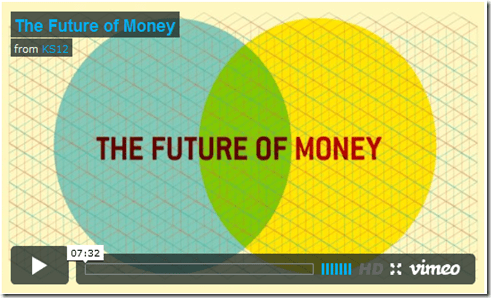
As most of you will remember, SWIFT’s innovation initiative “Innotribe” was one of the Executive Sponsors of Future of Money video production.
image

The Future of Money from KS12 on Vimeo.

The video is in my opinion a milestone. Not only for it’s content and the way it was produced (co-funding), but the whole movement that followed.

It is only now that it became clear to me that the event – in this case Sibos – is not the end-point in a process, but the middle. The post-event discussions and dynamics are at least as important, if not more important. Just check-out for example the animated discussion on Chris Skinner’s blog in November 2010 on “Why banks and socials agree to disagree”.

“Social” – as in Social tools, Social Currencies and Social Capitalism – is in my opinion a very strong force to take into account in our long-term thinking about financial services. It is one of the suggested topics we have in mind for Innotribe at Sibos 2011.

  • I am preparing another blog post “The Long Direction” on this subject and some other deep understreams that are going to change fundamentally how we think about corporations, banks and economy and corporate culture in general.
  • With Innotribe will sponsor a new research on Social Cognition by Stowe Boyd, the most important Social Philosopher and Webthropologist at this moment.

The Future Of Money crew produced post-event the following interesting infographic. I love the sharpness and detail of their analysis. In one view, you see how Creation, Storage and Access of VALUE intersect and how these intersections are each interesting opportunities to be taken up by start-ups or modern capitalists. Some indeed have taken their chances already: see the bottom of the chart with a number of start-ups in this space.

I would like to emphasize that the intersections in the infographic do NOT talk about the Future of MONEY, but about the Future of VALUE. More about this as well in the upcoming “The Long Direction” post. At this stage it’s enough to point you to Umair Hague’s latest book “The New Capitalist Manifesto: Building a Disruptively Better Business” (AmazonAssociates Link).

But I divert… Here is the Future of Money infographic (you can also download a nice PDF version of this by clicking on the graph below).

FOM_infographic_540x764

What an impressive list of start-ups and new contacts ! Indeed,  one of the biggest wins of our Innotribe initiative is the network of people we connect with.

This network is a very powerful force. Here is another example of this network-effect:

Given our work on Future of Money at Sibos, Mike Sigal  – Founder and CEO of Guidewire Group and part of our start-up judge panel at Sibos – introduced me recently to Brian Zisk, founder and organizer of the Future of Money and Technology conference in San-Francisco on 28 Feb 2011.

image

When looking at the conference program and the list of confirmed speakers, I thought “Wow” and two days later I was on a confcall with Brian. Besides being the Executive Producer of this Future of Money & Technology conference, Brian Zisk is a serial entrepreneur and technology industry consultant specializing in digital media, web broadcasting and distribution technologies.

brianzisk

Brian wanted us to speak about Innotribe and Future of Money at Sibos 2010, but unfortunately, given to some other commitments and plans, none of our team could make it to San Francisco on that day.

But we both quickly spotted the possible synergies – wouldn’t it be great to get a subset of these speakers to Sibos into the Innotribe stream for example – and we came to the following pragmatic agreement.

  • I was going to write a blog about his event, and in return my readers could get some discounted tickets for his show. And he would promote our Mumbai and Toronto events later that year. Yes, it can be that dead-easy. No strings attached, pragmatic. Piece of cake if you share the same passion. If you want such a discounted ticket, see the end of this post.
  • But we kept on talking… It suddenly crossed my mind that only 2 weeks later, SWIFT was organizing its SWIFT Operational Forum Americas on 8-9 March 2011 (SOFA). As we had an Innovation slot in the Special Session on day-2 of that event, why not ask Brian to come over and give a wrap-up of his conference ? Btw, watch this space on the Innotribe activities at SOFA: we are working on an impressive list of speakers for this Innovation Slot on 9 March 2011. Will be subject of another post.
  • And why not continue in this direction and see what we can do together for the first stand-alone Innotribe event in Mumbai, later this year on 1-2 June 2011 ? This event – hopefully a first in a long series, will be titled “Unpacked” and this Mumbai edition will focus on Mobile Payments. More on that later as well.
  • And then let the whole movement culminate to a climax at Sibos Toronto from 19-23 Sep 2011 ? I have a first meeting with the Sibos 2011 organizing committee in 2 weeks. Yes, we start early °-)

So how to get a discounted ticket for the Future of Money & Technology conference on 28 Feb 2011 in San-Francisco ?

Enhanced by Zemanta

Breaking: Lazaro Campos opens Innotribe @ Sibos 2010

Drop everything ! Get up early ! THE session not to be missed at Sibos this year is the Opening Innotribe Keynotes. Be there at 9am on Monday 25 Oct 2010 in Conference Room #1.

Print

Lazaro Campos (CEO SWIFT) will open this session and participate to the following interactive Q&A with the speaker panel.

Matteo Rizzi (Innovation Leader at SWIFT and your master of ceremony) and Kosta Peric (Head of Innovation SWIFT) will guide you through the Innotribe program of the week. Knowing Matteo, he for sure will have some humoristic gimmicks in his sleeve to keep you energized that morning: it will start already when you come in, as you will be “bugged”. More details on-site 😉

Five speakers, thought leaders in their respective domains will thrill you with their latest perspectives on the tectonic shifts that underpin the topics of the rest of the week at Innotribe @ Sibos. Each of them will give a 15 min presentation:

  • John Hagel, Director, Deloitte Centre of the Edge, will follow with “The Power of Pull”, or how business models fundamentally change in our hyper-connected world, and how passionate he is about passion. “The Power of Pull” is also John’s latest best-selling business book.


  • Nova Spivack, CEO, Lucid Ventures is the world-renowned “guru” on Semantic Web. He will entertain you with a talk on “The Present is the Future”, how real-time and “Nowism” is permeating everything.


  • Stephen Ellis, EVP, Wholesale Banking Group, Wells Fargo, will fire you up with his views on tectonic shifts in Banking.


  • Venessa Miemis, Graduating Student NYC, Emergent by Design will speak on “The Future of Money”. Her talk will be spiced-up with a video she produced exclusively for this event in Berlin. We already blogged and twittered a lot about Venessa here


For early birds, there will be a couple of copies of the books of Peter Hinssen and John Hagel.

After these keynotes, Matteo will pick another trick from his sleeves to make sure the audience participates interactively in a short interactive Q&A with the speakers. He will wrap-up the session with the highlights of the Innotribe day and week, and will give you a call for action to keep you engaged with us throughout the week.

Both in content, quality of the speakers, and format of this session, this will be THE not-to-be-missed session on Sibos Monday. We are convinced it will set the bar for any session for the upcoming week.

Innotribe is organized by SWIFT Innovation with the support of financial institutions, vendors and innovation leaders. In the true spirit of less push and more pull, we encourage you to engage in a true dialogue with the Innotribe team.

We look forward to seeing you in Amsterdam.

The Innotribe team

www.sibos2010.com 

www.innotribe.com 

www.swiftcommunity.net/innotribe 

innotribe@swift.com 

innovate@swift.com 

Twitter: http://twitter.com/innotribe

Innotribe at Sibos 2010: Gen-Y and The Future of Money

Cross-posted on Swiftcommunity.net

Print

Matteo may have been a bit over-enthusiastic when he declared his session "probably the best session at Sibos 2010" . I guess he may have been unaware of something very special that is happening in the context of the Innovation Keynote Sessions of Monday 25 Oct 2010 at 9am .

What’s going on there is so unique , that i suggest you doublecheck your travel plans to ensure you can be there at 9am Monday morning !

What’s up ?

One of our keynote speakers is Venessa Miemis, a brilliant 28 year old Graduating pursuing a Masters in Media Studies at the New School in NYC. Venessa has a fantastic blog called Emergent by Design  and you can follow her tweets @venessamiemies  where she is leading us in a fascinating way through a collaborative effort to explore the emerging Network Culture and ways in which we can collaboratively build human intelligence and raise consciousness.

Some months ago, i asked Venessa to do a 15 min keynote on The Future of Money as seen through the eyes of Gen-Y. We occasionally kept contact via mail, twitter and skype, and in the spirit of her blog tag-line "emergent by design", and did not give and further instructions and trusted the process and the smartness of young people.

Great was my pleasant surprise when Venessa published her outline some weeks ago under the title "The Future of Money Begins !" .

futureofmoney

The keynote will be on "large scale shifts in cultural values and the impact they’re having on our relationship with money, our perceptions about ourselves as humanity, and how we are redefining what ‘true wealth’ means." For more details on the content, see the link/picture above.

What is really cool is not only the content of this keynote, but also they way how Gen-Y people like Venessa approach such task .

Without corporate structural constraints, Venessa told me very early in the process how she wanted to do something special: she wanted to produce a video as part of her keynote.

And in a true on-line collaboration Gen-Y way, she was going to produce this video with a company in… Berlin. For Gen-Y, they are truly no geographical boundaries anymore.

But to produce such video will require some money. No problem, how do Gen-Y approach this ? They ask their on-line communities for support.

So she launched the Future of Money Website  – and Emergence Collective "creating innovative momentum" with a fundraising via PayPal .

You can determine for yourself what degree of support you can muster to help. It starts at 5$ and can go up to 1,000$ if you want to be Executive Producer of this video.

At the time of this writing, the counter stands at 470$ ! I made a small calculation:

  • if each of the 10,000 readers of this swiftcommunity.net blog contribute 1$, will be able to make come true their full blown dream.
  • if each only 1% of the 10,000 readers donate 100$, same !

I don’t think it should be so difficult for our banks, partners, employees to find between 1-5$ to help support this really cool project.

  • For $5,000: They will create a beautiful and useful visualization of all the companies, initiatives and organizations we’ve been tracking in their research. Right now this research is a tangled mind map but with the skills in their team they have the ability to transform it into an informative and elegant visualization. This would include an overview of peer-to-peer lending platforms, open money protocols, emerging virtual currencies, microfinance platforms, and social currencies.
  • For $10,000: They’re going to be conducting a bunch of interviews very soon. Typically interviews will run between 10-30 minutes. However the video they’re producing will be between 3-5 minutes when it’s finished. Obviously they’re going to have to leave some stuff out. With this level of support they’ll be willing to edit each interview on its own and release it as its own video.

So let’s see what happens. The offer is made. The deadline is Venessa’s presentation on October 25, 2010. It’s up to you to decide if these expanded aspects of the project are worth your money and our time.

The result of this work – the video and the presentation – will be given away under a creative commons license.

Even just a small amount will go a long way towards helping us cover our time and expenses on this volunteer effort. And of course it couldn’t hurt to tell your friends   via your blogs and tweets.

To show the example, we just sent via PayPal some encouragement from the SWIFT Innovation budget to kick-start the process.

Very curious to see where this goes.

And Matteo, no offence, but i think this session will probably be the best attended session at Innotribe @ Sibos 2010

Social Currency: My Personal Identity

Recently came across this great site by Dan Robles.

image

One of his latest posts Will Social Capitalism Replace Market Capitalism? (Parts 1&2) included great video material on how social currency can change industries.

image

His forecasting example is the airline industry. And it’s even not so far fetched. What if you could “Time-Share” seats in private jets ?

It’s easy to think how this social currency model would apply to any other business and radically innovate by creative destruction.

It’s a very novel way to show how a number of trends come together:

  • The influence of gaming theories and practices in new business models
  • The value and tradability of my personal information
  • The power shift from Push to Pull that is so well described in John Hagel’s latest book “The Power of Pull” (I repeat it, in my opinion THE business book of 2010)

By the way, we recently had a face to face meeting with John exploring the possibility to have him with us at Innotribe at Sibos in Amsterdam, 25-29 October 2010.

image

We have asked John to consider a talk in our Innotribe Opening Keynotes, and to be part of our special Innotribe Lab on The long now in Financial Services.

To come back to the subject of the power of identity, I’d like to spend a bit more time on the tradability of my personal information.

The essence of the story is that some parts of my personal data have value and can be traded under the user’s control to get a better service.

It opens questions to:

  • How tradable is my personal identity ?
  • How tradable is my digital footprint ?
  • How tradable are my on and off-line relationships ?

I have been immersed in “personal digital identity” the last couple of weeks. Recently i attended the EEMA’s The European e-Identity Management Conference in London.

The week after i was the “tour guide” for a "Digital Identity Tour” we organized with some colleagues on the West-Coast”. I am preparing a set of blog posts on these conferences and 1-1 conversations with thought leaders in e-Identity space.

In this blog i will just simplify my summary thoughts with the statement that e-identity is much, much more that a certificate on a smart-card, or for sake of the argument any other form factor.

We are witnessing a power-shift:

In stead of the government (or the bank, or any other service offering entity) creating digital identities to give more value to the citizen, we see the emergence of  identities created by the user to give greater value to the government (or the bank, or any other service offering entity)

We have to carefully think this through, as identity – and relations between and with persons – is really a complex animal.

Have a look at this fantastic 210+ slides presentation “The Real Life Social Network V2” by a Google analyst @Padday aka Paul Adams, working for the UX team at Google. The essence of his story is that there is nothing such as a generic “Friends”. You have all sorts of friends and different depths in relations. Whether those relations are between people-people or people-companies.

It’s a great story, and all slides are annotated. As a teaser, here are his 3 summarizing slides:

image

image

image

It’s interesting how the words identity, privacy, care, relationships, collaboration, strong/week ties, Klout, etc are now all coming together. As a matter of fact, these are all attributes that make us truly human.

As a sherry on today’s cake, i’d like to link you once more to Venassa Miemis site “Emergent by Design” and the great recent blog post on Guidelines for Group Collaboration and Emergence, that is building on both her previous work on “Strenghts Based Society”, “”Skills for a 21st century connected world”, and her work on the open source collaborative tool “Junto”.


image

As we are preparing Innotribe at Sibos, i had the pleasure to talk to Venassa during a Skype session. We are discussing her participation at several levels of our Innotribe Program.

It is great to see how these novel ideas become “totally” relevant when you start thinking about their value for a “community” like SWIFT and an innitiative like Innotribe where “Enabling Collaborative Innovation” is our “Leifmotto”.

From the conversation with Venassa, i can tell you she “totally” got it, and she is preparing some material and levels of interactivity for Sibos that you even never dreamed of.

We are now 16 weeks from Sibos. The idea is to begin hosting a junto every week, invite different thinkers to discuss the future of money, record all conversations and develop a presentation based on them, but also make the videos available for the attendees of the conference to be able to watch whenever they want to see what those conversations were like.

If we think about the Long Now, will there still be currency as we know it? Or will social currency become central to our trade? And what impact does that have on banks ? Should be have personal data stores where we deposit our digital footprint and open personal accounts and do payments for services from there?

Feel free to jump in.

Need for a new currency based on abundancy

Thanks to my subscription to Fredzimmy’s blog, I found this wonderful blog from Esko Kilpi.

image

I really recommend you to explore this site from A to Z.

  • Look at the wonderful slidedeck on Slideshare
  • Have a look at the Flickr photos
  • Have a look at the Bookmarks

image

MIT Media Lab Human Dynamics Group, Howard Rheingold (one of the first ever “internet”-books i ever bought,…, Barbarian Blog.

Yummy, Yummy. This is great stuff for a Sunday afternoon. So inspiring. Delicious 😉

This way, i discovered the FANTASTIC Web 2.0 Expo speech of Douglas Rushkoff about Radical Abundance.

It is a 15 min video, and worth every minute:

Not sure if the video embed worked, so in any case you can find it here by clicking the below image.

image


Some mind-blowing quotes (in 140 characters ;-):

  • The operating system for money is obsolete…
  • Abundance based currencies and monopoly based currencies…
  • Central Bank Monarch imprinted currencies are scarcity based currencies…
  • The money we use today was created so that rich people to stay rich by being rich (and lending) rather than doing anything…


google-coin

  • Our economy is based on the growth of interest
  • The people lending money get richer, the people creating value are getting poorer
  • But, what happens if you get something that’s abundant ? That you can’t make scarce.
  • The computers and networks change the “centrality” of value creation
  • You are now able to exchange value directly between one another rather than through a centralized currency
  • Optimize human beings to technology
  • Technology is more compatible with the values of efficiency than with all the other human values
  • Now you’re open and free to Google-Ads
  • Web³ will be won by the power of those who can index and aggregate. Is that what we want ?
  • Open Source and Crowdsourcing are not the same things
  • This notion of “free” leads to a society of copying, to no creativity, to no originality, to DJ’ing of culture
  • The abundance of genuinely creative output is declining
  • What we need is the development of a digital culture that respects the labor of individuals
  • What we need is the creation of new modes of currency based on abundance rather than scarcity.
  • I am talking about the original PayPal dream before banks asked them to be regulated like… banks
  • The next BIG thing are from people who will create genuine alternative electronic currencies and P2P exchange that do not involve cash.
  • I am talking about primitive local currencies such as Timebanks, Itex, Superfluid’s Quids
  • Cash has already lost its utility value, as it has been sucked out into investment capital, in the speculative marketplace
  • The only real competition against a Google universe (and their ideas of openness – see last weeks Google Blog post about openness btw) would be peer to peer exchange
  • We are not suffering from an abundance of creativity, just from an abundance of productivity, efficiency and openness.
  • If Web² leads to aggregation and indexers, then genuine P2P will lead to bottom-up value creation.
  • The next era is not about scaling-up anymore, it’s about figuring out how to exchange value, in stead of extracting value.
  • We are at a crossroads: right now we have the opportunity to optimize our systems, technologies, currencies to humans in stead of optimizing humans to them.


Reblog this post [with Zemanta]

Real-Time Trade

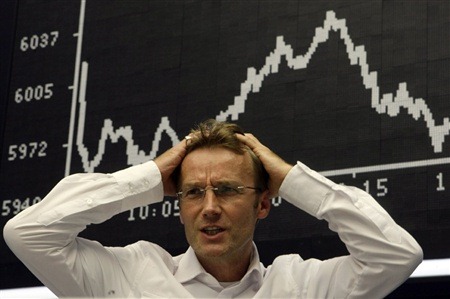
Fascinating article on how stock market is getting completely automated in a matter of seconds. Who was saying something about real-time.

04_traderfaces

Article found on MIT Technology Review. 5 pager can be found here.

Some extracts:

The profits go to the company with the fastest hardware and the best algorithms–advantages that enable it to spot and exploit subtle market patterns ahead of everyone else

TheTabb Group, a consultancy based in Westborough, MA, estimates that high-frequency automated trading now accounts for 61 percent of the more than 10 billion shares traded daily across the numerous exchanges that make up the U.S. market.

Trading is now essentially a virtual art, and its practitioners put such a premium on speed that NASDAQ has considered issuing equal 100-foot lengths of cable to the brokers who send orders to its exchange servers.

Hardware used at the facility will operate at a 40-gigabyte-per-second standard, enabling it to handle as many as a million messages a second.

New York City-based Lime Brokerage, wrote the SEC in 2009 to voice concerns over the proliferation of brokers who allow major clients to engage in high-frequency trading without validating their margins–that is to say, without making sure they actually have enough money to back a trade

Jacobs regularly sees algorithms executing more than 1,000 orders a second. At that rate, one algorithm trading the wrong way could execute 120,000 orders in two minutes. At 1,000 shares per order and an average price of, say, $20 a share, that’s $2.4 billion inunintended trades in 2 … SECONDS.

Institutional traders like Fidelity, which buy large blocks of shares for their mutual funds, use algorithmic trading to split their enormous orders into blocks of 100 to 300 shares so that other traders don’t recognize the true demand and take advantage of that knowledge for their own profit.

These are big numbers. And it happens every day. Scary.

New Money and Payments

The last couple of days there have been several blogs reporting on new types of money and payments.

First there was the great interview of Steve Boyd with Jamais Cascio.

Some highlights of the highlights:

You have to get a critical mass of people to agree in a new fantasy.

Groups with shared purposes could in fact have new currencies.

The unbanked are the source of many innovations in the world, right now.

Governments start to care when economies arise.

The question of anonymous money and the roll of cell phones in future money.

Then there were 2 news items on micropayments to news publishers:

The first one related to a New platform for micropayments to news publishers

image

The key comment in the Spingwise article being that:

…for bitcents to work, it will need to attract enough publishers who produce content that readers are willing to pay for. Meanwhile, other ventures—like the soon-to-be-launched Journalism Online—are also working to create a new economic model for the news industry. Keep a close eye on this space—change is in the air, and business opportunities won’t be far behind.

Especially if the big boys want a piece of the cake. Here comes Google again.

googlecheckout

I found this one via my Twine subsription, and Nova Spivak was the first one posting it.

Again, some highlights only:

Google is developing a micropayment platform that will be “available to both Google and non-Google properties within the next year,” according to a document the company submitted to the Newspaper Association of America. The system, an extension of Google Checkout, would be a new and unexpected option for the news industry as it considers how to charge for content online.

While currently in the early planning stages, micropayments will be a payment vehicle available to both Google and non-Google properties within the next year. The idea is to allow viable payments of a penny to several dollars by aggregating purchases across merchants and over time. Google will mitigate the risk of non-payment by assigning credit limits based on past purchasing behavior and having credit card instruments on file for those with higher credit limits and using our proprietary risk engines to track abuse or fraud. Merchant integration will be extremely simple. [grey bold emphasis Google]

In a brief paragraph entitled “business model,” Google suggests that it would share revenue in a similar fashion to the iTunes App Store and its own Android Market, both of which take a 30% cut of revenue.

I downloaded the document and besides what’s covered in the blog post, it contains some other interesting facts about Google Checkout:

Key statistics:
• Tens of millions of registered Checkout users
• Several hundred thousand registered merchants, high number of sellers selling digital
goods
• $ Billions of orders processed

Planned Roadmap:
• Simplified Merchant Integration – Dramatically increase the speed by which merchants
integrate with Google Checkout. Target early 2010
• Guest Checkout – Allow users to buy goods with Checkout-enabled merchants without
creating an account. Target Q4 2009
• Stored Value – Gift cards and maintaining a balance for buyers on Google Checkout.
Planned for future
• Micropayments – Aggregation of small payments by buyers for purchasing digital
content. Planned for future

The PDF also mentions some really interesting thinking on what i would call “convenience” in a multi-vendor marketplace environment:

Easy Subscription Sign-up and Management for Users Plus Content
Packaging and Multiple Payment Forms for Publishers
o Single sign-on capability so users can use one login for access to premium content and a central place to manage subscriptions and payments.
o We envision the typical scenario to be where a user pays a monthly fee for access to a wide-ranging package of premium content. One example of a "package" might be full access to the WSJ; another "package" might include the top 10 business publications. Google believes that there is real power and benefit to publishers in providing these sorts of broad, multi-publication access passes.
o For multi-publication packages, publishers will receive a revenue disbursement that is proportional to the usage of their content in the package.
o While providing an option for micropayments will be important, we do not believe it will be the norm for accessing content. Example 1: A user has access to the "basic" premium content package. She hears about the latest Sarah Palin article in Vanity Fair, which  is not part of her package. She can make a one-off payment of $0.10 to read that article, which will show up on her bill as part of the monthly payment.

Just think: replace publishers by financial services providers, and micropayments by regular monthly payments. Sounds like a marketplace for financial services. With a single-sign on for the marketplace syndicated/federated to the underlying providers of services. But i am deviating, this post is about new money and payment systems.

Last but not least there is the iPhone Payment App by Twitter creator Jack Dorsey:

3aug09_squareccr

Here are the dongles again ! And i thought that the whole idea of smartcards, USB-Tokens, and other physical tokens were gone, as they do in my opinion no sense in a mobile world. Wrong again, Peter ! (Don’t worry, i am stubborn 😉

The innovation is in a small, plastic card reader that fits in to the headphone jack of an iPhone (or iPod Touch) and transfers the credit card’s swipe data to the app. After the employee enters the amount to charge, the customer confirms by scrawling their signature with their finger and then either one enters the customer’s email address to send the receipt to. The payment is processed by Square for a small percentage plus a fixed fee; the funds are transferred directly to the store’s bank account, cutting both time and complexity on the processing side. The customer’s receipt includes a map showing the location of the transaction which is handy for those who record, sort and file such things.

Jack Dorsey (please DO read the man’s Wikipedia bio), the man who all but built Twitter in a matter of two weeks, has been working on a half-secret start-up project since around May. His new venture — dubbed, funnily enough, Squirrel — is based around the concept of using the iPhone as… yep, a portable, personal cash register; essentially the exact device which Square has created

Two links if you want to know more. Here and Here.

Big changes coming in this area. Have you seen any bank involved in these innovations ?

Re-Inventing Wall Street: Finance 2.0

When Umair Hague posts something on his blog, i always take some extra quality time to read.

110-umair-haque

Umair Haque is Director of the Havas Media Lab, a new kind of strategic advisor that helps investors, entrepreneurs, and firms experiment with, craft, and drive radical management, business model, and strategic innovation.

Always sharp, and always in for a good controversy and/or polarizing opinion. I am a strong believer in polarization being a big driver for Innovation.

Have a look at his latest blog post titled “Reinventing Wall Street from the Bottom Up

Some super-quotes:

Welcome to the new trickle-down economics. Here’s how it works:

  1. Banks massively misallocate capital.
  2. The government uses money reserved for public goods — education, transportation, healthcare — to bail out banks instead.
  3. The bailout should trickle down, as lending to businesses and consumers alike sparks economic activity.
  4. No effort to settle bad debt is made; little reform of corporate governance, industry structure, or competition is necessary — because banks are too big to fail.
  5. Little oversight of steps 2, 3, or 4 are necessary, because markets are perfect resource allocators, and market actors are rational.

Result? In trade terms, a shock worse than the Great Depression, as Paul Krugman has noted.

In employment terms, a lost generation.

In monetary terms, a flight from the dollar.

In microeconomic terms, the stagnation of America’s industrial base.

If it weren’t for Apple, Google, and a handful of old-school companies pursuing dramatic reinvention, like Wal-Mart, we would be in a Great Depression.

In macroeconomic terms, value is transferred from you, me, and our grandchildren to Wall St — permanently.

And also:

The greatest transfer of wealth in history is taking place. It is already roughly worth a year’s output of the entire United States, or about 5% of the entire world’s output.

Or…

It’s is faith-based economics — and it’s Barack Obama’s biggest mistake. (Consider for a moment that 20+ per cent of hedge funds misrepresent info.) For years, George Bush hunted for phantom WMDs, while terrorist networks flourished under his nose. Now Barack Obama is hunting for a phantom prosperity, while the greatest robbery in the world is happening right under his nose.

In the same blog post, he is referring to his Finance 2.0 Manifesto, published back in April 2009, where he makes 9 recommendations for a better financial system. I have cut & pasted the whole lot, not because i am lazy, but because the context is worthwhile reading as well (orange/red highlighting by myself)

Edge funds. An edge fund is the opposite of a hedge fund. Where hedge funds are opaque, edge funds are transparent. Where hedge funds are closed, edge funds are open. Where hedge funds are run for near-term gains, edge funds are in it for the long run. Where hedge funds create artificial book value, edge funds create value that accrues to real people and society. Where hedge funds focus on long and short transactions, edge funds focus on relationships. Think Marketocracy on steroids.

Macro and microcurrencies. A currency tied to national interests determined by a political elite? That’s so 20th century 16th century. A better financial system needs better currencies. Finance 2,0 will be built on microcurrencies and macrocurrencies: currencies which operate hyperlocally and transnationally. Why? Because people shouldn’t have to bear collective responsibility for bankers looting or regulators cahooting. In the 21st century, the quiet tyranny of economic collective responsibility is intellectually bankrupt: it is fundamentally unjust, deeply inefficient, and vastly value-destructive.

Social banks. Despite what marketers tell you, banks do not exist to maximize profits. They exist to maximize the safety of deposits. We’ve been taken for a very expensive ride. Next-generation banks will be structured as social enterprises — because the incentives to safeguard deposits and reinvest profits for the common good perfectly converge to a dominant strategy for long-run value creation.

Fair markets. Markets are free like a shark is a fish. Anyone can play — but only at the risk of being manipulated, looted, and defrauded by the deepest-pocketed. The anonymous arms-length transactions orthodox economics lionizes are, in practice, just a hyperefficient mechanism for front-running, predatory trading, and bid rigging. Next-generation markets aren’t just free: they’re fair. They are markets where information about reputation, reliability, and relationship thickness are hardwired into the DNA.

Stakeholder communities. Institutional investors are so 20th century. Centralizing control over our biggest corporations in the hands of a bunch of old dudes asleep at the wheel was as good an idea as the spork: interesting in theory, useless in practice. Tomorrow’s radical innovators are already updating corporate governance for the 21st century, by letting communities of stakeholders shape managerial decision-making. Think mega-Etsy.

Whisper bullhorns. Why is trading such a great business? Because traders have access to info that you don’t. Why can’t everyone get in on the whisper circuit that powers prop desk profits? Because no radical innovator has taken on the challenge yet of amplifying the secretive whisper circuit into a blaring bullhorn. But imagine if the rumours that drive share prices up and down on trading desks were Twitterfied. The result would be a financial revolution: the market power Big Trading enjoys would vaporize faster than you can say "insider info."

Googlizing financial instruments. What business is Wall Street really in? The business of hoarding information: to seek a so-called informational edge. Of course, markets don’t work if everybody’s hiding info — they only work when people are revealing it. Google can help me find a tennis racquet, Match can help me find a date, and Last.fm can help me find some tracks to rip — but who can help me find a better place to put my cash that effortlessly? No one. And that’s a massive reason why we’re stuck with a 1.0 financial economy.

Anti-ratings. Your credit is rated mercilessly. But does anyone rate lenders — not to mention brokers, banks, and investors? Today’s crisis would have been far less severe if consumers had access to knowledge about who was a trustworthy lender — and who was going to sell them the financial equivalent of a roadside bomb. Credit ratings alone cannot create more efficient financial markets — doing so requires better information about both buyers and sellers of every kind of financial product.

Open source modeling. Every bank built the same models. Every bank built the same flawed models. Every bank built the same flawed models on similarly erroneous assumptions. How dumb is that? Incredibly. Unleashing the power of open source to vaporize this black hole of incompetence is going to be a tremendously powerful path to innovation. The peer review, voluntary contribution, and always-on negotiation at the heart of the open source model create powerful incentives for quality — which is exactly what the hare-brained quants at banks lacked.

Finance 1.0 cannot power growth 2.0. Yesterday’s finance cannot power tomorrow’s prosperity. Bailouts, taxes, nationalization, regulation are what your discussions this week are focused on. These can limit the depth and intensity of the crash. But what they cannot do is build a radically more efficient, productive, and effective financial system.

See also my previous post about Peter Thiel and the Singularity, where he said that credit only works in a growth society.

That requires a better kind of finance altogether — one designed not merely to make the worst among us richer, but

to make us all authentically, meaningfully wealthier.

That’s why finance 2.0 is the future.

This is the sort or personal and corporate values we want to discuss as underpinning for our Long Term Future. Hence the need for the Think Tank we are building from Flanders to gather like minded authentic people who do care about our next generations.

Robonomics

3838440758_2143b4757b

Really great post by Jamais Caisco on FastCompany blog.

Very much in line with my last posts on massive manias, booms and busts. I have not added much here: just mixing some different sources. But some folks told me i am not that bad in mashing-up stuff 😉

Think you can’t be replaced by a machine? Think again.

Definitely read this article in more depth. Key passage in ‘Think Again”:

Structural Shifts

The issue of a future in which there are large parts of the economy that are underemployed, unemployed, or unemployable is a serious issue. And the data already suggests this:

(source) Notice how after the last recession in 2001 the number shifted upwards. The boom year of 2006 have an additional 5% long-term unemployed than the boom years of 1998. If you go back even further in that graph, to the 1960s, you see an even larger structural shifts upwards. Here’s University of Chicago Economist Kevin Murphy thinking through this issue.

Robots are becoming more dextrous, able to do a growing number of tasks requiring precision and strength, and computer systems are becoming smarter, able to tackle jobs needing pattern-matching and creative skills.

Humans are still cheaper, for now, but this puts downward pressure on wages–and the old rule that new technology opens up entirely new fields of human labor won’t hold true forever. Smarter, more capable machines will snap up those jobs, too.

Robonomics: If robots and digital systems can do everything, let them–but let human society skim value from the result. This becomes a technologically-driven version of the Basic Income Guarantee model, where citizens are given a basic above-poverty income guarantee and are free to explore education, entrepreneurship, or even a life of indolence. Or they can get one of the remaining human jobs, jobs that may pay much more than they do now in order to attract people who otherwise wouldn’t want the work.

Picture Credits:
Money, courtesy Jamais Cascio, Creative-Commons Licensed

Bank are dead. Long live the banks !

image Paul2

Interesting article in Belgian dutch newspaper De Morgen this week-end by Paul De Grauwe, Professor Economics at the University of Leuven.

Free translation of the key paragraph:

What is clear now, is that banks start to take advantage of the more positive economic climate. They do this in different ways. First of all they almost get free money from the European Central Bank (ECB). They invest those assets in government bonds at an interest rate of 3 to 4%.

The government has thus created a money machine for the banks. The ECB, part of the government sector, lends money to the banks and “charges” an interest of 1%. The same government pays 3 to 4 % interest rate to those same banks. The banks take no risk whatsoever. The manna falls out of the sky. That way, i also want to become a banker.

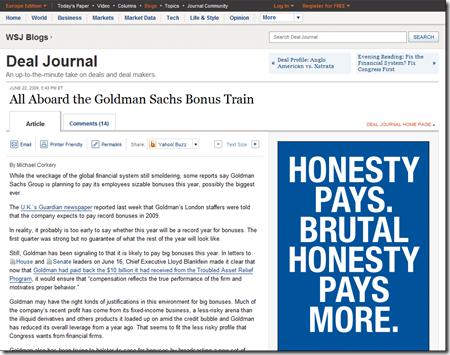
I was last week in New-York, and there was a lot to do on television channels and on Times Square billboards about the Goldman Sachs bonuses.

I just googled that subject, and i found this blog on Wall Street Journal:

image

It’s a bit cynical that this article gets the honesty ad from Barron’s.

Happens that over the week-end, i stumbles upon the latest blog from the always enlightened Sean Park on The Park Paradigm, with reference to Andy Haldane’s brilliant paper “Rethinking the Financial Network (April 2009).

Mr. Haldane is Executive Director, Financial Stability at the Bank of England. The Financial Stability area plays a key role in meeting the Bank’s responsibilities for maintaining the stability of the financial system as a whole. In this role, Andy has responsibility for developing Bank policy on financial stability issues and the management of the Financial Stability Area. Andy is a member of the Financial Stability Board, which gives high level guidance on priority-setting, and of the Bank’s Executive Management Team.

The document (text of a speech) starts with a comparison between the 2002 SARS pandemic (could also have been H1N1 in 2009) and the 2008-2009 Financial Market stand-still.

On 16 November 2002, the first official case of Severe Acute Respiratory Syndrome (SARS) was recorded in Guangdong Province, China. Panic ensued. Uncertainty about its causes and contagious consequences brought many neighbouring economies across Asia to a standstill. Hotel occupancy rates in Hong Kong fell from over 80% to less than 15%, while among Beijing’s 5-star hotels occupancy rates fell below 2%.

Etc….

On 15 September 2008, Lehman Brothers filed for Chapter 11 bankruptcy in a New York courtroom in the United States. Panic ensued. Uncertainty about its causes and contagious consequences brought many financial markets and institutions to a standstill. The market for Credit Default Swaps (CDS) froze, as Lehman was believed to be counterparty to around $5 trillion of CDS contracts.

Etc

And he goes on:

These similarities are no coincidence. Both events were manifestations of the behaviour under stress of a complex, adaptive network. Complex because these networks were a cat’s-cradle of interconnections, financial and non-financial.

Adaptive because behavior in these networks was driven by interactions between optimising, but confused, agents. Seizures in the electricity grid, degradation of ecosystems, the spread of epidemics and the disintegration of the financial system – each is essentially a different branch of the same network family tree.

This paper considers the financial system as a complex adaptive system. It applies some of the lessons from other network disciplines – such as ecology, epidemiology, biology and engineering – to the financial sphere. Peering through the network lens, it provides a rather different account of the structural vulnerabilities that built-up in the financial system over the past decade and suggests ways of improving its robustness in the period ahead.