Breaking: Lazaro Campos opens Innotribe @ Sibos 2010

Drop everything ! Get up early ! THE session not to be missed at Sibos this year is the Opening Innotribe Keynotes. Be there at 9am on Monday 25 Oct 2010 in Conference Room #1.

Print

Lazaro Campos (CEO SWIFT) will open this session and participate to the following interactive Q&A with the speaker panel.

Matteo Rizzi (Innovation Leader at SWIFT and your master of ceremony) and Kosta Peric (Head of Innovation SWIFT) will guide you through the Innotribe program of the week. Knowing Matteo, he for sure will have some humoristic gimmicks in his sleeve to keep you energized that morning: it will start already when you come in, as you will be “bugged”. More details on-site 😉

Five speakers, thought leaders in their respective domains will thrill you with their latest perspectives on the tectonic shifts that underpin the topics of the rest of the week at Innotribe @ Sibos. Each of them will give a 15 min presentation:

  • John Hagel, Director, Deloitte Centre of the Edge, will follow with “The Power of Pull”, or how business models fundamentally change in our hyper-connected world, and how passionate he is about passion. “The Power of Pull” is also John’s latest best-selling business book.


  • Nova Spivack, CEO, Lucid Ventures is the world-renowned “guru” on Semantic Web. He will entertain you with a talk on “The Present is the Future”, how real-time and “Nowism” is permeating everything.


  • Stephen Ellis, EVP, Wholesale Banking Group, Wells Fargo, will fire you up with his views on tectonic shifts in Banking.


  • Venessa Miemis, Graduating Student NYC, Emergent by Design will speak on “The Future of Money”. Her talk will be spiced-up with a video she produced exclusively for this event in Berlin. We already blogged and twittered a lot about Venessa here


For early birds, there will be a couple of copies of the books of Peter Hinssen and John Hagel.

After these keynotes, Matteo will pick another trick from his sleeves to make sure the audience participates interactively in a short interactive Q&A with the speakers. He will wrap-up the session with the highlights of the Innotribe day and week, and will give you a call for action to keep you engaged with us throughout the week.

Both in content, quality of the speakers, and format of this session, this will be THE not-to-be-missed session on Sibos Monday. We are convinced it will set the bar for any session for the upcoming week.

Innotribe is organized by SWIFT Innovation with the support of financial institutions, vendors and innovation leaders. In the true spirit of less push and more pull, we encourage you to engage in a true dialogue with the Innotribe team.

We look forward to seeing you in Amsterdam.

The Innotribe team

www.sibos2010.com 

www.innotribe.com 

www.swiftcommunity.net/innotribe 

innotribe@swift.com 

innovate@swift.com 

Twitter: http://twitter.com/innotribe

Innotribe @ Sibos 2010: Here are the finalists of the Innotribe Start-up Competition !

Cross-Posted on swiftcommunity.net

Print

As you know by now, Thursday 28 October 2010 is our Innotribe Grand Finale day where everything comes together!

After the “Pitch your Lab” session (9-10:30 am) and the “Open Innovation Best Practices” session (11:00 – 12:30), we launch for the first time a true “Start-Up competition”.

Make sure you book this high-energy session in your agendas!

The competition will start on Thursday 28 Oct 2010 at 12:30 in the Interactive Workspace : a rollercoaster of 11 five-minute pitches by start-ups in front of the full audience and a judge panel of real Venture Capitalists (VCs).

After the pitches, there will be a short Q&A with the judges, and a voice-of-the-public using our latest “high-tech” applause meter.

The winner of the Start-Up competition will be announced in the final Sibos Closing Plenary at 16:00 later that day.

Finalists have been selected based on their professionalism and fit with the one or more of the four themes of Innotribe 2010: Cloud, Mobile, Smart Data, and Long Now.

Here is the list of 11 finalists (in alphabetical order):

• AcceptEmail (www.acceptemail.com ): E-Billing and Payment via e-mail (**)
• BehavioSec (www.behaviosec.com ) : Behavioural analysis of keyboard/ mouse usage (***)
• Canatu (www.canatu.com ) : Printable devices based on nano-technology (***)
• Collibra (www.collibra.com ) : Business Semantics Glossary for Data Management (S)
• Cumulate: Mobile payments based on Cloud and Semantic Web (*)
• Hypios (www.hypios.com ) : Semantic web for finding experts (***)
• Kinamik (www.kinamik.com ) : Data Integrity and in-stream archiving (***)
• MiiCard (www.miicard.com ): Identity and dematerialization of bank account creation (S)
• MyWOT (www.mywot.com ) : My Web of Trust (***)
• FX Capital Group  (www.fxcapitalgroup.co.uk ): The Currency and Payments Platform (S)
• Smartlogic (www.smartlogic.com ) : Semantic analysis of contracts/legal documents (***)

(S) Spotted by our own SWIFT innovation scouts during the year
(*) Winner of the Innotribe Lab at CPA Conference June 2010, Vancouver
(**) Winner of the Florin Award competition at EPCA Conference March 2010, Paris
(***) Selected from Innovate 100 Pitchslams (www.innovate100.com ) sponsored by SWIFT.

All finalists will have the opportunity to get a G/SCORE assessment : a standardized, scalable methodology for the incisive analysis and transparent assessment of startups’ commercial viability, execution, team and business model.

This methodology has been developed by Chris Shipley and the Guidewire Group, the organizers of www.innovate100.com

And here are the VC Judges:

• Jennifer Schenker, Founder and Editor-in-chief – Informilo (www.informilo.com ) with focus on Mobile
• Oren Michels, CEO – The Mashery (www.mashery.com ) with focus on Cloud Computing
• Nova Spivack, CEO – Lucid Ventures (www.lucidventures.com ) with focus on Smart Data
• Guido Jouret, VP CTO Emerging Technologies Group – Cisco (www.cisco.com ). Best Practice Incubation.
• Mike Sigal, Co-Founder, President and Chief Development Officer – Guidewire Group (organiser of Innovate 100 –www.guidewiregroup.com ) and G/SCORE methodology to score start-ups.

The prize:

There is no other prize attached to this competition other than visibility towards the financial community and a group of experienced VC’s who have their own networks with Business Angels, VCs, and Investment Funds.

We run this competition for the first time this year. As such this is an experiment, where our main ambition is to expose the Sibos audience to the typical high-energy dynamics of such a competition and the start-up mindset in general.

Let’s start the conversation:

In the true spirit of less push and more pull, we encourage you to engage in a true dialogue with the Innotribe team and the Start-Up finalists. We look forward to seeing you in Amsterdam.

The Innotribe team

www.sibos2010.com
www.innotribe.com
www.swiftcommunity.net/innotribe
innotribe@swift.com
Twitter: http://twitter.com/innotribe
Hash tags: #innotribe and #sibos

Innotribe at Sibos 2010: Gen-Y and The Future of Money

Cross-posted on Swiftcommunity.net

Print

Matteo may have been a bit over-enthusiastic when he declared his session "probably the best session at Sibos 2010" . I guess he may have been unaware of something very special that is happening in the context of the Innovation Keynote Sessions of Monday 25 Oct 2010 at 9am .

What’s going on there is so unique , that i suggest you doublecheck your travel plans to ensure you can be there at 9am Monday morning !

What’s up ?

One of our keynote speakers is Venessa Miemis, a brilliant 28 year old Graduating pursuing a Masters in Media Studies at the New School in NYC. Venessa has a fantastic blog called Emergent by Design  and you can follow her tweets @venessamiemies  where she is leading us in a fascinating way through a collaborative effort to explore the emerging Network Culture and ways in which we can collaboratively build human intelligence and raise consciousness.

Some months ago, i asked Venessa to do a 15 min keynote on The Future of Money as seen through the eyes of Gen-Y. We occasionally kept contact via mail, twitter and skype, and in the spirit of her blog tag-line "emergent by design", and did not give and further instructions and trusted the process and the smartness of young people.

Great was my pleasant surprise when Venessa published her outline some weeks ago under the title "The Future of Money Begins !" .

futureofmoney

The keynote will be on "large scale shifts in cultural values and the impact they’re having on our relationship with money, our perceptions about ourselves as humanity, and how we are redefining what ‘true wealth’ means." For more details on the content, see the link/picture above.

What is really cool is not only the content of this keynote, but also they way how Gen-Y people like Venessa approach such task .

Without corporate structural constraints, Venessa told me very early in the process how she wanted to do something special: she wanted to produce a video as part of her keynote.

And in a true on-line collaboration Gen-Y way, she was going to produce this video with a company in… Berlin. For Gen-Y, they are truly no geographical boundaries anymore.

But to produce such video will require some money. No problem, how do Gen-Y approach this ? They ask their on-line communities for support.

So she launched the Future of Money Website  – and Emergence Collective "creating innovative momentum" with a fundraising via PayPal .

You can determine for yourself what degree of support you can muster to help. It starts at 5$ and can go up to 1,000$ if you want to be Executive Producer of this video.

At the time of this writing, the counter stands at 470$ ! I made a small calculation:

  • if each of the 10,000 readers of this swiftcommunity.net blog contribute 1$, will be able to make come true their full blown dream.
  • if each only 1% of the 10,000 readers donate 100$, same !

I don’t think it should be so difficult for our banks, partners, employees to find between 1-5$ to help support this really cool project.

  • For $5,000: They will create a beautiful and useful visualization of all the companies, initiatives and organizations we’ve been tracking in their research. Right now this research is a tangled mind map but with the skills in their team they have the ability to transform it into an informative and elegant visualization. This would include an overview of peer-to-peer lending platforms, open money protocols, emerging virtual currencies, microfinance platforms, and social currencies.
  • For $10,000: They’re going to be conducting a bunch of interviews very soon. Typically interviews will run between 10-30 minutes. However the video they’re producing will be between 3-5 minutes when it’s finished. Obviously they’re going to have to leave some stuff out. With this level of support they’ll be willing to edit each interview on its own and release it as its own video.

So let’s see what happens. The offer is made. The deadline is Venessa’s presentation on October 25, 2010. It’s up to you to decide if these expanded aspects of the project are worth your money and our time.

The result of this work – the video and the presentation – will be given away under a creative commons license.

Even just a small amount will go a long way towards helping us cover our time and expenses on this volunteer effort. And of course it couldn’t hurt to tell your friends   via your blogs and tweets.

To show the example, we just sent via PayPal some encouragement from the SWIFT Innovation budget to kick-start the process.

Very curious to see where this goes.

And Matteo, no offence, but i think this session will probably be the best attended session at Innotribe @ Sibos 2010

Innovation in/out the Castle ?

As member of the Innovation Team of our company, I try to stay up-to-date on innovation thinking and therefore I try to read +/- one innovation book per month. I also read other stuff, and if you’re interested in my readings, please check-out my GoodReads Shelf. I found that sharing the books one reads is a good way for connecting with people. Interested to hearing what you read.

I just finished a fantastic new book on innovation. It’s called The Other Side of Innovation: Solving the Execution Challenge (Harvard Business Review) by by Vijay Govindarajan and Chris Trimble.
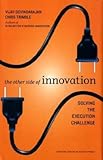


As the title suggests, this book goes way beyond the idea-generation phase of your innovation efforts. It’s about making ideas happen, especially if you are an Innovation Leader responsible for innovation WITHIN an existing organization.

Many models have been tried, but most stay stuck in idea generation:

The innovation = ideas + motivation formula can generate thousands of small initiatives, but does not support projects requiring resources beyond a few people and their spare time.

The innovation = ideas + process model can efficiently crank out innovation after innovation, as long as each initiative is mostly a repeat of prior efforts

Castle[3]

The books goes in great detail into the causes for tension between the “castle” (in the book referred to as the Performance Engine) and the Innovation Team.

Business organizations are not built for innovation; they are built for efficiency.

The authors also offer many solutions to solve this tension. The basic premise is that the Castle is organized for efficiency: to create as many as possible predictable processed and make them as efficient as possible. That’s where initiatives like Lean and Six Sigma found their origins.

An innovation initiative is any project that is new to you and has an uncertain outcome

Indeed, every innovation project is an experiment, always based on not-so-precise assumptions, and with continuous learning in order to change those assumptions in more precise decision foundations.

By definition, innovation is neither repeatable nor predictable. It is exactly the opposite—nonroutine and uncertain. An innovation initiative, even a major one, is just an experiment.

The castle loves planning (basically building upon the planning models of previous years), and comparing past actuals vs. plans. Innovation is fundamentally different, as it is about comparing current assumptions with future potential. The comparison also happens much more frequently in a rapid learning context. It’s exactly what the Castle hates.

This tension often leads to frustration with the innovation leaders. At first sight, the job of an innovation leader seems like a dream job. It is not. The aspiring leader has been set up to fail. He just doesn’t recognize it yet. In frustration, he goes a step further, fashioning himself a rebel and a subversive. He fearlessly, or maybe even recklessly, flaunts authority. One person against “the system” is an extraordinarily bad bet. Why is it that innovation leaders so often feel that their biggest enemy is not the competition but their own company? There is a simple answer. Organizations are not designed for innovation. Quite the contrary, they are designed for ongoing operations. Innovation and ongoing operations are always and inevitably in conflict.

But the break-all-of-the-rule

mantra

while understandable

and widely shared

is poison

First, innovation leaders need the Performance Engine. Most obviously, it is profits from the Performance Engine that pay for innovation. Innovation leaders, take note: antagonizing the Performance Engine is a really bad idea.

This is nothing more

than youthful fantasy

at work

Another eye-opener for me was that the innovation team must be distinct from the Performance Engine, but that the innovation team must be just as disciplined as the Performance Engine.

The authors also propose that the Innovation Leader is NOT part of the execution team. The execution of each innovation project is trusted to a “Dedicated Team” and “Shared Staff”. The shared staff comes from the Castle. And this is done for EACH individual innovation project !

The split of work between the two teams is based on the work relationships required for the innovation project: these work relationships have three essential dimensions—depth, power balance, and operating rhythm.

For the Dedicated Team, the authors have a very clear recommendation:


hire outsiders !


There is no more powerful antidote to organizational memory than outside hires. If you want to change the culture, change the people.

At least 1/4 of your Dedicated Team should be made of people from outside your organization. If not, you easily fall into the trap of the The Risk of Organizational Memory.

Experience is usually an asset for advancement within the Performance Engine, but it can be a liability for a Dedicated Team. Innovation initiatives are, by nature, deliberate departures from the past. The lessons of experience are therefore less relevant.

If everyone on the Dedicated Team has been shaped by the same lessons learned from the same victories and defeats inside the Performance Engine, then the collective instinct will be even harder to escape.

A couple of words as well on the role of the Executive Sponsor – correction – the Supervising Executive:

sponsor

By the way, we have deliberately chosen the term supervising executive instead of the more commonly used term sponsor. We dislike sponsor because it makes the job sound easy or even trivial. A sponsor just provides occasional support. But the supervising executive has a critical job. Few innovation initiatives succeed without a deeply engaged one.

The supervising executive should not only be there when the yearly budget of the innovation team is approved. He should be deeply involved throughout the year to coach the team and help them overcome the tensions with the castle.

If not innovation initiatives are looked at as “second class”. In the overall picture the innovation budgets are a fraction of the budgets for technology renewal of the castle for example.


The importance of innovation

should not be based

on the size of the budget

but on the size of it’s potential


If not innovation will end up as 5 lines in your company strategy papers, CEO reports and Annual Reports. The innovation leader should NOT content himself with just a mention of the word innovation in these reports.

At the end of the book, the authors really make you re-check your assumptions by listing their


10 myths of innovation:

myth

  • Myth 1: Innovation Is All About Ideas
  • Myth 2: The Great Leader Never Fails
  • Myth 3: Effective Innovation Leaders Are Subversives Fighting the System
  • Myth 4: Everyone Can Be an Innovator
  • Myth 5: Innovation Happens Organically
  • Myth 6: Innovation Can Be Embedded Inside an Established Organization
  • Myth 7: Catalyzing Innovation Requires Wholesale Organizational Change
  • Myth 8: Innovation Can Happen Only in Skunk Works
  • Myth 9: Innovation Is Unmanageable Chaos
  • Myth 10: Only Start-ups Can Innovate

The book also makes reference to some outdated books and consultants on innovation, that unfortunately are still used as the oracles in defining today’s modern innovation initiatives.

Chris Zook has recommended that companies take only small steps outside their existing business. Their conclusions, however, are based on studies of what organizations have accomplished in the past, not what organizations might deliver in the future. Their research is akin to someone studying all the aircraft built through the mid-1940s, collecting voluminous statistical data, and claiming, on the basis of all available evidence, that traveling faster than the speed of sound is impossible.

This is a great book on innovation. Doing away with a lot of the Bull Shiitake of Innovation.

Read it. Internalize it. Apply it.

 

Enhanced by Zemanta

Innotribe at Sibos 2010: Smart Data

Cross-posted on Swiftcommunity.net


Print


Imagine understanding thousands of data-sources in real-time and do market correlations; or leveraging deep unstructured data analytics in order to derive financial intelligence from unstructured data; and render all of this rich information to your users in rich user interfaces such as iPhone/iPAD or even gesture based user interfaces to do slicing and dicing of massive data sets.

Imagine unleashing the power of SWIFT semantics and standards knowledge on structured and non-structured information, and what could happen then. That is what our “Smart Data” theme in Innotribe at Sibos2010 (25 – 29 Oct 2010 in Amsterdam) is all about. We decided to call it “Smart Data” , as – at least in our industry – the words “semantic web” have – ironically – little meaning.

The ability to understand the semantic meaning of data will improve business intelligence for financial services. In essence, today SWIFT already tags semantically the fields of the standard SWIFT messages. Tomorrow, we could tag ANY information, including non-structured information hidden in PDF’s or Word documents or other information streams, overlay that information with existing other structured data sources, and offer pattern recognition services leading to deeper intelligence about those data sets. If you’re interested, I have prepared a more detailed write-up on my personal blog here .

As always in Innotribe @ Sibos, also this Smart Data theme is supported by Keynotes, Face-to-Face discussions, interactive workshops (Innotribe Labs) and R&D demonstrations.

Smart Data keynotes: “Towards more financial intelligence through semantics”
on Wednesday 27 October, from 09:00 – 10:30 in the Interactive workspace.

As for the other themes, we have a great line of speakers. All presentations will focus on what is the possible value of applying semantic technologies with a high relevance for financial services. So, these are not theoretical presentations, but examples of applied semantics. With demos so that you get a real feel of what happens when you start overlaying different data sources.

  • Nova Spivack, CEO, Lucid Ventures. We are very excited to have Nova Spivack with us. Nova is in my opinion a worldwide visionary on semantic web. Nova will give a vision presentation showing how semantic web applies to financial services. He will be assisted by somebody from the financial business.
  • Stephen Mongulla, Associate Partner, Financial Performance Management & Analytics, IBM (www.ibm.com ). In this talk, Stephen will describe a joint effort between IBM’s financial services research and software solution teams to leverage deep unstructured data analytics in order to derive financial intelligence from unstructured data. He will describe the various data sources available (such as SEC filings and social media), we show some interesting entities to be extracted (such as ownership structures, lending activity or consumer sentiment). He will briefly touch on the system aspects of our data extraction and analytics infrastructure and will conclude our presentation with a demo.
  • Gary Thompson, Co-Founder and President, CLOUD Inc (http://www.cloudinc.org ) will present a compelling story on how transactions (the what) and the participants to those transactions (the who’s) can be semantically tagged, and how that results in powerful iPhone/iPAD applications. For once and for all, you will understand there is no “where” on the Internet.
  • Mary Ann de Lares Norris, General Manager, Oblong Industries, Inc, Europe (www.oblong.com ). Mary Ann will give a video-demo of Oblong’s gesture-based user interface, slicing and dicing massive sets of semantic data sets. This is Minority Report becoming real. Not to be missed ! Here is the TED video on that subject:


Smart Data Face-to-Face discussion: “Which semantic evolutions will transform financial intelligence? “
on Wednesday 27 October from 12:30 – 14:00 in the Interactive workspace
The Face-to-Face discussion will be kicked-off by a 20 min thought provoking presentation by Rob Usey, CEO of www.Psydex.com , who will give a mind-blowing demo of their PsyngFX application: this application listens in real-time to thousand of structured and unstructured information feeds, does semantic tagging on the fly, and correlates this with marketdata. Whether your topic of interest is Oil Refinery Explosions, Apple Computer or Mergers & Acquisitions, Psyng can instantly alert you to key news events, delivering correlations and projected impacts as the news happens.

After this scene setting presentation, Eghosa D. Omoigui will moderate a panel of smart data specialists:

Currently confirmed are:

  • Nova Spivack, CEO, Lucid Ventures
  • Gary Thompson, Co-Founder and President, CLOUD Inc
  • Rob Usey, CEO Psydex
  • As we speak, we have 3-4 additional invitations to representatives of financial institutions using smart data technologies. Follow our Innotribe tweet to stay up-to-date on speaker confirmations in real-time.

Smart Data Lab

We are repeating the highly successful format of Innotribe Labs. One or more Smart Data Idea generation teams will be formed on the spot, and over the course of the 3 days they will prepare a professional pitch to be delivered on Thursday during the “Pitch your Lab competition, in front of the public and a very skilled Buyer’s Panel.

The Smart Data Innotribe Lab team will be supported by following professionals:

  • Innotribe Leader Business: to be advised
  • Innotribe Leader Technology: Nova Spivack, CEO, Lucid Ventures
  • VC-Coach: Eghosa Omoigui, investor in Semantic Web start-ups
  • Professional facilitators from The Value Web
  • Your’s truly, as SWIFT representative

R&D Demonstrations:

We’ll have this year a beautiful Innotribe corner integrated in the main SWIFT Stand. We’ll have a packed program here as well. We are still looking at the many candidates, and will do a separate blog on all the presentations scheduled throughout the week.

Educational Resources:

I am a big believer of Semantic Web, and always on the look for good educational material to help me explain what it is and why it is important.Please find below some great resources:
– Video made by Cisco, by their IBSG group (Internet Business Solutions Group).

– One single link with many other educational resources here .
– If you want to get somebody interested enough to do some more research, this 14 minute film by Kate Ray is the perfect thing to give you the appetite for the subject: Web 3.0 from Kate Ray on Vimeo.

Web 3.0 from Kate Ray on Vimeo.

Let’s start the conversation:

Innotribe is organised by SWIFT Innovation with the support of financial institutions, vendors and innovation leaders.

We just opened a Web-Storm on Innotribe.com to collect your idea on this Smart Data theme and the other 3 themes as we build up towards October. We will feed-back these ideas to the Innotribe Leaders before the actual Labs in Amsterdam. Check out www.innotribe.com

In the true spirit of less push and more pull, we encourage you to engage in a true dialogue with the Innotribe team. We look forward to seeing you in Amsterdam.

The Innotribe team

www.sibos2010.com
www.innotribe.com
www.swiftcommunity.net/innotribe
innotribe@swift.com
Twitter: http://twitter.com/innotribe

Innotribe Sibos 2010: Cloud Computing

Cross-posted at swiftcommunity.net

Print

Last time, we shared our high-level Innotribe program for the Sibos week (25-29 October 2010) . This week we’ll zoom into the details of our Cloud program, one of the 4 themes of this year’s Innotribe.

Cloud was already on the program last year. Our main ambition then was to introduce you to some basic concepts of Cloud Computing, such as Infrastructure-as-a-Service (IaaS), Platform-as-a-Service (PaaS) and Software-as-a-Service (SaaS).

This year we want to go beyond that basic definition stage. Following last year’s Labs, which were focused on the economics of cloud computing, this year focuses on the practical implementation, user experiences, and why it’s important for the financial industry. There will be a specific focus on hybrid cloud models and APIs.

As always in Innotribe @ Sibos, also this Cloud theme is supported by Keynotes, Face-to-Face discussions, interactive workshops (Innotribe Labs) and R&D demonstrations.

Cloud computing keynotes: “Towards new models and APIs”
on Monday 25 October from 11:00 – 12:30 in the Interactive Workspace
We have a great line of speakers. Confirmed at the time of this writing are:

  • Sean Kelly, Global CIO for Deutsche Asset Management, Deutsche Bank. Sean is also elected Chairman of ECLC (Enterprise Cloud Leadership Council) a key banking cloud initiative including participation of Bank of America and Commonwealth Bank of Australia.
  • Subhra Bose, CTO for alternative investments, Credit Suisse. He will share the experiences of Credit Suisse in implementing cloud in alternative investments.
  • Jacqui Taylor, Founder of Flying Binary. In a previous life, Jacqui was Design Manager at BACS. She will talk about a Google Apps application supporting the Payments Services Directive.
  • Paula Richards, Cloud Computing Initiatives Executive, IBM
  • Oren Michels, CEO, Mashery. He will give an amazing speech on how API’s are now offered as-a-Service, including a compelling demo of their developer’s portal. Oren is sharing his enthusiasm for the Cloud theme in following YouTube video

Face-to-Face discussion: “Appstore for financial services – dream or reality?”
on Monday 25 October from 12:30 – 14:00 in the Interactive Workspace, right after the Cloud keynotes.

The Face-to-Face discussion will be kicked-off by a provoking presentation by Sean Park (CEO, Nauiokaspark) on the need for a neutral platform for cloud applications for the financial services.

Peter Hinssen, CEO, A-Cross Technologies will again be our skilled moderator for the Cloud Face-to-Face discussions. Last year he managed a panel of 11 participants. The feedback indicated that such a big panel was maybe a bit over the top. So this year, we have a slightly smaller panel. Confirmed so far are:

  • All the Cloud keynote presenters above, complemented with
  • Amir Halfon, Senior Director & Global Lead Architecture and Technology, Oracle
  • Sean Park, CEO, Nauiokaspark
  • Abbie Barbir, VP Senior Architect, Bank of America
  • Keith Saxton, Director, of Banking & Financial Markets IBM Global Financial Services
  • Mary Knox, Research Director, Banking and Investment Services, Gartner Research

Innotribe Labs

We are repeating the highly successful format of Innotribe Labs. One or more Cloud Idea generation teams will be formed on the spot, and over the course of the 3 days they will prepare a professional pitch to be delivered on Thursday during the “Pitch your Lab competition, in front of the public and a very skilled Buyer’s Panel.

The Cloud Innotribe Lab team will be supported by following professionals:

  • Innotribe Leaders Business: Jacqui Taylor (ex-BACS) and now Founder of FlyingBinary
  • Innotribe Leader Technology: Sungard (to be advised)
  • VC-Coach: Sean Park
  • Professional facilitators from The Value Web
  • Your’s truly, as SWIFT representative

R&D Demonstrations:

We’ll have this year a beautiful Innotribe corner integrated in the main SWIFT Stand. We’ll have a packed program here as well. We are still looking at the many candidates, and will do a separate blog on all the presentations scheduled throughout the week.

Let’s start the conversation:

We just opened a Web-Storm on Innotribe.com to collect your idea on this Cloud theme and the other 3 themes as we build up towards October. We will feed-back these ideas to the Innotribe Leaders before the actual Labs in Amsterdam. Check out www.innotribe.com

Innotribe is organised by SWIFT Innovation with the support of financial institutions, vendors and innovation leaders.

In the true spirit of less push and more pull, we encourage you to engage in a true dialogue with the Innotribe team. We look forward to seeing you in Amsterdam.

The Innotribe team

www.sibos2010.com

www.innotribe.com
www.swiftcommunity.net/innotribe
innotribe@swift.com
Twitter: http://twitter.com/innotribe

Cisco explains semantic enterprise

At this year’s Innotribe at Sibos (25-29 Oct 2010), we have a whole track on “Smart Data” aka “Semantic Web”.

We decided to call it Smart Data is – at least in our industry – the words “semantic web” have ironically little meaning.

I am a big believer of Semantic Web, and always on the look for good education material to help me explain what it is and why it is important.

Here is a video made by Cisco, by their IBSG group (Internet Business Solutions Group). I had the pleasure of recently working with IBSG folks, and I can tell you these guys are NOT the router guys. They are very knowledgeable. I also recently discovered they had a whole practice on digital federated identity and now this one on semantic web.


Some highlights in this video:

Starting (!) from the iPhone App Siri (Siri was acquired by Apple in April 2010), to WiseWindow, the video gives you some teasers on what this technology can do for you, and then moves into a really good and quick tutorial on the standards underpinning semantic web.


The Siri application is about understanding natural language and giving intentional feedback and information back to the user. Watch the detailed video above.

image

WiseWindows looks into

  • assessing your competitive position
  • most desired features, discovering patterns in conversations and buzz, influencers, etc
  • market sentiment

The speaker also emphasizes the importance of onthologies. Highly relevant in a SWIFT Standards context. With the ISO20022 Standards, SWIFT is already at the core of THE semantic onthology for the financial industry. Fore Semantic web, an untapped goldmine for the emerging future of SWIFT.

The ability to understand natural language and reason about data could improve business intelligence for financial services. In essence, today SWIFT already tags semantically the fields of the standard SWIFT messages. Tomorrow – with our onthology – we could tag ANY information, including non-structured information hidden in PDF’s or Word documents, overlay that information with existing other structured data sources, and offer pattern recognition services leading to deeper intelligence about our and our customers’ data.

What I want to make clear is that this is not only related to the social web. On the contrary.

It’s about data-integration within and across organizations.

Was that not the purpose of EAI (Enterprise Application Integration) and EDI (Electronic Data Interchange) ? The difference is that the above systems are often messaging based: sending (standardized) structured messages from one system to another.

I believe that we are witnessing a paradigm shift

from “sending messages from A to B”

to “publishing linked data”

into centralized or distributed data repositories.

From “sending and storing messages”

to “publishing and subscribing

to linked-data repositories”


The key challenge in all this is to be able to (automatically) tag data semantically. Who else than SWIFT would be better placed to be that semantic quality anchor for the financial industry ?

The video closes with 5 messages for our leaders:

  1. Look for value both inside and outside your core by tapping also into public data sources
  2. Experiment and Scale success. Your innovation team should do proof-of-concepts on this, even if this is not yet foreseen in your product roadmaps
  3. Build semantic skillsets as these are competitive differentiators
  4. Lay the foundation for semantical enablement of unstructured data, like PDF’s, but also images, audio and video sources
  5. Look now at what semantics can do to transform business

I have seen recently from Cisco how they do live-streaming-and-tagging of video for their internal portal. Maybe we should invite somebody from the Cisco IBSG-team to our Smart Data stream at Sibos ?

photo

BTW: Guido Jouret from Cisco will speak at Innotribe at Sibos in the Open Innovation Best Practices session on Thursday 28 Oct 2010. Guido Jouret is Chief Technology Officer (CTO) of Cisco’s Emerging Markets Technology Group (EMTG), which is responsible for incubating Cisco’s future billion-dollar businesses.

Innotribe @ Sibos 2010 : High-Level program

Cross-Posted on SwiftCommunity.net

Last week, Kosta kicked-off the next Innotribe @ Sibos2010.

Print

I am pleased and excited to complement Kosta’s introduction by sharing with you our high-level program for the Sibos week (25-29 October 2010).

High Level program

A good presentation/show has a fantastic start, and great core, and an exciting grand finale. That’s exactly how our Innotribe @ Sibos2010 program is organized 😉

We have a fantastic start: our “Innovation Opening Keynotes: the big tectonic shifts” on Monday 25th from 9am – 10:30

What a line-up of speakers ! We have now confirmed:

  • John Hagel (Author of THE business book of the year “Power of Pull”),
  • Peter Hinssen on “The New Normal” (also title of his new book),
  • Nova Spivack with a long-term technology forecast,
  • Venessa Miemis (28 year old GEN-Y Graduate Student from NYC) who will prepare a talk on the future of money,
  • and a still to be announced very senior banker on tectonic shifts in banking.

Both in content, quality of the speakers, and format of this session, this will be THE not-to-be-missed session on Sibos Monday. We are convinced it will set the bar for any session for the upcoming week.

We have a great core: We have 4 Themes. As last year, we have appointed Innotribe Leaders and VC-Coaches to each of these themes:

  • Cloud: following last year’s Labs, which were focused on the economics of cloud computing, this year focuses on the practical implementation, user experiences, and why it’s important for the financial industry. There will be a specific focus on hybrid cloud models and API’s.
    • Innotribe Leaders:Jacqui Taylor (ex-BACS) and now building Google Apps with FlyingBinary and Sungard
    • VC-Coach: Sean Park
  • Mobile: the emergence of mobile payments, especially in the worker’s remittances area, and the role of banks.
    • Innotribe Leaders: Jonathan Bye (RBS) and Ville Sointu (Tieto)
    • VC-Coach: Matthaus Krzykowski (Venture Beat)
  • Smart data: how to capitalise on the power of semantic web technologies to enable greater intelligence for financial institutions.
    • Innotribe Leaders: Wells Fargo and Nova Spivack
    • VC-Coach: Eghosa Omoigui (ex Intel Capital)
  • The Long Now: this series of interactive workshops will engage in long term scenario planning for the financial industry.
    • Innotribe Leaders: Chris Skinner and Sean Park

The line-up of speakers, face-to-face panel members and moderators is stronger than ever before. This will be the subject of subsequent Innotribe @ Sibos2010 blogs.

We just opened a Web-Storm on Innotribe.com to collect your idea on these 4 themes as we build up towards October. We will feed-back these ideas to the Innotribe Leaders before the actual Labs in Amsterdam. Check out www.innotribe.com

In addition, we will have 2 Masterclasses Innovation, we have invited the 5 leading software vendors for innovation management tools, and we’ll have an update on eMe (winner of last year).

We also teamed-up in a quite significant way with our colleagues from Standards and Technology. You will notice on the Sibos program a number of interactive sessions that have been co-designed with Innotribe.

The exciting grand finale: the best of the Innotribe week comes together on Thursday 28 October 2010.

  • We start with “Pitch your Innotribe Lab”, a competition between the best idea teams that were formed during the Labs throughout the week, in front of the buyer’s panel. 5 minutes pitches with Q&A by the SWIFT Buyer’s Panel, with input from our VC-Advisors. They compete for the Sibos2010 Innovation Award. Last year’s winner was eMe. Who will it be this year ?
  • Right after, we’ll have the “Open Innovation Best Practices”, with again a staggering line up of Heads of Innovation of Banks, and thought leaders from other industries on Open Innovation
  • To pump up your adrenaline levels, we’ll close with a real Start-Up Competition, where we have invited some of the start-ups and great idea teams we met throughout the year. They will pitch in front of a real VC-Panel.
  • And who knows: last year’s Innotribe made it to the final plenary closing of Sibos. We know this year’s Innotribe @ Sibos is even better and The Long Now seems to be positioned in pole-position.

Some elements to spice it all up:

  • All the Innotribe @ Sibos2010 sessions will be supported and facilitated by a team from The Value Web.
  • The Long Now and the Grand Finale will be supported with live streaming and interaction technologies (more news to come in the next weeks)
  • We will be at 3 locations:
    • The Innovation Opening Keynotes in Conference Room #1 aka “the box-ring”. We’ll make maximum use of the interactive features of this room;
    • The Interactive Workspace: a special built space in the middle of the exhibition centre that will host all the other Innotribe sessions; the design of that space is just awesome.
    • The special Innotribe corner on the SWIFT Stand that will host the R&D sessions, including the results of some SWIFT proof-of-concepts.

Let’s start the conversation:

Innotribe is organised by SWIFT Innovation with the support of financial institutions, vendors and innovation leaders.

In the true spirit of less push and more pull, we encourage you to engage in a true dialogue with the Innotribe team. We look forward to seeing you in Amsterdam.

The Innotribe team

www.sibos2010.com

www.innotribe.com

www.swiftcommunity.net/innotribe

innotribe@swift.com

innovate@swift.com

Twitter: http://twitter.com/innotribe

Milo: gesture based interfaces 2.0

image


Have a look at this stunning gesture based interface with character Milo. First of all, it is more than gesture based. Milo also reacts to voice intonation, movements, etc

It is difficult to assess how much of this is a word-by-word script, or how much real interaction is going on here.

The most stunning effects are:

  • The women trying to capture goggles that thrown by Milo
  • The women moving the water with her hands
  • The women handing over a piece of paper, that gets scanned and taken over by Milo

It gives a sense where we are heading. Imagine this on your iPAD. My conservative guess is this will be real within the next 5 years.

This is very similar to what Oblong is doing with gesture based interfaces. See my previous blog on Oblong here. John Underkoffler indeed also said 5 years before this hits any PC.

Oh yes, in case I forget, Oblong will be at Innotribe at Sibos 2010 in the Smart Data track.

Intelligence Multipliers

Great book Multipliers: How the Best Leaders Make Everyone Smarter.

Summary here.


  • Multipliers are Talent Magnets: They look beyond their own capabilities to see the deep capabilities —or genius—of others. And then they utilize people at their highest point of contribution.
  • Multipliers are Liberators: They eradicate stress and fear from their organization and instead create an intense environment that requires people’s best thinking and work. They keep the pressure on but make it safe to make mistakes. The result is a climate that is intense without being tense.
  • Multipliers are Challengers: Instead of telling people what to do, they show them what they can do. They seed opportunities and let people discover needs for themselves. Then, they lay down challenges that cause people to stretch beyond what they thought was possible.
  • Multipliers are Debate Makers: Instead of making isolated decisions that leave others in the dark, they engage people in debating high-stakes decisions up front. This leads to decisions that people understand and can execute efficiently.
  • Multipliers are Investors: Instead of getting things done by micromanaging, they give other people the ownership for results and invest in their capability and success.