Holographic Week-End

Looks like i have a holographic week-end 🙂

At our Sep 2009 Innotribe, we’ll also have something holographic.

Michael Warner (CEO Quantum4D) and Ed Sesek (InfiniteZ), will show Holographic Analytics and Banking:

Holographic Analytics goes beyond pages and files to open a new universe of interconnected insights.  

Mike and Ed will show dynamic 3D holographic models of SWIFT’s global banking networks on a national scale. They will then fly into regional views and on down into a individual bank and its internal network topology.  The tour will include – among a number of potential tour stops – models of banking markets that ‘mash-up’ demographic and industry data with SWIFT traffic. 

 Holographic_Banking_Display

They also aim to show a visual model of the bank enterprise itself from several dimensions (staff activities, IT networks, etc…)  and how that those domains interact with each other and the larger banking ecosystem we help illuminate.

This includes the addition of a display platform which will allow the audience to cue up to view the same views displayed on the big screen in an experimental holographic 3D display. Users wearing polarized sun-glasses will be able to  see the above described animated network graphics ‘floating in space’ in the air between them and two screens.

Users will also be able to wear a head tracking hat and use a pen device to literally look around and manipulate the network visualizations.

The InfiniteZ Website has a fantastic tagline:

“Transforming human-computer interaction”

image

They will speak during our R&D Insights on the Innovation Floor on 16th Sep 2009 from 15:30 – 16:30, and the audience will be able to wear special glasses and play around with holographic pointers.

The hype of Augmented Reality

Good overview of latest Augmented Reality examples on ReadWriteWeb.

The example i “like” most is the Augmented Identity one.

I am re-iterating the thinking we did before on this blog on how any on-line person is starting to have its own “information shadow” that is unique. No more need for identity “cards” or alike.

In that context, I recently met Dave Birch, Director at Consult Hyperion, who is 1) a very cool presenter on identity and digital money and 2) has two pretty interesting blogs on these subjects:

– His identity blog is here

– His money blog is here

Not much to add to the ReadWriteWeb article.

Have a deep dive in Gartner’s 2009 Hype Circle for Emerging Technologies.

gartner-emerging-technologies-hype-cycle-2009

See also that Human Augmentation now appears at the very start of the Technology Triggers.

Augmented Reality in iPhone 3GS

Thanks to my twine.com subscription to “Technology Trends”, i found this.

You can read the related article here.

In case you doubted that man-machine are blurring more and more everyday.

The (ir)relevance of the desktop


How relevant will the desktop be in the next 5 years ? I don’t know about you, but I do more an more in online tools such as hotmail, gmail, googledocs, etc

I want to offer you 3 perspectives to this trend:

– A business to business point of view (Salesforce)

– A 2007 (!) vision by Aza Raskin from Mozilla Labs

– The announcement of Google Wave and OS

I have included 3 video is this post. The first one is short (1:54), the others are longer (1 hour 20 min) and (1 hour 20 min) respectively. But i can assure you they are worth every minute.

Let’s start with Salesforce. On 9 June 2009, I attended the free Salesforce-event “CloudTour 2009” in Eindhoven, Netherlands.


This was a very, very professionally run event with very professional speakers (drilled like an army). They flew over a number of hotshots from San Francisco for this event.

Some key facts about Salesforce:

  • 1,2 Billion $ revenue in FY 2009
  • 59,000+ customers
  • 1,5 Million users
  • 100 Million API transactions per day
  • Average response time: 300 Milliseconds
  • 3 releases per year, without any disruption for customers
  • Customers: big to small. Some examples: Solvay, VUM, Polycom, DELL, Corporate Express

All this to say this is not Mickey Mouse business: these folks exist for 10 years. This is mature business.

Their tag-line is: NO SOFTWARE.

Everything runs in the cloud.

There was a great demo on deep integration in Services Cloud of Twitter, Facebook discussions in Salesforce app, direct visibility in Google search. All in real-time.

Another demo was about “Building an app in 30 minutes”. They built in essence an expense report app like most companies have. Built and on-line in 30 minutes: With currency conversions, linked to accounts for which the expenses are incurred, with approval workflow, access management etc. All this was point and click. Not one single line of coding.

Peter Coffee, Director Platform Research had some strong messages about the economics of cloud. He stated that all of the following is commodity and does not add business value, and is ready to go to the cloud: Email, twitter, backup, security, virtualization, OS patches, running an Operating Centre, messaging. He also stated that SaaS, IaaS, PaaS are not relevant in itself. It’s about the apps and the business value add you create with that. And that cloud is NOT about IT budget cost reduction !

It is about moving from “less low level people on less value tasks” to “high value level people on high value tasks”

Your IT budget may go UP over the years, as you spent more on high value tasks

Beware of the expectation it is easy or cheap

When strolling through the exhibitor space, picked up a comment from a customer:

Now that I have this, I never want to go back to on-premise. This works. Never any probs of crashes and alike or things that do not work. Unbelievable I ever accepted doing business the old way.

Let’s have a  look at what Aza Raskin had to say about the desktop.

“Had” because this is dated May 2007, more than 2 years ago.

I am a big fan of Aza. See also my post on Mash-ups and Cloud and Semantic Web.

His bio is fantastic:

Aza is currently the Head of User Experience for Mozilla Labs, where he works on crafting the future of the web. He’s led projects ranging from semantic language-based interfaces (Ubiquity), to redesigning the Firefox extension platform (Jetpack). Aza gave his first talk on user interface at age 10 and got hooked. At 17, he was talking and consulting internationally; at 19, he coauthored a physics textbook because he was too young to buy alcohol; at 21, he started drinking alcohol and co-founded Humanized. Two years later, Aza founded Songza.com, a minimalist music search engine that had over a million song plays during it’s first week of operation. In another life, Aza has done Dark Matter research at both Tokyo University and the University of Chicago, from where he graduated with degrees in math and physics.

His GoogleTalk in 2007 was titled “Away with Applications: The Death of the Desktop”. On the opening picture, he looks even a bit like the very young Bill Gates ;-). Aza was born in 1984. So 25 years old now !

And it is NOT about bashing on Microsoft. He is explaining why it does not make sense anymore to follow what has been.

He is using some pretty powerful metaphors: the shovel analogy, “it’s not Microsoft’s fault”, Analog vs. Digital watch, “Start with the manual”.

If you don’t have the time to view the full video, go straight to minute 21 or so. In essence most user interfaces force the user to adhere to the program hierarchy of the developer.

He goes on with seeing natural language as a universal access to application: like you search the web, you could also search services. Basically, there are 4 “do this” commands: create, select, navigate, and transform.

Aza will this week also speak at TEDGlobal 2009 in the Connected Consequences track. I have also invited Aza to speak at SWIFT’s Sibos 2009, in the Innotribe track for which i am the overall content owner.

Enjoy Aza !

The other announcement that created a twitter & blog storm on the internet was Google Wave. Just google “Google Wave” and you will see what i mean 😉

I don’t get all the criticasters. This is really very cool stuff and it is going to change fundamentally how we think of online communication. I strongly recommend to watch every minute of this launch event video.

On May 29, a couple of days after the announcement, i spotted a Facebook comment from a person with a quite high-level position in the Belux Microsoft organization: "Not impressed by Google Wave. More of the same in a different jacket. Ever watched conversations in Outlook 2010 ?"

As i am an ex-Microsoft employee, and still have some friendly contacts there, i wrote him an e-mail and explained that i was soon going to write something on my blog on this and the relevance of the desktop.

I asked to share some links to Outlook 2010 to be able to link my readers to what Microsoft has to offer in this area so that my readers can make up their own mind ? This is the answer i got: “Outlook 2010 is in Technical Preview – we cannot show outside. But if you look on the web you will find a couple of things about it.”

So it’s “help yourself” at http://www.microsoft.com/office/2010/. Oh yeah, you probably will have to pay for Office 2010. Last week, Microsoft also announced they will offer a FREE on-line version of Office as part of the upcoming Microsoft Office 2010 release.

To close this post, a really good opinion on this in Hutch Carpenter’s blog “I’m actually not a geek”. One of his latest posts relate to SaaS and also relates to Google’s more recent announcement of the Chrome OS.

He positions all this in the context of Clayton Christensen’s “disruptive innovation” model, and goes on:

Which brings us to the PCs of today. They are marvels, providing a slick experience for users and able to accommodate a host of new applications. But if I were a betting man, I’d say the most common activities people do with their computers are:

  • Surf the web, engage in social media
  • Email
  • Write documents
  • Build spreadsheets
  • Create presentations
  • Consume and work with media (video, music, graphics)
  • Use web-based business apps

Among those activities, what’s the magic of client-based computing? The media-related activities perhaps require the horsepower of a client app. But even those are getting better with web apps.

I recently decided to switch from hotmail to gmail.

Competition is good.

Mash-up, Cloud, Semantic Web

Have been on the road quite a lot with a bag full of new ideas.

In all the discussions, it became clear for me that the end-game is about superior and dramatically better user experience.

The end-game is not cloud, the end game is not Web 3.0 or 4.0 for the matter. These are just enablers. The end-game is user experience.

And much of that experience will come from Mash-ups, real-time and giving the power for creating in the hands of the end-user.

We all have seen the Google map mash-ups with addresses of best bars in town. For sure a life-critical application, but what i have seen the last couple of week is a bit more impressive.

I will NOT cover Google Wave announcement, as already all over the place, and this blog is not intended as just an echochamber of other sites.

It all started at the iMinds conference some weeks ago, where i saw a presentation by Ben Cerveny from Stamen Design. Ben used to be one of the founders of Flickr.

Ben was really mis-casted in a political-themes-debate, but did well anyway. He gave a pitch about the importance of web-literacy of our population, and about identity in a special way. For ex everybody recognizes the New-York skyline. But would you also identify yourself with the traffic visualization map of your own city ? Ben showed some great visualization examples. Have a look at http://delicious.com/benstamen. I most like the swarm example and the cab-spotting. The swarm shows you real-time visualizations of chat/twitters/social media conversations. The cab-spotters is also real-time, and the resulting visualization shows most used street patterns.

Thanks to my sponsors, I also was lucky to be able to attend Semantic Web3.0 in NY some weeks ago. Many good stuff, but i would like to share at least 3 examples: Aza Raskin from Mozilla Labs, Dan Willis from Sapient and Alex Karp from Palantir Technologies.

Aza Rasking (have a look at his bio on wikipedia, the guy was already a star at the age of 17 😉 is Head of User Experience at Mozilla Labs, and gave a preview of some cool things that will come out of the box in Firefox. And yes, I know IE8 Accelerators can do similar things but not quite yet.

Aza gave demo of Ubiquity and TaskFox.

Here is Ubiquity:

And here is TaskFox, a bit slimmed down version of Ubiquity in Firefox:

Dan Willis from Sapient gave a presentation on what happens when machines talk to machines. He did a great pitch illustrating with some sort of Kindle device with transparent screen capturing signals from semantically enabled objects. I love the very last example about taxis that radiate their traffic violation history. His presentation is on slideshare below, but you should really have heard Dan’s voice-over during the conference which makes it much more lively.

Last one for today comes from Palantir Technologies. At Web3.0, Alex Karp gave an amazing demo about a mortgage fraud investigation system, build as a mash-up of many different data-sources that were exposed with semantic techniques.

Here is the video of the Mortgage Fraud Investigation app. http://www.palantirtech.com/government/analysis-blog/mortgage-fraud. Many other staggering mash-up videos from Palantir are at http://www.palantirtech.com/government/videos

The point i am trying to make is not that these are cool videos. The point i am making is that all these use the principles of the semantic web (which is essence is about giving meaning to data, meaning that can be exploited via APIs by a computer), ideally run in a cloud (where integration is done these days at data-level), enabling great user experience.

Interactive Radio

Very quick link to Tagger.FM

Tonight 13 May 2009 they do something special. There will be a concert by a band, and the audience will be able to live-tag the band during the concert.

You can also do this tag-test at home. Send after 8pm a SMS with text “TAG BBR” to 4123 (this is a Belgian SMS number)

Saw those guys at iMinds yesterday, and his really rocks.

More on the iMinds event in the next days

Smart Data go mainstream

Smart Data are the promise of the Semantic Web.

And yes, i heard the pitches from Tim-Berners Lee. But that sounded all so far away and abstract, and i could not imagine what it would give me as added value.

But the video & site below put this into a competitive advantage context and that’s where it gets interesting.


Check out the OpenCalais project: fantastic site with many interesting other links to semantic web related sites, blogs, etc. This will take me week to digest.

And these are not some geeks putting together something. This is an initiative powered by Thomson Reuters: “The Calais initiative supports the interoperability of content and advances Thomson Reuters mission to deliver pervasive, intelligent information. It builds on the company’s investment in semantic technologies and Natural Language Processing to offer free metadata generation services, developer tools and an open standard for the generation of semantic content. It also provides publishers with an automatic connection to the Linked Data cloud and introduces a global metadata transport layer that helps them leverage content consumers like search engines to reach more downstream readers.”

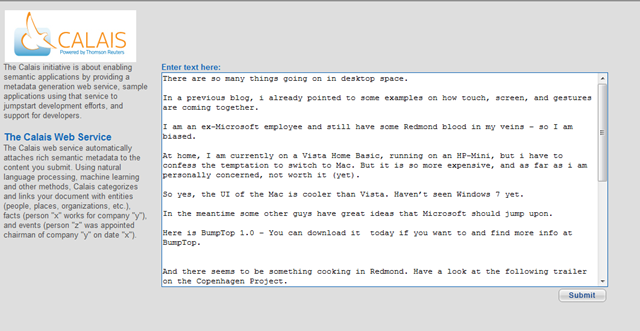
I decided to try the DocViewer at http://viewer.opencalais.com/ and i cut & pasted the full text of my recent blog on “My new desktop: touch and 3D of course” and hit the submit button:

image

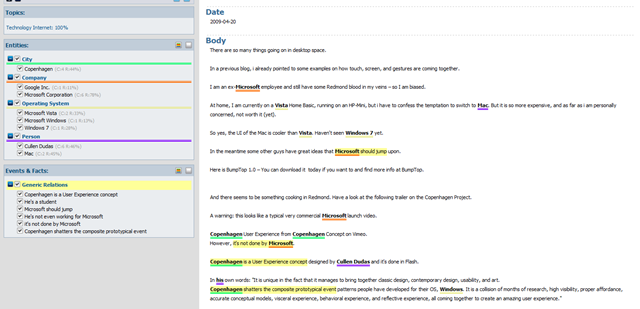
What i get back is amazing:

image

The unstructured data of my blog are parsed, patterns are recognized and semantic data is added. All this can now programmatically exploited as the APIs are published.

Imagine combining this power with drag & drop mash-up techniques such as Yahoo Pipes or similar.

Or imagine using this to feed info from financial data reference sources into your financial planning or even trading rooms. I recently have seen a similar demo, with very powerful multilingual parsing and pattern recognition of unstructured data, but this is the first time i see something that has the potential to go mainstream very fast.

PS: some folks ask me where i find these interesting links. Well, i spent quite some time researching on the web of course. But i also have some friendly secret sources. Friends that just share a link via Twitter or mail, and who themselves have no time or appetite to make a blog out of it. The subject for this post was kindly provided “xstof”

Tom Cruise Wall

Who has the real Tom Cruise touch-screen wall of Minority Report ?

Recently i had the chance to see ànd touch ànd play-around with Microsoft’s Surface Table. That was fun. Made me think of the video wall in Minority Report ;-).

Microsoft already showed some wall like this from their R&D group back in 2006

But what’s next ? Is the Tom Cruise Wall reality or still in the R&D labs ? Or is our vision of User Interface (UI) getting even better or fundamentally different ? Found in the meantime following cool stuff:

  1. Jeff Han’s http://www.perceptivepixel.com/ company. Jeff created havoc  at TED 2007
  2. Pattie Maes’ TED 2009 appearance without screen and based on gestures:
  3. More gestures: the QB1 computer from OZWE: http://www.ozwe.com/
  4. In stead of flat screens and Tablet PC’s, check out the Pulse Smartpen at http://www.livescribe.com/
  5. Or throw into this things like PopFly, Yahoo Pipes, Adobe AIR, Silverlight, etc

In other words: how will we interface with the computer in 5 years ? In 10 years ? Will we all have at home a 15 m³ wall-screen in our living room, connected to a Terabit Internet Connection ?

This must be fun: let’s share what other Tom Cruise Walls are available in the market today, or that you have seen on the web or in R&D labs.