His Purple Highness and Innovation

There has been a lot of coverage on the net about Prince’s statement “The Internet is Dead” and the responses “Prince is dead”. For me, Prince is never dead, as he left me with memories to the best concert I have ever seen during his Purple Rain tour, indeed quite some time ago ;-/

The master of funk – aka His Purple Highness – just has a new CD “20TEN”, and it seems to be a good one, and it is btw given away today for free with Newspapers in Europe.

I found this review of 20TEN in the Belgian Newspaper De Standaard. It’s in Dutch, but if you turn on Google translation, it’s quite readable in English.

Prince

I blog about it for the following (auto-translated) paragraphs:

We give Prince creative freedom and we understand that he does not want to live in the past. The most pressing question that loomed when we 20Ten in the CD-changer was explained: the album will be as good as Sign O The Times or Parade? Equally exciting as 1999 or as viciously as Controversy?

Well … (Drum roll) … No. Not really. More importantly, we find that bad? Because let’s be honest: you really expect the 52-year-old Prince a plate opinions so urgent, as controversial and as innovative as his work from the 1980s?

Maybe we should ask whether it is the responsibility of someone like Prince to remain the major role of innovator to take on. That role he has not already played out with fervor when it was needed? Charts when artists do not dare to take risks, but only when blacks were allowed to play funk and disco, when explicit sex or gay and bisexuality have been stashed away in the bright pop music?

The question – or statement if you want – was already raised by Guillaume Van der Stighelen during an interview with business TV Channel Kanaal-Z some years ago at the occasion of the launch of his book “Heldenmerk” (the brand as a hero) somewhere end 2008, begin 2009.

He said something along the lines that creativity (and innovation) should be left to the young generation, and that he – as a 50+ year old – should give room to the young generation where the real creativity sits, and that his role should be one of mentorship.

I am 50+, so that quite resonated with me. But I think he is right. Since then, I try to make others win, younger people than me, who still have to proof something.

It is actually fun to disappear backstage, and enjoy the show being delivered by others, and knowing you were a substantial part of getting it where it is right now.

That’s a different – and in my view “better” – type of satisfaction, fulfillment and motivation.

Management Innovation: Extreme Management Makeover

Stumbled upon this great blog post by Gary Hamel in the WSJ. Extremely relevant if your business is a service business run by first-level employees.

It’s based on the work of Vineet Nayar at HCL Technologies (HCLT).

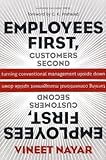
It’s now all documented in this great book Employees First Customer Second: Turning Conventional Management Upside Down

If you thought I was sometime being a bit extreme in challenging existing ways of doing things, have a look at following recommendations:

  • We must destroy the concept of the CEO
  • Employees First, Customers second
  • Exalt those with hierarchical power rather than those who created customer value
  • Turn sober-suited executives into rabid management heretics
  • “reverse accountability.” Managers should be accountable to those in the value zone
  • Give every employee a detailed set of financial metrics for their own team and other teams across the company
  • A non-censored censored “U&I” site, taking also the dirty questions
  • Install a web-based “Smart Service Desk” and SLA’s with powerful corporate departments, like HR and finance, who often seem more interested in enforcing blanket policies than in making life easier for employees.
  • Rate the performance of any manager whose decisions impact their work lives, and to do so anonymously
  • Crowdsourced review of divisional business plans
  • Employee First Councils: to help employees connect with team members who shared similar interests and passions

The last two concluding paragraphs are enlightening:

The world has become too complex for the CEO to play the role of “visionary-in-chief.” Instead, the CEO must become a “management architect”—someone who continually asks, “What are the principles and processes that can help us surface the best ideas and unleash the talents of everyone who works here?” Today, as never before, the world needs leaders who refuse to be seduced by the fatal allure of the familiar.

It really is possible to change the management DNA in a large, established company. When you dig into “Employees First” you’ll learn that it’s possible to reinvent management without blowing up the existing management system, without having a detailed master plan at the outset and without taking inordinate risks. If you’re a would-be management renegade—this means you’ve just run out of excuses.

We are as gods and might as well get good at it

Check out Raw Dawson’s blog post of today with superb video

TURNING INTO GODS – ‘Concept Teaser’ from jason silva on Vimeo.

Indeed today it is entirely appropriate for us to be thinking in terms of human transformation, and the power we have at our disposal. The cycle has swung back, and once again there is the promise that we have what it takes to change who we are… for the better. Whether human nature will allow those changes to be fully positive we have yet to discover. But that promise is – once again – part of the zeitgeist.

Heretic Team Glue

Last week we had a great team off-site.

We arrived late afternoon in the fantastic location of Chateau de la Poste, close to Namur, Belgium. Built in 1895, the Château de la Poste was the residence, for more than forty years, of Princess Clementine, daughter of King Léopold II. It later was sold to the postal services, who used it as a vacation resort for the children of the employees of the Belgian Post (times have changed). It recently was refurbished completely by a French wine maker, and it houses now a wonderful hotel, meeting centre and quality restaurant.

The amazing landscape, the silence and the soft welcome on the summer terrace set us all in the right mood. We all felt our physical and mental muscles relaxing, winding down.

Don’t know where I read it anymore, but I recently found a quote: “If you are not able anymore to take some time out for an off-site team gathering, you’re cooked”

For once, we did NOT have a packed agenda, and plenty of time for  real Quality Time Sessions.

We even made an acronym for it (QTS) to joke a bit with the “acronymitis” of the lean methodology.

More seriously, we invented QTS because we felt that the pure lean method was too much focused on a problem-mindset, and not enough on an opportunity-mindset, opportunities to develop some deeper quality thinking on subjects relevant to our business and team.

One of the items on the agenda was about “how to tell bad news”. In the subsequent discussion, one team member reflected on some sort of “fear” and “If I do this, then this and that may happen, and then…” thinking. Being in the acronym mode, we had a good discussion on


FEAR = Fantasy Experienced As Real


and how such behavior leads to blocking, status-quo situations.

Almost “emergent by design” our team culture principles unfolded, and we articulated them along the themes of “old” and “new” game.


  • Old game = fear, tricks, manipulation, raising stinky fish, machiavelism, creating and maintaining negative energy in general

  • New game = solution oriented, integrity and authenticity, fast correction (like Guy Kawasaki used to say”churn baby churn” a variation on the famous 1976 disco song “Disco Inferno” by the The Tramps), the holy fire, positive energy, who is the owner of the idea, who cares ? It’s about focusing on believers, and investing heavily in those VIP followers that will help us create a viral innovation infection/storm, like a raging holy fire that cannot be stopped anymore. Burn baby Burn…


We replaced “raising stinky fish” by regular update and feedback sessions, focusing on polishing rough idea diamonds, focusing on what works vs. what does not work, focusing solutions vs. problems.


If you think deeply about it, all this is about

the major cultural shift

from pushing towards pulling your ideas,

it’s about a strengths based society and team,

it’s about connecting ideas

and excel in making them real.


Another correction we made to lean was our understanding of a skills matrix.

We were very inspired by Venessa Miemis’ blog post “Framework for a Strengths Based Society” that included following diagram.

We decided to add these skills to our existing lean skills matrix that was too focused on identifying and solving problems and tools mastery. “We are not the tools, the builders are us” is another quote from one of Venessa’s presentations.

The subtle nuance is that we did NOT implement these skills as comparative/ competitive skills of different team members but


in terms of personal areas of

strength and potential

for each team member individually.


Our little team is SWIFT’s “Innovation Team”. Some time ago, we shared the details of the mission here and in summary it goes like this:

Build the Skills , Tools , Processes, Metrics , Values , Network , required to support collaborative innovation and transform SWIFT in an agile company, able to succeed in a changing environment.

I often make reflections on how real our innovation work really is. And although we are having lots of fun and some sizeable impact on how the company little by little opens up for innovative behavior, I always seem to be in search for that little extra in life and work.

Too many of our innovation experiments and proof-of-concepts remain just that: proof-of-concepts and prototypes. They never get into production. Worse, some outcome are just ‘filed vertically” or even never get the any executive attention.

I would like to hear from other innovators what is the secret sauce to get beyond the prototype stage. Because staying in prototype stage sometimes makes me wonder if I am in some sort of “busyness” therapy.

And I have come at an age where I cannot content myself with busyness.

I could sit here till my pension, having a good pay, and living honestly speaking in a quite luxurious working environment. But I am in search for more. I am in search for


meaning and significance


With the couple of years still to go, I still have the arrogant (?) ambition that I want to leave a legacy. On a personal level in my family. On a professional level that my passing in this company has substantially changed something. It’s about a deep sense of motivation, beyond pay and perks.

There is something heroic, even heretic about all this. That’s why the title of this post is Heretic Team Glue.
See full size image

Heretics are the ones that were expulsed from the Catholic Church because they did not follow the rules and challenged faith and established dogmas.

There are several dictionary definitions of “heretic”. The one I have in mind here is “anyone who does not conform to an established attitude,doctrine, or principle”.

I think we in our team are all some sort of heretics in the castle. It’s something very special in our team, that creates a very strong bonding.

At times it even has some masochistic flavor. Why on earth do we keep on trying again and again ? Even if the odds are against us. Why are we prepared to go time after time through the innovation pains over and over again ?

I truly believe it is because we do it for the right reason. Not for the pay. Not for the glory.


Because we believe there is a chance

we can succeed 


And believe we can create a tribe of followers in the same belief. It’s for some of us the only reason why we stay !

Are the above reflections caused by my age and my 3/4 life contemplations ?  Don’t think so. We invited some GEN-Y colleagues to join our off-site. And see: they too are driven by honesty, they too want promises to be kept, they too look for meaning and fulfillment in their lives.

But it was shocking to hear how some of them have been seduced to join a company based on huge expectations and promises that they would work soon for 3 years in the US, and have rapid accelerated career paths, and deep young graduate immersion programs. It’s unacceptable to make such promises if you know you can’t realize them.

And this is their first contact with corporate life !

How can we ever correct this ? How on earth can we regain the trust of these young people ? Our generation has planted the seeds of suspicion in these long lives. Big mistake.

Me too I have been mislead several times in my life, and I recognize the power-less emotion of trust that was betrayed. Lessons of life ? Normal life injuries ? The way it is ? Why do we need to accept that ? Why do we repeat the same errors over and over again ? Sooner or later, these young people will present us the invoice.

These folks actually think. Think deeply. Some GEN-Y people are for example  insulted when calling them “GEN-Y”. Because they see themselves as individual human beings, with their own identities and values systems, not prepared to be tagged as a category. And they have great ideas. We organized some sort of Innotribe Lab with them: more than 20 ideas on how to improve quality of work came out. I am honored that I can channel these ideas into the People & Culture “movement” team of the company.

Last but not least, we had a great discussion about “reverse mentorship”.

Instead of older experienced professionals mentoring new young people joining the company, why not letting young people mentor the already older – sometimes (mis)formatted – generation, and teach them how to use new technologies and apply 21st value systems ?

We had a fierce debate: how can one say that the young generation is the future, and five minutes later challenge reverse mentorship by not accepting that one can learn an awful lot from these fresh and well trained minds.

Maybe that’s where my future is ? In being mentored by a GEN-Y ? It will ask of course an attitude of

vulnerability


It’s also part of a give-ànd-take culture that includes transparency and openness. Especially give. Like a gift, where you don’t expect something in return.


When is the last time you made a Gift ?


How can we create an environment where we encourage learning from each other (in normal and reverse mentoring mode) ? An environment where we celebrate confidence building on your own rhythm, dare to be vulnerable, asking for feedback that is clarifying, supporting, challenging.

I am convinced I can learn something from every human being. Especially young people who have a renewed and fresh sense of civic responsibility, transparency, honesty, openness.

I have committed to take the challenge and invite one of our GEN-Y’s to monitor me during 6 months and give me feedback on my behavior and to keep me honest.

So that I walk the talk. Every manager should do this.
Creative juices everywhere

These days, when i kick-off an innovation workshop, i ask the participants “tell me about your hobbies/interests when you were 16-18 years old”.

The answers and the resulting effect are surprising.

  • First, it opens up people in a way they are not used to. The come out of their “i-am-at-work” comfort zone. Some people that you expect to be “emotional zombies”, suddenly have sparkles in their eyes and show leadership throughout the workshop. Having genuine interest in people unleashes nuclear creative energy.
  • Second, it is amazing how many creative juices you gave in your average workshop. People tell me about their dancing, painting, music instruments, fashion design, about crazy little (and big) things they did in life

I don’t know where it comes from, that attitude of “withholding” the best of yourself. Something that is for sure, is that once you tap into this creative well, the energy and engagement and idea generation increase by a factor 10.

Another example: a colleague from our German office came to see me on what our innovation team could mean for one of his customers. In stead of showing him a whitepaper or a slide show, i decided to show him some of our past productions. Again those sparkling eyes.

With hindsight, it is interesting to see how we almost unconsciously added some creative art/visual/audio layer to most of the things we do. You can call them “innovation productions”.

My German colleague was clearly surprised on the quality productions we do with relatively small means. “I have to let this sink” he said. “It’s all a bit overwhelming at this moment, but i am trying to grasp it all and how i can transfer the same excitement to my customer when going back to Frankfurt this evening”.

The point i am trying to make is that there are creative juices everywhere, and it only takes a little scratching or motivation to get the best out of people.

Here is an example of getting out the best in people. You remember by blog post on the Medici Effect ? Apparently it inspired my colleague Mela to some really video collage.


It’s beautiful. It touched me emotionally. Watch it. It’s only 5 min. You can use it as an inspiring start of your day as well. Or imagine starting a workshop after having played this video. The energy in the room is high. It’s a soft energy that makes you feel comfortable to share.

This video is used in our company to launch the next wave of internal innovation challenges.

Innovation Challenges are small competitions where we incentivize our creative people at all levels and locations in the organization to come up with ideas around a certain theme. The projects are presented to a judge panel that includes the CEO. The winner gets implemented. So the price is not money but personal fulfillment.

The Challenges of this wave are all run under the banner of “Create the Medici Effect”: bring together people of different expertise and with different creative and/or engineering skills, and let the power of intersections play.

It’s a powerful model.

You can expect this video at many of our events and workshops. Also at Innotribe @ Sibos this year in Amsterdam, where one of our labs will have a specific focus to amplifying the Medici Effect.

Nobody asked Mela to do this video. But she followed her own compass and did not wait to be called. Mela should not only start to blog. She should start her own “Mela Productions” company.

“Inspire other people to dream” seems to have worked. Creative juices are everywhere. Imagine if you could unleash this energy in a systemic way in your company and in your eco-system. Maybe we have to do a creative lab at Sibos where we ask teams to make a similar video on the topic Generation-Y and Banking and have it ready by the end of the conference for the closing plenary ? Any thoughts ?

I have to run now, but will polish up this post later in my usual way, but i wanted to get this off my chest and into the world as soon as possible.

Becoming Better Builders

This is about an amazing idea of a 23-year young big thinker who created a fantastic community on-line and almost by accident stumbled upon a new platform for on-line communication that could change our world.

I stumbled upon this absolutely great video of a speech given by Vanessa Miemis in NYC during the Social Business Edge Conference on 19 April 2010.

image

I am a big fan of Mrs. Miemis and fervent reader of her blog “Emergent by Design”.

image

It’s the first time I see and hear her speak. It’s adds a different dimension. It’s a different type of engagement, and that different type of engagement is exactly what “Junto” is a about: a conversational platform between “real” people (see later on this blog).

She has roughly 4 supporting slides, and talks from the heart, with only a small sheet of paper with probably a couple of keywords and key statements. That’s how really super keynoters do their thing.

In this video she talks in an almost shy way about what drives her, and makes one after the other bold statement about the way this society does (not) work anymore.

The story is in essence about

the old game and the new game


As my friend, coach and mentor Andre Pelgrims used to say:


our (mental) software has evolved, but our hardware did not (our value systems, our hierarchies, our corporate models)


Vanessa’s speech in in 3 chapters:

  • We are shaped by our tools
  • We learn by modeling behavior
  • We align around a shared vision

I was mainly blown away by the section on Modeling behavior, some elements in the vision alignment, and definitely by her description of Junto.


Modeling behavior


Some real deep thinking here:


This is how children learn. It makes interactions transparent

Encourage a culture of collaboration, there is a certain type of behavior that we are modeling, and one that is based on a value system that is predominantly different than the one that exists in society and business today.

And its difficult to expect a paradigm shift when the current model rewards selfishness, and hording of information and exploitative behavior.

This virtual space is actually like some kind of training ground to build trust and to have a different behavior where the outcome is more than the zero-sum (in the existing model)

We align around a shared vision


There is this new way. For the greater good. A new global conversation and collaboration platform. that would sit on top of the web and that would accelerate the rate of taking an idea to action. And we are calling it JUNTO.

Enter Junto’s vision: a 3D space, where it’s live-streaming video, with video streams of us human beings.


It’s actually you,

who you really are


On top of that a profile system, automatically generated by the conversations you are having. It’s a different kind of transparency on who your really are. On top of this this reputation system that would be build into these trust networks, and virtual currencies, … and it goes on.

It’s like 5 people having a public conversation about a topic that interests them, and 500 people sitting in the back-channel. It’s all open source. They don’t want to monetize the tool.


They co-create value

by what they do with each other


It’s sounds a lot like our “enabling collaborative innovation” theme of Innotribe. It sounds a lot like the “advancing critical dialogue” tag-line of Sibos.

I truly believe that this tool could bee the basis from which a new global economy and a new global society can emerge from.

Wouldn’t it be cool to address this a a theme at Sibos. In front of 8,000 bankers ? Wouldn’t it be cool to experiment with Junto – yes, live i mean – during Innotribe at Sibos ? We plan other cool remote interactive stuff anyway this year. Just have to keep you curious here, as we have not yet fully worked out the concept, but if we pull it off, it will be really cool. Sort of first off.

Her final idea to consider:

Technology is the tool, but not the builder. We are the builders.


I challenge you and ask how we get better use to tools to connect and to inspire, so that collectively we can become better builders.

I need to discuss with the Sibos team, but I’d like to invite Vanessa to our Innotribe @ Sibos 2010 in Amsterdam to be part of the keynotes on “the big tectonic shifts” and in our Gen-Y stream.

Let’s Prepare the Future !

image

This article is a cross-post of an essay that i prepared for The Fifth Conference and that was published this week.


image


The Fifth Conference is a forum for vision. Part publisher and part conference, The Fifth Conference tackles the ‘big issues’, the factors that drive our future. Think ten, twenty, even fifty years ahead and try to imagine how we will live and work. What will this world look like? How will we have solved the economic, social and environmental challenges that we confront today? To answer those questions we talk to entrepreneurs, policy makers and experts. We analyse the facts, the forecasts and the arguments. And most importantly, we collect vision.

As mentioned in my previous blog post “No more collateral damage”, this is so close to my idea of the Think Tank for Long Term Future that it was for me a no-brainer to passionately accept the invitation of Frank Boermeester (co-founder of The Fifth Conference) to draft an essay on Technology, with a focus on Technology Readiness in our region, and being conscientious aware of the “understream” that is driving all the changes and evolutions in Growth, Mobility, Green, Technology, Health. So here is the article:


Over the past 20 years we have witnessed a fantastic growth in and wealth of technologies. ICT technologies have started permeating our daily lives. Medical science and biotechnologies have increased longevity significantly. Other technologies (Nanotechnology, AI, Robotics, etc.) have kick-started.

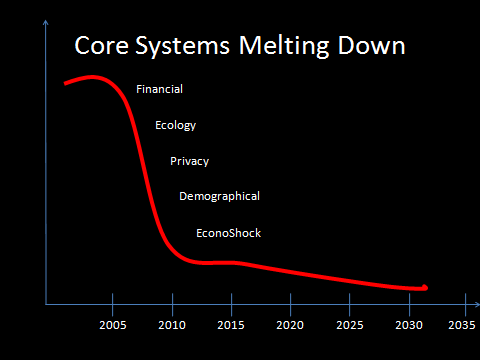
However, in the last couple of years, we have witnessed the breakdown of a number of core systems:

image

  • Our worldwide financial system is going through a “meltdown”. The old game of greed is being replaced by an all important requirement: trust.
  • Ecological, ethnological and demographical shocks (see also Geert Noels, author of Econoshock) are turning our systems upside-down: Green and Energy conservation thinking are now the mainstream.

image

  • The East-West shock: economic power is shifting from the Western world to the new economies of APAC and BRIC+ countries.
  • New forms of communication via the internet (blogs, wikis, social networks such as Facebook, Twitter, Netlog, etc.) propose a new paradigm in respect to privacy.

All these fundamental changes give us feelings of discomfort, disorientation, confusion and loss of control. Although our “collective intelligence” indicates that our old models do not apply anymore, our “hardware” seems not to have caught on. We have not adapted the way we are organized hierarchically; how we look at governance. Our traditional ‘system thinking’ got stuck and did not follow our ‘collective intelligence’.

On the other hand a new set of systems and tools are emerging:

image

  • Barack Obama describes it as the ‘audacity of hope’; innovators, planners, academics and authors are referring to ‘dreamtelligence’ as a new, vital, and visionary way to use play, fantasy, dream-thinking and innovation to kick-start ideas and stimulate community engagement.
  • A fantastic call for and revival of authenticity for ourselves and our leaders. Furthermore, having true leaders; with charisma, the power to attract, integrity and authenticity.
  • The Net-Generation (now young adults, 15-30 years old) have grown up as ‘digital natives’. They will be tomorrow’s leaders. What THEY think will co-form our future. The future will not be invented by today’s generation. This Net-Generation lives differently. They are “wired” differently. For them multitasking (multi-window chatting, gaming at the same time as listening to music, looking up information on the internet, being mobile, etc.) is very common. They also think differently (deeper and more authentically), and have a very strong sense of the common good and of collective and civic responsibility.

image

image

Our technological revolution has just started. To illustrate:

  • Today our technologists are capable of crafting a human ear in their labs. We are now in a position to create and grow cells, tissues and even bodies.
  • Artificial Intelligence is back: by 2030 our computers will be able to think, be self-learning, self-healing – some will even be able to have a consciousness.
  • Self-learning robots will soon be mainstream technology. Mercedes and BMW already have cars in the pipeline for 2012 that can drive entirely automatically, better than a human counterpart.
  • The emergence of Google brings forth the concept of the “Global Brain”. The internet today is already a tremendous source of information. Today’s search experience will pale in comparison to the mechanisms we’ll have in 20 years. All knowledge will be available anywhere, anytime, wirelessly via brain-implants.
  • Social networking is already revolutionizing the way people and companies are communicating. It is interesting to note that these technologies let us evolve from a system-to-system communication paradigm towards a human-to-human one.
  • Today you can order your personal DNA genome sequence in the USA for only $399. The company doing this is a Google backed start-up. Think of DNA in the ‘cloud’, with DNA comparisons between ancestors, relationships, etc …
  • Brain-wave helmets and chip-implants will give humans better sensory perception. By 2030 we will see the emergence of “super-humans”. In such a dramatically changed context, what will make us “human”?

A lot of these future scenarios are described by Ray Kurzweil’s “Singularity” concept. This is the moment when man and machine truly blend. Kurzweil claims this will happen around the year 2030.

And the pace of all these technological innovations is just increasing exponentially. In the next 20 years we will witness technological breakthroughs tenfold those of the same previous span of time.

All this evolution calls for a re-thinking of our value-compass for the future: We must carefully re- think how all this will influence the way we will work and live. What sort of quality of life should we aim for? What will be the socio-economic impact of all this? How will we want education to be structured? What areas of society will we still want (and be able to) influence?


How are we going to ensure that the

Technical and Value ‘Readiness’

of our region

are competitive in this new era?


Will we lead the change, as opposed to being mediocre followers? I believe it is time for action.

image

I believe The Fifth Conference and its organic network of inspiring leaders has deep within itself the embryo for a sort of “think-tank/foundation” addressing the long term future:


A movement and an energy

that prepares our Net-Generation

for the next 20 years,

with an emphasis on

our technical and value readiness


A place where “smart people” can meet. Where experts from different technological domains share their insights for 2030, cross-pollinating each other’s disciplines. Indeed, “savants” from different contexts & worldviews can act as our “eyes” and offer a perspective on how we will live and work in 2030.

image

How our education is best organized will also be addressed. We will investigate what our ideal value kit for that era should be, beyond traditional corporate culture. Moreover, with a culture of sharing and exploring – where we live committed to teams, groups, communities, regions and countries –a deep respect for the participating individual humanistic identities will nevertheless be maintained.

We don’t have to wait until our politicians have made up their minds as to whether or not they should invest more in innovation.


We can do this ourselves


I cannot accept that it would not be possible to raise private funding for such an organization/movement/tribe.

The resulting new models and scenarios will demand speed, creativity, dynamism, perseverance, courage, knowledge and working together in a multi-cultural context. This new society makes a plea for the respect for individuality, freedom, mobility and quality of life.

This paradigm is all about designing, exploring and organizing change, learning and fine-tuning as we go. Giving guidance to teams, organizations and leaders on how to surf these waves is part and parcel with this. Missing the first technology wave of speed and creativity will result in loss of economic relevance. Missing the wave of the new value kit will result in losing our Net-Generation; our brains for the future.

This is about preparing ourselves and our region for 2030.

image

Who wants to join the tribe? Who is a believer? Let’s debate this idea on- and off-line for a couple of weeks. If there is enough interest, let’s meet and make this happen.

Get a Life and Get Alive

It’s quite some time ago i did a post with brand new content. It’s partly because i also have a family and a job, but mainly because i only feel the urge to blog when i have real content to contribute.

These days i also share an awful lot via twitter: that’s where the day-to-day action is. So if you are interested in my lens on technology and values for the 21st century, you can also follow we on twitter @petervan . There is an almost daily stream of tweets on these subjects.
I “reserve” the blog to share some more elaborated thoughts on stuff that keeps me going or that touches me one way or another way emotionally, in the way i am.

This time, the post is about


People, Culture, Excitement and

Sculptural Integrity


And I’d like to share what happens if you truly stand for who you are and have the courage to stand up and stick out your neck.

The title of this post is of course a word-spiel on get-a-life and get alive. The discussion was part of an off-site recently attended in the wonderful city of Barcelona.

It was about 20 years ago i was in Barcelona, and the only thing i remembered were the ‘”Ramblas” and the “Plaza de Espagna”. Given my education as an architect (non many people know this ;-), i of course knew that Barcelona was the city of the Sagrada Familia of Gaudi.

The off-site was facilitated by Dan Newman and his team from The Value Web.

image

The off-site was our reflection moment about our company for the next 5 years.

Dan really “got me” with his opening speech: he used two words that deeply resonated very strong with me – at an emotional level.

The architect aims for


“Sculptural Integrity”


Especially in sculpting the old with the new. Old game and new game. And that the old and the new should be connected by more than just a link or a tunnel. That the end-result should show a deep sense of unity. And that this “sculptural integrity” and other architectural thoughts were the also the basis of facilitation work and techniques of the Value Web, because that was also how group dynamics could be looked upon.

The words entered by body and mind, as they reminded me of a piece of my true self and my youth 30 years ago when i was making drawings and sketches myself of the most bizarre and bold architectural designs.

Dan mentioned also a book: “The Timeless Way of Building” by Christopher Alexander.

The real and ultimate question in this book is:


What is it that makes a building “work” ?


When you see something that works, you just know it. And it’s something that has a timeless quality.

I was intrigued by the subject, and kept researching, and quickly discovered the site of Tomorrow Makers.

image

And especially the blog post titled “Happiness Pandemic (HP101) Hits Worldwide”. Just read and internalize the first two bullets:

The tendency to let yourself be guided by intuition instead of acting under pressure of fear, forced ideas and pre-conditioned behavior.

A total loss of interest in: – judging others, convicting yourself and preoccupation with things that create conflict.

During the off-site, Dan did something else that was brilliant. He took us out of the hotel into the city. In our case we went to the CosmoCaixa Barcelona, the Museum of Science.

Panorámica CosmoCaixa

Besides being a perfect metaphor for blending old and new with “sculptural integrity”, it also put all of us in a different context and mindset to look in quite different and innovative ways to our off-site subject.

I don’t know what happened exactly, but when we returned to the conference hotel, we were looking for topics likes

space

freedom

excitement

playfulness

culture

people

At a certain moment, we could form a small group of people, sort of a tribe around a subject that was not yet addressed.

I put the word “excitement” on a post-it, and look: 10 min later, we had 7 or so colleagues interested in discussing the subject.

I asked a simple question: “how excited do you get by the work done so far at this off-site” and rate it on a scale of 1-10. To my astonishment, the average rating was 3.

So we then looked for the root-cause of this score. A lot had to do with company culture, but also by the need for a new vocabulary, and not just words, but a vocabulary that was inspired by the value set that is needed for the 21st century.

In a follow-up session on people and culture this topic re-appeared in full force.

Although initially we were looking at symptoms and superficial quick fixes, it suddenly dawned to us that


the real root cause was about

the openness of

our minds, hearts, and minds.


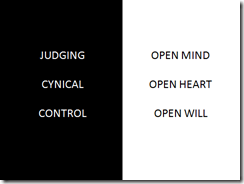
I have used the following slide many times in my postings.

In black the old game: full of macho behavior and Machiavellian attitudes and states of mind.

In white the new game. With true, genuine interest in the other and the true self – not based on tricks or quick fixes.

image

The discussions on these topics were deep and full of enthusiasm. We were looking at talent development, both the professional skills ànd the Personal Development side of it.

And i keep on fighting that “Personal Development” is NOT about “soft” skills.


It’s really about having and keeping

cutting-edge “good” people

on board


and nurturing them so that they can function optimally in today’s highly connected networked society.

You need to “train” and get exposed to a number of essential hard skills and values for the 21st century.

In this context, i get very inspired by the work of Vanessa Miemis, a Gen-Y student with a fantastic blog “Emergent by Design”. Look for example at her latest blog entry “Essential Skills for 21st Century Survival: Part-3 Network Weaving”

Or the post “Framework for a Strengths Based Society”

Do you feel how powerful this is ?


“Strengths Based Society”


Should we not invite her to Sibos ? To be part of Innotribe at Sibos. As part of our “Gen-Y meet Bankers” Face-to-Face interactive workshop ? Maybe with the help of some strong Gen-Y-power, we will be able to keep the sharpness of our ideas and dreams.

Because at the end of the off-site, each team had to boil it down its ideas to a pitch of 5 minutes and I was surprised to witness how in this pitching work, we lost quite some of the “cutting" edge”. Also surprised on how fear creeps in when people are volunteered to deliver the pitch to the executives.

And a strange behavior of watering down the message, and even scratching the most provocative words in the end deliverable.


We seem to have lost

our desire for

boldness


We also “frame” too conservatively. So, in order not to loose some of these more provocative statements, here are some examples:

  • In 5 years time, 10% of our workforce should be Generation-Y folks
  • By 2015, our company should be in the Top-10 of best companies to work for in the financial industry. Worldwide.
  • Gen-Y should drive the composition of the Leadership council of the future
  • 90% of the people in the 2015 leaders team should be new. Only 10% of today’s group should be the same
  • Doing things 10,000 time better rather than twice as good
  • “Do no evil” is not good enough anymore. “Great to Good” is the new paradigm.
  • “Get-a-Life and Get Alive !” Was the original title of our pitch. Somebody changed the title to the more boring “people and values for 2015”
  • Chief Corporate Activist
  • About framing: from “our company is 37 years old, are we in a mid-life crisis” to “our company is 37 years old, we are just-born, who do we want to feel “right” or “it works” in 500 years from now?”

At this moment, I decided to have a short break in my blogging activity, and go for my Sunday trip to the bakery. I bumped into a friend, who shared me a wonderful story about going for your dreams.

The story was basically about context. Of not waiting to be called. Of doing what you intuitively know is right. What works. In his case it was about seeing a wonderful motorbike, feeling it was just designed perfectly, and following your intuition and impulse and buying the motorbike. It happened to be a Can-Am Spyder Roadster. This was not just about buying something desirable. It was a story about contextual living. About flow. About following your compass. And not delaying your dreams till when you’re dead.

image

The story reminded me of the book “Zen and the Art of Motorcycle Maintenance”

You can find “flow” is everything you do. From the most banal activities like cleaning or motorbike maintenance to writing an inspiring blog and making a pitch that makes others dream and wanting to go after their dream.

When i started this blog in April 2009, i wanted it to be in line with my purpose in life “Inspire other people to dream” – and execute their dreams. I hope i have not disappointed you so far.

Last week, somebody said i should start writing a book. Maybe i will do that. Maybe using the funding model experimented by Stowe Boyd fro writing his report on Social Architecture: Microstreams In Business.

Last week, somebody gave me the greatest compliment somebody can give to a man of the 21st century:


“you have the most feminine mindset

of all the men i ever met”


Let’s eradicate the macho culture of judging, being cynical, and control freaks.

Let’s build a culture based on open mind, open heart and open will.

Are you also fed-up waiting on the side-line and do you feel the hunger to join me on the drawing board to help us sketch the “sculptural integrity” required for the 21st century ?

Then please use abundantly the comments feature of this blog.

Doing what you want to do, not waiting to be called. Stand-up and stand as you are. In your true self. Without fear. Living your dreams.


Get-a-Life !

Get ALIVE !


If you feel energized by this blog, you can get an extra doze at following previous posts:

No more collateral damage

Who am i really ?

Great to Good: New Value Kit

Broken Will

Our company is infected

Ethical Re-Boot

The Holy Fire

Emotional Zombies

HR and Innovation

Brand, Workforce and Innovation

The Medici Effect


The Medicis were a banking family in Florence who funded creators from a wide range of disciplines. Thanks to this family and a few others like it, sculptors, scientists, poets, philosophers, financiers, painters, and architects converged upon the city of Florence. There they found each other, learned from one another, and broke down barriers between disciplines and cultures.

Together they forged a new world based on new ideas—what became known as the Renaissance. As a result, the city became the epicenter of a creative explosion, one of the most innovative eras in history. The effects of the Medici family can be felt even to this day.

These introductory words come from a book “The Medici Effect: What Elephants and Epidemics Can Teach Us About Innovation: What You Can Learn from Elephants and Epidemics” by Frans Johansson (Author).

The book is not that new (it dates from 2006), but it is very relevant to today’s innovation challenges. You can find the book on Amazon.com via the links above, but there is also a free PDF summary here and a Google Book edition here. And obviously, there is the website www.themedicieffect.com .

There was also a 2004 book The Medici Effect: Breakthrough Insights at the Intersection of Ideas, Concepts, and Cultures

The core of these books is about two types of ideas:

  • Directional ideas
  • Intersectional ideas

Directional innovation improves a product in fairly predictable steps, along a well-defined dimension. Examples of directional innovation are all around us because they represent the majority of all innovations. This is what we call incremental improvements (Innovation is in my opinion a bit on the optimistic, even window-dressing side).

The goal is to evolve an established idea by using refinements and adjustments. The rewards for doing so are reasonably predictable and attained relatively quickly. People and organizations do this all the time through increasing level of expertise and specialization. It is absolutely necessary if one does not wish to squander the value of an idea. Even an intersectional idea will, once it has become established, develop and evolve along a specific direction.

Intersectional innovations, on the other hand, change the world in leaps along new directions. This is what Guy Kawasaki calls “jumping the curve”. These ideas are game changers. I am preparing a whitepaper on how NIBC (Nano, Info, Bio, Cogno)) technologies are major game changers.

Although intersectional innovations are radical, they can work in both large and small ways. They can involve the design of a large department store or the topic of a novella; they can include a special-effects technique or the product development for a multinational corporation.

In summary, intersectional innovations share the following characteristics:

  • They are surprising and fascinating.
  • They take leaps in new directions.
  • They open up entirely new fields.
  • They provide a space for a person, team, or company to call its own.
  • They generate followers, which means the creators can become leaders.
  • They provide a source of directional innovation for years or decades to come.
  • They can affect the world in unprecedented ways.

The Medici Effect is about bringing together people of different fields of expertise and

let the magic of

cross-fertilization of ideas

happen


What sort of people do we need to invite ? In essence, we are looking for people who succeeded at

breaking down

their associative barriers


because they did one or more of the following things:

  • Exposed themselves to a range of cultures
  • Learned differently
  • Reversed their assumptions
  • Took on multiple perspectives

The explosion of concept combinations at the Intersection can offer a myriad of uniquely combined, extraordinary ideas.


I have a dream


That we can turn Innotribe.com into a Medici Effect: the place where different disciplines find each other, and through that intersection come up with intersectional innovations.


I have a dream


That we can turn the SWIFT Campus into a hosting environment, where we facilitate those intersections to happen.


I have a dream


That i can blend my personal interest of creating a Think Tank on Long Term Future with my professional endeavors at SWIFT.


I have a dream


That together we can write The Readiness Manifesto. The strategies and focus areas to prepare the Net.Generation – the 20-25 years old of today – to stand up as our leaders in 20 years from now in 2030.

But NIBC technologies are not the holy grail. There was a fantastic quote in one of Fred Destin’s latest blogs on Venture Capital 2.1:

The fundamentals of the business have changed.  Technology is a quasi-commodity, the spread of ideas is instantaneous, competition is global, in other words the market is more efficient.

“Technology is a quasi-commodity”


Wow ! So what will be your differentiator ?

I believe it will be in the HOW of delivering products and services. And i can’t help re-quoting Umair Hague in his Good to Great Manifesto and my related post some days ago. Umair Hague proposes a number of new corporate principles:

  • First how, then who: “Do our people have the capacity to judge right and wrong, no matter how great they are?”
  • The Yoda/Hedgehog concept: “companies should only do what they can be great at, what makes tons of money, and what they’re passionate about.”
  • Ethical accelerators: “”transparency, openness, rules, and accountability. Most companies have not a single one of these”
  • A culture of meaning: “Production and consumption are meaningful when they actually yield durable, tangible benefits to people, communities, and society”
  • Confront reality:” Banks, for instance, confronted the “brutal fact” that selling toxic financial instruments was great for their bottom line. But they never confronted the simple reality that a classic asset bubble in housing was failing to do good.”

So, the question is not only “What will be the technical readiness kit that we will need to provide ?”.

The question really is:

What will be the value kit

that will have to underpin

this highly technological environment ?


As i mentioned in a previous post, I have accepted an opinion article/essay on technical readiness for The Fifth Conference. See also my posting “No more collateral damage”.

Below an extract of my initial input for this essay:

We must carefully analyze and think-through on how all this will influence the way we will and want to live and work in the future. What sort of life-quality we aim for? What the socio-economic impact of all this may be? How we want education to be organized? Where we still can and want to influence? How are we going to deal with the Technical and Value Readiness of our region to be competitive in this new era ? To lead the change, and not only be mediocre followers?

I believe it’s time for action. I believe The Fifth Conference and its natural network of inspiring leaders bears deep in itself the embryo for a sort of “think-tank/foundation” on long term future. A movement and an energy that prepares our Net-Generation for the next 20 years. To focus on our technical and value readiness. A place where “smart people” can meet. Where experts from different technological domains share their insights for 2030. Cross-fertilizing each other’s disciplines. With “savants” from different contexts & worldviews that can act as our “eyes” and offer a perspective on how we will live, work in 2030.

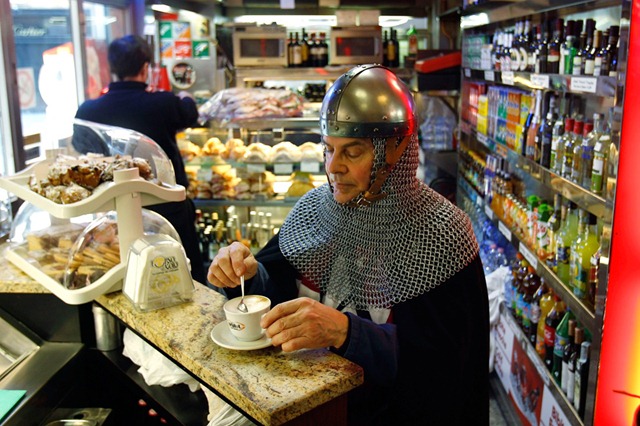
Or will we find ourselves in 2030 like this medieval knight trying to get his cup of coffee in the local deli ?


c03_22043139

No, in 2030 we want our children to be in a position to lead and not be the “behaving” followers in some old-European country that is by-passed by countries and regions that work at the speed of light, that have higher education standards, higher ethical standards, in other words who have found the “how-differentiator”.

My desire is to create

a movement

a tribe

a Medici Effect


where the dream can come true.

Who feels connected ? Who would like to join this tribe ?

Let me know via the comments of the blog, or contacting me directly. Please also let me know where the model flaws. What you would add to it ? Do you believe i am on to something or just living an illusion ? Let me know.

Maslow for Stakeholder Relations

If you have any role in Stakeholder Relations (in some companies this is called “PR” and/or “Investor Relations” and/or “HR”), i can recommend reading Chip Conley’s book “Peak: How Great Companies Get Their Mojo from Maslow”

Conley, the CEO and founder of Joie de Vivre Hospitality, turned to psychologist Abraham Maslow’s iconic Hierarchy of Needs. This book explores how Conley’s company "the second largest boutique hotelier in the world" overcame the storm that hit the travel industry by applying Maslow’s theory to what Conley identifies as the key Relationship Truths in business with Employees, Customers and Investors.

To be honest, the essence of the book is in the first chapter. The other chapters are endless variations and illustrations of the same with rather simplistic, naive, and even romantic examples.

For those not-familiar with the work of Abraham Maslow:

Maslow studied mentally healthy individuals instead of people with serious psychological issues. This enabled him to discover that people experience “peak experiences,”high points in life, when the individual is harmony with himself and his surroundings. A visual aid Maslow created to explain his theory, which he called the Hierarchy of Needs, is a pyramid depicting the levels of human needs, psychological and physical. When a human being ascends the steps of the pyramid he reaches self actualization.

Maslow for dummies is summarized in the table below (all tables below come from Chip Conley’s “Peak” book).

image

In his book “Peak”, Chip Conley applies this hierarchy of needs to the three main groups of Stakeholders for any company:

  • Employees
  • Customers
  • Investors

Conley may be over-simplifying, as he reduces Maslow’s five layers to three.

But in the end, i found this an interesting way to assess and improves a company’s stakeholder relations.

1. Employee pyramid

image

Chris Conley basically says that most companies offer a salary and perks in compensation for the employee’s time. Fewer companies succeed in giving true recognition to their staff, and only a very few know that their company should shape the conditions for the employee to find meaning in his work.

2. Customer pyramid

image

The same principles apply to the customer pyramid.  At the top, the customer is truly delighted. Not because you got a “”license to operate” (btw the minimum level pursued in the Lean “Kano” model, but because you address unrecognized needs. You will NOT identify those unrecognized needs through customer surveys, consultations or market research. And the risk exists -  if your organization has been “leaned” to offer in a scalable way the “license to kill” satisfaction – that you won’t have any resources left to try to “create evangelism” by your customers.

3. Investor Pyramid

image

When we look at the relation with the investors, most companies are transaction oriented in their Shareholder’s Relations: when they assess the relation, they ask whether the Board member gets regular and sufficient information or whether the dining and site-seeing arrangements are to everybody’s satisfaction. However, the ultimate nirvana in Investor relations is that your investors are PROUD of being your investor. This is much more than “being treated well”. It’s much more that just being a happy shareholder, or somebody who would recommend doing business with you.

Reaching the top-levels for each of the three categories of stakeholders is already an unreachable dream for many organizations.

However, shareholder relations should aim for an even higher goal.

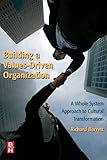
Anybody who has been reading Maslow, should be familiar with Richard Barrett. Chip Conley missed that opportunity. One of the best books to get familiar with the thinking of Barrett, i can recommend “Building a Values-Driven Organization: A Whole System Approach to Cultural Transformation”.

In essence Barrett is saying that Maslow levels focus on our personal self-interest – meeting the needs of the ego.

Beyond Maslow’s level-5 (transformation/self-actualization), Barrettt sees 3 higher levels:

  • Level-6: Internal Cohesion: this is about finding personal meaning in existence
  • Level-7: Making a Difference: about making a positive difference in the world
  • Level-8: Service: leading a life of self-less service

Barrett’s levels beyond transformation are about being ego-less, at the service of others.

The fears of the ego lead us to believe that we do not have enough of what we need. Consequently, we are never fully happy because we do not have enough money, we do not have enough love, and we do not have enough respect.

In this situation, we lead a dependency-based existence.

What if we would apply these upper-levels from Barrett to our Stakeholders Relations ambitions ?

  • Do you have the courage to assess your stakeholder relations based on the Maslow of the Barrett models ?
  • What would you change in your shareholder relations if you would just aim for one higher level then where you are today ?

It’s becoming a trend/pattern: today’s business is not anymore about transactional and technical readiness.

The more important under stream is to develop and execute a solid stakeholders architecture. It’s about an openness and transparency. Often Social Media tools are used to support such strategy and ambition. But they are just tools. They are worthless and only become “tricks for the quick fix” in the absence of a genuine stakeholders architecture.

Execution on this is what you could call innovation in stakeholder relations

In the end, our new-game economy is about doing good, giving meaning, and realizing your relationships.

In the end, its all a matter of

ambition


The level of ambition will define how innovative your company wants to be.

No ambitions leads to no innovation or incremental improvements at best.

Ambition will force you to look into other corners, will let you discover how you truly can redefine your marketplace and change the game.

Ambition will lead to radical innovation: in your products, services, and in your stakeholder relations.

So, what’s your ambition ?

Reblog this post [with Zemanta]