Massive manias, booms and busts.

Remarkable video from Peter Thiel speaking at the Singularity Summit two years ago about the need for Singularity in todays Financial Markets.

Peter Andreas Thiel (born 1967) is an American entrepreneur, hedge fund manager, libertarian and venture capitalist. With Max Levchin, Thiel co-founded PayPal and was its CEO. He currently serves as president of Clarium Capital.

Thiel has made early-stage investments in several startups, including Slide, LinkedIn, Friendster, Geni.com, Yammer, Yelp, Powerset, Vator, Palantir Technologies, Joyent and IronPort.

Btw, we already mentioned Palantir Technologies in this earlier blog post. Also those folks are ex-PayPal.

“As you can’t predict, you have to bet” says Thiel.

And “The alternative to the singularity is the apocalypse”. See also my previous post on the need for a singleton if we want to avoid humans to be overruled by Artificial Intelligence

We will (are) witness massive manias, booms and busts

on a scale unprecedented.

But that’s not normal for markets that are well connected. Markets that are well connected (such as the financial markets) have more information circulating on their networks. Normally, when more and more information is floating around in a market, that market gets smoothened out and gets more efficient. Stocks would evolve at a smooth 6-7% per year, and most volatility would go out of the market.

Well, unless you have been living on another planet, the contrary is true. And worse,

the frequency ànd amplitude of the booms and busts gets bigger.

There was the Japanese crash end 80ies, the emerging markets mid 90ies, the intro of the financial derivatives that scaled to a 1 trillion hype industry, in 98 Russian market blew up, the March 2000 Internet bubble, the 2008 bust of Lehman’s and the big crisis we are in now. Peter Thiel explains how in March 2009 was the last month of insanity before the bust.

Dillusion and insanity were at their peak.

What i really like is when he says: “at the peak of the boom, you can see furthest”.

It reminds me of another quote – can’t find right away from who – that when innovating you better start with the future in mind, rather than starting from the now. The latter approach usually leads to small incremental adjacencies, whereas the first approach at least gives you a chance of driving something disruptive.

All big breakthroughs were disruptive. None of them were predictable by extrapolating the past of the now. See also Nassim Nicholas Taleb’s The Black Swan book.

Btw, in the last Wired (Aug 2009), you can read that speaking of the Black Swan is really “tired”. That’s the stage before “expired”. Old-fashioned.

Isn’t this about big trends ? Like that all sorts of businesses will  not work in the enterprise 2.0 economy. That running a more authentic business becomes mandatory. See book industry, see newspapers, etc.

However, the biggest trend –says Thiel in 2007 -  is the trend from old to new media. So big a trend you don’t even see it.

That was at the Singularity Summit in 2007 two years ago. Next summit is in October 2009. Have  a look at the line-up of speakers. Very curious what those great thinkers will spot as trends you don’t even see.

What are the biggest manias, busts and booms to come ?
Human Evolution Future

Found a really interesting post today on Accelerating Future blog of Michael Anissimov.

He refers to the technology optimism of Kevin Kelly (KK). If you’re not familiar with KK, you should and definitely to his blog.

Kevin Kelly’s Panglossian optimism is exactly the type criticized in Nick Bostrom’s paper “The Future of Human Evolution”. The PDF version of this paper can be found here.

I read the paper and was blown away by some strong starting points, assumptions, statements and conclusions.

Some teasing extracts to further encourage you to download the paper and – more importantly – read and consume it.

The past few hundred years have seen enormous improvements in human life‐span, labor productivity, scientific knowledge, and social and political organization, which have enabled billions of people to enjoy unprecedented opportunities for enjoyment and personal development. On a historical as well as on a geological timescale, the big picture shows an overarching trend towards increasing levels of complexity, knowledge, consciousness, and coordinated goal‐directed organization, a trend which, not to put too fine a point on it, we may label

 “progress”.

… this past record of success gives us good grounds for thinking that evolution (whether biological, memetic, or technological) will continue to lead in desirable directions. This view, however, can be criticized on at least two grounds.

First, because we have no reason to think that all this past progress was in any sense inevitable‒‐much of it may, for aught we know, have been due to luck.

And second, because even if the past progress were to some extent inevitable, there is no guarantee that the melioristic trend will continue into the indefinite future.

then the only way we could avoid long‐term existential disaster is by

taking control of our

own evolution.

Doing this, I shall further argue, would require the development of a “singleton,” a world order in which at the highest level of organization there is only one independent decision‐making power (which may be, but need not be, a world government).

Second, new methods of reliably communicating information about oneself might be available to technologically mature creatures, methods that do not rely on flamboyant display. Even today, professional lenders tend to rely more on ownership certificates, bank statements, and the like, than on costly displays such as designer suits and Rolex watches. In the future, it might be possible to employ auditing firms that can

verify through direct inspection that a client possesses a claimed attribute.

Signaling one’s qualities by such auditing may be much more efficient than signaling via flamboyant display. Such a professionally mediated signal would still be costly to fake (this is of course the essential feature that makes the signal reliable), but the signal could be much cheaper to transmit than a flamboyantly communicated one when it is

truthful

… not all possible costly or “flamboyant” displays are ones which we should regard as intrinsically valuable…

Just as current human beings benefit from other species, which pose no serious threat to the human species, so too may technologically more advanced agents benefit from the existence of an ecology of non‐eudaemonic agents

Moreover, by contrast to current human political competition, where alliances shift over time, it might be possible for more advanced life forms verifiably to commit themselves permanently to a particular alliance (perhaps using

mind‐scanning techniques

and

technologies for controlling motivation

All this makes me think about Kosta Peric’s posting on www.innotribe.com on developing a vision for 2020. Initial posting and debate can be found here.

Back from the future – tell your story

Consider the following "thought experiment" – imagine yourself in the future (let’s say somewhere in the 2020’s) and describe how the world looks like – and also how we got there. Something like this:

http://idorosen.com/mirrors/robinsloan.com/epic/

Some predictions are off and some are … quite close and still unfolding. In fact as we speak there are examples of newspapers attacking google or the internet in general.

(There is another movie applying the same trick for the financial industry known as "amazonbay"  but unfortunately all the links to it on the web are all off)

As a matter of fact that video is here:

image

I find this type of thinking very useful and creative – you can drop all constraints and just let the imagination loose!
Any candidates for visionary story telling?

If you look at the stories posted, they are just lacking a bit of imagination on what’s going to happen by 2020 or 2030. Most of the the things posted there are already possible today !

I have a couple of days off and will try to write some sort of trailer on  what i believe is going to happen based on the singularity principles of Ray Kurzweil, and other great thinkers like Kevin Kelly and Nick Bostrom.

Stay tuned for some amateur SiFi.

Bank are dead. Long live the banks !

image Paul2

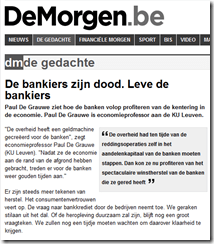
Interesting article in Belgian dutch newspaper De Morgen this week-end by Paul De Grauwe, Professor Economics at the University of Leuven.

Free translation of the key paragraph:

What is clear now, is that banks start to take advantage of the more positive economic climate. They do this in different ways. First of all they almost get free money from the European Central Bank (ECB). They invest those assets in government bonds at an interest rate of 3 to 4%.

The government has thus created a money machine for the banks. The ECB, part of the government sector, lends money to the banks and “charges” an interest of 1%. The same government pays 3 to 4 % interest rate to those same banks. The banks take no risk whatsoever. The manna falls out of the sky. That way, i also want to become a banker.

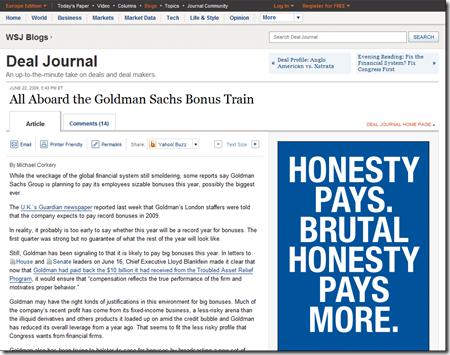
I was last week in New-York, and there was a lot to do on television channels and on Times Square billboards about the Goldman Sachs bonuses.

I just googled that subject, and i found this blog on Wall Street Journal:

image

It’s a bit cynical that this article gets the honesty ad from Barron’s.

Happens that over the week-end, i stumbles upon the latest blog from the always enlightened Sean Park on The Park Paradigm, with reference to Andy Haldane’s brilliant paper “Rethinking the Financial Network (April 2009).

Mr. Haldane is Executive Director, Financial Stability at the Bank of England. The Financial Stability area plays a key role in meeting the Bank’s responsibilities for maintaining the stability of the financial system as a whole. In this role, Andy has responsibility for developing Bank policy on financial stability issues and the management of the Financial Stability Area. Andy is a member of the Financial Stability Board, which gives high level guidance on priority-setting, and of the Bank’s Executive Management Team.

The document (text of a speech) starts with a comparison between the 2002 SARS pandemic (could also have been H1N1 in 2009) and the 2008-2009 Financial Market stand-still.

On 16 November 2002, the first official case of Severe Acute Respiratory Syndrome (SARS) was recorded in Guangdong Province, China. Panic ensued. Uncertainty about its causes and contagious consequences brought many neighbouring economies across Asia to a standstill. Hotel occupancy rates in Hong Kong fell from over 80% to less than 15%, while among Beijing’s 5-star hotels occupancy rates fell below 2%.

Etc….

On 15 September 2008, Lehman Brothers filed for Chapter 11 bankruptcy in a New York courtroom in the United States. Panic ensued. Uncertainty about its causes and contagious consequences brought many financial markets and institutions to a standstill. The market for Credit Default Swaps (CDS) froze, as Lehman was believed to be counterparty to around $5 trillion of CDS contracts.

Etc

And he goes on:

These similarities are no coincidence. Both events were manifestations of the behaviour under stress of a complex, adaptive network. Complex because these networks were a cat’s-cradle of interconnections, financial and non-financial.

Adaptive because behavior in these networks was driven by interactions between optimising, but confused, agents. Seizures in the electricity grid, degradation of ecosystems, the spread of epidemics and the disintegration of the financial system – each is essentially a different branch of the same network family tree.

This paper considers the financial system as a complex adaptive system. It applies some of the lessons from other network disciplines – such as ecology, epidemiology, biology and engineering – to the financial sphere. Peering through the network lens, it provides a rather different account of the structural vulnerabilities that built-up in the financial system over the past decade and suggests ways of improving its robustness in the period ahead.

MIT Personas Project

Spotted via Techcrunch and my always reliable source “xstof”:

MIT Personas Project.

It gives you an idea on how the internet sees you. A quite better version of Google your own name.

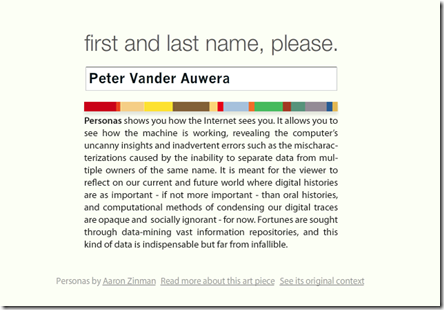
Personas is a component of the Metropath(ologies) exhibit, currently on display at the MIT Museum by the Sociable Media Group from the MIT Media Lab. It uses sophisticated natural language processing and the Internet to create a data portrait of one’s aggregated online identity. In short, Personas shows you how the Internet sees you.

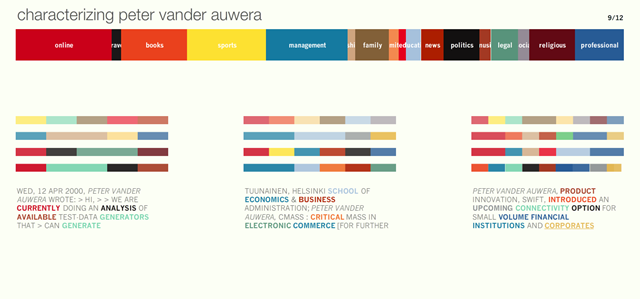
Enter your name, and Personas scours the web for information and attempts to characterize the person – to fit them to a predetermined set of categories that an algorithmic process created from a massive corpus of data. The computational process is visualized with each stage of the analysis, finally resulting in the presentation of a seemingly authoritative personal profile.

Have a look here and enter your full name and allow MIT to determine your online profile or the associations they’re able to make based upon your name.

image

First, this thing starts scanning your information shadow on the internet:

image

At the end you get:

image

Doing this live is much more impressive !

This is a very good example of what i meant in earlier posts on your Information Shadow on the internet, and how that is leading to your unique identity “footprint” or DNA. Just start imagining that the colored bar above is your own unique personal spectrum analysis. Just like they do for spectrum analysis of substances or stars. 

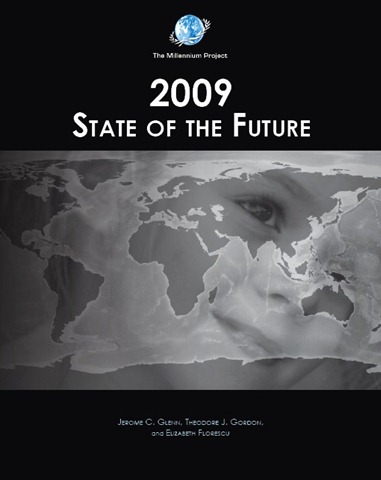
2009 State of the Future

The 2009 State of the Future report, just published by the Millennium Project, a global, independent futures-research think tank.

sof2009

The Executive Summary can be downloaded here.

Interesting dimensions in the report:

  1. Two State of the Future Indexes are presented; one without the recession and one based on an extended recession
  2. Emerging International Environmental Security Issues
  3. Future Economic Elements to Improve the Human Condition

The Future Economic Elements receiving the highest average ratings from the international panel for beneficial impacts for the future of humanity were:

Ethics a key element in most work relations and economic exchanges
• New GNP/GDP definitions that include all forms of national wealth: e.g., energy, materials, ecosystems, social and human capital
• Global commons—air, climate, oceans, biodiversity (bees necessary for agriculture, etc.)—supported by international agreements among countries for very small (less than 1%) tax on selected categories, including currency trading and international travel; the funds collected would amount to several hundred billion per year for global public goods
Collective intelligence––global commons for the knowledge economy
• On-line and in-classroom educational systems that continually update curriculum on the evolving economic system and its elements.

Interesting quote:

In March 2009 an asteroid missed Earth by 77,000 kilometers, 80% closer to the planet than our moon is. If it had hit Earth, it would have wiped out all life on 800 square kilometers.

No one knew it was coming.

The time between its discovery and close approach was very short.

Few people knew the global financial crisis was coming; fewer still forecast its breadth and depth. We need global, national, and local systems for resilience—the capacities to anticipate, respond, and recover from disasters while identifying future technological and social innovations and opportunities.

The acceleration of change reduces the time from recognizing the need to make a decision to completing all the steps to make the right decision. The number and intricacy of choices seem to be growing beyond leaders’ abilities to analyze and make decisions.

For example, do we have the right to clone ourselves, or to rewrite genetic codes to create thousands of new life forms, or to genetically change ourselves and future generations into new species?

Some experts speculate that the world is heading for a “singularity”—a time in which technological change is so fast and significant that we today are incapable of conceiving what life might be like beyond the year 2025.

Fortunately, we have the means for many people to know the world as a whole, identify global improvement systems, and seek to improve such systems—hence accelerating the improvements of our global situation.

We are the first generation to act via Internet with like-minded individuals around the world.

We have the ability to connect the right ideas to resources and people to help address global and local challenges. This is a unique time in human history.

Mobile phones, the Internet, international trade, language translation, and jet planes are giving birth to an interdependent humanity that can create and implement global strategies to improve the prospects for humanity.

Identity revisited by Google: WebFinger

Great post on TechCrunch by Michael Siegler. WebFinger from Google.

picture-1111

I have posted many times in my blog about identity and the uniqueness of the information shadow each of us leaves on the internet.

webfinger_450c

This is exactly what Google plans to do: link your e-mail address to your information shadow.

Today they think (WebFinger Google Code page) think about:

    • – public profile data
    • – pointer to identity provider (e.g. OpenID server)
    • – a public key
    • – other services used by that email address (e.g. Flickr, Picasa, Smugmug, Twitter, Facebook, and usernames for each)
    • – a URL to an avatar
    • – profile data (nickname, full name, etc)
    • – whether the email address is also a JID, or explicitly declare that it’s NOT an email, and ONLY a JID, or any combination to disambiguate all the addresses that look like something@somewhere.com
    • – or even a public declaration that the email address doesn’t have public metadata, but has a pointer to an endpoint that, provided authentication, will tell you some protected metadata, depending on who you authenticate as.

But to be honest, it could be anything about your information shadow.

Update on Louis Gray Blog: somebody already developed first client.

webfinger_450a

The whole thing is just starting: http://webfingerclient-dclinton.appspot.com/ 

Curious what Dave Birch has to say about this on Digital Identity Forum or Kim Cameron on Identity Blog.

Nanohands


EU-funded NanoHand project uses mobile microrobots equipped with delicate handling tools. NanoHand builds on the work of ROBOSEM, an earlier EU project that developed the basic technologies that are now being put into effect. The robots, about two centimetres in size, work inside a scanning electron microscope where their activities can be followed by an observer. Each robot has a ‘microgripper’ that can make precise and delicate movements. It works on an electrothermal principle to open and close the jaws, much like a pair of tweezers.

The jaws open to about 2 micrometres and can pick up objects less than 100 nanometres in size. “[It is] really able to grip micro or even nano objects,” Eichhorn says. “We have handled objects down to tens of nanometres.”

Bugs from the screen into your arm

Via Beyond the Beyond:

What’s real and what’s screen ?

What are our boundaries ?

Scary pushing of known boundaries. How will this look in 2030 ? Food for thought for our Think Tank on Long Term Future.

The Distinction of Past and Future

Thanks to my subscription to Twine.com, i found this great website of Humansfuture.

future_human_evolution

It brings together subjects like Artificial Intelligence, Nano, Genetic Engineering, Transhumanism, etc, etc,… exactly all the subject matter for our Think Tank on Long Term Future.

From there i went on a surf “trip”, and discover The Next Big Thing, an initiative from BBC2 Open University.

They find their stuff at the Vega Science Trust.

Which led me discover the Classic Feynman Lectures that were put on line recently by Bill Gates on Microsoft Research under Project Tuva.

Btw, i wonder what became of Bill Gates new company, a sort of Think Tank.

White1

Microsoft Research Project Tuva presents Nobel Prize winning physicist Richard Feynman’s Messenger Series lectures within a new video player. This enhanced video player features searchable video, linked transcripts, user notes, and interactive extras.

Have a look at the 1964 lecture on “The distinction of past & future”. Dont forget this is 50 years old !

You can of course also google/bing Feynman. Here is a cool video: he starts by saying “I want to investigate everything”.

So, while the title of this post relates to future that is still 30-50 years away, it brings us back 50 years ago !