Check out this interesting company Recorded Future.
This is very relevant to my upcoming post on Digital Identity Tuner 7.0
Start thinking of this metaphor when looking at your digital footprint.

Check out this interesting company Recorded Future.
This is very relevant to my upcoming post on Digital Identity Tuner 7.0
Start thinking of this metaphor when looking at your digital footprint.
Summer is coming to an end.
I had some good times off, disconnected with lots of reading, biking, and hanging around. Also the best way to let new ideas emerge.

Lately, i have been immersed in digital identity. First, I attended the EEMA European e-Identity Management Conference in London . The week after, I was the “tour guide” for a study week on the subject with 4 other colleagues.
We discovered a rich subject – in full (r)evolution – and we met really very smart people who were extremely knowledgeable about the subject.
Since then, I have been reading and thinking a lot about the subject.
This blog post – in different parts – is a detailed report of those conversations, reflections, interpreted in a very personal way. In other words, this is my very personal consolidation and internalization on the subject.
The subtitle of the blog is “the unpolished diamond”. Indeed, what I will present here is a multifaceted subject. It’s like a rough diamond, which still needs to be polished into a beautiful multifaceted shiny precious diamond.
The different facets of the diamond are organized in “chapters”. I feel like this can become the basis of a more in-depth whitepaper, or – time and ambition permitting – a book at some day. Please let me know and/or encourage me if you want me to go ahead with this crazy idea of a book.
I will come up with some other metaphores in subsequent posts. The one on “Digital Identity Tuner 7.0” is in the making, where I will really push the identity envelope.
Anyway, my identity story starts in 2001 or so. That’s when I got infected by the identity-virus: I was working for Microsoft (2001-2005) on the Belgian e-Identity Card (eID) project.
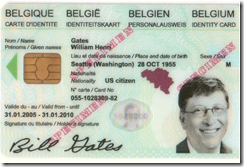
This was a once-in-a-life project, sponsored by Bill Gates himself, who saw the advent of 8 million eID citizen cards being distributed in a mandatory way to the Belgian citizens over a period of 5 years as a ideal test/pilot market. (BTW: Belgium is already renewing the first cards that were issued at the time; this means this has to be looked at as an infrastructure thing, that needs to be maintained for several generations)
We wanted to discover how citizens reacted to such eID card, assess what sort of applications were being build that consume this eID card, and what would be needed to support this sort of card in Microsoft products. This was far reaching, as we looked across the board at Windows OS, Microsoft Office, MSN (Safe chat for children), workflow, audit and regulatory requirements, and last but not least privacy.
My role was one of Business Development Manager, not so much in a sales mode, but rather in a research and discovery mode.
It was during this time that I met Kim Cameron (Microsoft’s Chief Architect Identity), just at a moment when Kim had published his seminal whitepapers “Laws of Identity” and “Towards an e-identity meta-system”.
Kim has become a friend since then, and I highly recommend his blog www.identityblog.com.
I was permeated with the early concepts of claims based identities, and ever since, I felt a natural attraction towards anything that was related to identity, not only e-identity but also identity in it’s philosophical and existential sense “who am I really ?”
Already at that time (2001),
I felt that the eID card
(a smart card with certificates issued
by the Belgian government)
was an anachronism.
We seemed to use
concepts of a physical world,
and tried to use them
in an on-line world
fundamentally different because
hyper-distributed and
highly interconnected
In addition one can question today whether the government (or a bank, or another “trusted” party should be the originator of the identity).
It’s like maintaining a 2D view on a world that has since long moved to 3D. It’s like looking at the sunset in 2D: what you see is a circle that gets smaller and smaller until it’s a dot and then finally disappears.
But in this 2D view, one has lost the 3D dimension of our planetary system, and the highly dynamic and interdependent set of moving parts.
This view is shared by David Birch, who runs a very interest Digital Identity Blog when he says:
The analog-digital comparison does not work when thinking about 21st century e-identity
There are indeed some novel views that
instead of having “an e-identity
issued by the government
to offer value to the citizens”,
it would not be better to have “an e-identity
issued and managed by the citizens
to offer value to the government”
This view is highly related to a tectonic shift of power back to the owner of the data, or more in general the revolution from “Push to Pull” business models that are so well described in John Hagel’s seminal book “The Power of Pull”, in my opinion THE business book of 2010 (although not shortlisted in FT’s 2010 best business books –> FT is wrong 😉
In the next editions of the “unpolished digital identity series”, I will tackle following “chapters”:
Hmmm… it starts indeed looking like a book. Any input and suggestions welcome.
Cross-posted on Swiftcommunity.net
Imagine understanding thousands of data-sources in real-time and do market correlations; or leveraging deep unstructured data analytics in order to derive financial intelligence from unstructured data; and render all of this rich information to your users in rich user interfaces such as iPhone/iPAD or even gesture based user interfaces to do slicing and dicing of massive data sets.
Imagine unleashing the power of SWIFT semantics and standards knowledge on structured and non-structured information, and what could happen then. That is what our “Smart Data” theme in Innotribe at Sibos2010 (25 – 29 Oct 2010 in Amsterdam) is all about. We decided to call it “Smart Data” , as – at least in our industry – the words “semantic web” have – ironically – little meaning.
The ability to understand the semantic meaning of data will improve business intelligence for financial services. In essence, today SWIFT already tags semantically the fields of the standard SWIFT messages. Tomorrow, we could tag ANY information, including non-structured information hidden in PDF’s or Word documents or other information streams, overlay that information with existing other structured data sources, and offer pattern recognition services leading to deeper intelligence about those data sets. If you’re interested, I have prepared a more detailed write-up on my personal blog here .
As always in Innotribe @ Sibos, also this Smart Data theme is supported by Keynotes, Face-to-Face discussions, interactive workshops (Innotribe Labs) and R&D demonstrations.
Smart Data keynotes: “Towards more financial intelligence through semantics”
on Wednesday 27 October, from 09:00 – 10:30 in the Interactive workspace.
As for the other themes, we have a great line of speakers. All presentations will focus on what is the possible value of applying semantic technologies with a high relevance for financial services. So, these are not theoretical presentations, but examples of applied semantics. With demos so that you get a real feel of what happens when you start overlaying different data sources.
Smart Data Face-to-Face discussion: “Which semantic evolutions will transform financial intelligence? “
on Wednesday 27 October from 12:30 – 14:00 in the Interactive workspace
The Face-to-Face discussion will be kicked-off by a 20 min thought provoking presentation by Rob Usey, CEO of www.Psydex.com , who will give a mind-blowing demo of their PsyngFX application: this application listens in real-time to thousand of structured and unstructured information feeds, does semantic tagging on the fly, and correlates this with marketdata. Whether your topic of interest is Oil Refinery Explosions, Apple Computer or Mergers & Acquisitions, Psyng can instantly alert you to key news events, delivering correlations and projected impacts as the news happens.
After this scene setting presentation, Eghosa D. Omoigui will moderate a panel of smart data specialists:
Currently confirmed are:
Smart Data Lab
We are repeating the highly successful format of Innotribe Labs. One or more Smart Data Idea generation teams will be formed on the spot, and over the course of the 3 days they will prepare a professional pitch to be delivered on Thursday during the “Pitch your Lab competition, in front of the public and a very skilled Buyer’s Panel.
The Smart Data Innotribe Lab team will be supported by following professionals:
R&D Demonstrations:
We’ll have this year a beautiful Innotribe corner integrated in the main SWIFT Stand. We’ll have a packed program here as well. We are still looking at the many candidates, and will do a separate blog on all the presentations scheduled throughout the week.
Educational Resources:
I am a big believer of Semantic Web, and always on the look for good educational material to help me explain what it is and why it is important.Please find below some great resources:
– Video made by Cisco, by their IBSG group (Internet Business Solutions Group).
– One single link with many other educational resources here .
– If you want to get somebody interested enough to do some more research, this 14 minute film by Kate Ray is the perfect thing to give you the appetite for the subject: Web 3.0 from Kate Ray on Vimeo.
Web 3.0 from Kate Ray on Vimeo.
Let’s start the conversation:
Innotribe is organised by SWIFT Innovation with the support of financial institutions, vendors and innovation leaders.
We just opened a Web-Storm on Innotribe.com to collect your idea on this Smart Data theme and the other 3 themes as we build up towards October. We will feed-back these ideas to the Innotribe Leaders before the actual Labs in Amsterdam. Check out www.innotribe.com
In the true spirit of less push and more pull, we encourage you to engage in a true dialogue with the Innotribe team. We look forward to seeing you in Amsterdam.
The Innotribe team
www.sibos2010.com
www.innotribe.com
www.swiftcommunity.net/innotribe
innotribe@swift.com
Twitter: http://twitter.com/innotribe
Last week, I had the privilege to attend the first edition of Techonomy, a fantastic new conference blurring technology and economy with an optimistic balance that technology in its broadest sense (not only IT, but also gnome sequencing, bio-fuels, big history, etc) can be the driving force for a better world.
First enjoy the announcing video below.
The conference was bringing together 3/4 of Silicon Valley’s leadership, including Eric Schmidt, Jeff Bezos, Bill Joy, Bill Gates, Steward Brand, Kevin Kelly, John Hagel, Deborah Hopkins (Chairman of Venture Capital Initiatives and Chief Innovation Officer Citi), Nicolas Negroponte, Sean Parker, Padmassree Warrior CTO Cisco), Jeff Weiner (CEO LinkedIn), and the list goes on, and only a couple of non-US leaders such as Nobuyuki Idea (Founder of CEO of Quantum Leaps Corporation, working on innovation, and previous CEO of Sony Corporation), Nellie Kroes (European Commissioner for Digital Agenda), Vineet Nayar (CEO HCL Technologies, India), and Ory Okolloh (Founder/Executive Director Ushahidi, South Africa).
How to describe Techonomy conference ? I would say “a super-TED with a technology focus and with an agenda”.
The agenda is “a new philosophy for progress”.
It’s a movement
Somebody asked “a movement against which enemy, against which barriers ?”.
I believe it is a movement FOR something.
For a better world. Finding techonomic solutions to tackle the global climate challenges, feeding the world, a better health for everybody, a new value kit for the current and next generation, not based on greed but on the concepts of creative capitalism as formulated some years ago by Bill Gates in the Bill and Melinda Gates Foudation.
In that sense, it should not surprise the regular reader of this blog how much this resonated with myself. Not only the personal inspiration, but especially how we with on organization like SWIFT can adopt and promote the techonomist values and objectives.
I also came across some leaders that could be subject of SWIFT’s CSR initiatives. Take Bill Drayton, Leadership Group Member Chair and CEO of Ashoka, the global association of the world’s leading social entrepreneurs, men and women with system changing solutions for the world’s most urgent social problems, encouraging everybody to be a changemaker.
It’s impossible to describe the intensity of the content and contacts of these 3 Techonomy days.
Some highlights:
The conference is so good. It cries for a European and an Asian chapter. Any European Leader should not hesitate a second to be associated with and sponsor it.
I was dreaming of hosting a European chapter of Techonomy at the fantastic SWIFT Headquarters south of Brussels.
El Jefe, do you hear me ?
Cross-posted at swiftcommunity.net
Last time, we shared our high-level Innotribe program for the Sibos week (25-29 October 2010) . This week we’ll zoom into the details of our Cloud program, one of the 4 themes of this year’s Innotribe.
Cloud was already on the program last year. Our main ambition then was to introduce you to some basic concepts of Cloud Computing, such as Infrastructure-as-a-Service (IaaS), Platform-as-a-Service (PaaS) and Software-as-a-Service (SaaS).
This year we want to go beyond that basic definition stage. Following last year’s Labs, which were focused on the economics of cloud computing, this year focuses on the practical implementation, user experiences, and why it’s important for the financial industry. There will be a specific focus on hybrid cloud models and APIs.
As always in Innotribe @ Sibos, also this Cloud theme is supported by Keynotes, Face-to-Face discussions, interactive workshops (Innotribe Labs) and R&D demonstrations.
Cloud computing keynotes: “Towards new models and APIs”
on Monday 25 October from 11:00 – 12:30 in the Interactive Workspace
We have a great line of speakers. Confirmed at the time of this writing are:
Face-to-Face discussion: “Appstore for financial services – dream or reality?”
on Monday 25 October from 12:30 – 14:00 in the Interactive Workspace, right after the Cloud keynotes.
The Face-to-Face discussion will be kicked-off by a provoking presentation by Sean Park (CEO, Nauiokaspark) on the need for a neutral platform for cloud applications for the financial services.
Peter Hinssen, CEO, A-Cross Technologies will again be our skilled moderator for the Cloud Face-to-Face discussions. Last year he managed a panel of 11 participants. The feedback indicated that such a big panel was maybe a bit over the top. So this year, we have a slightly smaller panel. Confirmed so far are:
Innotribe Labs
We are repeating the highly successful format of Innotribe Labs. One or more Cloud Idea generation teams will be formed on the spot, and over the course of the 3 days they will prepare a professional pitch to be delivered on Thursday during the “Pitch your Lab competition, in front of the public and a very skilled Buyer’s Panel.
The Cloud Innotribe Lab team will be supported by following professionals:
R&D Demonstrations:
We’ll have this year a beautiful Innotribe corner integrated in the main SWIFT Stand. We’ll have a packed program here as well. We are still looking at the many candidates, and will do a separate blog on all the presentations scheduled throughout the week.
Let’s start the conversation:
We just opened a Web-Storm on Innotribe.com to collect your idea on this Cloud theme and the other 3 themes as we build up towards October. We will feed-back these ideas to the Innotribe Leaders before the actual Labs in Amsterdam. Check out www.innotribe.com
Innotribe is organised by SWIFT Innovation with the support of financial institutions, vendors and innovation leaders.
In the true spirit of less push and more pull, we encourage you to engage in a true dialogue with the Innotribe team. We look forward to seeing you in Amsterdam.
The Innotribe team
www.sibos2010.com
www.innotribe.com
www.swiftcommunity.net/innotribe
innotribe@swift.com
Twitter: http://twitter.com/innotribe
At this year’s Innotribe at Sibos (25-29 Oct 2010), we have a whole track on “Smart Data” aka “Semantic Web”.
We decided to call it Smart Data is – at least in our industry – the words “semantic web” have ironically little meaning.
I am a big believer of Semantic Web, and always on the look for good education material to help me explain what it is and why it is important.
Here is a video made by Cisco, by their IBSG group (Internet Business Solutions Group). I had the pleasure of recently working with IBSG folks, and I can tell you these guys are NOT the router guys. They are very knowledgeable. I also recently discovered they had a whole practice on digital federated identity and now this one on semantic web.
Some highlights in this video:
Starting (!) from the iPhone App Siri (Siri was acquired by Apple in April 2010), to WiseWindow, the video gives you some teasers on what this technology can do for you, and then moves into a really good and quick tutorial on the standards underpinning semantic web.
The Siri application is about understanding natural language and giving intentional feedback and information back to the user. Watch the detailed video above.

WiseWindows looks into
The speaker also emphasizes the importance of onthologies. Highly relevant in a SWIFT Standards context. With the ISO20022 Standards, SWIFT is already at the core of THE semantic onthology for the financial industry. Fore Semantic web, an untapped goldmine for the emerging future of SWIFT.
The ability to understand natural language and reason about data could improve business intelligence for financial services. In essence, today SWIFT already tags semantically the fields of the standard SWIFT messages. Tomorrow – with our onthology – we could tag ANY information, including non-structured information hidden in PDF’s or Word documents, overlay that information with existing other structured data sources, and offer pattern recognition services leading to deeper intelligence about our and our customers’ data.
What I want to make clear is that this is not only related to the social web. On the contrary.
It’s about data-integration within and across organizations.
Was that not the purpose of EAI (Enterprise Application Integration) and EDI (Electronic Data Interchange) ? The difference is that the above systems are often messaging based: sending (standardized) structured messages from one system to another.
I believe that we are witnessing a paradigm shift
from “sending messages from A to B”
to “publishing linked data”
into centralized or distributed data repositories.
From “sending and storing messages”
to “publishing and subscribing
to linked-data repositories”
The key challenge in all this is to be able to (automatically) tag data semantically. Who else than SWIFT would be better placed to be that semantic quality anchor for the financial industry ?
The video closes with 5 messages for our leaders:
I have seen recently from Cisco how they do live-streaming-and-tagging of video for their internal portal. Maybe we should invite somebody from the Cisco IBSG-team to our Smart Data stream at Sibos ?

BTW: Guido Jouret from Cisco will speak at Innotribe at Sibos in the Open Innovation Best Practices session on Thursday 28 Oct 2010. Guido Jouret is Chief Technology Officer (CTO) of Cisco’s Emerging Markets Technology Group (EMTG), which is responsible for incubating Cisco’s future billion-dollar businesses.
Cross-Posted on SwiftCommunity.net
Last week, Kosta kicked-off the next Innotribe @ Sibos2010.

I am pleased and excited to complement Kosta’s introduction by sharing with you our high-level program for the Sibos week (25-29 October 2010).
High Level program
A good presentation/show has a fantastic start, and great core, and an exciting grand finale. That’s exactly how our Innotribe @ Sibos2010 program is organized 😉
We have a fantastic start: our “Innovation Opening Keynotes: the big tectonic shifts” on Monday 25th from 9am – 10:30
What a line-up of speakers ! We have now confirmed:
Both in content, quality of the speakers, and format of this session, this will be THE not-to-be-missed session on Sibos Monday. We are convinced it will set the bar for any session for the upcoming week.
We have a great core: We have 4 Themes. As last year, we have appointed Innotribe Leaders and VC-Coaches to each of these themes:
The line-up of speakers, face-to-face panel members and moderators is stronger than ever before. This will be the subject of subsequent Innotribe @ Sibos2010 blogs.
We just opened a Web-Storm on Innotribe.com to collect your idea on these 4 themes as we build up towards October. We will feed-back these ideas to the Innotribe Leaders before the actual Labs in Amsterdam. Check out www.innotribe.com
In addition, we will have 2 Masterclasses Innovation, we have invited the 5 leading software vendors for innovation management tools, and we’ll have an update on eMe (winner of last year).
We also teamed-up in a quite significant way with our colleagues from Standards and Technology. You will notice on the Sibos program a number of interactive sessions that have been co-designed with Innotribe.
The exciting grand finale: the best of the Innotribe week comes together on Thursday 28 October 2010.
Some elements to spice it all up:
Let’s start the conversation:
Innotribe is organised by SWIFT Innovation with the support of financial institutions, vendors and innovation leaders.
In the true spirit of less push and more pull, we encourage you to engage in a true dialogue with the Innotribe team. We look forward to seeing you in Amsterdam.
The Innotribe team
www.swiftcommunity.net/innotribe
Twitter: http://twitter.com/innotribe
Great book Multipliers: How the Best Leaders Make Everyone Smarter.
Summary here.
Stumbled upon this great blog post by Gary Hamel in the WSJ. Extremely relevant if your business is a service business run by first-level employees.
It’s based on the work of Vineet Nayar at HCL Technologies (HCLT).
It’s now all documented in this great book Employees First Customer Second: Turning Conventional Management Upside Down
If you thought I was sometime being a bit extreme in challenging existing ways of doing things, have a look at following recommendations:
The last two concluding paragraphs are enlightening:
The world has become too complex for the CEO to play the role of “visionary-in-chief.” Instead, the CEO must become a “management architect”—someone who continually asks, “What are the principles and processes that can help us surface the best ideas and unleash the talents of everyone who works here?” Today, as never before, the world needs leaders who refuse to be seduced by the fatal allure of the familiar.
It really is possible to change the management DNA in a large, established company. When you dig into “Employees First” you’ll learn that it’s possible to reinvent management without blowing up the existing management system, without having a detailed master plan at the outset and without taking inordinate risks. If you’re a would-be management renegade—this means you’ve just run out of excuses.
Recently came across this great site by Dan Robles.

One of his latest posts Will Social Capitalism Replace Market Capitalism? (Parts 1&2) included great video material on how social currency can change industries.

His forecasting example is the airline industry. And it’s even not so far fetched. What if you could “Time-Share” seats in private jets ?
It’s easy to think how this social currency model would apply to any other business and radically innovate by creative destruction.
It’s a very novel way to show how a number of trends come together:
By the way, we recently had a face to face meeting with John exploring the possibility to have him with us at Innotribe at Sibos in Amsterdam, 25-29 October 2010.

We have asked John to consider a talk in our Innotribe Opening Keynotes, and to be part of our special Innotribe Lab on The long now in Financial Services.
To come back to the subject of the power of identity, I’d like to spend a bit more time on the tradability of my personal information.
The essence of the story is that some parts of my personal data have value and can be traded under the user’s control to get a better service.
It opens questions to:
I have been immersed in “personal digital identity” the last couple of weeks. Recently i attended the EEMA’s The European e-Identity Management Conference in London.
The week after i was the “tour guide” for a "Digital Identity Tour” we organized with some colleagues on the West-Coast”. I am preparing a set of blog posts on these conferences and 1-1 conversations with thought leaders in e-Identity space.
In this blog i will just simplify my summary thoughts with the statement that e-identity is much, much more that a certificate on a smart-card, or for sake of the argument any other form factor.
We are witnessing a power-shift:
In stead of the government (or the bank, or any other service offering entity) creating digital identities to give more value to the citizen, we see the emergence of identities created by the user to give greater value to the government (or the bank, or any other service offering entity)
We have to carefully think this through, as identity – and relations between and with persons – is really a complex animal.
Have a look at this fantastic 210+ slides presentation “The Real Life Social Network V2” by a Google analyst @Padday aka Paul Adams, working for the UX team at Google. The essence of his story is that there is nothing such as a generic “Friends”. You have all sorts of friends and different depths in relations. Whether those relations are between people-people or people-companies.
It’s a great story, and all slides are annotated. As a teaser, here are his 3 summarizing slides:


It’s interesting how the words identity, privacy, care, relationships, collaboration, strong/week ties, Klout, etc are now all coming together. As a matter of fact, these are all attributes that make us truly human.
As a sherry on today’s cake, i’d like to link you once more to Venassa Miemis site “Emergent by Design” and the great recent blog post on Guidelines for Group Collaboration and Emergence, that is building on both her previous work on “Strenghts Based Society”, “”Skills for a 21st century connected world”, and her work on the open source collaborative tool “Junto”.

As we are preparing Innotribe at Sibos, i had the pleasure to talk to Venassa during a Skype session. We are discussing her participation at several levels of our Innotribe Program.
It is great to see how these novel ideas become “totally” relevant when you start thinking about their value for a “community” like SWIFT and an innitiative like Innotribe where “Enabling Collaborative Innovation” is our “Leifmotto”.
From the conversation with Venassa, i can tell you she “totally” got it, and she is preparing some material and levels of interactivity for Sibos that you even never dreamed of.
We are now 16 weeks from Sibos. The idea is to begin hosting a junto every week, invite different thinkers to discuss the future of money, record all conversations and develop a presentation based on them, but also make the videos available for the attendees of the conference to be able to watch whenever they want to see what those conversations were like.
If we think about the Long Now, will there still be currency as we know it? Or will social currency become central to our trade? And what impact does that have on banks ? Should be have personal data stores where we deposit our digital footprint and open personal accounts and do payments for services from there?
Feel free to jump in.
 Petervan Studios