TEDxNewWallStreet was designed to explore moving banking into the Information Age.
In 2009, Marc Andreessen remarked “banking is just information science.” Inspired by Marc’s words, Bruce Cahan and the Team set out to organize TEDxNewWallStreet to explore the empowerment of the new reality – a banking system different than the Industrial Age system we inherited.
What if Silicon Valley/SanFrancisco/Pacific Northwest or other technology clusters grew New Wall Streets, on quite different terms than exist in New York?
How would they spearhead technology in faster, cheaper, more transparent and accountable ways that contrast with the recent (and recurring) issues of the game as defined and played on old Wall Street?
At that event i did a talk titled “FinOlympics”. We are in the Olympic year 2012 after all, right ?
The talk is a consolidation of my latest thinking on innovation. It is an 18 min story about babies as a metaphor for ideas, sandboxes for experimentation and incubation. The babies story is about the process of innovation. The process is complemented by the soul of innovation: the typical characteristics of innovators and disrupters. That section includes the basics of Corporate Rebels United. The inspiration for that section came at the Sandbox conference in Lisbon in January 2012. The Digital Asset Grid (DAG) is a salient example of a SWIFT Innotribe Incubation project. It is one of the more forward looking projects, where we not only look ahead in time, but also ahead in levels of abstraction and disruption. I condensed my latest thinking on DAG in a post titled “The Programmable Me: we are all nodes in the grid”. At the end of this talk, there is a call for creating an experimentation sandbox for Financial Services in Silicon Valley. You can also check-out the my different Prezi’s on each of these topics here. Enjoy!
From time to time I get a mail with encouragements for my work at SWIFT and my work on the edges like “Rebels”. Today was one of those days. This is why I keep doing what i do. Below a letter from an anonymous reader of my blogs and tweets; a nice wrap-up of some of my latest work and efforts. At least it paid off for one person. I reproduced the mail without changing one letter. I just added the links where appropriate.
Peter,
Thanks for sharing your world in the links you provided.
I like the high energy style and content on your curated page on scoop.it (here and here)
Also looked at the Prezi presentations. Outstanding. I particularly liked the digital asset grid and the notion of a spectrum. I think the digital identity element coupled with a digital asset perspective is key to the next stage of digital development. I also like the services model you present at the end — like the perspective of both an enterprise and a customer or individual perspective and call for action on it and suggest some solutions. I too came to a similar conclusion that the power of identity is key and that it can be viewed as an exchange between the individual and other parties. Great work, Peter. I have attached two papers that I wrote with colleagues some time ago that explore what we called pervasive personal identity and a second paper on alternative security viewpoints (atomistic view — which is really an asset view). Totally agree with your From To perspective on security.
Also very intrigued with notion of SWIFT playing a role in this space. We need some trusted players in this space that are not simply motivated by big data and commercial interests (e.g. Facebook, Google etc. “Everybody wants to replace me with my data. Your experience in Belgium also, in my opinion, can provide a leadership role on the global scene. I would like to see more told about that story.
And I would say the soul of innovation is a tour de force. Uplifting, emotive and a powerful message. I very much like the juxtapositions of art, science, psych, esthetic, and experience. Also a fan of B. Fuller.
Bottom line: Important, inspirational and incisive message(s)…
Thanks for sharing. Made my day. You also gave me additional motivation to get on Prezi.
Have a great time and much success in Bangkok and Sydney.
(x) name known
Thank you (x) from deep in my heart. You know who you are. It gives me a boost of energy for next weeks Innotribe in Bangkok.
The last couple of weeks I have been aroused with many ideas and reflections on Personal Digital Assets and on Digital Assets in general.
The journey started some weeks ago with my prezi talk at TEDxNewWallStreet and included my participation to the WEF “tiger team” on Personal Data, where a group of 30 experts are looking at what is needed to make realize the vision of Personal data as a new economic “asset class”. Personal data created by and about people, touching all aspects of society. That group is stitching the pieces together for a framework of business, technical and legal elements that are needed to underpin this vision.
However, the following video from Kynetx was the big aha-moment during my 4-weeks tour on the subject.
I never thought of a Personal Data Store as a “Personal Event Network”.
This changes everything ™
indeed as Phil Windley (@windley), CTO of Kynetx says.
One years ago, there was this beautiful video animation by David Siegel (@pullnews), a great vision of distributed nodes of personal data content talking to each other through API’s.
In the meantime, there is a rich ecosystem of start-ups that are building something very similar as we speak.
Maybe not yet to its fullest grand vision, but definitely going way beyond the traditional concept of a “personal data store”.
Check out leading start-ups such as Personal.com. Btw I dream of one day seeing an integration of Personal.com with an on-line bank. Anybody needing a brokering service here ? 😉
What Kynetx is adding to the mix are three important things:
the “event” based thinking
the prototol for the data-web
Cloud Operating System
Event based thinking:
He really nailed it down for me last time I met him:
In the past we had RPC (Remote Procedure Calls), in essence fire and forget
Then came request/response: you ask for something, and you get it
Now there is the “event-signal”. It does not ask for something, it just says “something’s happened”, and any entity in the network can subscribe to the event and decide itself to do something with it.
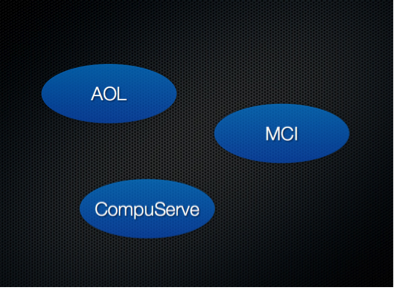
For those who remember, in the past we had silo-d email systems. AOL, Compuserve, etc. They did not interoperate. We got rid of those silos when there was a standard protocol, allowing competing commercial and open source servers to talk to each other in SMTP.
We now see the same with data, personal data, social graphs. We have data-silos (Facebook, Google, Bank systems, Health systems, Government systems, etc). What we need is a “Data-Server” and a “Protocol” that allows these data servers to be interoperable.
All this, Phil calls “The Live Web” (Amazon Associates link). He is so excited about this that he has written a book about it.
In other words, start thinking about your “Personal Data Locker” become a “Personal Event Cloud”: your personal data-server in the cloud that can talk and do things on your behalf, can make decisions, interpret rules, etc…
And it can talk to any entity, any node in the web (or at least nodes in any discoverable namespace). In real-time. In multiplexing mode (meaning the node can be both a server and a client).
It suddenly dawned to me that over the last years we have been hyping “The Programmable WEB”, and that if we are serious about customer centric identity or “customer centric” or “personal” whatever, we may wish to start with the “me”.
Suddenly it was flashing in my brain: “The Programmable Me”
“Me” is becoming a node in the grid. We are all nodes in the grid, sending and receiving signals. Like neurons passing an electrical or chemical signal to another cell. And start thinking “synapses” when you talk about the API’s of your Programmable Me.
From Wikipedia:
“Synapses are essential to neuronal function: neurons are cells that are specialized to pass signals to individual target cells, and synapses are the means by which they do so”
The APIs of your “Programmable Me”, of your Personal Event Cloud are indeed the means to make all these nodes interoperable.
Add to this the graph-thinking of Drummond Reed (@drummondreed), Co-Chair of the XDI/XRI Technical Committee of OASIS. Check-out http://wiki.oasis-open.org/xdi/XdiGraphModel and more specifically some of the Powerpoints out there:
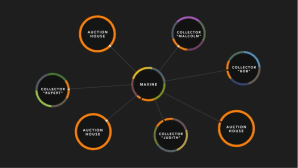
Each circle in this drawing represents a node in the grid. I really encourage you to look at this as a graph – this ensemble of inter-connected nodes – as something 3-dimensional, possibly multi-dimensional.
We have all been trained to think hierarchical. Flat files with a root, that sort of thing.
We have to learn to think in graph-models.
You can start anywhere in the galaxy. Every point can be the center of the universe. There is no root. At least, not in absolute terms. Yes, in relative terms with respect to the other nodes in the universe…
A grand vision starts to develop when you realize that the nodes can be any type of entities:
Humans (or their agents)
Circles (like Google Circles) of humans (entities without legal form)
Corporations, non-profits, governmental or educational institution (aka organizational constructs of humans with specific legal form)
We should also include less traditional forms of organizational constructs such as co-operatives, P2P communities, Commons,…
Programs (yes, software code), that perform tasks on behalf of the entities above or that operates as fully independent entities.
Each of these nodes/entities can participate in transactions – or better, “value dances”. “Dance” because the protocol is multiplexing, not one-way request-response.
Of course all these entities will require identity, in the broadest sense, not only URI or ID number, but in the sense of a spectrum, a graph that can be shared in context with other nodes/entities.
Sharing the spectrum becomes the essence of trade
What we are witnessing is a 180° turn in the power balance between client and server, slave and master, buyer and supplier, consumer and merchant.
But look at the subtitle: “When Customers Take Charge”.
I like Doc a lot, but his subtitle may suggest that somebody else is in charge: the empowered customer. I am afraid that we may end-up with another un-balance, where the pendulum has swung the other side: where the customer has an unfair data-advantage versus the merchant. But let their be no doubt that today the merchant has the unfair data-advantage, and I read Doc’s book more like a plea for getting the balance right rather than a socialist rant against establishment represented by the “big boys”, the vendors, the merchants, the silos like Facebook and Google.
In all the discussions about the Empowered Customers, we see classic commerce use cases like buying a book, buying flowers for grandma, etc
But I would like to make the jump to truly balanced financial transactions and what “dances between equals” would mean in that space. I invite you to think about your bank as the merchant, the merchant of financial services, and the consumer as the retail or wholesale customer of the bank.
In such scenario, the fundamental shift in thinking already happens at the Point of Sale (POS). We even have the question the term “Point of Sale”. It stems from an old thinking where the merchant “owns” the customer.
YOU are the point of sale
YOU are the point of data integration!
In the past the POS was the master,
now it will be YOU who is in charge,
or your agent,
the “Programmable Me”.
What if we start thinking about banking where YOU are the point of data-integration? What if your bank would offer you a service that enables you to manage your Personal Event Cloud?
I don’t know how it would look like, but it probably would be something triggered from your mobile phone. It probably would look like one of the Next-Gen banks (Simple, Movenbank, Fidor) with a Personal Event Network out-of-the-box.
Some of these Next-Gen banks are already accepting the CRED of your Social Graph as a much richer (in all senses of the word) basis for “Know you Customer”. Although we probably also have to inverse that: from the captive notion of “know your customer” to the user-centric meaning of “know your bank”. Then we may come back to the “primitive” of the meaning of “bank”: a bench where two people meet to build a relationship of value.
So, the discussion is NOT about the next coolest thing for doing a copy-cat of existing money-transactions through the latest greatest gadget like NFC or Bump, or whatever.
“The thing to keep in mind here” says Crone, “is that NFC was developed more than 20 years ago. It was first deployed 10 years ago. 10 years ago, we didn’t have ubiquitous access to data plans. We didn’t have more smartphones in circulation than feature phones and we had to depend on an ‘offline’ connection for processing payments. But now, there are 124 million households that have more than one device connected to the internet. Typically, that’s a smartphone, but very quickly it’s becoming a tablet.”
Also Christopher Carfi (@ccarfi) starts thinking in this direction in his recent post “Musings in Small Data”. In there, he refers to a video of Jerry Michalski (@jerrymichalski) of the REXpedition doing a demo his “Personal Brain”. (Disclosure: I am member of the REXpedition). The video is titled “Gardening My Brain” and the talk was given at Personal Digital Archiving on February 22, 2012 in San Francisco.
It’s a pity that this talk is in the context of a personal digital archiving conference. Because, in my opinion, we have dramatically evolved from archiving to sharing.
Sharing of information and digital assets is becoming the new normal in this world of Abundance of information.
Christopher Carfi nails it when he says:
As these issues become more widely understood, more individuals will be tracking their own information. Perhaps it won’t be to the level that Jerry has done it in the video above, but it will be happening. This means that we, while wearing our business hats, will need to be developing real relationships with our customers. We need to listen to what they are saying, what they are asking for, and working collaboratively with them in order to help them fulfill their needs. In the best cases, we’ll have built up levels of trust with our customers and will have been given the explicit permission to access our customers’ personal data stores. In doing so, we’ll be able to actually take the guesswork out of the equation that was noted so clearly above in the Facebook example and will, instead, be able to connect directly with our customers’ intentions and deliver value on their terms.
Creating an economy based on the principles of relations is of course at the heart of the REXpedition. It is probably the next territory for competitive advantage beyond the mundane money transaction.
All this is about creating “Relationship Channels”, channels the vendor can tune into of the user has opened the channel.
All the above are of course very much related to our Innotribe incubation project “Digital Asset Grid” (DAG), which is about the sharing of any digital asset with any party.
The real question is then: “Where will value be created when all the connections between nodes have become frictionless?” Mark has some ideas on this, and he describes them as “irreducibles”
“No matter how ‘smooth’ and frictionless hyperconnected commerce becomes, certain frictions in the business world will persist. These represent both speed humps and opportunities. The businesses of the 21st century will find leverage and differentiation by identifying and exploiting them.”
What those “irreducibles” are, you will be able to discover at our upcoming Innotribe event in Bangkok on 26-27 April 2012, where together with Mark Pesce we will have some great interactive learning experiences. Be there, or read the report that we will make on this post-conference.
If you really want to take a meta-view on all this, I believe all the examples above illustrate our species being in search for a deeper meaning, a thicker value in everything we experience:
We are in search for a higher level of consciousness, a further evolution in Spiral Dynamics, in search for a richer value system, much richer than the pure transaction world that is the narrow lens of today
We start looking at companies being nodes in the grid, in fair-trade constellations of equals, trying to maximize the commons and contribution and giving back to society
We want to go beyond the “advertising” thinking of “let’s hit the target with an ad”. We are in search for a better world with more Thick value and less Thin value
We are starting to see the emergence of “The universe as a Computer” as wonderfully described by Nova Spivack (@novaspivack) in one of his milestone posts last month.
All the above is about defining, articulating, and living lives of greater meaning. With the “M” of meaning. Umair Hague (@umairh) already in 2009 called this “Generation-M”, which in essence is anchored in “constructive capitalism”
Generation M is more about what you do and who you are than when you were born. So the question is this: do you still belong to the 20th century – or the 21st?
What I liked about this book is that it encourages you to look at where you are in your life, and to look at it through the “M” lens. The lens of meaning.
I then discover that what I am writing today, what job I am doing, who I am married to, was probably all meant to be this way. Not “meant” in a deterministic way. No, “meant” as everything I have done, the decisions I have made, my architecture studies, my infection by the identity virus, my journey in Leading By Being, etc… all these things have made me who I am.
What if I could capture all this richness about me, and have a tool and an infrastructure to share that on my terms and conditions, in context, and with the parties or nodes in the grid that I choose to? What if I could share my meaning in a programmable way?
I would end up with something called “the programmable me”
People call you an instigator, a protagonist, a renegade, a pirate, a mercenary, a rebel, or an empowered employee. We know you for what you really are: a change agent who sees speed, change and innovation as the new corporate norm. We know because we are you. We know the challenges – and the excitement – of driving change in an incumbent or start-up company. We know what it means to go for “The Innovator’s Risk”
We call ourselves “Corporate Rebels United”.
The concept of Corporate Rebels is not new. Many people have written about or have alluded to it:
The key answer that defines the post-digital enterprise is to shift attention from the cost side to the value side. Rather than treating employees as cost items that need to be managed wherever possible, why not view them as assets capable of delivering ever-increasing value to the marketplace? This is a profound shift in focus. For one thing, it moves us from a game of diminishing returns to an opportunity for increasing returns. There is little, if any, limit to the additional value that people can deliver if given the appropriate tools and skill development.
and
The post-digital divide will force them to choose sides – on the side of employee empowerment, or on the side of tactical cost cutting, job cutting, and diminishing returns. If not, the divide will choose for them.
But a Corporate Rebel has something extra. It is about daring to stick out your neck. It is about taking personal leadership.
So perhaps we could use a more neutral word: protagonist. A protagonist is a principal champion of a cause or program or action. The protagonist does not wait for permission to lead, innovate, or strategize. They do what is right for the firm, without regard to status. Their goal is to do what’s good for the whole.
Lois Kelly (@loiskelly) from Foghound and Mike Maney (@the_spinmd) from Alcatel-Lucent also discussed recently whether the word “rebel” is not too negative. Mike made some very deep reflections why the hard dividing line between good and bad rebels does not always make sense.
Argument aside, we believe that – positioned well – the word “corporate rebel” exactly reflects who we are.
The aim of “Corporate Rebels United” is to create a global community of extraordinary corporate change agents. It is not an academic exercise or research effort. It’s something deeply actionable.
Our mission is to build the most amazing community of corporate rebels worldwide to ensure that true change and innovation happens virally
The initial idea for Corporate Rebels United emerged when innovation teams of Alcatel-Lucent and Swift met and worked closely in the context of Swift’s Innotribe program. We were excited by the exchange of ideas and energy that emerged when like-minded folks came together. And that got us thinking about some big “what if’s”:
What if we could create a tribe of the best and most exceptional corporate rebels worldwide – people like us, people like you?
What if we could start leveraging each other’s ideas, energy and best practices?
What if we could design a movement to support each other when the going gets tough?
What if we could cross-fertilize and infect our organizations with the change-virus from within?
We want to identify exceptional people worldwide that already have an impressive impact on change and innovation in their corporations, no matter in what field or industry. The movers and the shakers. The do-ers of today. The ones who take initiative. Who create deep change from within. People who energize their organizations by leading from their true selves. The crazy ones. The rebels. The troublemakers. The ones who see things differently, and who are crazy enough to think they can change the world. People like you.
Our plan is to start small – 15 founding rebels cross-industry – because we want to ensure quality and resilience in the initial starters group. We’d like to get the spirit right from the start. We have scheduled a kickoff call on March 30, 2012 with 15 founding rebels. We will follow that call with an off-site meeting where we’ll jointly build a set of agreed upon principles and a longer-term action plan to open and expand Corporate Rebels United to a wider audience.
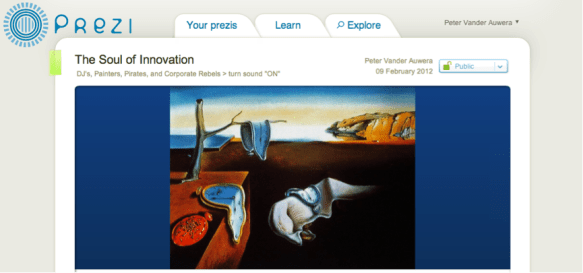
A lot of “getting the spirit right” was already included in one of my latest prezi’s on the “Soul of Innovation”. Without any publicity, this prezi already generated more than 3,000 hits in less than one month. We seem to have touched something that resonates. Some of it was withheld for my TEDxNewWallStreet talk last week in Mountain-View. Innovation is more than a set of tools and processes. Innovation is an attitude with tribal energy!
For viewing this prezi, turn audio “on”, as I experimented a lot with sound and visual landscapes.
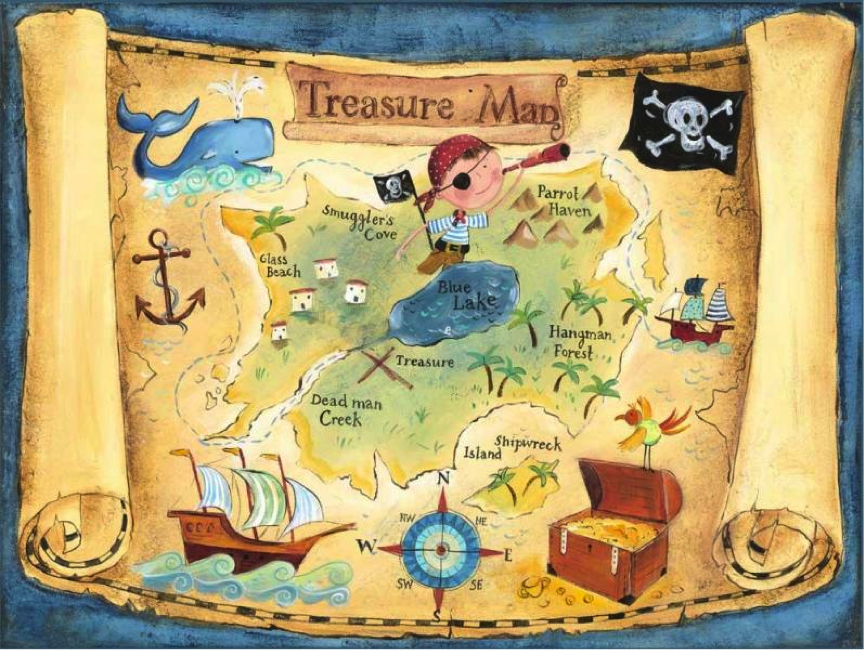
Somewhere halfway in that prezi, you will discover the Rebels Manifesto in the Pirates Treasure Map
Rebels Manifesto
Relentlessly
Challenging the status quo
Breaking the rules
Saying the unsaid
Spreading the innovation virus
Seeding Tribal energy
With No fear
With a cause to do good
Leading by Being from our True Selves
Going after the un-named quality
Relentlessly
What exactly Corporate Rebels United will do is the essence of our discussion at our kick-off call and event. Initial ideas include:
We want to build an action-driven community.
We want to create an incredible energy bomb of corporate change.
We aim for a very high level of integrity and authenticity. We want this to be morally, intellectually, and artistically right
We want to re-enforce the energy of known rebels in a non-zero sum community.
We want to identify and unleash the energy from the hidden rebels and the hidden pearls in our organizations and give them a voice
We want to create exchange programs between our corporations
We want to have deep positive business impact on the corporations and organizations that host and pay our salaries.
We want to create a culture in our corporations where change is the norm.
We want to measure the progress and propulsionwe make/create:
Individually
The folks we influence
The corporate change heartbeat
We want to evolve our corporations into places of constant change, resilience, responsiveness, reflection and vibrant energy.
We want to create a place for play, fun, rock, and rich personal expression
At the start, Corporate Rebels United will be a closed community: we’re looking for atypical people who make us go WOW!
Because they act from their true self and without fear, and make amazing change happen within their organizations and the ecosystems they are part of.
People with a moral, architectural, almost artistic integrity. People with a BIG innovation heart in the right place.
We’re looking for people who inspire us as human beings. With open mind, open heart, and open will.
We plan to go full-steam as from our Kick-Off call on 30 March 2012, right after the start of the 2012 spring. Our ambition is to be able to shine and radiate as a strong community with first results by end October – Mid November, not co-incidentally the busy conference season with Innotribe at Sibos, Techonomy, Defrag and Blur.
Like Bill Gates wanted to see a PC on every desktop, and Eric Schmidt wants to see an (Android) mobile in every pocket, we want to see a corporate rebel in every company. That’s a lot of corporate rebels 😉
Of course, I am not Bill Gates, nor Eric Schmidt. But there is still enough room for a normal human being like me to create significant impact. And although I am 55 years old now, I still want to change the world. And yes – at 55 – I still would like to instigate a Corporate Spring. There is no age for Corporate Rebels.
We jump and want to feel the daily adrenaline of being and coaching Corporate Rebels every day of our life.
If you are interested to join Corporate Rebels United, leave a note and some argumentation on why you’d like to join in the comments section of this blog post. And/or let us know what you can bring to the table to make this a big success.
Let’s 21 March 2012 be the start of our Corporate Spring! Because we believe it matters to infect our organizations with “change-as-the-norm” from the bottom-up!
Innotribe, the innovation initiative of SWIFT, will be launching its innovation lab for Asian corporates at the forthcoming Asian Banker Summit to be held in Bangkok from 26-27 April, 2012.
(Drawing by Kosta Peric on iPAD)
The lab is designed for executives and managing directors of Asian companies, to collectively think through their business strategies and organization in a hyper-connected world. The lab will bring these companies, your clients, together with you to design new strategies and business models for a new generation of customers.
The two day highly interactive workshop will cover the following topics:
The hyper-connected corporation – understanding the soul of a business tuned for the hyper-connected new generation of customers and employees.
“Hyper economics” – following the money in a hyper-connected value chain
“Organizational hyper vitality” – preparing corporate culture for challenges that a hyper-connected world will bring
Idea generation within your own organization
APIs and how they can open up the core competencies of your business
Friction points in the value chain
Digital identity and digital assets
Presentation of ideas
The future of collaboration – figuring out how the value chain of your business will evolve
The programme promises to be highly interactive with great speakers, innovators, motivators, all contributing to provide a thrilling learning experience that will help you understand the instincts required to get the future of your organization right.
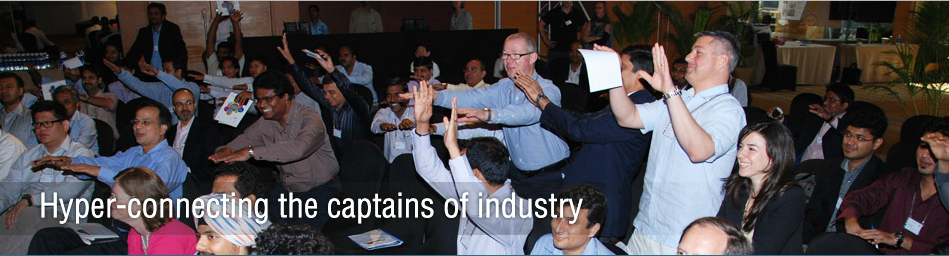
Innotribe events are like no conference you’ve ever attended before. No dull presentations, no strict presenters – instead we guide participants through a process of broadening their outlook, thinking differently and emerging with tangible ideas that they can apply to the future success of their business.
Innotribe –a hyper-collaborative learning lab
The best way to learn how to deal with a hyper-connected world is to learn in a hyper-collaborative community.
Traditional conferences and training courses tend to offer a fairly one-dimensional view of the challenge at hand. Innotribe is an interactive learning experience in which you will be doing a lot of the thinking for yourself. Our facilitators, motivators and ‘thought instigators’ will push you to consider tough questions and look at things from multiple perspectives. One thing is for sure, you’ll emerge from Innotribe having engaged with your fellow participants, acquired a better understanding of your organisation’s decision-making process and generated new ideas you can apply as soon as you return to the office.
Creativity is a journey. Our agenda has been designed based on a flight metaphor: we will simulate a flight to encourage participants to understand and engage in the process of thought development and idea generation.
Just before take-off, the pilot will inform the passengers of what will happen during the flight: the planned route, the weather conditions, the expected turbulences, and that we are in for a bumpy ride. The weather conditions will be influenced by turbulences: digitization, API’s, the age of the machines, redefinition of value. There will be a steep take-off, take some time to enjoy and get inspired by the flight, with a pleasant approach and soft landing in foggy weather conditions.
We want to land with one strong idea to take away after the lab: an idea that is ambitious but achievable in the short to medium term.
Our list of instigators includes following thought leaders:
William H. Saito, CEO, the Innovation Platform Technology Fund (IPTF)
Dr Matt McDougall, Founder and CEO, SinoTech Group Bejing – Magic by Numbers: using algorithms & analytics to create Insight and Innovation
Dan Marovitz, Buzzumi – hyper-collaboration
Speakers from SWIFT include Kosta Peric, Matteo Rizzi, Luc Meurant and yours truly
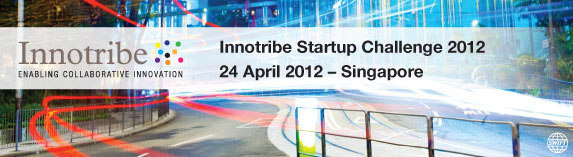
The 2 days will culminate with the 2 winners of the Innotribe APAC Start-Up competition, that will be held earlier that week on 24 April 2012 in Singapore. This competition is part of our worldwide Innotribe Start-Up competition that started a couple of weeks ago in New-York.
It is still not to late to put forward your candidatures for the Asian start-up competition here. You have to apply before 21 March 2012.
The Asian Banker is managing this event as part of The Asian Banker Summit. All registration should be done directly with them, either through The Asian Banker or our websites or the event website www.theasianbankerforums.com/innotribe directly.
Every now and then people ask me what incentives we have in place for encouraging innovative behavior.
The short answer is: there are no incentives other than recognition and self-esteem when your idea happens for real. For people with a specific innovation role – such as our “Megaphones” – we do have their innovation objectives as 10-15% of their NORMAL objectives. But no special deals, bonuses, etc.
From the start of Innotribe, we had this discussion about getting 20% time like Google (Btw, that myth of the 20% has been challenged and discussed already many times on the internet. For example here and here. It even leads to big failures).
Many other ways exist in other environments than SWIFT to incentivize innovation like special bonuses, shares in projects that can be turned in real bucks once the project gets critical mass and generates revenues, and much more.
From very early on in our innovation endeavors, we got a clear “no” from our top management.
We do not want a culture
where working on innovation
lead to some sort of “entitlement”
for x% of time or any other resource
In the beginning, i found this a bit harsh, but with hindsight, i think they were right. Personally, I have done some introspection on all this and have come to the conclusion that:
I truly believe that the true innovators manifest themselves, and that any request for incentives to innovate just says a lot about the person requesting.
What we need is people daring to stick out there neck, and acting from their true selves.
As many of you know, I am deep believer of viral infection of the company. That will not happen through incentives.
It will happen when we unleash the deep energy of the many hidden change-makers in this company.
Let me develop that thought a little bit.
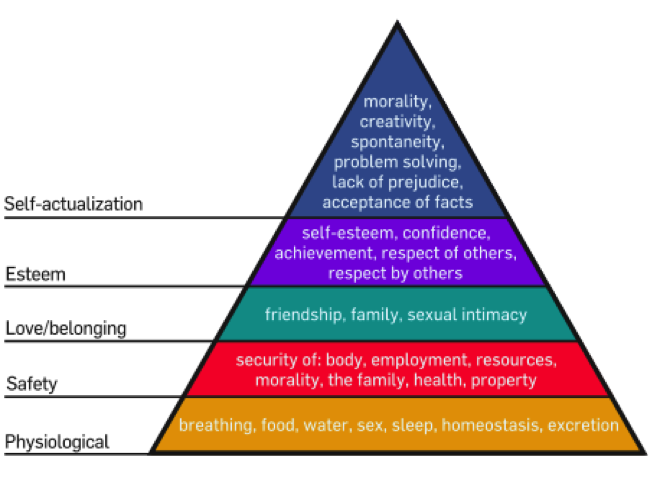
It all has to do with the Maslow’s hierarchy of needs – where self-esteem and self-actualization are on the top of the pyramid.
In our luxury world, most of us already have reached at least some level of self-esteem or self-actualisation.
I believe there is a lot to say to go beyond self-esteem, where the personal transformation fundamentally changes the focus from the “self” to the “others”.
This is where Richard Barrett has evolved the thinking of Maslow. Or where Don Beck did brilliant work with Spiral Dynamics, whose initial thinking was inspired by Clare W Graves who already in sixties/seventies said:
“Briefly, what I am proposing is that the psychology of the mature human being is an unfolding, emergent, oscillating, spiraling process, marked by progressive subordination of older, lower-order behavior systems to newer, higher-order systems as man’s existential problems change.”
“… me too big fan John Hagel, Geoffrey West, Brian Arthur. I love how you squeeze in Mihaly Czikszentmihalyi at the end, as I agree that organization starts more and more looking like an organism in search for flow. If you push the idea, you could add Maslow, as the organization is probably also looking for self-esteem in all its nodes (its people). Even pushing it further and beyond self-esteem, a similar flow “dynamic” is also embedded in Don Becks “Spiral Dynamics”…. the next area of competitive differentiation is in the higher layers of Spiral Dynamics, more or less the space of relationships, the space the Jerry Michalski’s REXpedition is exploring.”
JP responded:
“I am more of a fan of Nohria and Lawrence than I am of Maslow. Parallel not serial, networked not hierarchical”
I wrote about JP and Nohria, when trying to do a transcript of in my post “JP on Gamification, Lipstick and Pigs”. So I won’t repeat myself on that topic, and summarize JP as: The 4 drivers of motivation: the drive to acquire, the drive to defend, the drive to bond, and the drive to learn
In my opinion, it is about discovering your true self in the full context of all its relationships (family, work, company, country, culture, world, cosmos). As Marti Spiegelman recently said during a REXpedition call:
Awareness of the context creates meaning
And meaning creates value
Do you really believe that people will start innovating more if they get an extra bonus of 2% ? Only when people act from the power of their true self and experience meaning in what they do, only then real motivation kicks in.
I am deeply convinced that innovation and culture change will NOT happen through rolling out huge top-down innovation programs. On the contrary, I am a strong believer in “viral” innovation, where you seed the people that act from their true self throughout the company.
They will act as they believe they should act, and because their environment will feel inspired by this real motivation, they will inspire and infect others, form natural tribes with their own team dynamics and influence, become self-organizing teams that create their own meaning and value, and change the company from within.
Forever. Unstoppable. That is how real change happens.
Discovering and nurturing the hidden pearls in your organization that have the mindset to do this is the real challenge. It’s about finding the people who want to move, to challenge the status quo, dare to stick out their neck, etc and do so not because the incentive program has framed them that way, but because their true self boosts them towards the others with unlimited and eternal energy.
In the end it is about creating meaning in YOUR life.
Am I dreaming? Maybe. Am I ambitious? Maybe. Will it work? Maybe. But at least this way you know that’s where I have put the bar. So next time you see me, don’t ask for incentives, but tell we about what you want to achieve, and let’s see how I can help you.
A couple of weeks ago, I had a discussion with colleague Joe on the program for one of our upcoming main Innotribe events. My colleague is not part of the innovation team, but has shown growing interest in what we are doing: great! Joe is known in the company as rather a conservative, cautious person, making decisions on data and not feelings. So, like many human beings, when I go and see him, I already have put my projection biases on (shame on me).
Taking into account my manager’s request to start dancing with the company, I decided to use a different approach and asked Joe what sort of innovations got him excited. He was looking for innovations that were 1-2 years out at maximum, complemented the core, were easy to implement and had effect on the bottom-line right away. Joe felt that I was too much in science fiction territory, out “there”, looking at a horizon of 10-15 years, my head in the skies.
At first sight, this seems to be about different perceptions on what is important based on time-criticality of the innovations.
But then, another colleague Jamie, said it was also about being used to think in abstract concepts.
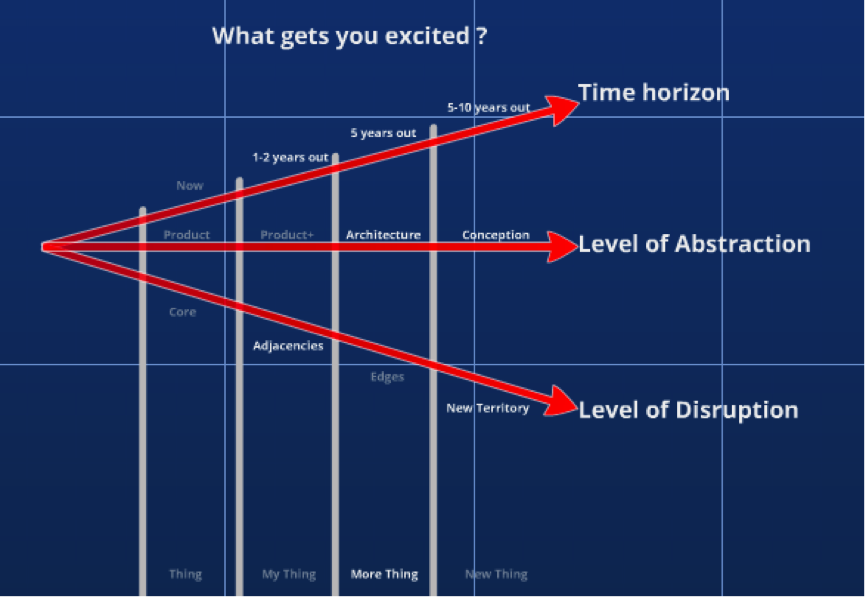
The whole discussion made me think, and I started making some notes on what was going on. I landed with the following high-level “concept” drawing:
In my opinion, there are 3 forces at work, all on the same continuum, and more or less the same scale:
Time horizon
Level of abstraction
Level of disruption
What I see happening all the time is that innovations start with adjacencies and evolve towards new territory:
If the product in the core is called “thing”, then the adjacency is smelling “My thing”, the edge is trending towards “More thing”, and finally the new territory is really about the “New thing”
In SWIFT world there are many examples of “My Thing”: MyStandards.com is the “My thing” variation of the core Standards proposition. In the same way, the EBAM Hub is like “My EBAM” variation of the EBAM Standards, and Alliance Lite is a “My messaging” variation of FIN.
The point I am trying to make is that we rarely look at the next level of abstraction or disruption. Because deemed to far away from the core. Because that was not the way it was supposed to work. Or not fixing an immediate problem: why fix if it ain’t broken?
The other point I am making is that we risk becoming complacent and happy with adjacent innovations only. Tick-box innovation.
From the perspective of the authors, design is not static. It is continually evolving in a quest to find more effective ways to support flows. “This evolution occurs in one direction: Flow designs get measurably better, moving more easily and farther if possible. This evolution can be observed at all timescales. Rivers evolve at a different rate than a lightning bolt or snowflake. If a design ceases to evolve, it will quickly become a fossilized flow system, tossed aside to make way for more effective flow designs.”
And
“Now that new digital technology infrastructures are emerging globally, we are witnessing a profound and disruptive shift to from knowledge stocks to knowledge flows as the source of value creation. With the benefit of hindsight, we may come to realize that the powerful institutions that emerged in the last century and continue to govern our lives – whether companies, NGO’s, schools or government – were in fact a very brief detour in the evolution of institutional design to facilitate flow.”
It confirms my thinking that if we want to remain a powerful institution, we have to be part of this disruptive shift towards knowledge flows, and we have to create design as an institutional core value.
And who says “design” says “abstraction”.
In an older 2009 post, John Hagel talks about “How to bring the edge to the core”
“What’s the best way for companies to participate in this dynamic? Disruption theory suggests it’s by bringing the edge to the core. The approach we suggest is to instead bring the core to the edge, to expose your company to institutional innovations and new management practices that emerge on the edge.”
It’s clear from the above that I am not the first one making such reflections. And I am fully conscious that John Hagel plays in a different league that I do 😉 John seems to have landed on bringing the core to the edge, whilst I still believe in my maybe naïve enthusiasm that the result of our innovation work will lead to the edge eventually becoming the new core. Wisdom will probably come later 😉
John goes on:
“To exploit opportunities on the edge, executives must resist the temptation to prematurely integrate edge resources into the core of their operations. Instead, they should determine what resources they can offer to help SCALE the innovations being developed by edge participants. This could catalyze the development and deployment of growth platforms, platforms that edge participants can then use to more effectively design and deploy new innovations.”
“By seeking to mobilize and engage with a large number of edge participants, core players can reduce the risk of prematurely locking into edge resources or of overwhelming smaller edge players with the demands of much larger core assets.”
We at Innotribe are looking into the edges in our incubation initiative. Is it enough focus on the edges? Maybe not. In my personal opinion, incubation has to focus exclusively on the edge and the new territory. The continuous improvements to the core and the creation of “My things” should be part of the normal product evolution/enhancement cycle and should not be funded from the incubation fund.
And it’s about putting in place a well-balanced innovation portfolio, a yin/yang of core and edge, and a continuum of different types of innovation. It’s fairly “easy” to do stuff at the left side of the continuum. It is usually a stretch to work on the far right side of the continuum. Innovation is NOT about launching the next cool mobile app. Real innovation is about moving to the right. Where the edge has the potential to become the core.
Real innovation “hurts”, disturbs.
It has to disturb something: be it the core, the market, the hierarchies, the power balances, whatever… but it has to disturb. In some ways, innovation is rebellious. Rebels are needed. Not rebels as in “anarchists”, but rebels as in change makers, the ones who relentlessly challenge the status-quo.
On the other hand, innovation is about holding hands, showing different sides of the coin, and inviting each other to come and see at your end of the wall. Having empathy for the other’s opinion, for their lens on the topic. And taking them on our innovation journey from that empathic moment.
It’s not one or the other. It’s sensitive dosage on the continuum of challenge and empathy.
On March 11th, 400 people will gather in Mountain View, CA, to map out a new banking system fit for the Information Age, with new technologies, transparencies and values… at TEDxNewWallStreet.
Just down the street from Google, some of the brightest minds locally and internationally are coming together at the famed Computer History Museum to re-imagine banking for the Information Age at TEDxNewWallStreet on March 11, 2012. This audience routinely disrupts Industrial Age paradigms, and will be encouraged to do so for banking, by inventing new technologies and processes that make banking a game that people can win.
Mobile deposits and bill pay, online stock market quotes and trades show people will use technology to do the banking they used to do, faster. Re-imagining banking changes the guts of how money is created, priced, moved, saved and transparently tracked to its impacts.
More than 400 venture capitalists, serial entrepreneurs, technologists, inspired bankers, Stanford faculty and students, politicians from the San Francisco Bay Area and Pacific Northwest, and a global online live-stream audience in the thousands using Facebook, Google and Twitter are expected to attend TEDxNewWallStreet. Speakers will give talks on a number of topics, including:
banking as a facet of civil rights so as to raise personal wealth,
virtual/peer-to-peer banking,
how bank technologies can protect customer identity and increase global sustainability,
reframing how banks use customer data to price credit and investments, and
how public finance accounting and bond offerings can evolve to value what matters to people and community in an economy.
Speakers on the day include Silicon Valley industry leaders and upstarts,venture capitalists (VCs) and serial entrepreneurs like Bill Harris, formerly of Intuit and now of Personal Capital; Joe Lonsdale and Rosco Hill of Palantir; Macarthur Fellow and European accountancy historian Jacob Soll; Peter Vander Auwera at SWIFT Innotribe and startup micro-investment entrepreneur Shivani Siroya of InVenture. Many more speakers will outline their “wish lists” for Information Age banks and banking, and how to build it now.
TEDxNewWallStreet is organized by Bruce Cahan, an Ashoka Fellow and Stanford University Engineering Visiting Scholar. Bruce is creating a new bank paradigm through his high-transparency, impacts-aware bank project, known as GoodBank™(IO). Living in Palo Alto, Bruce saw that as disruptive as Silicon Valley is, it was missing a huge opportunity to move banking from its Industrial Age camouflage to the Information Age paradigm for user experience, transparency and social media. “Banking should be what customers co-create for their own needs, not the ‘one size fits all’ take it or leave it choices most banks today offer. Given how iTunes® and Spotify® reimagined music distribution, how Netflix® and Hulu® changed movies and television, and how digital and subscription libraries are reducing the cost of knowledge sharing, banking creates frictions transactionally, regionally, environmentally and socially that no longer are justifiable, safe or inevitable. We have an Internet of Things, let’s use it to re-imagine banks built in and for the Information Age.”
Business reporter Camilla Websterwill serve as event moderator. Camilla is a seasoned, business journalist, writing for Forbes and Huffington Post, and is co-author of The Seven Pearls of Wisdom: A Woman’s Guide to Enjoying Wealth and Power. “TEDxNewWallStreet is a solution-based, engaging, idea-generating conversation during a historic time in the finance industry” says Camilla, who as MC will guide speakers and audience on a novel journey.
This event is about financial innovation beyond the next cool mobile app. We will be looking for deep innovations that may dramatically impact the way we think about the function of a bank. It is an honor for the Innotribe team to be invited as speaker at TEDxNewWallStreet. It is a reflection of the Innotribe reputation and brand. My presentation is combining material from “How to make Babies” and “The Soul of Innovation”, complemented with brand new material on our research project “Digital Asset Grid”, and some new insights on innovation disruption levels. Just last week, I gave Bruce Cahan a preview of the draft presentation, and Bruce’s reaction was: “you’ll blow a few circuits with this one!”. Looking forward to this event with all my heart and in full support for Bruce Cahan’s cause.
He keeps inspiring me, by the challenging content and his oratory skills. And yes, I am trying very hard to get Mark to one or more of our main Innotribe events as core anchor/igniter of some of our conversations.
I also recommend my readers to have a look at some of his recent work, especially about “hypereconomics”, Flexible Futures, and last but not least his upcoming book “The Next Billion Seconds”. The chapters of the books are being released now on an almost weekly basis, and here are some of the catchy titles with associated content:
Initiation
Introduction
Articulation
Replication
Duration
Revelation
Revolution
Origin
It reads like an “Origin of Species”, looking back and projecting us in the future of the Next Billion Seconds, aka the next several ten thousand of years. A fascinating read indeed.
But I wanted to use his 2010 talk as guidance to some of the work our Innotribe team is doing in our incubation project called the “Digital Asset Grid” (DAG)
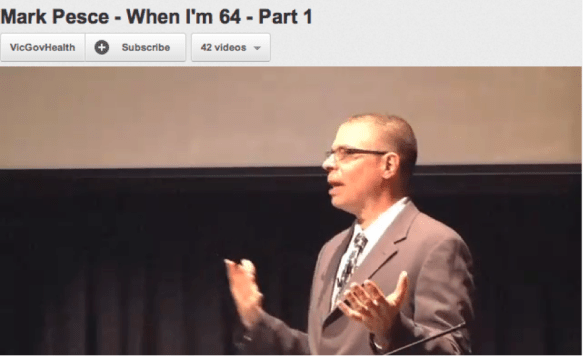
In this talk, Mark Pesce talks to a group of Human Service folks and Health officials. Although it is about health, I encourage you to listen with holistic ears, as everything he says is applicable for any vertical.
The talk is titled “When I am 64” and is looking forward 17 years from 2010. The “64” is a wordplay on the famous Beatles song.
Here is the link to the first part of the talk. The talk was split into 3 separate videos.
I will avoid the temptation to do an ad-verbatim transcript, and will just use a couple of quotes to illustrate my own points.
Highlights first video
Somewhere half-way, Mark Pesce mentions how his team went open source with their 3D Mark Up language and how surprised they were with the amazing ideas people came up with on what they could do with it.
He mentions and Austrian project that made a 3D encyclopedia, like a tree of knowledge, and
a 3D visualization of NYSE stock data.
The latter one makes it possible to see 5,000 times more information than on could see with the standard flatlanders’ Bloomberg terminal. Mind you, this was in 1997, that now 15 years ago.
My lessons learned for DAG:
The DAG story is a story of value propositions. That is what the prototype we are building will focus on. It is NOT a technology showcase.
We play with the idea of an open source DAG server. There is some hesitation. We should not hesitate. We should look at it like IBM looked at Apache Server at the time. Our core competence is to operate a high-available, secure and resilient infrastructure. Probably less in building server software. We know more than me.
There is so much innovation in the ecosystem. Our current thinking is to bring the APIs of the infrastructure in a controlled open. So that Banks and other 3rd parties can be on the bleeding edge of innovation.
On the longer term, this whole concept of stream-servers makes me think a lot about the Metacurrency.org software project of Art Brock and Eric Harris-Braun. The idea is to build a basic communication later to be able to deal with stream-scapes.
I can assure you that “streams” and “scapes” will be commongood in some years time. Another very cool initiative in this space is Nova Spivack’s latest start-up BottleNose.
Highlights second video
It really gets interesting when Mark Pesce starts unfolding how the power of our communities shape our behavior. Somewhere at minute 09:10, Mark develops an extremely interesting banking scenario:
Imagine someone steals your identity, walks into bank, and takes a loan in your name (if they are able to present the proper documentation)
The problem is that once you present stolen proof documents at the entry of the process, the process usually kicks off perfectly and delivers the programmed results
Better would be to be proofed by others, by your community. “An identity that is confined and constrained by those you are connected to”, by your on-line context
At minute 10:35, Mark suggest
that you should be able to handing the bank your social graph!
You really would expect your bank to be able to write some piece of software which could confirm your identity
Bank validating your identity strength based on who vouched for you !!!
This really comes very-very close to some of the use cases we have in mind for DAG.
This would result in a system with greater resilience, much harder to fool, because:
Identity is a function of community
And not just identity > even TALENT is a function of and a recognized value of a community
The social graph is the foundation of identity
In my opinion, all this is leading towards “interest based connections”.
The relationship economy, the reason why REXpedition is so important, is the next battlefield of competition; after most organizations squeezed all the juice out of SixSigma, Lean, and similar programs for increasing productivity and efficiency.
The focus of these programs was on doing better what we already did (sometimes doing bad things better)
Now its’ about doing new things, the right things. And those right things have all to do with better managing our trustful relationships
Therefore, Mark’s thesis that “a group of well connected highly empowered individuals is a force to be reckoned with” is one of the biggest forces in place. It has always been, but now returning in force thanks to our hyper-connectivity and information abundance.
Highlights third video
This part, entitled “Senior Concessions” really got my attention when Mark Pesce starts talking about “Personal Broadcasting”, networks of trust and sharing of social graphs.
Sharing of social graphs will enable us to identify who brings real value, who brings insight, who bring wisdom. And also those who seek to confuse, who are confused, or who are self-seeking.
This smells very much like reputation and influence like:
the reputation score in eBay
the thinking of Andreas Weigend’s from the Stanford Social Data Lab
Drummond Reed’s Social Vouching start-up connect.me with its underlying Respect Trust Framework.
Mark continues how boundaries of expertise are becoming more and more fuzzy. The patient now often knows more than the specialist. The student knows more than the teacher. It reminded me to one of the first books I read about fuzzy logic by Bart Kosko in 1994. “The new science of fuzzy logic”
Reading that book so very early in my career was probably meant to be part of my life and my purpose.
Anyway, Pesce puts the patient in the center, like Doc Searls put the user in the center of his user-centric intention economy.
In my opinion, banks have a similar huge opportunity to put the customer back in the center and offer unprecedented high-quality data services.
And Mark Pesce goes on:
This is about user centric “social” graph
Knowledge will pass from one user to another (similar to John Hagel’s knowledge flows)
As knowledge is passed on to the community, the community empowers itself
Person as agency of his own data, deciding who gets access
Privacy of medical data is about making these data freely available to those who need it in context, but make them secret to those who do not need those data
Only if person has agency for his data and authorizing access to his (medical) records, and tools to track that access (and give/release access)
Without those tools we will loose track of who owns what etc and becomes easier for those who shouldn’t to have a look in
As our medical records spread through our networks of medical expertise, we will feel less fear, and more to surrender our privacy
There is power in releasing our privacy because we gain connections
It’s almost going back to Doc Searls (and others’) 1999 ClueTrain Manifesto where the authors declare in one of their 95 thesis that “Markets are Conversations”.
It’s also going back to Buckminster Fuller’s geodesic domes, where the each element is weak, but where the combined structure is stable.
As a matter of fact, the 3D space of the geodesic dome perfectly illustrates what the DAG is all about. Look at it as a certified map of where the data are located with their associated usage rights. Sharing as utility. P2P sharing with certified pointing infrastructure. It’s moving us from a Flatlanders 2D thinking of the physical world to a 3D thinking of the graph. That is what the DAG is really all about.
I put this blog together during one of my weeks off, weeks that are completely un-planned and un-structured. For me these are weeks where I refresh my brain, new ideas pop-up during moments of organized boredom. You could call it my Boredom Weeks.
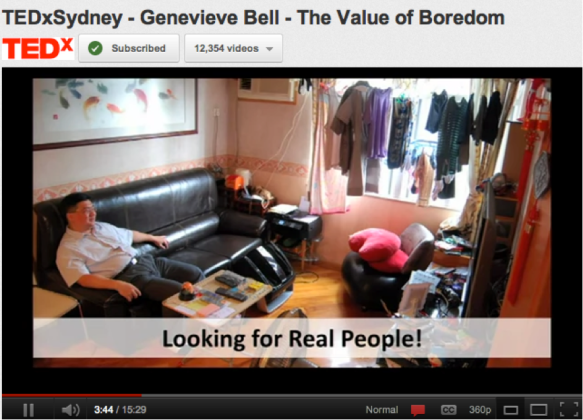
It can therefore not be a co-incidence that Mark Pesce ends with a referral to Genevieve Bell, Intel Fellow and director of the Interaction and Experience Research Group within the Intel Labs. Just on that same day, I received a tweet from one of my followers referring to Genevieve Bell’s TEDxSydney 2011 talk on boredom.
The video basically illustrates that ideas come in moments you don’t expect, when you are not focused, when you have this blissful moments of boredom. Its back to the start and title of this blog post: “The future rarely arrives when planned and it rarely arrives in the form that we expect”
I can already see now how DAG will take off from and into un-expected directions. And we are just at the start of the prototype phase. Exciting times
I spent last weekend in the wonderful city of Lisbon, under a blue sky, lots of sunshine and an pleasant spring-like 18°C! The atmosphere in the city is super-relaxed, the best description I heard was “like Barcelona on tranquilizers”.
A couple of months ago, Venessa Miemis pointed me to the website of SandBox, a movement/network of young entrepreneurs < 30 years old. I am almost double that age, and was very pleased and humbled when the organizers accepted me as one of their elderly guest at their first Sandbox Global Summit.
A few weeks ago, I had a Skype call with Laura Merling from Alcatel Lucent in San-Francisco in the context of our crazy Corporate Rebels United initiative, introduced her to the organizers, and she was accepted as well to attend. Here we were: two corporate rebels together enjoying the energy and enthusiasm of 200 highly energized young folks.
Sandbox is all about incubating people versus incubating projects: I love the idea of building a strengths based society on the energy of this young generation. Sandbox is now a community of 700 young leaders. About 200 of them were present at Sandbox Lisbon (twitter hash tag #lisbox12).
The event site suggested something that would be anything but a traditional “conference” and without any “keynotes” as most of the participants were each keynoters on their own right. I was indeed quite impressed with the quality of the audience.
The event formula was in essence a un-conference format, but where the session owners were pre-listed with their subjects before the event.
The event was really very well executed: personalized welcome for all participants at the airport, great catering, breakfast you don’t even see at sibos, excellent ice-brakers for speed-dating, many ways to mix up groups, well managed serendipity, trips in town, speed dating, collective raising hands to call for silence, and at the end a crowd-produced playbook: a post-event testimonial guidebook for change-makers, with Bloomberg Businessweek co-production.
All this smells very Innotribe of course, and that’s great! We have a bit different emphasis on design, facilitation, immersive learning experiences and performance and it would be great exchange ideas and to explore with Sandbox some sort of co-production at one of their or our events.
Some other ideas of collaboration that crossed my mind were:
Having some Sandbox representatives in our corporate rebels united group (see later)
Let some Sandboxers present at Innotribe Sibos, topics abundant in anything that has to do with corporate culture and innovation
Co-produce Innovation Gardens for our customers: some Sandboxers already do this ad-hoc for corporations
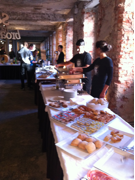
What was really very cool at Sandbox was the decoration by cardboard company Oupas! Design: its amazing to see how many shapes in cardboard one can built in no time. The whole event took place in the former HQ of a Portuguese bank, now Museum for Fashion and Design of Lisbon, close to the Plaza di Comercio.
Sandbox had “occupied” the third floor, which was just an empty space 5 days before the event.
During the opening session, the core group of Sandbox explained what they were all about: young do-ers with a passion for change, a passion for impact, and together on an “expedition” to become the leaders of our world in 20 years. What if they would meet and connect now when they are <30, and not when they are in leadership positions when 50+.
What could happen in terms of
creating relationships
and deep circles of trust ?
The organizers made clear that this event was NOT about networking or exchanging business cards. They also had a “no-wifi” policy to maximize real people connections:
connecting by disconnecting
They also had some big name sponsors: Bertelsmann, Siemens, and Bloomberg Business Week. It was a nice coincidence to see that the edition of Business Week where our Innotribe DAG incubation project was covered, was one of the giveaways at the event.
I have rarely seen such a concentration of young brainpower, and any smart company interested in recruiting from this well should not hesitate in sponsoring this organization.
And the core-group is quite ambitious for 2012:
Growing the community from 700 to 2-3000 members: in my opinion they will have to monitor very closely the quality of their members, if not the whole concept will dilute very quickly.
They want to increase the focus on incubation of projects
They think about a venture fund. It was indeed interesting to see how many of the Sandboxers were entrepreneurs and start-ups with strong ties to VC and Angel community. Some investors already “infiltrated”
I don’t know: it seems to me difficult to maintain the deep circle of trust concept when commercial and investment interests start to mingle. And I would like to see some of the “un-polished-ness” and “free-flow” nurtured and maintained for some time. The risk of wanting to grow too fast, you see?
Over the 2 1/2 days, there were 4 times 14 parallel sessions, all interesting and inspiring! Here is a couple of sessions I attended:
What if robots take over, and all jobs disappear?
My biggest learning was about how to lead a session. One participant made a great move. In stead of cutting if the creative flow he asked for your first name, and then asked a clarifying question, really inviting, and with great sensitivity for relationship building
It seemed to me that the participants in this session were in search for “better”, for “the unnamed quality”, something that resonates with the shift from finite to infinite games, the shift from money to wealth, the shift from having to produce something to the search for deeper relationships. It was as if they all wanted to grow on the Spiral Dynamics tornado of Don Beck.
The greatest question came from Lina:
“What makes you so afraid?”
Looking in the eyes of the session facilitator,
I saw the fear for loss of power,
not being part of the elite,
the fear for the loss of the ego.
Bank/finance 2.0
This was an incredible session with +/- 20 participants, lead by @marcpbernegger.
I was truly amazed how much they knew about this subject. One guy even made a PHD dissertation on banking/finance 2.0 in Switzerland. Some salient points of this session:
Most of the innovations spotted in financial services fall in one of these categories:
Front end innovation
Moral banking (Triodos, etc)
Financial crisis leading to more transparency
Alternative currencies leading to a redefinition of value/wealth
I also heard some very relevant statements/observations:
Why is it such a hassle
to care where your money is invested?
Why is it so difficult
to open a shared account?
This group was so powerful that I invited the session owner to open their closed Facebook group to the Innotribe Community.
Pirates session by Peter (@petervan) and Laura (@magicmerl)
As mentioned before, Laura, Mike Maney, myself and several Innotribe team members have been playing with the idea of “Rebels United”. During Sandbox, Laura and myself animated a session on this that was well attended by about 15 young people, 3 of them from a large corporation.
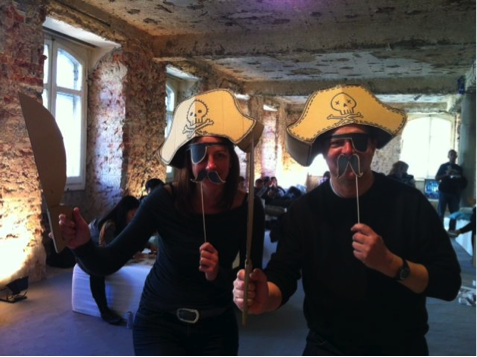
We asked the 3 ladies from Upash to make some cardboard props to announce our session. Here is Laura and me with our Pirates outfit:
Below the input we received:
Everybody thinks its a very cool idea
To succeed, we will need an inspiring vision, a shared belief system versus a generic and fluffy “we are going to change this place”
A good way to get to that vision is to answer the question: “What needs to change in big corporations to get these young people willing to come to work for them?”
We should be looking for processes and best practices for efficient pirating in corporations
We have to be clear whether we want a “Movement” or a “network”
We need a budget to experiment
The metaphor of “How to make Babies” was very much appreciated and lead into a discussion on co-creation and ownership
In terms of ownership we should evolve from “my vision” towards “our project”
We have to get OUT physically of your normal corporate environment to meet in outside environment
Any movement of this kind will need executive sponsorship, but there is a reciprocal value of offering reverse mentorship: how can rebels inspire the current executive leaders?
We have to recognize and reward rebels’ success, show it can be a career to move up the ladder
We also introduced the concept of “The Castle and the Sandbox (or the Garage)”.
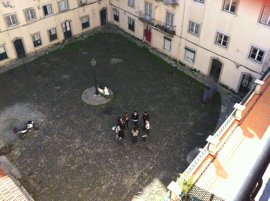
There was a lively discussion that still resonates with me. Is it really such a good idea to isolate innovation projects in a separate “garage” location? I got even more inspired by the Lisbon City tour that brought us to the “Villas”. The “villas” were actually houses for the poor that were build INSIDE the patio of houses of very rich people. Below picture of the inside of Villa Sousa that was part of our tour.
It got me thinking and I was getting more and more confuzed by the polarization effect of the castle/sandbox pitch we like to use so much in Innotribe.
Instead of separate innovation ghettos, we might be better off thinking about incubation “floors”, zones, islands, meeting points, plazas, patios, “Villas”, planets, etc, where anybody of the company can look over the shoulder, get interested, and get infected by the innovation virus.
The same way we should plant and nurture innovation angels/flowers/rebels deep in the fabric of our company to create innovation from within and thus
creating viral waves of change
To push the metaphor of “babies” even further: once the rejected baby comes out of the incubator, find an adoption family or zone that going to take care as if their own baby, in stead of creating special-character camps – garages – ghettos, where the kids will come out like non-adaptive aliens, prone to development of criminal behavior and ending up in jail (exaggerated pun intended, but you get the idea 🙂
Other suggestions from our crowdsourcing session included:
Make failure affordable: organize “failure-fairs”
Create “safety nets” for Corporate Rebels
Offer case studies
Declare and organize a “Worldwide corporate rebel day”
Reward and celebrate corporate rebels
Rebels competition
Exchange programs to inject rebels in organizations wishing to experiment with the idea
Go undercover, build in some secrecy, have a little pin, a secret code
There was also some discussion on the word “Rebels”
It has connotations with subversive, disruptive
Better would be to talk about the “Supreme Head of Internal Innovation” (pun intended J
Don’t be shy, don’t try to hide from the start: just call what it is. Certified corporate rebels
Go further: provide formal corporate rebels training
Don’t get hang-up on the word “rebel”: allow for different styles adapted to the specific situation: rebels, shakers, igniters, instigators, champs, angels, corporate tree shakers
crosses a threshold, tips, and spreads like wildfire.”
A wildfire, I love it. While we are getting organized to more formally set up our movement, get further inspired by a curation of resources I have been compiling for a while now via Scoop.It




























 Petervan Studios