Broken Will

Good morning, Vietnam !

Bad start of the day. Have a terrible cold. Did not sleep well. Outside; it’s 1°C, windy, humid, and dark. Again, i woke up angry.

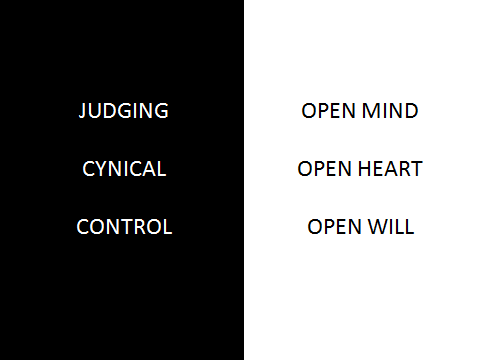
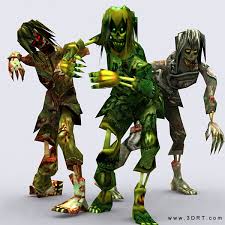
Was thinking about my previous post “Emotional Zombies”, where i wrote about Open Mind, Open Heart, and Open Will.

image

Open Mind, Heart, Will is based on the work of about Theory “U” by Otto Scharmer.

It’s a book about presence, and how – if you dive deep to the level at the bottom of the “U” – you will discover your true purpose. The subtitle is “Leading from the future as it emerges”. Now you know where i got the title of this blog.

In “Emotional Zombies”, I also wrote about the golden cages.

I recently discovered it can get worse. Much worse.

It can get to the stage of BROKEN Mind, BROKEN Heart, and BROKEN Will.

It remember somebody quoting about education just 50 years or so.

In the family instruction books of that time, the general sense was that the parent had to break the will of the child as early as possible in the education of the child, to ensure that the child would be fully under the parents’ and teachers’ control. Luckily, education has evolved, but you get a sense what it means to break somebody’s will.

To further explain that feeling of Broken Will, i will tell a true story. When i was studying architecture (yes, building houses and so) at the art school in Brussels, one year we had to design an art exposition space. We also needed to make a maquette of it.

I worked on mine for days and nights. It was made of the finest balsa wood, and the construction was made of hundreds of mini balsa pillars. Oh boy, was i proud !

Then the jury comes along. The judging was a session in full public where the other 200 students could follow the judgment of the pros.

Professor Jonckers – i even remember his name after 30 years ! – looked at my piece of art. He smiled dangerously and said: “Let’s see if this thing is also as solid from a construction point of view as it looks like” and then he demolished the whole thing by shooting with his fingers all 100 pillars into pieces. I could have kicked him in the face (i should have done it).

That hurts. It hurts when your piece of work gets demolished. It hurts when your contribution gets ignored. It brings me in my state of “Broken will”. Its an emotion beyond broken heart. It cuts deep.

This week, i mourned my broken will.

And what about the cage ? I suddenly remember a line of a poem: “she smiled gently when she discovered that the door of the jail was already open for some days”

Love and Hate Relationships


image

A good friend of mine commented on one of the blog post. It’s a comment that cuts deep. Knowing the person, i think it was quite a step to be this open on a public blog. So first of all, congrats for coming-out !

Here is the original comment:

I have spent some time reading through this and other blogs of yours. And they make me react strongly in a very controversial way: I love them and I hate them; I agree and fully reject their contents.
And, beyond the very valid and daring points you make, I’d like to reflect about the channel: speaking one’s true mind, yet doing so hiding behind a screen and sometimes even a fake name.
My fear is having my own children communicating with me via a blog.

You make me reflect, to the point of writing this reply. So I guess we should both be content as the blog has obviously achieved its goal…
But I dont know if I should be happy or sad about it. After all, I could have also called you!

With respect to the fake name, this was to protect. Not myself, but somebody else. I really would like to know on what content you agree or reject. Contact me.

In response to the strong point you make about the communication channel, I believe we have to let the future emerge (We don’t have a choice anyway ;-). We have to be in this world and evolve and adapt to survive. Or we can disconnect and go to a monastery, which is a valid choice of course.

My and your children consider e-mail as really very old-fashioned. And blogs are really for guys with grey hairs. So here we are. It’s 2010.

49 n02_21582623

Whether you like it or not, your and my children will communicate using Twitter, Facebook, Netlog, Foursquare etc or whatever will be applicable the next years. Like we used to send SMS’s, our kids will Tweet or whatever the channel will be.

special4

One thing is inevitable. The on-line communication channels move into real-time. Nova Spivack coined this “The Stream”. See my post on World Wide Web.

I have btw another blog post in preparation about about a very related subject: privacy.

We seem to have passed the tipping point where the default is NOT privacy, but Public. It will then be up to you to indicate what about yourself you want to keep private. I struggle with that too. It has a lot with digital identity. If you’re interested in digital identity, i can really recommend the blog of Kim Cameron: www.identityblog.com

I encourage anyone to get into discussion with me on the CONTENT of this blog. Via the comment link, via phone, mail, face-to-face.

When i started this blog, i had some blog-shyness. That over now. I feel more comfortable with this channel now.

Probably 10 years later than the early adopters, but who cares !

Cubicle 3B23: Let me entertain you


The idea for this blog post emerged when a colleague visited my cubicle.

I will from now on refer to my cubicle as “cubicle 3B23”. The idea developed to write regular post under the title “Cubicle 3B23”, reporting about the good, the bad and the ugly of corporate life. This is the first in a series. Maybe it’s the first and only one. But i thought the idea was “cute” to try it out, to see where it goes and to let the future emerge.

The initial idea was to do a one-off under a different title (go the the very end of the blog to find out), but a friend told me that “Let me entertain you” makes you want to read on. So here we go.

Sometimes people come to cubicle 3B23 for some good fun brainstorming: “Do you have 5 minutes, I want to pick your brain ?”. Others put their head into cubicle 3B23 and say something like “Oh, i see you’re busy, i will come back later”. The latter usually have something “sad” in their eyes.

These are the moments to connect. In both cases i know this connection will make somehow a difference.

The other day, Joe was the one with sad eyes.

He was doubting himself, and wondering whether he should do his own thing, or continue to shut-up and play the game of being mister nice-guy.

samrt-swine-flu-mask-4 

Joe was responsible for a program incentivizing staff to think out of the box. At TEDx Brussels, i heard a better expression for that: “burn the box”.

 

image

In the planning for the new year, he was asked to run the program again. But he felt it was just not right. He felt he would be cheating the people joining the program. He was doubting whether it really mattered. He felt that he would not be able to look those folks in the eyes at the end of the program as the expectations created were just over the top. It’s a bit like the subtle difference between lying and not fully telling the truth. Both don’t feel right, and appeal to your ethical compass.

He was tired. In search for his real purpose in life. Fed up with playing games.

We had a long chat. He kept on complaining about the artificial aspects in corporate life. Somewhere 1/2 way in our discussion, i asked Joe what really kept him going. What was giving him energy. In what circumstances he felt he could be his true self. Not the self that you construct/imagine to be in synch with the big bad world out there. No, the self that silently is waiting inside you to be discovered. To be stumbled upon is probably a better way to say this.

Joe gave it a long thought, and said: “when i can inspire other people, and make them happy”. (it was another answer, but then i would reveal too much about that person).

There was a short silence, and went to my PC, searched my music collection, started a song and said: “This is you, Joe !”

The song was right on. I could see the emotional impact on Joe. The song was “Let me entertain you” by Robbie Williams.

Robbie Williams' 'You Know Me' Music Video Debuted

I am an all-time fan of Robbie Williams. He is a great performer – once saw a concert of him in Wembley stadium – and you can love or hate him, but for me he is really authentic. Even if he puts on his rabbit/bunny head on. But i deviate. Although, this post is mainly about authenticity.

“Let me entertain you” is a high tempo energizing pop/rock song, but the real secret in Williams’ are often the lyrics.

Hell is gone and heaven’s here
There’s nothing left for you to fear
Shake your arse come over here
Now scream
I’m a burning effigy
Of everything I used to be
You’re my rock of empathy, my dear
So come on let me entertain you
Let me entertain you

I could see the sparkles in Joe’s eyes. “Yes, that’s what i want !” he said. “I want to entertain people ! Make them happy. Make them move/shake their arse.”

I have to say, me too.

But for me it translates into having this strange connection with “stage”
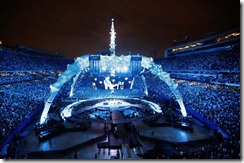
album_large_2215503

When i was young (…), i used to be a quite successful DJ. I organized rock concerts. I was on one of the first free-radio stations (end seventies). I even was singer :-/ in a rock-band.

I was always attracted by “stage”. The good buddies feeling with the roadies. The equipment being set-up. A great show. The after party.

Also today, when we do “events”, i love being close to the stage. I love to put together a program like Innotribe, and see how that resonates with the audience. Maybe we should do a TEDx @ Sibos 😉

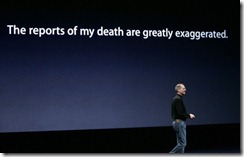
I love to have and to apply authentically that soft “power” to move people emotionally. I even have that “stage” feeling when i try to do a good presentation in PowerPoint, Prezi, Adobe or whatever. Always in search for some good metaphors, good supporting images, have some “rhythm”, add some music to it.

But the last couple of weeks, it started smelling “like a trick”.
24_09092008ikugtf

It has become “too easy” to put a presentation together that is “different” than the average.

On my blog, i often experiment a very little with fonts, font colors and sizes, left/right indents etc. But it all starts smelling like a “trick”. Starts smelling like on auto-pilot. That’s why in this blog post no “tricks” with fonts. I don’t feel that way today.

I once was told that one recognizes the best the feelings of others when you recognize them with yourself. For ex if you easily spot arrogant people, that’s probably because you’re arrogant yourself. Projection that is called, i believe.

That’s why i feel a bit like Joe. I recognize the feeling. I can do more with my skills. I am in search for that something extra. Like Joe, I am not happy anymore with just well executing a job.

I want to make a difference. Not just a ripple but a wave.

My wife sometimes asks me: “Peter, why don’t you settle down ? Look at the others. They don’t worry that much.” But i can’t. And i doubt. Is this my true self ? Is this who i really am ? Or is this the image that i’d like people to have from me ?

By now you probably get a feel of the initial title of this blog post. It was “doubting my impact”. Doubting my impact when working for this or that particular company. For this or that particular audience. Not doubting my skills or my added value.

I know i have the holy fire and can ignite others.

But doubting my added value and whether at the end of the day it’s all worth it. Whether at the end of the day it all made a difference. Whether at the end of the day there is some new meat on the bone. Whether it really matters.

lov-story

This blog is often walking a thin balance between telling from the field, and packaging/romanticizing the story a bit that it just triggers the intelligent reader to do something with it but without going in “full contact”. The thin balance between private and public when you go public with a blog.

One of my bosses used to say “Management is a full contact sport”.

Ouch !

Do i want to be there ? Not in the way he meant it.

But yes, i want to go “full contact” in the connection. In keeping the doors of cubicle 3B23 open. To pick my brain or to share your pain.

Who feels the same ? Who wants to share his story ? Who wants to follow ?
Emotional Zombies

Great post on “Who needs employees anyway ?”. Discovered via Fred Zimny’s Blog.

This is based on a recent “Global Workforce Survey” conducted by Towers Perrin, an HR consultancy. In an attempt to measure the extent of employee engagement around the world, the company polled more than 90,000 workers in 18 countries. The survey covered many of the key factors that determine workplace engagement, including: the ability to participate in decision-making, the encouragement given for innovative thinking, the availability of skill-enhancing job assignments and the interest shown by senior executives in employee well-being.

Barely 21%

of employees are truly engaged in their work, in the sense that they would “go the extra mile” for their employer.


Nearly 38%

are mostly or entirely disengaged, while the rest are in the tepid middle.


Surprisingly, 86%

of the employees in the Towers Perrin study said they loved or liked their job.


So, next time you evaluate your yearly employee satisfaction survey, beware of the numbers saying that the majority of employees is happy. Even if you sense in every office, corridor and corner that is not true.


Anyway, why these rather shocking results ? The article suggests a number of reasons:


Ignorance

It may be that managers don’t actually realize that most of their employees are emotional zombies

Indifference

Another explanation: managers know that a lot of employees are flatlining at work, but maybe they simply don’t care

Impotence

It could be that managers do care, but can’t imagine how they could change things for the better. After all, a lot of jobs are just plain boring.

Reputation

The company’s reputation and its commitment to making a difference in the world—is this a company that deserves the best efforts of its people;

Leaders’ Trust

Are the behaviors and values of the organization’s leaders—are they people employees respect and want to follow?


Anybody who has ever read a Dilbert strip knows that cynicism and passivity are endemic in large organizations.


image


However – in my opinion – we too easily get away with joking about cynicism. In my opinion, it is the cancer of today’s organizations that seem great at the outside, but grim at the inside. They look like golden cages. They offer all the perks possible, but they ignore 3 basic attitudes for any human being to function well.

#1: To have an open mind. Companies/People who do not have an open mind tend to retract into highly judgmental.

#2: To have an open heart. The next level is that of the heart. People who do not have an open heart have developed cynicism as a defense. They have learned NOT to show their heart.

#3: To have an open will. Last but not least, when there is no room for open will, we become control freaks.

In today’s society, driven more and more by openness and transparency, these “tricks” of judging, being cynical and control don’t work anymore.

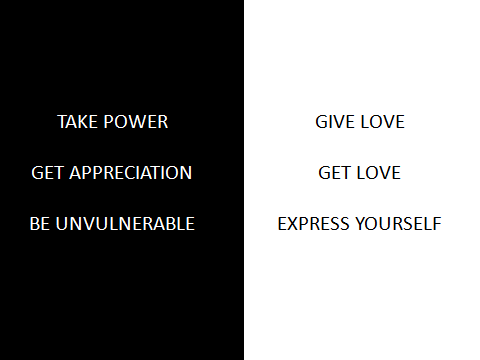
It all boils down to 3 fundamental needs for every human being:


image


People who are not able to express themselves (anymore), position themselves as “invulnerable”. In stead of being able to receive love, they compromise on getting appreciation. And in stead of giving love, the defense mechanism becomes one of taking power. As long as we have power games between the silos, the CEO can shout “change” and “innovation” as long as he wants, at the bottom of the pyramid nothing will change.

Surprisingly, the origins of these needs – and their fulfillment or not – is formed during the first 1-3 years of your life. In other words beyond the control of the organization you work for today.

But organizations should be conscious about these facts, and offer their employees probably the most interesting perk they can give: to follow a personal development program that lets the employee explore it’s true self.

  • Who am I ?
  • Who am I in a group ?
  • Who am I in the world ?
  • Finding your true passion.
  • Finding your true purpose in life.

And hopefully finding (or founding) a company that welcomes you respectfully as an employee, and gives you the chances to develop your true potential in line with your purpose.

It reminds me of Jim Collins and a 2003 blog post found back earlier today.

The start of the New Year is a perfect time to start a stop doing list and to make this the cornerstone of your New Year resolutions, be it for your company, your family or yourself. It also is a perfect time to clarify your three circles, mirroring at a personal level the three questions asked by Smith:

1) What are you deeply passionate about?
2) What are you are genetically encoded for — what activities do you feel just "made to do"?
3) What makes economic sense — what can you make a living at?

Those fortunate enough to find or create a practical intersection of the three circles have the basis for a great work life.

An to come back to the Global Workforce Survey:

  • In every industry, there are huge swathes of critical knowledge that have been commoditized—and what hasn’t yet been commoditized soon will be.
  • Given that, we have to wave goodbye to the “knowledge economy” and say hello to the “creative economy.”
  • What matters today is how fast a company can generate new insights and build new knowledge—of the sort that enhances customer value.
  • To escape the curse of commoditization, a company has to be a game-changer, and that requires employees who are proactive, inventive and zealous.
  • Problem is, you can’t command people to be enthusiastic, creative and passionate.
  • These critical ingredients for success in the creative economy are gifts that people will bring to work each day only if they’re truly engaged. (Eric Raymond made this point way back in 2001 when he argued that in the new economy, “enjoyment predicts productivity.”)

For passionate readers, i can recommend in this context Eric Raymond’s book The Cathedral and the Bazaar.

Or a bit an older – but still very relevant book – “The Cultural Creatives


Must be that I am some sort of +


positive guy when i turn a title like Emotional Zombies” into something positive like “The cultural creatives”

As Seth Godin was saying in his today’s blog:


One of the most common things I hear is, "I’d like to do something remarkable like that, but my xyz won’t let me." Where xyz = my boss, my publisher, my partner, my licensor, my franchisor, etc.

Well, you can fail by going along with that and not doing it, or you can do it, cause a ruckus and work things out later.

In my experience, once it’s clear you’re willing (not just willing, but itching, moving, and yes, implementing) without them, things start to happen. People are rarely willing to step up and stop you, and often just waiting to follow someone crazy enough to actually do something.

I’m going

Come along if you like


Reblog this post [with Zemanta]

Brand, Workforce and Innovation

If you’re interested in Innovation, you have to subscribe to Blogging Innovation. All posts are just worthwhile reading.

image

They also have a group on LinkedIn.

Today’s article typically resonated with me. It’s titled: “Combining Brand Management with Workforce Enablement”.

IBM-718954

It’s about the speech by Jon Iwata, SVP of communications and marketing at IBM on the future of the communications profession at the November 4th 2009 Institute for Public Relations Distinguished Lecture Series at the Yale Club in New York City. Full text of the speech is here.

Iwata says:

"One day soon, every employee, every retiree, every customer, every business partner, every investor and every neighbor associated with every company will be able to share an opinion about that company with everyone in the world, based on firsthand experience. The only way we can be comfortable in that world is if every employee of the company is truly grounded in what their company values and stands for."

IBM has developed an IBM Brand “System”:

Picture a framework with five columns. From left to right the columns are labeled what it means to look like IBM, to sound like IBM, to think like IBM, to perform like IBM and ultimately to be IBM. Simple enough. You could in 30 seconds create the same frame for J&J, Chevron or Ketchum. But of course it would — and should — take you much longer to fill in the details. Every word, every phrase and description in that framework would be painstakingly chosen. Because this is your corporate genome. It describes what makes your company unique. Developing the framework is hard work, but it’s only the foundation. Because, like a genome, the real work — and value — are in bringing it to life.

and also:

For example, we are now collaborating with our colleagues in HR to redesign IBM’s leadership competencies for the first time in many years. If this is ultimately approved by the CEO – and we’ll know in a few weeks – it will mark the first time in my 25-year career that the foundational elements of HR will not only be aligned with our brand and workforce strategies, they will be essentially the same.

I would like to see some examples on how this works in an environment where efficiency programs are run in parallel with innovation programs and (re)branding programs. What is the ideal role of HR in all of this ? Will HR be degraded to a “management” machine to deal with lay-offs only ?

I’d love to see more HR in a true leadership role. Leadership as opposite to management in its narrow definition of executing a course set out by somebody else. See also below the very important message about the role for HR in creating the eminence of our workforce.

About this, Iwata says:

But the building of constituency goes beyond the reaching of audiences. It gets to how a company establishes shared attraction and shared values: how it shapes not just common ground, but a deeper, enduring, shared idea.

They weren’t simply sending messages to audiences. They were creating audiences.

They weren’t shaping relationships with existing constituents. They were creating constituencies.

This is the basis of our Smarter Planet strategy. We are specifically and deliberately working to validate and stoke the optimism of forward-thinkers. We are saying to them – because we really believe it ourselves: “Your hopes for your industry, your city, your environment, your community are now within your grasp. This isn’t a metaphor. We can actually build a smarter planet.”

Our work of late tries to get at the real substance of change, the real issues on the table. The work is long-form. It’s argued, not pitched. It doesn’t focus on our products and services.

It purposefully invites people to

 think


Wow !


And lastly about Building the eminence of our workforce.

I believe that 2010 will be the year that corporations grapple with and ultimately accept that their employees are engaging with – and must engage with – social media. We’ll certainly go through a necessary period when people raise all sorts of objections.

The CFO worries about financial disclosure. The General Counsel fears intellectual property leakage. HR will say we’re helping competitors recruit our people. And everyone will be nervous about criticism of management. These are all legitimate.

So the answer to all this may be another set of policies and guidelines for using social media. My employer has indeed such a set of policies. They are difficult to find, but they exist. But are another set of policies and guidelines a solution. Will the fact that each employee has to sign-off the blogging policy or any other code of conduct really change our actual behavior ?

I doubt it.

Let’s say we actually do that. Then what? Policies and guidelines may keep individuals and their companies out of trouble but, by themselves, they won’t create business value.

The key is to build the eminence of our workforce.


What do I mean by “eminence”? No matter what their industry, their profession, their discipline or their job, people with eminence are acknowledged by others as expert. It’s not simply to know a lot about Tuscan villas, digital cameras or banking. You need to be recognized as an expert. And when you show up – in person, or online; in writing, or in conversation – you are both knowledgeable and persuasive. Because being an expert and being good at communications aren’t the same thing, as we all know.

Which is why


we need to make the creation

of this kind of workforce

an intentional act,

a new discipline in our function

Yes, we need guidelines and policy – but also training, resources and support for broad networks of experts.

Related to this, i found just a couple of days ago a great post from Hugh McLeod’s site titled: If your boss tells you, “our brand must speak with one voice”, quit.

I once had a boss who didn’t like the fact that I had a blog. Especially when I blogged about stuff that was relative to our industry. Yeah, “Our brand must speak with one voice” was his idea. Yes. I know.

Actually, the reality was, HE wanted to be “The One Voice”. He wanted all the credit, and all the rewards. He didn’t mind me put ting words into his mouth– stuff I had writ­ten– so long as the outside world gave him all the credit. But he didn’t want me in any other role, other than subservient, nowheresville wage slave. He fought tooth and nail to keep me from ever becoming a rainmaker inside the company, something he wanted all for himself.

And back to the end of the speech by Iwata:

To me, this is what “values” are about… and what “authenticity” means. This is about consciously choosing a unique identity. And it’s about actually being that unique thing you have chosen to be.

In other words:

Leading by Being

The Algorithmic Principle Behind Curiosity and Creativity

One of the very best presentations at last month’s Singularity Summit. And it comes from a European 😉

Lots of inspirarational slides and ideas, and – as a bonus – Jürgen is quite funny as well when presenting.

Privacy is dead

This blog post is triggered by a start-up demonstration i saw at DEMOFall2009 some weeks ago.

The demo was about an iPhone application called “datecheck” aka “creepfinder”

You can find the video here.

Not that i am interested in on-line or real-life dating – i am happily married – but in essence the application allows me to do a check on my date. It basically crawls the internet, twitter, facebook, and  – in the US – public data such as your real-estate tax income and even criminal records.

The end-result is that i find data about criminal records about my future fiancée, full real-estate data about what house he/she lives in, family composition, real-estate tax-income etc

The US government also is getting quite open and transparent on its own data. Have a look at www.data.gov

image

And these days all these data are accessible via API’s to take data OUT of these systems. Some API’s like twitter, facebook etc also allow you to INPUT data via for example Tweetdeck, Seismic, and many others. I would love to have something that not only allows me to INPUT my Tweets, but also something that allows me to input and maintain my personal profile data, across services. See also at the end of this post.

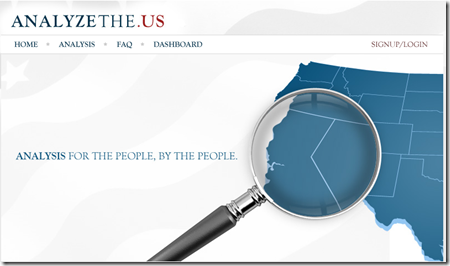
For the US government data, you see start appearing end-consumer apps that let you search through this massive amount of for example government contractor’s data with quite advanced intelligence tools in the hand of the citizen.

In stead of FBI (Federal) it’s becoming

CBI (Citizen’s Bureau of Investigation).

It says “analysis for the people, by the people”. I would add “"about the people”

image

All this is sold as “transparency” and “democracy”, and those are of course very important values.

But – and I don’t know about you – I start more and more FEELING quite uncomfortable about all this. Not that i have to hide anything, or that i have a criminal record (at least not that I am aware of ;-), but I do FEEL all this is quite intrusive.

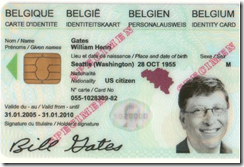
As most of you know, in my previous life i was quite close to the Belgian eID project (electronic identity card). The card also allows you to access the on-line government database, where I can look at my OWN data and check who in the government has accessed those data.

But i believe we should make a big plea for the appliance of Law #1 of Kim Cameron’s Laws of Identity:

image

That’s easy said, but how do you enforce that. I took the pain to look at the privacy policy of Twitter (see http://twitter.com/privacy). In essence – as a user – i have nothing to say. I have 2 choices: to use twitter and accept the privacy policy, or not use it. But how many of the many million Twitter users have ever read the privacy policy ? How many know what sort of deep intelligence engines are crawling all these data that i released to the net WITH A DIFFERENT PURPOSE ?

This is not Twitter specific. It applies to Facebook, Friendfeed, or any other form of social network or service.

In my opinion, i would like to have something where i can control what data about myself i want to release to what service and in what context. I update my information there once, and have also guarantee that my profile information is consistent across Twitter, Facebook or even event/conference sites that these days more and more use their own social media piece of technology.

Of course you would need a highly trusted party to deal with these data. I think i would even be prepared to pay a price for my privacy.

This concept of a central digital vault comes pretty close to eMe, the winner of the Innotribe idea-contest at Sibos 2009 some weeks ago. But they started from “mydata” and information and documents related to financial services. If you start thinking privacy and putting control of data back into the user’s hands, you get a much more powerful proposition.

I would like to hear the opinion of a number of identity and privacy experts that are following this blog

UPDATE: Can’t help it, but just at the same time as i published this post, Guy Kawasaki tweeted the following URL:

 http://holykaw.alltop.com/why-you-should-think-before-you-tweet

Mobile Vein Identity

We all know that userid’s and passwords are not good enough anymore.

That’s why more and more companies move to two-factor authentication, using those little contact-less “calculators” that generate one-time password, or contact-ful solutions like smartcards, USB-tokens, etc or other concepts such as OpenID or Microsoft’s CardSpace (i still prefer the old name “InfoCard”).

Only a couple of days ago there was a whitepaper on Open Government published by the OpenID Foundation and The Information Card Foundation.

In one of my previous life, i was involved in the Belgian Electronic Identity (eID) project, that uses a smartcard containing 2 certificates issued and certified by the Belgian government. One for signing and one for authentication.

image

For a latest on Belgian eiD have a look at:http://welcome-to-e-belgium.be/.

image

The Belgian eID has now been rolled out to roughly 8 million citizens over a period of about 5 years.

But, the card requires a card-reader and a driver.

But what about mobile ? Yesterday, i shared the post about teenagers online behavior. 99% have a mobile. Also, there are roughly 4 times more mobiles in the world than bank-accounts !

And yes, i have seen those card reader “sliders” for some PDA’s. Then you have a slick PDA, and now you need a slider that’s twice the size of your PDA.

There must be a better way !

What about one of the contesters of TechCrunch Japan Tokyo Camp ?

prev05 mobile_vein_universal_robot

Universal Robot’s (JP) compact mobile vein authentication software (40KB core module) can be installed on cell phones, for example, and uses the camera to scan your wrist vein for identification. The technology seems to have many advantages: It works fast (I tried it myself), it’s completely software-based, compatible to a variety of CPUs and operating systems, usable for persons doing hard manual labor (who can’t use fingerprints), and most importantly extremely accurate (the company speaks of a false accept ratio of 0.001% and of a false reject ratio of less than 0.1%). The award-winning software works even with cameras with a 1MP sensor or lower.

Some good identity blogs are Kim Cameron’s www.identityblog.com and Dave Birche’s Digital Identity Forum. To get a broader perspective on identity based on information shadows, see also my recent post on MIT Personas Project.

Digital Identity will become the cornerstone of our online experiences. That’s why identity should be one of the key research areas of our Think Tank on Long Term Future. We have the experience in Belgium of having rolled out the first generation, let’s now also be leaders in defining and rolling out the next generation.

Massive manias, booms and busts.

Remarkable video from Peter Thiel speaking at the Singularity Summit two years ago about the need for Singularity in todays Financial Markets.

Peter Andreas Thiel (born 1967) is an American entrepreneur, hedge fund manager, libertarian and venture capitalist. With Max Levchin, Thiel co-founded PayPal and was its CEO. He currently serves as president of Clarium Capital.

Thiel has made early-stage investments in several startups, including Slide, LinkedIn, Friendster, Geni.com, Yammer, Yelp, Powerset, Vator, Palantir Technologies, Joyent and IronPort.

Btw, we already mentioned Palantir Technologies in this earlier blog post. Also those folks are ex-PayPal.

“As you can’t predict, you have to bet” says Thiel.

And “The alternative to the singularity is the apocalypse”. See also my previous post on the need for a singleton if we want to avoid humans to be overruled by Artificial Intelligence

We will (are) witness massive manias, booms and busts

on a scale unprecedented.

But that’s not normal for markets that are well connected. Markets that are well connected (such as the financial markets) have more information circulating on their networks. Normally, when more and more information is floating around in a market, that market gets smoothened out and gets more efficient. Stocks would evolve at a smooth 6-7% per year, and most volatility would go out of the market.

Well, unless you have been living on another planet, the contrary is true. And worse,

the frequency ànd amplitude of the booms and busts gets bigger.

There was the Japanese crash end 80ies, the emerging markets mid 90ies, the intro of the financial derivatives that scaled to a 1 trillion hype industry, in 98 Russian market blew up, the March 2000 Internet bubble, the 2008 bust of Lehman’s and the big crisis we are in now. Peter Thiel explains how in March 2009 was the last month of insanity before the bust.

Dillusion and insanity were at their peak.

What i really like is when he says: “at the peak of the boom, you can see furthest”.

It reminds me of another quote – can’t find right away from who – that when innovating you better start with the future in mind, rather than starting from the now. The latter approach usually leads to small incremental adjacencies, whereas the first approach at least gives you a chance of driving something disruptive.

All big breakthroughs were disruptive. None of them were predictable by extrapolating the past of the now. See also Nassim Nicholas Taleb’s The Black Swan book.

Btw, in the last Wired (Aug 2009), you can read that speaking of the Black Swan is really “tired”. That’s the stage before “expired”. Old-fashioned.

Isn’t this about big trends ? Like that all sorts of businesses will  not work in the enterprise 2.0 economy. That running a more authentic business becomes mandatory. See book industry, see newspapers, etc.

However, the biggest trend –says Thiel in 2007 -  is the trend from old to new media. So big a trend you don’t even see it.

That was at the Singularity Summit in 2007 two years ago. Next summit is in October 2009. Have  a look at the line-up of speakers. Very curious what those great thinkers will spot as trends you don’t even see.

What are the biggest manias, busts and booms to come ?

Human Evolution Future

Found a really interesting post today on Accelerating Future blog of Michael Anissimov.

He refers to the technology optimism of Kevin Kelly (KK). If you’re not familiar with KK, you should and definitely to his blog.

Kevin Kelly’s Panglossian optimism is exactly the type criticized in Nick Bostrom’s paper “The Future of Human Evolution”. The PDF version of this paper can be found here.

I read the paper and was blown away by some strong starting points, assumptions, statements and conclusions.

Some teasing extracts to further encourage you to download the paper and – more importantly – read and consume it.

The past few hundred years have seen enormous improvements in human life‐span, labor productivity, scientific knowledge, and social and political organization, which have enabled billions of people to enjoy unprecedented opportunities for enjoyment and personal development. On a historical as well as on a geological timescale, the big picture shows an overarching trend towards increasing levels of complexity, knowledge, consciousness, and coordinated goal‐directed organization, a trend which, not to put too fine a point on it, we may label

 “progress”.

… this past record of success gives us good grounds for thinking that evolution (whether biological, memetic, or technological) will continue to lead in desirable directions. This view, however, can be criticized on at least two grounds.

First, because we have no reason to think that all this past progress was in any sense inevitable‒‐much of it may, for aught we know, have been due to luck.

And second, because even if the past progress were to some extent inevitable, there is no guarantee that the melioristic trend will continue into the indefinite future.

then the only way we could avoid long‐term existential disaster is by

taking control of our

own evolution.

Doing this, I shall further argue, would require the development of a “singleton,” a world order in which at the highest level of organization there is only one independent decision‐making power (which may be, but need not be, a world government).

Second, new methods of reliably communicating information about oneself might be available to technologically mature creatures, methods that do not rely on flamboyant display. Even today, professional lenders tend to rely more on ownership certificates, bank statements, and the like, than on costly displays such as designer suits and Rolex watches. In the future, it might be possible to employ auditing firms that can

verify through direct inspection that a client possesses a claimed attribute.

Signaling one’s qualities by such auditing may be much more efficient than signaling via flamboyant display. Such a professionally mediated signal would still be costly to fake (this is of course the essential feature that makes the signal reliable), but the signal could be much cheaper to transmit than a flamboyantly communicated one when it is

truthful

… not all possible costly or “flamboyant” displays are ones which we should regard as intrinsically valuable…

Just as current human beings benefit from other species, which pose no serious threat to the human species, so too may technologically more advanced agents benefit from the existence of an ecology of non‐eudaemonic agents

Moreover, by contrast to current human political competition, where alliances shift over time, it might be possible for more advanced life forms verifiably to commit themselves permanently to a particular alliance (perhaps using

mind‐scanning techniques

and

technologies for controlling motivation

All this makes me think about Kosta Peric’s posting on www.innotribe.com on developing a vision for 2020. Initial posting and debate can be found here.

Back from the future – tell your story

Consider the following "thought experiment" – imagine yourself in the future (let’s say somewhere in the 2020’s) and describe how the world looks like – and also how we got there. Something like this:

http://idorosen.com/mirrors/robinsloan.com/epic/

Some predictions are off and some are … quite close and still unfolding. In fact as we speak there are examples of newspapers attacking google or the internet in general.

(There is another movie applying the same trick for the financial industry known as "amazonbay"  but unfortunately all the links to it on the web are all off)

As a matter of fact that video is here:

image

I find this type of thinking very useful and creative – you can drop all constraints and just let the imagination loose!
Any candidates for visionary story telling?

If you look at the stories posted, they are just lacking a bit of imagination on what’s going to happen by 2020 or 2030. Most of the the things posted there are already possible today !

I have a couple of days off and will try to write some sort of trailer on  what i believe is going to happen based on the singularity principles of Ray Kurzweil, and other great thinkers like Kevin Kelly and Nick Bostrom.

Stay tuned for some amateur SiFi.