You have to be somebody before you can share yourself

It’s holiday time, and I have reduced significantly my blogging, reading RSS feeds, tweeting, mailing, etc

Time for hanging around, some biking, some good food, and… a good book. If you want to follow what I am reading, check-out my page on Goodreads.

For me, a good book is one that leaves you puzzled, that makes you think,


that re-calibrates your perspective,


that is a pleasant read, that has depth.

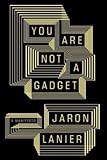
“You are not a gadget” by Jaron Larnier is such a book. I discovered it thanks to a tweet of my friend Paul, who reacted to one of my enthusiastic Singularity tweets. The title of this blog post “You have to be somebody before you can share yourself” is very early in the book, and captures its essence.

Jaron Larnier was listed on The 2010 TIME 100 in the Thinkers category. His Wikipedia entry is here.

It’s a great read if you are in your over-enthusiasm mode about  computationalism, the noosphere, the Singularity, web 2.0, the long tail, the hive mind, the global brain, crowdsourcing, collective intelligence and all the other buzzwords and trends and all the rest. It gives you some solid pushback and sound criticism.

I am not going to do a book review, but my experience of the book was like there were 3 stories interwoven:

  • How technology is limiting our potential and who we are on-line. This of course resonated a lot with my work on Digital Identity.
  • Our communication limitations. He has a great chapter on how cephalopods have the great ability to “morph” and how one could use “visual” communication and another dimension of communication, other than language. And how humans in virtual reality environments quickly adapt to a body with tentacles. Intriguing !
  • The notion of “neoteny”: humans are born as fetuses in air, and our brain is being developed during childhood. Lanier compares this to a newborn horse that can stand on its own and already possesses almost all the skills of an adult horse. Humans – in modern civilizations – have an artificial, protected space called “the classroom, the extended womb”.

Neoteny opens a window to the world before our brains can be developed under the sole influence of instinct.

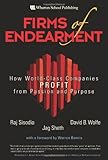
A similar concept related to neoteny – “generativity” – comes back in another great read Firms of Endearment: How World-class Companies Profit from Passion and Purpose.


This is a book about

the pragmatic role of

love in business


It’s about the epochal change into the Age of Transcendence. The dictionary defines transcendence as a "state of excelling or surpassing or going beyond usual limits."


The second event is the aging of the population. For the first time in history, people 40 and older are the adult majority. This is driving deep systemic changes in the moral foundations of culture. Higher levels of psychological maturity mean greater influence on society of what Erik Erikson called "generativity"—the disposition of older people to help incoming generations prepare for their time of stewardship of the common good

The Firms of Endearment book in essence talks about a new form of capitalism that is not only focused on profit and shareholders’ value, but on value creation for all parties in a company’s stakeholders’ ecosystem.

Joran also has an opinion on capitalism when he says:

Visiting the offices of financial cloud engines (like high-tech hedge funds) feels like visiting the Googleplex. There are software engineers all around, but few of the sorts of topical experts and analysts who usually populate investment houses. These pioneers have brought capitalism into a new phase, and I don’t think it’s working… capitalism in a digital future will require a general acceptance of a social contract

He is also calling for “so-called AI techniques to create formal versions of certain complicated or innovative contracts that define financial instruments” and that setting standards for these could be facilitated by “a cooperative international body” that

would probably have specific requirements for the formal representation, but any individual application making use of it could be created by a government, a nongovernmental organization, an individual, a school, or a for-profit company. The formal transaction-representation format would be nonproprietary, but there would be a huge market for proprietary tools that make it useful. These tools would quickly become part of the standard practice of finance

What a great potential for my employer SWIFT ! We are indeed a full-blown cooperative international organization with our roots in financial services.

In essence, Jaron Laniers’ manifesto and rant is about “The deep meaning of personhood is being reduced by illusions of bits”.

That should make us reflect deeply on how we want to engage as human beings in an on-line world, how we define digital identity in the relative and the absolute, and be very vigilant that we don’t loose our potential in our technology enthusiasm.

For me, the prospect of an entirely different notion of communication is more thrilling than a construction like the Singularity. Any gadget, even a big one like the Singularity, gets boring after a while. But a deepening of meaning is the most intense potential kind of adventure available to us

Finally, I also found some consolation to deal with my 3/4 Life Crisis. The following quote always helps:

If you are young and childless, you can run around in a van to gigs, and you can promote those gigs online. You will make barely any money, but you can crash on couches and dine with fans you meet through the web. This is a good era for that kind of musical adventure. If I were in my twenties I would be doing it. But it is a youthiness career. Very few people can raise kids with that lifestyle. It’s treacherous in the long run, as youth fades.

My blog is my “adult” way of doing gigs online.

Heretic Team Glue

Last week we had a great team off-site.

We arrived late afternoon in the fantastic location of Chateau de la Poste, close to Namur, Belgium. Built in 1895, the Château de la Poste was the residence, for more than forty years, of Princess Clementine, daughter of King Léopold II. It later was sold to the postal services, who used it as a vacation resort for the children of the employees of the Belgian Post (times have changed). It recently was refurbished completely by a French wine maker, and it houses now a wonderful hotel, meeting centre and quality restaurant.

The amazing landscape, the silence and the soft welcome on the summer terrace set us all in the right mood. We all felt our physical and mental muscles relaxing, winding down.

Don’t know where I read it anymore, but I recently found a quote: “If you are not able anymore to take some time out for an off-site team gathering, you’re cooked”

For once, we did NOT have a packed agenda, and plenty of time for  real Quality Time Sessions.

We even made an acronym for it (QTS) to joke a bit with the “acronymitis” of the lean methodology.

More seriously, we invented QTS because we felt that the pure lean method was too much focused on a problem-mindset, and not enough on an opportunity-mindset, opportunities to develop some deeper quality thinking on subjects relevant to our business and team.

One of the items on the agenda was about “how to tell bad news”. In the subsequent discussion, one team member reflected on some sort of “fear” and “If I do this, then this and that may happen, and then…” thinking. Being in the acronym mode, we had a good discussion on


FEAR = Fantasy Experienced As Real


and how such behavior leads to blocking, status-quo situations.

Almost “emergent by design” our team culture principles unfolded, and we articulated them along the themes of “old” and “new” game.


  • Old game = fear, tricks, manipulation, raising stinky fish, machiavelism, creating and maintaining negative energy in general

  • New game = solution oriented, integrity and authenticity, fast correction (like Guy Kawasaki used to say”churn baby churn” a variation on the famous 1976 disco song “Disco Inferno” by the The Tramps), the holy fire, positive energy, who is the owner of the idea, who cares ? It’s about focusing on believers, and investing heavily in those VIP followers that will help us create a viral innovation infection/storm, like a raging holy fire that cannot be stopped anymore. Burn baby Burn…


We replaced “raising stinky fish” by regular update and feedback sessions, focusing on polishing rough idea diamonds, focusing on what works vs. what does not work, focusing solutions vs. problems.


If you think deeply about it, all this is about

the major cultural shift

from pushing towards pulling your ideas,

it’s about a strengths based society and team,

it’s about connecting ideas

and excel in making them real.


Another correction we made to lean was our understanding of a skills matrix.

We were very inspired by Venessa Miemis’ blog post “Framework for a Strengths Based Society” that included following diagram.

We decided to add these skills to our existing lean skills matrix that was too focused on identifying and solving problems and tools mastery. “We are not the tools, the builders are us” is another quote from one of Venessa’s presentations.

The subtle nuance is that we did NOT implement these skills as comparative/ competitive skills of different team members but


in terms of personal areas of

strength and potential

for each team member individually.


Our little team is SWIFT’s “Innovation Team”. Some time ago, we shared the details of the mission here and in summary it goes like this:

Build the Skills , Tools , Processes, Metrics , Values , Network , required to support collaborative innovation and transform SWIFT in an agile company, able to succeed in a changing environment.

I often make reflections on how real our innovation work really is. And although we are having lots of fun and some sizeable impact on how the company little by little opens up for innovative behavior, I always seem to be in search for that little extra in life and work.

Too many of our innovation experiments and proof-of-concepts remain just that: proof-of-concepts and prototypes. They never get into production. Worse, some outcome are just ‘filed vertically” or even never get the any executive attention.

I would like to hear from other innovators what is the secret sauce to get beyond the prototype stage. Because staying in prototype stage sometimes makes me wonder if I am in some sort of “busyness” therapy.

And I have come at an age where I cannot content myself with busyness.

I could sit here till my pension, having a good pay, and living honestly speaking in a quite luxurious working environment. But I am in search for more. I am in search for


meaning and significance


With the couple of years still to go, I still have the arrogant (?) ambition that I want to leave a legacy. On a personal level in my family. On a professional level that my passing in this company has substantially changed something. It’s about a deep sense of motivation, beyond pay and perks.

There is something heroic, even heretic about all this. That’s why the title of this post is Heretic Team Glue.

See full size image

Heretics are the ones that were expulsed from the Catholic Church because they did not follow the rules and challenged faith and established dogmas.

There are several dictionary definitions of “heretic”. The one I have in mind here is “anyone who does not conform to an established attitude,doctrine, or principle”.

I think we in our team are all some sort of heretics in the castle. It’s something very special in our team, that creates a very strong bonding.

At times it even has some masochistic flavor. Why on earth do we keep on trying again and again ? Even if the odds are against us. Why are we prepared to go time after time through the innovation pains over and over again ?

I truly believe it is because we do it for the right reason. Not for the pay. Not for the glory.


Because we believe there is a chance

we can succeed 


And believe we can create a tribe of followers in the same belief. It’s for some of us the only reason why we stay !

Are the above reflections caused by my age and my 3/4 life contemplations ?  Don’t think so. We invited some GEN-Y colleagues to join our off-site. And see: they too are driven by honesty, they too want promises to be kept, they too look for meaning and fulfillment in their lives.

But it was shocking to hear how some of them have been seduced to join a company based on huge expectations and promises that they would work soon for 3 years in the US, and have rapid accelerated career paths, and deep young graduate immersion programs. It’s unacceptable to make such promises if you know you can’t realize them.

And this is their first contact with corporate life !

How can we ever correct this ? How on earth can we regain the trust of these young people ? Our generation has planted the seeds of suspicion in these long lives. Big mistake.

Me too I have been mislead several times in my life, and I recognize the power-less emotion of trust that was betrayed. Lessons of life ? Normal life injuries ? The way it is ? Why do we need to accept that ? Why do we repeat the same errors over and over again ? Sooner or later, these young people will present us the invoice.

These folks actually think. Think deeply. Some GEN-Y people are for example  insulted when calling them “GEN-Y”. Because they see themselves as individual human beings, with their own identities and values systems, not prepared to be tagged as a category. And they have great ideas. We organized some sort of Innotribe Lab with them: more than 20 ideas on how to improve quality of work came out. I am honored that I can channel these ideas into the People & Culture “movement” team of the company.

Last but not least, we had a great discussion about “reverse mentorship”.

Instead of older experienced professionals mentoring new young people joining the company, why not letting young people mentor the already older – sometimes (mis)formatted – generation, and teach them how to use new technologies and apply 21st value systems ?

We had a fierce debate: how can one say that the young generation is the future, and five minutes later challenge reverse mentorship by not accepting that one can learn an awful lot from these fresh and well trained minds.

Maybe that’s where my future is ? In being mentored by a GEN-Y ? It will ask of course an attitude of

vulnerability


It’s also part of a give-ànd-take culture that includes transparency and openness. Especially give. Like a gift, where you don’t expect something in return.


When is the last time you made a Gift ?


How can we create an environment where we encourage learning from each other (in normal and reverse mentoring mode) ? An environment where we celebrate confidence building on your own rhythm, dare to be vulnerable, asking for feedback that is clarifying, supporting, challenging.

I am convinced I can learn something from every human being. Especially young people who have a renewed and fresh sense of civic responsibility, transparency, honesty, openness.

I have committed to take the challenge and invite one of our GEN-Y’s to monitor me during 6 months and give me feedback on my behavior and to keep me honest.

So that I walk the talk. Every manager should do this.

Social Currency: My Personal Identity

Recently came across this great site by Dan Robles.

image

One of his latest posts Will Social Capitalism Replace Market Capitalism? (Parts 1&2) included great video material on how social currency can change industries.

image

His forecasting example is the airline industry. And it’s even not so far fetched. What if you could “Time-Share” seats in private jets ?

It’s easy to think how this social currency model would apply to any other business and radically innovate by creative destruction.

It’s a very novel way to show how a number of trends come together:

  • The influence of gaming theories and practices in new business models
  • The value and tradability of my personal information
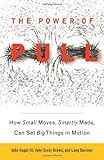
  • The power shift from Push to Pull that is so well described in John Hagel’s latest book “The Power of Pull” (I repeat it, in my opinion THE business book of 2010)

By the way, we recently had a face to face meeting with John exploring the possibility to have him with us at Innotribe at Sibos in Amsterdam, 25-29 October 2010.

image

We have asked John to consider a talk in our Innotribe Opening Keynotes, and to be part of our special Innotribe Lab on The long now in Financial Services.

To come back to the subject of the power of identity, I’d like to spend a bit more time on the tradability of my personal information.

The essence of the story is that some parts of my personal data have value and can be traded under the user’s control to get a better service.

It opens questions to:

  • How tradable is my personal identity ?
  • How tradable is my digital footprint ?
  • How tradable are my on and off-line relationships ?

I have been immersed in “personal digital identity” the last couple of weeks. Recently i attended the EEMA’s The European e-Identity Management Conference in London.

The week after i was the “tour guide” for a "Digital Identity Tour” we organized with some colleagues on the West-Coast”. I am preparing a set of blog posts on these conferences and 1-1 conversations with thought leaders in e-Identity space.

In this blog i will just simplify my summary thoughts with the statement that e-identity is much, much more that a certificate on a smart-card, or for sake of the argument any other form factor.

We are witnessing a power-shift:

In stead of the government (or the bank, or any other service offering entity) creating digital identities to give more value to the citizen, we see the emergence of  identities created by the user to give greater value to the government (or the bank, or any other service offering entity)

We have to carefully think this through, as identity – and relations between and with persons – is really a complex animal.

Have a look at this fantastic 210+ slides presentation “The Real Life Social Network V2” by a Google analyst @Padday aka Paul Adams, working for the UX team at Google. The essence of his story is that there is nothing such as a generic “Friends”. You have all sorts of friends and different depths in relations. Whether those relations are between people-people or people-companies.

It’s a great story, and all slides are annotated. As a teaser, here are his 3 summarizing slides:

image

image

image

It’s interesting how the words identity, privacy, care, relationships, collaboration, strong/week ties, Klout, etc are now all coming together. As a matter of fact, these are all attributes that make us truly human.

As a sherry on today’s cake, i’d like to link you once more to Venassa Miemis site “Emergent by Design” and the great recent blog post on Guidelines for Group Collaboration and Emergence, that is building on both her previous work on “Strenghts Based Society”, “”Skills for a 21st century connected world”, and her work on the open source collaborative tool “Junto”.


image

As we are preparing Innotribe at Sibos, i had the pleasure to talk to Venassa during a Skype session. We are discussing her participation at several levels of our Innotribe Program.

It is great to see how these novel ideas become “totally” relevant when you start thinking about their value for a “community” like SWIFT and an innitiative like Innotribe where “Enabling Collaborative Innovation” is our “Leifmotto”.

From the conversation with Venassa, i can tell you she “totally” got it, and she is preparing some material and levels of interactivity for Sibos that you even never dreamed of.

We are now 16 weeks from Sibos. The idea is to begin hosting a junto every week, invite different thinkers to discuss the future of money, record all conversations and develop a presentation based on them, but also make the videos available for the attendees of the conference to be able to watch whenever they want to see what those conversations were like.

If we think about the Long Now, will there still be currency as we know it? Or will social currency become central to our trade? And what impact does that have on banks ? Should be have personal data stores where we deposit our digital footprint and open personal accounts and do payments for services from there?

Feel free to jump in.

Becoming Better Builders

This is about an amazing idea of a 23-year young big thinker who created a fantastic community on-line and almost by accident stumbled upon a new platform for on-line communication that could change our world.

I stumbled upon this absolutely great video of a speech given by Vanessa Miemis in NYC during the Social Business Edge Conference on 19 April 2010.

image

I am a big fan of Mrs. Miemis and fervent reader of her blog “Emergent by Design”.

image

It’s the first time I see and hear her speak. It’s adds a different dimension. It’s a different type of engagement, and that different type of engagement is exactly what “Junto” is a about: a conversational platform between “real” people (see later on this blog).

She has roughly 4 supporting slides, and talks from the heart, with only a small sheet of paper with probably a couple of keywords and key statements. That’s how really super keynoters do their thing.

In this video she talks in an almost shy way about what drives her, and makes one after the other bold statement about the way this society does (not) work anymore.

The story is in essence about

the old game and the new game


As my friend, coach and mentor Andre Pelgrims used to say:


our (mental) software has evolved, but our hardware did not (our value systems, our hierarchies, our corporate models)


Vanessa’s speech in in 3 chapters:

  • We are shaped by our tools
  • We learn by modeling behavior
  • We align around a shared vision

I was mainly blown away by the section on Modeling behavior, some elements in the vision alignment, and definitely by her description of Junto.


Modeling behavior


Some real deep thinking here:


This is how children learn. It makes interactions transparent

Encourage a culture of collaboration, there is a certain type of behavior that we are modeling, and one that is based on a value system that is predominantly different than the one that exists in society and business today.

And its difficult to expect a paradigm shift when the current model rewards selfishness, and hording of information and exploitative behavior.

This virtual space is actually like some kind of training ground to build trust and to have a different behavior where the outcome is more than the zero-sum (in the existing model)

We align around a shared vision


There is this new way. For the greater good. A new global conversation and collaboration platform. that would sit on top of the web and that would accelerate the rate of taking an idea to action. And we are calling it JUNTO.

Enter Junto’s vision: a 3D space, where it’s live-streaming video, with video streams of us human beings.


It’s actually you,

who you really are


On top of that a profile system, automatically generated by the conversations you are having. It’s a different kind of transparency on who your really are. On top of this this reputation system that would be build into these trust networks, and virtual currencies, … and it goes on.

It’s like 5 people having a public conversation about a topic that interests them, and 500 people sitting in the back-channel. It’s all open source. They don’t want to monetize the tool.


They co-create value

by what they do with each other


It’s sounds a lot like our “enabling collaborative innovation” theme of Innotribe. It sounds a lot like the “advancing critical dialogue” tag-line of Sibos.

I truly believe that this tool could bee the basis from which a new global economy and a new global society can emerge from.

Wouldn’t it be cool to address this a a theme at Sibos. In front of 8,000 bankers ? Wouldn’t it be cool to experiment with Junto – yes, live i mean – during Innotribe at Sibos ? We plan other cool remote interactive stuff anyway this year. Just have to keep you curious here, as we have not yet fully worked out the concept, but if we pull it off, it will be really cool. Sort of first off.

Her final idea to consider:

Technology is the tool, but not the builder. We are the builders.


I challenge you and ask how we get better use to tools to connect and to inspire, so that collectively we can become better builders.

I need to discuss with the Sibos team, but I’d like to invite Vanessa to our Innotribe @ Sibos 2010 in Amsterdam to be part of the keynotes on “the big tectonic shifts” and in our Gen-Y stream.

Get a Life and Get Alive

It’s quite some time ago i did a post with brand new content. It’s partly because i also have a family and a job, but mainly because i only feel the urge to blog when i have real content to contribute.

These days i also share an awful lot via twitter: that’s where the day-to-day action is. So if you are interested in my lens on technology and values for the 21st century, you can also follow we on twitter @petervan . There is an almost daily stream of tweets on these subjects.

I “reserve” the blog to share some more elaborated thoughts on stuff that keeps me going or that touches me one way or another way emotionally, in the way i am.

This time, the post is about


People, Culture, Excitement and

Sculptural Integrity


And I’d like to share what happens if you truly stand for who you are and have the courage to stand up and stick out your neck.

The title of this post is of course a word-spiel on get-a-life and get alive. The discussion was part of an off-site recently attended in the wonderful city of Barcelona.

It was about 20 years ago i was in Barcelona, and the only thing i remembered were the ‘”Ramblas” and the “Plaza de Espagna”. Given my education as an architect (non many people know this ;-), i of course knew that Barcelona was the city of the Sagrada Familia of Gaudi.

The off-site was facilitated by Dan Newman and his team from The Value Web.

image

The off-site was our reflection moment about our company for the next 5 years.

Dan really “got me” with his opening speech: he used two words that deeply resonated very strong with me – at an emotional level.

The architect aims for


“Sculptural Integrity”


Especially in sculpting the old with the new. Old game and new game. And that the old and the new should be connected by more than just a link or a tunnel. That the end-result should show a deep sense of unity. And that this “sculptural integrity” and other architectural thoughts were the also the basis of facilitation work and techniques of the Value Web, because that was also how group dynamics could be looked upon.

The words entered by body and mind, as they reminded me of a piece of my true self and my youth 30 years ago when i was making drawings and sketches myself of the most bizarre and bold architectural designs.

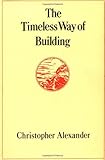
Dan mentioned also a book: “The Timeless Way of Building” by Christopher Alexander.

The real and ultimate question in this book is:


What is it that makes a building “work” ?


When you see something that works, you just know it. And it’s something that has a timeless quality.

I was intrigued by the subject, and kept researching, and quickly discovered the site of Tomorrow Makers.

image

And especially the blog post titled “Happiness Pandemic (HP101) Hits Worldwide”. Just read and internalize the first two bullets:

The tendency to let yourself be guided by intuition instead of acting under pressure of fear, forced ideas and pre-conditioned behavior.

A total loss of interest in: – judging others, convicting yourself and preoccupation with things that create conflict.

During the off-site, Dan did something else that was brilliant. He took us out of the hotel into the city. In our case we went to the CosmoCaixa Barcelona, the Museum of Science.

Panorámica CosmoCaixa

Besides being a perfect metaphor for blending old and new with “sculptural integrity”, it also put all of us in a different context and mindset to look in quite different and innovative ways to our off-site subject.

I don’t know what happened exactly, but when we returned to the conference hotel, we were looking for topics likes

space

freedom

excitement

playfulness

culture

people

At a certain moment, we could form a small group of people, sort of a tribe around a subject that was not yet addressed.

I put the word “excitement” on a post-it, and look: 10 min later, we had 7 or so colleagues interested in discussing the subject.

I asked a simple question: “how excited do you get by the work done so far at this off-site” and rate it on a scale of 1-10. To my astonishment, the average rating was 3.

So we then looked for the root-cause of this score. A lot had to do with company culture, but also by the need for a new vocabulary, and not just words, but a vocabulary that was inspired by the value set that is needed for the 21st century.

In a follow-up session on people and culture this topic re-appeared in full force.

Although initially we were looking at symptoms and superficial quick fixes, it suddenly dawned to us that


the real root cause was about

the openness of

our minds, hearts, and minds.


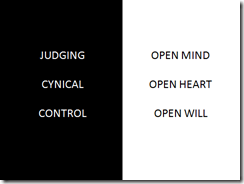
I have used the following slide many times in my postings.

In black the old game: full of macho behavior and Machiavellian attitudes and states of mind.

In white the new game. With true, genuine interest in the other and the true self – not based on tricks or quick fixes.

image

The discussions on these topics were deep and full of enthusiasm. We were looking at talent development, both the professional skills ànd the Personal Development side of it.

And i keep on fighting that “Personal Development” is NOT about “soft” skills.


It’s really about having and keeping

cutting-edge “good” people

on board


and nurturing them so that they can function optimally in today’s highly connected networked society.

You need to “train” and get exposed to a number of essential hard skills and values for the 21st century.

In this context, i get very inspired by the work of Vanessa Miemis, a Gen-Y student with a fantastic blog “Emergent by Design”. Look for example at her latest blog entry “Essential Skills for 21st Century Survival: Part-3 Network Weaving”

Or the post “Framework for a Strengths Based Society”

Do you feel how powerful this is ?


“Strengths Based Society”


Should we not invite her to Sibos ? To be part of Innotribe at Sibos. As part of our “Gen-Y meet Bankers” Face-to-Face interactive workshop ? Maybe with the help of some strong Gen-Y-power, we will be able to keep the sharpness of our ideas and dreams.

Because at the end of the off-site, each team had to boil it down its ideas to a pitch of 5 minutes and I was surprised to witness how in this pitching work, we lost quite some of the “cutting" edge”. Also surprised on how fear creeps in when people are volunteered to deliver the pitch to the executives.

And a strange behavior of watering down the message, and even scratching the most provocative words in the end deliverable.


We seem to have lost

our desire for

boldness


We also “frame” too conservatively. So, in order not to loose some of these more provocative statements, here are some examples:

  • In 5 years time, 10% of our workforce should be Generation-Y folks
  • By 2015, our company should be in the Top-10 of best companies to work for in the financial industry. Worldwide.
  • Gen-Y should drive the composition of the Leadership council of the future
  • 90% of the people in the 2015 leaders team should be new. Only 10% of today’s group should be the same
  • Doing things 10,000 time better rather than twice as good
  • “Do no evil” is not good enough anymore. “Great to Good” is the new paradigm.
  • “Get-a-Life and Get Alive !” Was the original title of our pitch. Somebody changed the title to the more boring “people and values for 2015”
  • Chief Corporate Activist
  • About framing: from “our company is 37 years old, are we in a mid-life crisis” to “our company is 37 years old, we are just-born, who do we want to feel “right” or “it works” in 500 years from now?”

At this moment, I decided to have a short break in my blogging activity, and go for my Sunday trip to the bakery. I bumped into a friend, who shared me a wonderful story about going for your dreams.

The story was basically about context. Of not waiting to be called. Of doing what you intuitively know is right. What works. In his case it was about seeing a wonderful motorbike, feeling it was just designed perfectly, and following your intuition and impulse and buying the motorbike. It happened to be a Can-Am Spyder Roadster. This was not just about buying something desirable. It was a story about contextual living. About flow. About following your compass. And not delaying your dreams till when you’re dead.

image

The story reminded me of the book “Zen and the Art of Motorcycle Maintenance”

You can find “flow” is everything you do. From the most banal activities like cleaning or motorbike maintenance to writing an inspiring blog and making a pitch that makes others dream and wanting to go after their dream.

When i started this blog in April 2009, i wanted it to be in line with my purpose in life “Inspire other people to dream” – and execute their dreams. I hope i have not disappointed you so far.

Last week, somebody said i should start writing a book. Maybe i will do that. Maybe using the funding model experimented by Stowe Boyd fro writing his report on Social Architecture: Microstreams In Business.

Last week, somebody gave me the greatest compliment somebody can give to a man of the 21st century:


“you have the most feminine mindset

of all the men i ever met”


Let’s eradicate the macho culture of judging, being cynical, and control freaks.

Let’s build a culture based on open mind, open heart and open will.

Are you also fed-up waiting on the side-line and do you feel the hunger to join me on the drawing board to help us sketch the “sculptural integrity” required for the 21st century ?

Then please use abundantly the comments feature of this blog.

Doing what you want to do, not waiting to be called. Stand-up and stand as you are. In your true self. Without fear. Living your dreams.


Get-a-Life !

Get ALIVE !


If you feel energized by this blog, you can get an extra doze at following previous posts:

No more collateral damage

Who am i really ?

Great to Good: New Value Kit

Broken Will

Our company is infected

Ethical Re-Boot

The Holy Fire

Emotional Zombies

HR and Innovation

Brand, Workforce and Innovation

Innotribe your event: CPA and SWIFT

Print

Innovation is a key theme in SWIFT’s discussions with the community on how they can collectively address both complex and basic challenges. Via the launch of the Innotribe Program, SWIFT has embarked on a new way of promoting innovation amongst the financial industry. Innotribe is an initiative that leverages the collective intelligence of the SWIFT community to find new ideas, projects, and the infrastructure to let them grow.

“Innotribe your event” is a bit similar to “Pimp your car”, but then for events.

Through a soft collaboration with the Innotribe team, you can add some additional dynamics to your event. It’s part of our renewed SWIFT Innovation mission. Kosta Peric (Head of Innovation at SWIFT – i.e. my boss) wrote about this mission here and it goes like this:

“Build the Skills , Tools , Processes, Metrics , Values , Network , required to support collaborative innovation and transform SWIFT in an agile company,
able to succeed in a changing environment.”

This mission is btw inspired by the book “Innovation to the Core”, that i already mentioned several times on this blog.

The sentence in that book that got us inspired was:

In our experience, it can take an organization three to five years to build the kinds of skills, tools, management processes, metrics, values, and IT systems that are required to support ongoing, across-the-board innovation.

As you have noticed, we added the network dimension to it. I’d like to focus today a bit on that dimension of our mission, and more particularly what we do with events.

Of course we have our own SWIFT events, such as SOFA, SIBOS, the regional events and the business fora worldwide. In each of these events we try to put some innovation spices. For the complete list of SWIFT event, check out the SWIFT website events section.

But what is new this year is that we very selectively partner with third-party events. A good example is our event partnership with CPA (Canadian Payments Association) where we work together on CPA’s Biennial Conference. The conference is tagged as the 2010 Payments Panorama and CPA is inviting you to join industry leaders from June 16 to 18 in Vancouver as we explore the latest trends, technology and processes in the payments industry.

The year’s conference theme – Leadership, Change and Vision – forms the basis for plenary discussions and breakout sessions on mobile and person to person (P2P) payments, evolution and innovation in merchant retail payments, the need for international standards, who is driving technology, and crime and payments. Full program here.

image

SWIFT is excited to launch the Innotribe Progam to the Canadian Community during a half-day session on Wednesday, 16 June2010. SWIFT’s Innotribe Leaders, in partnership with the Canadian Payments Association (CPA), will immerse you in a workshop that is inventive, interactive and collaborative. We will demonstrate how collaborative innovation works in practice.

The workshop will help you promote your ideas, be it a new service, product or a small internal project. You will learn how to grow it, nurture it, develop it, promote it, get others excited about it and sell it – to your colleagues, to the internal stakeholders, to customers, to venture capitalists.

In a workshop, called “The Art of Pitching,” orchestrated by experienced facilitators and innovation coaches, you will be able to develop an idea from a rough sketch to a selling pitch. The ideas will be around two hot trends:

· Cloud computing  and

· Collaborative Risk/Fraud and Security services

The workshop will conclude with a contest where a panel of judges will select a winning pitch. The winner will be showcased together with champions of Innotribe contests from around the world at this year’s Innotribe at Sibos 2010 Amsterdam, running from 25-29 Oct 2010.

What’s important is that this event is one of Innotribe events building up towards Sibos 2010.

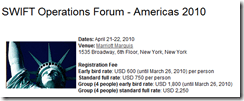
  • The output of the Innotribe workshops of SOFA in NYC on 21-22 April 2010 will be the input of the CPA Innotribe workshop. Detailed agenda of SOFA here. You will notice that “The New Normal” and “Innovation” are prominent themes on this event as well.

image

  • We had a very good similar experience lately in our event collaboration with the EPCA Conference (presentations here) in Paris, France on 22-23 March 2010 and the related Florin Awards. In collaboration with Innotribe, they organized the “Best Product Pitch” Award which was won by the folks of AcceptEmail. We will showcase them as well during Innotribe @ Sibos 2010.

image

image


We are still looking forward for an Innotribe collaboration with an Financial Services APAC organized event, ideally before summer.

Obviously, we are open to any other suggestion that helps creating a win-win situation: improving your event with Innotribe “spices” and confirming our credibility and innovative organization and catalyst in the financial services industry.

Don’t hesitate to contact me or one of the Innotribe team members to find our more.

Identity Rights System 3.0

Next week, SWIFT Innotribe will be hosting the European eID Interoperability Conference 2010.

It’s a great agenda with presentations by European experts on eID, and also some of the smartest SWIFT folks on identity. For example, we’ll have Jacques Hagelstein, our Chief Architect, and we’ll also run an Innotribe Lab on day-2. Check out and download the PDF agenda here.

Hosting this sort of events is an interesting win-win model, where we at SWIFT can share our great meeting and auditorium facilities and at the same time dove-tail with important topics that are relevant in our industry.

Acting like this beyond our traditional boundaries nicely fits The Medici Effect that i described in my previous post, although i am not sure we at SWIFT apply this principle always with full consciousness and intent. It does not matter, the key thing is that it just happens, and i feel confident that on this intersection of worlds some new ideas will emerge naturally.

Thinking through how we deal with company and personal identities in an on-line world, and being able to deliver this on a world-wide, predictable, resilient and secure way is one of the key value propositions of SWIFT in the financial services eco-system. SWIFT has the advantage – it’s a deliberate choice – that we are a community based venture, and a lot of services we offer adhere to standards and rulebooks that have been subscribed to by our membership. Even then, delivering this is not a sinecure.

But in this post, i’d like to take you on a journey beyond SWIFT’s ecosystem and edges, and look at what is happening in terms of identity and privacy outside our safe community walls.

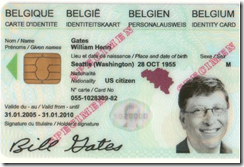
My first contacts with privacy related matters date back to my Microsoft period, where I was quite involved in the Belgian eID project.
image

Microsoft saw Belgium as a good test ground to see what happens when a country rolls-out in a mandatory way 8 million electronic identity cards to its citizens, what applications get developed, and what needed to be done at the level of Windows, Office, MSN Chat, etc to support an identity card issued by a third party, in this case a government. At that time, I experienced the Belgian Privacy Commission more as a pain in the neck, limiting us in doing ‘”real cool things” with on-line identity. But they surely planted in my head the first seeds of some “culture” of privacy. It’s only now that i start to fully appreciate the importance of privacy, and the role of Privacy commissions and alike.

Now the Belgian eID cards are rolled out, we even look at a second and third generation, but the number of applications that are really leveraging the eID on a day-to-day basis are disappointingly low.

Already when the first eID cards got rolled out, it appeared to me that the card was already a dated old-fashioned way of dealing with identities. It does not make a difference whether we talk here about a smart-card, a USB token, or whatever other hardware device.

The point i am trying to make is that

the model of an identity “card”

does not match anymore

the online realities of today

The “card” is an artifact of the physical world, and we try – in vain – to squeeze all sort of on-line concepts into an off-line model.

The next occasion where I felt something was wrong with our model, was when i saw the demo of Intelius Date Checker. See also my post on “privacy is dead” for more details on this application. I was shocked that nobody in the audience made any reflection on the huge privacy issues at stake here. It must have been American culture ?

Then a couple of months ago, there was the famous debate launched by Mark Zuckerberg of Facebook, where he basically suggested to change the paradigm with 180°: in stead of considering "private” as the default setting of personal data and letting the user decide what data he releases to whom, he suggested “public” as the default setting, forcing to “un-public” data the user did not want to make public and keep private. See also ReadWriteWeb coverage here. Unfortunately for Zuckerberg, there was around the same period an article about a Facebook employee revealing how much privacy data they have access to by for example super-admin passwords and alike.

And even ex-colleague Paul Shetler took the pain to scream out his frustration on why public as a default really does not make sense.

It all makes me feel very uncomfortable how much i have to believe from Mark Zucherberg or Eric Schmidt when they are behaving like the white-knights of privacy.

It looks to me that

privacy is out-of-control


and that they would like to officialise the dead of privacy by declaring “public” as the new norm. It looks to me as privacy has become


too complex to fix it


Via Facebook, Google Buzz, Twitter, etc, etc, there is already too much data out there. Fixing this taking into account regional and country laws and regulations must be a real nightmare for the Facebooks and alike.

It’s an interesting debate what should be the default: privacy or publicy. And Stowe Boyd rightly adds the dimension of “sociality”. Because you release some info about yourself consciously (when participating on social media, your really want people to know about yourself and your preferences) or passively (by accepting blindly the privacy notices on Facebook and alike. Some related info on sociality here.

This aspect of passive privacy is really well explained by David Birch. He recently wrote a whitepaper: “who do you want to be today ?” and “Kissing Phones”. Check-out here. And just a couple of weeks ago, David wrote this fantastic post about Moving to Privacy 3.0

And the big boys are feeling the pressure. A couple of years ago the audience at the Gartner IT Symposium in Cannes was still having fun with “The Great Google Hack” scenario. This session was part of an “Unconventional Thinking” set of sessions with following disclaimer from Gartner: “This research doesn’t have the full Gartner seal of approval (we call them Mavericks internally).” Today this is not just a scenario but getting very real. I am just picking one of the thousands of articles that have been written on the Google China hack described as the privacy breach of the year.

Let’s throw in some additional dimensions, so that you as novice reader on this subject really start feeling the pain.

  • What have you browsed ? Interesting reflections by Microsoft’s Chief Architect Identity on “browser fingerprints”. Btw, Kim is confirmed speaker at the eID Interoperability Conference next week.
  • Where have you been, and how your iPhone becomes a spy-phone here and here
  • What have you bought recently ? How you can let a service like Blippy stream your purchases online.
  • Who have you slept with ? Given some’s willingness to post all their data online, and the rising casual nature of some behavior, this isn’t so far out of reach to be completely ridiculous.
  • Add to this things like Facesence MIT, about mind-reading
  • Bodyscanners about being “sniffed-out” by chemical noses.
  • Did you take your pil and when. In essence about “body-surfing” and RFID like tracking inside your body.
  • Please rob me, in essence about real-time location tracking

Some suggested solutions for all this go into the direction of


“gatekeepers”


Trusted entities that are the safe-harbor for keeping these personal data. Or even distributed models of “gatekeepers” certification.

image

The recent announcement at the March 2010 RSA Conference of the Open Identity Exchange (OIX) goes in this direction. Please note that this initiative is backed by industry leaders Google, PayPal,Equifax, VeriSign, Verizon, CA, and Booz Allen Hamilton.

However, I don’t think it will work, and i am not alone, although from a different perspective (see below on PETs). I think it won’t work, because in the open online world, it will not be acceptable that somebody or some company sits in the middle of all this identity hocus-pocus, and controls our world. The internet has just become way too distributed to accept this sort of models. Maybe this works in a closed community (vertical or other) where users subscribe to a common set of standards and rules), but not on the open internet.

One possible route are PETs (privacy enhancing technologies).  For example, Stephan Engberg, one of the speakers at the European Commission’s December 2009 workshop talks about security (and privacy) “in context” and seems to be a big advocate of PETs. Check-out an interesting debate here.

The word “context” is very important here.

To come back to the beginning of this blog post, i believe we have to change the old eID model to a model where we acknowledge that the personal data are highly distributed on the net today and are dealt with “in context”.

Personal data sits everywhere, and you really can start imagining “data weavers” or “identity weavers” that combine these individual sets of personal data into new sets of relevant information, based on the context of usage.

The concept of data-weavers was already introduced in my guest blog “Digital Identity Weavers” by Gary Thompson from CLOUD, Inc.

image

I repeat myself by saying that this CLOUD vision goes way beyond the web of pages, goes way beyond the early thinking on Semantic Web. It is in essence proposing an identity architecture for the Internet. Because the internet is broken. It was never designed with identity in mind.

Its about user control of personal data.

It’s about context awareness.

It’s about who i am, how i am, and

what i do and intend to do in an on-line world.

But we all have problems in imagining how such standard and supporting system might work.

How it would look like ?


And then suddenly last night the pieces seemed to fall together. What if we start thinking about this in a way similar to “Information Right Management” (probably called something else today), something that Microsoft built as a feature in Microsoft Office, and basically put the user in control of what somebody could do with his documents. Mind you, this is about “USAGE” rights, not access-rights.

In Microsoft Office this was visualized by the “do not pass” sign.

By clicking on that icon, you – as the user – can control whether somebody can cut-and-paste from your document, whether they can print it, forward it, etc.

We need a standard that makes it possible to control/manage the usage-rights of the different pieces of our personal data that are distributed over the internet. And then we need to let play the competition on how this standard gets implemented in our day-to-day tools. Maybe by a clickable icon, maybe something else. Would be great to let Heads of User Experiences have a go at this.

But maybe it is too late. Maybe there is already so much data out there, that there is no way to 1) find where they are and 2) give back the control to the user/owner of the data. The breach already happened.

To conclude, get inspired by this NYT article “Redrawing the Route to Online Privacy”

So if the current model is broken, how can it be fixed? There are two broad answers: rules and tools.

“Getting this balance right is critical to the future of the Web, to foster innovation and economic growth,” Mr. Weitzner said.

Whatever the future of regulation, better digital tools are needed. Enhancing online privacy is a daunting research challenge that involves not only computing, but also human behavior and perception. So researchers nationwide are tackling the issue in new ways.

At Carnegie Mellon University, a group is working on what it calls “privacy nudges.” This approach taps computer science techniques like machine learning, natural language processing and text analysis, as well as disciplines like behavioral economics.

How would all this be relevant for our financial services industry ? One example would be to apply semantic web technologies to Corporate Actions. For folks at SWIFT it’s pretty obvious that we can apply our semantic knowledge to the data in the “messages” that are exchanged between parties of Corporate Actions.

What seems less obvious is to apply the same semantic tagging techniques to the personal data and attributes of the persons who participate in a Corporate Action transaction.

In essence this is about applying the CLOUD concepts. It’s about setting new standards and rules in this space. And are standards not one of the cornerstones of SWIFT.

It would be great to build an innovation prototype to educate our community on the power of semantic web.

I call this the “Identity Rights System 3.0”

UPDATE: apparently the subject is red-hot at SXSW in Austin this week. Check out Danah Boyd at SXSW “Privacy is not dead”

Thought experiment: who am i really ?

i34_21657263

About a year ago, I did my “coming-out” of the Leading by Being program. That program led to the start of this blog in April 2009.

Leading by Being is in essence a deep search for yourself and how you function in groups and in the world in general. It’s trying to answer the question “Who am I ?”.

Read that again:

“Who am i REALLY ?”


A couple of weeks, i “lost” my right foot – luckily only temporarily. Reflecting a bit during my extra free time sitting in my sofa with my right leg in the air, i started doing the following thought experiment:


What if i would loose not only my foot but everything ?

My job, my lovely wife and daughter, my family, my friends,…

Would that change who i am ?


And more related to this blog:


Would i write about the same things

in my blog as today ?

And if about the same things,

would i write about them

with the same intensity ?


The answer for me is yes.

  • Yes, i would write about different things
  • Yes, i would write about the same things but with a different intensity

What different things ?

  • Probably much much more about the realness of innovation.
  • Probably more on the themes like “Sex, Money, Happiness, and Death”
  • Probably more about ethics and ethical reboot
  • Probably more about meaning
  • Probably more about Love/Hate relationships
  • Probably more about digital identity. Not so much as a technology, but more as a philosophical aspiration
  • Probably more about soft things like poetry, romance, melancholy, more introspecting
  • Probably about my daughter and my wife. Without compromising them.
  • Probably about some nice sentences i read in novels.
  • Probably some writing of my own. As in my very first post:

I want to be playful like the birds,

showing little tricks,

challenge and pursue

but not limited

by any form of danger

In essence, it’s about a free mind.

What different intensity ?

  • I would be more radical on the innovation themes. Yes, even more radical 😉 I feel i still withhold, because of – real or imaginary ? – fear for reactions of my employer.

album_large_3571670

  • I would set-up the Think Tank Long Term Future on my own. With less dependency on others. Going my own way. I would look at setting up a open innovation web-site with online fund raising.

All the above is basically struggling with the fear of

“how naked do i dare to go ?”

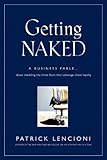
There seems to be an interesting book on this topic: “Getting Naked: A Business Fable About Shedding The Three Fears That Sabotage Client Loyalty” by by Patrick M. Lencioni (Author)


“Naked” is a term that refers to the idea of being vulnerable with clients, being completely open and honest with no sense of pretense or cover. The book looks at 3 basic and well-known fears:

1) Fear of Losing the Business – No service provider wants to lose clients or revenue. Interestingly, it is this very notion that prevents many service providers from having the difficult conversations that actually build greater loyalty and trust. Clients want to know that their service providers are more interested in helping succeed in business than protecting their revenue source.

2) Fear of Being EmbarrassedThis fear is rooted in pride. No one likes to publicly make mistakes, endure scrutiny or be embarrassed. Naked service providers are willing to ask questions and make suggestions even if those questions and suggestions turn out to be laughably wrong. Clients trust naked service providers because they know that they will not hold back their ideas, hide their mistakes, or edit themselves to save face.

3) Fear of Being Inferior – Similar to the previous fear, this one is rooted in ego. Fear of being inferior is not about being intellectually wrong (as in Fear of being Embarrassed) it is about preserving social standing with the client. Naked service providers are able to overcome the need to feel important in the eyes of their client and basically do whatever a client needs to help the client improve – even if that calls for the service provider to be overlooked or temporarily looked down upon.

The last one is in my opinion also related to your relation with your employer and how prepared you are to stick out your neck, and to evangelize your ideas, because you have a genuine desire to make your employer succeed and improve.

The worst than could happen is when your employer gives you a negative appraisal for sticking out your neck, or pushing change too hard. Especially if you are part of the innovation team. Though everybody in the company has creative juices and is an innovator.

And what do you do when this happens ? What do you do when you discover that the innovation your company proclaims is not real ? What do you do when you find out or get confirmed it’s all a big illusion ?

How much do you once again want to compromise your own authenticity and just go on ? Or are you prepared to go through the resistance of big changes and boldly daring to pursue your own dreams as suggested in Seth Godin’s Linchpin ?

Or how long are you prepared to you hide in your own shadows and have your will broken ?

In Leading by Being, one of the exercises was to think about one of your “shadow”-sides, some negative something about yourself, something that you would not like others to identify you with, such as being arrogant or manipulative or … and then the do a play-role yourself “playing” / “acting” that shadow role for 3 hours. It’s pretty confrontational !
 

What if i would start blogging under an alias

to express those shadow thoughts ?


It’s an interesting thought experiment that helps you assess how Trapped or Free your are in your worldviews.


Yes, i am still trapped

But much less then a year ago


What would you like me to explore further ? What different things would you like most ? Where would you like to see a different intensity ?

Let me know. Give me clarifying, supportive and challenging feedback.

Hotel Mama

This blog post is a little tribute to my wife Mieke.

The picture above are home baked muffins. This is how i get treated during my 6 weeks stay home after my broken foot accident.

I am now 100% dependent on her. As walking on crutches usually requires using both hands, i can not help her in any way. Not even opening the fridge, or cleaning up some of the kid’s toys.

But it’s going to be better 😉 I had a check-up with the surgeon yesterday, and i am rid of the plaster. Hurray ! And i also will get a wheelchair, so that i can contribute a bit more to the daily small things to be done in our household.

But for the time being, the only thing i can do is laying in the sofa the whole day, with my right foot up in the air. I have my laptop and Kindle. So not completely contactless or inspiration-less.

The high (inter)-dependency makes me feel uncomfortable. But at the same time grateful for all the little and big things Mieke is managing.

A friendly colleague sent me a very nice mail on this saying: “it will confront you with yourself, and also will make you appreciate your wife’s dependency on you” (when you were 100% fit, and were so busy not noticing it).

It’s true. My broken foot accident helps me to re-calibrate. To see what really important.

In summary, my wife is everything in one: all CxO tasks combined, complemented by a absolute unbeatable care-factor. And my 4-year old daughter gives a lot of kisses to accelerate my healing. I am sure it works !

No place like home. It’s my personal personalized 5 stars Hotel Mama.

Thank you, mama !

Digital Identity Weavers

I have a job where i regularly meet fascinating people.

I recently had the opportunity to chat with Gary Thompson from CLOUD, Inc.

image

CLOUD Inc. is the Consortium for Local Ownership and Use of Data, a non-profit organization that has filed for 501(c)(6) status with the IRS and is open to people, companies, and other organizations. CLOUD has been formed to create standards to give people property rights in their personal information on the Web and in the cloud, including the right to decide how and when others might use personal information and whether others might be allowed to connect personal information with identifying information.

So all this is about your personal digital identity, and giving back control of these data to the user. Kim Cameron (Chief Architect Identity at Microsoft and the man behind www.identityblog.com will love this – and i am not cynical 😉

A couple of weeks ago, i had a fascinating chat on identity. How identity is all about context. Where you are, what you do, etc. During that conversation, Gary suddenly used a metaphor of what i would call “identity weavers”.

I found this metaphor really powerful. And i suggested Gary he should blog about it, and that i would offer him a guest post 😉

So, here is Gary with his post on Reweaving the Fabric of the Internet on his personal blog The End of Linearity. Peter Hinssen will love this story, as so closely related to the Explore the Limits story.

I just have cut&pasted some strong one-liners. For the full story, check out Gary’s blog.

From health to education to finance and beyond, the ability to bring together people, concepts, and ideas (threads) in new ways is an invigorating journey.  Our “weavers” of the future can design beautiful new fabrics from cures to cancer to dynamic global learning communities to rapidly evolving financial models.  When thread and fabric are unleashed, when weaver and woven can dynamically change places, when loom and head are released from the bonds of the physical, the Internet can take a vital step forward.  By applying an end of linearity to how we think about the Internet, we can see the true beauty of Vint Cerf and Bob Kahn’s creation. It is a connector of people, not of web pages, and it is at the heart of a new future, a rewoven future.

This compelling vision goes way beyond the web of pages, goes way beyond the early thinking on Semantic Web. It is in essence proposing an identity architecture for the Internet. Because the internet is broken. It was never designed with identity in mind.

By now, you will notice that Digital Identity is much more than distributing hardware tokens, or putting an PKI infrastructure in place.

Its about user control of personal data. It’s about context awareness. It’s about who i am, how i am, and what i do and intend to do in an on-line world.