Cambrian Explosion of Everything

“The Cambrian explosion was the relatively rapid appearance of most major animal life forms, accompanied by major diversification of organisms. Before, most organisms were simple, composed of individual cells occasionally organised into colonies. Over the following 70 or 80 million years the rate of evolution accelerated by an order of magnitude and the diversity of life began to resemble that of today.” (Adapted from Wikipedia )

I believe we are witnessing a similar “Cambrian Explosion of everything” in the information technology evolution of the recent years, and we see a relatively rapid appearance of new “life” forms, new building blocks for the way we do business in this hyper-connected economy.

This thought came into my mind when attending recently the Cloud Identity Summit in Vail, Colorado 16-19 July 2012.

Explosion of API’s

During the pre-conference workshops, I had already seen the explosion of a whole set of new authentication methods and digital identity concepts like SAML, OAuth 2.0, OpenID Connect, OIX, Facebook Connect, Google’s Accountholder.com initiative, etc, etc

And then came Craig Burton with a presentation announced as “The future of Authentication” but in essence a variation of his epic talk on “Identity and the API economy”. His full prezi presentation is here. (Disclosure: Craig has been advising us on our Digital Asset Grid research project)
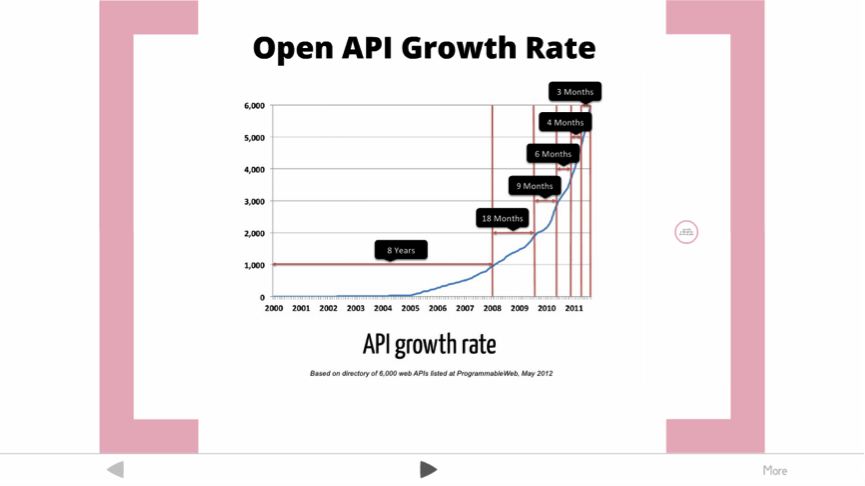
  • If this evolution goes on, we’ll have 30K “open” APIs by 2016
  • But most enterprise API’s are not open, they are kept private, and their growth rate is 5 times that of open API’s. They are also referred to as “Dark API’s”, because you don’t see these species in the open.

Craig then showed some staggering stats of open API’s, the so-called “API Billionaires”

If you do the calculation, this means 150,000 API calls per second for Twitter!

Update: apparently most of these stats come from John Musser @johnmusser from The Programmable Web. Credits are made in Craig’s prezi, but not apparent in my post here. Sorry, John !

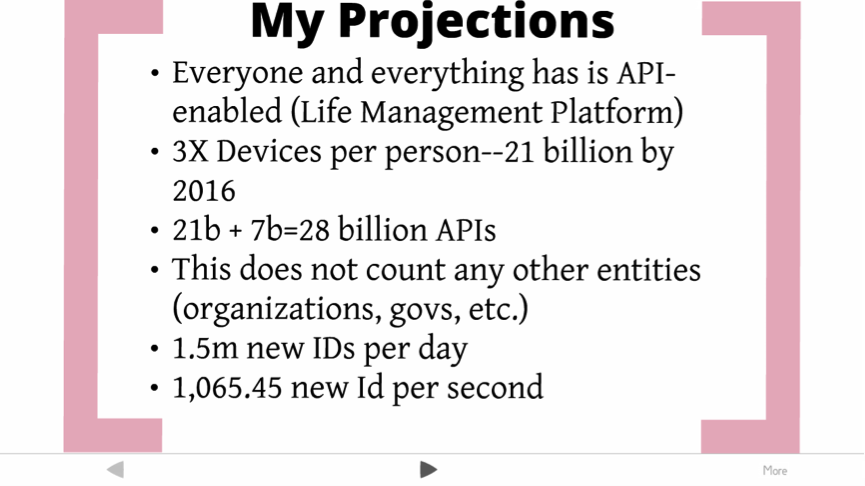
Craig believes – and I subscribe – that we will see a very fast evolution where

“everyone and everything will have its API”

And every API needs its identity. Leading to the staggering conclusion that we will need to provision more than 1,000 new identities per second.
In enterprise, one of the more accepted federated identity authentication and authorization standards is SAML (Security Assertion Markup Language). Craig created some consternation by stating, “SAML is dead”, because it is not made for the provisioning of this Cambrian explosion of identities. In essence the SAML model does not scale. For this type of scale, manual provisioning does not work anymore, we need high levels of automation, also at the provisioning level.

Explosion of Nodes

In his Cloud Identity Summit presentation, Craig was focusing on the explosion of number of API’s and the identities they will require.

Let me give another dimension, triggered by the research work we are doing on the Digital Asset Grid: when Craig talks about “everyone and everything will get an API”, I’d like to offer the dimension of “entities” aka “nodes in a grid” that need share data with each other. Those entities can be:

  • Humans
  • Group of humans – a good example is a Google “circle”, it’s a group of people without legal entity and therefore no liabilities associated
  • Companies – another type of groups of people – with legal entity and liability. Note that the liability of a non-profit is different from a commercial organization, from a educational institution, etc
  • But now we also add devices to the mix
  • And programs – pieces of software code – that act on our behalf or independently
  • Services and 3rd parties representing the seller, and 4th parties representing the buyer.
  • And personal and corporate clouds, where persons and corporations will keep the data they want to share in context with all the other entities in this grid of nodes.

And all these entities will get an API and will need to get an identity. It is leading to a “Catastrophic Complexity” unless we find a way to govern our communities differently, less manual, and highly automated.

It was very interesting to see that in the closing plenary of the Summit, Bob Blakley – now Global Head of Information Security at Citigroup – introduced the concept of the “Limited Liability Persona” that you could select as your identity to participate in certain data sharing use-cases. I’d like to emphasise he talks “personas” (plural of persona) and not “persons”. For example using your Limited Liability Persona “1” for getting a bank-account, and Persona “2” for your health transactions, etc.

This multiplication in personas will just add to the number of identities to deal with.

Explosion of Data

Big Data, Small Data, Real-Time Data, Fast Data, etc… I guess you are familiar with the buzzwords. I would like to share some insights that go beyond the generalities heard at most conferences.
Have a look at Avinash Kaushik – Digital Marketing Evangelist at Google – in his fascinating talk at Strata 2012 earlier this year. And especially pay attention as from minute 4:00 where he introduces Donald Rumsfeld as one of the “greatest philosophers when it comes to analytics”:

“Reports say that something hasn’t happened are always interesting to me, because as we know, there are the known knowns; there are things we know we know. We also know there are known unknowns; that is to say we know there are some things we do not know. But there are also unknown unknowns – the ones we don’t know we don’t know”

And then there is this recent Future of Internet PEW report that opens with:

Big Data: Experts say new forms of information analysis are helping us be more nimble and adaptive, but they worry over humans’ capacity to understand and use new tools well

And in the opening para:

We swim in a sea of data … and the sea level is rising rapidly. Tens of millions of connected people, billions of sensors, trillions of transactions now work to create unimaginable amounts of information. An equivalent amount of data is generated by people simply going about their lives, creating what the McKinsey Global Institute calls “digital exhaust”—data given off as a byproduct of other activities such as their Internet browsing and searching or moving around with their smartphone in their pocket.

“The realisation of dynamic and emergent systems as a natural order will cause people to realize the foolishness of trying to game systems to the Nth degree. We will see the rise of more algorithmic thinking among average people, and the application of increasingly sophisticated algorithms to make sense of large-scale financial, environmental, epidemiological, and other forms of data. Innovations will be lauded as long as they register a blip in the range of large-scale emergent phenomena.”

Explosion of Time

This leads me into one of the coolest presentations I have seen on big data, high frequency trading and the new algorithmic ecosystem by Sean Gourley from Quid.com at TEDxNewWallStreet

Especially watch the section as from minute 9:00 or so, where he lets us discover how machines are doing business in matter of nanoseconds: a world of machines where black-swans almost become the norm!

It is not so much that more time is created, but more some form or time “implosion”, where things happen in milli- and nano-seconds timeframes, an outer-space alien to human beings.

Btw: Sean Gourley will be with us at Innotribe@Sibos Osaka 2012 in the session about The Future of Big and Small Data

Explosion of Mobile

Also repeated over and over again at Cloud Identity Summit by different speakers. Whereas many of the suggested solutions consisted of some form of “identity bridges” or translators if you want, I start to believe we come at a point where also here the existing metaphors and techniques are not adapted to the new paradigm of super-scale.

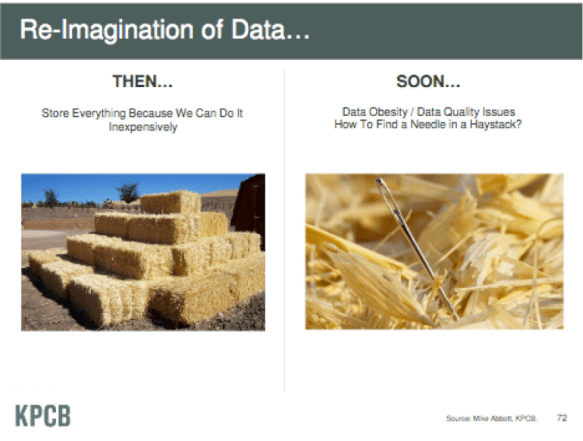
I have seen so many statistics and data that mobile is big, I prefer to refer to the mother of all internet trends, Mary Meeker who moved last year from Morgan Stanley to Kleiner Perkins Caufield Beyers with her May 2012 update on Internet trends.

As from slide #29, she introduces  the “Re-Imagination of nearly everything”
And closes her presentation with

“This cycle of tech disruption

is materially faster & broader

then prior cycles…”

Explosion of Decentralization

With some delay, I found some time this week to watch Don Tapscott’s talk at  TEDGlobal 2012 where he gets into “the interest of the collective”

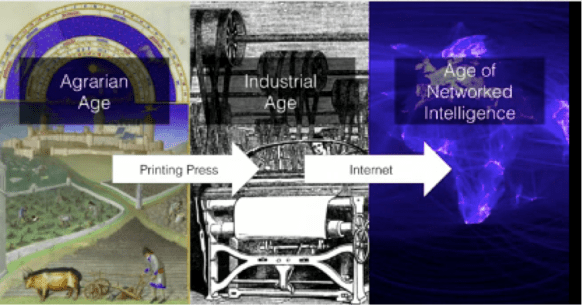
Tapscott points out that this is “Not an Information Age, but an Age of Networked Intelligence

And Don Tapscott nails it when he summarised the 4 principles for the open world:

  • Collaboration
  • Transparency
  • Sharing
  • Empowerment

The meta-story underpinning all this, is probably well reflected in the recent essay “The Democratization of Globalization” by Parag Khanna: We are not only moving into the age of Networked Intelligence, but we are also moving into Globalization 5.0 that is characterized by a high level of fragmentation and decentralization.
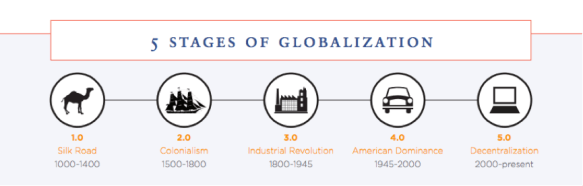
“Call it Globalization 5.0, the most decentralized form of the phenomenon in history. If succeeding in Globalization 5.0 comes down to exhibiting a single trait, it would be resilience—a decentralized, node-to-node way of doing business, where hundreds or thousands of points of interconnection form a giant web of commerce, information and social good. Those who can demonstrate resilience will adapt and thrive. Those who cling to the old, centralised paradigm do so at their own risk”

I am deeply convinced that the “Cambrian Explosion of Everything” is leading us very fast in a highly fragmented world of heterogeneous entities that are sharing and analysing data at warp speed.

It’s a new world

that will soon require new levels of

governance, security, identity

and community or commons management

Who could be the neutral trusted organisation for the financial industry to deliver us that resilience and trust for the next superfast and hyper-connected data-age?

TEDxNewWallStreet Talk

On March 11, 2012 Bruce Cahan and team organized TEDxNewWallStreet.

TEDxNewWallStreet was designed to explore moving banking into the Information Age.

In 2009, Marc Andreessen remarked “banking is just information science.” Inspired by Marc’s words, Bruce Cahan and the Team set out to organize TEDxNewWallStreet to explore the empowerment of the new reality – a banking system different than the Industrial Age system we inherited.

  • What if Silicon Valley/SanFrancisco/Pacific Northwest or other technology clusters grew New Wall Streets, on quite different terms than exist in New York?
  • How would they spearhead technology in faster, cheaper, more transparent and accountable ways that contrast with the recent (and recurring) issues of the game as defined and played on old Wall Street?

At that event i did a talk titled “FinOlympics”. We are in the Olympic year 2012 after all, right ?

The talk is a consolidation of my latest thinking on innovation. It is an 18 min story about babies as a metaphor for ideas, sandboxes for experimentation and incubation. The babies story is about the process of innovation. The process is complemented by the soul of innovation: the typical characteristics of innovators and disrupters. That section includes the basics of Corporate Rebels United. The inspiration for that section came at the Sandbox conference in Lisbon in January 2012. The Digital Asset Grid (DAG) is a salient example of a SWIFT Innotribe Incubation project. It is one of the more forward looking projects, where we not only look ahead in time, but also ahead in levels of abstraction and disruption. I condensed my latest thinking on DAG in a post titled “The Programmable Me: we are all nodes in the grid”. At the end of this talk, there is a call for creating an experimentation sandbox for Financial Services in Silicon Valley. You can also check-out the my different Prezi’s on each of these topics here. Enjoy!

Greetings that make my day

From time to time I get a mail with encouragements for my work at SWIFT and my work on the edges like “Rebels”. Today was one of those days. This is why I keep doing what i do. Below a letter from an anonymous reader of my blogs and tweets; a nice wrap-up of some of my latest work and efforts. At least it paid off for one person. I reproduced the mail without changing one letter. I just added the links where appropriate.

Peter,

Thanks for sharing your world in the links you provided.

I love what you’ve done with the Innotribe channel on YouTube.  Great style and excellent testimonials.

I like the high energy style and content on your curated page on scoop.it (here and here)

Also looked at the Prezi presentations.  Outstanding.  I particularly liked the digital asset grid and the notion of a spectrum.  I think the digital identity element coupled with a digital asset perspective  is key to the next stage of digital development.  I also like the services model you present at the end — like the perspective of both an enterprise and a customer or individual perspective and call for action on it and suggest some solutions.  I too came to a similar conclusion that the power of identity is key and that it can be viewed as an exchange between the individual and other parties.  Great work, Peter.  I have attached two papers that I wrote with colleagues some time ago that explore what we called pervasive personal identity and a second paper on alternative security viewpoints (atomistic view — which is really an asset view).  Totally agree with your From To perspective on security.

Also very intrigued with notion of SWIFT playing a role in this space.  We need some trusted players in this space that are not simply motivated by big data and commercial interests (e.g. Facebook, Google etc. “Everybody wants to replace me with my data.   Your experience in Belgium also, in my opinion, can provide a leadership role on the global scene.   I would like to see more told about that story.

Love the “Babies” presentation.  Fan of the Diogenes quote. Informative and energizing.

And I would say the soul of innovation is a tour de force.  Uplifting, emotive and a powerful message.  I very much like the juxtapositions of art, science, psych, esthetic, and experience.   Also a fan of B. Fuller.

Bottom line:  Important, inspirational and incisive message(s)…

Thanks for sharing.  Made my day.  You also gave me additional motivation to get on Prezi.

Have a great time and much success in Bangkok and Sydney.

(x) name known

Thank you (x) from deep in my heart. You know who you are. It gives me a boost of energy for next weeks Innotribe in Bangkok.

The Programmable Me: we are all nodes in the grid

The last couple of weeks I have been aroused with many ideas and reflections on Personal Digital Assets and on Digital Assets in general.

The journey started some weeks ago with my prezi talk at TEDxNewWallStreet and included my participation to the WEF “tiger team” on Personal Data, where a group of 30 experts are looking at what is needed to make realize the vision of Personal data as a new economic “asset class”. Personal data created by and about people, touching all aspects of society. That group is stitching the pieces together for a framework of business, technical and legal elements that are needed to underpin this vision.

However, the following video from Kynetx was the big aha-moment during my 4-weeks tour on the subject.

I never thought of a Personal Data Store as a “Personal Event Network”.

This changes everything ™

indeed as Phil Windley (@windley), CTO of Kynetx says.

One years ago, there was this beautiful video animation by David Siegel (@pullnews), a great vision of distributed nodes of personal data content talking to each other through API’s.

In the meantime, there is a rich ecosystem of start-ups that are building something very similar as we speak.

Maybe not yet to its fullest grand vision, but definitely going way beyond the traditional concept of a “personal data store”.

Check out leading start-ups such as Personal.com. Btw I dream of one day seeing an integration of Personal.com with an on-line bank. Anybody needing a brokering service here ? 😉

What Kynetx is adding to the mix are three important things:

  • the “event” based thinking
  • the prototol for the data-web
  • Cloud Operating System

Event based thinking:

He really nailed it down for me last time I met him:

  • In the past we had RPC (Remote Procedure Calls), in essence fire and forget
  • Then came request/response: you ask for something, and you get it
  • Now there is the “event-signal”. It does not ask for something, it just says “something’s happened”, and any entity in the network can subscribe to the event and decide itself to do something with it.

Protocol for the data-web:

The other aha-moment was when Phil was doing his talk at the New Digital Economies conference on 27 March 2012.

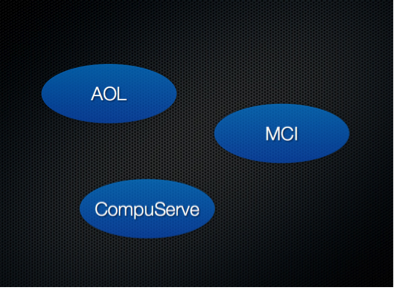
For those who remember, in the past we had silo-d email systems. AOL, Compuserve, etc. They did not interoperate. We got rid of those silos when there was a standard protocol, allowing competing commercial and open source servers to talk to each other in SMTP.

We now see the same with data, personal data, social graphs. We have data-silos (Facebook, Google, Bank systems, Health systems, Government systems, etc). What we need is a “Data-Server” and a “Protocol” that allows these data servers to be interoperable.

Cloud Operating Systems:

Phil has explained all this beautifully in a series of blogs on www.windley.com and I get very inspired when he makes a call for thinking about personal clouds as “cloud operating systems”

All this, Phil calls “The Live Web” (Amazon Associates link). He is so excited about this that he has written a book about it.

In other words, start thinking about your “Personal Data Locker” become a “Personal Event Cloud”: your personal data-server in the cloud that can talk and do things on your behalf, can make decisions, interpret rules, etc…

And it can talk to any entity, any node in the web (or at least nodes in any discoverable namespace). In real-time. In multiplexing mode (meaning the node can be both a server and a client).

It suddenly dawned to me that over the last years we have been hyping “The Programmable WEB”, and that if we are serious about customer centric identity or “customer centric” or “personal” whatever, we may wish to start with the “me”.

Suddenly it was flashing in my brain: “The  Programmable Me”

“Me” is becoming a node in the grid. We are all nodes in the grid, sending and receiving signals. Like neurons passing an electrical or chemical signal to another cell. And start thinking “synapses” when you talk about the API’s of your Programmable Me.

From Wikipedia:

Synapses are essential to neuronal function: neurons are cells that are specialized to pass signals to individual target cells, and synapses are the means by which they do so”

The APIs of your “Programmable Me”, of your Personal Event Cloud are indeed the means to make all these nodes interoperable.

Add to this the graph-thinking of Drummond Reed (@drummondreed), Co-Chair of the XDI/XRI Technical Committee of OASIS. Check-out http://wiki.oasis-open.org/xdi/XdiGraphModel and more specifically some of the Powerpoints out there:

Each circle in this drawing represents a node in the grid. I really encourage you to look at this as a graph – this ensemble of inter-connected nodes – as something 3-dimensional, possibly multi-dimensional.

We have all been trained to think hierarchical. Flat files with a root, that sort of thing.

We have to learn to think in graph-models.

You can start anywhere in the galaxy. Every point can be the center of the universe. There is no root. At least, not in absolute terms. Yes, in relative terms with respect to the other nodes in the universe…

A grand vision starts to develop when you realize that the nodes can be any type of entities:

  • Humans (or their agents)
  • Circles (like Google Circles) of humans (entities without legal form)
  • Corporations, non-profits, governmental or educational institution (aka organizational constructs of humans with specific legal form)
  • We should also include less traditional forms of organizational constructs such as co-operatives, P2P communities, Commons,…
  • Programs (yes, software code), that perform tasks on behalf of the entities above or that operates as fully independent entities.

Each of these nodes/entities can participate in transactions – or better, “value dances”. “Dance” because the protocol is multiplexing, not one-way request-response.

Of course all these entities will require identity, in the broadest sense, not only URI or ID number, but in the sense of a spectrum, a graph that can be shared in context with other nodes/entities.

Sharing the spectrum becomes the essence of trade

What we are witnessing is a 180° turn in the power balance between client and server, slave and master, buyer and supplier, consumer and merchant.

All entities are equal.

We are all equal

Doc Searls (@dsearls) has written a book about it. The Intention Economy. (Amazon Associates Link)

But look at the subtitle: “When Customers Take Charge”.

I like Doc a lot, but his subtitle may suggest that somebody else is in charge: the empowered customer. I am afraid that we may end-up with another un-balance, where the pendulum has swung the other side: where the customer has an unfair data-advantage versus the merchant. But let their be no doubt that today the merchant has the unfair data-advantage, and I read Doc’s book more like a plea for getting the balance right rather than a socialist rant against establishment represented by the “big boys”, the vendors, the merchants, the silos like Facebook and Google.

In all the discussions about the Empowered Customers, we see classic commerce use cases like buying a book, buying flowers for grandma, etc

But I would like to make the jump to truly balanced financial transactions and what “dances between equals” would mean in that space. I invite you to think about your bank as the merchant, the merchant of financial services, and the consumer as the retail or wholesale customer of the bank.

In such scenario, the fundamental shift in thinking already happens at the Point of Sale (POS). We even have the question the term “Point of Sale”. It stems from an old thinking where the merchant “owns” the customer.

YOU are the point of sale

YOU are the point of data integration!

In the past the POS was the master,

now it will be YOU who is in charge,

or your agent,

the “Programmable Me”.

What if we start thinking about banking where YOU are the point of data-integration? What if your bank would offer you a service that enables you to manage your Personal Event Cloud?

I don’t know how it would look like, but it probably would be something triggered from your mobile phone. It probably would look like one of the Next-Gen banks (Simple, Movenbank, Fidor) with a Personal Event Network out-of-the-box.

Some of these Next-Gen banks are already accepting the CRED of your Social Graph as a much richer (in all senses of the word) basis for “Know you Customer”. Although we probably also have to inverse that: from the captive notion of “know your customer” to the user-centric meaning of “know your bank”. Then we may come back to the “primitive” of the meaning of “bank”: a bench where two people meet to build a relationship of value.

So, the discussion is NOT about the next coolest thing for doing a copy-cat of existing money-transactions through the latest greatest gadget like NFC or Bump, or whatever.

Some of all this already permeates in a recent Techcrunch article suggesting the “NFC is already out-moded”

“The thing to keep in mind here” says Crone, “is that NFC was developed more than 20 years ago. It was first deployed 10 years ago. 10 years ago, we didn’t have ubiquitous access to data plans. We didn’t have more smartphones in circulation than feature phones and we had to depend on an ‘offline’ connection for processing payments. But now, there are 124 million households that have more than one device connected to the internet. Typically, that’s a smartphone, but very quickly it’s becoming a tablet.”

Also Christopher Carfi (@ccarfi) starts thinking in this direction in his recent post “Musings in Small Data”.  In there, he refers to a video of Jerry Michalski (@jerrymichalski) of the REXpedition doing a demo his “Personal Brain”. (Disclosure: I am member of the REXpedition). The video is titled “Gardening My Brain” and the talk was given at Personal Digital Archiving on February 22, 2012 in San Francisco.

It’s a pity that this talk is in the context of a personal digital archiving conference. Because, in my opinion, we have dramatically evolved from archiving to sharing.

Sharing of information and digital assets is becoming the new normal in this world of Abundance of information.

Christopher Carfi nails it when he says:

As these issues become more widely understood, more individuals will be tracking their own information. Perhaps it won’t be to the level that Jerry has done it in the video above, but it will be happening. This means that we, while wearing our business hats, will need to be developing real relationships with our customers. We need to listen to what they are saying, what they are asking for, and working collaboratively with them in order to help them fulfill their needs. In the best cases, we’ll have built up levels of trust with our customers and will have been given the explicit permission to access our customers’ personal data stores. In doing so, we’ll be able to actually take the guesswork out of the equation that was noted so clearly above in the Facebook example and will, instead, be able to connect directly with our customers’ intentions and deliver value on their terms.

Creating an economy based on the principles of relations is of course at the heart of the REXpedition. It is probably the next territory for competitive advantage beyond the mundane money transaction.

All this is about creating “Relationship Channels”, channels the vendor can tune into of the user has opened the channel.

All the above are of course very much related to our Innotribe incubation project “Digital Asset Grid” (DAG), which is about the sharing of any digital asset with any party.

All of the above is also very relevant to Mark Pesce’s (@mpesce) thinking about “hypereconomics”, described in one of my previous posts “The future rarely arrives when planned”.

The real question is then: “Where will value be created when all the connections between nodes have become frictionless?” Mark has some ideas on this, and he describes them as “irreducibles

No matter how ‘smooth’ and frictionless hyperconnected commerce becomes, certain frictions in the business world will persist.  These represent both speed humps and opportunities.  The businesses of the 21st century will find leverage and differentiation by identifying and exploiting them.”

What those “irreducibles” are, you will be able to discover at our upcoming Innotribe event in Bangkok on 26-27 April 2012, where together with Mark Pesce we will have some great interactive learning experiences. Be there, or read the report that we will make on this post-conference.

If you really want to take a meta-view on all this, I believe all the examples above illustrate our species being in search for a deeper meaning, a thicker value in everything we experience:

  • We are in search for a higher level of consciousness, a further evolution in Spiral Dynamics, in search for a richer value system, much richer than the pure transaction world that is the narrow lens of today
  • We start looking at companies being nodes in the grid, in fair-trade constellations of equals, trying to maximize the commons and contribution and giving back to society
  • We want to go beyond the “advertising” thinking of “let’s hit the target with an ad”. We are in search for a better world with more Thick value and less Thin value
  • We are starting to see the emergence of “The universe as a Computer” as wonderfully described by Nova Spivack (@novaspivack) in one of his milestone posts last month.

All the above is about defining, articulating, and living lives of greater meaning. With the “M” of meaning. Umair Hague (@umairh) already in 2009 called this “Generation-M”, which in essence is anchored in “constructive capitalism”

Generation M is more about what you do and who you are than when you were born. So the question is this: do you still belong to the 20th century – or the 21st?

I would like to close with a reference to The Wellbeing Revolution (Amazon Associates Link) by James McWhinney (@JamesMcWhinney).

What I liked about this book is that it encourages you to look at where you are in your life, and to look at it through the “M” lens. The lens of meaning.

I then discover that what I am writing today, what job I am doing, who I am married to, was probably all meant to be this way. Not “meant” in a deterministic way. No, “meant” as everything I have done, the decisions I have made, my architecture studies, my infection by the identity virus, my journey in Leading By Being, etc… all these things have made me who I am.

What if I could capture all this richness about me, and have a tool and an infrastructure to share that on my terms and conditions, in context, and with the parties or nodes in the grid that I choose to? What if I could share my meaning in a programmable way?

I would end up with something called “the programmable me”

By @petervan from the SWIFT Innotribe team.

The future rarely arrives when planned

The title for this blog post comes from a 2010 talk by Mark Pesce. He adds to it:

it rarely arrives in the form that we expect

it is too hard to grasp, a bridge too far

the seeds of the future are always with us in the present

I have referred many times already to Mark Pesce in my previous posts:

He keeps inspiring me, by the challenging content and his oratory skills. And yes, I am trying very hard to get Mark to one or more of our main Innotribe events as core anchor/igniter of some of our conversations.

I also recommend my readers to have a look at some of his recent work, especially about “hypereconomics”, Flexible Futures, and last but not least his upcoming book “The Next Billion Seconds”. The chapters of the books are being released now on an almost weekly basis, and here are some of the catchy titles with associated content:

  • Initiation
  • Introduction
  • Articulation
  • Replication
  • Duration
  • Revelation
  • Revolution
  • Origin

It reads like an “Origin of Species”, looking back and projecting us in the future of the Next Billion Seconds, aka the next several ten thousand of years. A fascinating read indeed.

But I wanted to use his 2010 talk as guidance to some of the work our Innotribe team is doing in our incubation project called the “Digital Asset Grid” (DAG)

In this talk, Mark Pesce talks to  a group of Human Service folks and Health officials. Although it is about health, I encourage you to listen with holistic ears, as everything he says is applicable for any vertical.

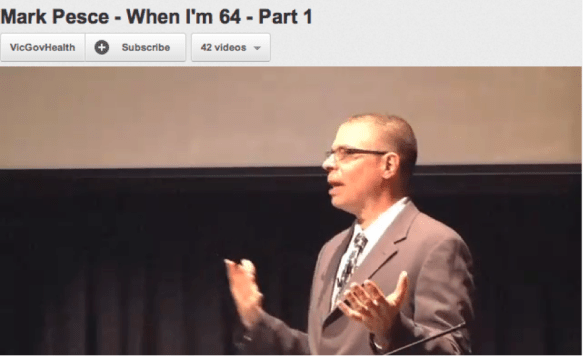
The talk is titled “When I am 64” and is looking forward 17 years from 2010. The “64” is a wordplay on the famous Beatles song.

Here is the link to the first part of the talk. The talk was split into 3 separate videos.

I will avoid the temptation to do an ad-verbatim transcript, and will just use a couple of quotes to illustrate my own points.

Highlights first video

Somewhere half-way, Mark Pesce mentions how his team went open source with their 3D Mark Up language and how surprised they were with the amazing ideas people came up with on what they could do with it.

  • He mentions and Austrian project that made a 3D encyclopedia, like a tree of knowledge, and
  • a 3D visualization of NYSE stock data.

The latter one makes it possible to see 5,000 times more information than on could see with the standard flatlanders’ Bloomberg terminal. Mind you, this was in 1997, that now 15 years ago.

My lessons learned for DAG:

  • The DAG story is a story of value propositions. That is what the prototype we are building will focus on. It is NOT a technology showcase.
  • We play with the idea of an open source DAG server. There is some hesitation. We should not hesitate. We should look at it like IBM looked at Apache Server at the time. Our core competence is to operate a high-available, secure and resilient infrastructure. Probably less in building server software. We know more than me.
  • There is so much innovation in the ecosystem. Our current thinking is to bring the APIs of the infrastructure in a controlled open. So that Banks and other 3rd parties can be on the bleeding edge of innovation.
  • On the longer term, this whole concept of stream-servers makes me think a lot about the Metacurrency.org software project of Art Brock and Eric Harris-Braun. The idea is to build a basic communication later to be able to deal with stream-scapes.

I can assure you that “streams” and “scapes” will be commongood in some years time. Another very cool initiative in this space is Nova Spivack’s latest start-up BottleNose.

Highlights second video

It really gets interesting when Mark Pesce starts unfolding how the power of our communities shape our behavior. Somewhere at minute 09:10, Mark develops an extremely interesting banking scenario:

  • Imagine someone steals your identity, walks into bank, and takes a loan in your name (if they are able to present the proper documentation)
  • The problem is that once you present stolen proof documents at the entry of the process, the process usually kicks off perfectly and delivers the programmed results
  • Better would be to be proofed by others, by your community. “An identity that is confined and constrained by those you are connected to”, by your on-line context
  • At minute 10:35, Mark suggest

that you should be able to handing the bank your social graph!

You really would expect your bank to be able to write some piece of software which could confirm your identity

Bank validating your identity strength based on who vouched for you !!!

This really comes very-very close to some of the use cases we have in mind for DAG.

This would result in a system with greater resilience, much harder to fool, because:

  • Identity is a function of community
  • And not just identity > even TALENT is a function of and a recognized value of a community
  • The social graph is the foundation of identity

In my opinion, all this is leading towards “interest based connections”.

The relationship economy, the reason why REXpedition is so important, is the next battlefield of competition; after most organizations squeezed all the juice out of SixSigma, Lean, and similar programs for increasing productivity and efficiency.

  • The focus of these programs was on doing better what we already did (sometimes doing bad things better)
  • Now its’ about doing new things, the right things. And those right things have all to do with better managing our trustful relationships

Therefore, Mark’s thesis that “a group of well connected highly empowered individuals is a force to be reckoned with” is one of the biggest forces in place. It has always been, but now returning in force thanks to our hyper-connectivity and information abundance.

Highlights third video

This part, entitled “Senior Concessions” really got my attention when Mark Pesce starts talking about “Personal Broadcasting”, networks of trust and sharing of social graphs.

Sharing of social graphs will enable us to identify who brings real value, who brings insight, who bring wisdom. And also those who seek to confuse, who are confused, or who are self-seeking.

This smells very much like reputation and influence like:

  • the reputation score in eBay
  • the thinking of Andreas Weigend’s from the Stanford Social Data Lab
  • Doc Searls VRM (Vendor Relationship Management) thinking
  • Drummond Reed’s Social Vouching start-up connect.me with its underlying Respect Trust Framework.

Mark continues how boundaries of expertise are becoming more and more fuzzy. The patient now often knows more than the specialist. The student knows more than the teacher. It reminded me to one of the first books I read about fuzzy logic by Bart Kosko in 1994. “The new science of fuzzy logic

Reading that book so very early in my career was probably meant to be part of my life and my purpose.

Anyway, Pesce puts the patient in the center, like Doc Searls put the user in the center of his user-centric intention economy.

In my opinion, banks have a similar huge opportunity to put the customer back in the center and offer unprecedented high-quality data services.

And Mark Pesce goes on:

  • This is about user centric “social” graph
  • Knowledge will pass from one user to another (similar to John Hagel’s knowledge flows)
  • As knowledge is passed on to the community, the community empowers itself
  • Person as agency of his own data, deciding who gets access
  • Privacy of medical data is about making these data freely available to those who need it in context, but make them secret to those who do not need those data
  • Only if person has agency for his data and authorizing access to his (medical) records, and tools to track that access (and give/release access)
  • Without those tools we will loose track of who owns what etc and becomes easier for those who shouldn’t to have a look in
  • As our medical records spread through our networks of medical expertise, we will feel less fear, and more to surrender our privacy
  • There is power in releasing our privacy because we gain connections

It’s almost going back to Doc Searls (and others’) 1999 ClueTrain Manifesto where the authors declare in one of their 95 thesis that “Markets are Conversations”.

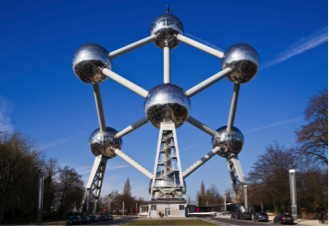
It’s also going back to Buckminster Fuller’s geodesic domes, where the each element is weak, but where the combined structure is stable.

As a matter of fact, the 3D space of the geodesic dome perfectly illustrates what the DAG is all about. Look at it as a certified map of where the data are located with their associated usage rights. Sharing as utility. P2P sharing with certified pointing infrastructure. It’s moving us from a Flatlanders 2D thinking of the physical world to a 3D thinking of the graph. That is what the DAG is really all about.

I put this blog together during one of my weeks off, weeks that are completely un-planned and un-structured. For me these are weeks where I refresh my brain, new ideas pop-up during moments of organized boredom. You could call it my Boredom Weeks.

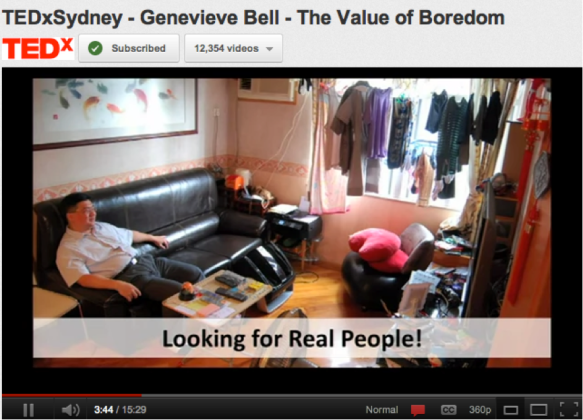
It can therefore not be a co-incidence that Mark Pesce ends with a referral to Genevieve Bell, Intel Fellow and director of the Interaction and Experience Research Group within the Intel Labs. Just on that same day, I received a tweet from one of my followers referring to Genevieve Bell’s TEDxSydney 2011 talk on boredom.

The video basically illustrates that ideas come in moments you don’t expect, when you are not focused, when you have this blissful moments of boredom. Its back to the start and title of this blog post: “The future rarely arrives when planned and it rarely arrives in the form that we expect”

I can already see now how DAG will take off from and into un-expected directions. And we are just at the start of the prototype phase. Exciting times

@petervan from the #innotribe team

2012: my boss wants me to dance!

We are getting towards the end of the year, and time has come to nail down the Innotribe 2012 objectives of our team members.

Last Friday, I had my regular 1-1 with my boss Kosta Peric @copernicc – Head of Innovation at SWIFT. We had a really good discussion, challenging each other vigorously on what would be the best use of my time and talents in 2012.

Just the fact that we start from a strengths based paradigm is typical for how we get around these things in the Innotribe team. It remembers be the blog of Venessa Miemis on “Framework for a strengths-based society”.

And as digital identity and digital footprint are some of the topics that have deeply infected me virally, I was wondering why not apply the principles of sharing to my objectives 2012. So far, I don’t recall anybody doing this, and reflecting on it: why not?

It’s a good way to articulate your agreement with your manager, and then to share it in the open with your followers: one way or another, this adds to your personal transparency, and on the other hand I feel it makes me commit stronger to these objectives as it’s now in the open, and shared with your followers. And applying the principles of crowdsourcing and open innovation, the worst that can happen is that my followers come up with ideas to better implement my objectives.

My objectives are organized around following clusters:

  • Sensing and curating for Innotribe Events
  • Internal Evangelism
  • Digital Asset Grid
  • Innovation seeds for Lite Application Platform

Sensing and curating for Innotribe Events

Like in previous years, I will use my “antennas” to sense what’s happening at the edges of our ecosystem. Spotting the new themes and inspiring igniters that help shape our Innotribe events.

I will focus and be involved in the following main Innotribe events:

  • Innotribe stand-alone events: Bangkok in April 2012, and Belfast in June 2012
  • Innotribe @ Sibos Osaka, from 29 Oct – 2 Nov 2012

My role is that of “content curator”: these themes are the basis for my “painting” of events. It’s the architectural canvas. After conceptually agreeing on this main direction, the fantastic Innotribe facilitation team gets into action and shapes the events into immersive learning experiences. In many of our events in 2012, we will inject a “Start-Up Competition” under the leadership of Matteo.

  • The “technical” themes I have in mind today – this may still change in the coming weeks/months – are about: API’s, The Age of the Machine, Augmented Reality combined with big data.
  • The “non-technical” themes are about: Organizational Fitness, Hypereconomics, and new approaches to Innovation. And some of the 2011 themes will be re-enforced and go mainstream: Future of Money, Banks for a Better World, Digital Asset Grid.

We have some early wild ideas on how we can excel the 2011 experience of our Innotribe events: in 2012 we are going to play all senses, and looking into performance elements based on art, dance, and music. We also have some ambition to inject young people (20-25 years) into everything we do.

Internal Evangelism

In many of my previous blogs – especially the one on the digital asset grid – I have been using the metaphor of “the dance”.

So far, I “dance” quite well with the outside world of SWIFT, but I will now apply that skill more to the “internal dance”. Getting from just “shooting some bullets” and scaring the hell out of my colleagues, towards “dancing together” and making sure that we can make sense and meaning for SWIFT of everything we sense/spot outside. It’s what I would call: creating a knowledge flow out of our knowledge stock. I have some wild dream to one day have an “Innotribe University”, where we have internal and external 101 and 102 courses on for example big data, digital identity, etc. But I would like it to “emerge” from the brown bag sessions and other initiatives: again, seed a lot, see what works, be a gardener for the new promising species, incubate, grow, repeat.

Part of this cluster is a new initiative that I have under preparation: “corporate rebels united”. I am a big believer of viral infection of companies by planting seed “bombs” throughout the organization. People who act genuinely from their true self, from their true force, with no fear for sticking out their neck. Expect soon a website and on-line community where you can meet inspiring corporate rebels worldwide.

Digital Asset Grid

I have written a lot about digital identity last year, and especially about the Digital Asset Grid (DAG) incubation project at SWIFT. The last post was titled: “Digital Asset Grid: Let’s meet at the SWIFT Dance Hall”

The theme of dancing is back there as well: it will indeed be about dancing with constraints. From rather simple constraints like time and budget, to more complicated challenges like keeping the SWIFT “Castle” deeply involved, and balancing and mixing some other internal projects that have clear touch points with the DAG.

It’s a real challenge for me, as I have a tendency to “give-up” too soon when involving internal resources. But I like the challenge, as it is one of perseverance.

Innovation seeds for Lite Application Platform

Whereas the above is about a 30-30-30% of my time in 2012, I look forward to collaborating with my colleagues on phase-2 of “LAP-15”.

LAP stands for “Lite application platform” and “15” refers to the 2015 strategy of SWIFT, and is a continuation of the Alliance Lite project that I was part of and launched in 2008 at Sibos Vienna. As in our team, we have learned quite a lot in our pilots and prototypes about B2B marketplaces, that thinking can be re-injected in LAP. Also some of the ideas articulated in the Digital Asset Grid project with respect to API’s will most probably be of great interest to LAP15.

A dream mission:

I have said it many times, and repeat again: I have a dream job. After having prepared my brand new presentation “The Soul of Innovation: a story about DJ’s, Painters, Pirates and Corporate Rebels”, I probably have to re-word this.

What we do in the Innotribe team is not a “job”. We are on a mission. So, based on that, I can happily state:

“I don’t have a job, I have a dream mission”.

That combined with a boss and organization that wants me to dance internally and externally: what else do you need 😉

So, who wants to dance with me?
Happy @petervan from the Innotribe Team

Digital Identity: Buzzuminar with Dan Marovitz

Yesterday, i had the pleasure to be interviewed by Dan Marovitz, the founder of Buzzumi, a knowledge monetization platform, and a board member of rbidr, and the Professional Diversity Network. He is currently on sabbatical from Deutsche Bank where he was, until June of this year, Head of Product Management for Deutsche Bank’s Global Transaction Banking business.

The subject was digital identity, and the chat covered several subjects from privacy, KYC, user centric identity, and of course our latest incubation project the Digital Asset Grid.

The chat is available online here.

We could have gone on for hours, as the subject is so rich. Buzzumi is a new kid in town for doing online webinars, a bit like WebEx or Skype, with the big difference you don’t have to install any client. The session yesterday was more or less flowless, with some small audio hick-ups (minor). But they are still in beta. I like the idea of “one click and on”.

It also learned me that i am in beta myself for this sort of on-line interviews. I have done some media interviews in the past, and we got here at SWIFT a proper media training, but this is different. You have to watch several inputs at the same time, the chat box is also a source of streaming info. The most important thing is that i need to be better prepared. Really walk through in advance the questions with the interviewer, prepare my key messages i want to convey, prepare content blobs (just keyword is enough) around certain themes that i can tap into at will as the conversation flows.

“Messaging” is fundamentally changing in nature. Video will be an integral component of it, and i can’t wait to see the first blending of this with Twitter and semantic video searching. On good track, Dan !

Digital Asset Grid: Let’s meet at the SWIFT Dance Hall

This post is a fifth in a series on personal digital identity. Part-1 “The unpolished diamond was published here in August 2010 and Part-2 ‘The Digital Identity Tuner” was published here in September 2010. Part-3 “Personal Data Something” was published here in December 2010. And part-4 “Austin-Munich-Toronto” was published in February 2011 here.

Drawing by Hugh MacLeod (@gapingvoid) during the Innotribe Deep Dive on Digital Identity, Sibos Toronto, September 2011.

That was February 2011. Since then a lot happened. I had so many rich discussions, met so many new fascinating people, and have been aroused by a deluge of new ideas on digital identity.  And my employer SWIFT gave the go-ahead for an incubation project on Digital Identity that is now called the “Digital Asset Grid”.

As I mentioned in my Innotribe Sibos report, the Digital Asset Grid (DAG) is important because:

  • We are moving from money bank to digital (asset) bank
  • The DAG is an infrastructure play for SWIFT to offer a certified pointer system pointing at the location of digital assets and the associated usage rights
  • It’s and economic imperative for SWIFT to expose its core competence via API’s
  • The DAG is a huge opportunity for SWIFT to be a key infrastructure player in offering an end to end hardened infrastructure and end-point to enable the seamless exchange of any sort of digital asset between any number of entities
  • This is also a huge opportunity for financial institutions to plug-in to this infrastructure for offering a new set of services in the data leverage space in un-regulated data market places

For me Digital Identity is so much more than your log-in, or our account-number that is backed by a Know-Your-Customer (KYC) process, or another userid/password or a security token.

I look at it a spectrum. Like you have a spectrum analysis for a star that uniquely identifies it, you can imagine a spectrum for the digital identity of persons:

Digital Identity Spectrum is everything from PKI, account#, Log-In to address, attributes, history, preferences, biometrics, reputation, risk profile, intentions, signals, etc and all this in transaction and time context.

It’s no co-incidence that Facebook recently announced “TimeLine”. Identity in time-context leads to your identity spectrum that is unique at one given time. And yes, you will be able to play it backwards like a movie, but also forward to do trend analysis and forecasting.

VRM (Vendor Relationship Management) is about sharing specific parts of my spectrum with specific vendor(s) in specific transaction context(s). In the Digital Asset Grid project we asked ourselves:

“What if we could apply the VRM principles not only to personal data but to any content, to any piece of information, to ANY digital asset?”

You could then start thinking about sharing specific parts of any digital assets with specific vendor(s) in specific transaction context(s).

In essence, what we are doing, is “weaving” digital contents with associated digital rights and who has the rights to that content.

It’s a map of digital weavings

of digital fabrics

This is how the Digital Asset Grid was born.

Is this not too consumer oriented for an organization like SWIFT? I believe this is the wrong question. The discussion “consumer vs. enterprise” has kept us blind. Same by all sorts of other customer segmentations like “small-medium-large”. In the identity ubiquity game, all this is segmentation is irrelevant.

We have to start thinking in terms of different sorts of entities that participate to the identity-dance. Those entities can be:

  • Person (humans)
  • Loose group of persons (for ex Google Circles), that have no legal construct
  • Commercial companies
  • Non-Profit companies
  • Governments
  • Educational institutions
  • Programs (code)

The last one – programs – is quite fundamental. We are witnessing the blurring between humans and computers. It smells like early singularity. And in this debate we should not only be concerned on how programs augment humans, but also how humans augment programs. But that is another more philosophical discussion, and some good reading on this can be found in the book “The Most Human Human” by Brian Christian. (Amazon Affiliate link)

Back to our Digital Asset Grid…

The vision of the Digital Asset Grid

is to move the SWIFT network and SWIFT services

from a closed, single-purpose, and messaging-based system

to an open, general-purpose, API-based system

It’s a natural evolution. That’s it. No disruption. No—“the next big thing.”

Just apply out-of-band our core competency to the modern age of connectivity. Instead of destabilizing the market by disruptive innovations, provide the basic infrastructure missing for a global transaction-based platform on the Internet.

Of course, its vision is grand, with plenty of innovative elements and thinking. Here are some examples how we move from the traditional identity “space” to the new “Digital Identity Grid”

I would like to zoom-in on one of the bullet points above: from one way request-response to full duplex dance.

The web – a collection of pages – is based on some simple request-response mechanisms. I request a page and the server responds and gives me the page. End of that transaction.

With the dataweb – a collection of Digital Assets with associated usage rights – we will need something where exchanging entities can perform a dance around and with the Digital Assets. And we want to be sure that they are who they say they are, and that they have the right usage rights to the digital assets. So we move from a two dimensional view of the world (in computer terms a “table”) to a multi-dimensional view (in computer terms a “graph”)

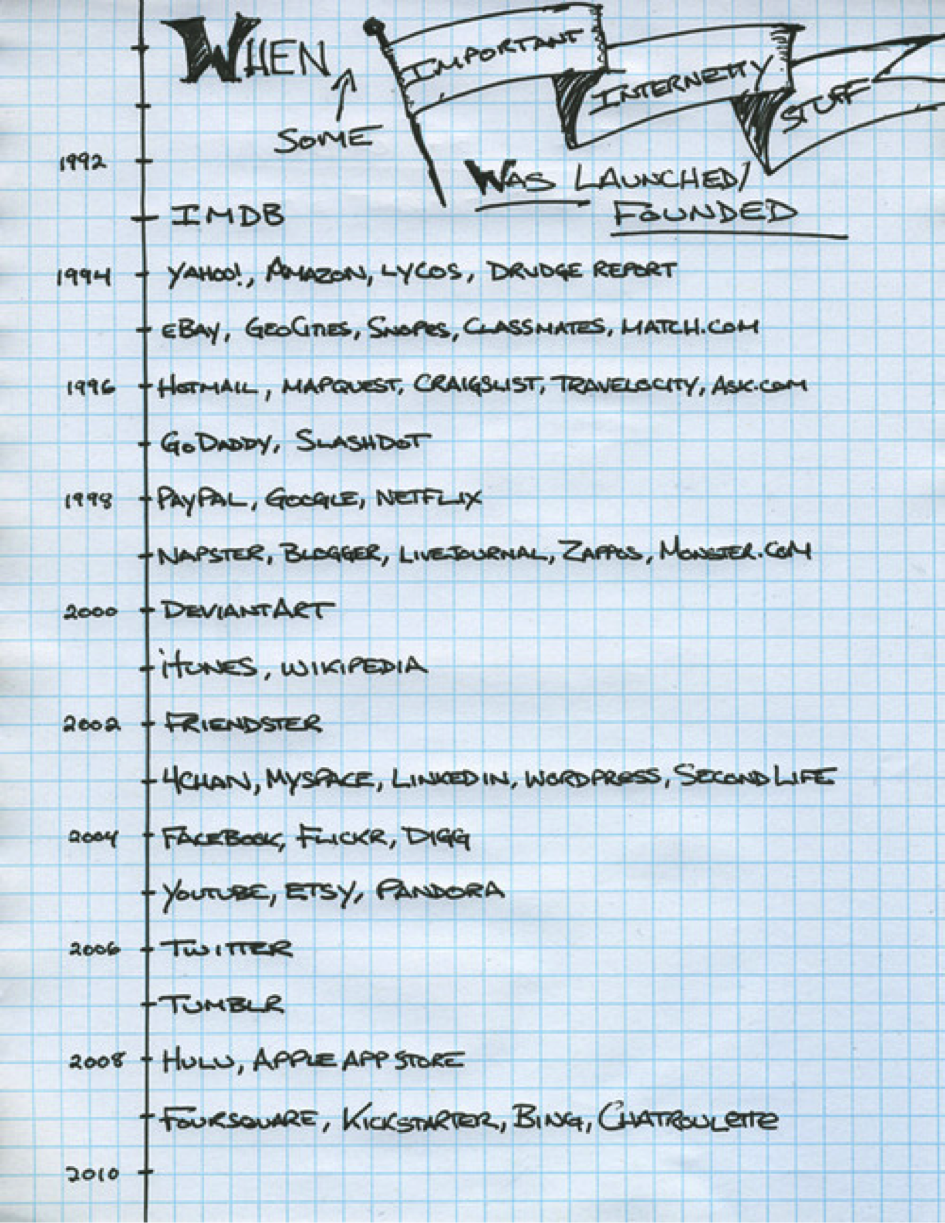
The Digital Asset Data Web is the next phase in the evolution of important internet stuff. It’s probably what comes next in the following series:

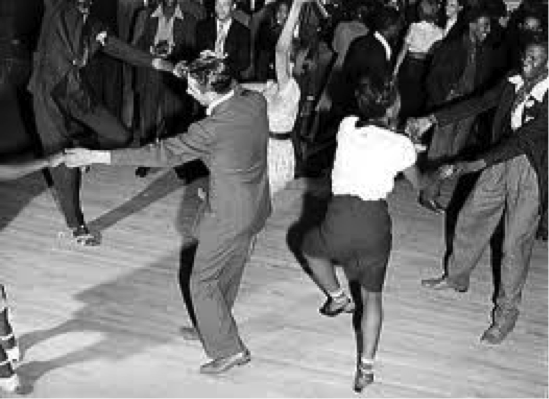
To continue the dance metaphor, the SWIFT infrastructure is the Dance Hall where entities meet to perform certain specific dances.

One of the many use cases for the Digital Asset Grid would be to solve compliance, In stead of moving messages from A to B, we keep the data where they are and “point” to them with SWIFT certified pointers to where the data are located and the associated usage rights.

The dance protocol (full duplex) for this use case, from opening of the dance with (a “webhook” in technical terms), to the actual picking-up of the content, and closing the dance and everything in-between, could look like something like this:

  • PartyA: “hey, I am sending a signal that I wanna dance the tango (slang for payment instructions) with any party in the Swift dance hall at 9pm”
  • PartyB: “yep, I wanna dance with you, let’s meet in the SWIFT dance hall at the bar”
  • PartyA: “ok, here we are, cool place ;-)”
  • PartyA: “Let’s get to business”
  • PartyA: “I just gave you following rights my payment instructions at this XRI: you have XDI pick-up rights”
  • PartyB: “ok, gotja. Will pick it up right away”
  • PartyB: “knock knock, I am coming to fetch those payment instructions”
  • PartyA: “let’s check if you have the usage rights….”
  • PartyA: “everything looks fine, go ahead”
  • PartyB: “loading, loading, loading…”
  • PartyB: “Ok I am done”
  • PartyA: “So am I”
  • PartyB: “tomorrow, same place same time to dance ?”
  • PartyA: “would love to 😉 9pm again ?”
  • PartyB: “sure, bye bye”
  • PartyA: “bye bye”

And, what’s really cool about it, it’s fully auditable, end-to-end.

When telling this story to one of my colleagues, I got the following reaction: “Hey, but you are changing the basic messaging paradigm of SWIFT… I am not sure that I want to support an innovation like this… one that is cutting off the branch from the tree I am sitting on…”

Here is something essential for innovation. Any innovation team in any company should not only look at some nitty-gritty small incremental innovations, but

daring to be great and to re-think

the cash cows of our companies

Like Guy Kawasaki used to say: “the best way to innovate is to set-up a company that is trying to kill your cash-cow”

All the above is about the infrastructure story that SWIFT could play in and in that sense is a bit navel staring. But the biggest opportunity however in all this is probably for banks, financial institutions, and new upcoming innovative financial service providers.

This is a HUGE opportunity to offer new digital services in non-regulated markets

Many examples and use-cases here :

  • Personal Data Lockers, Digital Asset Lockers, Digital Asset Services aka Digital Bank, « Who-touched-my-data » services, Personal Data Trading Platforms, Digital Asset Trading Platforms, Corporate and Bank Klout Services, Audit services, Tracking services, Big Data and Analytics services, EBAM, Corporate Actions, etc.
  • Also e-Wallets of all kinds. Not only « wallets » for money but wallets for all sorts of Digital Assets. An e-Wallet is nothing else than a browser on a personal money store. What if we start thinking a browser for a personal data (asset) store?
  • And I spoke recently to one of our managers in Securities Business : also there plenty of examples, even in looking at trading assets.

So far, the Digital Asset Grid was just the result of a research project at SWIFT. Today, I am very pleased to announce that the SWIFT Incubation Team just gave the green light to move this project in prototype stage.

It means that during Q1 2012, we’ll have a working prototype targeted at a specific use case, but we will expose the API’s of the infrastructure and give them in the hands of developers and challenge them to come up with some cools apps that can be built on top of this infrastructure.

A lot of the thinking in this blog is the condensation of a lot of teamwork of many many people who participated to this Digital Asset Grid project. With the risk of missing out somebody, I’d like to send out a digital invitation signal to those people for a thank-you dance in the SWIFT Dance Hall: Mary Hodder, Kaliya Hamlin, Doc Searls, Drummond Reed, Craig Burton, Andreas Weigend, Gary Thompson, Tony Fish, and also lurking-in Don Thibeau, Scott David, and Peter Hinssen.

I would like to say Thank you! Maybe with David Bowie’s 1983 hit “Let’s Dance”? http://www.youtube.com/watch?v=N4d7Wp9kKjA

Let’s dance put on your red shoes and dance the blues
Let’s dance to the song they’re playin’ on the radio

Let’s sway while colour lights up your face
Let’s sway sway through the crowd to an empty space

If you say run, I’ll run with you
If you say hide, we’ll hide
Because my love for you
Would break my heart in two
If you should fall
Into my arms
And tremble like a flower

Silence, I am painting

I have a week off, so it gives me some time to reflect and muse about things that are close to my heart.

This is a post about my intensity in creating and curating Innotribe events.


It is about creating

memorable events

that are memorable

because they deliver

an authentic experience


I got inspired when discussing the drive behind my work with a good old friend. At a certain moment, i described event production as some form of composition, like a piece of music, like a painting. It’s where this story starts…

clip_image002

Jan Van Eyck – Arnolfini portret

Flemish painting flourished from the early 15th century until the 17th century. Flanders delivered the leading painters in Northern Europe and attracted many promising young painters from neighboring countries. These painters were invited to work at foreign courts and had a Europe-wide influence. The so-called Flemish "Primitives" were the first to popularize the use of oil paint. Their art has its origins in the miniature painting of the late Gothic period. Chief among them were Jan van Eyck, Hans Memling, Hugo van der Goes, Robert Campin and Rogier van der Weyden.

From the early 16th century, the Italian Renaissance started to influence the Flemish painters. The result was very different from the typical Italian Renaissance painting. The leading artist was Pieter Brueghel the Elder, who avoided direct Italian influence, unlike the Northern Mannerists.

clip_image004

The painting above is by Pieter Breugel the Elder: “The Blind lead the Blind.”

What is interesting in this painting is that the little church actually exists. It is located in a small village “Sint-Anna-Pede”, in the heart of the “Pajottenland”, West South-West of Brussels, and where famous beers like Geuze and Lambic have their origins.

It is also the place where I spent most of my youth till +/- 21 years old.


clip_image006clip_image008

A later generation of Flemish painters were the Flemish Expressionist, with Permeke  from ‘Group of Latem’,  as generally the best known:


clip_image010

Permeke – Laying Farmer

I love the “primitiveness” of Permeke. The primitiveness makes me think about some deep and profound thoughts from Jerry Michalski himself, who planted the seed to go back to the primitive level of our understanding of a bank.

clip_image011

The word “Bank” comes from “Banca” which means “Bench”.

People used to sit on a bench, and had a conversation. It was relationship building avant-la-letter, it as about wealth creation for everybody, it was a community play. The metaphor also applies to “stocks” which originally was a “stick” with carves indicating what values where loaned between parties. See also my blog post “Banks for a Better World”

The Flemish Primitives originated in Flanders. As you all know, Brussels is the capital of Flanders (this statement in itself – albeit factual true – may cause a whole political debate in Belgium, a debate i definitely do not want to get in now ;-).

All the above just to say I was born in Brussels, raised in Flanders, where the Flemish Primitives originated.


It’s sort of back to my roots

It’s somewhere deep in my DNA


And it is the sort of DNA that i want to build into our Innotribe events. This is the sort of deep “primitiveness” i want to be the understream of Innotribe events.

Building on this DNA, I was trained as an architect at the Sint-Lucas School of Architecture in Ghent and Brussels.

Sint-Lucas School of Architecture educates designers in a spirit of critical reflection and personal responsibility. Students question their limits and the limits of the discipline. They gain insight into both material and immaterial, physical and social structures. Teaching and research are organized in a spirit of artistic and intellectual openness, of tolerance and inclusion. 

This is more the artistic direction rather than the engineering section of architecture. It’s about designing space, experiences, total experiences. It’s probably why I often “clash” with engineers. We have a different mind-set, training, framework.

It is probably why i like so much the job that i am doing today. Because in my mind, creating a quality event is about creating a total experience.


Yep,

that’s where I am setting the bar


The end result must be an experience like a very good concert. Or a painting with many layers. Although concerts and paintings are one-directional. To be consumed only. It’s push-only. Modern life has evolved to more pull. Paintings and concerts in general miss the participatory element that we try to build in all our Innotribe events.

Building an event is like doing a production. I’d like to see my role as “written by”. With a team/crew of highly sensitive, critical, creative people, who do not accept compromise. Who do not need always the team to be aligned on everything up-front.

Who can express

their very personal emotions in an emerging landscape

of diversity


When the team is blended, we don’t need alignment up-front. The forces of the understream propel us forward in the right direction. Always. Unless some team members or the enabling organization do not have this deep force, energy. Or when the team you are asking to innovate has to waste its creative energy scrambling to find resources.

Harvard Business Review wrote about this basic idea of building in constraints to instigate innovation (credits to Mela of our team for finding this quote):

Scarcity seems to have replaced necessity as the mother of invention in today’s organizations. Far too many managers believe that depriving projects of resources [such as time – Mela’s comment] will inspire innovation. While that’s true sometimes, you’re better off using constraints rather than starvation. The human brain reacts to stimuli, so while a blank sheet can terrify, one or two constraints can stimulate. Experiment with introducing a clearly defined problem and an urgent need. But, don’t create false urgency by refusing to fund a project [or not giving time to work on it – again Mela’s comment].

Can we push the limit of events further ? Yes, of course. We are just getting started.

In my wildest dreams, an Innotribe event is multi-sensory. Appealing not only to visual and audio senses, but also to smell, touch, and taste. We can have total experiences, with music as a background/foreground canvas,


building and architecting

the rhythm of the event

like a rave


With moveable and touchable walls that give way and light-up when you touch them, with people dancing and raving, sharing a Californian style new-age, un-conference open-space tribe.  OMG, I hear you thinking, what good stuff did he smoke today?


It is about the power of the tribe

The deep power of the tribe

The Innotribe


clip_image013


So it happens that some of the finest Flemish chefs put together this fantastic site and tribe of The Flemish Primitives, which is all about the very-very best of Flemish gastronomic cuisine and experiment. World-class. If you have ever seen the drive, intensity, uncompromising drive of a chef like Peter Goossens of 3-star Michelin Restaurant Hof Van Cleve then you know what i mean.

clip_image014

“It was a great experience to participate in The Flemish Primitives 2010. It’s a high-energy, high-spirited meeting, and a unique mixture of people and points of view. A very stimulating day!”

Having that drive and that result is my inspiration. That’s how we want our audience to come out of an Innotribe event.

We don’t want to go for less!


clip_image016

The atelier – be it an art atelier or a gastronomic kitchen – is a nice metaphor for our group: a couple of artists cooking and painting together. Really together-together, but in the end the composition, the final plate, goes through the hands of the master curator, the “written by” guy, the one who composes.


clip_image018

I do this with

an extreme deep intensity


I have all my antennas “on” for 24 hours a day, 365 hours a year. When i read, tweet, blog, view, listen, taste, etc it looks like i have always that lens of “how can i use this or that for the next innotribe event?”.

For me, writing a new Innotribe composition is like being in a creative flow, my most individualistic expression of my emotions.


When I am in that flow,

I do not want to be distracted

by personal drama


People exposing personal drama usually don’t have anything else better to do.

clip_image020

Hugh McLeod posted a couple of days ago:

Why are some people such drama queens? Why do some people get so obsessed with the little stuff, the gossip, who said what to who, who’s sleeping with who, who’s no longer sleeping with who…? The short answer: Because it gives them something to do. Life is short. You’d think we would have learned by now, how to make better use of our VERY limited time here on Earth.

That’s where i am setting the bar. Workaholic ? Maybe. Arrogant ? Maybe.

“I don’t expect everybody using the same standards” is often a standard phrase used in corporate landscape. But is that really so ? Maybe i DO expect everybody using the same high standards.

Or at least, I expect respect from others when I am trying and getting into this high state of flow and expression.


Respect for my time and space

Respect for my high standards


That’s probably why I hate “enterprise tourists”. The ones that make a lot of noise, but have no content. When they deliver something – if they deliver something – set the bar at creating a ripple where I want a wave.

Why I hate “seagull managers”, who pop-in, drop some comments like seagulls drop shit, and leave you behind alone with the clean-up until they show-up next year for another annual review of KPI’s or whatever artificial measurement criteria.

Why I hate an even worse category of “enterprise rats”. The ones that don’t add any value but only bring process and problems and challenges. The ones that are the messengers, the go-betweens. The ones that forward you mails where they clearly contain actionable items that could have been resolved by the rat herself in the first place. The energy suckers.

So, for you enterprise rats and tourists out there: next time you come into my space and interrupt me in my painting, be aware you are interrupting me in my creative process. Next time you create havoc in my atelier, beware you are messing up the medici effect. I don’t want energy suckers in our atelier

Team is not about celebrating individualism. Team is not the sum of the individuals. Team is about a safe harbor where every individual keeps its own identity. Team is not about dependence. Or about using the team consensus or lack thereof as an excuse.


Team is about “inter-dependence”


The team and each member of the team is one of the conditions for me – and each of us – to develop my/our full potential and make a great painting.

The team is more than the sum of the parts, the individuals. The team should not be a bowling team: where every player is after her personal best score. They miss positive feedback loops. That flows and fuels back the team.

Don’t mess around with/in team.

Messing around with/in the team is messing around with our full potential.

Digital Identity Tour Part-4: Austin–Munich–Toronto

This post is a fourth in a series on personal digital identity. Part-1 “The unpolished diamond was published here in August 2010 and Part-2 ‘The Digital Identity Tuner” was published here in September 2010. Part-3 “Personal Data Something” was published here in December 2010.

The journey continues. Now we move into Austin for TEDxAustin and SXSW Interactive.

You can follow the livestream here. It’s a fascinating way to spend your week-end and get inspired.

image

Gary from CLOUD is on stage today 19 Feb 2011 at 4pm Austin time.

Some time ago, I teamed up with the folks of CLOUD, Inc. (www.cloudinc.org), a non-profit technology standard consortia founded in March 2009 and based in Austin, Texas. “CLOUD” stands for Consortium for Local Ownership of Use of Data. I am on their Strategic Advisory Board, together with Charlie Hoffman, Director of Innovation, UBMatrix, a leading provider of XBRL software, Anthony J. Barrett, Senior Vice President, Integration, Walgreens, and Dan Walker, former Chief Talent Officer for Apple and GAP.

image

The power of people. Connected.

If you have read my previous post on team dynamics, then you may have noticed a pattern developing in my thinking. With kudos to co-thinkers Verna Allee from Valuenetworks.com and Mela from the SWIFT Innovation Team. We had a great synchronicity chat in London, and what emerged was a model for organizing our thinking for Innotribe at Sibos 2011 along the theme of the Connected Economy.

album_large_3991397

Suddenly, it all made sense. One could zoom into the Connected Economy into different facets such as:

  • our connected companies: this is where we could talk about company culture and new organizational models that do away with the silo construction of most companies
  • our connected teams: how we create healthy team dynamics, how we collaborate, how we realize full potential with social cognition
  • our connected self: acting from our authentic strong self, this is more about personal and corporate values for the next decades. This is also about our Digital Identity/Footprint. The power of people. Connected. What CLOUD is all about.
  • our connected value: new thinking about capitalism, social currencies, financial inclusion, P2P networking, money vs. value, the accounting for intangibles

What we want to do at Sibos and our Innotribe Events is to create ongoing conversations, with the rigor around these conversations, focused around sense-making. But let the future emerge.


The art of the half finished


Where the event is the middle of a process, not the end-point. Leaving enough room for others to fill in, for ideas having sex. Where humans can get inspired by something else than logic.

CLOUD has been featured as a keynote speaker at SWIFT’s annual Sibos conference in October 2010 in Amsterdam and will be speaking at TEDxAustin on February 19, SXSW Interactive on March 14 and leading a panel at XBRL22 in Brussels the week following the European Identity Conference.

image

For the Munich KuppingerCole conference, Gary submitted a speaking slot by CLOUD and Co, and we just got the news that the proposal was accepted. I let you enjoy what Gary put together:

In March of 2010, SWIFT’s Innotribe hosted last year’s European eID Interoperability Conference. Peter Vander Auwera, Innovation Leader at SWIFT, and former colleague of Kim Cameron has said this about CLOUD, Inc. in his post on Identity Rights 3.0: "I repeat myself by saying that this CLOUD vision goes way beyond the web of pages, goes way beyond the early thinking on Semantic Web. It is in essence proposing an identity architecture for the Internet. Because the internet is broken. It was never designed with identity in mind."

CLOUD sees the issue of identity as one that goes far beyond log-ins and enterprise management. The issues of identity, privacy, security, data portability and governance are not separate issues but simply separate axes of the same problem.

CLOUD sees the answer to these issues coming from a new language for the Internet, so as to extend the revolution started by TCP/IP and accelerated by HTML. CLOUD’s CTML (contextual markup language) is a language for people. however and not another language for web pages, like HTML.

CLOUD also sees the answer going beyond current approaches like OpenID, which assumes the web paradigm in its log-in approach. Even with the same log-in, my ‘identity’ could change over time.

CLOUD also believes that a multi-dimensional approach is vital. WHO I Am™, WHAT I Am™, WHEN I Am™ and WHERE I Am™ are all axes of my identity and vital to a new language for people and "the identity architecture for the Internet" as Peter said about CLOUD.

Our goal is not to replace other standards nor displace for-profit initiatives but to instead put a new foundation in place for the Internet that makes the approaches to privacy, security, data and identity consistent and architecturally-driven.

We would see our thought leadership keynote (and/or panel) outlining what this paradigm would mean to the future of the Internet and how this new language would not only change the approach to identity but will transform industries from banking to health to education. Our recent post on the WHO I Am™ dimension would provide the foundation for our comments and panel: http://cloudinc.org/?/ecosystems/article/cloud-dimensions-who-i-am.

Suggested Panelists:

  • Gary Thompson, CEO CLOUD
  • Peter Vander Auwera, Innovation Leader, SWIFT
  • Kaliya Hamlin (@Identitywoman), Founder Internet Identity Workshops
  • Kim Cameron, Microsoft Distinguished Engineer and Chief Architect Identity 
  • Vint Cerf or Bob Kahn, Founders of TCP/IP

Some people say we try to boil the ocean. I don’t think so. Why would we limit ourselves to a narrowly defined vision of identity being a federated authentication issue ? Identity and Digital Footprint are much more than that and so important for our being as human beings in a permanent digital reality.

n06_freddy-cerdeira

That’s why I am so proud that this advanced vision now get exposure at TEDx Austin, at SWSX Austin, at the European Identity conference, at XBRL, at the KuppingerCole conference in Munich. And we will bring it back to Innotribe at Sibos 2011 as part of the connected self. As part of some new work we just kicked off last week in London.

Some folks give me pushback. They are warned: I am at my best when constrained. My innovation juices then flow at full debit. Then I want to think and work out-of-the-box, no – even better – I want to burn the box.


the optimist in me


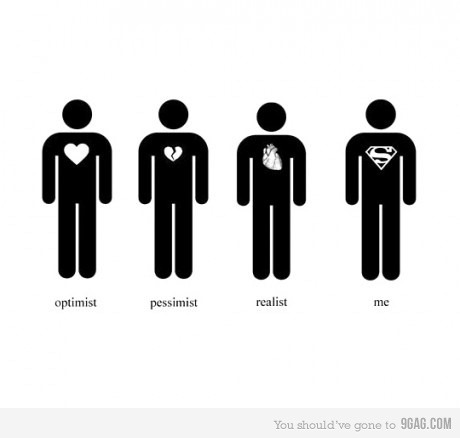
The times of being mister nice guy are over. Of being a mediocre optimist, or pessimist, or realist.

We can’t live

with mediocrity

anymore


Who is going to stop us ? The better question is: who is a believer and wants to support us? Are you ? Then join is on this digital identity journey and


be your digital self !

Enhanced by Zemanta