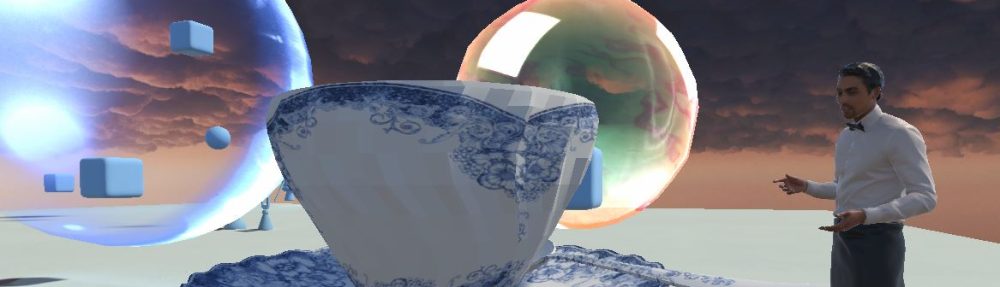
How Bill Gates destroyed the universe

The Singularity Summit is coming on 3-4 Oct 2009 in NYC. See the impressive list of speakers here.

One of the speakers is Ben Goertzel, who will speak about “Pathways to Beneficial Artificial General Intelligence: Virtual Pets, Robot Children, Artificial Bioscientists, and Beyond”.

BenGoertzel

When talking about Robot Children, i would not be surprised if he used the following video made by his 12 year old daughter. Found it via Accelerating Future.

Is this what a 12 year old is thinking about ?

  • Grand Pa’s dying, and let’s upload his brain onto the computer ?
  • It’s uploaded on a Windows computer… do kids care ?
  • Is Grand Pa dead together with all the files on my computer ?
  • A universe with Windows does not deserve to exist ?

If you can believe the credits at the end of the video, at least 12-year old Scheherazade Goertzel does.

image

In this case  – among many other things – Scheherazada’s father is the originator of the OpenCog open-source AGI framework, as well as the proprietary Novamente Cognition Engine AGI system.

Artificial General Intelligence (AGI) is an emerging field aiming at the building of "thinking machines", that is, general-purpose systems with intelligence comparable to the human mind. Good starting point to learn more about AGI is http://agi-network.org/

You see what happens when kids get this sort of ideas served with the mothermilk 😉 We recently presented another mothermilk example when we spoke about Aza Raskin, now Head of User Experience at Mozillla Labs. His father was Jeff Rasking, one of the big minds behind the Apple user interface.

Very curious to see what how this Generation-M will move up the ladders, and one day be our leaders. Any other wizkids you are aware of ?

State of the Web Sep 2009

Over the last month there was an interesting series of articles on Read Write Web about the Top-5 trends on the web.

They now come all together here.

There is also a presentation on slideshare and you can download the whole thing also in PowerPoint.

The author covers the following 5 trends:

  1. Structured data
  2. Real-time web
  3. Personalisation
  4. Mobile Web / Augmented reality
  5. Internet of things

The sections on Real-Time web and Internet of things are a bit poor. I would definitely add a 6th trend: reputation and clout. Also semantic web could have some more meat around the bones. Not much left, huh ?

Coincidently, i found another one on slideshare addressing that same topic. It takes Boris about 30 slides to get up to speed, but he is bringing some interesting concepts such as “Robot Food”, Open Source licensing of data (our lawyers will go bananas), economic incentive to influence search, and community building.

However, i am not convinced by this deck either. Is there any better material around that would allow me to explain in layman’s terms why this is so important (you preach to the convinced).

In my opinion, there is a great role for standards organizations such a SWIFT to leverage and redefine their role as semantic ontology sources for vertical segments such as the financial industry. They must be able to leverage their standardization expertise into other domains than just standard “messages”. Now they could take the lead in standardizing ALL data: structured and non-structured. That would allow us to create powerful mash-up driven solutions that get us into intelligent pattern recognitions engines for the industry.

Cluetrain

Sometimes you hit a site and you’re blown away. Here is one like that:

www.cluetrain.com

It’s like finding your home.

This thing exists for 10 years now.

And nobody hinted me to hit. Never heard about it. It feels like having missed some cultural and existential dimension in my life.

image

I feel so inspired by this. It also brings me very close to the purpose of this bog. See very first blog entry on

“Inspire others to dream”.

Or the “elevator rap”

image

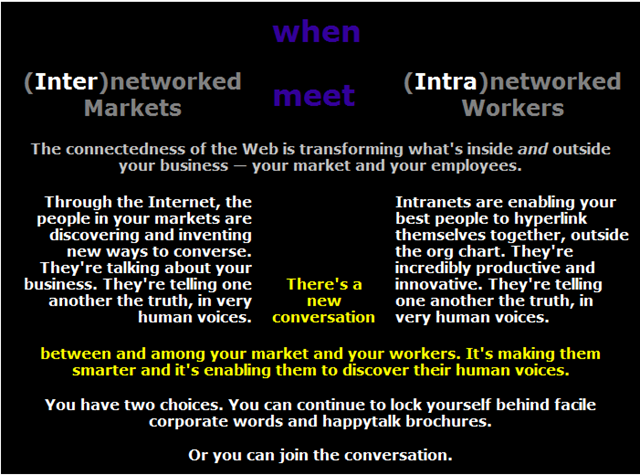
There is a new conversation !

Or some of the 95 themes, just some examples here:

2) Markets consist of human beings, not demographic sectors.

14) Corporations do not speak in the same voice as these new networked conversations. To their intended online audiences, companies sound hollow, flat, literally inhuman.

29) Elvis said it best: "We can’t go on together with suspicious minds."

41) Companies make a religion of security, but this is largely a red herring. Most are protecting less against competitors than against their own market and workforce.

50) Today, the org chart is hyperlinked, not hierarchical. Respect for hands-on knowledge wins over respect for abstract authority.

78) You want us to pay? We want you to pay attention.

84) We know some people from your company. They’re pretty cool online. Do you have any more like that you’re hiding? Can they come out and play?

Who are those pretty cool people online that want to come out and play ?

90) Even at its worst, our newfound conversation is more interesting than most trade shows, more entertaining than any TV sitcom, and certainly more true-to-life than the corporate web sites we’ve been seeing.

95) We are waking up and linking to each other. We are watching. But we are not waiting.

Damn. And this is 10 years old. And i thought being quite up-to-date.

Who can help me getting up to speed on this interesting movement ?

Yes. Movement.

That is what this is.

Robonomics

3838440758_2143b4757b

Really great post by Jamais Caisco on FastCompany blog.

Very much in line with my last posts on massive manias, booms and busts. I have not added much here: just mixing some different sources. But some folks told me i am not that bad in mashing-up stuff 😉

Think you can’t be replaced by a machine? Think again.

Definitely read this article in more depth. Key passage in ‘Think Again”:

Structural Shifts

The issue of a future in which there are large parts of the economy that are underemployed, unemployed, or unemployable is a serious issue. And the data already suggests this:

(source) Notice how after the last recession in 2001 the number shifted upwards. The boom year of 2006 have an additional 5% long-term unemployed than the boom years of 1998. If you go back even further in that graph, to the 1960s, you see an even larger structural shifts upwards. Here’s University of Chicago Economist Kevin Murphy thinking through this issue.

Robots are becoming more dextrous, able to do a growing number of tasks requiring precision and strength, and computer systems are becoming smarter, able to tackle jobs needing pattern-matching and creative skills.

Humans are still cheaper, for now, but this puts downward pressure on wages–and the old rule that new technology opens up entirely new fields of human labor won’t hold true forever. Smarter, more capable machines will snap up those jobs, too.

Robonomics: If robots and digital systems can do everything, let them–but let human society skim value from the result. This becomes a technologically-driven version of the Basic Income Guarantee model, where citizens are given a basic above-poverty income guarantee and are free to explore education, entrepreneurship, or even a life of indolence. Or they can get one of the remaining human jobs, jobs that may pay much more than they do now in order to attract people who otherwise wouldn’t want the work.

Picture Credits:
Money, courtesy Jamais Cascio, Creative-Commons Licensed

SOA for Human Brains ?

thumbnail

SOA stands for Service Oriented Architecture. Services can be assembled together to form news (composed) services. Most of the time this terminology is used in the back-end. The same way, but then more on the user interface side (the front-end), we talk about mash-ups, which is in essence a service oriented componentization of the user-interface, where one can combine (mash-up) different information sources into new user experiences.

In interesting article in the breakthrough section of Forbes online makes a similar “SOA” like metaphor for the human brains.

0824_michael-l-anderson_170x170

Michael Anderson talks about the “Brain Economy” and how Diffusion Tensor Imaging (DTI) lets us delve deeper into the workings of the cortex.

Psychology generally approaches the study of the mind by starting with behavior, and trying to infer the hidden mechanisms that produce it.

Neuroscience, in contrast, begins by examining the smallest, deepest parts of the mechanism–genes and neurons–and tries to determine which behaviors these help produce.

DTI allows you to see where nerve fibers lead and to map the fiber bundles wiring together various parts of the cortex. Such a map is called a

connectome.


The brain has just such an economy, where the raw materials of perception are gathered, processed, transformed and distributed in accordance with the dictates of a complex network of business and consumer relations. The brain’s transportation and distribution network is the connectome. Combining information on activity and information about the topographic features of this network gives us our most powerful tool yet to pinpoint what this mental economy produces and how it does it.

Compared to IT SOA, the connectome is like the information “bus”, containing connectors and adaptors to the different underlying components of brain functions. The semantic backbone of such connectomes makes it possible to make sense out of structured and non-structured information. By combining these information, we create “mask-ups” and new data patterns.

The human mind is great at pattern recognition, and relatively poor when it comes to pure processing power (at least compared to what your average PC/Mac can do, and certainly to what your average PC/Mac will be able to do in 20 years from now).

With the emergence of powerful semantic tagging engines and pattern recognition software,

we are entering a new era of the

Global Brain


What does all this mean for the sciences of the mind? It likely means that the brain isn’t organized quite the way we once thought, with each area dedicated to specialized cognitive domains like vision, language and decision-making.

Rather, just as in a real economy, the output of each factory is used in distinctive ways that depend on who the business partners or consumers are. In the brain, too, every local product is put to many uses, and so patterns of cooperation between "producers" and "consumers" govern cognitive outcomes. Our intelligence is largely powered by borrowing and re-organizing our existing resources to deal with ever-changing situations.

In a service oriented marketplace, the “producers” are called the “service providers” and the “consumers” are called the “service consumers”.

This is a lot of similarities to be a co-incidence. In this new hype of semantic web, we are seeing this a lot of modeling techniques and conventions that we’ve seen 25 years ago when people started talking seriously about relational databases and object oriented programming.

It looks like this time it’s going to be made real. In my opinion because we now have true distributed architectures and clouds, because we have now this massive computing, search and semantic power from Google, AWS, Microsoft, Apple, etc.

A Global Mind coming true. Such a big trend that most of use just don’t see the trend.