
Every morning I wake up angry

crash

It was triggered in me for the first time when I was watching the movie “Crash” featuring Sandra Bullock. She plays a rich wealthy healthy good looking woman that has everything. Has a great job, good family, fancies the better restaurants and clubs.

But she is spoiled and disconnected with the real world. She lives in an ivory tower.

It gets as bad as her saying during a morning breakfast discussion:

“Every morning I wake up angry”.


Angry

That emotion that was so present during (and after) the 18 month personal development program Leading by Being that a ended about a year ago now. The 23 Feb 2009 coming-out of that program also resulted in this blog.

My angriness this morning is basically triggered by an argument I has last night with my lovely wife about something really stupid. Nothing spectacular, but the feeling remained during the night. So, i had a bad night.

The trigger is pulled when i recognize that feeling of not living my full potential. When i feel swimming in syrup. What i feel i don’t progress anymore. Status-quo. It’s protest. It’s rebellion. It’s Anger.

In one of my previous posts i was writing about the holy fire. This time it’s maybe the devil’s fire.

This fire is also burning like hell, but the burning is one like

acid


It’s a lot of negative energy. It’s the devil inside me. The Hannibal Lector with his own (melo)-drama, showing himself as the complex persons as that suits him well, and does not force him to show his true (empty) self.

image

I went back to my notes of Leading by Being, “refreshing” what caused my angriness. This is what i found back:

image

It’s this feeling that i can do so much more but am standing in my own status-quo. Since the coming-out on 23 Feb 2009, there is not much i have done with all the nice resolutions i wrote down at that time.

It’s the feeling that you know very well what to do/change in your life to be your true self and not the self that you imagined for yourself. And being angry for not applying in any way all the great lessons you have learned in this program or in all the great books you have been reading in your life-time.

And feeling deep inside that something “big” is on your life-path, and that you seem to have missed it consistently or avoided it on purpose. The thing that Huge McLeod calls “You have to find your own shtick”

It was the fact that somehow playing around with something new, suddenly they found they were able to put their entire selves into it. Only the did it become their “shtick”, their true voice, etc. That’s what people responded to. The humanity, not the form. The voice, not the form". Put your whole self into it, and you will find your true voice. Hold back and you won’t. It’s that simple.

I have also been reflecting on this blog. I read quite a lot. Books. And I spent quite some time reading postings via my Google Reader. 2 hours per day is not uncommon (my wife loves me for this).

It really would not be difficult to post 3-4 new posts per day linking to other stuff i found interesting. And i discovered the trick that if my blog post title contains “Google”, or “Android” or… I get a lot more hits. But do those hits also mean impact ?

If so, it’s mere quantitative, not qualitative. And even when that happens, what does that do ? Make myself interesting and exposing how smart i think i am ? It is not satisfying. Anymore. Like others, I am in search for more

depth


I enjoyed much more the postings like holy fire. They’re more “authentic”. I know it is a big word. Maybe i should now share what stuff i am reading at this moment. Puts it all more in context.

I am in 4-5 books at the same time: re-read Seth Godin’s “Tribes”, devastated by Hugh McLeod’s “Ignore Everybody”, the disappointing Nick Carr’s “The Big Switch”, Howard Gardner’s “Five Minds for the Future”, Joel Garreau’s “Radical Evolution” and – in Dutch – Rik Torfs “Wie gaat er dan de wereld redden ?”  (translated: “And who is then going to save the world "?).

Those guys really inspire me.

I am inspired by what Howard Man, entrepreneur and the author of Your
Business Brickyard, has to say:

I’m continually amazed by the number of people on Twitter and on blogs, and the growth of people (and brands) on Facebook. But I’m also amazed by how so many of us are spending our time. The echo chamber we’re building is getting larger and louder.

More megaphones don’t equal a better dialogue. We’ve become slaves to our mobile devices and the glow of our screens. It used to be much more simple and, somewhere, simple turned into slow.

We walk the streets with our heads down staring into 3-inch screens while the world whisks by doing the same. And yet we’re convinced we are more connected to each other than ever before.

Multi-tasking has become a badge of honor. I want to know why.

I don’t have all the answers to these questions but I find myself thinking about them more and more.

In between tweets, blog posts and Facebook updates.

That’s why I’d like to write more about the real life. My life. Yours. My colleagues.

And not to show fear but

vulnerability


And to inspire others to dream.

What matters now

This is the time of New Year resolutions.

If you need some inspiration for your resolutions, I can recommend Seth Godin’s latest free e-book ‘”What Matters Now”

image

You can download it here.

It’s a collection of wonderful one-pagers written by smart friends of Seth Godin about noble themes such as Generosity, Fear, Passion, Compassion, etc

It also has a couple of advertisements for a fund-raising campaign for “Room to Read”, a program for providing books and education to children in developing countries.

image

In the collection of one-pages, the one that attracted immediately my attention and that really resonated with me was …

image


Have you ever wondered who’s behind that little voice in your head that tells you, “you’re in this by yourself, one person doesn’t make a difference, so why even try?” His name is Fear. Fear plays the role of antagonist in the story of your life. You must rid yourself of him using all necessary means.

We’re often impressed by those who appear to be fearless. The people who fly to the moon. Chase tornadoes. Enter dangerous war zones. Skydive. Speak in front of thousands of people. Stand up to cancer. Raise money and adopt a child that isn’t their flesh and blood.

So, why are we so inspired by them? Because deep down, we are them. We all share the same characteristics. We’re all divinely human. Until Fear is gone, (and realize he may never completely leave) make the decision to be courageous.

The world needs your story in order to be complete

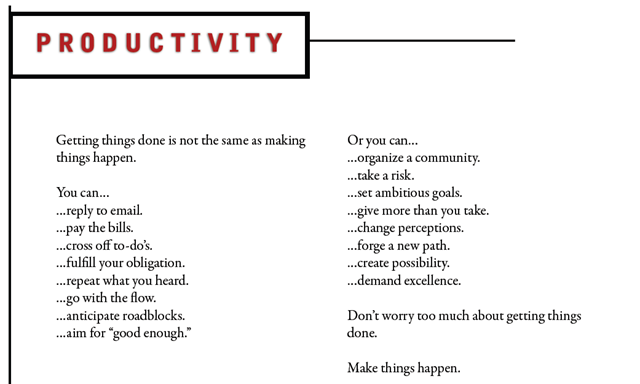
Or about Productivity:

image


Or about Gumption:

image

I want to be fear-less

I want to be productive

I want to make things happen


I am hungry


Want to flap my wings


I want it now

Google Chrome: who is right and who is wrong?

All over the tech websites last week: Google previewing their Chrome OS and releasing it’s code to the open source community.

Planning, pre-viewing and releasing an OS is a big thing. Especially if everybody is looking at you as the provider of THE cloud OS.

It stroke me that some of the comments are so diverging. Some examples. Who is right and who is wrong ? With – as usual – some additional thoughts and spices by yours truly.

Negative

When the title says “Why Chrome OS will fail” you know what to expect.

However, it also inherits that platform’s (Linux) many warts, including spotty hardware compatibility.

It’s a move born of desperation. Google knows it can’t possibly establish a viable hardware ecosystem and still meet its self-imposed release deadline of "mid-2010”.

…no surprise that the primary interface to the Chrome OS is … Chrome, as in the Google browser. Unlike a traditional OS, there’s no desktop. The "applications" running under the Chrome OS are really just interactive Web pages,…

The bottom line is that while there is virtually nothing that you’ll be able to do with the Chrome OS that you won’t be able to do equally well with Windows, there are literally millions of things that you can do with Windows today that you’ll likely never be able to do with the Chrome OS.

It should come as no surprise that this is the article that is tweeted around Twitterspace with great and almost malicious pleasure by current Microsoft employees. Still loyal to their employer.

But think twice when you use the word loyalty in this context. See how fast the love can turn into competition when the company does not treat its ambassadors rightly (Don Dodges 180° love/hate turn around after being hired by Google)

See also James Gardner on the “Evidence of the (Microsoft) chip (in Microsoft employees)” and the introduction of a new term:

the Borgocrat

Fake Steve Jobs, one of my favourite blogs on the internet, summarised the whole thing very nicely I thought, in a post where he calls Don a Borgocrat (Fake Steve refers to everything Microsoft as the Borg), and compares previous posts Don has made with his new position on products for the company.

If this isn’t evidence that the “chip” still exists, I don’t know what is.

The more a read those opinions of some of head-in-the-sand Microsoft opinion makers , the more they are irritating and even not credible.

What to think of a Microsoftie making fun of Google Gmail being down, when their Hotmail has been down and hacked so many times.

But it’s a more general irritation.

What to think of traditional network vendors making fun of some cloud outages, knowing that their legacy technology is 30 years old, and the cloud players are doing relatively well, if you would add an adoption ratio of number of users and the incredible short time to market for users to take up.

That sort of arguments are so passé,

so old game

Neutral

Starting with a safe “Personally, I think it’s too early to tell.” The more interesting part in this posting is the effect that “geeks” can have on mainstream.

Yes, the "geek" audience is without a doubt a niche market. So it’s easy for Microsoft or Apple to write off Chrome OS. But that’s a mistake. As John Gruber wrote in his excellent piece, "Microsoft’s Long, Slow Decline":

People who love computers overwhelmingly prefer to use a Mac today. Microsoft’s core problem is that they have lost the hearts of computer enthusiasts. Regular people don’t think about their choice of computer platform in detail and with passion like nerds do because, duh, they are not nerds. But nerds are leading indicators.

Microsoft’s losses to Apple aren’t based on "regular people" choosing the Mac. Rather, these "regular people" were encouraged to do so by the geeks in their lives who had made the switch to a Mac years ago. Consumer technology vendors can ignore the alpha geek niche at their peril.

Positive

Louis Gray has a long term view.

Google’s preview of the Chrome OS was more than a product release. It was a milestone in a vision of a Web-centric world, one in which we are increasingly living.

For the vast majority of my own activity, I am online, not using software. I intentionally use some applications, like Microsoft’s Office suite or Adobe Photoshop, quickly, and then close them just as quickly, as to not slow down my computer’s performance. Google’s Chrome OS is the latest development in a vision that says our activity will be online, our data will be stored in the cloud, and applications that have traditionally been desktop software will make their way online.

Under no uncertain terms, I agree with their vision. This is happening and it is happening fast.

Robert Scoble (an ex-Microsoft himself) has as usual a more documented insight on his blog.

Google is playing a different game. Google Chrome OS is NOT about killing Microsoft or Apple.

What is it about? Developers, developers, developers, developers, developers.

This reminds me of the famous video where Steve Ballmer cheers up the developer’s audience in the good old days. It looks however – like pointed out in the neutral article above – that Microsoft has lost its’ “clout” with the developers at large.

It’s even getting worse: last week at PDC, Ray Ozzie was saying that apps won’t be a differentiating factor on smart phones. Sounds a bit arrogant to me when you know that iPhone Appstore has 100,000+ apps in store, and Android Marketplace building up fast.

Scobleizer continues:

I have not seen a single thing demonstrated on stage yet that won’t run on Google Chrome OS.

This is a winner, but on a new field

Web Wide World


“The web is transforming society”

m04_20979625

“Web Squared: how the web transforms the world”

web2009_websquared-cover

“Web Wide World” transforming “World Wide Web”

image

Several very interesting publications and postings over the last couple of weeks, all confirming that something very profound is happening with our core systems, our core values, and how the collective intelligence of the web is gradually but surely transforming our value kit for the nearby and long term future.

First, i would like to point to 2 very rich and profound postings by Nova Spivack.

250px-Nova_spivack

On Nov 4, Nova posted The Web Wide World — The Web Spreads Into the Physical World.

A world in which every physical object, everything we do, and eventually perhaps our every thought and action is recorded, augmented, and possibly shared. What will the world be like when it’s all connected? When all our bodies and brains are connected together — when even our physical spaces, furniture, products, tools, and even our natural environments, are all online? Beyond just a Global Brain,

we are really building a Global Body

Even more profound and more elaborated is his posting What after the Real Time Web ? This supposes that you already have an idea what Real Time Web is all about. It’s a very long posting, but worth every minute/word of it. Some highlights/bullets with some personal comments:

About Web Attention Deficit Disorder: You can experience this every day if you are a Twitter, Facebook, Google Reader user. It’s about having tools to filter out the noice and focus on the essence

About Web Intention Deficit Disorder. Great “bridge” from attention to intention. I was thinking in terms of moving from “Crowd-Sourcing” towards “Crowd-Targeting

About Messaging. Messaging as we know it for 20 years is going to change 180°. In these days it is somewhat insane that we still send messages from A to B, whereas with today’s technology it’s more about having something stored centrally and collaboratively participate to this "information object in the cloud”. Google Wave is a powerful trendsetter.

About Semantics. What can i say. It should be clear by now for any semantic standards setting organization like SWIFT, like GS1, like… that their knowledge to deal with semantics in “messages” can now have a ten-fold impact in a “semantic web” world, where we now can automatically semantically tag any form of information, whether that information is already structured, or not (like in Word, PDF, images, digital information footprints, etc)

About Attenuation. About helping someone focus their finite attention more efficiently on the things they care about most. This makes me think of Generation-M (see elsewhere on this blog). The generation that cares about things that Matter.

About The WebOS.  I like Nova’s statement that “the winning WebOS is probably not going to come from Google, Microsoft or Amazon — rather it will probably come from someone neutral, with the best interests of developers as the primary goal.”

About Decentralization. “By this time the Web will be far too vast and complex and rapidly changing for any centralized system to index and search it”. It becomes increasingly clear that “central control” or “central policing” does not work in this Web Wide World. Definitely not if you don’t add value in the middle.

The intelligence is moving

to the edges

About Socialization. There is no escape. No hiding possible anymore. The future is for those who can share. That will be rewarded in new “currencies”. See elsewhere on this blog about the Whuffie Bank.

About Augmentation. Just today i was reading another post about augmented reality eye-lenses. And about Google Latitude now offering historical tracking on your whereabouts. Nova is mainly talking about real-time augmentation. Adding the historical tracker to all of this is pretty exciting.

About Collective Intelligence. Just quoting here: “This collective mind is not just comprised of humans, but also of software and computers and information, all interlinked into one unimaginably complex system: A system that senses the universe and itself, that thinks, feels, and does things, on a planetary scale.”

About Social Evolution. “Existing and established social, political and economic structures are going to either evolve or be overturned and replaced.” This has been my thesis since the beginning of my blogging. Stronger, it’s the raison d’être for my blog. If all this happens, what is the 2020-2030 impact on our core systems, on our core corporate and personal values. How will our companies, countries, world systems going to be organized and how can we prepare for the day when “Top-down beaurocratic control systems are simply not going to be able to keep up or function effectively in this new world of distributed, omnidirectional collective intelligence.”

About Physical Evolution. In essence, Nova describes the age of the Singularity, when our human brains will  be complemented by the collective and give leeway to a different type of human being.

The environment we will live in will be a constantly changing sea of collective thought in which nothing and nobody will be isolated. We will be more interdependent than ever before. Interdependence leads to symbiosis, and eventually to the loss of generality and increasing specialization.

This must sound as music in the ears to my friend and coach André Pelgrims, who is fighting the sort of societal and corporate change management that is often not more than a big illusion, because the company has been focusing on aligning (not event fusing) of departmental silos, and was not able to descend to the level of person-to-person connection and enlightenment.

These are just some of the changes that are likely to occur as a result of the things we’re working on today. The Web and the emerging Real-Time Web are just a prelude of things to come.

The last element i’d like to ask your attention for is the existence and activities of the Web Science Trust.

image

The Web is the largest human information construct in history. The Web is transforming society. In order to understand what the Web is, engineer its future and ensure its social benefit we need a new interdisciplinary field that we call Web Science.

Have a look at some of the big names behind the Web Science Trust: Tim Berners-Lee, etc. Also very good to see that some European (UK) universities are starting to take the lead.

Most interesting is to look at the Research Roadmap. Just look at the research perspectives, and it gives you an idea of the deep profound impact of the Web Wide World:

  • Computational perspective
  • Mathematical perspective
  • Social Science perspective
  • Economic perspective
  • Legal perspective

And the integrative research themes:

  • Collective Intelligence
  • Openness of the Web
  • Dynamics of the Web
  • Security, Privacy and Trust
  • Inference

I took the effort to download one of the students research reports. Oh boy, how interesting how these young people study, research, reflect, analyze. I’d love to be back at university 🙂

Here is one sentence about the WebSci’09: Society On-Line Conference:

Thanks to the support of the Web Science exchange bursary, I had also the opportunity to participate in the WebSci’09: Society On-Line Conference, which was held in Athens, Greece from 18th to 20th March 2009. The conference was actually a very special one, as it was the first conference I have ever been to where I had the chance to exchange ideas with not only computer scientists but and legal studies.

I believe it is key that

we start building companies

made of the “hybrids”

Not only computer-scientists, but people with cross-fertilizing expertise. Like “experts of other areas including social science, humanities and legal studies” and bio-engineering and nanotechnology.

All the above is very close to the suggested scope of our Think Tank on Long Term Future.

No Belgian University in WW Top-100

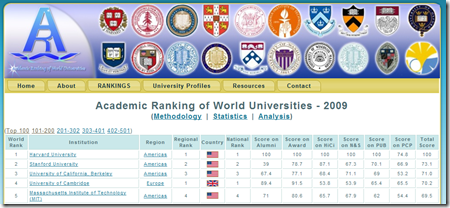
The Academic Ranking of World Universities just got published.

image

Not a single Belgian University in the Top-100. Leuven comes in at 102 and Ghent at 106.

I found this resource via Eric Drexler’s blog, which was focusing on Asian Universities.

The “Academic Ranking of World Universities” (ARWU) is widely regarded as the best objective, international measure of university quality, and the ARWU says that excellent universities in Asia are scarce.

This seemed to me to be out of line with reality, and on further investigation, I concluded that the ARWU has a strong negative bias as a measure of the current quality of rapidly advancing universities.

In examining a paper on the ARWU methodology [pdf], I found that its scores place great weight on numbers of Nobel Prizes and Fields Medals won, to publications in Science  and Nature , and to publications listed in the Science Citation Index. The problem is that, as a consequence, the scores are weighted toward cumulative numbers, which are poor measures of rapidly rising institutions, such as the leading universities in China and India. For example, if an identical twin of Harvard materialized in Somerville or Beijing today, its rank would be abysmal for years to come.

In summary, the much-cited Academic Ranking of World Universities is very much a lagging indicator of quality.

Although that nuance may be good for the Asian universities, this is bad news for the Belgian universities.

The university of Leuven was founded in 1425 ! That’s almost 600 years ago. So if the ARWU is measuring (lagging) current quality of universities, that’s really bad news for Leuven.

Also, the omni-presence of US-universities should be of some concern to our society – the European in particular. This is also reflected in the number of innovation think tanks that exist in the world. Most are from US origin. Most of their analysis have a very US domestic focus.

That’s why our upcoming European based Think Tank for Long Term Future will try to change that, and start from the rich and diverse European culture and history. We’ll have our kick-off meeting with a number of passionate creatives and local captains of industry on 24 Nov 2009.

However, regional or anti-regional focus should not be the focus. And we do not want to start from a laggard’s position, as a catching-up strategy is always a loosing strategy.

In our inter-connected world, we are moving towards a new world order, based on collective intelligence and collective intention, inspired by transhumanism. I am preparing a separate post on that.

The focus will be on ensuring that our next generation is well prepared for a new world order. Preparing those who will be our leaders in 2030 is the focus.

Stay tuned.

Google and Finance 2.0

Umair Haque has written an Open Letter to Google titled “Can Google take on Wall Street – and Win ?”

It starts with: “Dear Google,…”

and goes on with:

Every day, you handle more searches than the NYSE handles trades — and that difference, I’m guessing, is about to hit an order of magnitude more. Every day, you connect people, businesses, and communities in deeper and tighter ways than besuited beancounters do. From my tiny perspective, it seems that you just might be in the best position of any organization in the world to take on Finance 2.0.

Umair’s open letter is nothing more (or less) than

asking Google to implement

his Finance 2.0 Manifesto

written some months ago, and commented in this blog here. I strongly recommend to read the Manifesto.

And he continues:

What would a Googlier

finance industry resemble?

What would a more Googly set of capital markets look like? That’s the $12 trillion dollar question. After all, markets are just search engines — remember?

You still think you’re in the media business. You’re not. In the 21st century, everyone’s in the same business: the awesomeness business. It doesn’t matter what you make, as long as it offers maximum awesomeness. And right now, better finance would be pretty awesome.

Yesterday, you used to change the world. If you think a bit harder, a bit smarter, a bit more disruptively — you still can. If you don’t — well, the biggest catfish in a parched, dried up pond sure ain’t the smartest catfish.

And he gives some “leading” examples:

Tracked, ValueCruncher, StockTwits, and many more are the leading edge of a revolution — a revolution in what finance has been for the last several centuries, and what it must become in the 21st.

Something i don’t like in Umair’s post is the polarizing tone as if all in financials services is bad, and Google is “doing good” and Google being positioned as the solution to cure world hunger. Although i have already promoted many times on his blog that

polarization fosters innovation

Also, the “leading” examples offered above are putting Google in its traditional role of information manager, searcher of information.

I believe we could also look at Google as a utility. They have some great tools that could be applied in a big way to financial services. What if for example a neutral party would host a federated Google Wave as a SaaS solution for the financial market ? Running on a secure messaging platform like SWIFT ? Next generation person to person communication ? Or apply the same technology to do Collateral Margin calls for example ? Where every new call is a new Call “wave”. Think about it.

There is of course a lot i like in this article, especially the implicit push for extreme – even “impossible” innovation. Last week, i was attending the 11th European Conference on Creativity and Innovation. One of the keynotes came from Mark Raison, titled “The Power of Impossible”

Look at this presentation. Internalize it. And then let’s play-back Umair’s open letter with The Power of the Impossible in mind.

What would happen then ?

PS: Mark Raison is on my target speaker list for Innotribe @ Sibos 2010.

Re-Inventing Wall Street: Finance 2.0

When Umair Hague posts something on his blog, i always take some extra quality time to read.

110-umair-haque

Umair Haque is Director of the Havas Media Lab, a new kind of strategic advisor that helps investors, entrepreneurs, and firms experiment with, craft, and drive radical management, business model, and strategic innovation.

Always sharp, and always in for a good controversy and/or polarizing opinion. I am a strong believer in polarization being a big driver for Innovation.

Have a look at his latest blog post titled “Reinventing Wall Street from the Bottom Up

Some super-quotes:

Welcome to the new trickle-down economics. Here’s how it works:

  1. Banks massively misallocate capital.
  2. The government uses money reserved for public goods — education, transportation, healthcare — to bail out banks instead.
  3. The bailout should trickle down, as lending to businesses and consumers alike sparks economic activity.
  4. No effort to settle bad debt is made; little reform of corporate governance, industry structure, or competition is necessary — because banks are too big to fail.
  5. Little oversight of steps 2, 3, or 4 are necessary, because markets are perfect resource allocators, and market actors are rational.

Result? In trade terms, a shock worse than the Great Depression, as Paul Krugman has noted.

In employment terms, a lost generation.

In monetary terms, a flight from the dollar.

In microeconomic terms, the stagnation of America’s industrial base.

If it weren’t for Apple, Google, and a handful of old-school companies pursuing dramatic reinvention, like Wal-Mart, we would be in a Great Depression.

In macroeconomic terms, value is transferred from you, me, and our grandchildren to Wall St — permanently.

And also:

The greatest transfer of wealth in history is taking place. It is already roughly worth a year’s output of the entire United States, or about 5% of the entire world’s output.

Or…

It’s is faith-based economics — and it’s Barack Obama’s biggest mistake. (Consider for a moment that 20+ per cent of hedge funds misrepresent info.) For years, George Bush hunted for phantom WMDs, while terrorist networks flourished under his nose. Now Barack Obama is hunting for a phantom prosperity, while the greatest robbery in the world is happening right under his nose.

In the same blog post, he is referring to his Finance 2.0 Manifesto, published back in April 2009, where he makes 9 recommendations for a better financial system. I have cut & pasted the whole lot, not because i am lazy, but because the context is worthwhile reading as well (orange/red highlighting by myself)

Edge funds. An edge fund is the opposite of a hedge fund. Where hedge funds are opaque, edge funds are transparent. Where hedge funds are closed, edge funds are open. Where hedge funds are run for near-term gains, edge funds are in it for the long run. Where hedge funds create artificial book value, edge funds create value that accrues to real people and society. Where hedge funds focus on long and short transactions, edge funds focus on relationships. Think Marketocracy on steroids.

Macro and microcurrencies. A currency tied to national interests determined by a political elite? That’s so 20th century 16th century. A better financial system needs better currencies. Finance 2,0 will be built on microcurrencies and macrocurrencies: currencies which operate hyperlocally and transnationally. Why? Because people shouldn’t have to bear collective responsibility for bankers looting or regulators cahooting. In the 21st century, the quiet tyranny of economic collective responsibility is intellectually bankrupt: it is fundamentally unjust, deeply inefficient, and vastly value-destructive.

Social banks. Despite what marketers tell you, banks do not exist to maximize profits. They exist to maximize the safety of deposits. We’ve been taken for a very expensive ride. Next-generation banks will be structured as social enterprises — because the incentives to safeguard deposits and reinvest profits for the common good perfectly converge to a dominant strategy for long-run value creation.

Fair markets. Markets are free like a shark is a fish. Anyone can play — but only at the risk of being manipulated, looted, and defrauded by the deepest-pocketed. The anonymous arms-length transactions orthodox economics lionizes are, in practice, just a hyperefficient mechanism for front-running, predatory trading, and bid rigging. Next-generation markets aren’t just free: they’re fair. They are markets where information about reputation, reliability, and relationship thickness are hardwired into the DNA.

Stakeholder communities. Institutional investors are so 20th century. Centralizing control over our biggest corporations in the hands of a bunch of old dudes asleep at the wheel was as good an idea as the spork: interesting in theory, useless in practice. Tomorrow’s radical innovators are already updating corporate governance for the 21st century, by letting communities of stakeholders shape managerial decision-making. Think mega-Etsy.

Whisper bullhorns. Why is trading such a great business? Because traders have access to info that you don’t. Why can’t everyone get in on the whisper circuit that powers prop desk profits? Because no radical innovator has taken on the challenge yet of amplifying the secretive whisper circuit into a blaring bullhorn. But imagine if the rumours that drive share prices up and down on trading desks were Twitterfied. The result would be a financial revolution: the market power Big Trading enjoys would vaporize faster than you can say "insider info."

Googlizing financial instruments. What business is Wall Street really in? The business of hoarding information: to seek a so-called informational edge. Of course, markets don’t work if everybody’s hiding info — they only work when people are revealing it. Google can help me find a tennis racquet, Match can help me find a date, and Last.fm can help me find some tracks to rip — but who can help me find a better place to put my cash that effortlessly? No one. And that’s a massive reason why we’re stuck with a 1.0 financial economy.

Anti-ratings. Your credit is rated mercilessly. But does anyone rate lenders — not to mention brokers, banks, and investors? Today’s crisis would have been far less severe if consumers had access to knowledge about who was a trustworthy lender — and who was going to sell them the financial equivalent of a roadside bomb. Credit ratings alone cannot create more efficient financial markets — doing so requires better information about both buyers and sellers of every kind of financial product.

Open source modeling. Every bank built the same models. Every bank built the same flawed models. Every bank built the same flawed models on similarly erroneous assumptions. How dumb is that? Incredibly. Unleashing the power of open source to vaporize this black hole of incompetence is going to be a tremendously powerful path to innovation. The peer review, voluntary contribution, and always-on negotiation at the heart of the open source model create powerful incentives for quality — which is exactly what the hare-brained quants at banks lacked.

Finance 1.0 cannot power growth 2.0. Yesterday’s finance cannot power tomorrow’s prosperity. Bailouts, taxes, nationalization, regulation are what your discussions this week are focused on. These can limit the depth and intensity of the crash. But what they cannot do is build a radically more efficient, productive, and effective financial system.

See also my previous post about Peter Thiel and the Singularity, where he said that credit only works in a growth society.

That requires a better kind of finance altogether — one designed not merely to make the worst among us richer, but

to make us all authentically, meaningfully wealthier.

That’s why finance 2.0 is the future.

This is the sort or personal and corporate values we want to discuss as underpinning for our Long Term Future. Hence the need for the Think Tank we are building from Flanders to gather like minded authentic people who do care about our next generations.

The Power of Choice

Great post on the confused of calcutta.

How consumerization of IT now really starts hitting the enterprise. Quite obvious, and i am sure you too use more and more external tools like Google Docs, iPhone Apps, Drop-It and other company external services to get your job done.

The article however is on something more profound that is emerging. The power of choice, and how companies need to plan to design services to be “choice-able”:

The more intriguing questions of choice come up when you look at how tasks and resources get allocated to each other within an enterprise. Firms exist at least partly because they serve to reduce transaction costs. They could borrow capital cheaply, obtain global reach and scale, attract and retain staff by the provision of pay and benefits. At least that was the theory; over the years those advantages have dwindled: enterprise credit ratings aren’t what they used to be, the internet lowers the barrier for global reach and scale, security of tenure is no longer to be assumed and benefits sometimes  become millstones around legacy operations. So yes, firms are changing.

Despite all that change, some things haven’t changed. Management structures exist to define and agree objectives, to prioritise activities in the context of those objectives, to allocate scarce resources to the completion of those objectives, to monitor feedback on performance and to intervene when and where appropriate, to fix problems, overcome obstacles, resolve conflicts.

and

People choosing what they do, when and how they do it, where they do it, what services and tools they need to do it, what devices they use. All possible. All being done now. But not holistically across the enterprise anywhere.

For that we need to architect our services differently. Which is where outside-in design comes in, designing for the customer, designing to provide that customer with choice. At a level of abstraction, everyone’s a customer. Your actual customers. Your trading partners. Your supply chain. And your staff.

Privacy is dead

This blog post is triggered by a start-up demonstration i saw at DEMOFall2009 some weeks ago.

The demo was about an iPhone application called “datecheck” aka “creepfinder”

You can find the video here.

Not that i am interested in on-line or real-life dating – i am happily married – but in essence the application allows me to do a check on my date. It basically crawls the internet, twitter, facebook, and  – in the US – public data such as your real-estate tax income and even criminal records.

The end-result is that i find data about criminal records about my future fiancée, full real-estate data about what house he/she lives in, family composition, real-estate tax-income etc

The US government also is getting quite open and transparent on its own data. Have a look at www.data.gov

image

And these days all these data are accessible via API’s to take data OUT of these systems. Some API’s like twitter, facebook etc also allow you to INPUT data via for example Tweetdeck, Seismic, and many others. I would love to have something that not only allows me to INPUT my Tweets, but also something that allows me to input and maintain my personal profile data, across services. See also at the end of this post.

For the US government data, you see start appearing end-consumer apps that let you search through this massive amount of for example government contractor’s data with quite advanced intelligence tools in the hand of the citizen.

In stead of FBI (Federal) it’s becoming

CBI (Citizen’s Bureau of Investigation).

It says “analysis for the people, by the people”. I would add “"about the people”

image

All this is sold as “transparency” and “democracy”, and those are of course very important values.

But – and I don’t know about you – I start more and more FEELING quite uncomfortable about all this. Not that i have to hide anything, or that i have a criminal record (at least not that I am aware of ;-), but I do FEEL all this is quite intrusive.

As most of you know, in my previous life i was quite close to the Belgian eID project (electronic identity card). The card also allows you to access the on-line government database, where I can look at my OWN data and check who in the government has accessed those data.

But i believe we should make a big plea for the appliance of Law #1 of Kim Cameron’s Laws of Identity:

image

That’s easy said, but how do you enforce that. I took the pain to look at the privacy policy of Twitter (see http://twitter.com/privacy). In essence – as a user – i have nothing to say. I have 2 choices: to use twitter and accept the privacy policy, or not use it. But how many of the many million Twitter users have ever read the privacy policy ? How many know what sort of deep intelligence engines are crawling all these data that i released to the net WITH A DIFFERENT PURPOSE ?

This is not Twitter specific. It applies to Facebook, Friendfeed, or any other form of social network or service.

In my opinion, i would like to have something where i can control what data about myself i want to release to what service and in what context. I update my information there once, and have also guarantee that my profile information is consistent across Twitter, Facebook or even event/conference sites that these days more and more use their own social media piece of technology.

Of course you would need a highly trusted party to deal with these data. I think i would even be prepared to pay a price for my privacy.

This concept of a central digital vault comes pretty close to eMe, the winner of the Innotribe idea-contest at Sibos 2009 some weeks ago. But they started from “mydata” and information and documents related to financial services. If you start thinking privacy and putting control of data back into the user’s hands, you get a much more powerful proposition.

I would like to hear the opinion of a number of identity and privacy experts that are following this blog

UPDATE: Can’t help it, but just at the same time as i published this post, Guy Kawasaki tweeted the following URL:

 http://holykaw.alltop.com/why-you-should-think-before-you-tweet

Peter Thiel and the Singularity

I am just back from the Singularity Summit that took place in NY during the week-end of 3-4 Oct 2009.

banner_125x125

I will make a separate report on the rest of the event, but i was completely blown away by the 30 min speech by Peter Thiel and following panel discussion with Venture Capitalists.

PeterThiel

Peter Thiel is president of Clarium, a global macro hedge fund. He is also the founder and chairman of Palantir Technologies, a national security software firm, and a founding investor and board member of Facebook, which serves more than 200 million active users. He helps launch many other new technology companies as a founder and partner of the Founders Fund. Previously, he was founder and CEO of PayPal, which manages more than 175 million financial accounts.

Peter Thiel has philosophy and law degrees from Stanford University, where he occasionally teaches on globalization and sovereignty and serves on the board of overseers of the Hoover Institution. He funds research in artificial intelligence and life extension technologies.

See for his other investments on the above link to Wikipedia. It also becomes very apparent what a fine crew must have been at the basis of PayPal. Many of the ex-PayPallers have created very successful companies.

Also his philanthropic endeavors in the Singularity Institute, the Methuselah Mouse Prize foundation (Michael Rose himself was also at the conference) and Dr. de Grey’s work on extending human life span are some examples where Thiel’s long term vision is. I will come back later in this blog post on “time horizons”

But back to his 30 min speech at the Singularity Summit.

First his appearance. He made me immediately think about Steve Ballmer: his eyes are hypnotizing. His body language shows "withhold energy”. His jaws and mouth tense. Ready to explode. Clearly fit and in top shape. Laser sharp attention when somebody asks a question. Always listening and answering with respect.

And he delivered his speech without any supporting slide, and – as far as i could see – without any notes nor an autocue or something like that. Wow !

The title of his speech last Sunday was “Macroeconomics and Singularity”.

He started his speech with letting the crowd choose between a number of catastrophe scenarios: from bio-terrorism, to nuclear war, global warming, and a couple more like that.

His thesis was that the biggest disaster that could happen would be that the Singularity does not happen quickly. It was the start of a staggering discourse on why innovation – and especially disruptive innovation – is key to the continuation of our society. And in a grandiose move, he interweaved the financial crisis in to all of this.

Credit only works against a background of growth. But if claims of the future (singularity is a good example) don’t realize, that has a big impact on credit, on to be expected returns (which he claims are way too high for non-risk taking investments), and on the basis (growth) of our society at large. Society would still be “functioning” by fixes such as working till the age of 80, or earn less, or have low returns on capital, but that’s not what we understand with progress.

Investing in “tech” firms like Microsoft, Oracle, IBM, and even Google is betting that they will churn their revenues and profits in the foreseeable future. In other words, this is betting that nothing disruptive is going to happen.

A lot of this is driven by short term return horizons. We seem to fix the short term problems, but are stuck with the chronic long term problems.

Having a longer time horizon may be the biggest Chinese advantage.

Some other interesting quotes from his speech and following panel discussion:

    • The short run becomes the long run
    • All experts are biased in a positive direction, especially when presenting their start-up to VC’s
    • The risk of the return of fascism is very underestimated (this is about the emergence of a totalitarian regime trying to control AGI (Artificial General Intelligence) in a (pre)-Singularity time-frame.
    • I tend to invest in companies that will loose money for a long time, and a look for disruption
    • For every dollar that the government invests in opera, art, etc i want to see a dollar go to technology
    • We need to dramatically re-invest in technology education, even at primary school
    • I don’t like Darwinism, i prefer guaranteed survival. I could not resist a smile as right after this panel discussion there was Dr. de Grey himself on the agenda.

And about companies to invest in:

    • I am mainly looking at the team. And the potential of the people in that team to stay together for the long run, before founders start to argue and have a “farm" shoot-out”
    • And whether this team is capable to attract excellence. (I personally love this one as a measure for running a successful company)
    • He took his investment in Palantir Technologies as an example for this, where hiring seems to be organized around these themes. Co-incidentally, i had a meeting with Palantir the day before the Singularity Summit. I have mentioned them already several times in my blog and i would like to get them to Innotribe at Sibos 2010.

The effect of his speech was obvious. Where all other speakers at the event got max 2 rows of 4 people queuing for asking questions, there was immediately a row of 15 people of the auditorium eager to ask questions. You could feel the electricity in the air with each response from Peter Thiel.

This guy is sharp. Has vision. Has cred. Has Clout. Is a super-entertaining speaker. Has a story to tell to the financial industry. Peter Thiel would be an ideal keynote speaker for next year’s Sibos in Amsterdam 25-29 Oct 2010. It’s the first thing on my list today: go and see the organizing committee for Sibos 2010.

Of course, he would be great as well for the first event next year of our little Think Tank on Long Term Future (see previous blog posts).