Organizations Fit for the Future

Awesome “Must-see” video by Gary Hamel. Contains a lot of the wisdom of Vineet Nayar of HCL, who wrote the book “Employees First, Customers Second”.

Btw: have invited Vaneet to Innotribe at Sibos Toronto on Corporate Culture. Hope he accepts.

I’d love to get to a stage where

Innotribe is the place

where you discover

what futures emerge

on the fringe


"Modern” management is one of humanity’s most important inventions, Gary Hamel argues. But it was developed more than a century ago to maximize standardization, specialization, hierarchy, control, and shareholder interests.

While that model delivered an immense contribution to global prosperity, the values driving our most powerful institutions are fundamentally at odds with those of this age—zero-sum thinking, profit-obsession, power, conformance, control, hierarchy, and obedience

don’t stand a chance against community, interdependence, freedom, flexibility, transparency, meritocracy, and self-determination.

It’s time

to radically rethink

how we mobilize people

and organize resources

to productive ends

It’s one one-line after the other, this talk is so inspirational. Check-out:

  • Fit for future, but also fit for human beings
  • We have to re-invent management
  • Management legacies
  • Change has changed
  • Hyper-competition
  • You have to earn your place in the market every single day
  • Knowledge itself is becoming a commodity
  • How fast am I creating new knowledge
  • An organization where people are willing to bring the gifts of their creativity and passion
  • Real reverse accountability
  • Holding your managers accountable for you succeeding in your job
  • Challenge management dogma
  • What problem is management trying to solve?
  • How do you turn human beings into semi-programmable robots?
  • You have to have aspiration, you have to be contrarian, you have to be willing learning from the fringe
  • The future happens on the fringe
  • Management is a feudalistic system
  • The web is sort of the global operating system of innovation


We have to bake

into our management values

the deep web values of

Openness,

Meritocracy,

Flexibility,

and Collaboration

  • We have been told that we can’t change our organization: that’s nonsense
  • Being resilient as human beings

We hope

that you become

a champion

for the future

Bring Jack Back (Update: Jack IS back)

Update: just minutes after posting by blog, it was announced that Jack IS back at Twitter, now as “Executive Chairman”. Check-out the news everywhere or here at ReadWriteWeb.

I am getting so inspired by the fabulous Jack Dorsey from Square. Watch this video and the full transcript on Techcrunch. Read David Kirkpatrick’s article in Vanity Fair with the title “Twitter Was Act One”

He makes me think of Liam Gallagher from Oasis. He has something “very British”. He is stylish. The same arrogance. The same pureness. The same design and drive for perfection. And skimming down until only the essence is left over.


One comment reads: “you know what ? Maybe it’s too sounding like the beatles or John Lennon (that was my first reaction). But as a great beatles fan, i’m just glad to see some guys carrying the torch and able to do great music”


beadyeye1stpiconline (1)


And have you seen the interview over the week-end (I think it was BBC) with Liam as part of the launch of the new post-Oasis band Beady Eye ? It seems that the voice of Liam was recorded without any effect, no echo, nothing (not the case in above video).


Pure

The essence

The minimalism of Twitter


Which brings us back to Jack. I believe Jack is the John Lennon of Payments. That Square means for payments what The Beatles mean for music.

Back to the video.


image


Some quotes from the different articles and transcripts, to get you a good idea how genius this guy is.

  • “Little Jack Dorsey was obsessed with maps of cities”. Read my recent posts and thinking about the connected economy, the connected company, the connected team and the connected value. They happen also to be the big trusts for our Innotribe at Sibos 2011 in Toronto, later this year
  • he studied for a year to become a certified massage therapist (Martine will love this)


“Payment is another form of communication,” he says, “but it’s never been treated as such. It’s never been designed. It’s never felt magical. We’re the only payments company in the world that’s concerned with design,”

  • So the architects designed this gorgeous bridge, but the problem with the Golden Gate is that this is an extremely tumultuous area, if you’ve ever sailed through this or taken a boat through this, the waves are immense. Or surfed through it, which is more dangerous. It’s a disaster, I mean all the weather of the Bay is being forced through this one single point. So, all these elements create this perfect storm of turbulence. It’s extremely deep in the middle and it’s an epic span, so this was not an easy challenge.
  • And a lot of people think of design, when they hear the word design as visual, something that looks pretty.


Design is not just visual, design is

efficiency

Design is making something simple

Design is epic

Design is making it easy for a user to

get from point A to point B


Reliability is a feature. This is what Brian said earlier, availability, reliability, and staying up, that’s a feature and that’s a product, and it has to be well-designed and thought after and considered, and that’s what we’re doing.

I think I’m just an editor, and I think every CEO is an editor. I think every leader in any company is an editor. Taking all of these ideas and you’re editing them down to one cohesive story, and in my case, my job is to edit the team, so we have a great team that can produce the great work and that means bringing people on and in some cases having to let people go.

This is the bridge I want to cross. [Shows Golden Gate]


This is how I want to arrive at a destination:


This is classy

This is limitless

This is inspiring

This is gorgeous


My dream is to have him at Innotribe Mumbai, where we’ll talk and discuss about Mobile Payments, connecting the un-banked and financial inclusion.

Would really like to hear Jack’s view on design and perfection for that.

Bring Jack Back. To be classy, limitless, inspiring and gorgeous.

How to make babies ?

UPDATE: the Prezi version of the SOFA presentation mentioned at the end of this post is now available here.


image


Sibos 2010 is over! It was one of the best ever. After that week I felt completely exhausted. Empty. Because I gave my full self. Went deep. Gave and received loads of energy.

This week, it’s time for reflection. For chilling-out. Took some days off: late breakfast, some power naps. A walk here and there. Still lots of reading. Lots of tinkering. Some up-moments, some down-moments. Flowing.

And the future starts to emerge again.

Soon we have to go back to the salt-mine. Soon the treadmill starts all over again. But it does not have to be a copy-cat.

Soon we have SOFE (SWIFT’s Operations Forum Europe), running from 13-15 December 2010 in Conference Center “Dolce” in our home town La Hulpe (close to Brussels).

I have been asked to organize the Innovation Plenary on 14 December. So, here we go again!

Sean Park from the Anthemis Group will be there as well.

He was one of our VC-coaches and Innotribe Leaders for Cloud at Sibos. He will do a keynote during the plenary (a great Prezi presentation on “Platforms, Markets, and Bytes”) and a viewing of his trailer video on “Financial Reformation”. And he will help us run an Innotribe Lab on Cloud computing. Yammy !

Also for me it’s a great opportunity to refresh/reboot. I will do the second part of the innovation plenary armed with


a brand new presentation titled

 “How to make babies”


It will be one of those presentations that have been breeding in my head from some while, and suddenly materialize. Like a painting on a canvas. Like poetry on a sheet of paper. Like joy and harmony in music. Suddenly, it’s there!


clip_image002


“How to make babies” will bring together numerous thoughts collected during many conferences visited this year and ideas distilled from the books I have been reading recently. If you are interested in the books I am reading, I am inviting you to subscribe to my GoodReads.

In essence my story will start with the collision of two ideas.

The first idea was seeded in my brain by Geoffrey West (Distinguished Professor at the The Santa Fe Institute) in a presentation titled “The Secrets of Scale” delivered during the Techonomy conference in June of this year.


clip_image003

Geoffrey West is a theoretical physicist whose primary interests include elementary particles and their cosmological implications; the theory of companies, cities and global sustainability; and biology, including metabolism, aging and sleep. He served as the Santa Fe Institute’s (SFI) President from 2005 to 2009.

It happens that the folks at Techonomy just put up all the videos, including Geoffrey West’s presentation:

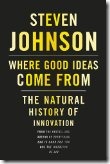
It also happens to be the story that opens chapter one of one of the latest books that made a great impression on me: “Where Good Ideas Come From” by Steven Johnston.

clip_image004

At Sibos, we reflected on the Long Now. In the first chapter of “where ideas come from”, Steven Johnson talks about that vantage point the long zoom.

It can be imagined as a kind of hourglass:


clip_image006

Several years ago, the theoretical physicist Geoffrey West decided to investigate whether Kleiber’s law applied to one of life’s largest creations: the superorganisms of human-built cities

And

the quarter-power law governing innovation was positive, not negative. A city that was ten times larger than its neighbor wasn’t ten times more innovative; it was seventeen times more innovative. A metropolis fifty times bigger than a town was 130 times more innovative.

The essence of Geoffrey West’s story is that cities are intensities. That cities never die. That cities are the ideal womb for idea generation, incubation and execution. That innovation scales differently than the size of the city.


Because

the information and the ideas

flow freely and in high intensity.


But how does one create a culture of intensity, of innovation? How does one create the vibrancies of cities within the walls of a castle?

Here is some additional video material featuring Steven Johnson’s ‘”Where do ideas come from”.

And a TED talk on the same subject:


It brings me to the second idea in the collision: the one of incubators.

clip_image008

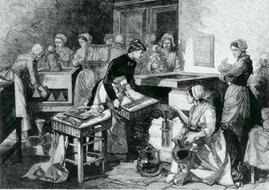
Incubators at the Maternity Hospital, Port Royal, Paris (Maternité de Paris, Port-Royal). An engraving by Eugene Froment (1844-1900) from the Illustrated London News, 1884.

Incubators were invented by Stéphane Tarnier in 1880, and documented by Auvard in the historic 1883 article De La Couveuse Pour Enfants. Incubators help us grow babies. Physical babies. What I am talking about are ideas. Baby ideas that need to be prototyped. And then incubated. Many incubator models for ideas and start-ups exist.

Probably one of the more famous ones is MIT Building 20. Building 20 was designed differently. With flexibility in mind. A bit like the Value Web walls that allow you to create spaces of intensities. And when the job is done, you disperse and build new spaces, new teams. Disperse and re-group. A different composition for each new project. Get rid of the one size fits all.


clip_image010

Old Building 20, Vassar Street facade, 1997.

clip_image011

New Building 20 at MIT

The point I am trying to make here is that physical environment is equally important to have a free flow ideas. Ideas will not flow in a castle with long corridors and closed offices.

Once incubated, you need to scale. Which brings us back to Geoffrey West and “The Secrets of Scale”. You need to create intensities. As I already mentioned in a previous post:

Intensities and intentions. City intensities. Platforms of intensities. Physical or virtual. Almost requires an architectural purism and surroundings to make it work. Has to be physical.

I want to create these environments. Where small groups of intense people can meet. Can radiate. Can nurture and inspire each other. Where one hunch leads to another, and ideas cross-fertilize. Where we play the Medici-Effect for 100%.

We need to build some sort of city, some platform of intensities, some sort of campus. Not a “chalet” next to the castle.


Think big

Think scale

Think city

Embedded in the social and economic fabric of our industry. Where experts can meet and weave the next generation solutions.

Where we not only have a fertile environment for funding “only”, but where we also thought about physical housing, novel resourcing models like dedicated teams combined with shared staff from the castle. Or in-residence programs as another way to resource and bring fresh blood.

Where we have a shared infrastructure for support, project management and IT. And where we nurture a culture of experimentation. Where we have reverse-mentorship of our bankers BY the Gen-Y generation.

Venessa Miemis hit us all hard in the face at Sibos:

There is a class of young, intelligent, creative people who are disillusioned with the debt-based monetary system, and are busy building the infrastructures for a commons-based economy, which is emerging, right now, in parallel to what currently exists. The foundation of this economy is built on trust… and transparency…. and the ability of distributed networks to self organize. And using the Web as a grounds for experimentation, we’re learning more effective ways to link unmet needs with unused resources, innovate, generate wealth, and build resilient communities.

This is the prototype of the future. This is where the opportunities are.

I hope that during the Innotribe sessions the remainder of the week, we can explore ways to create bridges between these two worlds and ways of thinking, and co-evolve the next global economy.”

Venessa & friends already followed up post-Sibos with the idea of an in-residence program for bankers. To understand and connect with the new class of young, intelligent, creative people. To learn their language and adapt their values. Yes, you got it right: the bankers get mentored by Gen-Y.

I think it’s a fantastic idea. To think wealth instead of money.


With trust as the currency

of the 21st century


Where we create bridges in a strengths-based society instead of a problem mindset.


We are in a different Zeitgeist,

and most of our bankers

haven’t noticed yet.

The realization that most senior executives in finance (or elsewhere for that matter) would be completely at a loss – “sans moyens” – faced with an articulate and intelligent Gen-Y as personified by Venessa.

Things like this residence program idea: that’s the sort of babies we need to create. That’s the sort of family harbor we want for our children. And when babies become adolescents and adults, when those ideas have matured into successful companies in their own strength, keep thinking about our off-spring. As it never stops.

And despite big hopes from the singularity movement, there is a fair chance that all who read this in 2010 will die sometime. But as Geoffrey West pointed out and proved mathematically:


Biological beings die

Cities never die


The big “contours” of my SOFE presentation are drawn. This post-Sibos holiday & chilling season is ideal to let it mature. To perfect the visuals. To come to the essence. To get to its full purity. To be different by less not more. So that you can feel the full intensity. So that each of you can realize his full potential.

Let’s practice making babies !

Breaking: Lazaro Campos opens Innotribe @ Sibos 2010

Drop everything ! Get up early ! THE session not to be missed at Sibos this year is the Opening Innotribe Keynotes. Be there at 9am on Monday 25 Oct 2010 in Conference Room #1.

Print

Lazaro Campos (CEO SWIFT) will open this session and participate to the following interactive Q&A with the speaker panel.

Matteo Rizzi (Innovation Leader at SWIFT and your master of ceremony) and Kosta Peric (Head of Innovation SWIFT) will guide you through the Innotribe program of the week. Knowing Matteo, he for sure will have some humoristic gimmicks in his sleeve to keep you energized that morning: it will start already when you come in, as you will be “bugged”. More details on-site 😉

Five speakers, thought leaders in their respective domains will thrill you with their latest perspectives on the tectonic shifts that underpin the topics of the rest of the week at Innotribe @ Sibos. Each of them will give a 15 min presentation:

  • John Hagel, Director, Deloitte Centre of the Edge, will follow with “The Power of Pull”, or how business models fundamentally change in our hyper-connected world, and how passionate he is about passion. “The Power of Pull” is also John’s latest best-selling business book.


  • Nova Spivack, CEO, Lucid Ventures is the world-renowned “guru” on Semantic Web. He will entertain you with a talk on “The Present is the Future”, how real-time and “Nowism” is permeating everything.


  • Stephen Ellis, EVP, Wholesale Banking Group, Wells Fargo, will fire you up with his views on tectonic shifts in Banking.


  • Venessa Miemis, Graduating Student NYC, Emergent by Design will speak on “The Future of Money”. Her talk will be spiced-up with a video she produced exclusively for this event in Berlin. We already blogged and twittered a lot about Venessa here


For early birds, there will be a couple of copies of the books of Peter Hinssen and John Hagel.

After these keynotes, Matteo will pick another trick from his sleeves to make sure the audience participates interactively in a short interactive Q&A with the speakers. He will wrap-up the session with the highlights of the Innotribe day and week, and will give you a call for action to keep you engaged with us throughout the week.

Both in content, quality of the speakers, and format of this session, this will be THE not-to-be-missed session on Sibos Monday. We are convinced it will set the bar for any session for the upcoming week.

Innotribe is organized by SWIFT Innovation with the support of financial institutions, vendors and innovation leaders. In the true spirit of less push and more pull, we encourage you to engage in a true dialogue with the Innotribe team.

We look forward to seeing you in Amsterdam.

The Innotribe team

www.sibos2010.com 

www.innotribe.com 

www.swiftcommunity.net/innotribe 

innotribe@swift.com 

innovate@swift.com 

Twitter: http://twitter.com/innotribe

Innotribe at Sibos 2010: Gen-Y and The Future of Money

Cross-posted on Swiftcommunity.net

Print

Matteo may have been a bit over-enthusiastic when he declared his session "probably the best session at Sibos 2010" . I guess he may have been unaware of something very special that is happening in the context of the Innovation Keynote Sessions of Monday 25 Oct 2010 at 9am .

What’s going on there is so unique , that i suggest you doublecheck your travel plans to ensure you can be there at 9am Monday morning !

What’s up ?

One of our keynote speakers is Venessa Miemis, a brilliant 28 year old Graduating pursuing a Masters in Media Studies at the New School in NYC. Venessa has a fantastic blog called Emergent by Design  and you can follow her tweets @venessamiemies  where she is leading us in a fascinating way through a collaborative effort to explore the emerging Network Culture and ways in which we can collaboratively build human intelligence and raise consciousness.

Some months ago, i asked Venessa to do a 15 min keynote on The Future of Money as seen through the eyes of Gen-Y. We occasionally kept contact via mail, twitter and skype, and in the spirit of her blog tag-line "emergent by design", and did not give and further instructions and trusted the process and the smartness of young people.

Great was my pleasant surprise when Venessa published her outline some weeks ago under the title "The Future of Money Begins !" .

futureofmoney

The keynote will be on "large scale shifts in cultural values and the impact they’re having on our relationship with money, our perceptions about ourselves as humanity, and how we are redefining what ‘true wealth’ means." For more details on the content, see the link/picture above.

What is really cool is not only the content of this keynote, but also they way how Gen-Y people like Venessa approach such task .

Without corporate structural constraints, Venessa told me very early in the process how she wanted to do something special: she wanted to produce a video as part of her keynote.

And in a true on-line collaboration Gen-Y way, she was going to produce this video with a company in… Berlin. For Gen-Y, they are truly no geographical boundaries anymore.

But to produce such video will require some money. No problem, how do Gen-Y approach this ? They ask their on-line communities for support.

So she launched the Future of Money Website  – and Emergence Collective "creating innovative momentum" with a fundraising via PayPal .

You can determine for yourself what degree of support you can muster to help. It starts at 5$ and can go up to 1,000$ if you want to be Executive Producer of this video.

At the time of this writing, the counter stands at 470$ ! I made a small calculation:

  • if each of the 10,000 readers of this swiftcommunity.net blog contribute 1$, will be able to make come true their full blown dream.
  • if each only 1% of the 10,000 readers donate 100$, same !

I don’t think it should be so difficult for our banks, partners, employees to find between 1-5$ to help support this really cool project.

  • For $5,000: They will create a beautiful and useful visualization of all the companies, initiatives and organizations we’ve been tracking in their research. Right now this research is a tangled mind map but with the skills in their team they have the ability to transform it into an informative and elegant visualization. This would include an overview of peer-to-peer lending platforms, open money protocols, emerging virtual currencies, microfinance platforms, and social currencies.
  • For $10,000: They’re going to be conducting a bunch of interviews very soon. Typically interviews will run between 10-30 minutes. However the video they’re producing will be between 3-5 minutes when it’s finished. Obviously they’re going to have to leave some stuff out. With this level of support they’ll be willing to edit each interview on its own and release it as its own video.

So let’s see what happens. The offer is made. The deadline is Venessa’s presentation on October 25, 2010. It’s up to you to decide if these expanded aspects of the project are worth your money and our time.

The result of this work – the video and the presentation – will be given away under a creative commons license.

Even just a small amount will go a long way towards helping us cover our time and expenses on this volunteer effort. And of course it couldn’t hurt to tell your friends   via your blogs and tweets.

To show the example, we just sent via PayPal some encouragement from the SWIFT Innovation budget to kick-start the process.

Very curious to see where this goes.

And Matteo, no offence, but i think this session will probably be the best attended session at Innotribe @ Sibos 2010

People and Culture: too wooly ?

Here is your deejay with the brainwave helmet again: look at the wide open eyes of Sam from Sam The Sham and the Pharaos with their 60’ies monster hit “Wooly Bully”. His eyes wide open. Uno, Duo, Très, Quatro ! Let’s have some fun here. And be a bit crazy !

image

I recently got somewhat involved in the People & Culture thinking of our company. Already at our first attempt during our fantastic off-site in April, we identified excitement as one of the components that need to be part of our culture.

We should all re-read that blog post titled “Get a Life and Get Alive”, as we seem to loose lots of the sharpness of our ideas when we start putting them through committees, and the whole thing seems to get watered down.

So, for 4 months+, we kept ongoing and had a good solid understream of ideas, depicted by different people in different ways, depending on their left or right brain orientations.

After a couple of weeks, this was my best effort:

image


It was a combination of keeping the best, improving drastically the mediocre, and getting rid of the worst. The most important in this slide were the


“quality lenses”


They reflect the deeper purpose that guides our transformation process and choices, and these lenses can be used as a compass to be sure we still navigate in the right direction.

The direction was an ambitious one, a radical one.

But most executives do not like the words “radical” or “disruptive”.

  • Does that mean we should adapt our packaging, our wording or worse our meaning and purpose to please our audience ?
  • What happens with ambition when filtered through endless reviews ?

By the end of last week, we had our seventh or so iteration of the slide deck to be presented to the executive committee.

I though we had quite an “acceptable” outcome in a culture of consensus.

As I write this, I notice how polluted I have become myself by the consensus-virus. In the end, one compromises so much that all you end up with is a grey mouse. 

Herman Van Rompuy arrives at the EU summit in Brussels on Thursday evening.   Photo AP

So, to hell with outcomes that are “acceptable”. We don’t want grey mouse. They don’t inspire.

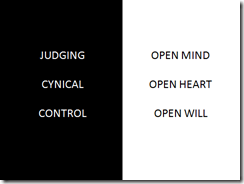
Nevertheless, I was surprised that version seven still included our famous words “Open Mind, Open Heart, Open Will”. You had to search for them (see the big fat arrow above), but they were there.

Too optimistic though.

Throughout the week, folks kept on saying this was “too wooly”

So we tried to put different words. In version eight, we ended up with some things like “Intrinsically motivated people” and “Co-creation with Customers”, etc. Not bad, but “acceptable” in my opinion.

What made me write this post was the following comment on exactly this part of that version:

This part is a bit too vague

and b-school jargonistic

for my taste

Can we turn that into our

company terminology ?

(the other parts already were in company-speak)


My answer: NO, absolutely NO !


As I wrote in back in April, the real root cause (to use some Lean terminology) was about the openness of our minds, hearts, and minds.

image

Some indeed call this “wooly” or “b-school”. I don’t know what is meant here.

There seems to be some negative connotation here:

  • “b-school” could mean several things. In the most optimistic case is stands for Business School, and then the wording may be perceived as too academic. In the worst case, it means b-grade school or even worst kindergarten or naivety. But I believe that many of our corporations would thrive well if they would resource themselves with some naivety of better

freshness and purity

like a young child

discover with eyes wide open

and without prejudices

  • “wooly” has something to do with a certain form of “softness”. I sense all sorts of touch points with New-Agism, or the Hippies 2.0 movementExecutives seem to have e a natural aversion to topics related to softness, philosophy, emotion, feeling, sensing, or anything that has to do with mind, heart, and will. It is probably exactly this that needs to change in many company cultures if we want to make our companies more “human”. Or as Jeff Bezos so eloquently said: “It’s harder to be kind than to be clever” Read every word and sentence of his Princeton speech here. Listen to the emotion in his voice. You sense here stands a man who embodies and believes what he says. You want to follow him. Maybe he is Hippies 2.0 ? Maybe. But he’s inspiring.

Leaders will be followed, not because they have dictated so or by hierarchical power, but because they are authentic in everything they do, because they are inspirational, because they are charismatic, because they are truly “at service” and not “in command”.

The new game is about new hierarchies, not based on ranks and power but based on true service value.


The hierarchical PYRAMID changes

into a collaboration and service SPHERE

where there is no upper or lower level

where the value comes

from the strong interdependency and

100% service mind to make the OTHER win

What we need is a culture based on a fundamental shift from Old Game thinking to New Game thinking. We will not succeed if we stay “acceptable”.

Our ambition level in this should be nothing but an extreme makeover, respecting our company’s financial, operational and reputational integrity.

You can use whatever words for it, but the messages and its wording must be fresh, inspiring, ambitious, rejuvenating. Not only on its messaging surface but especially in its deep culture core.

I don’t believe that you can capture your “culture” in one word. Culture is a complex thing. It’s a combination of tacit, implicit and explicit values, attitudes, and knowledge. Is combines the good positive heritage of the past with the vibrant youth-ness of the future. So, here are some words that “capture” that culture.

image


That’s also why Talent and Culture are so closely interwoven. Because culture is the result of the people you have on board. If you want to change the culture, there are basically two things you can do:

  • Try to change the people you have on board. Although this is very difficult, I believe we have enough cultural creatives to at least inspire more than 50% of the company to change gears. For the others, we’ll have to wait till the Hippie 1.0 generation is retired and made room for the new generation.
  • Bring on board new young people with fresh insights. We should be extremely aggressive about this. Hire “en-masse” young people. If possible younger than 20 years, as even some 25+ “don’t get it”

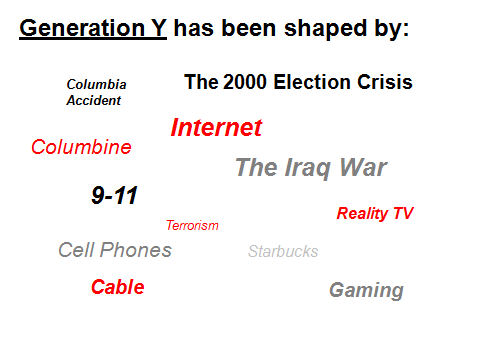
Both generations where shaped by different time and historical contexts:

image

image

With courtesy: NASA Generation-Y Perspectives. Full slidedeck here.

Of course, when implementing such aggressive plans, we need to make sure that these programs do not become the exclusivity labs for personal and professional development for the young only, and that everybody gets her chance to fully realize their potential, so that they don’t have to ask us


“and where do I play ?”


Like many things, I think you recognize an inspiring culture when you see it. When you see the people of that culture. They have sparkles in their eyes. When you interact with them. They go the extra mile.

We need word and spirit that reflects:

  • Excitement
  • Intrinsically motivated people, as mean by Daniel Pink in “Drive”
  • Extreme Management Make-Over and Employees First, as meant and intended by Vineet Nayar in his latest book, considered now as THE reference for modern HR

I was lucky to see Vineet deliver his message in person to the audience at Techonomy last week. The story goes like this:

  • The goal of our company is to deliver value to our customers
  • Where is that value created ? At the interfaces of our company.
  • Who is at those interfaces ? Our employees
  • Therefore the whole company should be organized to be “at the service” of the employees.

This is about a management extreme make-over.

  • From managers giving instructions to employees and measuring their efficiency
  • To managers at the service of employees

When I spoke to HR, my contact said: “Oh, that is what is called Service Management, I know about that”. When I asked whether he already proposed this as a management culture to the executives, he said


“Oh no !

That would be too radical

that’s a revolution !”


But I am afraid many of our corporations need nothing less than such a revolution, a fundamental make-over.

In the end

Culture = Company = People


People with a Life and Alive. Not wooly sheep following the dress code and complacent in being “acceptable”. People who share the “wooliness” of “kindness” vs. “cleverness”.

Our culture has to be provoking and inspiring. You should be able to rally your troops behind it. As soon as it becomes “acceptable” that won’t work.

In the song Sam sings about a “wooly saw”. What we need now is a very sharp saw.

To give the sharpness back to the Wooly Bully !

The DJ with the Brainwave Helmet

Found this TED 2010 video via Kurt Vega’s tweets.

From the TED site: “Tan Le’s astonishing new computer interface reads its user’s brainwaves, making it possible to control virtual objects, and even physical electronics, with mere thoughts (and a little concentration). She demos the headset, and talks about its far-reaching applications.”

Out-of-the-box support for facial expressions and emotional experiences, with some sensitivity adjustments available for personalization.

The demo is focusing  on the “cognitive suite”: the ability to move virtual objects with your mind.

And it just costs only a few hundred dollars. Like an iPAD, but it’s a hPAH “head-PAD”

Start mixing this with the ongoing discussions on personal digital identity. As you will notice, the demo starts with making a personal profile for this headset owner. And tuning to a neutral signal, a signal where you’re doing nothing particular, your are relaxed, hanging-out: a but like my holidays at home where I basically don’t do anything particular other than hanging around.

It’s interesting to see that the test is about “pulling” an object forward instead of “pushing”. I may be too influenced by John Hagel’s latest book “The Power of Pull” 😉

The cool stuff starts when the helmet man starts visualizing something that does not exist in real life: making something disappear.

Applications are obvious in virtual reality games, domotica systems, all sort of gesture and thought based interactions, control an electric wheel-chair. In banking it would be nice is I could raise the balance on my account just by thinking about it.

What I do NOT like about it is that the “system” has some built-in leveling system. It makes me think of Jaron Renier’s fantastic rant / manifesto that I mentioned in my previous blog “you have to be somebody before you can share yourself”

Start mixing this up with some of the cool ideas like Mark Pesce’s Plexus which is a quite novel way of looking and using your social graph in a sort of

event driven pub-sub system

where you decide as a user

what you listen to and

who and what you want to share

with

Sometimes, I think of myself as a disc-jockey (which I was as a matter of fact for more than 15 years starting in the late 70’ies), and I very much like Ethan Zuckerberg’s description of a DJ in this also great TED 2010 video on our distorted world-views.

His talk is basically about

getting you out of your normal orbit, of stepping out of your usual “flock” of people you normally interact with (both on- and off-line).

Around min 15:30, he describes a DJ as a guide:

A skilled human curator, who knows what material is available to her, who is able to listen to the audience, and who is able to make a selection and push people forward in one fashion or another

Of course, I could now make jokes on Faithless “God is a DJ”, and/or refer to one of my previous posts called “We are as gods and might as well get good at it”, but I won’t do that.

Instead, I’d like to share with you the feeling of giving pleasure to my audience.

It’s something I feel while writing these blogs, and it’s a very similar feeling as being a DJ in front of an audience and pushing people forward.

Its has a same sort of stage-fright

when starting a gig,

and the same sort of excitement

when you see your crowd getting

excited

As a DJ, I was doing some quite big gigs for 3,000 people or so, and my following community is not that big yet. But the feeling is the same, and everyday there are some more folks following my tweets. Some more reacting to my blog. Some more getting inspired by what’s on these pages.

So, I just continue doing that, and hope to inspire you to dream and execute your dreams.

His Purple Highness and Innovation

There has been a lot of coverage on the net about Prince’s statement “The Internet is Dead” and the responses “Prince is dead”. For me, Prince is never dead, as he left me with memories to the best concert I have ever seen during his Purple Rain tour, indeed quite some time ago ;-/

The master of funk – aka His Purple Highness – just has a new CD “20TEN”, and it seems to be a good one, and it is btw given away today for free with Newspapers in Europe.

I found this review of 20TEN in the Belgian Newspaper De Standaard. It’s in Dutch, but if you turn on Google translation, it’s quite readable in English.

Prince

I blog about it for the following (auto-translated) paragraphs:

We give Prince creative freedom and we understand that he does not want to live in the past. The most pressing question that loomed when we 20Ten in the CD-changer was explained: the album will be as good as Sign O The Times or Parade? Equally exciting as 1999 or as viciously as Controversy?

Well … (Drum roll) … No. Not really. More importantly, we find that bad? Because let’s be honest: you really expect the 52-year-old Prince a plate opinions so urgent, as controversial and as innovative as his work from the 1980s?

Maybe we should ask whether it is the responsibility of someone like Prince to remain the major role of innovator to take on. That role he has not already played out with fervor when it was needed? Charts when artists do not dare to take risks, but only when blacks were allowed to play funk and disco, when explicit sex or gay and bisexuality have been stashed away in the bright pop music?

The question – or statement if you want – was already raised by Guillaume Van der Stighelen during an interview with business TV Channel Kanaal-Z some years ago at the occasion of the launch of his book “Heldenmerk” (the brand as a hero) somewhere end 2008, begin 2009.

He said something along the lines that creativity (and innovation) should be left to the young generation, and that he – as a 50+ year old – should give room to the young generation where the real creativity sits, and that his role should be one of mentorship.

I am 50+, so that quite resonated with me. But I think he is right. Since then, I try to make others win, younger people than me, who still have to proof something.

It is actually fun to disappear backstage, and enjoy the show being delivered by others, and knowing you were a substantial part of getting it where it is right now.

That’s a different – and in my view “better” – type of satisfaction, fulfillment and motivation.

We are as gods and might as well get good at it

Check out Raw Dawson’s blog post of today with superb video

TURNING INTO GODS – ‘Concept Teaser’ from jason silva on Vimeo.

Indeed today it is entirely appropriate for us to be thinking in terms of human transformation, and the power we have at our disposal. The cycle has swung back, and once again there is the promise that we have what it takes to change who we are… for the better. Whether human nature will allow those changes to be fully positive we have yet to discover. But that promise is – once again – part of the zeitgeist.

Heretic Team Glue

Last week we had a great team off-site.

We arrived late afternoon in the fantastic location of Chateau de la Poste, close to Namur, Belgium. Built in 1895, the Château de la Poste was the residence, for more than forty years, of Princess Clementine, daughter of King Léopold II. It later was sold to the postal services, who used it as a vacation resort for the children of the employees of the Belgian Post (times have changed). It recently was refurbished completely by a French wine maker, and it houses now a wonderful hotel, meeting centre and quality restaurant.

The amazing landscape, the silence and the soft welcome on the summer terrace set us all in the right mood. We all felt our physical and mental muscles relaxing, winding down.

Don’t know where I read it anymore, but I recently found a quote: “If you are not able anymore to take some time out for an off-site team gathering, you’re cooked”

For once, we did NOT have a packed agenda, and plenty of time for  real Quality Time Sessions.

We even made an acronym for it (QTS) to joke a bit with the “acronymitis” of the lean methodology.

More seriously, we invented QTS because we felt that the pure lean method was too much focused on a problem-mindset, and not enough on an opportunity-mindset, opportunities to develop some deeper quality thinking on subjects relevant to our business and team.

One of the items on the agenda was about “how to tell bad news”. In the subsequent discussion, one team member reflected on some sort of “fear” and “If I do this, then this and that may happen, and then…” thinking. Being in the acronym mode, we had a good discussion on


FEAR = Fantasy Experienced As Real


and how such behavior leads to blocking, status-quo situations.

Almost “emergent by design” our team culture principles unfolded, and we articulated them along the themes of “old” and “new” game.


  • Old game = fear, tricks, manipulation, raising stinky fish, machiavelism, creating and maintaining negative energy in general

  • New game = solution oriented, integrity and authenticity, fast correction (like Guy Kawasaki used to say”churn baby churn” a variation on the famous 1976 disco song “Disco Inferno” by the The Tramps), the holy fire, positive energy, who is the owner of the idea, who cares ? It’s about focusing on believers, and investing heavily in those VIP followers that will help us create a viral innovation infection/storm, like a raging holy fire that cannot be stopped anymore. Burn baby Burn…


We replaced “raising stinky fish” by regular update and feedback sessions, focusing on polishing rough idea diamonds, focusing on what works vs. what does not work, focusing solutions vs. problems.


If you think deeply about it, all this is about

the major cultural shift

from pushing towards pulling your ideas,

it’s about a strengths based society and team,

it’s about connecting ideas

and excel in making them real.


Another correction we made to lean was our understanding of a skills matrix.

We were very inspired by Venessa Miemis’ blog post “Framework for a Strengths Based Society” that included following diagram.

We decided to add these skills to our existing lean skills matrix that was too focused on identifying and solving problems and tools mastery. “We are not the tools, the builders are us” is another quote from one of Venessa’s presentations.

The subtle nuance is that we did NOT implement these skills as comparative/ competitive skills of different team members but


in terms of personal areas of

strength and potential

for each team member individually.


Our little team is SWIFT’s “Innovation Team”. Some time ago, we shared the details of the mission here and in summary it goes like this:

Build the Skills , Tools , Processes, Metrics , Values , Network , required to support collaborative innovation and transform SWIFT in an agile company, able to succeed in a changing environment.

I often make reflections on how real our innovation work really is. And although we are having lots of fun and some sizeable impact on how the company little by little opens up for innovative behavior, I always seem to be in search for that little extra in life and work.

Too many of our innovation experiments and proof-of-concepts remain just that: proof-of-concepts and prototypes. They never get into production. Worse, some outcome are just ‘filed vertically” or even never get the any executive attention.

I would like to hear from other innovators what is the secret sauce to get beyond the prototype stage. Because staying in prototype stage sometimes makes me wonder if I am in some sort of “busyness” therapy.

And I have come at an age where I cannot content myself with busyness.

I could sit here till my pension, having a good pay, and living honestly speaking in a quite luxurious working environment. But I am in search for more. I am in search for


meaning and significance


With the couple of years still to go, I still have the arrogant (?) ambition that I want to leave a legacy. On a personal level in my family. On a professional level that my passing in this company has substantially changed something. It’s about a deep sense of motivation, beyond pay and perks.

There is something heroic, even heretic about all this. That’s why the title of this post is Heretic Team Glue.
See full size image

Heretics are the ones that were expulsed from the Catholic Church because they did not follow the rules and challenged faith and established dogmas.

There are several dictionary definitions of “heretic”. The one I have in mind here is “anyone who does not conform to an established attitude,doctrine, or principle”.

I think we in our team are all some sort of heretics in the castle. It’s something very special in our team, that creates a very strong bonding.

At times it even has some masochistic flavor. Why on earth do we keep on trying again and again ? Even if the odds are against us. Why are we prepared to go time after time through the innovation pains over and over again ?

I truly believe it is because we do it for the right reason. Not for the pay. Not for the glory.


Because we believe there is a chance

we can succeed 


And believe we can create a tribe of followers in the same belief. It’s for some of us the only reason why we stay !

Are the above reflections caused by my age and my 3/4 life contemplations ?  Don’t think so. We invited some GEN-Y colleagues to join our off-site. And see: they too are driven by honesty, they too want promises to be kept, they too look for meaning and fulfillment in their lives.

But it was shocking to hear how some of them have been seduced to join a company based on huge expectations and promises that they would work soon for 3 years in the US, and have rapid accelerated career paths, and deep young graduate immersion programs. It’s unacceptable to make such promises if you know you can’t realize them.

And this is their first contact with corporate life !

How can we ever correct this ? How on earth can we regain the trust of these young people ? Our generation has planted the seeds of suspicion in these long lives. Big mistake.

Me too I have been mislead several times in my life, and I recognize the power-less emotion of trust that was betrayed. Lessons of life ? Normal life injuries ? The way it is ? Why do we need to accept that ? Why do we repeat the same errors over and over again ? Sooner or later, these young people will present us the invoice.

These folks actually think. Think deeply. Some GEN-Y people are for example  insulted when calling them “GEN-Y”. Because they see themselves as individual human beings, with their own identities and values systems, not prepared to be tagged as a category. And they have great ideas. We organized some sort of Innotribe Lab with them: more than 20 ideas on how to improve quality of work came out. I am honored that I can channel these ideas into the People & Culture “movement” team of the company.

Last but not least, we had a great discussion about “reverse mentorship”.

Instead of older experienced professionals mentoring new young people joining the company, why not letting young people mentor the already older – sometimes (mis)formatted – generation, and teach them how to use new technologies and apply 21st value systems ?

We had a fierce debate: how can one say that the young generation is the future, and five minutes later challenge reverse mentorship by not accepting that one can learn an awful lot from these fresh and well trained minds.

Maybe that’s where my future is ? In being mentored by a GEN-Y ? It will ask of course an attitude of

vulnerability


It’s also part of a give-ànd-take culture that includes transparency and openness. Especially give. Like a gift, where you don’t expect something in return.


When is the last time you made a Gift ?


How can we create an environment where we encourage learning from each other (in normal and reverse mentoring mode) ? An environment where we celebrate confidence building on your own rhythm, dare to be vulnerable, asking for feedback that is clarifying, supporting, challenging.

I am convinced I can learn something from every human being. Especially young people who have a renewed and fresh sense of civic responsibility, transparency, honesty, openness.

I have committed to take the challenge and invite one of our GEN-Y’s to monitor me during 6 months and give me feedback on my behavior and to keep me honest.

So that I walk the talk. Every manager should do this.