Innotribe Special Session at SOFA: The new thinkers

SOFA stands for SWIFT Operational Forum Americas, a yearly event targeted at a typical operational audience. This year’s SOFA is on 8-9 March 2011 in NYC. The theme for SOFA 2011 is “Defining the next generation of financial services”.


marriot marquis NY


Innotribe is SWIFT’s innovation initiative. Innotribe’s mission is ‘Enabling Collaborative Innovation’. Part of our activities includes events: existing SWIFT events like Sibos and SOFA, third party events like CPA in Canada and EPCA in Europe last year. It usually translated into a “special” session, with lots of professionally facilitated interactivity.


Print


With Innotribe events we have the ambition to “unpack” stereotypes, myths and hypes. These Innotribe Events are an energizing mix of education, perspective, collaboration and facilitation. Our success factors for this new type event are organized along the following three axes of “opening-up” our traditional ecosystem: audience, content and brand recognition.

So, what’s up at SOFA this year ? We have two things going on:

  • At the end of day-1, yours truly will give the presentation “How to make babies” a strong metaphor for SWIFT’s Innovation Framework. Prezi version of this presentation is here. Tip: set sound “on”
  • At the end of day-2, our innovation team will animate a Special Session “The New Thinkers”

Building on the Innotribe @ Sibos tradition of exploring “Tectonic Shifts”, this Special Session will be an energizing mix of education, new perspectives, collaboration and facilitation.

Our goal is to stimulate the generation of new ideas by bringing together a powerful mixture of audience members and by enabling freedom of discussion – allowing the conversation to take the participants into any and all areas that open up on the day.


We believe strongly in the potential

of unexpected encounters,

and the magic that can happen

when people from

different background

are brought together


So the innovators and change agents of our industry will be invited to join the SOFA audience (and also to join us in Toronto for Sibos 2011 in September), and we hope this will foster exciting new discussions between them and the traditional SOFA attendees.


skyscraper lunch


Ideas do not typically come out of the blue. Rather, they are usually variations of existing ideas. Sometimes, simply looking at a familiar idea from a different perspective can spark a new idea or the combination of existing ideas to achieve new goals and create radically different value propositions. All the topics we propose to discuss during this Innotribe Special Session at SOFA are also potential subjects to explore in Toronto – but we are looking for your feedback to tell us if these are the right ideas to stimulate your creative thinking!

Presentations from five great modern thinkers will culminate in an interactive exchange between the SOFA audience and the speakers, led by Innotribe facilitation champ Mariela Atanassova. The audience will be able to drive the discussion according to the themes that most interest them – ensuring everyone will have an opportunity to collaborate in the innovation we hope this session will stimulate.

Here are The new thinkers:

introducing_miemis
Venessa Miemis
(http://emergentbydesign.com/about/): Free agent, Master in Media Studies at the New School, NYC, futurist and digital ethnographer, researching the impacts of social technologies on society and culture and designing systems to facilitate innovation and the evolution of consciousness. Venessa will update us on The Future of Money project (world premiere at Sibos 2010) and The Future of Facebook, a new research project sponsored by Innotribe as Corporate Patron.



rushkoffbiosm

Douglas Rushkoff (http://rushkoff.com/bio/): thought leader and provocateur. Author of best selling books Cyberia : Life in the Trenches of HyperspaceLife, Inc, and Program or be Programmed (all Amazon Affiliate links). Doug will give a talk about New Capitalism, and introduce his latest project on a Summit he is organizing in NYC on 20 October 2011 called “Contact”. Contact Summit will seek to explore and realize the greater promise of social media to promote new forms of culture, commerce, collective action and creativity.


brianzisk

Brian Zisk: organizer of the Future of Money & Technology Summit in San-Francisco (www.futureofmoney.com). Brian will summarise the findings of the Summit that took place on 28 Feb 2011. Psssst ! If you still want to go to Brian’s event, go the the registration page at ttp://futureofmoney.eventbrite.com/ and use the discount code “Innotribe”.


stoweboyd

Stowe Boyd (http://www.stoweboyd.com/ ): probably THE authority on Social media, Stowe is a Social Philosopher and Webthropologist from NY. His work focuses on social tools and their impact on media, business, and society. In 2011, Stowe is focused on a new line of research: Social Cognition. This research is co-sponsored by Innotribe, and we hope to share the final results at Sibos 2011 in Toronto.


kevinslavin

Kevin Slavin (http://about.me/slavin): also from NY, Kevin is founder of AreaCodeInc (recently acquired by Zygna, the undisputed leader of Social Games). Kevin will talk about the New Future and “Those algorithms that govern our lives” – including our personal finances!


5429335705_93ef6aa3cb

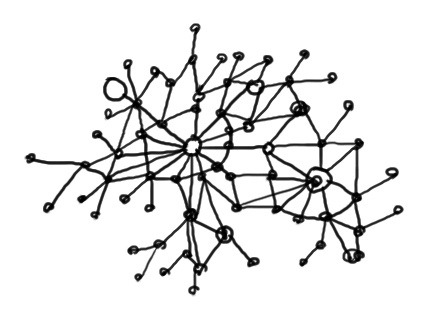
(picture from Dave Gray’s blog)

For the interactive part, we will organise the session around the organic growth aspects of cities. I have written about this before in my post “How to make babies”, and recently there was a fantastic post by Dave Gray on “The Connected Company”.  We invited Dave to SOFA as well, but he unfortunately could not make it.

Dave’s post is a fantastic post – and as far as I am concerned – one of those game changing post already for 2011, and I will definitely come back to it later.

Dave for example says:

And today, thanks to social technologies, we finally have the tools to manage companies like the complex organisms they are. Social Business Design is design for companies that are made out of people. It’s design for complexity, for productivity, and for longevity. It’s not design by division but design by connection.

He is also author of “Gamestorming, A Playbook for Innovators, Rulebrakers, and Changemakers” (Amazon Associate Link)


Looks like the book is very much about the principles that our team applies for interactive session design.

And gamestorming

is exactly what we’re going to do

at SOFA

during this special session


What: Innotribe Special Session at SOFA 2011, NYC

When: From 2-5 pm on 9 March 2011 at SOFA (http://www.swift.com/events/2011/SOFA/index.page

Location: Marriott Marquis, Broadway, NYC

Future of Money and/or Value

If you’re interested in discounted tickets for one of the coolest Future of Money conferences of Q1 2011, bear with me and read till the end of this post.

Print

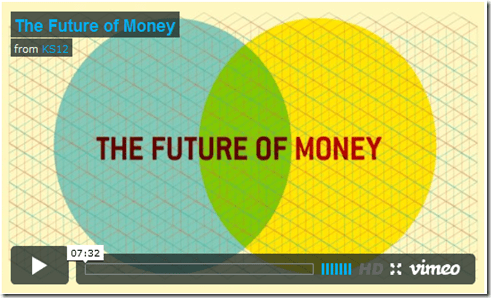
As most of you will remember, SWIFT’s innovation initiative “Innotribe” was one of the Executive Sponsors of Future of Money video production.

image

The Future of Money from KS12 on Vimeo.

The video is in my opinion a milestone. Not only for it’s content and the way it was produced (co-funding), but the whole movement that followed.

It is only now that it became clear to me that the event – in this case Sibos – is not the end-point in a process, but the middle. The post-event discussions and dynamics are at least as important, if not more important. Just check-out for example the animated discussion on Chris Skinner’s blog in November 2010 on “Why banks and socials agree to disagree”.

“Social” – as in Social tools, Social Currencies and Social Capitalism – is in my opinion a very strong force to take into account in our long-term thinking about financial services. It is one of the suggested topics we have in mind for Innotribe at Sibos 2011.

  • I am preparing another blog post “The Long Direction” on this subject and some other deep understreams that are going to change fundamentally how we think about corporations, banks and economy and corporate culture in general.
  • With Innotribe will sponsor a new research on Social Cognition by Stowe Boyd, the most important Social Philosopher and Webthropologist at this moment.

The Future Of Money crew produced post-event the following interesting infographic. I love the sharpness and detail of their analysis. In one view, you see how Creation, Storage and Access of VALUE intersect and how these intersections are each interesting opportunities to be taken up by start-ups or modern capitalists. Some indeed have taken their chances already: see the bottom of the chart with a number of start-ups in this space.

I would like to emphasize that the intersections in the infographic do NOT talk about the Future of MONEY, but about the Future of VALUE. More about this as well in the upcoming “The Long Direction” post. At this stage it’s enough to point you to Umair Hague’s latest book “The New Capitalist Manifesto: Building a Disruptively Better Business” (AmazonAssociates Link).

But I divert… Here is the Future of Money infographic (you can also download a nice PDF version of this by clicking on the graph below).

FOM_infographic_540x764

What an impressive list of start-ups and new contacts ! Indeed,  one of the biggest wins of our Innotribe initiative is the network of people we connect with.

This network is a very powerful force. Here is another example of this network-effect:

Given our work on Future of Money at Sibos, Mike Sigal  – Founder and CEO of Guidewire Group and part of our start-up judge panel at Sibos – introduced me recently to Brian Zisk, founder and organizer of the Future of Money and Technology conference in San-Francisco on 28 Feb 2011.

image

When looking at the conference program and the list of confirmed speakers, I thought “Wow” and two days later I was on a confcall with Brian. Besides being the Executive Producer of this Future of Money & Technology conference, Brian Zisk is a serial entrepreneur and technology industry consultant specializing in digital media, web broadcasting and distribution technologies.

brianzisk

Brian wanted us to speak about Innotribe and Future of Money at Sibos 2010, but unfortunately, given to some other commitments and plans, none of our team could make it to San Francisco on that day.

But we both quickly spotted the possible synergies – wouldn’t it be great to get a subset of these speakers to Sibos into the Innotribe stream for example – and we came to the following pragmatic agreement.

  • I was going to write a blog about his event, and in return my readers could get some discounted tickets for his show. And he would promote our Mumbai and Toronto events later that year. Yes, it can be that dead-easy. No strings attached, pragmatic. Piece of cake if you share the same passion. If you want such a discounted ticket, see the end of this post.
  • But we kept on talking… It suddenly crossed my mind that only 2 weeks later, SWIFT was organizing its SWIFT Operational Forum Americas on 8-9 March 2011 (SOFA). As we had an Innovation slot in the Special Session on day-2 of that event, why not ask Brian to come over and give a wrap-up of his conference ? Btw, watch this space on the Innotribe activities at SOFA: we are working on an impressive list of speakers for this Innovation Slot on 9 March 2011. Will be subject of another post.
  • And why not continue in this direction and see what we can do together for the first stand-alone Innotribe event in Mumbai, later this year on 1-2 June 2011 ? This event – hopefully a first in a long series, will be titled “Unpacked” and this Mumbai edition will focus on Mobile Payments. More on that later as well.
  • And then let the whole movement culminate to a climax at Sibos Toronto from 19-23 Sep 2011 ? I have a first meeting with the Sibos 2011 organizing committee in 2 weeks. Yes, we start early °-)

So how to get a discounted ticket for the Future of Money & Technology conference on 28 Feb 2011 in San-Francisco ?

Enhanced by Zemanta

You don’t have to suffer

Have you also noticed ? How many people you see dragging themselves through the office, through their lives ? They seem to have lost sense of engagement.

5131778313_fb1c97decd_z

It makes me so sad. Such a shame not to enjoy life.

Sad in the sense of empathy, and the feeling there is little I can do about it. Maybe just write a blog and hope that some of my readers will get inspired and re-find that spark that makes yourself worthy.

We all know what caused this feeling of uncompleted, not being worthy, being imperfect.

It’s caused by the disconnect between the soft/hardware of your company and the world outside there.

  • The software is what is between your ears. But  even more so about the fine sensors you have in your whole body. This is not about “mind”, this is about “heart” and “feeling”. Deep feeling.
  • The hardware is about how your company is structured. The hierarchies. The power games. The team dynamics. The motivational models. The focus on the optimization engine with efficiency programs like Lean and SixSigma that such the soul out of great companies. At the end there is only efficiency and no soul.

That’s why people are “dragging” their feet. They just FEEL its not right. And they have lost the energy to fight. The hope to regain their souls.

But of course there is something you, we, all of us can do about it.


We can start a movement


From within. Find the peers who care about people, about life, about soul.

And of course we can ask help. Outside help if needed.

Check out the site of TeamPelgrims:

image

The NEW ECONOMY demands speed, creativity, dynamism, perseverance, courage, knowledge and the ability to work with others on a multicultural basis.

The NEW SOCIETY, prompted by the Human Interest movement, demands respect for individuality, freedom, mobility and quality of life

The last thing a fish can see is the water he is in… It’s very difficult to understand the “cultural mechanisms” in which we live and breath. Leaders should be made aware that they are “trapped” in cultural viruses. We see in too many occasions that cultural viruses are multiplying and contaminating substantial parts of the organization or company. Be accountable to manage and master this non-transparent but very present dimension in the engine of the organization.

It brings me to the topic of team dynamics.

album_large_3884809

I am very lucky to be part of a great team.

But due to the stress of the last months, we seem to regress a bit as a team. Just a little bit. In the sense that we start to grow more individualistic.

Luckily some of us have good “consciousness” antennas, and the team is strong enough to 1) bring this to the table and 2) openly discuss them.

My alarm-bell went off when a new team member joined, and I witnessed myself not 100% caring for the newcomer. I said something like “Throw him in the water, and he will learn to swim”. That’s not fair. Because there are so many new things to learn, so many unwritten conventions, rules, habits, cultures.


The problem was

that I did not have any time left

to give quality time to each other


  • Luckily our team is great, and we are working on great inspirational topics.
  • Luckily the newcomer is outspoken and has the courage to send invitations for feedback.

But I can imagine if you are not in such a team, if your have not this courage, if you have lost some of your closest colleagues is the latest restructuring, and you can’t work with your new boss and the new efficiency rules, that you get dragged.

We should not let this happen. We have to redefine, revive the company culture from within. Push it to the next level. Be viral. Infect he company, as it will not work by a top down approach or rolling out a big program.

Live the spark, the energy, the enthusiasm. And hope – be sure – that it will have a rippling effect – no, an unstoppable wave – within your team, spreading out to other teams, to other departments, to other regions, to other companies, to everybody you meet everyday.

n06_freddy-cerdeira

Enthusiasm is contagious.

And don’t be afraid to ask for help. And to offer help. Probably one of the best ways I can offer help is by transferring authority to others. To hold the bike saddle and then let go. But WITH transfer of authority.

Be not afraid to show vulnerability. Create safe harbors for vulnerability. These harbors become like the womb for the fetus.

iStock_000004280142Small

Your team could be a womb.

And especially:

be nice to yourself


It’s ok to be imperfect.

I am excelling in being imperfect by NOT being nice to myself. It has to do with the word “mildness”. Be “mild” for yourself. For yourself first. I used to say to others: “apply mildness to the 3rd degree”. But it did not come across as authentic. As I was not able to be nice for myself. People, human beings just “feel” when you’re not authentic.

Brené Brown has written a whole book about this.

Brené Brown, Ph.D., LMSW is a research professor at the University of Houston Graduate College of Social Work. She has spent the past ten years studying vulnerability, courage, authenticity, and shame. Brené spent the first five years of her decade-long study focusing on shame and empathy, and is now using that work to explore a concept that she calls Wholeheartedness.

Ordinary Courage

Have a look at the “look” of her website. The illustrations have something “round”. The site creates some feeling of safety. Of roundness. Of “womb”-ness. It has a feminine softness/roundness that we seem to have lost in our company hard- and software.

I was very touched and moved by her TEDxHouston talk of June 2010.

The video is a 20 min summary of her book: The Gifts of Imperfection: Let Go of Who You Think You’re Supposed to Be and Embrace Who You Are

The video has subtitles, so the words have more impact. Without trying to make a transcript of her talk, here are some lines that resonated very strong with me:

  • Shame as the fear of disconnection
  • Don’t try to outsmart vulnerability
  • Do you believe YOU are worthy of love and belonging ?
  • Courage, compassion, connection.. who you are with all your heart
  • The courage to be imperfect
  • Be kind to yourself first
  • Connection as the result of authenticity
  • Let go who you think you should be
  • What makes me vulnerable makes me beautiful
  • Do something where there are no guarantees
  • Research is about control and predict
  • You know who you are when you think you need help
  • See a therapist who sees therapists: no family, no childhood shit, I just need some strategies
  • Vulnerability is the care of shame and fear and your struggle for worthiness
  • But also source and birthplace of joy, creativity, belonging, love
  • Vulnerability and tenderness are important
  • We “numb” the vulnerability. We “numb” everything
  • Blame is a way to discharge pain and discomfort
  • But then there is no conversation, discourse
  • We try to perfect our children, but babies are hardwired for struggle
  • We pretend that what we do does not have an effect on people
  • Let ourselves be seen, deeply seen, vulnerably seen
  • “I am enough”

Suddenly it became clear to me:

The difference is in

the (lack of) indifference

It’s about the capability

to be able

to relate to this


I am playing with the idea of building into Innotribe at Sibos 2011 in Toronto a topic on “New Corporate Culture” or “Towards a new corporate culture of difference”. Where we would invite people like Brené Brown, Vineet Nayar, Andre Pelgrims, Keith Yamashita, Marc Dowds and others ?

Something else than technology. Something else than payments. Something that touches our lives everyday. Probably more hours at work than at home. To feel happy, fulfilled, and worthy should resonate with all of us, no ? Or are you not afraid of becoming one of these “dragging” people ?

Let’s put back the “juice” in our companies.

What do you think ? Sibos ? About new corporate culture ? You really don’t have to suffer alone !

Is it really worth daring to be great?

In September this year, I was attending the BIF-6 Summit, in Providence, RI.

Why only report about it now ? Because they finally released the videos of the stories that were told at this year’s edition of BIF.

Next year’s edition BIF-7 dates will be 21-22 Sep 2011, unfortunately the same week as Sibos 2011 in Toronto. Wonder if we can not do something together with BIF that week at Sibos, if only sharing some of the 2011 speakers? I will give a call to Saul Kaplan. Look at the confirmed dream-list of already confirmed speakers: Danah Boyd, Lisa Gansky, John Hagel, Dan Pink, etc. Wow ! What a start, and still almost a year to go!

From this year’s edition, I suggest you take some time to go through my personal top-5:

Absolute topper, world-class, inspiring, moving, energizing, whatever talk came from Keith Yamashita.

Is it really worth daring to be great?

SY Partners chairman Keith Yamashita dares us all in this moving video story crafted as a metaphor from the Charles and Ray Eames video “Powers of Ten.” It’s a remarkable tale that reminds us that the future is here for us to create and it starts one collaborative duo at a time.

It’s worth every of it’s 25 minutes, and it’s a fantastic story about how “twins” in teams are the fuel of great teams.

  • It’s about doing great things like landing the Eagle in the moon, and “turning a bunch of folks blue” back home
  • It’s about having the house full of diagrams
  • It’s about when you start to believe that anything is possible
  • It’s about kids being born with greatness
  • It’s about being fully aware and fully alive
  • Trusting so deeply you can create together remarkable things
  • Duo-ships are about great invitations
  • Going actively after the status quo
  • About systems thinking + creativity
  • Building different type of organizations
  • That there is a better optimum than just the first choice
  • About having deep conversations on how to get smarter
  • To tackle things at a societal level
  • About finite/infinite resource and infinite/no possibility
  • About “then” (pre-crash), and “tomorrow”: finite resource + infinite possibility


About saying

“I trust you implicitly

to do a brilliant job,

and come back

with what  you learned”


About

Ending the tyranny

of false trade-offs


Who is Keith Yamashita ? All the quoted text below comes straight from the BIF site, but I have added my usual color and typographic emphasis:


When Keith Yamashita looks at the world, he sees complexity—a beautiful and rich one, if we can visualize our place within it.

As chairman of SYPartners , a consultancy that has worked with leaders at IBM, Apple, Facebook, Target, Blackstone, Target Financial Services, Bloomberg, Starbucks and The Coca-Cola Company, Yamashita is a master at helping people define themselves against the backdrop of a profoundly shifting business landscape. The task requires tremendous empathy, he says, a singular understanding of what clients need and want.

“The biggest fallacy of business is that it’s only rational,” he says. “All business is personal and all business is human.” Yamashita is intensely curious about what makes people tick. Who are they? What are their deep aspirations? What do they need to be successful? What’s holding them back?


Ambition

Love

Fear

The human component of consulting goes deep. “We hope for people what they wish for themselves,” Yamashita says. “I’d like to think that when we show up in a room, we authentically care about the people in that room and that they sense that.”

Still, it is not enough to simply identify a dream, Yamashita tells his clients. The only way to stand out is to be fully aware of how you fit into a wider spectrum, to figure out what unique part you play, given the circumstances around you.

“Because we live in a world that is more interconnected than it’s ever been, we are particularly susceptible to the dynamics at play,” Yamashita says. “People feel overwhelmed—it’s a natural outcome of the world we live in. There are more systems problems that require creativity than there are creative people in the world.”

To minimize the potential fallout from system shifts and to maximize the positive impact we can have on the world, Yamashita urges a return to authenticity. He says it’s a question of unlearning bad habits and relearning what comes naturally:

I do believe

that people enter this world

with a certain amount of

greatness

So many people,

through the pressures

of society

or the way we’re educated,

unlearn that greatness.

They fritter it away.

They start limiting themselves.

It’s really about

reclaiming that greatness

people learning about

how to be just themselves,

fully alive and aware.”


The positive exponential effect of all this self-awareness arises when individuals begin working together. Yamashita encourages his clients to build “powerful duo relationships” that require one of the trickiest human emotions: trust. “The duo is the smallest atomic unit where trust is built,” he points out. “If there’s only two people, you can’t shovel blame.”

With competent, self-aware individuals who relate to others on the basis of that trust, an organization has the potential to expand by the power of ten, just as in the Eames film. Zooming out, Yamashita sees a universe where companies design their own destinies by connecting purposefully to a wider array of players in order to work on a tougher set of problems.

Other remarkable stories came from:

  • John Hagel, with an even more personal version of his Sibos2010 talk on “The Power of Pull” and the role of passion in high-performance organizations,
  • Carmen Medina, on how one can innovate in a conservative castle like the CIA,
  • Jigar Shah, talking about scale in our Global Warming initiatives, and why everybody buying a Prius is really a drop in the ocean.
  • Kim Scheinberg (no video available yet), who also was interviewed in the FutureofMoney video. She’s an ex-gambler and now a new wave angel investor,
  • Gerard van Grinsven, (no video available yet), a former Ritz-Carlton executive, who became CEO of a hospital where it is all about health-care and not sick-care.

All these speakers indeed confirm, inspire and motivate it is really worth daring to be great.

That it is worth everyday to re-question yourself, and there to re-invent yourself to keep the greatness-bar high, very high.


And greatness is

not good enough anymore.


A program is not good enough anymore. What we need is an agenda.

“For a better world” for example.


Idealistic? Maybe.


Ambitious? Sure.


It is so easy to copy-cat last year’s success formula. But it does not satisfy myself. I believe you – readers, followers, innotribers – you expect more. You want us to surprise you, year after year.

I hope these principles will also guide us when articulating our Innotribe 2011 initiatives.

Innovation in/out the Castle ?

As member of the Innovation Team of our company, I try to stay up-to-date on innovation thinking and therefore I try to read +/- one innovation book per month. I also read other stuff, and if you’re interested in my readings, please check-out my GoodReads Shelf. I found that sharing the books one reads is a good way for connecting with people. Interested to hearing what you read.

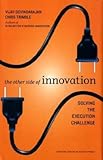
I just finished a fantastic new book on innovation. It’s called The Other Side of Innovation: Solving the Execution Challenge (Harvard Business Review) by by Vijay Govindarajan and Chris Trimble.


As the title suggests, this book goes way beyond the idea-generation phase of your innovation efforts. It’s about making ideas happen, especially if you are an Innovation Leader responsible for innovation WITHIN an existing organization.

Many models have been tried, but most stay stuck in idea generation:

The innovation = ideas + motivation formula can generate thousands of small initiatives, but does not support projects requiring resources beyond a few people and their spare time.

The innovation = ideas + process model can efficiently crank out innovation after innovation, as long as each initiative is mostly a repeat of prior efforts

Castle[3]

The books goes in great detail into the causes for tension between the “castle” (in the book referred to as the Performance Engine) and the Innovation Team.

Business organizations are not built for innovation; they are built for efficiency.

The authors also offer many solutions to solve this tension. The basic premise is that the Castle is organized for efficiency: to create as many as possible predictable processed and make them as efficient as possible. That’s where initiatives like Lean and Six Sigma found their origins.

An innovation initiative is any project that is new to you and has an uncertain outcome

Indeed, every innovation project is an experiment, always based on not-so-precise assumptions, and with continuous learning in order to change those assumptions in more precise decision foundations.

By definition, innovation is neither repeatable nor predictable. It is exactly the opposite—nonroutine and uncertain. An innovation initiative, even a major one, is just an experiment.

The castle loves planning (basically building upon the planning models of previous years), and comparing past actuals vs. plans. Innovation is fundamentally different, as it is about comparing current assumptions with future potential. The comparison also happens much more frequently in a rapid learning context. It’s exactly what the Castle hates.

This tension often leads to frustration with the innovation leaders. At first sight, the job of an innovation leader seems like a dream job. It is not. The aspiring leader has been set up to fail. He just doesn’t recognize it yet. In frustration, he goes a step further, fashioning himself a rebel and a subversive. He fearlessly, or maybe even recklessly, flaunts authority. One person against “the system” is an extraordinarily bad bet. Why is it that innovation leaders so often feel that their biggest enemy is not the competition but their own company? There is a simple answer. Organizations are not designed for innovation. Quite the contrary, they are designed for ongoing operations. Innovation and ongoing operations are always and inevitably in conflict.

But the break-all-of-the-rule

mantra

while understandable

and widely shared

is poison

First, innovation leaders need the Performance Engine. Most obviously, it is profits from the Performance Engine that pay for innovation. Innovation leaders, take note: antagonizing the Performance Engine is a really bad idea.

This is nothing more

than youthful fantasy

at work

Another eye-opener for me was that the innovation team must be distinct from the Performance Engine, but that the innovation team must be just as disciplined as the Performance Engine.

The authors also propose that the Innovation Leader is NOT part of the execution team. The execution of each innovation project is trusted to a “Dedicated Team” and “Shared Staff”. The shared staff comes from the Castle. And this is done for EACH individual innovation project !

The split of work between the two teams is based on the work relationships required for the innovation project: these work relationships have three essential dimensions—depth, power balance, and operating rhythm.

For the Dedicated Team, the authors have a very clear recommendation:


hire outsiders !


There is no more powerful antidote to organizational memory than outside hires. If you want to change the culture, change the people.

At least 1/4 of your Dedicated Team should be made of people from outside your organization. If not, you easily fall into the trap of the The Risk of Organizational Memory.

Experience is usually an asset for advancement within the Performance Engine, but it can be a liability for a Dedicated Team. Innovation initiatives are, by nature, deliberate departures from the past. The lessons of experience are therefore less relevant.

If everyone on the Dedicated Team has been shaped by the same lessons learned from the same victories and defeats inside the Performance Engine, then the collective instinct will be even harder to escape.

A couple of words as well on the role of the Executive Sponsor – correction – the Supervising Executive:

sponsor

By the way, we have deliberately chosen the term supervising executive instead of the more commonly used term sponsor. We dislike sponsor because it makes the job sound easy or even trivial. A sponsor just provides occasional support. But the supervising executive has a critical job. Few innovation initiatives succeed without a deeply engaged one.

The supervising executive should not only be there when the yearly budget of the innovation team is approved. He should be deeply involved throughout the year to coach the team and help them overcome the tensions with the castle.

If not innovation initiatives are looked at as “second class”. In the overall picture the innovation budgets are a fraction of the budgets for technology renewal of the castle for example.


The importance of innovation

should not be based

on the size of the budget

but on the size of it’s potential


If not innovation will end up as 5 lines in your company strategy papers, CEO reports and Annual Reports. The innovation leader should NOT content himself with just a mention of the word innovation in these reports.

At the end of the book, the authors really make you re-check your assumptions by listing their


10 myths of innovation:

myth

  • Myth 1: Innovation Is All About Ideas
  • Myth 2: The Great Leader Never Fails
  • Myth 3: Effective Innovation Leaders Are Subversives Fighting the System
  • Myth 4: Everyone Can Be an Innovator
  • Myth 5: Innovation Happens Organically
  • Myth 6: Innovation Can Be Embedded Inside an Established Organization
  • Myth 7: Catalyzing Innovation Requires Wholesale Organizational Change
  • Myth 8: Innovation Can Happen Only in Skunk Works
  • Myth 9: Innovation Is Unmanageable Chaos
  • Myth 10: Only Start-ups Can Innovate

The book also makes reference to some outdated books and consultants on innovation, that unfortunately are still used as the oracles in defining today’s modern innovation initiatives.

Chris Zook has recommended that companies take only small steps outside their existing business. Their conclusions, however, are based on studies of what organizations have accomplished in the past, not what organizations might deliver in the future. Their research is akin to someone studying all the aircraft built through the mid-1940s, collecting voluminous statistical data, and claiming, on the basis of all available evidence, that traveling faster than the speed of sound is impossible.

This is a great book on innovation. Doing away with a lot of the Bull Shiitake of Innovation.

Read it. Internalize it. Apply it.


Enhanced by Zemanta

Student Summer Job: making meaning and sense

A couple of weeks ago, I was taking a short break and chatting with a new young guy I never had seen before at the company.

We had some chit-chat discussions about the weather and other small talk, until i asked him in what group he was working. "I am a summer student and i am working in the A-department”.

"And what are you doing there ?", I asked.

Student: "I am filling spreadsheets. They document the discussions of the daily whiteboard discussions, and that is needed to report back to the different management layers in the company."

Me: "And that keeps you busy for the whole day ?" I replied.

S: "Yep, sort of"

"And do you think that’s useful ?"

S: "No, not at all, but it is just a summer student job for a month, but

it pays well

and with the money I will be able to afford a holiday trip to Australia."

A couple of observations here:

  • how many times do you/we do things we profoundly think are useless, but still do them as "it pays well" and we are not prepared to go through the pain of challenging THAT status-quo ?
  • how many of these useless things have anything to do with adding value to the customer, and have all to do with internal policies ?
  • when is the last time you did something that really made a positive difference to your customer ?

We can have all sorts of theoretical debates about company culture, but as long as we don’t start focusing exclusively on the value zone – there where value is created at the interfaces of our company – all these efforts will only continue to add to the numerous sets of policies and initiatives.

These keep on existing and having a life of their own, even long after the crowdsourced intelligence of your company has acknowledged they have been bypassed by the events and only are alive because some senior manager identified him/herself so much with the initiative that giving-in would cause irreparable damage to his/her ego.

When are we going to stop and refuse doing things that don’t make sense anymore, only because the circumstances when these practices were created have changed dramatically ? Or even worse, have proven to have has counterproductive effect ?

Keep on searching for meaning and sense in everything you do. Refuse to do useless tasks.

People and Culture: too wooly ?

Here is your deejay with the brainwave helmet again: look at the wide open eyes of Sam from Sam The Sham and the Pharaos with their 60’ies monster hit “Wooly Bully”. His eyes wide open. Uno, Duo, Très, Quatro ! Let’s have some fun here. And be a bit crazy !

image

I recently got somewhat involved in the People & Culture thinking of our company. Already at our first attempt during our fantastic off-site in April, we identified excitement as one of the components that need to be part of our culture.

We should all re-read that blog post titled “Get a Life and Get Alive”, as we seem to loose lots of the sharpness of our ideas when we start putting them through committees, and the whole thing seems to get watered down.

So, for 4 months+, we kept ongoing and had a good solid understream of ideas, depicted by different people in different ways, depending on their left or right brain orientations.

After a couple of weeks, this was my best effort:

image


It was a combination of keeping the best, improving drastically the mediocre, and getting rid of the worst. The most important in this slide were the


“quality lenses”


They reflect the deeper purpose that guides our transformation process and choices, and these lenses can be used as a compass to be sure we still navigate in the right direction.

The direction was an ambitious one, a radical one.

But most executives do not like the words “radical” or “disruptive”.

  • Does that mean we should adapt our packaging, our wording or worse our meaning and purpose to please our audience ?
  • What happens with ambition when filtered through endless reviews ?

By the end of last week, we had our seventh or so iteration of the slide deck to be presented to the executive committee.

I though we had quite an “acceptable” outcome in a culture of consensus.

As I write this, I notice how polluted I have become myself by the consensus-virus. In the end, one compromises so much that all you end up with is a grey mouse. 

Herman Van Rompuy arrives at the EU summit in Brussels on Thursday evening.   Photo AP

So, to hell with outcomes that are “acceptable”. We don’t want grey mouse. They don’t inspire.

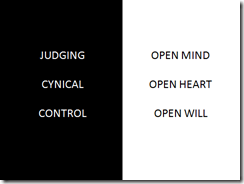
Nevertheless, I was surprised that version seven still included our famous words “Open Mind, Open Heart, Open Will”. You had to search for them (see the big fat arrow above), but they were there.

Too optimistic though.

Throughout the week, folks kept on saying this was “too wooly”

So we tried to put different words. In version eight, we ended up with some things like “Intrinsically motivated people” and “Co-creation with Customers”, etc. Not bad, but “acceptable” in my opinion.

What made me write this post was the following comment on exactly this part of that version:

This part is a bit too vague

and b-school jargonistic

for my taste

Can we turn that into our

company terminology ?

(the other parts already were in company-speak)


My answer: NO, absolutely NO !


As I wrote in back in April, the real root cause (to use some Lean terminology) was about the openness of our minds, hearts, and minds.

image

Some indeed call this “wooly” or “b-school”. I don’t know what is meant here.

There seems to be some negative connotation here:

  • “b-school” could mean several things. In the most optimistic case is stands for Business School, and then the wording may be perceived as too academic. In the worst case, it means b-grade school or even worst kindergarten or naivety. But I believe that many of our corporations would thrive well if they would resource themselves with some naivety of better

freshness and purity

like a young child

discover with eyes wide open

and without prejudices

  • “wooly” has something to do with a certain form of “softness”. I sense all sorts of touch points with New-Agism, or the Hippies 2.0 movementExecutives seem to have e a natural aversion to topics related to softness, philosophy, emotion, feeling, sensing, or anything that has to do with mind, heart, and will. It is probably exactly this that needs to change in many company cultures if we want to make our companies more “human”. Or as Jeff Bezos so eloquently said: “It’s harder to be kind than to be clever” Read every word and sentence of his Princeton speech here. Listen to the emotion in his voice. You sense here stands a man who embodies and believes what he says. You want to follow him. Maybe he is Hippies 2.0 ? Maybe. But he’s inspiring.

Leaders will be followed, not because they have dictated so or by hierarchical power, but because they are authentic in everything they do, because they are inspirational, because they are charismatic, because they are truly “at service” and not “in command”.

The new game is about new hierarchies, not based on ranks and power but based on true service value.


The hierarchical PYRAMID changes

into a collaboration and service SPHERE

where there is no upper or lower level

where the value comes

from the strong interdependency and

100% service mind to make the OTHER win

What we need is a culture based on a fundamental shift from Old Game thinking to New Game thinking. We will not succeed if we stay “acceptable”.

Our ambition level in this should be nothing but an extreme makeover, respecting our company’s financial, operational and reputational integrity.

You can use whatever words for it, but the messages and its wording must be fresh, inspiring, ambitious, rejuvenating. Not only on its messaging surface but especially in its deep culture core.

I don’t believe that you can capture your “culture” in one word. Culture is a complex thing. It’s a combination of tacit, implicit and explicit values, attitudes, and knowledge. Is combines the good positive heritage of the past with the vibrant youth-ness of the future. So, here are some words that “capture” that culture.

image


That’s also why Talent and Culture are so closely interwoven. Because culture is the result of the people you have on board. If you want to change the culture, there are basically two things you can do:

  • Try to change the people you have on board. Although this is very difficult, I believe we have enough cultural creatives to at least inspire more than 50% of the company to change gears. For the others, we’ll have to wait till the Hippie 1.0 generation is retired and made room for the new generation.
  • Bring on board new young people with fresh insights. We should be extremely aggressive about this. Hire “en-masse” young people. If possible younger than 20 years, as even some 25+ “don’t get it”

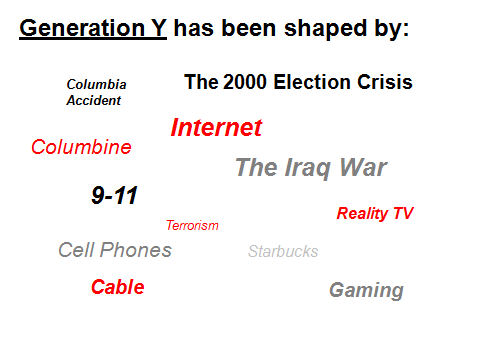
Both generations where shaped by different time and historical contexts:

image

image

With courtesy: NASA Generation-Y Perspectives. Full slidedeck here.

Of course, when implementing such aggressive plans, we need to make sure that these programs do not become the exclusivity labs for personal and professional development for the young only, and that everybody gets her chance to fully realize their potential, so that they don’t have to ask us


“and where do I play ?”


Like many things, I think you recognize an inspiring culture when you see it. When you see the people of that culture. They have sparkles in their eyes. When you interact with them. They go the extra mile.

We need word and spirit that reflects:

  • Excitement
  • Intrinsically motivated people, as mean by Daniel Pink in “Drive”
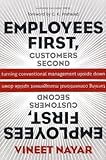
  • Extreme Management Make-Over and Employees First, as meant and intended by Vineet Nayar in his latest book, considered now as THE reference for modern HR

I was lucky to see Vineet deliver his message in person to the audience at Techonomy last week. The story goes like this:

  • The goal of our company is to deliver value to our customers
  • Where is that value created ? At the interfaces of our company.
  • Who is at those interfaces ? Our employees
  • Therefore the whole company should be organized to be “at the service” of the employees.

This is about a management extreme make-over.

  • From managers giving instructions to employees and measuring their efficiency
  • To managers at the service of employees

When I spoke to HR, my contact said: “Oh, that is what is called Service Management, I know about that”. When I asked whether he already proposed this as a management culture to the executives, he said


“Oh no !

That would be too radical

that’s a revolution !”


But I am afraid many of our corporations need nothing less than such a revolution, a fundamental make-over.

In the end

Culture = Company = People


People with a Life and Alive. Not wooly sheep following the dress code and complacent in being “acceptable”. People who share the “wooliness” of “kindness” vs. “cleverness”.

Our culture has to be provoking and inspiring. You should be able to rally your troops behind it. As soon as it becomes “acceptable” that won’t work.

In the song Sam sings about a “wooly saw”. What we need now is a very sharp saw.

To give the sharpness back to the Wooly Bully !

Techonomy: a new philosophy of progress

image

Last week, I had the privilege to attend the first edition of Techonomy, a fantastic new conference blurring technology and economy with an optimistic balance that technology in its broadest sense (not only IT, but also gnome sequencing, bio-fuels, big history, etc) can be the driving force for a better world.

First enjoy the announcing video below.

The conference was bringing together 3/4 of Silicon Valley’s leadership, including Eric Schmidt, Jeff Bezos, Bill Joy, Bill Gates, Steward Brand, Kevin Kelly, John Hagel, Deborah Hopkins (Chairman of Venture Capital Initiatives and Chief Innovation Officer Citi), Nicolas Negroponte, Sean Parker, Padmassree Warrior CTO Cisco), Jeff Weiner (CEO LinkedIn), and the list goes on, and only a couple of non-US leaders such as Nobuyuki Idea (Founder of CEO of Quantum Leaps Corporation, working on innovation, and previous CEO of Sony Corporation), Nellie Kroes (European Commissioner for Digital Agenda), Vineet Nayar (CEO HCL Technologies, India), and Ory Okolloh (Founder/Executive Director Ushahidi, South Africa).

How to describe Techonomy conference ? I would say “a super-TED with a technology focus and with an agenda”.

The agenda is “a new philosophy for progress”.

It’s a movement

Somebody asked “a movement against which enemy, against which barriers ?”.

I believe it is a movement FOR something.

For a better world. Finding techonomic solutions to tackle the global climate challenges, feeding the world, a better health for everybody, a new value kit for the current and next generation, not based on greed but on the concepts of creative capitalism as formulated some years ago by Bill Gates in the Bill and Melinda Gates Foudation.

In that sense, it should not surprise the regular reader of this blog how much this resonated with myself. Not only the personal inspiration, but especially how we with on organization like SWIFT can adopt and promote the techonomist values and objectives.

I also came across some leaders that could be subject of SWIFT’s CSR initiatives. Take Bill Drayton, Leadership Group Member Chair and CEO of Ashoka, the global association of the world’s leading social entrepreneurs, men and women with system changing solutions for the world’s most urgent social problems, encouraging everybody to be a changemaker.

It’s impossible to describe the intensity of the content and contacts of these 3 Techonomy days.

Some highlights:

  • Evolution is incremental. Revolution is disruptive movement
  • Collective learning is what makes us human
  • The physical economy is sensoring a second economy of conversational plumbing
  • As long as we draw boundaries (for ex US vs. China, we against them, etc) we will not be able to solve the world’s problems.
  • The economy is NOT recovering, consumer is running out of money
  • Governments do not understand globalisation, businesses do.
  • Employees first, customers second.
  • Promote younger people must faster
  • Building and tapping from tacit knowledge will become core skill
  • Markets are like gardens: they need tending
  • Innovation happens outside the regulated markets
  • Banks make money on spread and opacity. They are by definition against transparency
  • Currency is “the instrument of trust in a transaction”. Unfortunately the debate focused solely on the payment transaction and money as the trust element.
  • Health agenda: from illness fixing to personal health prediction and coaching
  • Some technomists are skeptical optimists that do not take progress for granted. One has to make progress. It does not happen.
  • Recalibrating our assumption that form our perceptions. For ex we learned that world population will NOT grow indefinitely and probably max around 9 billion, and then go down.
  • Innovation at Cisco: Looking at 30 ! adjacencies as a “portfolio” like a Venture Capitalist does.
  • Computer Associates CTO: “a lot of leading edge innovation comes from financial services”
  • Innovation requires a culture of taking risk and celebrating failure
  • Change happens when the DESIRE not to change is greater than the desire to change. The power struggle to make this balance change is based on societal needs.
  • Innovation requires 1) Money, 2) Desire, 3) Need
  • There is no value in the idea, there is value in its commercialization
  • We have a moral obligation of bringing less developed regions up.
  • Cities are “intensities” that have a critical mass of people
  • In a city-“OS”, no one single company can dominate. It has to be open source by definition.
  • Generation-Y or whatever: you need the backing of 18 year olds. That’s “youth”. 25 years+ does not quite get it.
  • Companies scale like biology, and in the end they die. Cities scale like networks, and do not die. The city is the framework model for the future.
  • In the developed world, a disruptive innovation is something that can create the biggest disruption. In the developing world, innovation is a technology that is simple, reliable, and that can function as an integrated unit.
  • Success in mobile in Afghanistan is because there was no legacy. They are willing to take the risk to jump to the next curve.
  • The future is for (techonomist) entrepreneurs that are willing to work together.

The conference is so good. It cries for a European and an Asian chapter. Any European Leader should not hesitate a second to be associated with and sponsor it.

I was dreaming of hosting a European chapter of Techonomy at the fantastic SWIFT Headquarters south of Brussels.

El Jefe, do you hear me ?

You have to be somebody before you can share yourself

It’s holiday time, and I have reduced significantly my blogging, reading RSS feeds, tweeting, mailing, etc

Time for hanging around, some biking, some good food, and… a good book. If you want to follow what I am reading, check-out my page on Goodreads.

For me, a good book is one that leaves you puzzled, that makes you think,


that re-calibrates your perspective,


that is a pleasant read, that has depth.

“You are not a gadget” by Jaron Larnier is such a book. I discovered it thanks to a tweet of my friend Paul, who reacted to one of my enthusiastic Singularity tweets. The title of this blog post “You have to be somebody before you can share yourself” is very early in the book, and captures its essence.

Jaron Larnier was listed on The 2010 TIME 100 in the Thinkers category. His Wikipedia entry is here.

It’s a great read if you are in your over-enthusiasm mode about  computationalism, the noosphere, the Singularity, web 2.0, the long tail, the hive mind, the global brain, crowdsourcing, collective intelligence and all the other buzzwords and trends and all the rest. It gives you some solid pushback and sound criticism.

I am not going to do a book review, but my experience of the book was like there were 3 stories interwoven:

  • How technology is limiting our potential and who we are on-line. This of course resonated a lot with my work on Digital Identity.
  • Our communication limitations. He has a great chapter on how cephalopods have the great ability to “morph” and how one could use “visual” communication and another dimension of communication, other than language. And how humans in virtual reality environments quickly adapt to a body with tentacles. Intriguing !
  • The notion of “neoteny”: humans are born as fetuses in air, and our brain is being developed during childhood. Lanier compares this to a newborn horse that can stand on its own and already possesses almost all the skills of an adult horse. Humans – in modern civilizations – have an artificial, protected space called “the classroom, the extended womb”.

Neoteny opens a window to the world before our brains can be developed under the sole influence of instinct.

A similar concept related to neoteny – “generativity” – comes back in another great read Firms of Endearment: How World-class Companies Profit from Passion and Purpose.


This is a book about

the pragmatic role of

love in business


It’s about the epochal change into the Age of Transcendence. The dictionary defines transcendence as a "state of excelling or surpassing or going beyond usual limits."


The second event is the aging of the population. For the first time in history, people 40 and older are the adult majority. This is driving deep systemic changes in the moral foundations of culture. Higher levels of psychological maturity mean greater influence on society of what Erik Erikson called "generativity"—the disposition of older people to help incoming generations prepare for their time of stewardship of the common good

The Firms of Endearment book in essence talks about a new form of capitalism that is not only focused on profit and shareholders’ value, but on value creation for all parties in a company’s stakeholders’ ecosystem.

Joran also has an opinion on capitalism when he says:

Visiting the offices of financial cloud engines (like high-tech hedge funds) feels like visiting the Googleplex. There are software engineers all around, but few of the sorts of topical experts and analysts who usually populate investment houses. These pioneers have brought capitalism into a new phase, and I don’t think it’s working… capitalism in a digital future will require a general acceptance of a social contract

He is also calling for “so-called AI techniques to create formal versions of certain complicated or innovative contracts that define financial instruments” and that setting standards for these could be facilitated by “a cooperative international body” that

would probably have specific requirements for the formal representation, but any individual application making use of it could be created by a government, a nongovernmental organization, an individual, a school, or a for-profit company. The formal transaction-representation format would be nonproprietary, but there would be a huge market for proprietary tools that make it useful. These tools would quickly become part of the standard practice of finance

What a great potential for my employer SWIFT ! We are indeed a full-blown cooperative international organization with our roots in financial services.

In essence, Jaron Laniers’ manifesto and rant is about “The deep meaning of personhood is being reduced by illusions of bits”.

That should make us reflect deeply on how we want to engage as human beings in an on-line world, how we define digital identity in the relative and the absolute, and be very vigilant that we don’t loose our potential in our technology enthusiasm.

For me, the prospect of an entirely different notion of communication is more thrilling than a construction like the Singularity. Any gadget, even a big one like the Singularity, gets boring after a while. But a deepening of meaning is the most intense potential kind of adventure available to us

Finally, I also found some consolation to deal with my 3/4 Life Crisis. The following quote always helps:

If you are young and childless, you can run around in a van to gigs, and you can promote those gigs online. You will make barely any money, but you can crash on couches and dine with fans you meet through the web. This is a good era for that kind of musical adventure. If I were in my twenties I would be doing it. But it is a youthiness career. Very few people can raise kids with that lifestyle. It’s treacherous in the long run, as youth fades.

My blog is my “adult” way of doing gigs online.