The age of the unthinkable

Some weeks ago, i had the opportunity to listen to a fantastic speech by Joshua Cooper Ramo, writer of the book “The Age of the Unthinkable: why the new world disorder constantly surprises us and what we can do about it”.

This is the sort of guy that when he takes the stage, you immediately know you’re in for something special.

Some personal notes on this great speech:

Our world has now more actors, more groupings. The unpredictability is part of the system. It will be a given part of our future. He talks about:

SHAPESHIFT

Our world offers more options. We have a spectrum choice between no options –> limited options –> unlimited options. You can’t predict what people are going to do with these unlimited options.

YOU CAN’T PREDICT

Our world is more networked. It also means it is easier to share and spread risk

So far the analysis. How can we manage this unpredictability ?

One eye-opener was a visual showing how differently western and eastern people look at a picture: western people mainly look at the object, eastern people mainly at the surrounding environment of that object. So, understanding of unpredictability has a lot to do with understanding the environment.

It will also require resilience. But not resilience as we know it from messaging networks like SWIFT. More a resilience deeply integrated in the ecosystem, a bit like Hezbollah integrates resilience in every little piece of its organization.

Periods of change are not the exception but the rule.

You have to surf the wave, not try to predict the wave, but

look at how the wave can help you.

It will be ever easier to disrupt. The question is how to empower people to disrupt for the good. This is really about innovation driven by a set of values. Oh boy, how close is all this to the ideas of our Think Tank on Long Term Future.

Innovation in big companies can NOT take the lead. They have NOT been instrumental in the shifts from magazines to online, from Microsoft desktops to web2.0 cloud, from Financial Institutions to… un-banked payment and financial solutions.

The speech was delivered as part of an Oracle conference. So, i found it a bit “cheap” to say that Oracle was innovative and Microsoft not. The rationale being that Oracle “buys and integrates” and Microsoft buys “tons” of innovation but does nothing with it, does not integrate. Was a bit too close to the Oracle conference message of acquire and integrate.

He then went further on the theme of personal responsibility (i am free to smoke) and the balance with a certain set of basic rights (for ex healthcare). And that in the USA, everything is about rights (and maintaining that state) not about personal responsibility and that that has to change.

About maintaining states: Twitter is all about maintaining state in a constant changing environment.

And that there is hope.

And that

FEAR is an easy commodity to sell when

people are confused

during disruptive change. And that in these circumstances simple answers are usually dangerous answers.

Or the closing topic: never invest in people older than 25 years, as they are not used to live in constant change.

The speech was great. The book reads “like a train”.


Ted, Bill, Steve, Larry: The way it is

From the Andy Kessler blog of 20 July 2009 with my choice of extracts and highlights…

The 70s were a smog-filled haze. Upward mobility was a pipedream. Stock markets stagnated and all the moon-walking Space Age dreams of the 60s were shattered with layoffs and plant closings and Rust Belts and urban unrest.

You were told to do well in school and maybe you could get an entry level job at a big company and wear a white short-sleeved shirt and work your way up over twenty or so years, so you could buy that little house in the suburbs and squeeze out 2.3 kids and afford a station wagon and … well, that’s the way it is.

Someone else has all the money and you don’t.

That’s the way it is.

Unknown forces control your life.

That’s the way it is.

Governments are corrupt.

That’s the way it is.

Society is divided into classes, and you’re stuck in yours.

That’s the way it is.

Instead, what it took was a few little microchips (Ted Hoff at Intel), and a couple of funky pieces of code (Bill Gates at Microsoft) and a few smart people (Steve Jobs at Apple and Larry Ellison at Oracle and thousands of others), who weren’t content working for The Man. Each of them dislodged "the way it is" and got a few people asking "why is it this way?" and declaring "think different" and "eat my dust," and

bang,

the status quo crumbled.

Hoff1Bill_gates_011  Jobs_and_wozniak_1975-7564451 Larry_Ellison

You could create your own future. Power shifted out of the hands of conglomerates like Gulf & Western and Engulf and Devour and away from centralized bureaucrats running faceless government operations. Instead, power ended up in your hands, my hands, all of our hands. To do what we wanted.

To change the world, for the better, increase the size of the pie, bring the rest of the world onto our wealth grid. And not by building huts in Costa Rica but by taking down those obstructing progress, those leeching off the rest of us, holding us back, milking the present for their own benefit rather than standing aside and letting wealth-creating innovation increase everyone’s living standard.

Those "that’s the way it is" types needed to move over.

But they didn’t move on their own, so we either had to wait for them to die or just destroy them. Seek and Destroy. Music companies. Travel agents. Insurance brokers. And we’re not done–the hard work has just started.

It took me a long time, well into my life, to get Cronkite’s words out of my head and realize that not only is anything possible (thank you Kevin Garnett), but that I was the one that had to make it happen. There were no gifts, no trailblazers to follow.

We all have to invent the future

by destroying the past.

Sadly, the old mentality is back.

Citibank is too big to fail.

That’s the way it is.

The government needs to bail out the automakers.

That’s the way it is.

Taxes are going up.

That’s the way it is.

Carbon dioxide will boil the oceans so we need to live in cities and walk to work.

That’s the way it is.

Elites like Robert Reich and Paul Krugman and Al Gore will tell you what you’ll be paid, how much health care you’ll get, how much risk you can take, what kind of car you can drive, how much water you can use to flush your toilet, because …

That’s The Way It Is.


It does NOT have to be that way.


Inspire people to dream,

and to realize their dreams.

15 years and counting to 51

Not that recent anymore: Morgan Stanley Research Europe published mid July 2009 a report on Media & Internet “How Teenagers Consume Media”.

image

What’s cool is they asked a 15 year old summer work intern, Matthew Robson, to describe how he and his friends consume media.

There is a lot to do about this report, as Twitter co-founder Stone does not care that teens are NOT interested in Twitter.

biz-stone

Also the New-York Times jumped on the bandwagon and said:

As the Web grows up, so do its users, and for many analysts, Twitter’s success represents a new model for Internet success. The notion that children are essential to a new technology’s success has proved to be largely a myth.

Adults have driven the growth of many perennially popular Web services. YouTube attracted young adults and then senior citizens before teenagers piled on. Blogger’s early user base was adults and LinkedIn has built a successful social network with professionals as its target.

That’s interesting, especially in the context of the Think Tank for Long Term Future we are putting together – starting up later this year from Flanders: in that Think Tank we want to include upfront young people between 15-25 years old today, who will be our future leaders in 20 years from now (2030 timeframe).

So what is all the fuss about in the Morgan Stanley report  ? I took the pain to download the report and read it myself to have an unbiased opinion and share it with you.

I found the report via the site of the Financial Times. Download here.

First, it is important to understand that the report does not have any representation or statistical accuracy, as it is just the opinion of one 15 year old. It is also very UK centric referring to BBC services and Virgin Media as provider.

The paragraph where all the fuss is about is the following:

Most teenagers are heavily active on a combination of social networking sites. Facebook is the most common, with nearly everyone with an internet connection registered and visiting >4 times a week. Facebook is popular as one can interact with friends on a wide scale. On the other hand, teenagers do not use twitter. Most have signed up to the service, but then just leave it as they release that they are not going to update it (mostly because texting twitter uses up credit, and they would rather text friends with that credit). In addition, they realise that no one is viewing their profile, so their ‘tweets’ are pointless.

No wonder that Stone does not care very much. A lot to do about nothing.

The report contained however some other interesting elements. I am just picking a couple that surprised myself. I don’t have a 15 year old at home. My daughter is 3 1/2, so i guess all this is coming my way big time :-). Also, when reading those statements, i feel 15 again as sharing the same feelings. But for my age you have to invert the digits :-/

My personal top-10:

  1. Fast.FM: can choose the songs they want instead of listening to what the radio presenter/DJ chooses
  2. Online TV allows them to watch shows when they want
  3. Don’t read newspapers
  4. Teenagers never use real directories (hard copy catalogues such as yellow pages).
  5. Most teenagers enjoy and support viral marketing, as often it creates humorous and interesting content.
  6. Teenagers see adverts on websites (pop ups, banner ads) as extremely annoying and pointless, as they have never paid any attention to them and they are portrayed in such a negative light that no one follows them.
  7. Music: They are very reluctant to pay for it (most never having bought
    a CD) and a large majority (8/10) downloading it illegally from file sharing sites.
  8. 99% of teenagers have a mobile phone and most are quite capable phones
  9. Nearly all teenagers’ computers have Microsoft office installed, as it
    allows them to do school work at home. Most (9/10) computers owned by teenagers are PCs, because they are much cheaper than Macs and school computers run Windows, so if a Mac is used at home compatibility issues arise.
  10. Games Consoles: Close to 1/3 of teenagers have a new (<2 ½ years old) games console, 50% having a Wii, 40% with an Xbox 360 and 10% with a PS3.

The summary of the report says it all:

What is Hot?

•Anything with a touch screen is desirable.
•Mobile phones with large capacities for music.
•Portable devices that can connect to the internet (iPhones)
•Really big tellies

What Is Not?

•Anything with wires
•Phones with black and white screens
•Clunky ‘brick’ phones
•Devices with less than ten-hour battery life

image

I really would be interested to find recent and statistically relevant sources of information on 15-25 years old internet behavior, and more importantly on the typical value kit of teenagers, if anything as such exists. Or are we now talking about Generation-M ?

Cluetrain

Sometimes you hit a site and you’re blown away. Here is one like that:

www.cluetrain.com

It’s like finding your home.

This thing exists for 10 years now.

And nobody hinted me to hit. Never heard about it. It feels like having missed some cultural and existential dimension in my life.

image

I feel so inspired by this. It also brings me very close to the purpose of this bog. See very first blog entry on

“Inspire others to dream”.

Or the “elevator rap”

image

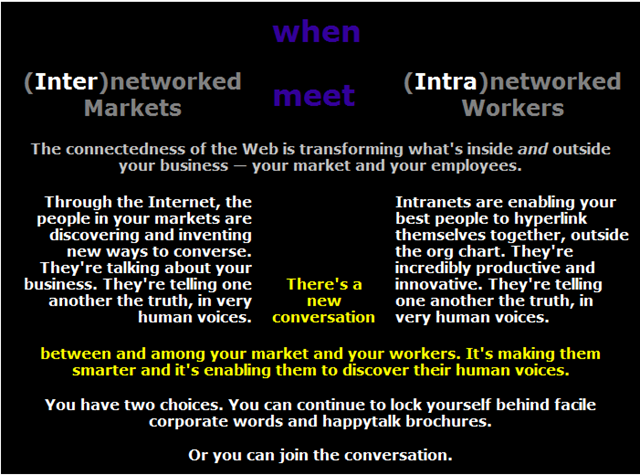
There is a new conversation !

Or some of the 95 themes, just some examples here:

2) Markets consist of human beings, not demographic sectors.

14) Corporations do not speak in the same voice as these new networked conversations. To their intended online audiences, companies sound hollow, flat, literally inhuman.

29) Elvis said it best: "We can’t go on together with suspicious minds."

41) Companies make a religion of security, but this is largely a red herring. Most are protecting less against competitors than against their own market and workforce.

50) Today, the org chart is hyperlinked, not hierarchical. Respect for hands-on knowledge wins over respect for abstract authority.

78) You want us to pay? We want you to pay attention.

84) We know some people from your company. They’re pretty cool online. Do you have any more like that you’re hiding? Can they come out and play?

Who are those pretty cool people online that want to come out and play ?

90) Even at its worst, our newfound conversation is more interesting than most trade shows, more entertaining than any TV sitcom, and certainly more true-to-life than the corporate web sites we’ve been seeing.

95) We are waking up and linking to each other. We are watching. But we are not waiting.

Damn. And this is 10 years old. And i thought being quite up-to-date.

Who can help me getting up to speed on this interesting movement ?

Yes. Movement.

That is what this is.

Robonomics

3838440758_2143b4757b

Really great post by Jamais Caisco on FastCompany blog.

Very much in line with my last posts on massive manias, booms and busts. I have not added much here: just mixing some different sources. But some folks told me i am not that bad in mashing-up stuff 😉

Think you can’t be replaced by a machine? Think again.

Definitely read this article in more depth. Key passage in ‘Think Again”:

Structural Shifts

The issue of a future in which there are large parts of the economy that are underemployed, unemployed, or unemployable is a serious issue. And the data already suggests this:

(source) Notice how after the last recession in 2001 the number shifted upwards. The boom year of 2006 have an additional 5% long-term unemployed than the boom years of 1998. If you go back even further in that graph, to the 1960s, you see an even larger structural shifts upwards. Here’s University of Chicago Economist Kevin Murphy thinking through this issue.

Robots are becoming more dextrous, able to do a growing number of tasks requiring precision and strength, and computer systems are becoming smarter, able to tackle jobs needing pattern-matching and creative skills.

Humans are still cheaper, for now, but this puts downward pressure on wages–and the old rule that new technology opens up entirely new fields of human labor won’t hold true forever. Smarter, more capable machines will snap up those jobs, too.

Robonomics: If robots and digital systems can do everything, let them–but let human society skim value from the result. This becomes a technologically-driven version of the Basic Income Guarantee model, where citizens are given a basic above-poverty income guarantee and are free to explore education, entrepreneurship, or even a life of indolence. Or they can get one of the remaining human jobs, jobs that may pay much more than they do now in order to attract people who otherwise wouldn’t want the work.

Picture Credits:
Money, courtesy Jamais Cascio, Creative-Commons Licensed

Massive manias, booms and busts.

Remarkable video from Peter Thiel speaking at the Singularity Summit two years ago about the need for Singularity in todays Financial Markets.

Peter Andreas Thiel (born 1967) is an American entrepreneur, hedge fund manager, libertarian and venture capitalist. With Max Levchin, Thiel co-founded PayPal and was its CEO. He currently serves as president of Clarium Capital.

Thiel has made early-stage investments in several startups, including Slide, LinkedIn, Friendster, Geni.com, Yammer, Yelp, Powerset, Vator, Palantir Technologies, Joyent and IronPort.

Btw, we already mentioned Palantir Technologies in this earlier blog post. Also those folks are ex-PayPal.

“As you can’t predict, you have to bet” says Thiel.

And “The alternative to the singularity is the apocalypse”. See also my previous post on the need for a singleton if we want to avoid humans to be overruled by Artificial Intelligence

We will (are) witness massive manias, booms and busts

on a scale unprecedented.

But that’s not normal for markets that are well connected. Markets that are well connected (such as the financial markets) have more information circulating on their networks. Normally, when more and more information is floating around in a market, that market gets smoothened out and gets more efficient. Stocks would evolve at a smooth 6-7% per year, and most volatility would go out of the market.

Well, unless you have been living on another planet, the contrary is true. And worse,

the frequency ànd amplitude of the booms and busts gets bigger.

There was the Japanese crash end 80ies, the emerging markets mid 90ies, the intro of the financial derivatives that scaled to a 1 trillion hype industry, in 98 Russian market blew up, the March 2000 Internet bubble, the 2008 bust of Lehman’s and the big crisis we are in now. Peter Thiel explains how in March 2009 was the last month of insanity before the bust.

Dillusion and insanity were at their peak.

What i really like is when he says: “at the peak of the boom, you can see furthest”.

It reminds me of another quote – can’t find right away from who – that when innovating you better start with the future in mind, rather than starting from the now. The latter approach usually leads to small incremental adjacencies, whereas the first approach at least gives you a chance of driving something disruptive.

All big breakthroughs were disruptive. None of them were predictable by extrapolating the past of the now. See also Nassim Nicholas Taleb’s The Black Swan book.

Btw, in the last Wired (Aug 2009), you can read that speaking of the Black Swan is really “tired”. That’s the stage before “expired”. Old-fashioned.

Isn’t this about big trends ? Like that all sorts of businesses will  not work in the enterprise 2.0 economy. That running a more authentic business becomes mandatory. See book industry, see newspapers, etc.

However, the biggest trend –says Thiel in 2007 -  is the trend from old to new media. So big a trend you don’t even see it.

That was at the Singularity Summit in 2007 two years ago. Next summit is in October 2009. Have  a look at the line-up of speakers. Very curious what those great thinkers will spot as trends you don’t even see.

What are the biggest manias, busts and booms to come ?

Human Evolution Future

Found a really interesting post today on Accelerating Future blog of Michael Anissimov.

He refers to the technology optimism of Kevin Kelly (KK). If you’re not familiar with KK, you should and definitely to his blog.

Kevin Kelly’s Panglossian optimism is exactly the type criticized in Nick Bostrom’s paper “The Future of Human Evolution”. The PDF version of this paper can be found here.

I read the paper and was blown away by some strong starting points, assumptions, statements and conclusions.

Some teasing extracts to further encourage you to download the paper and – more importantly – read and consume it.

The past few hundred years have seen enormous improvements in human life‐span, labor productivity, scientific knowledge, and social and political organization, which have enabled billions of people to enjoy unprecedented opportunities for enjoyment and personal development. On a historical as well as on a geological timescale, the big picture shows an overarching trend towards increasing levels of complexity, knowledge, consciousness, and coordinated goal‐directed organization, a trend which, not to put too fine a point on it, we may label

 “progress”.

… this past record of success gives us good grounds for thinking that evolution (whether biological, memetic, or technological) will continue to lead in desirable directions. This view, however, can be criticized on at least two grounds.

First, because we have no reason to think that all this past progress was in any sense inevitable‒‐much of it may, for aught we know, have been due to luck.

And second, because even if the past progress were to some extent inevitable, there is no guarantee that the melioristic trend will continue into the indefinite future.

then the only way we could avoid long‐term existential disaster is by

taking control of our

own evolution.

Doing this, I shall further argue, would require the development of a “singleton,” a world order in which at the highest level of organization there is only one independent decision‐making power (which may be, but need not be, a world government).

Second, new methods of reliably communicating information about oneself might be available to technologically mature creatures, methods that do not rely on flamboyant display. Even today, professional lenders tend to rely more on ownership certificates, bank statements, and the like, than on costly displays such as designer suits and Rolex watches. In the future, it might be possible to employ auditing firms that can

verify through direct inspection that a client possesses a claimed attribute.

Signaling one’s qualities by such auditing may be much more efficient than signaling via flamboyant display. Such a professionally mediated signal would still be costly to fake (this is of course the essential feature that makes the signal reliable), but the signal could be much cheaper to transmit than a flamboyantly communicated one when it is

truthful

… not all possible costly or “flamboyant” displays are ones which we should regard as intrinsically valuable…

Just as current human beings benefit from other species, which pose no serious threat to the human species, so too may technologically more advanced agents benefit from the existence of an ecology of non‐eudaemonic agents

Moreover, by contrast to current human political competition, where alliances shift over time, it might be possible for more advanced life forms verifiably to commit themselves permanently to a particular alliance (perhaps using

mind‐scanning techniques

and

technologies for controlling motivation

All this makes me think about Kosta Peric’s posting on www.innotribe.com on developing a vision for 2020. Initial posting and debate can be found here.

Back from the future – tell your story

Consider the following "thought experiment" – imagine yourself in the future (let’s say somewhere in the 2020’s) and describe how the world looks like – and also how we got there. Something like this:

http://idorosen.com/mirrors/robinsloan.com/epic/

Some predictions are off and some are … quite close and still unfolding. In fact as we speak there are examples of newspapers attacking google or the internet in general.

(There is another movie applying the same trick for the financial industry known as "amazonbay"  but unfortunately all the links to it on the web are all off)

As a matter of fact that video is here:

image

I find this type of thinking very useful and creative – you can drop all constraints and just let the imagination loose!
Any candidates for visionary story telling?

If you look at the stories posted, they are just lacking a bit of imagination on what’s going to happen by 2020 or 2030. Most of the the things posted there are already possible today !

I have a couple of days off and will try to write some sort of trailer on  what i believe is going to happen based on the singularity principles of Ray Kurzweil, and other great thinkers like Kevin Kelly and Nick Bostrom.

Stay tuned for some amateur SiFi.

Bank are dead. Long live the banks !

image Paul2

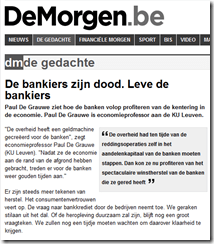
Interesting article in Belgian dutch newspaper De Morgen this week-end by Paul De Grauwe, Professor Economics at the University of Leuven.

Free translation of the key paragraph:

What is clear now, is that banks start to take advantage of the more positive economic climate. They do this in different ways. First of all they almost get free money from the European Central Bank (ECB). They invest those assets in government bonds at an interest rate of 3 to 4%.

The government has thus created a money machine for the banks. The ECB, part of the government sector, lends money to the banks and “charges” an interest of 1%. The same government pays 3 to 4 % interest rate to those same banks. The banks take no risk whatsoever. The manna falls out of the sky. That way, i also want to become a banker.

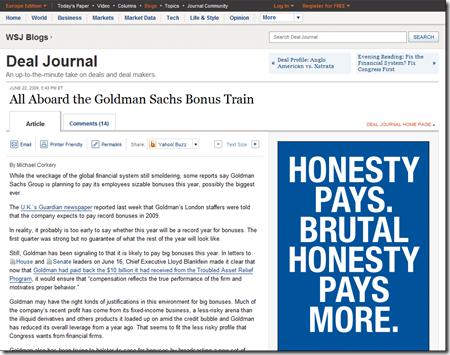
I was last week in New-York, and there was a lot to do on television channels and on Times Square billboards about the Goldman Sachs bonuses.

I just googled that subject, and i found this blog on Wall Street Journal:

image

It’s a bit cynical that this article gets the honesty ad from Barron’s.

Happens that over the week-end, i stumbles upon the latest blog from the always enlightened Sean Park on The Park Paradigm, with reference to Andy Haldane’s brilliant paper “Rethinking the Financial Network (April 2009).

Mr. Haldane is Executive Director, Financial Stability at the Bank of England. The Financial Stability area plays a key role in meeting the Bank’s responsibilities for maintaining the stability of the financial system as a whole. In this role, Andy has responsibility for developing Bank policy on financial stability issues and the management of the Financial Stability Area. Andy is a member of the Financial Stability Board, which gives high level guidance on priority-setting, and of the Bank’s Executive Management Team.

The document (text of a speech) starts with a comparison between the 2002 SARS pandemic (could also have been H1N1 in 2009) and the 2008-2009 Financial Market stand-still.

On 16 November 2002, the first official case of Severe Acute Respiratory Syndrome (SARS) was recorded in Guangdong Province, China. Panic ensued. Uncertainty about its causes and contagious consequences brought many neighbouring economies across Asia to a standstill. Hotel occupancy rates in Hong Kong fell from over 80% to less than 15%, while among Beijing’s 5-star hotels occupancy rates fell below 2%.

Etc….

On 15 September 2008, Lehman Brothers filed for Chapter 11 bankruptcy in a New York courtroom in the United States. Panic ensued. Uncertainty about its causes and contagious consequences brought many financial markets and institutions to a standstill. The market for Credit Default Swaps (CDS) froze, as Lehman was believed to be counterparty to around $5 trillion of CDS contracts.

Etc

And he goes on:

These similarities are no coincidence. Both events were manifestations of the behaviour under stress of a complex, adaptive network. Complex because these networks were a cat’s-cradle of interconnections, financial and non-financial.

Adaptive because behavior in these networks was driven by interactions between optimising, but confused, agents. Seizures in the electricity grid, degradation of ecosystems, the spread of epidemics and the disintegration of the financial system – each is essentially a different branch of the same network family tree.

This paper considers the financial system as a complex adaptive system. It applies some of the lessons from other network disciplines – such as ecology, epidemiology, biology and engineering – to the financial sphere. Peering through the network lens, it provides a rather different account of the structural vulnerabilities that built-up in the financial system over the past decade and suggests ways of improving its robustness in the period ahead.

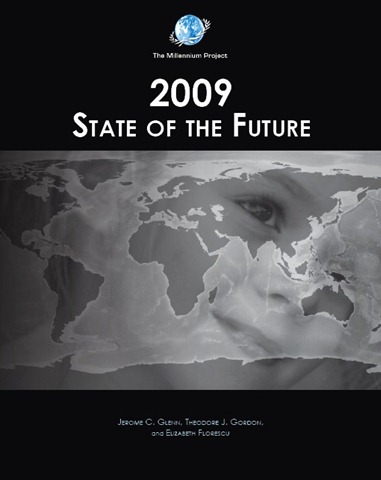
2009 State of the Future

The 2009 State of the Future report, just published by the Millennium Project, a global, independent futures-research think tank.

sof2009

The Executive Summary can be downloaded here.

Interesting dimensions in the report:

  1. Two State of the Future Indexes are presented; one without the recession and one based on an extended recession
  2. Emerging International Environmental Security Issues
  3. Future Economic Elements to Improve the Human Condition

The Future Economic Elements receiving the highest average ratings from the international panel for beneficial impacts for the future of humanity were:

Ethics a key element in most work relations and economic exchanges
• New GNP/GDP definitions that include all forms of national wealth: e.g., energy, materials, ecosystems, social and human capital
• Global commons—air, climate, oceans, biodiversity (bees necessary for agriculture, etc.)—supported by international agreements among countries for very small (less than 1%) tax on selected categories, including currency trading and international travel; the funds collected would amount to several hundred billion per year for global public goods
Collective intelligence––global commons for the knowledge economy
• On-line and in-classroom educational systems that continually update curriculum on the evolving economic system and its elements.

Interesting quote:

In March 2009 an asteroid missed Earth by 77,000 kilometers, 80% closer to the planet than our moon is. If it had hit Earth, it would have wiped out all life on 800 square kilometers.

No one knew it was coming.

The time between its discovery and close approach was very short.

Few people knew the global financial crisis was coming; fewer still forecast its breadth and depth. We need global, national, and local systems for resilience—the capacities to anticipate, respond, and recover from disasters while identifying future technological and social innovations and opportunities.

The acceleration of change reduces the time from recognizing the need to make a decision to completing all the steps to make the right decision. The number and intricacy of choices seem to be growing beyond leaders’ abilities to analyze and make decisions.

For example, do we have the right to clone ourselves, or to rewrite genetic codes to create thousands of new life forms, or to genetically change ourselves and future generations into new species?

Some experts speculate that the world is heading for a “singularity”—a time in which technological change is so fast and significant that we today are incapable of conceiving what life might be like beyond the year 2025.

Fortunately, we have the means for many people to know the world as a whole, identify global improvement systems, and seek to improve such systems—hence accelerating the improvements of our global situation.

We are the first generation to act via Internet with like-minded individuals around the world.

We have the ability to connect the right ideas to resources and people to help address global and local challenges. This is a unique time in human history.

Mobile phones, the Internet, international trade, language translation, and jet planes are giving birth to an interdependent humanity that can create and implement global strategies to improve the prospects for humanity.

The Distinction of Past and Future

Thanks to my subscription to Twine.com, i found this great website of Humansfuture.

future_human_evolution

It brings together subjects like Artificial Intelligence, Nano, Genetic Engineering, Transhumanism, etc, etc,… exactly all the subject matter for our Think Tank on Long Term Future.

From there i went on a surf “trip”, and discover The Next Big Thing, an initiative from BBC2 Open University.

They find their stuff at the Vega Science Trust.

Which led me discover the Classic Feynman Lectures that were put on line recently by Bill Gates on Microsoft Research under Project Tuva.

Btw, i wonder what became of Bill Gates new company, a sort of Think Tank.

White1

Microsoft Research Project Tuva presents Nobel Prize winning physicist Richard Feynman’s Messenger Series lectures within a new video player. This enhanced video player features searchable video, linked transcripts, user notes, and interactive extras.

Have a look at the 1964 lecture on “The distinction of past & future”. Dont forget this is 50 years old !

You can of course also google/bing Feynman. Here is a cool video: he starts by saying “I want to investigate everything”.

So, while the title of this post relates to future that is still 30-50 years away, it brings us back 50 years ago !