The holy fire

If you are in one of those dips – and who doesn’t from time to time – I’d like to recommend you some “power-reading”. It’s better than zapping in front of your television, or better than (re)tweeting 140 characters. It’s definitely better than booze or drugs. And it has some element of “depth” that you don’t get from those other media/substances.

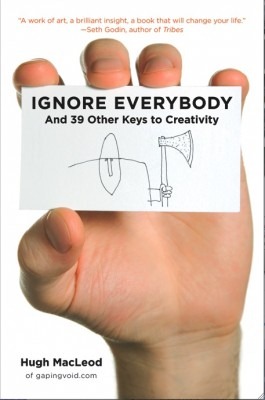
I could have titled this blog post “Ignore Everybody”, the title of a fantastic book by Hugh MacLeod of gapingvoid.com. The subtitle is ‘And 39 Other Keys to Creativity”.
ie222jpeg1-265x400

This is one of those rare books that hits you in the face. Subscribe to his blog. A drawing on a business card will wake/shake you up every day when you open your Google Reader.

091125d

Guy Kawasaki said: “Hugh’s book will kick your ass and push you out of your zone of mediocrity and stagnation”.

On one of the other cards in the book it reads:

The price of being a sheep is boredom. The price of being a wolf is loneliness. Choose one or the other with great care.

Hugh refers to the “Pissed Off Gene”. That burning fire inside that make you want to challenge the status quo.

It has something primal.

a25_17287961

So there i am with my wildfire, and now i come across a bunch of folks who feel down and ask me why we need an innovation team. They feel down because they have just gone through one of those mandatory efficiency or six sigma programs to cut fat out of the processes. Nothing wrong with that, some organizations can use a diet, and it’s in essence about being fit and going to the gym (looking at my belly it’s time for me to do so ;-). But what i think is really going on is that they feel the “Pissed Off Gene” coming alive again. It’s protest. It’s challenging where we are. It is challenging the status quo. This gene is a great source of energy. If only we could turn that negative energy in a positive one. Wouldn’t we loose less time and move forward faster ?

Sometimes however it’s getting worse. These days i believe we not only need a physical-gym, but also a mental-gym, because these days, some people already feel down in advance of the program: they start to hide, don’t dare to stick out their neck, afraid that if they become too visible or are not in line with the blueprint, they will be the first to be cut. That’s a ream shame. Come on, guys ! Don’t ignore yourselves in such a big way. Because your are worth it.

So back to the question “Why we need an innovation team ?”. Why we need innovation ? Really, reading the above i wished you did not ask. Because a company that does not have a focus on innovation does not believe in the future. Does not believe in growth. Does not believe in creating wealth. Is a dead company.

images

Dead wood.

So, what should we do ? Get rid of the innovation team ? Have no focus on innovation ? Come on !

We should probably quadruple our efforts.

But i know there is also the reality of budgets, certainly in these days. But I will keep pushing for it. So please, for once be proud that your company überhaupt has an innovation program in place (and a quite good one compared to other companies), and embrace it and help it and the company succeed, instead of complaining about it.

Our innovation team gives help. To the people who have that “Pissed Off Gene”, who have that holy fire. To help them to stand up and keep on fighting the status quo. To help them and the company make the difference. We are not measured on the ideas generated by the innovation team. We are measured on the ideas and success stories in the rest of the company and the eco-system at large. We can help those “passionate creatives” with resources (people and money).

And i hope that we also kick some ass

,and send out some wake-up calls, when we see things at the edge of our jungle that could be beneficial for our community. It is our duty to report those things, to orient/position them, to evangelize those new ideas and to help people moving from prototype into incubation.

And yes, that can be fun

Seems to be a bad thing these days to have fun. Really don’t get it. Also, they don’t see the hard work that goes on behind the scenes. They only see the fun part. Innovation is about change. People resist change.

Some days i feel like swimming in syrup

And some days it really feels good when we achieve something. But complaining seems to be the fashion of the day. And being in a good mood is these days like almost like an offense. In any case, the complainers never come to see us to see how they can be part of the fun. They complain. By preference in the gossip aisles of “radio-corridor”, hiding in the safety of anonymity.

It was probably a bad idea to call our team “the innovation team”, as we are measured on how many ideas we make the others generate and realize. But heck ! What should we have called it ? The A-Team ? The Tiger team ? The incentivators ? Cut the crap !

Print

In the end the name “InnoTribe” is right on. A tribe of innovators. Tribe as in Seth Godin’s book “Tribes”. One of those other great books if you have one of those dips.

banana_tribes

You know what all this is about ? I am going to use a big word: “leadership”. Not the leadership that you read about in McKinsey’s Newsletters. No, personal leadership. The leadership from within. From your true self. When you know damn well when something is right or wrong. Leading by Being. It is daring to follow your internal compass. It’s the difference between putting the fault on others and taking initiative yourself to fix the problem, or to come-up with something bright new. It’s daring to choose between old-game and new-game.

Old Game is being judgmental. New Game is Open Mind.

Old Game is being cynical. New Game is Open Heart

Old Game is being in control. New Game is Open Mind

In the end it’s people with passion that drive the innovation.

You can lead a horse to water but you can’t make him drink
You can’t push a string uphill
Time waits for no man

Jeffrey Philips adds one about innovation. While we like to say that everyone can innovate, its probably also safe to say that

You can’t force a disinterested person to innovate

So, what is it ? Are you the interested or the disinterested person ? If you are of the first category, join the journey. If you are the latter, come and see me. I’ll try to give you a pep-talk and try to shake/wake up that fire in you that is burning for sure in every human being. We just learned through the accidents of life/work to ignore and hide those fires. They’re too close to emotions. And emotions do not belong at work. What a crap !

Express yourself and come alive !


Do YOU have the hole fire ?

I do. And I am not ashamed to say so. And I am 52. And there is no age for it. And i am burning like hell. It’s primal. I am on a mission. “Ignore Everybody”. Don’t wait for the others to support you. GO !

And if you still feel in a dip after this, turn on Madonna’s “Jump”, volume knob on 10, and dance and listen to the following words:

The more that I wait, the more time that I waste
I haven’t got much time to waste
It’s time to make my way
I’m not afraid of what I’ll face
But I’m afraid to stay
I’m going down my road and I can make it alone
I’ll work and I’ll fight till I find a place of my own
[Chorus]
Are you ready to jump
Get ready to jump
Don’t ever look back oh baby
Yes, I’m ready to jump
Just take my hand
get ready to jump

Web Wide World


“The web is transforming society”

m04_20979625

“Web Squared: how the web transforms the world”

web2009_websquared-cover

“Web Wide World” transforming “World Wide Web”

image

Several very interesting publications and postings over the last couple of weeks, all confirming that something very profound is happening with our core systems, our core values, and how the collective intelligence of the web is gradually but surely transforming our value kit for the nearby and long term future.

First, i would like to point to 2 very rich and profound postings by Nova Spivack.

250px-Nova_spivack

On Nov 4, Nova posted The Web Wide World — The Web Spreads Into the Physical World.

A world in which every physical object, everything we do, and eventually perhaps our every thought and action is recorded, augmented, and possibly shared. What will the world be like when it’s all connected? When all our bodies and brains are connected together — when even our physical spaces, furniture, products, tools, and even our natural environments, are all online? Beyond just a Global Brain,

we are really building a Global Body

Even more profound and more elaborated is his posting What after the Real Time Web ? This supposes that you already have an idea what Real Time Web is all about. It’s a very long posting, but worth every minute/word of it. Some highlights/bullets with some personal comments:

About Web Attention Deficit Disorder: You can experience this every day if you are a Twitter, Facebook, Google Reader user. It’s about having tools to filter out the noice and focus on the essence

About Web Intention Deficit Disorder. Great “bridge” from attention to intention. I was thinking in terms of moving from “Crowd-Sourcing” towards “Crowd-Targeting

About Messaging. Messaging as we know it for 20 years is going to change 180°. In these days it is somewhat insane that we still send messages from A to B, whereas with today’s technology it’s more about having something stored centrally and collaboratively participate to this "information object in the cloud”. Google Wave is a powerful trendsetter.

About Semantics. What can i say. It should be clear by now for any semantic standards setting organization like SWIFT, like GS1, like… that their knowledge to deal with semantics in “messages” can now have a ten-fold impact in a “semantic web” world, where we now can automatically semantically tag any form of information, whether that information is already structured, or not (like in Word, PDF, images, digital information footprints, etc)

About Attenuation. About helping someone focus their finite attention more efficiently on the things they care about most. This makes me think of Generation-M (see elsewhere on this blog). The generation that cares about things that Matter.

About The WebOS.  I like Nova’s statement that “the winning WebOS is probably not going to come from Google, Microsoft or Amazon — rather it will probably come from someone neutral, with the best interests of developers as the primary goal.”

About Decentralization. “By this time the Web will be far too vast and complex and rapidly changing for any centralized system to index and search it”. It becomes increasingly clear that “central control” or “central policing” does not work in this Web Wide World. Definitely not if you don’t add value in the middle.

The intelligence is moving

to the edges

About Socialization. There is no escape. No hiding possible anymore. The future is for those who can share. That will be rewarded in new “currencies”. See elsewhere on this blog about the Whuffie Bank.

About Augmentation. Just today i was reading another post about augmented reality eye-lenses. And about Google Latitude now offering historical tracking on your whereabouts. Nova is mainly talking about real-time augmentation. Adding the historical tracker to all of this is pretty exciting.

About Collective Intelligence. Just quoting here: “This collective mind is not just comprised of humans, but also of software and computers and information, all interlinked into one unimaginably complex system: A system that senses the universe and itself, that thinks, feels, and does things, on a planetary scale.”

About Social Evolution. “Existing and established social, political and economic structures are going to either evolve or be overturned and replaced.” This has been my thesis since the beginning of my blogging. Stronger, it’s the raison d’être for my blog. If all this happens, what is the 2020-2030 impact on our core systems, on our core corporate and personal values. How will our companies, countries, world systems going to be organized and how can we prepare for the day when “Top-down beaurocratic control systems are simply not going to be able to keep up or function effectively in this new world of distributed, omnidirectional collective intelligence.”

About Physical Evolution. In essence, Nova describes the age of the Singularity, when our human brains will  be complemented by the collective and give leeway to a different type of human being.

The environment we will live in will be a constantly changing sea of collective thought in which nothing and nobody will be isolated. We will be more interdependent than ever before. Interdependence leads to symbiosis, and eventually to the loss of generality and increasing specialization.

This must sound as music in the ears to my friend and coach André Pelgrims, who is fighting the sort of societal and corporate change management that is often not more than a big illusion, because the company has been focusing on aligning (not event fusing) of departmental silos, and was not able to descend to the level of person-to-person connection and enlightenment.

These are just some of the changes that are likely to occur as a result of the things we’re working on today. The Web and the emerging Real-Time Web are just a prelude of things to come.

The last element i’d like to ask your attention for is the existence and activities of the Web Science Trust.

image

The Web is the largest human information construct in history. The Web is transforming society. In order to understand what the Web is, engineer its future and ensure its social benefit we need a new interdisciplinary field that we call Web Science.

Have a look at some of the big names behind the Web Science Trust: Tim Berners-Lee, etc. Also very good to see that some European (UK) universities are starting to take the lead.

Most interesting is to look at the Research Roadmap. Just look at the research perspectives, and it gives you an idea of the deep profound impact of the Web Wide World:

  • Computational perspective
  • Mathematical perspective
  • Social Science perspective
  • Economic perspective
  • Legal perspective

And the integrative research themes:

  • Collective Intelligence
  • Openness of the Web
  • Dynamics of the Web
  • Security, Privacy and Trust
  • Inference

I took the effort to download one of the students research reports. Oh boy, how interesting how these young people study, research, reflect, analyze. I’d love to be back at university 🙂

Here is one sentence about the WebSci’09: Society On-Line Conference:

Thanks to the support of the Web Science exchange bursary, I had also the opportunity to participate in the WebSci’09: Society On-Line Conference, which was held in Athens, Greece from 18th to 20th March 2009. The conference was actually a very special one, as it was the first conference I have ever been to where I had the chance to exchange ideas with not only computer scientists but and legal studies.

I believe it is key that

we start building companies

made of the “hybrids”

Not only computer-scientists, but people with cross-fertilizing expertise. Like “experts of other areas including social science, humanities and legal studies” and bio-engineering and nanotechnology.

All the above is very close to the suggested scope of our Think Tank on Long Term Future.

No Belgian University in WW Top-100

The Academic Ranking of World Universities just got published.

image

Not a single Belgian University in the Top-100. Leuven comes in at 102 and Ghent at 106.

I found this resource via Eric Drexler’s blog, which was focusing on Asian Universities.

The “Academic Ranking of World Universities” (ARWU) is widely regarded as the best objective, international measure of university quality, and the ARWU says that excellent universities in Asia are scarce.

This seemed to me to be out of line with reality, and on further investigation, I concluded that the ARWU has a strong negative bias as a measure of the current quality of rapidly advancing universities.

In examining a paper on the ARWU methodology [pdf], I found that its scores place great weight on numbers of Nobel Prizes and Fields Medals won, to publications in Science  and Nature , and to publications listed in the Science Citation Index. The problem is that, as a consequence, the scores are weighted toward cumulative numbers, which are poor measures of rapidly rising institutions, such as the leading universities in China and India. For example, if an identical twin of Harvard materialized in Somerville or Beijing today, its rank would be abysmal for years to come.

In summary, the much-cited Academic Ranking of World Universities is very much a lagging indicator of quality.

Although that nuance may be good for the Asian universities, this is bad news for the Belgian universities.

The university of Leuven was founded in 1425 ! That’s almost 600 years ago. So if the ARWU is measuring (lagging) current quality of universities, that’s really bad news for Leuven.

Also, the omni-presence of US-universities should be of some concern to our society – the European in particular. This is also reflected in the number of innovation think tanks that exist in the world. Most are from US origin. Most of their analysis have a very US domestic focus.

That’s why our upcoming European based Think Tank for Long Term Future will try to change that, and start from the rich and diverse European culture and history. We’ll have our kick-off meeting with a number of passionate creatives and local captains of industry on 24 Nov 2009.

However, regional or anti-regional focus should not be the focus. And we do not want to start from a laggard’s position, as a catching-up strategy is always a loosing strategy.

In our inter-connected world, we are moving towards a new world order, based on collective intelligence and collective intention, inspired by transhumanism. I am preparing a separate post on that.

The focus will be on ensuring that our next generation is well prepared for a new world order. Preparing those who will be our leaders in 2030 is the focus.

Stay tuned.

The Future by Chris Anderson


Big Think Interview with Chris Anderson

Chris_anderson

CHRIS ANDERSON

Editor-in-Chief, Wired

A conversation with the Editor-in-Chief of Wired Magazine and author of The Long Tail and Free: The Future of a Radical Price.

October 29, 2009  |  In Business & Economics, Science & Tech, Media & Internet

You can see the 36 min video here.

The full transcript is also available. Some extracts and quotes (red highlights by me)

On “free”:

What happened with the Internet is that it took computers and storage and bandwidth, silicone chips, spinning metal platters, and fiber optics and put them together. It turns out that Moore’s law falls in price 50 percent every 18 months. Storage and bandwidth fall in price every 14 and 12 months, each by 50 percent and they’re accelerating their race to zero even faster than Moore’s law. You put all three together and you have this general rule that anything you do on the internet, whatever it costs today, it will cost half as much a year from now. This has relatively profound consequences. First, it makes zero – It makes free not really a marketing gimmick but kind of an inevitable price. Not to say that everything is going to be free. The greatest misunderstanding of free is that everything’s going to be free.

At the same time, they have iTunes, a very successful way to sell music. In that case, what they’re selling is convenience, not music.

On “infinities” (see also Peter Hinssen’s Innotribe Keynote on “exploring the limits.”

I think the most profound thing about turning products into digital products from my prospective is that price becomes arbitrary. In the traditional world, there’s a pretty strong correlation between the cost of a product to make and the price you can charge for it. You charge something that’s slightly above the cost and the more competition there is, the less you can charge. It tends to drive prices down to the marginal cost. In digital products where the marginal cost is zero, the price can be anywhere from zero to infinity.

On “Cloud Computing”:

We talk about lowering the barriers to entry but you also want to lower the barriers to exit so that people don’t feel like they’re risking everything.

Open ID and open apps are two examples. I think we’re seeing these two battles play out and although Jonathon is absolutely right, that this is a risk, I perhaps have more confidence in the power of the marketplace to sort this out. I think that the one thing we’re sure about in this era is that we have choice, lots and lots of choice. If Facebook gets it wrong or if Twitter gets it wrong, there are a thousand other companies in the wings just waiting to get it righter. Knowing that, I believe –and so true for Google the elephant in the room on this– I think knowing that their hold on the consumer is not permanent, it’s not cast in stone and is only permitted as long as they serve the consumer better than the obvious alternatives, I believe, will keep them doing the right thing.

About “monopolies”:

I can only hope that the regulators move slowly because I don’t think the answers are clear and any answer we give today will be wrong tomorrow. I mean, today, isn’t it sort of absurd the fuss we made over Microsoft, now, in retrospect? Now Microsoft looks like the underdog right? We were so worried about their monologist abuse of the desktop. I mean, desktop, when was the last time you even saw your desktop?

About “going after small or big business (the next 1B$ business):

That model distributed innovation. Letting the community sort of invent products, try them out at small scale, figure out the bugs, whether there is real demand, and then use the big company’s power to scale them up to mass markets. That feels about right.

See also my yesterday’s blog post about Failure is NOT an Option.

On “what upcoming technology will disrupt the industry ?”

The simple answer to your question is the most disruptive thing I can see right now is the fact that you and I are carrying GPS chips in our pocket. If you have an iPhone in your pocket or any other smart phone, you’ve got a GPS chip. Now we’re not doing much with them right now but we have, for the first time in history, the capacity to link our physical world, the world we live in, to the virtual world.

I think GPS and the internet combined is a game changer. Now I’ll add just one thing on top of that. The fact that your phone is not just GPS and internet connection, but also other sensors, accelerometers, it has proximity sensors, light sensors, things like that. It could have other sensors. You know, we’ll see what we do with that. To what extent could that be used for health care? To what extent can that be used for, sort of, environmental monitoring? I don’t know but we now have nodes. We have smart nodes in people’s pockets, in their hands, spread all around the world, connected to each other and the internet that know where they are. I think that’s a big deal.

Anderson is also mentioning a company called 37Signals. Ever heard of them ?

image

37signals is a different approach in that they are relatively lean and targeted. They are not trying to become Microsoft. They know who they are. They were kind of born on the web and, as a result, the products sort of feel organically web centric.

And finally, on “Small is the new big”

Lower transaction cost was the advantage of the firm. Now we’re in an era where it’s completely reversed. Now big companies have bureaucracy. They have red tape. They have long procedures. They have certain profit requirements. The transaction costs are actually higher inside the walls of a big company than they are outside.

Bill Joy famously said that the smarter people in the world for any given project don’t work for you. That’s a problem if you can only work with people that work with you. I mean, why are you working with this guy? Is he the best person in world?

No, he’s the closest person in the world. Now it’s incredible easy to find the best person in the world and to get them to work with you. The internet has provided a sort of global lowering of transaction and so we can now, it’s often more efficient to look outside your company and, you know, I’m joking on some level. The idea of finding the right person via Elance versus your internal HR is actually often easier to go outside and get things done. What that’s done is that it’s said we have a diseconomy of scale with big companies. The bigger they are, the harder it is to get things done. Small companies are nimble. They’re focused. The cost base is lower. They don’t need big markets so they can target more narrow opportunities.

Open source software, hosted solutions, all this cloud stuff, those will lower the cost of starting a company. The internet has lowered the barrier of reaching products. These global markets of talent have lowered the cost of finding people the right people to work on your project. All of it is really creating an army of competitors to the large company model. Large companies are still great at mass but there is a long tail. And large companies are bad at the long tail. Small companies are perfect for the long tail. And we’re not going to see a battle between the two.

Failure is NOT an option (you don’t know until you try)

A couple of weeks ago, i was attending the Web 2.0 Summit. Actually, it is the Web² Summit (read as Web Squared).

If you want to stay up-to-date a little bit, a must read is the Web Squared Whitepaper. You can read it online here or download it here.

web2009_websquared-cover

One morning, i was taking the elevator to have breakfast. In front of me in the elevator was somebody i never met, but he had a conference badge. So i started a chat. By the time we got to the ground floor, i understood i was chatting with Don Dodge, Director Business Development Emerging Business Team at Microsoft. UPDATE: just learned via Don’s blog that he has left Microsoft

6a00d8341bf9da53ef00e550076d788834-150wi

I identified myself as part of SWIFT’s Innovation Team, we got connected, and Don invited me to join him for breakfast.

We chatted about innovation cultures and where we were coming from. About our deep DNA of FNAO (Failure is not an Option), and how people in such culture usually feel reluctant to come up with idea of dare to take risks.

Don told me i gave him inspiration for a new blog post on The Next Big Thing.

Never thought he would do this, but hey ! Today i received from Don a mail with a link to his post. I have copied it here below in it’s entirety. Don’t hesitate to comment on this blog on on Don’s blog.

BTW: i have invited Don to be part of our Innotribe @ Sibos 2010 in Amsterdam in Oct 2010 :-). Hope he accepts.

PS-1: I am not an “Exec”. I am just part of SWIFT’s Innovation Team.

PS-2: “Make a mistake and you are fired” is of course a metaphor to indicate that an FNAO culture does not promote taking risks and being innovative. Sometime to the contrary. But that metaphor does not change anything to the important message Don has for big and small companies trying to innovate.

+++ start Quote from Don’s Blog

Failure is NOT an option – Why this can be a bad strategy

An exec at a large European financial company recently told me his former CEO believed “Failure is not an option”. Great, I thought. This means they will do whatever it takes to succeed, try five or ten different approaches until it works, get the whole company focused on the goal, etc. No, he told me. What it means is “Make a mistake and you are fired.” Wow! Another example of the difference between startups and big companies. I have worked most of my career in startups where you are always pushing the envelope, taking big risks, where there are no obvious answers, and you just keep trying until you find the combination that works.

Poker ChessStartups play poker, big companies play chess – This “failure is not an option” discussion reminded me of the huge differences between startups and big companies. Success is not easy in either case, but the approaches are radically different. Using a game analogy, startups are more like poker players. They take big risks, they bluff, they make quick decisions, change direction constantly, and they keep their competitors off balance. Poker is an aggressive game where if you play your cards right you win big, and win fast. If you lose a hand you can come back and double your money in the next hand. There is no time to wallow over a loss. You did your best. Move on and your luck will be better next time. Chess is a different game. Both require incredible skill and talent. A great poker player is rarely a good chess player.

Big companies think long term. Like chess players they think four or five moves (years) ahead. They protect their assets, play defensively, think strategically, and carefully consider the options before making a move. Big companies have a lot to lose, while small companies don’t. Big companies leverage their assets (conservatively) and flex their muscles where they can. They go for incremental improvements in position. Big company CEOs, like chess players, work a long term strategy. Each short term move plays a part in a longer term strategy that is not visible to the casual observer. In fact, their strategy is often kept secret, and they take care to make sure their short term moves don’t reveal their long term plan. Strategy is a competitive advantage.

There is another interesting topic on how to make the transition from startup to successful big company, but we will save that for another day.

Fail Fast – If you are going to fail, do it fast and move on to the next thing.More in depth thoughts here. The only thing better than a “Yes” is a quick “NO”. When you are raising money, selling a customer, or trying to get a deal done, it is the long drawn out process that never ends that will kill you. It is the same thing with startups. Being successful is always the goal, but if it is going to fail…Fail fast.

Bill Warner, founder of Avid Technologies, Wildfire Communications, etc, said recently “Some of you guys are so smart you turn what should have been a one year failure into a five year death march.” Entrepreneurs are resourceful, smart, and have that indomitable spirit that doesn’t allow them to quit. This can be good and bad. Sometimes it is better to “fold” and move on to the next game.

Hold ‘em or Fold ‘em? – “You got to know when to hold em, know when to fold em, know when to walk away, know when to run.” Kenny Rogers. The toughest decision any entrepreneur makes is giving up on a company. It just isn’t in their DNA to do it. In fact, they rarely decide to do it, it is the investors who finally make the call. How do they decide? It is really about passion and commitment – from the founders, investors, employees, and customers. If the passion is lost in any two of the four groups…it is probably time to “fold” and move on.

Fine line between success and failure – There are no easy and obvious answers. If it were easy everyone would have already done it. Timing and luck play a big part in success…bigger than most people will admit. There are four key elements to success in any business; great people, great idea, great timing, and luck. If you don’t have any two of the four…you are probably going to fail. I have seen startups with great people and a great idea that were too early (timing), or had bad luck on things they couldn’t control. They failed. The same idea tried five years later succeeded. Timing matters. The market needs to be ready to adopt your ideas. The answer is never obvious. You don’t know for sure until you try.

+++ End quote

Energy from Passionate Creatives

Fantastic blog by Hutch Carpenter about The Passionate Creatives. His blog is always quality. Always new content. Feeling deeply the pulse of the Enterprise 2.0 wave.

0990783

A lot in Hutch’s blog post reminded me about the book – The Cultural Creatives – How 50 million people are changing the world. By Paul H. Ray & Cherry Ruth Anderson.

418MH0BC23L._SL500_AA240_

In his recent blog entry, Hutch talks about “Passionate Creatives”.

Especially about passionate creatives at the edges.

Passionate creatives are everywhere among us, but they are not evenly distributed. They tend to gather on the edges where unmet needs intersect with unexploited capabilities.  Edges are fertile seedbeds for innovation.

Or also

Companies are best-served by allowing employees who are attracted to these changes to pursue innovative ways to address them. Why?

They get energy

They get an experimenter’s mentality. They get a happier workforce. Let employees exercise some form of self-organization to accomplish this.

The alternative may be incumbent staffers who have fallen into routines, or

have reason to protect

the status quo

This does not help companies address rising levels of volatility. Free the passionate creatives!

Makes me think of Red Monkey story by Jef Staes. I use it a lot. In every presentation about innovation. It’s where my audience does NOT loose me on my trip to the future.

Book_Wordcloud

Let me make another connection here. Just like Hutch, i would like to refer to  A Labor Day Manifesto for a New World by John Hagel.

John Hagel founded the Deloitte Center for Edge Innovation. And is having a fantastic blog The Big Shift. I had the honor of meeting John Hagel in person during the last Web 2.0 Summit. We had a brief chat on his possible participation to next years Innotribe @ Sibos 2010 in Amsterdam.

Have a look at the whole Labor Day Manifesto, and more specifically at the last paragraph:

Stop and think about the last truly great person who left your organization. First think about what made that employee great. We bet you name such characteristics as action-oriented, driven, passionate, fun, and genuine.

Now think about where that worker went. Chances are, to a position with a perceived promise of putting his or her talents to better use—moving into a role with greater challenges and opportunities to learn and make a difference. It wasn’t about money.

What a great test for each organization !

And there is also the interesting innovation blog from Stefan Lindegaard. In his 5 oct post Job Opening- Senior Innovation Manager he describes how difficult it is to find a senior innovation job:

I am sad to say this is just not the time to seek such a job. I see this in the networks I facilitate where many innovation leaders have lost their jobs in the past year. I have been in touch with several of them discussing their options and trying to help them move on. Actually, last year some of them got a new job pretty fast, but this is not happening now. It takes longer – if at all.

Just to give you an idea of how bad the job situation looks like: There are less than 20 companies on Monster.com in the U.S looking for senior innovation managers and offering interesting challenges.

Somewhere in the middle there is a great advice for people wanting to work with innovation:

So my advice to all the people working with innovation right now is this: If you really want to work with innovation, then

your current job

is most likely the best chance to do this.

My dream scenario is that – in these times of crisis, with efficiency programs cutting out the best when focusing solely on efficiency and allowing managers to settle old bills with team members that took the risk to innovate – that the group of passionate creatives on the edges of every company will stand-up, claim their space, and fight to destruct the cynicism that reigns in some many companies.

The root cause for this unbearable cynicism are usually power-games between silos. These power games are putting a major barrier to success to any CEO shouting “change” at the top, as the change – or desire thereto – does not permeate into the lower echelons of the organization, and therefore remains nothing more than

a big illusion

This is the difference between old and new game.

In the new game, we don’t shoot at Red Monkeys, we don’t fire the guys who have the courage to take risk. On the contrary,

we protect them,

expose care, and

channel the energy

for the better of the company

I met a couple of those passionate creatives recently:

what an energy !

If only we could turn the negative cynicism energy into a positive creative energy.

Who feels energized by this ? Let’s join forces. Let me know who you and where you are.

Google and Finance 2.0

Umair Haque has written an Open Letter to Google titled “Can Google take on Wall Street – and Win ?”

It starts with: “Dear Google,…”

and goes on with:

Every day, you handle more searches than the NYSE handles trades — and that difference, I’m guessing, is about to hit an order of magnitude more. Every day, you connect people, businesses, and communities in deeper and tighter ways than besuited beancounters do. From my tiny perspective, it seems that you just might be in the best position of any organization in the world to take on Finance 2.0.

Umair’s open letter is nothing more (or less) than

asking Google to implement

his Finance 2.0 Manifesto

written some months ago, and commented in this blog here. I strongly recommend to read the Manifesto.

And he continues:

What would a Googlier

finance industry resemble?

What would a more Googly set of capital markets look like? That’s the $12 trillion dollar question. After all, markets are just search engines — remember?

You still think you’re in the media business. You’re not. In the 21st century, everyone’s in the same business: the awesomeness business. It doesn’t matter what you make, as long as it offers maximum awesomeness. And right now, better finance would be pretty awesome.

Yesterday, you used to change the world. If you think a bit harder, a bit smarter, a bit more disruptively — you still can. If you don’t — well, the biggest catfish in a parched, dried up pond sure ain’t the smartest catfish.

And he gives some “leading” examples:

Tracked, ValueCruncher, StockTwits, and many more are the leading edge of a revolution — a revolution in what finance has been for the last several centuries, and what it must become in the 21st.

Something i don’t like in Umair’s post is the polarizing tone as if all in financials services is bad, and Google is “doing good” and Google being positioned as the solution to cure world hunger. Although i have already promoted many times on his blog that

polarization fosters innovation

Also, the “leading” examples offered above are putting Google in its traditional role of information manager, searcher of information.

I believe we could also look at Google as a utility. They have some great tools that could be applied in a big way to financial services. What if for example a neutral party would host a federated Google Wave as a SaaS solution for the financial market ? Running on a secure messaging platform like SWIFT ? Next generation person to person communication ? Or apply the same technology to do Collateral Margin calls for example ? Where every new call is a new Call “wave”. Think about it.

There is of course a lot i like in this article, especially the implicit push for extreme – even “impossible” innovation. Last week, i was attending the 11th European Conference on Creativity and Innovation. One of the keynotes came from Mark Raison, titled “The Power of Impossible”

Look at this presentation. Internalize it. And then let’s play-back Umair’s open letter with The Power of the Impossible in mind.

What would happen then ?

PS: Mark Raison is on my target speaker list for Innotribe @ Sibos 2010.

New Money and Payments

The last couple of days there have been several blogs reporting on new types of money and payments.

First there was the great interview of Steve Boyd with Jamais Cascio.

Some highlights of the highlights:

You have to get a critical mass of people to agree in a new fantasy.

Groups with shared purposes could in fact have new currencies.

The unbanked are the source of many innovations in the world, right now.

Governments start to care when economies arise.

The question of anonymous money and the roll of cell phones in future money.

Then there were 2 news items on micropayments to news publishers:

The first one related to a New platform for micropayments to news publishers

image

The key comment in the Spingwise article being that:

…for bitcents to work, it will need to attract enough publishers who produce content that readers are willing to pay for. Meanwhile, other ventures—like the soon-to-be-launched Journalism Online—are also working to create a new economic model for the news industry. Keep a close eye on this space—change is in the air, and business opportunities won’t be far behind.

Especially if the big boys want a piece of the cake. Here comes Google again.

googlecheckout

I found this one via my Twine subsription, and Nova Spivak was the first one posting it.

Again, some highlights only:

Google is developing a micropayment platform that will be “available to both Google and non-Google properties within the next year,” according to a document the company submitted to the Newspaper Association of America. The system, an extension of Google Checkout, would be a new and unexpected option for the news industry as it considers how to charge for content online.

While currently in the early planning stages, micropayments will be a payment vehicle available to both Google and non-Google properties within the next year. The idea is to allow viable payments of a penny to several dollars by aggregating purchases across merchants and over time. Google will mitigate the risk of non-payment by assigning credit limits based on past purchasing behavior and having credit card instruments on file for those with higher credit limits and using our proprietary risk engines to track abuse or fraud. Merchant integration will be extremely simple. [grey bold emphasis Google]

In a brief paragraph entitled “business model,” Google suggests that it would share revenue in a similar fashion to the iTunes App Store and its own Android Market, both of which take a 30% cut of revenue.

I downloaded the document and besides what’s covered in the blog post, it contains some other interesting facts about Google Checkout:

Key statistics:
• Tens of millions of registered Checkout users
• Several hundred thousand registered merchants, high number of sellers selling digital
goods
• $ Billions of orders processed

Planned Roadmap:
• Simplified Merchant Integration – Dramatically increase the speed by which merchants
integrate with Google Checkout. Target early 2010
• Guest Checkout – Allow users to buy goods with Checkout-enabled merchants without
creating an account. Target Q4 2009
• Stored Value – Gift cards and maintaining a balance for buyers on Google Checkout.
Planned for future
• Micropayments – Aggregation of small payments by buyers for purchasing digital
content. Planned for future

The PDF also mentions some really interesting thinking on what i would call “convenience” in a multi-vendor marketplace environment:

Easy Subscription Sign-up and Management for Users Plus Content
Packaging and Multiple Payment Forms for Publishers
o Single sign-on capability so users can use one login for access to premium content and a central place to manage subscriptions and payments.
o We envision the typical scenario to be where a user pays a monthly fee for access to a wide-ranging package of premium content. One example of a "package" might be full access to the WSJ; another "package" might include the top 10 business publications. Google believes that there is real power and benefit to publishers in providing these sorts of broad, multi-publication access passes.
o For multi-publication packages, publishers will receive a revenue disbursement that is proportional to the usage of their content in the package.
o While providing an option for micropayments will be important, we do not believe it will be the norm for accessing content. Example 1: A user has access to the "basic" premium content package. She hears about the latest Sarah Palin article in Vanity Fair, which  is not part of her package. She can make a one-off payment of $0.10 to read that article, which will show up on her bill as part of the monthly payment.

Just think: replace publishers by financial services providers, and micropayments by regular monthly payments. Sounds like a marketplace for financial services. With a single-sign on for the marketplace syndicated/federated to the underlying providers of services. But i am deviating, this post is about new money and payment systems.

Last but not least there is the iPhone Payment App by Twitter creator Jack Dorsey:

3aug09_squareccr

Here are the dongles again ! And i thought that the whole idea of smartcards, USB-Tokens, and other physical tokens were gone, as they do in my opinion no sense in a mobile world. Wrong again, Peter ! (Don’t worry, i am stubborn 😉

The innovation is in a small, plastic card reader that fits in to the headphone jack of an iPhone (or iPod Touch) and transfers the credit card’s swipe data to the app. After the employee enters the amount to charge, the customer confirms by scrawling their signature with their finger and then either one enters the customer’s email address to send the receipt to. The payment is processed by Square for a small percentage plus a fixed fee; the funds are transferred directly to the store’s bank account, cutting both time and complexity on the processing side. The customer’s receipt includes a map showing the location of the transaction which is handy for those who record, sort and file such things.

Jack Dorsey (please DO read the man’s Wikipedia bio), the man who all but built Twitter in a matter of two weeks, has been working on a half-secret start-up project since around May. His new venture — dubbed, funnily enough, Squirrel — is based around the concept of using the iPhone as… yep, a portable, personal cash register; essentially the exact device which Square has created

Two links if you want to know more. Here and Here.

Big changes coming in this area. Have you seen any bank involved in these innovations ?

Re-Inventing Wall Street: Finance 2.0

When Umair Hague posts something on his blog, i always take some extra quality time to read.

110-umair-haque

Umair Haque is Director of the Havas Media Lab, a new kind of strategic advisor that helps investors, entrepreneurs, and firms experiment with, craft, and drive radical management, business model, and strategic innovation.

Always sharp, and always in for a good controversy and/or polarizing opinion. I am a strong believer in polarization being a big driver for Innovation.

Have a look at his latest blog post titled “Reinventing Wall Street from the Bottom Up

Some super-quotes:

Welcome to the new trickle-down economics. Here’s how it works:

  1. Banks massively misallocate capital.
  2. The government uses money reserved for public goods — education, transportation, healthcare — to bail out banks instead.
  3. The bailout should trickle down, as lending to businesses and consumers alike sparks economic activity.
  4. No effort to settle bad debt is made; little reform of corporate governance, industry structure, or competition is necessary — because banks are too big to fail.
  5. Little oversight of steps 2, 3, or 4 are necessary, because markets are perfect resource allocators, and market actors are rational.

Result? In trade terms, a shock worse than the Great Depression, as Paul Krugman has noted.

In employment terms, a lost generation.

In monetary terms, a flight from the dollar.

In microeconomic terms, the stagnation of America’s industrial base.

If it weren’t for Apple, Google, and a handful of old-school companies pursuing dramatic reinvention, like Wal-Mart, we would be in a Great Depression.

In macroeconomic terms, value is transferred from you, me, and our grandchildren to Wall St — permanently.

And also:

The greatest transfer of wealth in history is taking place. It is already roughly worth a year’s output of the entire United States, or about 5% of the entire world’s output.

Or…

It’s is faith-based economics — and it’s Barack Obama’s biggest mistake. (Consider for a moment that 20+ per cent of hedge funds misrepresent info.) For years, George Bush hunted for phantom WMDs, while terrorist networks flourished under his nose. Now Barack Obama is hunting for a phantom prosperity, while the greatest robbery in the world is happening right under his nose.

In the same blog post, he is referring to his Finance 2.0 Manifesto, published back in April 2009, where he makes 9 recommendations for a better financial system. I have cut & pasted the whole lot, not because i am lazy, but because the context is worthwhile reading as well (orange/red highlighting by myself)

Edge funds. An edge fund is the opposite of a hedge fund. Where hedge funds are opaque, edge funds are transparent. Where hedge funds are closed, edge funds are open. Where hedge funds are run for near-term gains, edge funds are in it for the long run. Where hedge funds create artificial book value, edge funds create value that accrues to real people and society. Where hedge funds focus on long and short transactions, edge funds focus on relationships. Think Marketocracy on steroids.

Macro and microcurrencies. A currency tied to national interests determined by a political elite? That’s so 20th century 16th century. A better financial system needs better currencies. Finance 2,0 will be built on microcurrencies and macrocurrencies: currencies which operate hyperlocally and transnationally. Why? Because people shouldn’t have to bear collective responsibility for bankers looting or regulators cahooting. In the 21st century, the quiet tyranny of economic collective responsibility is intellectually bankrupt: it is fundamentally unjust, deeply inefficient, and vastly value-destructive.

Social banks. Despite what marketers tell you, banks do not exist to maximize profits. They exist to maximize the safety of deposits. We’ve been taken for a very expensive ride. Next-generation banks will be structured as social enterprises — because the incentives to safeguard deposits and reinvest profits for the common good perfectly converge to a dominant strategy for long-run value creation.

Fair markets. Markets are free like a shark is a fish. Anyone can play — but only at the risk of being manipulated, looted, and defrauded by the deepest-pocketed. The anonymous arms-length transactions orthodox economics lionizes are, in practice, just a hyperefficient mechanism for front-running, predatory trading, and bid rigging. Next-generation markets aren’t just free: they’re fair. They are markets where information about reputation, reliability, and relationship thickness are hardwired into the DNA.

Stakeholder communities. Institutional investors are so 20th century. Centralizing control over our biggest corporations in the hands of a bunch of old dudes asleep at the wheel was as good an idea as the spork: interesting in theory, useless in practice. Tomorrow’s radical innovators are already updating corporate governance for the 21st century, by letting communities of stakeholders shape managerial decision-making. Think mega-Etsy.

Whisper bullhorns. Why is trading such a great business? Because traders have access to info that you don’t. Why can’t everyone get in on the whisper circuit that powers prop desk profits? Because no radical innovator has taken on the challenge yet of amplifying the secretive whisper circuit into a blaring bullhorn. But imagine if the rumours that drive share prices up and down on trading desks were Twitterfied. The result would be a financial revolution: the market power Big Trading enjoys would vaporize faster than you can say "insider info."

Googlizing financial instruments. What business is Wall Street really in? The business of hoarding information: to seek a so-called informational edge. Of course, markets don’t work if everybody’s hiding info — they only work when people are revealing it. Google can help me find a tennis racquet, Match can help me find a date, and Last.fm can help me find some tracks to rip — but who can help me find a better place to put my cash that effortlessly? No one. And that’s a massive reason why we’re stuck with a 1.0 financial economy.

Anti-ratings. Your credit is rated mercilessly. But does anyone rate lenders — not to mention brokers, banks, and investors? Today’s crisis would have been far less severe if consumers had access to knowledge about who was a trustworthy lender — and who was going to sell them the financial equivalent of a roadside bomb. Credit ratings alone cannot create more efficient financial markets — doing so requires better information about both buyers and sellers of every kind of financial product.

Open source modeling. Every bank built the same models. Every bank built the same flawed models. Every bank built the same flawed models on similarly erroneous assumptions. How dumb is that? Incredibly. Unleashing the power of open source to vaporize this black hole of incompetence is going to be a tremendously powerful path to innovation. The peer review, voluntary contribution, and always-on negotiation at the heart of the open source model create powerful incentives for quality — which is exactly what the hare-brained quants at banks lacked.

Finance 1.0 cannot power growth 2.0. Yesterday’s finance cannot power tomorrow’s prosperity. Bailouts, taxes, nationalization, regulation are what your discussions this week are focused on. These can limit the depth and intensity of the crash. But what they cannot do is build a radically more efficient, productive, and effective financial system.

See also my previous post about Peter Thiel and the Singularity, where he said that credit only works in a growth society.

That requires a better kind of finance altogether — one designed not merely to make the worst among us richer, but

to make us all authentically, meaningfully wealthier.

That’s why finance 2.0 is the future.

This is the sort or personal and corporate values we want to discuss as underpinning for our Long Term Future. Hence the need for the Think Tank we are building from Flanders to gather like minded authentic people who do care about our next generations.

Peter Thiel and the Singularity

I am just back from the Singularity Summit that took place in NY during the week-end of 3-4 Oct 2009.

banner_125x125

I will make a separate report on the rest of the event, but i was completely blown away by the 30 min speech by Peter Thiel and following panel discussion with Venture Capitalists.

PeterThiel

Peter Thiel is president of Clarium, a global macro hedge fund. He is also the founder and chairman of Palantir Technologies, a national security software firm, and a founding investor and board member of Facebook, which serves more than 200 million active users. He helps launch many other new technology companies as a founder and partner of the Founders Fund. Previously, he was founder and CEO of PayPal, which manages more than 175 million financial accounts.

Peter Thiel has philosophy and law degrees from Stanford University, where he occasionally teaches on globalization and sovereignty and serves on the board of overseers of the Hoover Institution. He funds research in artificial intelligence and life extension technologies.

See for his other investments on the above link to Wikipedia. It also becomes very apparent what a fine crew must have been at the basis of PayPal. Many of the ex-PayPallers have created very successful companies.

Also his philanthropic endeavors in the Singularity Institute, the Methuselah Mouse Prize foundation (Michael Rose himself was also at the conference) and Dr. de Grey’s work on extending human life span are some examples where Thiel’s long term vision is. I will come back later in this blog post on “time horizons”

But back to his 30 min speech at the Singularity Summit.

First his appearance. He made me immediately think about Steve Ballmer: his eyes are hypnotizing. His body language shows "withhold energy”. His jaws and mouth tense. Ready to explode. Clearly fit and in top shape. Laser sharp attention when somebody asks a question. Always listening and answering with respect.

And he delivered his speech without any supporting slide, and – as far as i could see – without any notes nor an autocue or something like that. Wow !

The title of his speech last Sunday was “Macroeconomics and Singularity”.

He started his speech with letting the crowd choose between a number of catastrophe scenarios: from bio-terrorism, to nuclear war, global warming, and a couple more like that.

His thesis was that the biggest disaster that could happen would be that the Singularity does not happen quickly. It was the start of a staggering discourse on why innovation – and especially disruptive innovation – is key to the continuation of our society. And in a grandiose move, he interweaved the financial crisis in to all of this.

Credit only works against a background of growth. But if claims of the future (singularity is a good example) don’t realize, that has a big impact on credit, on to be expected returns (which he claims are way too high for non-risk taking investments), and on the basis (growth) of our society at large. Society would still be “functioning” by fixes such as working till the age of 80, or earn less, or have low returns on capital, but that’s not what we understand with progress.

Investing in “tech” firms like Microsoft, Oracle, IBM, and even Google is betting that they will churn their revenues and profits in the foreseeable future. In other words, this is betting that nothing disruptive is going to happen.

A lot of this is driven by short term return horizons. We seem to fix the short term problems, but are stuck with the chronic long term problems.

Having a longer time horizon may be the biggest Chinese advantage.

Some other interesting quotes from his speech and following panel discussion:

    • The short run becomes the long run
    • All experts are biased in a positive direction, especially when presenting their start-up to VC’s
    • The risk of the return of fascism is very underestimated (this is about the emergence of a totalitarian regime trying to control AGI (Artificial General Intelligence) in a (pre)-Singularity time-frame.
    • I tend to invest in companies that will loose money for a long time, and a look for disruption
    • For every dollar that the government invests in opera, art, etc i want to see a dollar go to technology
    • We need to dramatically re-invest in technology education, even at primary school
    • I don’t like Darwinism, i prefer guaranteed survival. I could not resist a smile as right after this panel discussion there was Dr. de Grey himself on the agenda.

And about companies to invest in:

    • I am mainly looking at the team. And the potential of the people in that team to stay together for the long run, before founders start to argue and have a “farm" shoot-out”
    • And whether this team is capable to attract excellence. (I personally love this one as a measure for running a successful company)
    • He took his investment in Palantir Technologies as an example for this, where hiring seems to be organized around these themes. Co-incidentally, i had a meeting with Palantir the day before the Singularity Summit. I have mentioned them already several times in my blog and i would like to get them to Innotribe at Sibos 2010.

The effect of his speech was obvious. Where all other speakers at the event got max 2 rows of 4 people queuing for asking questions, there was immediately a row of 15 people of the auditorium eager to ask questions. You could feel the electricity in the air with each response from Peter Thiel.

This guy is sharp. Has vision. Has cred. Has Clout. Is a super-entertaining speaker. Has a story to tell to the financial industry. Peter Thiel would be an ideal keynote speaker for next year’s Sibos in Amsterdam 25-29 Oct 2010. It’s the first thing on my list today: go and see the organizing committee for Sibos 2010.

Of course, he would be great as well for the first event next year of our little Think Tank on Long Term Future (see previous blog posts).