Cubicle 3B23: Our company is infected !

image

This week, our small innovation team got the opportunity to design and animate the department’s “All Hands”. In stead of doing the boring “we-tell-you-and-you-listen death by PowerPoint” session, we split the group in 8 break-out sessions. Each team was randomly selected, and the managers were NOT allowed to lead the discussion.

Each team had 45 min to come up with a 5 minute pitch of one of the 2010 priorities of the department. As if they would have to sell that opportunity/idea to a Venture Capitalist. A bit like a short version of the Innotribe Labs at Sibos last year.

Before this meeting, some managers were skeptical whether all folks would be able to fully participate, contribute and let their creative juices flow.

But – as you all know – creativity is a bug that is implanted from birth in every human being. And getting back to this feeling of “playfulness” is oh so important and enjoyable.

There is playfulness and there is purity.

It’s the purity of my 4 old year daughter. Full of energy, creativity and fantasy and anything is possible.

It’s the purity of your true self. If we can tap into that energy, unbelievable things happen.

It’s all about passion and drive, and what motivates us

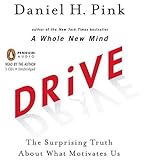
“Drive” is btw the title of Daniel Pink’s latest book.


It’s about “the surprising truth about what motivates us”. And Daniel Pink explains it’s NOT measurement, KPI’s, bonuses, perks, etc. It’s about belief and being believed. And knowing that management does never doubt people’s abilities.

So, we got 8 idea pitches of 5 minutes followed by a Q&A of 2 minutes by the audience (not by the managers). I can assure you, i saw a lot of fun and smiling faces, and people getting energized.

And it is something very infectious.

image

The day after, I got a chat from another Cubicle on the other floor:

It feels good to be able to think out of the box. Really refreshing ! If you guys succeed in changing only a little but the “sub-culture” of the company, and wake up gently the people from their winter-sleep, that alone would be a big success ! And that will be needed, if we want to keep our company relevant on the long term.

Yes, this is about passion. Yes, this is about enthusiasm. Combined with purity, this is a very contagious, irresistible cocktail.

image

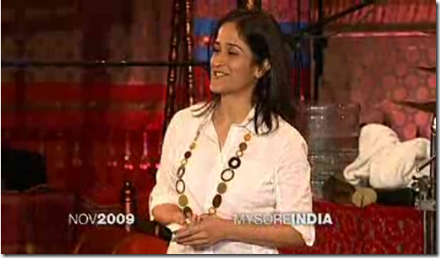
This is not new. It’s off all ages. It works for young and older humans. Have a look at this TED Talk from November 2009 TED India, just posted on the TED web-site. Kiran Bir Sethi from the Riverside schools explains how contagious the “i can” bug is.


image


It’s about children taking charge of their own destiny.


image


Its about


being aware and feeling the change


enable to be changed


empower and lead the change


leading by being


At the end of the TED Talk you see how children teach their parents to read and write. In professional life this is called


reverse mentorship


All this is VERY relevant to Innovation and how “real” your company is about innovation. You need to inject the purity of young people. New blood. Let them rethink the strategy for the next 5 years. And then take it to the next step. And let those young people reverse mentor the older generation.

Next time check out the average age of your employees. And ask yourself the question: do we have the open mind, open heart, and playfulness to indeed radically innovate this company ?

  • It’s about maturing from the stage where “the teacher told me” to “i can lead this myself”
  • It’s about not waiting anymore and following your own compass.

Like Joe told me after the meeting:


“I am not waiting anymore


to be called”


m01_16895561


When are you going to wake up and recognize your full potential ? Your potential, your team’s potential, your company’s potential ?

When will you start protesting, because you know your company sits on a goldmine, and every day that passes, it gets suffocated in end-less political debates with many off-sites leading to no conclusions.

How much longer are you going to waste your time ?

How much longer are you going to take this ?

Open your hearts and minds to the purity of the children and go ! Who will follow ?

Are you ready ?


image


If  not now, then when ?


If not us, then who ?


The bug has landed. It has infected our company and the infection spreads.

Big time, i believe this time

Reblog this post [with Zemanta]

If you can’t manage, measure

I was just reading my Sunday newspaper online,

image

and found this great summary by Gilbert Roox about Matthew Stewart’s book “The Management Myth: Why the Experts Keep Getting it Wrong”

The article is in Dutch, so i decided to use Google Chrome’s Translation extension.

image

So, here are some translated extracts, SLIGHTLY edited as the Google translate result was quite accurate. Impressive.

The management myth is a hilarious review of ten years in the Belly of the Beast. All the tricks of the fair will pass in review. For a client to win, you hunt him the fright. Then make themselves so indispensable that you no longer can think independently, and then they press the lemon patiently. “You should compare consultants with parasites” says Stewart. "I talked and talked, and meantime the meter ran,"

In all these years, the sensation that I sucked everything from my thumb never left me." Bruce Henderson, founder of the Boston Consulting Group, once described the consultant business as "the most incredible business on earth:"

Successful and leading companies hire school leavers to tell them how they should be run. And those companies are also prepared for those millions of opinions count down? "

Stewart called the pundits of McKinsey & Co “Modern shamans” : in the highly uncertain world of global competition drive them to fear the magic of their spreadsheets and charts. "If you can not manage, measure it," writes Stewart – a sneer to the home of McKinsey motto: "If you can measure, you can also manage".

Among the most successful CEO’s of Fortune 500 does not have an MBA fourth title. Success in business is simply not a hard science. Roughly revolves around three things: luck, you work hard and seize opportunities. Even then it can go wrong. But with such wisdom farmer earns a living not a management expert.

Management gurus such as Peters and Jim Collins(Good to Great) posing as prophets like, but after closer inspection they appear mainly to be the specialists of the past. They promote experimentation and out of the box thinking, while their best sellers but only document worn paths. A good advice: if you want money, then do just the opposite of what management gurus say, advises Stewart.

Management gurus seem more like religious preachers. The world they paint is invariably chaotic and uncertain, because fear sells. Bureaucracy is the great evil, and they call for a white collar revolution to overthrow that. Repetitively, they tell the poor middle class to thunder, because "you have the power".


Success is about passion;

imagination

and perseverance


With his plea for excellence the guru paves the path of a crazy work ethic that “starts with the notion that work can be meaningful, and that thought is stretched to the point where outside work is no longer significant”.

While most people only work

for a good bit to live

Hence the remarkable opinion of Matthew Stewart to youth who want to get an MBA:

"Stay away from the business schools

to study philosophy rather

to know the real life"

"In business, experience is the great teacher. We deceive ourselves if we think that an MBA makes you an energetic manager. Managers learn to manage not very different from teaching people how to live in a civilized world.

Managers do not need training,

they have educational needs

I just ordered the book. Looks like some good counter-weight for the other stuff i am reading, and will prepare me for the Lean exercise that our Innovation Team will go through as from begin February 2010.

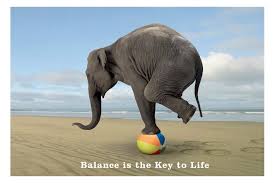
The balance is probably somewhere in between.

Ethical Re-boot

UPDATE: Cool ! It seems that my site has been blocked from Myanmar 2 hours after posting this article. Now i really feel what freedom of speech means.

UPDATE-2: added some other interesting links at the end of this post.

I fully agree with Robert Scoble that Google’s threat to withdraw from China is a world changer. A huge milestone.
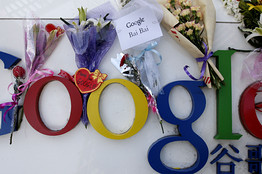
chinagoogle

Image courtesy WSJ

I believe that – when we will look back some years from now – this move will be seen as the “tipping point” in Corporate Ethical Re-Boot.

In this post, is will share some of my personal views on the Google-China event, and some other ethical old game/new game type of events i observed recently in my country.

There is a tsunami of responses to Google’s position. Some good recent blogs on the subject can be found here: Wall Street Journal’s overview and clearing up the confusion/myths, Scoble’s push/pull article, Kara Swisher’s China’s Internet Behavior, and John Paczkowski U.S. State Department to complain article.

UPDATE-3: another interesting one is from Christopher Meyer “Why is Google doing Government’s Job ?”

Walter Wriston (CEO of Citicorp in the 1970s) , in his 1992 book The Twilight of Sovereignty, predicted that business institutions would take over many of the roles of the state. He had a front-row seat — maybe the whole front row — as private financial institutions became more powerful than every central bank in the world save the US Fed (until now, at least). Governments’ power in shaping world affairs wanes as access to information broadens. As another affirmation of this, Carne Ross, a former UK diplomat, now does business as an "Independent Diplomat," offering professional-class diplomacy to state and non-state actors.

A new thesis by Miranda Meyer of the University of Chicago (umm…yes, relation) asserts that non-sovereign organizations like Hamas and Hezbollah belong to a class of actors that have important impacts but are not recognized in the Political Science literature.

Miranda Meyer’s thinking is very much in line with Joshua Cooper Ramo’s book “The age of the unthinkable”

Back in 1993, Wriston’s subtitle was "How the Information Revolution is Transforming Our World." Indeed, 17 years on, who can doubt that it has? One of his favorite observations was that "information about money is more important than money itself." Google’s influence is a sign that information about information may be more powerful still.

I found two other blog posts remarkably interesting.

First there was Fred Destin’s blog on Communist China, the misbehaving superpower.

The global outcome of a fast-growing command economy has been the government-determined explosion of asset bubbles all over the world – not because China is growing, the cause assumed by most economists, but because the government is buying resources (and their future options) on the global market, forward for 5-20 years. The result: instant commodity asset bubbles, worldwide, and further destabilization for non-Chinese consumers of these commodities. Of course, if the Chinese play the bubbles wrong, they will lose even more as prices collapse.

Could the Chinese create a global catastrophe by commanding all of this leverage into the wrong assets at the wrong time, by deflating the value of high-IP goods, by forcing global competition against unsustainable cost bases, and destroying non-Chinese business infrastructure? Sure. In fact, this is almost a “when,” and not an “if,” question.


What could possibly be more

dangerous to the world than a

command economic system run

on a global scale?


This is one view, a bit driven by


FEAR


Fear is also coming into the picture when you see that US Government is starting to take position, with all it’s possible impact on the US-China relations, the world economy and the quite fragile balance in world peace (at least between the super-powers).

But there is also the view driven by the opposite of fear:


LOVE


Translated into hope for an ethical reveille, beautifully articulated in Umair Hague’s MUST READ post “Google, China, and the new High Ground of Advantage” and you start seeing a pattern:

But the high ground has shifted. The new high ground is an ethical edge. It’s not about having more; it’s about doing better. It’s not about protecting exports, pressuring buyers and suppliers, price discriminating against the powerless, and programming consumers to buy, buy, buy — it’s about making people, communities, and society authentically better off. It’s not about caring less — but caring more. It’s not about ruthlessness. It’s about mindfulness.

The 20th century high ground might let China build a few dozen Microsofts, Fords, and Gaps: industrial-era companies that make industrial-era stuff — and play by industrial-era rules. Yawn. We know how that story ends, because we’re living it: an economy, polity, society, and natural world in stagnation and decline. Dear Wen Jiabao: want fries with that Zombieconomy?

The only way to step past the industrial era’s zombified endgame is the new high ground, because only an ethical edge can do all the good stuff above. The old high ground was built for 20th century economics: sell more junk, earn more profit, "grow" — and then crash. An ethical edge operates at a higher economic level.

It is concerned with

what we sell,

how profits are earned, and

which authentic, human benefits "grow."


It’s a concept built for the economics of an interdependent world.

Ethical edge is advantage reconceived for the 21st century. It’s an institutional innovation: the institution of "advantage" rebuilt for a threadbare, fraying, global economy. It’s a radical new definition of "advantage" that blows past the stale, tired idea of competitive advantage.

For me personally, i am on the hope side, and what’s going on here is really opening the Ethical Firehose.
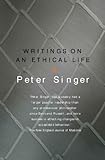
I have always been inspired by the work of Peter Singer, especially his books “One World” and “Writings on Ethical Life”, but had somehow lost hope due to being confronted with the sad and disappointing realities of corporate life. I guess we all got our wounds as we lived our professional lives.

Umair Hague already pointed at it: one of the cultivated behaviors in corporate life is cynicism. As i have mentioned at several occasions before, cynicism is applied by folks who have lost the ability of "opening their heart”.

The other corporate disease is “Machiavellian" behavior. I have met recently professionals who even seem to be proud of their Machiavellian “skills”.


I think it’s wrong, very wrong


I looked up in some dictionaries what Machiavellian really means.

Being or acting in accordance with the principles of government analyzed in Machiavelli’s The Prince, in which political expediency is placed above morality and the use of craft and deceit to maintain the authority and carry out the policies of a ruler is described. Characterized by subtle or unscrupulous cunning, deception, expediency, or dishonesty: He resorted to Machiavellian tactics in order to get ahead.

And in the Business Dictionary, i found:

Conduct or philosophy based on (or one who adopts) the cynical beliefs of Niccolò Machiavelli (1469-1527) whose name (in popular perception) is synonymous with deception and duplicity in management and statecraft. Born in Florence (Italy), Machiavelli was its second chancellor and (in 1531) wrote the book ‘The Prince’ that discusses ways in which the rulers of a nation state can gain and control power. Although The Prince contains some keen and practical insights into human behavior, it also displays a pessimistic view of human nature and condones opportunistic and unethical ways of manipulating people. One of its suggestions reads, "Whoever desires to found a state and give it laws, must start with assuming that all men are bad and ever ready to display their vicious nature."

It’s fundamentally about dishonesty and manipulation. It’s about trust (or the lack of it) . Would you be able to trust Machiavellians ? Do you trust your leaders if they don’t apply the basic ethical principles ?

Some shocking examples come from my own country.

Last week we had our Minister of Pensions Michel Daerden showing up drunk in Parliament. It even made BBC News. I am so proud of our leaders (hmmm. this is cynicism again).

Or our ex-prime minister Jean-Luc Dehaene whose famous arrogant answer to journalists was usually “no comments”: he is now on the board of AB Inbev as “independent” advisor. We have in Belgium an “ethical code of conduct” called the “Code Lippens”. 

The Corporate Governance Committee was established on 22 January 2004. Maurice Lippens was appointed chairman. The Committee was created at the initiative of the Banking, Finance and Insurance Commission, the Federation of Enterprises in Belgium and Euronext Brussels.The Committee issued a single reference code for listed Belgian companies. The Code is to set out principles of good governance and transparency, which will contribute to the development of companies and to the quality of their image among investors and the general public.

Guess what ? based on the information in Belgian quality newspaper De Standaard, Directors of the Board get a yearly fixed compensation of 70,000 to 80,000 EUR plus a variable compensation, let’s say a bonus. How can you be an independent advisor to the board in these circumstances ?


Who does still trust these people ?


Getting closer to the business of financial services i am working in – and the importance of trust in this new decade – there was this related article in the Confused of Calcutta titled Musing about Trust.

There’s something very human about trust. Something more related to the Age of Biology rather than the Age of Physics. We’ve seen what happens when we rely on mathematics for ratings and values and decisions. Last time round it was called the Credit Crunch. A decade earlier it was called LTCM. Whatever.

Some of us believe passionately in the power of what’s happening today, in terms of democratized tools and access and community-based approaches to many things, from home to work to government and beyond. In fact, I’m personally somewhat at a loss as to why no one has really put together the right community-based vehicle for “climate change”, built as an open and transparent platform, on open source principles and in a global inclusive manner.

Trust is about covenant relationships, not about contract relationships. In a contract you await breach and effect recourse. The question answered is “who pays?” In a covenant the question that’s answered is “how do we fix it?”

I think we’re going to spend a lot of time in 2010 learning about covenant relationships and their role in society. At home. In the community. At work. As a nation. As the world.

Which brings me to Michael Moore’s recent film “Capitalism: a love story”.

michael-moore.jpg

I was chatting with a colleague in Cubicle 3B23 about this.

The person’s reaction was:

I am ashamed to work

for this industry

I think i am going to watch the movie too. Because, somewhere somehow it all starts feeling wrong and not in line with my true compass.

Other related articles

Reblog this post [with Zemanta]

Idea Killer #30

At the end of my post “How real is your innovation”, i added a list of 29 typical idea killers that should be eradicated from a company culture claiming to be innovative.

f11_19845979

A couple of days ago, i came across #30:


“And what are your metrics ?”


Those Idea Killers really cut-out the last bit of creative juice and energy from the poor guy daring to stick out his neck and coming up with a new idea.

It’s now a real coincidence – really, this was not planned and is pure synchronicity – that Adam Hartung from The Phoenix Principle posts a blog item called Overcoming metrics to grow – Motorola, Xerox, Kodak, Six Sigma, TQM, Lean.

You can read the full article for yourself, but as usual i will select some salient points:

Measurements are good control tools.  Measurements can help force a focus on short term improvements.  But measurements, and the concomitant focus,reduces an organization’s ability to look laterally

They lose sight of information from lost customers, from small customers, from fringe customers and fringe competitors 

Measurement often leads to obsession, and a


deepening of

Defend & Extend behavior 


Regular readers of my blog will have noticed my preference for radical innovation and innovation beyond the core.

Measurements are created when a business is doing well.  In the Rapids.  Like Kodak during the 1960s and Xerox in the 1970s. 

Measurements are structural Lock-ins that help "institutionalize" the behavior which makes the Success Formula operate most effectively

And they help growth


But they do nothing for

recognizing a market shift, and

when new technology comes

along they stand in the way 


That’s why a powerful Six Sigma or Total Quality Management (TQM) or Lean Manufacturing project can help reduce costs short term, but become an enormous barrier to innovation over time when markets shift. These institutionalized efforts keep people doing what they measure, even if it doesn’t really add much incremental value any longer.

To overcome measurement Lock-ins we all have to use scenario planning.  Scenarios can help us see that in a future marketplace, a changed marketplace, measuring what we’ve been doing won’t aid success. 

And even more so if the organization is not capable of keeping itself honest in measuring what his has been doing and/or recognizing past failures. If that would happen, the whole exercise of looking back into the past is just futile and a marketing exercise. Not an honest assessment.

ist1_3721281-frustration-and-denial

And because we don’t yet know what the future market will really look like, we can’t just swap out existing metrics for something different

As we proceed to do new things, in White Space, it’s about learning what the right metrics are – about getting into the growth Rapids – before we tie ourselves up in metrics.


I have a question for you:

In the weeks to come, our Innovation Team goes (like any other department) will go through a Lean exercise ? I am really interested in maximizing the knowledge of the Lean Navigators and to make the best out of it.

a19_20725937

So, to help my team’s preparation for Lean, I have the following questions:

  • Who has experience with Lean and Innovation ?
  • How can Lean help us delivering better Innovation ?
  • How can we avoid that Lean will become a barrier to innovation

Thanks in advance for sharing your experiences.

Cubicle 3B23: Let me entertain you


The idea for this blog post emerged when a colleague visited my cubicle.

I will from now on refer to my cubicle as “cubicle 3B23”. The idea developed to write regular post under the title “Cubicle 3B23”, reporting about the good, the bad and the ugly of corporate life. This is the first in a series. Maybe it’s the first and only one. But i thought the idea was “cute” to try it out, to see where it goes and to let the future emerge.

The initial idea was to do a one-off under a different title (go the the very end of the blog to find out), but a friend told me that “Let me entertain you” makes you want to read on. So here we go.

Sometimes people come to cubicle 3B23 for some good fun brainstorming: “Do you have 5 minutes, I want to pick your brain ?”. Others put their head into cubicle 3B23 and say something like “Oh, i see you’re busy, i will come back later”. The latter usually have something “sad” in their eyes.

These are the moments to connect. In both cases i know this connection will make somehow a difference.

The other day, Joe was the one with sad eyes.

He was doubting himself, and wondering whether he should do his own thing, or continue to shut-up and play the game of being mister nice-guy.

samrt-swine-flu-mask-4 

Joe was responsible for a program incentivizing staff to think out of the box. At TEDx Brussels, i heard a better expression for that: “burn the box”.


image

In the planning for the new year, he was asked to run the program again. But he felt it was just not right. He felt he would be cheating the people joining the program. He was doubting whether it really mattered. He felt that he would not be able to look those folks in the eyes at the end of the program as the expectations created were just over the top. It’s a bit like the subtle difference between lying and not fully telling the truth. Both don’t feel right, and appeal to your ethical compass.

He was tired. In search for his real purpose in life. Fed up with playing games.

We had a long chat. He kept on complaining about the artificial aspects in corporate life. Somewhere 1/2 way in our discussion, i asked Joe what really kept him going. What was giving him energy. In what circumstances he felt he could be his true self. Not the self that you construct/imagine to be in synch with the big bad world out there. No, the self that silently is waiting inside you to be discovered. To be stumbled upon is probably a better way to say this.

Joe gave it a long thought, and said: “when i can inspire other people, and make them happy”. (it was another answer, but then i would reveal too much about that person).

There was a short silence, and went to my PC, searched my music collection, started a song and said: “This is you, Joe !”

The song was right on. I could see the emotional impact on Joe. The song was “Let me entertain you” by Robbie Williams.

Robbie Williams' 'You Know Me' Music Video Debuted

I am an all-time fan of Robbie Williams. He is a great performer – once saw a concert of him in Wembley stadium – and you can love or hate him, but for me he is really authentic. Even if he puts on his rabbit/bunny head on. But i deviate. Although, this post is mainly about authenticity.

“Let me entertain you” is a high tempo energizing pop/rock song, but the real secret in Williams’ are often the lyrics.

Hell is gone and heaven’s here
There’s nothing left for you to fear
Shake your arse come over here
Now scream
I’m a burning effigy
Of everything I used to be
You’re my rock of empathy, my dear
So come on let me entertain you
Let me entertain you

I could see the sparkles in Joe’s eyes. “Yes, that’s what i want !” he said. “I want to entertain people ! Make them happy. Make them move/shake their arse.”

I have to say, me too.

But for me it translates into having this strange connection with “stage”

album_large_2215503

When i was young (…), i used to be a quite successful DJ. I organized rock concerts. I was on one of the first free-radio stations (end seventies). I even was singer :-/ in a rock-band.

I was always attracted by “stage”. The good buddies feeling with the roadies. The equipment being set-up. A great show. The after party.

Also today, when we do “events”, i love being close to the stage. I love to put together a program like Innotribe, and see how that resonates with the audience. Maybe we should do a TEDx @ Sibos 😉

I love to have and to apply authentically that soft “power” to move people emotionally. I even have that “stage” feeling when i try to do a good presentation in PowerPoint, Prezi, Adobe or whatever. Always in search for some good metaphors, good supporting images, have some “rhythm”, add some music to it.

But the last couple of weeks, it started smelling “like a trick”.

24_09092008ikugtf

It has become “too easy” to put a presentation together that is “different” than the average.

On my blog, i often experiment a very little with fonts, font colors and sizes, left/right indents etc. But it all starts smelling like a “trick”. Starts smelling like on auto-pilot. That’s why in this blog post no “tricks” with fonts. I don’t feel that way today.

I once was told that one recognizes the best the feelings of others when you recognize them with yourself. For ex if you easily spot arrogant people, that’s probably because you’re arrogant yourself. Projection that is called, i believe.

That’s why i feel a bit like Joe. I recognize the feeling. I can do more with my skills. I am in search for that something extra. Like Joe, I am not happy anymore with just well executing a job.

I want to make a difference. Not just a ripple but a wave.

My wife sometimes asks me: “Peter, why don’t you settle down ? Look at the others. They don’t worry that much.” But i can’t. And i doubt. Is this my true self ? Is this who i really am ? Or is this the image that i’d like people to have from me ?

By now you probably get a feel of the initial title of this blog post. It was “doubting my impact”. Doubting my impact when working for this or that particular company. For this or that particular audience. Not doubting my skills or my added value.

I know i have the holy fire and can ignite others.

But doubting my added value and whether at the end of the day it’s all worth it. Whether at the end of the day it all made a difference. Whether at the end of the day there is some new meat on the bone. Whether it really matters.

lov-story

This blog is often walking a thin balance between telling from the field, and packaging/romanticizing the story a bit that it just triggers the intelligent reader to do something with it but without going in “full contact”. The thin balance between private and public when you go public with a blog.

One of my bosses used to say “Management is a full contact sport”.

Ouch !

Do i want to be there ? Not in the way he meant it.

But yes, i want to go “full contact” in the connection. In keeping the doors of cubicle 3B23 open. To pick my brain or to share your pain.

Who feels the same ? Who wants to share his story ? Who wants to follow ?

Emotional Zombies

Great post on “Who needs employees anyway ?”. Discovered via Fred Zimny’s Blog.

This is based on a recent “Global Workforce Survey” conducted by Towers Perrin, an HR consultancy. In an attempt to measure the extent of employee engagement around the world, the company polled more than 90,000 workers in 18 countries. The survey covered many of the key factors that determine workplace engagement, including: the ability to participate in decision-making, the encouragement given for innovative thinking, the availability of skill-enhancing job assignments and the interest shown by senior executives in employee well-being.

Barely 21%

of employees are truly engaged in their work, in the sense that they would “go the extra mile” for their employer.


Nearly 38%

are mostly or entirely disengaged, while the rest are in the tepid middle.


Surprisingly, 86%

of the employees in the Towers Perrin study said they loved or liked their job.


So, next time you evaluate your yearly employee satisfaction survey, beware of the numbers saying that the majority of employees is happy. Even if you sense in every office, corridor and corner that is not true.


Anyway, why these rather shocking results ? The article suggests a number of reasons:


Ignorance

It may be that managers don’t actually realize that most of their employees are emotional zombies

Indifference

Another explanation: managers know that a lot of employees are flatlining at work, but maybe they simply don’t care

Impotence

It could be that managers do care, but can’t imagine how they could change things for the better. After all, a lot of jobs are just plain boring.

Reputation

The company’s reputation and its commitment to making a difference in the world—is this a company that deserves the best efforts of its people;

Leaders’ Trust

Are the behaviors and values of the organization’s leaders—are they people employees respect and want to follow?


Anybody who has ever read a Dilbert strip knows that cynicism and passivity are endemic in large organizations.


image


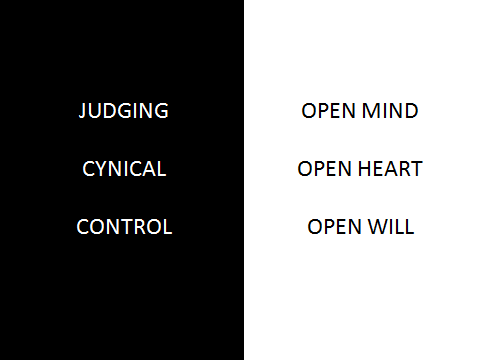
However – in my opinion – we too easily get away with joking about cynicism. In my opinion, it is the cancer of today’s organizations that seem great at the outside, but grim at the inside. They look like golden cages. They offer all the perks possible, but they ignore 3 basic attitudes for any human being to function well.

#1: To have an open mind. Companies/People who do not have an open mind tend to retract into highly judgmental.

#2: To have an open heart. The next level is that of the heart. People who do not have an open heart have developed cynicism as a defense. They have learned NOT to show their heart.

#3: To have an open will. Last but not least, when there is no room for open will, we become control freaks.

In today’s society, driven more and more by openness and transparency, these “tricks” of judging, being cynical and control don’t work anymore.

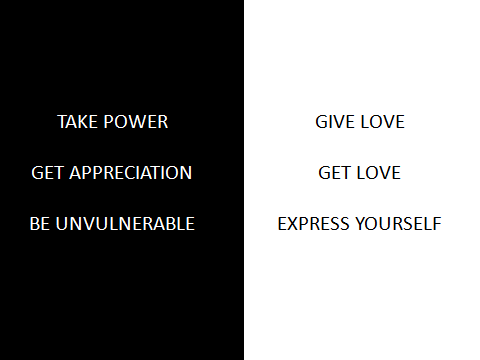
It all boils down to 3 fundamental needs for every human being:


image


People who are not able to express themselves (anymore), position themselves as “invulnerable”. In stead of being able to receive love, they compromise on getting appreciation. And in stead of giving love, the defense mechanism becomes one of taking power. As long as we have power games between the silos, the CEO can shout “change” and “innovation” as long as he wants, at the bottom of the pyramid nothing will change.

Surprisingly, the origins of these needs – and their fulfillment or not – is formed during the first 1-3 years of your life. In other words beyond the control of the organization you work for today.

But organizations should be conscious about these facts, and offer their employees probably the most interesting perk they can give: to follow a personal development program that lets the employee explore it’s true self.

  • Who am I ?
  • Who am I in a group ?
  • Who am I in the world ?
  • Finding your true passion.
  • Finding your true purpose in life.

And hopefully finding (or founding) a company that welcomes you respectfully as an employee, and gives you the chances to develop your true potential in line with your purpose.

It reminds me of Jim Collins and a 2003 blog post found back earlier today.

The start of the New Year is a perfect time to start a stop doing list and to make this the cornerstone of your New Year resolutions, be it for your company, your family or yourself. It also is a perfect time to clarify your three circles, mirroring at a personal level the three questions asked by Smith:

1) What are you deeply passionate about?
2) What are you are genetically encoded for — what activities do you feel just "made to do"?
3) What makes economic sense — what can you make a living at?

Those fortunate enough to find or create a practical intersection of the three circles have the basis for a great work life.

An to come back to the Global Workforce Survey:

  • In every industry, there are huge swathes of critical knowledge that have been commoditized—and what hasn’t yet been commoditized soon will be.
  • Given that, we have to wave goodbye to the “knowledge economy” and say hello to the “creative economy.”
  • What matters today is how fast a company can generate new insights and build new knowledge—of the sort that enhances customer value.
  • To escape the curse of commoditization, a company has to be a game-changer, and that requires employees who are proactive, inventive and zealous.
  • Problem is, you can’t command people to be enthusiastic, creative and passionate.
  • These critical ingredients for success in the creative economy are gifts that people will bring to work each day only if they’re truly engaged. (Eric Raymond made this point way back in 2001 when he argued that in the new economy, “enjoyment predicts productivity.”)

For passionate readers, i can recommend in this context Eric Raymond’s book The Cathedral and the Bazaar.

Or a bit an older – but still very relevant book – “The Cultural Creatives


Must be that I am some sort of +


positive guy when i turn a title like Emotional Zombies” into something positive like “The cultural creatives”

As Seth Godin was saying in his today’s blog:


One of the most common things I hear is, "I’d like to do something remarkable like that, but my xyz won’t let me." Where xyz = my boss, my publisher, my partner, my licensor, my franchisor, etc.

Well, you can fail by going along with that and not doing it, or you can do it, cause a ruckus and work things out later.

In my experience, once it’s clear you’re willing (not just willing, but itching, moving, and yes, implementing) without them, things start to happen. People are rarely willing to step up and stop you, and often just waiting to follow someone crazy enough to actually do something.

I’m going

Come along if you like


Reblog this post [with Zemanta]

Need for a new currency based on abundancy

Thanks to my subscription to Fredzimmy’s blog, I found this wonderful blog from Esko Kilpi.

image

I really recommend you to explore this site from A to Z.

  • Look at the wonderful slidedeck on Slideshare
  • Have a look at the Flickr photos
  • Have a look at the Bookmarks

image

MIT Media Lab Human Dynamics Group, Howard Rheingold (one of the first ever “internet”-books i ever bought,…, Barbarian Blog.

Yummy, Yummy. This is great stuff for a Sunday afternoon. So inspiring. Delicious 😉

This way, i discovered the FANTASTIC Web 2.0 Expo speech of Douglas Rushkoff about Radical Abundance.

It is a 15 min video, and worth every minute:

Not sure if the video embed worked, so in any case you can find it here by clicking the below image.

image


Some mind-blowing quotes (in 140 characters ;-):

  • The operating system for money is obsolete…
  • Abundance based currencies and monopoly based currencies…
  • Central Bank Monarch imprinted currencies are scarcity based currencies…
  • The money we use today was created so that rich people to stay rich by being rich (and lending) rather than doing anything…


google-coin

  • Our economy is based on the growth of interest
  • The people lending money get richer, the people creating value are getting poorer
  • But, what happens if you get something that’s abundant ? That you can’t make scarce.
  • The computers and networks change the “centrality” of value creation
  • You are now able to exchange value directly between one another rather than through a centralized currency
  • Optimize human beings to technology
  • Technology is more compatible with the values of efficiency than with all the other human values
  • Now you’re open and free to Google-Ads
  • Web³ will be won by the power of those who can index and aggregate. Is that what we want ?
  • Open Source and Crowdsourcing are not the same things
  • This notion of “free” leads to a society of copying, to no creativity, to no originality, to DJ’ing of culture
  • The abundance of genuinely creative output is declining
  • What we need is the development of a digital culture that respects the labor of individuals
  • What we need is the creation of new modes of currency based on abundance rather than scarcity.
  • I am talking about the original PayPal dream before banks asked them to be regulated like… banks
  • The next BIG thing are from people who will create genuine alternative electronic currencies and P2P exchange that do not involve cash.
  • I am talking about primitive local currencies such as Timebanks, Itex, Superfluid’s Quids
  • Cash has already lost its utility value, as it has been sucked out into investment capital, in the speculative marketplace
  • The only real competition against a Google universe (and their ideas of openness – see last weeks Google Blog post about openness btw) would be peer to peer exchange
  • We are not suffering from an abundance of creativity, just from an abundance of productivity, efficiency and openness.
  • If Web² leads to aggregation and indexers, then genuine P2P will lead to bottom-up value creation.
  • The next era is not about scaling-up anymore, it’s about figuring out how to exchange value, in stead of extracting value.
  • We are at a crossroads: right now we have the opportunity to optimize our systems, technologies, currencies to humans in stead of optimizing humans to them.


Reblog this post [with Zemanta]

Brand, Workforce and Innovation

If you’re interested in Innovation, you have to subscribe to Blogging Innovation. All posts are just worthwhile reading.

image

They also have a group on LinkedIn.

Today’s article typically resonated with me. It’s titled: “Combining Brand Management with Workforce Enablement”.

IBM-718954

It’s about the speech by Jon Iwata, SVP of communications and marketing at IBM on the future of the communications profession at the November 4th 2009 Institute for Public Relations Distinguished Lecture Series at the Yale Club in New York City. Full text of the speech is here.

Iwata says:

"One day soon, every employee, every retiree, every customer, every business partner, every investor and every neighbor associated with every company will be able to share an opinion about that company with everyone in the world, based on firsthand experience. The only way we can be comfortable in that world is if every employee of the company is truly grounded in what their company values and stands for."

IBM has developed an IBM Brand “System”:

Picture a framework with five columns. From left to right the columns are labeled what it means to look like IBM, to sound like IBM, to think like IBM, to perform like IBM and ultimately to be IBM. Simple enough. You could in 30 seconds create the same frame for J&J, Chevron or Ketchum. But of course it would — and should — take you much longer to fill in the details. Every word, every phrase and description in that framework would be painstakingly chosen. Because this is your corporate genome. It describes what makes your company unique. Developing the framework is hard work, but it’s only the foundation. Because, like a genome, the real work — and value — are in bringing it to life.

and also:

For example, we are now collaborating with our colleagues in HR to redesign IBM’s leadership competencies for the first time in many years. If this is ultimately approved by the CEO – and we’ll know in a few weeks – it will mark the first time in my 25-year career that the foundational elements of HR will not only be aligned with our brand and workforce strategies, they will be essentially the same.

I would like to see some examples on how this works in an environment where efficiency programs are run in parallel with innovation programs and (re)branding programs. What is the ideal role of HR in all of this ? Will HR be degraded to a “management” machine to deal with lay-offs only ?

I’d love to see more HR in a true leadership role. Leadership as opposite to management in its narrow definition of executing a course set out by somebody else. See also below the very important message about the role for HR in creating the eminence of our workforce.

About this, Iwata says:

But the building of constituency goes beyond the reaching of audiences. It gets to how a company establishes shared attraction and shared values: how it shapes not just common ground, but a deeper, enduring, shared idea.

They weren’t simply sending messages to audiences. They were creating audiences.

They weren’t shaping relationships with existing constituents. They were creating constituencies.

This is the basis of our Smarter Planet strategy. We are specifically and deliberately working to validate and stoke the optimism of forward-thinkers. We are saying to them – because we really believe it ourselves: “Your hopes for your industry, your city, your environment, your community are now within your grasp. This isn’t a metaphor. We can actually build a smarter planet.”

Our work of late tries to get at the real substance of change, the real issues on the table. The work is long-form. It’s argued, not pitched. It doesn’t focus on our products and services.

It purposefully invites people to

 think


Wow !


And lastly about Building the eminence of our workforce.

I believe that 2010 will be the year that corporations grapple with and ultimately accept that their employees are engaging with – and must engage with – social media. We’ll certainly go through a necessary period when people raise all sorts of objections.

The CFO worries about financial disclosure. The General Counsel fears intellectual property leakage. HR will say we’re helping competitors recruit our people. And everyone will be nervous about criticism of management. These are all legitimate.

So the answer to all this may be another set of policies and guidelines for using social media. My employer has indeed such a set of policies. They are difficult to find, but they exist. But are another set of policies and guidelines a solution. Will the fact that each employee has to sign-off the blogging policy or any other code of conduct really change our actual behavior ?

I doubt it.

Let’s say we actually do that. Then what? Policies and guidelines may keep individuals and their companies out of trouble but, by themselves, they won’t create business value.

The key is to build the eminence of our workforce.


What do I mean by “eminence”? No matter what their industry, their profession, their discipline or their job, people with eminence are acknowledged by others as expert. It’s not simply to know a lot about Tuscan villas, digital cameras or banking. You need to be recognized as an expert. And when you show up – in person, or online; in writing, or in conversation – you are both knowledgeable and persuasive. Because being an expert and being good at communications aren’t the same thing, as we all know.

Which is why


we need to make the creation

of this kind of workforce

an intentional act,

a new discipline in our function

Yes, we need guidelines and policy – but also training, resources and support for broad networks of experts.

Related to this, i found just a couple of days ago a great post from Hugh McLeod’s site titled: If your boss tells you, “our brand must speak with one voice”, quit.

I once had a boss who didn’t like the fact that I had a blog. Especially when I blogged about stuff that was relative to our industry. Yeah, “Our brand must speak with one voice” was his idea. Yes. I know.

Actually, the reality was, HE wanted to be “The One Voice”. He wanted all the credit, and all the rewards. He didn’t mind me put ting words into his mouth– stuff I had writ­ten– so long as the outside world gave him all the credit. But he didn’t want me in any other role, other than subservient, nowheresville wage slave. He fought tooth and nail to keep me from ever becoming a rainmaker inside the company, something he wanted all for himself.

And back to the end of the speech by Iwata:

To me, this is what “values” are about… and what “authenticity” means. This is about consciously choosing a unique identity. And it’s about actually being that unique thing you have chosen to be.

In other words:

Leading by Being

Every morning I wake up angry

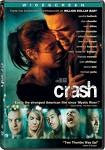
crash

It was triggered in me for the first time when I was watching the movie “Crash” featuring Sandra Bullock. She plays a rich wealthy healthy good looking woman that has everything. Has a great job, good family, fancies the better restaurants and clubs.

But she is spoiled and disconnected with the real world. She lives in an ivory tower.

It gets as bad as her saying during a morning breakfast discussion:

“Every morning I wake up angry”.


Angry

That emotion that was so present during (and after) the 18 month personal development program Leading by Being that a ended about a year ago now. The 23 Feb 2009 coming-out of that program also resulted in this blog.

My angriness this morning is basically triggered by an argument I has last night with my lovely wife about something really stupid. Nothing spectacular, but the feeling remained during the night. So, i had a bad night.

The trigger is pulled when i recognize that feeling of not living my full potential. When i feel swimming in syrup. What i feel i don’t progress anymore. Status-quo. It’s protest. It’s rebellion. It’s Anger.

In one of my previous posts i was writing about the holy fire. This time it’s maybe the devil’s fire.

This fire is also burning like hell, but the burning is one like

acid


It’s a lot of negative energy. It’s the devil inside me. The Hannibal Lector with his own (melo)-drama, showing himself as the complex persons as that suits him well, and does not force him to show his true (empty) self.

image

I went back to my notes of Leading by Being, “refreshing” what caused my angriness. This is what i found back:

image

It’s this feeling that i can do so much more but am standing in my own status-quo. Since the coming-out on 23 Feb 2009, there is not much i have done with all the nice resolutions i wrote down at that time.

It’s the feeling that you know very well what to do/change in your life to be your true self and not the self that you imagined for yourself. And being angry for not applying in any way all the great lessons you have learned in this program or in all the great books you have been reading in your life-time.

And feeling deep inside that something “big” is on your life-path, and that you seem to have missed it consistently or avoided it on purpose. The thing that Huge McLeod calls “You have to find your own shtick”

It was the fact that somehow playing around with something new, suddenly they found they were able to put their entire selves into it. Only the did it become their “shtick”, their true voice, etc. That’s what people responded to. The humanity, not the form. The voice, not the form". Put your whole self into it, and you will find your true voice. Hold back and you won’t. It’s that simple.

I have also been reflecting on this blog. I read quite a lot. Books. And I spent quite some time reading postings via my Google Reader. 2 hours per day is not uncommon (my wife loves me for this).

It really would not be difficult to post 3-4 new posts per day linking to other stuff i found interesting. And i discovered the trick that if my blog post title contains “Google”, or “Android” or… I get a lot more hits. But do those hits also mean impact ?

If so, it’s mere quantitative, not qualitative. And even when that happens, what does that do ? Make myself interesting and exposing how smart i think i am ? It is not satisfying. Anymore. Like others, I am in search for more

depth


I enjoyed much more the postings like holy fire. They’re more “authentic”. I know it is a big word. Maybe i should now share what stuff i am reading at this moment. Puts it all more in context.

I am in 4-5 books at the same time: re-read Seth Godin’s “Tribes”, devastated by Hugh McLeod’s “Ignore Everybody”, the disappointing Nick Carr’s “The Big Switch”, Howard Gardner’s “Five Minds for the Future”, Joel Garreau’s “Radical Evolution” and – in Dutch – Rik Torfs “Wie gaat er dan de wereld redden ?”  (translated: “And who is then going to save the world "?).

Those guys really inspire me.

I am inspired by what Howard Man, entrepreneur and the author of Your
Business Brickyard, has to say:

I’m continually amazed by the number of people on Twitter and on blogs, and the growth of people (and brands) on Facebook. But I’m also amazed by how so many of us are spending our time. The echo chamber we’re building is getting larger and louder.

More megaphones don’t equal a better dialogue. We’ve become slaves to our mobile devices and the glow of our screens. It used to be much more simple and, somewhere, simple turned into slow.

We walk the streets with our heads down staring into 3-inch screens while the world whisks by doing the same. And yet we’re convinced we are more connected to each other than ever before.

Multi-tasking has become a badge of honor. I want to know why.

I don’t have all the answers to these questions but I find myself thinking about them more and more.

In between tweets, blog posts and Facebook updates.

That’s why I’d like to write more about the real life. My life. Yours. My colleagues.

And not to show fear but

vulnerability


And to inspire others to dream.

What matters now

This is the time of New Year resolutions.

If you need some inspiration for your resolutions, I can recommend Seth Godin’s latest free e-book ‘”What Matters Now”

image

You can download it here.

It’s a collection of wonderful one-pagers written by smart friends of Seth Godin about noble themes such as Generosity, Fear, Passion, Compassion, etc

It also has a couple of advertisements for a fund-raising campaign for “Room to Read”, a program for providing books and education to children in developing countries.

image

In the collection of one-pages, the one that attracted immediately my attention and that really resonated with me was …

image


Have you ever wondered who’s behind that little voice in your head that tells you, “you’re in this by yourself, one person doesn’t make a difference, so why even try?” His name is Fear. Fear plays the role of antagonist in the story of your life. You must rid yourself of him using all necessary means.

We’re often impressed by those who appear to be fearless. The people who fly to the moon. Chase tornadoes. Enter dangerous war zones. Skydive. Speak in front of thousands of people. Stand up to cancer. Raise money and adopt a child that isn’t their flesh and blood.

So, why are we so inspired by them? Because deep down, we are them. We all share the same characteristics. We’re all divinely human. Until Fear is gone, (and realize he may never completely leave) make the decision to be courageous.

The world needs your story in order to be complete

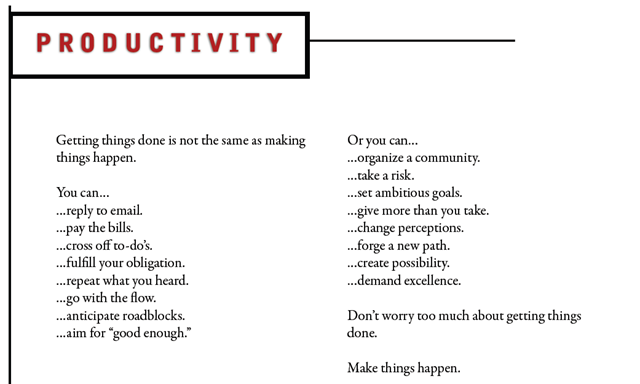
Or about Productivity:

image


Or about Gumption:

image

I want to be fear-less

I want to be productive

I want to make things happen


I am hungry


Want to flap my wings


I want it now