Innotribe @ Sibos – News Flash 3 – Final Agenda Published


Print

Also posted on www.innotribe.com:

https://www.swiftcommunity.net/blogs/blogDetail.cfm?id=1525

We have just published the final detailed agenda of Innotribe @ Sibos 2009.

An overview of
– Innotribe Opening and Closing details
– All keynotes
– All Face to Face panels/debates
– All Innotribe Sibos Labs sessions
– All R&D Insights sessions
– Names and business titles of all speakers, moderators, and facilitators.

You can download the PDF here: 
https://www.swiftcommunity.net/communities/download.cfm?id=5114

You can see the on-line version here: 
http://www.swift.com/sibos2009/conference/Forumsandstreams.page?

Enjoy !

Innotribe News Flash 2 – Innotribe Sibos Labs

Also posted at:

https://www.swiftcommunity.net/blogs/blogDetail.cfm?id=1514

Exactly one month to go ! Then Innotribe @ Sibos will kick-off for an exciting week of inspiring presentations, face to face discussions, interactive workshops, and special challenges – all aimed at one single goal: enabling collaborative innovation.

clip_image002

Feel the heat building up at www.innotribe.com. The community is buzzing of new ideas. As you will see, our Innotribe Leaders have changed gears and are now posting very actively to collect your ideas to work on them during our Innotribe Sibos Labs from 14-18 Sep 2008 in Hong-Kong.

Some quick links:

Mash-up:

https://www.swiftcommunity.net/communities/blogdetail.cfm?id=1512

Corporates needed:

https://www.swiftcommunity.net/communities/blogdetail.cfm?id=1511

So, here is our 2nd News Flash on Innotribe.

Today, more detailed information about the Innotribe Sibos Labs.

The Innotribe Sibos Labs are one of the key components of Innotribe. These are interactive workshops, fully equipped with tools and connectivity, to brainstorm on new ideas but more importantly to make these ideas tangible in application mock-ups or prototypes. These Sibos Labs will be led by the Innotribe leaders helped by professional facilitators from The Value Web. Additional help is offered to the participants by two Venture Capitalists acting as "consultants" to the teams. The Value Web will simultaneously scribe to advice / assist groups in packaging their idea. We will also have a number of PC’s with internet connectivity available to help documenting the ideas and to possibly make some mock-ups of applications illustrating the ideas.

image

The objective of the first Innotribe Sibos Lab on 14 Sep 2009 is to generate ideas and selection criteria to be used for evaluating the ideas. First we will create working groups per theme: Cloud, Crowd, Mash-up. Participants are asked to join the group of their "prime interest". "Prime" implies that the topic is not exclusive and leaves space for transversal ideas. Each team goes in a dedicated space, and find an assignment. The groups will brainstorm with the Innotribe leaders on how the Cloud, Mash-up and Crowd trends can transform the industry. "knowledge kiosks" will propose food for thought in free access: Hand-out with ideas from the swiftcommunity.net, any document collected upfront, etc. Groups will reflect on the criteria that would best qualify the ideas proposed. New assignments will be brought in, to shift the focus of the discussion. The challenge is to introduce the filtering process without restraining the creativity of the group. Assignment shall be more of an invitation. Expected outcome is a first draft of idea/ideas and a documented set of relevant criteria

The objective of the second Innotribe Sibos Lab on 15 Sep 2009 is to narrow down ideas to likely candidates to be developed further and “sold” to buyers panel during the Innotribe Closing. The groups will go back in same configuration as day before and iterate and their ideas. The assignment will invite to select one idea before going forward (if not already done). This session will be about refining your ideas – give them spin & shine. The Value Web facilitator will suggest many different tools and techniques to sell their ideas (glossy add, marketing with the public, raising capital, getting developers to mock up, using the VCs etc…). We will also use Guy Kawasaki’s 10/20/30 rule for making good pitches. Expected outcome is to have framed idea(s) – the core of what the teams will present to the buyer’s panel should be clear.

During the third Innotribe Sibos Lab on 16 Sep 2009, we will mock the ideas up in order to get them ready for a presentation to the jury on the next day. The groups go back in same configuration as day before and iterate and their ideas. Facilitation will invite to further refine outside of the time & space that is offered in the Lab.

During the dry-runs on 16 Sep 2009 late afternoon, participants will refine their presentation and prepare for the oral with the buyer’s panel.

The Innotribe Sibos Labs will culminate into the presentation to the buyer’s panel during the Innotribe Closing on 17 Sep 2009. Each team will get maximum 8 minutes to give a condensed power presentation. More on the Innotribe closing in one of our next Innotribe News Flashes.

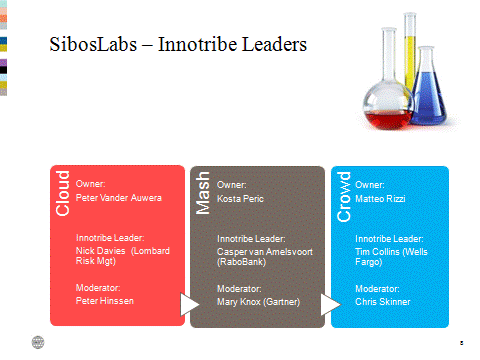
Innotribe Leaders:

clip_image006

Practical:

Where: The Innotribe Sibos Labs take place in the Innotribe Dome (located in the Sibos Labs room).

When:

– First Innotribe Sibos Lab: Monday 14 Sep 2009, from 12:15 – 13:45

– Second Innotribe Sibos Lab: Tuesday 15 Sep 2009, from 14:30 – 16:00

– Third Innotribe Sibos Lab: Wednesday 16 Sep 2009, from 14:30 – 16:00

– Dry-Runs: Wednesday 16 Sep 2009, from 17:30 – 18:30

– Idea pitches during Innotribe Closing: Thursday 17 Sep 2009, from 10:30 – 12:00

To let us know if you will be coming to this event, login to www.swiftcommunity.net, go to the Innotribe Sibos Labs event and click I will attend button next to the event. You can also see who else is coming.

Innotribe @ Sibos – Newsflash on Opening

Also published at:

https://www.swiftcommunity.net/blogs/blogdetail.cfm?id=1495

Within a little more than one month to go, Innotribe @ Sibos will kick-off for an exciting week of inspiring presentations, face to face discussions, interactive workshops, and special challenges – all aimed at one single goal: enabling collaborative innovation.

From now on, we’ll post regular news flashes about the details of the Innotribe program.

Today, more detailed information about the Innotribe Opening: “Beyond Web 2.0 – what will YOU create?”

We have chosen this title 1) to make the connection with last year’s Sibos Labs where the theme was Web 2.0, and 2) because we really wanted to have YOU work together to collaboratively generate and flesh-out ideas before, during and after Sibos.

The Innotribe Opening will give 4 perspectives on the future. It will set the scene for a joint journey with the audience -exploring how current and emerging trends will shape our industry and landscape. With vibrant and stunning examples our speakers will energize you to join the Innotribe, innovating and crafting the future as it emerges throughout the Sibos week.

· Innovation 2.0: It’s OPEN, not closed

Peter Hinssen (1969) (www.peterhinssen.com ) is co-founder of ACROSS Group and Managing Director of ACROSS Technology. An entrepreneur, lecturer and writer, he is also the chairman of Porthus.com and has been an Entrepreneur in Residence with McKinsey & Company. He will kick-off with a 15 min presentation on the need to innovate together with customers, partners, and the eco-system at large. Peter is a regular keynote speaker. Those who have seen him before will certainly agree with me that he is our ideal speaker to give a thundering wake-up call on this subject.

· The Future of IT: Driving Innovation across Financial Services

Bindia Hallauer is the Chief Technology Strategist for Worldwide Financial Services Sector at Microsoft Corporation, based in Redmond, Washington, USA.  In this leadership role, Bindia owns shaping Microsoft’s technology strategy in financial services industry across banking, capital markets and insurance. She owns the overall technical vision, architecture and roadmap, coordinating a single point of view for FSI solution offerings IP development and productization.

Session abstract: Bindia will talk about disruptive technology trends are shaping the future of IT.  Increasing software complexity and the shift to many-core architecture, consumer-driven IT, Petabyte storage and Petaflop processing power, and cloud computing are some of the key technology trends.  This session will focus on profound changes that the future of IT will bring to Financial Services industry.  Thought provoking ideas will be presented.

· The Shape Of Banking Architecture In 2023

Jost Hoppermann is Vice-President of Forrester Research. Jost serves Enterprise Architecture professionals, particularly around financial services. As an analyst, he is an expert on a number of global banking technology topics, including banking platforms, software infrastructure, multi-channel platforms, architecture, and application strategy planning. He also covers enterprise architecture from an organizational and process perspective on an industry neutral basis.

Session abstract: this session will summarize the key findings of a global Forrester research project focusing on potential changes in the banking and financial services space in 2023. It will show how financial services firms will interact with each other and with their customers in the future; which core competencies banks expect to need; how information technology and its successor business technology will need to help the business to differentiate from competition. While 2023 looks like a very concrete date, some banks will only need five or eight years to arrive in 2023 — to some degree — while others may have to take a 10 or 15-years-long path. Bulletized agenda:

– Business scenarios

– Customer interaction

– Business technology scenarios

– Peer advice for the future

· Innovating  Around the Customer

Cindy Murray is Global Banking and Wealth Management Ecommerce Executive at Bank Of America.

Cindy Murray is responsible for designing, building and launching new credit and treasury products across Global Corporate & Investment Banking to drive the acquisition and deepening of client relationships. Her team also leads the Ecommerce portal strategic direction and development for the bank’s corporate and commercial clients.

Session abstract: It was less than 5 short years ago when we heard the term Web 2.0 used for the very first time. If you fast forward to today, it’s clear that Web 2.0 is already morphing into Web 3.0. This session will not only highlight the basics of these technology trends, but more importantly show how they are enabling companies to “innovate around the client”. You will learn how ethnographic research can transform client needs assessments, how best to leverage clients’ discussion forums, and how the financial services industry will continue to be transformed by these new methods of client engagement.

· What’s up this week @ Innotribe ?

Kosta Peric – Head of Innovation at SWIFT, and Philippe Coullomb – Facilitator from The Value Web.

Kosta will introduce the 3 themes of this year’s Innotribe: Cloud, Crowd and Mash-up and the creativity challenge. Philippe will introduce the process and rules of engagement of the first Innotribe Sibos Lab, immediately following the opening. More about that in a next newsletter.

· Innotribe Leaders pitch their Sibos Lab

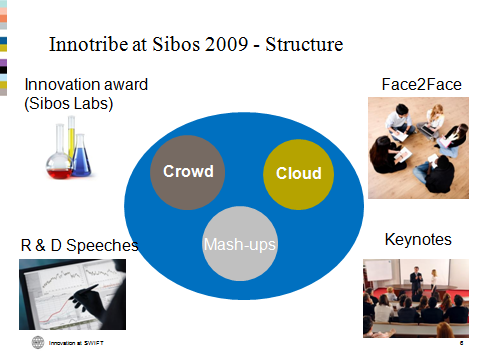
We plan 3 parallel Sibos Labs: one on Cloud, one on Crowd, and one on Mash-ups. Our Innotribe Leaders will introduce the ideas that emerged pre-Sibos on Swiftcommunity.net and will pitch their Sibos Lab as the best to attend.

Where: The opening will take place in the Innotribe Dome (located in the Sibos Labs room).

When: Monday 14 Sep 2009, from 10:30 – 12:15

To let us know if you will be coming to this event, login to www.swiftcommunity.net, go to the opening event and click I will attend button next to the event. You can also see who else is coming.

Virtual Worlds

Thanks to my job, i get in contact with interesting people. As preparation for the Innovation track at Sibos (called www.innotribe.com), our team is focusing on 3 themes:

  1. Cloud
  2. Crowd
  3. Mash-ups

In total we’ll have more than 40 speakers during one week, combined with speedlabs, debates, and R&D pitches. And during the last day, Guy Kawasaki will be part of our VC debate and Buyers Panel.

Detailed agenda available here.

As you have probably noticed, in my private life and endeavors (such as the Think Tank for Long Term Future), i am blurring the lines between real and virtual, between flesh & bone human and robots.

As a matter of fact, i am also blurring the lines between job and private here, and i  don’t see anything wrong with it.

What about virtual reality in a business context ?

Welcome to project Wonderland from Sun Microsystems. They will do during Innotribe @ Sibos a demo on the Virtual Bank Branch Office. In the meantime , have a look at below 2 videos, that once again proof how fast our real and virtual worlds are merging.

First listen to the project manager, Nicole Yankelovich. What’s really interesting is that the sort of people that work on this are true hybrids: a mix of nerds, psychologists, anthropological and ethnographic R&D…

This video is a hidden job advertisement, so you’re warned 🙂

But this sort of stuff and skills is really were we as a society should put stimuli and scholarships for our net.generation to be ready for 2030. Those who are 20 today will be 40 by then and our next leaders.

Then enjoy to this wonderful Wonderland scenario tour based on the preview of version 0.5 in their labs:

First time i see things like federation of worlds. I already heard about federated identities, federated clouds, federated services, but this ? No, not yet.

Oh yes, you can also restore a world in his previous state.

However, i still find that the user is forced into the developers mind of properties, cells, etc. No way i can explain this to my dad. It’s like the first time you see Windows: only if you get used to it, you start making sense out of it. You adapt to the programmer’s mind.

Think.

Tank.

Thanks to Amir for providing me the links.

Augmented Reality in iPhone 3GS

Thanks to my twine.com subscription to “Technology Trends”, i found this.

You can read the related article here.

In case you doubted that man-machine are blurring more and more everyday.

The (ir)relevance of the desktop


How relevant will the desktop be in the next 5 years ? I don’t know about you, but I do more an more in online tools such as hotmail, gmail, googledocs, etc

I want to offer you 3 perspectives to this trend:

– A business to business point of view (Salesforce)

– A 2007 (!) vision by Aza Raskin from Mozilla Labs

– The announcement of Google Wave and OS

I have included 3 video is this post. The first one is short (1:54), the others are longer (1 hour 20 min) and (1 hour 20 min) respectively. But i can assure you they are worth every minute.

Let’s start with Salesforce. On 9 June 2009, I attended the free Salesforce-event “CloudTour 2009” in Eindhoven, Netherlands.


This was a very, very professionally run event with very professional speakers (drilled like an army). They flew over a number of hotshots from San Francisco for this event.

Some key facts about Salesforce:

  • 1,2 Billion $ revenue in FY 2009
  • 59,000+ customers
  • 1,5 Million users
  • 100 Million API transactions per day
  • Average response time: 300 Milliseconds
  • 3 releases per year, without any disruption for customers
  • Customers: big to small. Some examples: Solvay, VUM, Polycom, DELL, Corporate Express

All this to say this is not Mickey Mouse business: these folks exist for 10 years. This is mature business.

Their tag-line is: NO SOFTWARE.

Everything runs in the cloud.

There was a great demo on deep integration in Services Cloud of Twitter, Facebook discussions in Salesforce app, direct visibility in Google search. All in real-time.

Another demo was about “Building an app in 30 minutes”. They built in essence an expense report app like most companies have. Built and on-line in 30 minutes: With currency conversions, linked to accounts for which the expenses are incurred, with approval workflow, access management etc. All this was point and click. Not one single line of coding.

Peter Coffee, Director Platform Research had some strong messages about the economics of cloud. He stated that all of the following is commodity and does not add business value, and is ready to go to the cloud: Email, twitter, backup, security, virtualization, OS patches, running an Operating Centre, messaging. He also stated that SaaS, IaaS, PaaS are not relevant in itself. It’s about the apps and the business value add you create with that. And that cloud is NOT about IT budget cost reduction !

It is about moving from “less low level people on less value tasks” to “high value level people on high value tasks”

Your IT budget may go UP over the years, as you spent more on high value tasks

Beware of the expectation it is easy or cheap

When strolling through the exhibitor space, picked up a comment from a customer:

Now that I have this, I never want to go back to on-premise. This works. Never any probs of crashes and alike or things that do not work. Unbelievable I ever accepted doing business the old way.

Let’s have a  look at what Aza Raskin had to say about the desktop.

“Had” because this is dated May 2007, more than 2 years ago.

I am a big fan of Aza. See also my post on Mash-ups and Cloud and Semantic Web.

His bio is fantastic:

Aza is currently the Head of User Experience for Mozilla Labs, where he works on crafting the future of the web. He’s led projects ranging from semantic language-based interfaces (Ubiquity), to redesigning the Firefox extension platform (Jetpack). Aza gave his first talk on user interface at age 10 and got hooked. At 17, he was talking and consulting internationally; at 19, he coauthored a physics textbook because he was too young to buy alcohol; at 21, he started drinking alcohol and co-founded Humanized. Two years later, Aza founded Songza.com, a minimalist music search engine that had over a million song plays during it’s first week of operation. In another life, Aza has done Dark Matter research at both Tokyo University and the University of Chicago, from where he graduated with degrees in math and physics.

His GoogleTalk in 2007 was titled “Away with Applications: The Death of the Desktop”. On the opening picture, he looks even a bit like the very young Bill Gates ;-). Aza was born in 1984. So 25 years old now !

And it is NOT about bashing on Microsoft. He is explaining why it does not make sense anymore to follow what has been.

He is using some pretty powerful metaphors: the shovel analogy, “it’s not Microsoft’s fault”, Analog vs. Digital watch, “Start with the manual”.

If you don’t have the time to view the full video, go straight to minute 21 or so. In essence most user interfaces force the user to adhere to the program hierarchy of the developer.

He goes on with seeing natural language as a universal access to application: like you search the web, you could also search services. Basically, there are 4 “do this” commands: create, select, navigate, and transform.

Aza will this week also speak at TEDGlobal 2009 in the Connected Consequences track. I have also invited Aza to speak at SWIFT’s Sibos 2009, in the Innotribe track for which i am the overall content owner.

Enjoy Aza !

The other announcement that created a twitter & blog storm on the internet was Google Wave. Just google “Google Wave” and you will see what i mean 😉

I don’t get all the criticasters. This is really very cool stuff and it is going to change fundamentally how we think of online communication. I strongly recommend to watch every minute of this launch event video.

On May 29, a couple of days after the announcement, i spotted a Facebook comment from a person with a quite high-level position in the Belux Microsoft organization: "Not impressed by Google Wave. More of the same in a different jacket. Ever watched conversations in Outlook 2010 ?"

As i am an ex-Microsoft employee, and still have some friendly contacts there, i wrote him an e-mail and explained that i was soon going to write something on my blog on this and the relevance of the desktop.

I asked to share some links to Outlook 2010 to be able to link my readers to what Microsoft has to offer in this area so that my readers can make up their own mind ? This is the answer i got: “Outlook 2010 is in Technical Preview – we cannot show outside. But if you look on the web you will find a couple of things about it.”

So it’s “help yourself” at http://www.microsoft.com/office/2010/. Oh yeah, you probably will have to pay for Office 2010. Last week, Microsoft also announced they will offer a FREE on-line version of Office as part of the upcoming Microsoft Office 2010 release.

To close this post, a really good opinion on this in Hutch Carpenter’s blog “I’m actually not a geek”. One of his latest posts relate to SaaS and also relates to Google’s more recent announcement of the Chrome OS.

He positions all this in the context of Clayton Christensen’s “disruptive innovation” model, and goes on:

Which brings us to the PCs of today. They are marvels, providing a slick experience for users and able to accommodate a host of new applications. But if I were a betting man, I’d say the most common activities people do with their computers are:

  • Surf the web, engage in social media
  • Email
  • Write documents
  • Build spreadsheets
  • Create presentations
  • Consume and work with media (video, music, graphics)
  • Use web-based business apps

Among those activities, what’s the magic of client-based computing? The media-related activities perhaps require the horsepower of a client app. But even those are getting better with web apps.

I recently decided to switch from hotmail to gmail.

Competition is good.
Consumer Genetics Show


Found this link about the Consumer Genetics Show via a tweet from Tom Hague of the Open Calais project. Tom tweets that he never expected to see the words “Genetics”, “Consumer”, and “Show” to come together.

Coincidently, at about the same time, i am reading the following paragraph in chapter XV – Time Warp in the book “As the future catches you” by Juan Enriquez.

“Almost any species can be cloned today…

“In the United States, it is illegal to use federal funds to clone humans…

“But it is not illegal to clone a human… (except in California, Louisiana, Michigan, and Rhode Island.)

“Nor is it illegal in Singapore, Russia, Brazil, China.

“And if you combine desperate customers…

“Rapidly evolving and highly decentralized technology…

“And the moniker of “the first scientist to clone a human”…

“The incentives are too great to stop this from happening.

Juan Enriquez also had a great speech at TED 2009:

I am a big believer that we will see the biggest breakthroughs and innovations on the cross-roads of ICT and Bio-engineering.

And i would like to add one more dimension to it: the Global Brain or the Semantic Web.

Example ?

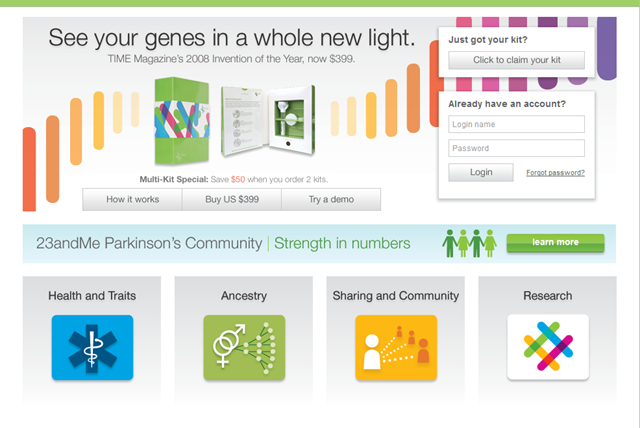
One of the companies mentioned in the article on the Consumer Genetics Show is 23andMe.

image

A customer of the Web-based service 23andMe sends in a sample of spit and receives a genome-wide analysis of nearly 600,000 genetic variations. The results include an estimate of genetic risk for various diseases, along with other personal information, such as where the customer’s ancient ancestors might have come from. Price tag ? 399$

Sergey Brin, the billionaire co-founder of Google plans to contribute money and his DNA to a large study intended to reveal the genetic underpinnings of Parkinson’s disease. See also this article in the New Your Times dated March 2009.

23andMe is co-founded and co-managed by Mr. Brin’s wife, Anne Wojcicki. The company offers a personal genomics service, in which it scans the DNA submitted by its customers and provides information on their health risks, ancestry and other traits. Esther Dyson is a Board member.

Start thinking DNA and gnome in the cloud.

“Getting a genome sequence has never been an end … just a start” -  Craig Venter

Mash-up, Cloud, Semantic Web

Have been on the road quite a lot with a bag full of new ideas.

In all the discussions, it became clear for me that the end-game is about superior and dramatically better user experience.

The end-game is not cloud, the end game is not Web 3.0 or 4.0 for the matter. These are just enablers. The end-game is user experience.

And much of that experience will come from Mash-ups, real-time and giving the power for creating in the hands of the end-user.

We all have seen the Google map mash-ups with addresses of best bars in town. For sure a life-critical application, but what i have seen the last couple of week is a bit more impressive.

I will NOT cover Google Wave announcement, as already all over the place, and this blog is not intended as just an echochamber of other sites.

It all started at the iMinds conference some weeks ago, where i saw a presentation by Ben Cerveny from Stamen Design. Ben used to be one of the founders of Flickr.

Ben was really mis-casted in a political-themes-debate, but did well anyway. He gave a pitch about the importance of web-literacy of our population, and about identity in a special way. For ex everybody recognizes the New-York skyline. But would you also identify yourself with the traffic visualization map of your own city ? Ben showed some great visualization examples. Have a look at http://delicious.com/benstamen. I most like the swarm example and the cab-spotting. The swarm shows you real-time visualizations of chat/twitters/social media conversations. The cab-spotters is also real-time, and the resulting visualization shows most used street patterns.

Thanks to my sponsors, I also was lucky to be able to attend Semantic Web3.0 in NY some weeks ago. Many good stuff, but i would like to share at least 3 examples: Aza Raskin from Mozilla Labs, Dan Willis from Sapient and Alex Karp from Palantir Technologies.

Aza Rasking (have a look at his bio on wikipedia, the guy was already a star at the age of 17 😉 is Head of User Experience at Mozilla Labs, and gave a preview of some cool things that will come out of the box in Firefox. And yes, I know IE8 Accelerators can do similar things but not quite yet.

Aza gave demo of Ubiquity and TaskFox.

Here is Ubiquity:

And here is TaskFox, a bit slimmed down version of Ubiquity in Firefox:

Dan Willis from Sapient gave a presentation on what happens when machines talk to machines. He did a great pitch illustrating with some sort of Kindle device with transparent screen capturing signals from semantically enabled objects. I love the very last example about taxis that radiate their traffic violation history. His presentation is on slideshare below, but you should really have heard Dan’s voice-over during the conference which makes it much more lively.

Last one for today comes from Palantir Technologies. At Web3.0, Alex Karp gave an amazing demo about a mortgage fraud investigation system, build as a mash-up of many different data-sources that were exposed with semantic techniques.

Here is the video of the Mortgage Fraud Investigation app. http://www.palantirtech.com/government/analysis-blog/mortgage-fraud. Many other staggering mash-up videos from Palantir are at http://www.palantirtech.com/government/videos

The point i am trying to make is not that these are cool videos. The point i am making is that all these use the principles of the semantic web (which is essence is about giving meaning to data, meaning that can be exploited via APIs by a computer), ideally run in a cloud (where integration is done these days at data-level), enabling great user experience.

Think Big – Think Open

My friend xstof pointed me at ThinkBigManifesto. I started this blog with “Inspire others to Dream”. It could have been “Inspire others to Think Big”. And the advertising text of ThinkBigManifesto suggests: “Big thinking is open and generous, discerning and judicious, yet not judgmental. Big thinking is not excessive, nor is it about the pursuit of excess. Rather, it is moderate.”

Google is big. Google is about Thinking Big. But what would it take to become a Google-Killer ? “More transparency and less opaqueness, more open”, says Jeff Jarvis in his short video posting on www.bigthink.com about the Google Killer. Jeff Jarvis is quite known from his bestseller “What would Google do”.

But how open can you go ? Whereas in the past “standards” or “protocols” were focusing only on the connectivity (how to get data from A to B) and syntactic (and sometimes semantic) standards for data standards and “messages”, today we have open standards for all layers.

I recently found this very interesting deck by Micah Laaker from Yahoo! I have to confess that these Yahoo! folks seem to be on top of everything these days. Also have a look at Yahoo Pipes if you have the time. Especially if one starts thinking about being open in a cloud and/or SaaS type of private or public community.

Micah basically proposes an updated set of standards for many more layers than we used to think of (with courtesy of http://developer.yahoo.net/blog/archives/2009/04/baychi_open.html):

1. Open Source (PHP, Hadoop)
2. Open Infrastructure (Amazon EC2 & S3)
3. Open Architecture (Firefox, YQL Open Tables)
4. Open Standards (XML, JSON)
5. Open Ontology (Microformats, RDFa). See also my recent blog on Smart Data and the OpenCalais project.
6. Open Access (Twitter, Yahoo! BOSS)
7. Open Canvas (Facebook, Yahoo! Application Platform)
8. Open Content (Google Reader, My Yahoo!)
9. Open Mic (WordPress, YouTube)
10. Open Forum (Digg, Yahoo! Buzz)
11. Open Door (Get Satisfaction)
12. Open Borders (OPML)
13. Open Identity (OpenID, AttributeExchange); btw have you noticed that Facebook is one of the first true big players to adopt OpenID ? Not as an Identity issuer, but accepting OpenID’s issued by other big players such as Windows Live ID, Yahoo ID, Google ID

Slide #43 gives a good overview which standards bring most value to what audience (users/developers).

This presentation was delivered on 14 April at BayCHI http://www.baychi.org The meeting Report by student Gregory Cabrera ends with the appropriate questions:

• Does the system need to be open in order for users (and developers) to derive value?

• Is creativity an important feature in the design of a platform?

• What are the features of a successful, creative, open system platform?

• How creative would you like your users (or developers) to be?

• How would you inspire creativity in the development of a product or service?

Imagine a business to business cloud. What of these or other standards would make your offering truly open ? Feel free to comment or to come up with “open” suggestions.

Smart Data go mainstream

Smart Data are the promise of the Semantic Web.

And yes, i heard the pitches from Tim-Berners Lee. But that sounded all so far away and abstract, and i could not imagine what it would give me as added value.

But the video & site below put this into a competitive advantage context and that’s where it gets interesting.


Check out the OpenCalais project: fantastic site with many interesting other links to semantic web related sites, blogs, etc. This will take me week to digest.

And these are not some geeks putting together something. This is an initiative powered by Thomson Reuters: “The Calais initiative supports the interoperability of content and advances Thomson Reuters mission to deliver pervasive, intelligent information. It builds on the company’s investment in semantic technologies and Natural Language Processing to offer free metadata generation services, developer tools and an open standard for the generation of semantic content. It also provides publishers with an automatic connection to the Linked Data cloud and introduces a global metadata transport layer that helps them leverage content consumers like search engines to reach more downstream readers.”

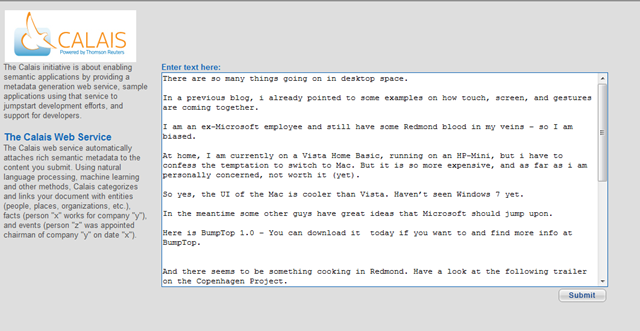
I decided to try the DocViewer at http://viewer.opencalais.com/ and i cut & pasted the full text of my recent blog on “My new desktop: touch and 3D of course” and hit the submit button:

image

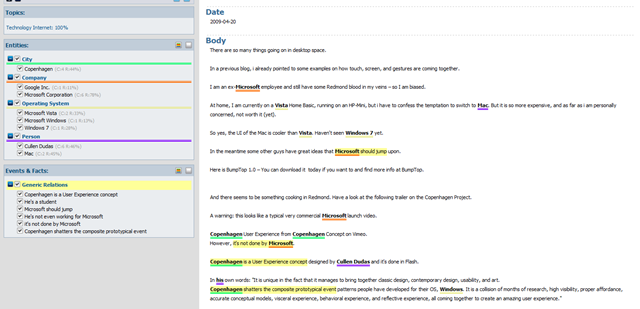
What i get back is amazing:

image

The unstructured data of my blog are parsed, patterns are recognized and semantic data is added. All this can now programmatically exploited as the APIs are published.

Imagine combining this power with drag & drop mash-up techniques such as Yahoo Pipes or similar.

Or imagine using this to feed info from financial data reference sources into your financial planning or even trading rooms. I recently have seen a similar demo, with very powerful multilingual parsing and pattern recognition of unstructured data, but this is the first time i see something that has the potential to go mainstream very fast.

PS: some folks ask me where i find these interesting links. Well, i spent quite some time researching on the web of course. But i also have some friendly secret sources. Friends that just share a link via Twitter or mail, and who themselves have no time or appetite to make a blog out of it. The subject for this post was kindly provided “xstof”