Compass Summit: can we win the race?

Last week, I attended Compass Summit.  After Contact Summit in NYC the weekend before, the contrast could not be bigger. Whereas Contact Summit was held in a worn-out synagogue, Compass was held in a 5 star luxury resort close to LA.

Also the audience was fundamentally different: in NY we saw a group of activists and revolutionaries (a good representation of the 99%): and the theme was “the evolution will be social”. In LA, scientists and economist – probably a subset of the 1% – shared the space for a couple of days under the overall tag line “What’s possible, What matters, What’s ahead?”

Innotribe was sponsoring both events. In Compass Summit, we also acted as co-curator and facilitator for 1 plenary on Future of Money, and 4 breakouts (see later)

Agenda and program

The Compass agenda was packed.

For a minute-by-minute coverage of the conference, I suggest to check out the #compass11 Twitter stream or Kosta Peric’s coverage by live e-scribing here.

UPDATE: all videos of all talks are now available here.

Instead of doing a vertical or chronological report on this conference, I will try to give you a horizontal report-cut of the topics discussed, and add some personal opinions to the mix.

The conference was a very high quality event, with super speakers from science and economy.

I left the conference with a mixed feeling: who will win, the positive scientists or the dooming economists? My overall take-away was that we are in a very deep crisis of everything, much deeper than most newspapers let us believe. I am worried for our children and what will happen the next 2-5 years.

Format

Compass Summit is a traditional conference, in the sense of  the format: speakers on stage, 20 min talks, fireside chats, and panel debates. The general sessions felt like a TED, but then one with audience interactions. Which gave the organizers a timing-headache as all the Q&A’s ran out time and so the whole conference program. No problem for me: as long as the content is as interesting as at Compass, I could stay there the whole night ;-). Towards the end of the conference, there was some experimentation with a “sequential conversation”, but there was more potential in that: it just requires more scripting and preparation. The Innotribe breakouts and wrap-up were – how would I say? – very “Innotribe”J . We always try to do something special, and you expect no less from us (more about this at the end of this blog post)

Science

The overall message was positive, although many questions were raised on the impact of the increasing human-machine blurring, and whether real life implementations of great ideas in current R&D will reach us in time to save the planet.

Danny Hills from Applied Minds and one of the originators of the Long Now indicated that “we are already in The Matrix” right now. “Nobody really knows how the Internet works” and “we overestimate the human ability to control and underestimate its adaptability” were some reflections leading to his conclusion “Forget the Enlightenment, we now live in the era of “the Entanglement.”

We also saw some great progress on Solar Energy production and photosynthesis Fuel. To put things in perspective: the energy needs for 2050 are such that if we want to cover it with nuclear energy, we would need to install one nuclear plan per day. The conclusion of the energy debate was clearly solar is the way forward and that energy storage was the Holy Grail for the immediate future.

David Gelernter stood out with a milestone presentation.

His talk was completely scripted, no slides. But it sounded like a novel, a piece of science poetry. So many beautiful metaphors, play of words, and fine humor! The content was mind-blowing as well. His starting premise was that we are witnessing the transition from a space-based organization of information to a time-based organization of information. Search starts smelling like value-based search, with time as just one of the values. The concept of a stream-browser instead of a web-browser was no less than brilliant, and I loved his evolutionary insight from “cybersphere” to “cyberflow”.

This was quite consistent with the messages form Brian Arthur and E. Stevenson: everyone is connected and it’s getting deeper and deeper…the grid starts to look like an organism, neural network. The underlying grid of machines talking to each other was described by Brian Arthur as “the second economy” that will soon be bigger than the real economy. The question “Who will win?” in the session “Race against the machine” – and also title of a new book by Andrew McAfee and Erik Brynjolfsson – was therefore spot on.

Cities and their dynamics and their impact on growth and innovation were also a recurring theme: Geoffrey West – world famous since his memorable TED talk – did his fantastic thing on “Cities never die”. Saskia Sassen added a new dimension for me: “a city talks back”, suggesting that a city tells us in immediate feedback loops what works and what not

Economy

The overall message was extremely negative. I was shocked by some of the facts presented.

Although we still see a growth in wealth creation, the wealth is more and more concentrated with the happy few. The 1% starts looking more and more like the 0.01%. The world is also turning younger, more urban, and more impatient for accountability, in both democracies and authoritarian states. We need a different diplomacy where also NGO’s, Philanthropies like the Bill & Melinda Gates Foundation, and companies like Google and Wall-Mart are represented. I believe that is a good starting point, as the concept of “country” is really dead. But the real question is what are the criteria for who can sit at that table: will be allow organizations like Goldman Sachs, who claims to rule the world, but is creating fake value through speculation, value outside of the real wealth system in my opinion. And whereas countries and UN are as good as dead, there is no transition in governance model between now and then, and we risk falling into a governance no-mans land.

Corporations are piling up cash that is sitting idle. Someone summarized this signal as “between fear and opportunity is paralysis”. In the meantime, the center of power and control is further moving East-wards: 2009 was the first year in 200 years where emerging markets outgrew developed ones. We aren’t going back.

Bernard Lietaer (author of “The Future of Money” and more recently “Creating Wealth: Growing Local Economies with Local Currencies”) was no less than impressive.

He showed that he had empirical evidence that the financial system is systemically instable. He pointed to some solutions to the monoculture of fiat state currencies. The most frightening was probably his statement that “we have 5-10 years to fix this, if not the game is over”.  This was the first (and not the last) time that the idea of war (as in world war) was uttered as a very possible scenario, and although Lietaer did not mention this, I interpreted his message as a warning for fascist behavior and polarizations.

And one day later, Mark Anderson painted a super confrontational picture between the USA and China, and indicated that the IP war was already going on, stronger even, that phase-1 of the war was over and we are already doing corporate body counting.

Add to this the Saudi Arabian oil situation, where the monarchy is a) paying it’s citizen from the oil reserves to avoid a Saudi Arabian spring and where the oil reserves will more and more be used for internal needs. Pierre Larroque added that Saudi Arabia is now in essence a supplier of China, and asked the question “why should we defend them?” Quite a statement!

Add to this water scarcity. Add to these big dysfunctions in education systems. Add to this the fact that the current young generation is the first generation that will enjoy LESS wealth than their parents. Add to this the #occupy movement, Middle East spring, etc. and the picture is not very rosy, the least to say

Values

Following his discourse in currency value debate, Bernard Lietaer also mentioned the need for more “feminine energy, presence and softness”, echoing a message from John Hagel in his blog a week earlier.

“Quod Demonstrandum Est” must have thought Caroline Stephens.

She gave the audience a wake-up call when stating “I have stopped talking about poverty in a 5 star hotel”. Her testimonials of future-less generations in South-America moved everybody in the audience, except the moderator who showed a pedantic lack of empathy and moved to the next point on the agenda by stating “now that we have solved a couple of world-problems…”

A genuine tweet from Heather Vescent sparked the Innotribe team to rally for an ad-hoc session to give Caroline the space needed for her message. It was interesting to see how people quickly tried to recuperate strong personalities like Caroline for their own agenda. It’s a very fine balance to walk. In the end, we failed to get such an ad-hoc session squeezed into the already busy Compass agenda. But we won’t give up: Caroline, we will contact you directly for one of next year’s Innotribe events.

The rest of the conference value discussions debated the rhetorical question whether value-based thinking is eroded by output concentration.

As a lot of the identity discussions were related to privacy, I quickly cover this under this value-section. One participant reacted somewhat sarcastic by saying that during the panel debate she almost believed that Google and Facebook were philanthropic organizations. We were probably closer to the truth when the moderator said “facial recognition will dramatically change what it means to show your face in public”.

Organization

Mark Bonchek introduced the notion of “Social Architecture” and gave a great example how this relates to networks and nation building during warfare. And how the US military has realized that shared situational awareness enables self-synchronization. It appears that the army’s counter-insurgency Field Manual (PDF Link) is “the best single guide for driving large scale corporate change.” After the conference we had a really interesting chat with Mark on corporate change and whether you really can steer change or whether it is just as effective to drop a seed bomb of corporate activists, and just watch what happens and emerges. That will be the subject of another blog

An interesting Risk Management debate revealed that trade-offs have to and are being made whether one should implement latest technology or proven technology only, and that the relentless push for efficiency pushes towards latest technology. If one would take the brain scan of the most adventurous CEO, one would see “40% risk taking, 60% risk aversion”.

Brian Arthur spoke about the “second economy” (see earlier). With some hindsight, I would like to suggest even a third economy underneath (or overlaying) that: “the values/spiritual economy”. What are the real values and intentions we have when completing a transaction? Values like transparency and fairness. Like belonging. Like intrinsic drivers of motivation such as the drive to acquire, to defend, to bond and to learn. Which brings us to education.

Education

It looks to me that the USA has a bigger problem with education than other continents. Or they focus more on it. I don’t think it is the latter. Michael Crow from Arizona State University was inspiring when stating “in stead of exclusion (to the education system), our metrics should be based on the output of our education system”. Other speakers insisted that the education system should celebrate from failure instead of exclusively focusing on and measuring success. Jack Hidary was passionate in his plea to “educate to innovate”.

But by the end of the conference, I got a bit tired of the so generic term “innovation”, used as the deus-ex-machina for world hunger problems, without specifying what the solution exactly is.

Innotribe sessions

In addition of the (rather traditional) plenary session on Future of Money with Bernard Lietaer, Innotribe was also responsible for 4 breakout sessions. Our team really went the extra mile in decorating the rooms, and using sound and visual landscaping to further add to the immersive learning experiences that have become the trademark of Innotribe sessions.

For the identity breakout we repeated our Sibos trick with the music from Tron. For the future of value, our ladies Mela and Martine almost created a zen-like experience with candles, rose leafs, and spiritual music.

From a content point of view, I would like to summarize each of them with a couple of tweet-like statements

–       The Future of Banking

  • “Money is the memory of value”
  • “Trust will define the future of banking”
  • “There are huge opportunities for banks in the unregulated space”

–       The Future of Transactions

  • “From the gift economy to the re-gifting economy”
  • “Transactions are the fuel to the relationship economy”

–       The Future of Identity and Trust

  • “Digitization of identity good or bad?”
  • “Identity should be part of digital inclusion”

–       The Future of Value

  • “The poverty of financial metrics prevents full wealth recognition”
  • “Right conduct + truth + peace +non-violence + love = living system of wealth”

Conclusion

Our economic, financial, energy, and wealth distribution problems are huge. The problems seem bigger and more insurmountable than the general press makes us believe. Scientists try to picture of optimism, but I could not resist the discomfort that the implementation of their inventions will come too late. Fear for war can turn any moment into a real possibility. And still our politicians don’t get it. We witness an aversion against the establishment in general. The cry to do without them gets louder.

But current problems and solutions are still presented as a game of winner and losers, with polarization leading to simplification, populism, and possibly fascism. I would prefer a model based on infinite game thinking. The world is the opposite of flat, and the role of black swans is not included in any of the models discussed today. It’s all about redefining a new value context, new value movement, less re-active, less “protest” than OWS, more pro-active.

It is about a collective awakening, where flow reveals structure. You can’t just start with structure and force everything to fit into it. It would be far better to create a parallel positive: a much safer way that just saying “nuke the system”.

Maybe I should close this blog post with the quote by Leonardo da Vinci that was printed on the back of the Compass Summit conference program:

I have been impressed with the urgency of doing. Knowing is not enough; we must apply. Being willing is not enough; we must do.

That’ s probably why the title of this blog post is “Can we win the race?” and why the Innotribe wrap-up ended with “It is only up to us to act”.

@petervan from the Innotribe team

Cross-posted on Innotribe blog here.

Metacurrency Collabathon: a wealth system

After Sibos, Q4 is usually the period of the year when I try to re-boot, to refresh my sources, to be a sponge and take-in new knowledge. It’s when I start painting for the next year. When the themes and trends for next year start emerging.

I wanted to get a much better feel for what this world of alternative and complementary currencies was all about, and decided to join a week-end  “Collabathon” organized by Art Brock (@artbrock) and Eric Harris-Braun (@zippy314), the founders of The Metacurrency Project. In the slipstream of the Contact Summit, they wanted to gather the minds to work on NextNet ideas and tools.

From their site:

What is the NextNet? A computing/protocol stack for operating a distributed Internet which enables individuals and communities to transact, self-organize, self-govern and empower themselves to build resilience, sustainability, and thrivability.

It was a small group of people – about 50 or so- gathering that Friday evening. But what a brainpower – and soft-power – in the room! Almost all my twitter heroes were there: it was great and heartwarming meeting many of them in real life.

Friday evening was intro-day. Saturday and Sunday were un-conference days.

The weekend had something “sacred”. The consciousness level of the participants was overwhelming, and Art and Eric introduced the different topics with so much softness and kindness. And every session had some sort or spiritual presence check-in and checkout moment. The location was clean and spacious, with lots of silent breakout rooms, so you could have relaxed but intense conversations. This was about taking quality time with quality people.

Some of you may remember that Art was one of our “igniters” for the New Economies session at Innotribe at Sibos Toronto, but there we only had a couple of minutes.

Here at this Collabathon, Art and Eric gave a 3-hour deep introduction on The Metacurrency project. These guys are so smart, so full of wisdom, so articulated. It was awesome.

Metacurrency comes in two parts:

  • The Metacurrency principles: the value kit
  • The Metacurrency Project: a software foundation

For further background, check-out this fantastic Metacurrency orientation in Prezi: http://prezi.com/ijiokjbrolwo/metacurrency-orientation/

The principles

The picture above is the essence of the Metacurrency principles. Note how in the bottom left corner, speculative wealth – what Goldman Sachs and others do – is positioned outside of the living systems model. It is fake wealth based on fake growth.

Instead of just describing the model above – plenty of that on the Metacurrency site – I decided in this blog post to transform my notes into some sort of rhythmic at times poetic expression. Step in the rhythm with me:

Currencies are Current-sees

Seas

Sea/See

The flow of value

Experience

The flow of value

Shifts

Capacity shifts

Beyond trading value

Currency as language

Money is one single dimensional sentence of value language

The value of currency is to be able track currents/flows

Currency measures and fails to measure

Money only measures only certain types of values

Spoken and unspoken rules of social norms

Lead to currency

Not currency in isolation

Currency in context

We need to simplify

Not complexify

Make complexity simple in its USE.

Like alphabet

Composable

Letter, words, sentences, compositions

Compositions on-the-fly

Fractal

Composable language

Metaphor of the cow and beef

Once you have beef,

You can’t re-compose the cow,

You can’t go back

The beef misses the whole

Same for milk

The market price of milk has nothing to do with Bessie the cow

With Bessie’s wealth

In context

Wealth in context

Wealth has same root as “wellness”

Value is more contextual, you may not value it, but I may value it

Contextual wealth

We are contextual beings

The Commons of Economics?

“Ecommonics?”

How to account for wealth?

Redo

The company balance sheet

Based on wealth

Balance sheet as momentarily map

The difference between map and territory

The symbols are at the level of the map

Measuring

and missing out something by measuring

Are we missing the context?

Balance sheets in context

Chains of Balance sheets

Balance Chains

Well-being

In context

Worthiness

In context

Worthiness

Currency as an expression of worthiness in something

Worthiness and credibility

Cred

The cred in something

The cred of value attributes of entities

Entities

Humans

Circles

Enterprises,

Governments

Educational institutions

Even software code

Even projects

Reputation of entities

Human reputation

Code reputation

Project reputation

Reputation as a signal of worthiness

Institution design

Institution emergence

Institution intrinsic motivation

Richer measurement

Other than up/down

Like/dislike

Commoditization of relations

The software project

For full details, checkout following Prezi. The guiding principles for the Metacurrency Project are:

  • Disintermediation of any action, at all possible layer
  • Composability at all levels

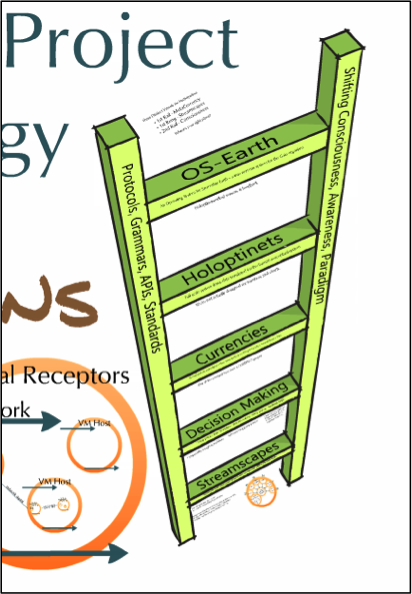
The ladder is about tools, grammars, APIs and standards on one side, and consciousness and new awareness on the other side.

The Metacurrency sees 5 different layers (steps on the ladder), each building upon each other, like emergent systems of small components:

  • Stream-scapes: a communication composition
  • Decision making: this is about flows, decision making, event based
  • Currencies: language for expression of value/wealth
  • Holoptinets: a new way of visualization of (big) data. Beyond graphs: with the richness of dimensions in an aquarium, a fish tank. The idea is to have an interface that fully exploits the human sensory capacities
  • OS earth: hat the Metacurrency is after is nothing less than a self-describing computing. And yes, why not be super-ambitious and aim for a redo of the whole computer infrastructure.

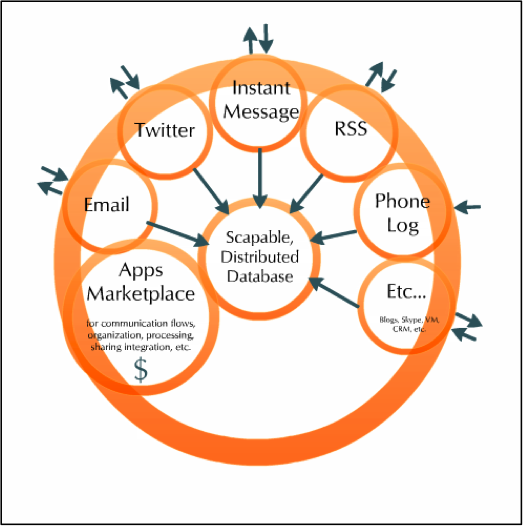
There were different sessions on this, the one already more geeky than the other. I particularly like the demo of stream-scapes:

In my own words, it is a sort of EAI-bus, a bus for channels, a channel mixer and filter. Basically, all possible communication channels (Email, Twitter, etc) are blended together in a “scapable distributed database”

A “scape” is a personalized “sculpture” of that blend, reflecting my personal interest and focus. The scape is a grammar. A self-describing grammar at communication protocol level. The idea that people can take existing stream-scapes, adapt/complement them and re-post them in a scape-store for others to re-use. People can build re-usable scapes (grammars) and UIs on top of that.

There was also a good discussion on the “holoptinets”. The initial vision was that the user looks to the fish tank from the outside. Movements of fishes, sounds of water, color, etc. are all expressions of data values. I made some contribution to the thinking by suggesting the user should be “in” the fish tank. Start thinking of concentric fish bowls, each circle representing the types and levels of wealth and the levels of systems integrity of the wealth model.

Is there any traction on all this?

I was witnessing the enthusiasm and passion in the different breakouts of the un-conference. For a lot of this, it is still very early days. And like at Contact Summit, these folks need some sort of coaching on how to “articulate” and “sell” their ideas.

I saw a lot of struggling with even trying to build a first communications strategy on all this. And in my opinion, those stories – if they already exist – are too much inwards looking, too much about the what and not enough about the why.

To get any traction, what needs to get done is to get awareness at senior executive levels. This is something where Innotribe can be instrumental. We can give exposure of these great ideas on the edge of our ecosystem to decision and policy makers. For example, it was a no-brainer to ask Art to fly-over with me to LA to the Compass Summit the next days to be part of our Innotribe Lab on the Future of Value. More about that in a later blog post.

What I found also encouraging was the presence of some Occupy Wallstreet residents. They had a plan to launch an OWS currency. When they saw the richness of Art’s work, they invited Art for a study day on alternative currencies the next Monday.

Because we need to think differently, and not just making a copycat of fiat currencies as a language for pure transaction value only in the left bottom corner of the wealth model.

There was so much richness – wealth – during these two days, that I am exploring the possibility to organize a 1-2 day deep Innotribe conversation with top bankers of our community. And as Art will soon move to Europe, it is a no-brainer to get him over at the SWIFT HQ for a brown bag session for staff and executives.

Next blog will take a bigger helicopter view and will be about the Compass Summit, a blend of technology and values looking at What’s Possible, What Matters, and What’s Ahead.

Digital Asset Grid: Let’s meet at the SWIFT Dance Hall

This post is a fifth in a series on personal digital identity. Part-1 “The unpolished diamond was published here in August 2010 and Part-2 ‘The Digital Identity Tuner” was published here in September 2010. Part-3 “Personal Data Something” was published here in December 2010. And part-4 “Austin-Munich-Toronto” was published in February 2011 here.

Drawing by Hugh MacLeod (@gapingvoid) during the Innotribe Deep Dive on Digital Identity, Sibos Toronto, September 2011.

That was February 2011. Since then a lot happened. I had so many rich discussions, met so many new fascinating people, and have been aroused by a deluge of new ideas on digital identity.  And my employer SWIFT gave the go-ahead for an incubation project on Digital Identity that is now called the “Digital Asset Grid”.

As I mentioned in my Innotribe Sibos report, the Digital Asset Grid (DAG) is important because:

  • We are moving from money bank to digital (asset) bank
  • The DAG is an infrastructure play for SWIFT to offer a certified pointer system pointing at the location of digital assets and the associated usage rights
  • It’s and economic imperative for SWIFT to expose its core competence via API’s
  • The DAG is a huge opportunity for SWIFT to be a key infrastructure player in offering an end to end hardened infrastructure and end-point to enable the seamless exchange of any sort of digital asset between any number of entities
  • This is also a huge opportunity for financial institutions to plug-in to this infrastructure for offering a new set of services in the data leverage space in un-regulated data market places

For me Digital Identity is so much more than your log-in, or our account-number that is backed by a Know-Your-Customer (KYC) process, or another userid/password or a security token.

I look at it a spectrum. Like you have a spectrum analysis for a star that uniquely identifies it, you can imagine a spectrum for the digital identity of persons:

Digital Identity Spectrum is everything from PKI, account#, Log-In to address, attributes, history, preferences, biometrics, reputation, risk profile, intentions, signals, etc and all this in transaction and time context.

It’s no co-incidence that Facebook recently announced “TimeLine”. Identity in time-context leads to your identity spectrum that is unique at one given time. And yes, you will be able to play it backwards like a movie, but also forward to do trend analysis and forecasting.

VRM (Vendor Relationship Management) is about sharing specific parts of my spectrum with specific vendor(s) in specific transaction context(s). In the Digital Asset Grid project we asked ourselves:

“What if we could apply the VRM principles not only to personal data but to any content, to any piece of information, to ANY digital asset?”

You could then start thinking about sharing specific parts of any digital assets with specific vendor(s) in specific transaction context(s).

In essence, what we are doing, is “weaving” digital contents with associated digital rights and who has the rights to that content.

It’s a map of digital weavings

of digital fabrics

This is how the Digital Asset Grid was born.

Is this not too consumer oriented for an organization like SWIFT? I believe this is the wrong question. The discussion “consumer vs. enterprise” has kept us blind. Same by all sorts of other customer segmentations like “small-medium-large”. In the identity ubiquity game, all this is segmentation is irrelevant.

We have to start thinking in terms of different sorts of entities that participate to the identity-dance. Those entities can be:

  • Person (humans)
  • Loose group of persons (for ex Google Circles), that have no legal construct
  • Commercial companies
  • Non-Profit companies
  • Governments
  • Educational institutions
  • Programs (code)

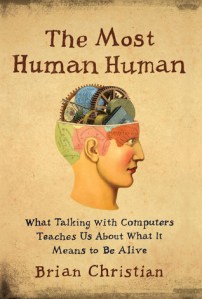
The last one – programs – is quite fundamental. We are witnessing the blurring between humans and computers. It smells like early singularity. And in this debate we should not only be concerned on how programs augment humans, but also how humans augment programs. But that is another more philosophical discussion, and some good reading on this can be found in the book “The Most Human Human” by Brian Christian. (Amazon Affiliate link)

Back to our Digital Asset Grid…

The vision of the Digital Asset Grid

is to move the SWIFT network and SWIFT services

from a closed, single-purpose, and messaging-based system

to an open, general-purpose, API-based system

It’s a natural evolution. That’s it. No disruption. No—“the next big thing.”

Just apply out-of-band our core competency to the modern age of connectivity. Instead of destabilizing the market by disruptive innovations, provide the basic infrastructure missing for a global transaction-based platform on the Internet.

Of course, its vision is grand, with plenty of innovative elements and thinking. Here are some examples how we move from the traditional identity “space” to the new “Digital Identity Grid”

I would like to zoom-in on one of the bullet points above: from one way request-response to full duplex dance.

The web – a collection of pages – is based on some simple request-response mechanisms. I request a page and the server responds and gives me the page. End of that transaction.

With the dataweb – a collection of Digital Assets with associated usage rights – we will need something where exchanging entities can perform a dance around and with the Digital Assets. And we want to be sure that they are who they say they are, and that they have the right usage rights to the digital assets. So we move from a two dimensional view of the world (in computer terms a “table”) to a multi-dimensional view (in computer terms a “graph”)

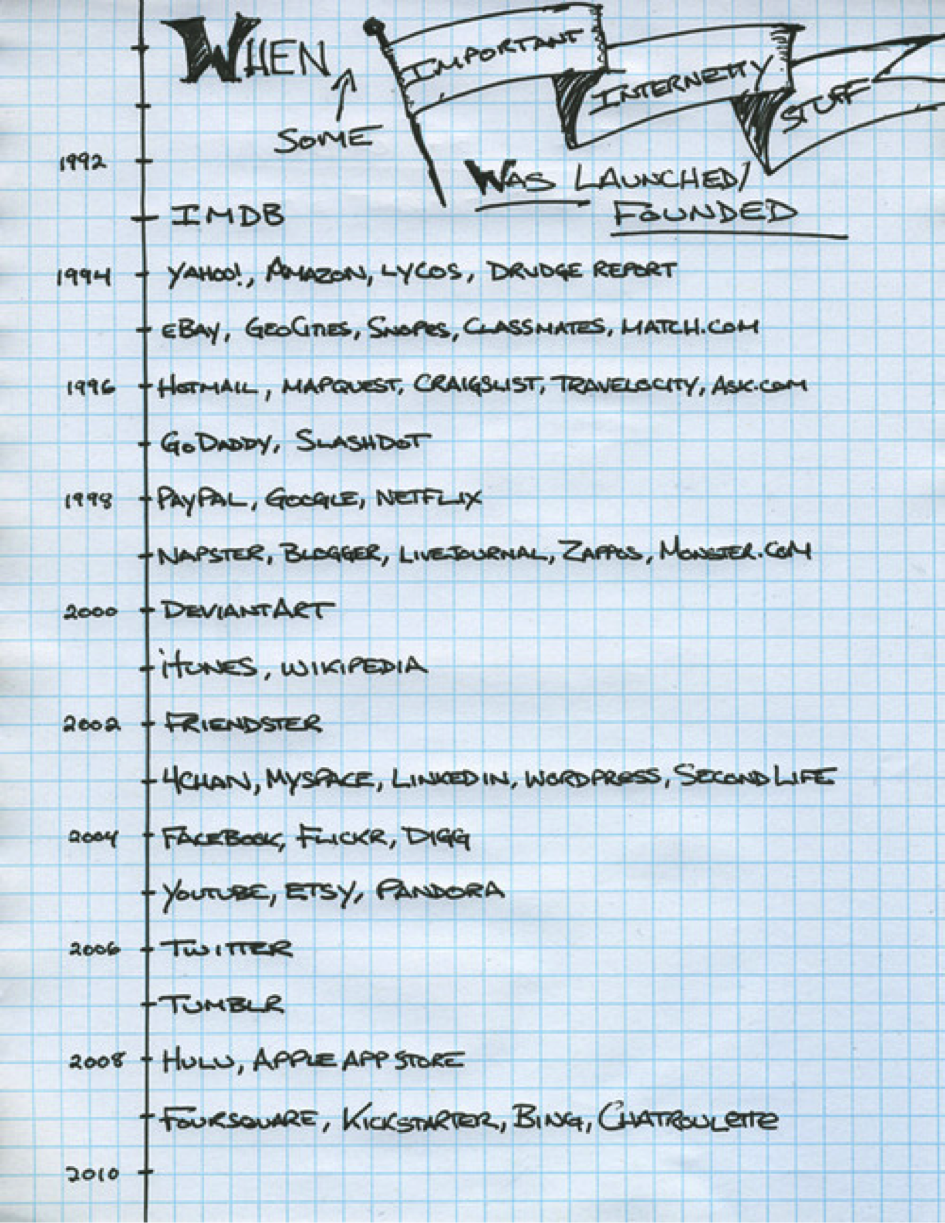
The Digital Asset Data Web is the next phase in the evolution of important internet stuff. It’s probably what comes next in the following series:

To continue the dance metaphor, the SWIFT infrastructure is the Dance Hall where entities meet to perform certain specific dances.

One of the many use cases for the Digital Asset Grid would be to solve compliance, In stead of moving messages from A to B, we keep the data where they are and “point” to them with SWIFT certified pointers to where the data are located and the associated usage rights.

The dance protocol (full duplex) for this use case, from opening of the dance with (a “webhook” in technical terms), to the actual picking-up of the content, and closing the dance and everything in-between, could look like something like this:

  • PartyA: “hey, I am sending a signal that I wanna dance the tango (slang for payment instructions) with any party in the Swift dance hall at 9pm”
  • PartyB: “yep, I wanna dance with you, let’s meet in the SWIFT dance hall at the bar”
  • PartyA: “ok, here we are, cool place ;-)”
  • PartyA: “Let’s get to business”
  • PartyA: “I just gave you following rights my payment instructions at this XRI: you have XDI pick-up rights”
  • PartyB: “ok, gotja. Will pick it up right away”
  • PartyB: “knock knock, I am coming to fetch those payment instructions”
  • PartyA: “let’s check if you have the usage rights….”
  • PartyA: “everything looks fine, go ahead”
  • PartyB: “loading, loading, loading…”
  • PartyB: “Ok I am done”
  • PartyA: “So am I”
  • PartyB: “tomorrow, same place same time to dance ?”
  • PartyA: “would love to 😉 9pm again ?”
  • PartyB: “sure, bye bye”
  • PartyA: “bye bye”

And, what’s really cool about it, it’s fully auditable, end-to-end.

When telling this story to one of my colleagues, I got the following reaction: “Hey, but you are changing the basic messaging paradigm of SWIFT… I am not sure that I want to support an innovation like this… one that is cutting off the branch from the tree I am sitting on…”

Here is something essential for innovation. Any innovation team in any company should not only look at some nitty-gritty small incremental innovations, but

daring to be great and to re-think

the cash cows of our companies

Like Guy Kawasaki used to say: “the best way to innovate is to set-up a company that is trying to kill your cash-cow”

All the above is about the infrastructure story that SWIFT could play in and in that sense is a bit navel staring. But the biggest opportunity however in all this is probably for banks, financial institutions, and new upcoming innovative financial service providers.

This is a HUGE opportunity to offer new digital services in non-regulated markets

Many examples and use-cases here :

  • Personal Data Lockers, Digital Asset Lockers, Digital Asset Services aka Digital Bank, « Who-touched-my-data » services, Personal Data Trading Platforms, Digital Asset Trading Platforms, Corporate and Bank Klout Services, Audit services, Tracking services, Big Data and Analytics services, EBAM, Corporate Actions, etc.
  • Also e-Wallets of all kinds. Not only « wallets » for money but wallets for all sorts of Digital Assets. An e-Wallet is nothing else than a browser on a personal money store. What if we start thinking a browser for a personal data (asset) store?
  • And I spoke recently to one of our managers in Securities Business : also there plenty of examples, even in looking at trading assets.

So far, the Digital Asset Grid was just the result of a research project at SWIFT. Today, I am very pleased to announce that the SWIFT Incubation Team just gave the green light to move this project in prototype stage.

It means that during Q1 2012, we’ll have a working prototype targeted at a specific use case, but we will expose the API’s of the infrastructure and give them in the hands of developers and challenge them to come up with some cools apps that can be built on top of this infrastructure.

A lot of the thinking in this blog is the condensation of a lot of teamwork of many many people who participated to this Digital Asset Grid project. With the risk of missing out somebody, I’d like to send out a digital invitation signal to those people for a thank-you dance in the SWIFT Dance Hall: Mary Hodder, Kaliya Hamlin, Doc Searls, Drummond Reed, Craig Burton, Andreas Weigend, Gary Thompson, Tony Fish, and also lurking-in Don Thibeau, Scott David, and Peter Hinssen.

I would like to say Thank you! Maybe with David Bowie’s 1983 hit “Let’s Dance”? http://www.youtube.com/watch?v=N4d7Wp9kKjA

Let’s dance put on your red shoes and dance the blues
Let’s dance to the song they’re playin’ on the radio

Let’s sway while colour lights up your face
Let’s sway sway through the crowd to an empty space

If you say run, I’ll run with you
If you say hide, we’ll hide
Because my love for you
Would break my heart in two
If you should fall
Into my arms
And tremble like a flower

Innotribe Mumbai : Indian Waves and Genuine Smiles

After Kosta’s wrap-up about the event some days ago, i’d like to share with you some personal impressions and lessons learned from this event.

We have been designing this event for a couple of months. Not every day 100% – though that may have been true the last two weeks when everything comes together – but a quite substantial piece of our time.

As many of our events, it all looks a bit like chaos – organized chaos.


It looks like

things happen by magic,

but there is no magic


There is just an awful amount of preparation and design.  We spent quite some time to think through the design of our Innotribe events.

But despite all the preparation, debriefs, visuals from the location, hotel rooms, etc, etc the whole thing comes really alive once you actually are on-site and see/feel the actual space that will be hosting your event.

I landed in Mumbai around 1am the morning of 31st May 2011. Baggage got lost in London Heathrow. It was 2:30am before i was in my hotel room. Tired. The rest of the team already flew in the day or some days before.

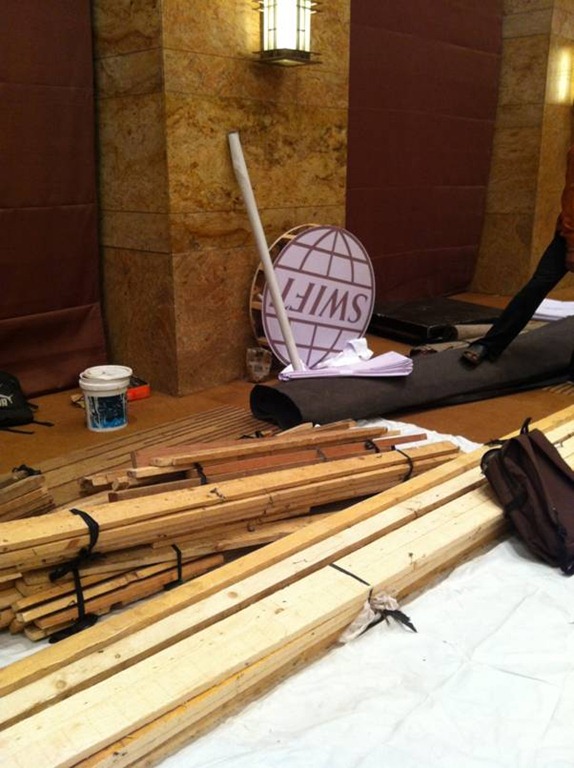
After a short night, team briefing. So far everything in pretty good shape. We have hijacked 2 rooms and use them as our headquarters. Don’t have pictures of this, but everybody is crew: Kosta and Matteo sitting on the ground cutting hardboard. In the meantime, the facilitation crew is changing once more the design of the event. It’s getting better and better.

Lessons learned so far:

  • Everybody in the team is crew.
  • I have to let go at this stage. Have the impression my interventions don’t add value anymore. My presence is becoming distracting. Let the team do what they need to do. Don’t intervene. Trust the process

Next checkpoint: room set-up at 7pm. Problems. The previous event has not even started breaking down. And the hotel turned off the airco in the ballroom: no need for airco for night workers… Room is steamy hot. There is nothing we can do. It will take at least till midnight before our audio/visual and stage guys will have set up our stuff. Decision: let’s go to bed early and gather back at 4am for general set-up.

clip_image002

Here is Alex keeping the morale up !

June 1, 4am: room is not ready yet. Some team members worked till 2am. Has hardly 2 hours sleep. You can feel the fatigue and the irritation settling in. 7:30am and we have not done even the sound-check and dry-run. Airco is back on.

clip_image004

Somehow – as by magic – all pieces of the puzzle fall in place. It’s 8:30am and the registration desk open. Quickly to room for shower and changing cloths so i don’t smell on stage.

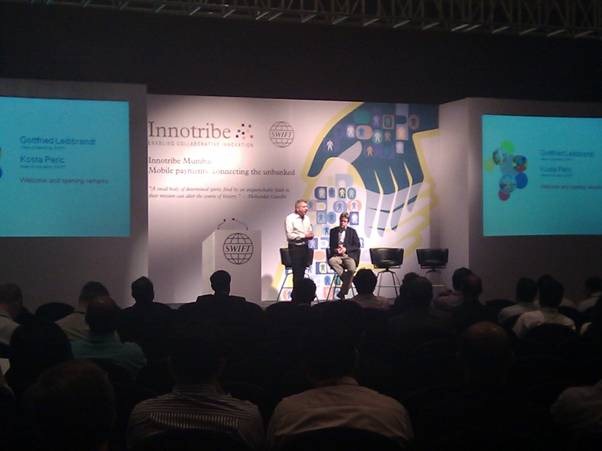
Here is a picture of the opening session

clip_image006

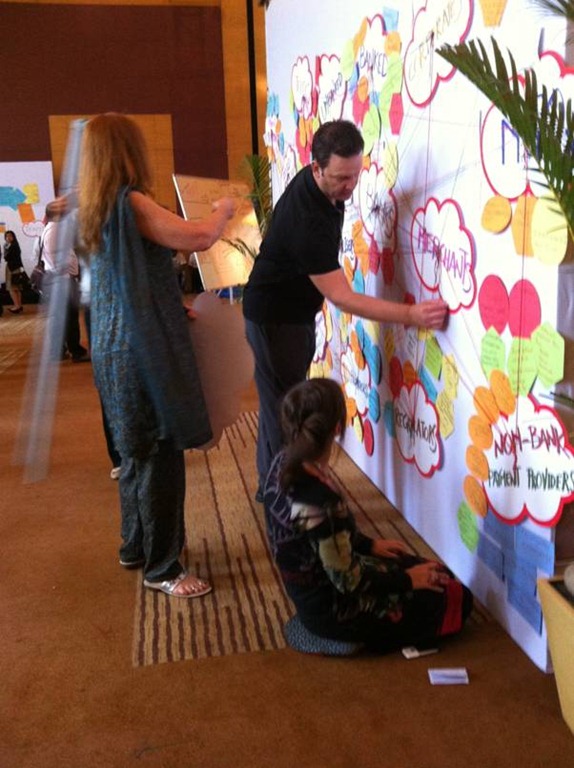
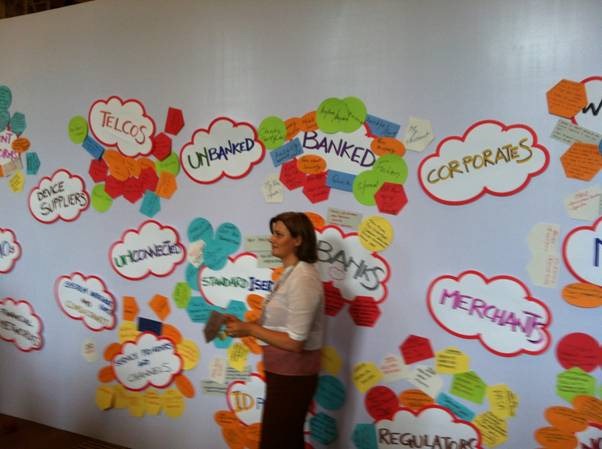
Events runs smoothly for the rest of day. End result is quite cool “knowledge wall”. Again, all team is crew.

clip_image008

clip_image010

17:30pm: Staff de-brief on day-1. Surprising how many folks turn up that i have not seen through the rest of the day. Obviously, those are the people who have most comments on day one. My role:

Assume

Take in

Don’t take it personal


What the hell do i care about the typography on some slides or the size of the coffee cups when this event is about financial inclusion? This is good inspiration for me to prepare another blog on event intensities.

Anyway, team will take comments on board and come-up with a redesign after the dinner.

19:00pm dinner. Have a deep discussion with one of the speakers. He has prepared video for the event, but i am lacking the authentic person behind the video. It looks like a documentary. Suggest speaker not to hide behind the lectern and to come in full vulnerability into the audience. Be vulnerable in saying “i don’t know”.


Be vulnerable in

being and standing there

as your authentic self


Do we all have the courage to do so ?

20:30pm after dinner. Debrief on new design. Don’t like it.


Seems we are having

a big illusion


Is financial inclusion the real agenda, or is it just a smoke-curtain to package a discussion between banks and telcos?

These are the real hard questions. It’s about the integrity and authenticity of the event. Should we put it on the table the next day?

We decide yes. We re-design the bloody thing once more. Late again, not enough hours of sleep. Back next morning at 6am.

The room has been re-arranged. From theatre into semi-circle context.

clip_image012

Have briefed all speakers that i will go into conversation with them during their presentation. Yes, i will interrupt them in their flow if they don’t manage to bring home their message fast and clear enough.

We also “play” with silence. With looking each of the participants in the eyes and call for honesty and integrity.

Highlight of the morning is (designed) conversational talk between Dan Marovitz and Neal Livingston.

clip_image014

Afternoon highlights are The Mixer – i love the station-format where you can go from station to station every 10 minutes.

clip_image016

Crown jewel of the event is the Mobile Arena. Matteo his usual self as master entertainer and master of ceremony of the Mobile Arena. There is lot of video material in Kosta’s previous blog.

But not only Matteo is in top shape. I have seen other people growing during this event.

For example Greet, who we bombarded to Audio/Visual manager: growing from shy and hyper-nervous rabbit with open eyes looking in the white light beam at 4am on day one, to the commander in chief controlling the A/V troops by the end of day-2.

clip_image018

Kosta, now in the crowd – anonymous, almost liberated from his staff – in symbiosis with the Indians, truly enjoying, his genuine smile, his body moving with some latency with the Indian Wave.

We end the day and the event with some powerful “Indian Waves”, sheering to everybody who contributed to the event.

Time to relax. We have a cool evening dinner. Lots of fun, jokes, drinks,… Landing…

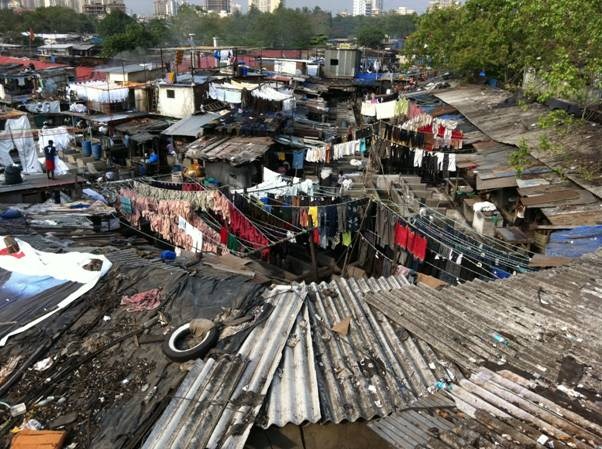
The day after, i go with Muriel on a guided tour in Mumbai. First time i leave the hotel. Amazed by the crowd, the traffic, the contrasts in wealth and poverty.

clip_image020

The Ghandi house leaves me deeply impressed.

clip_image022

clip_image024

clip_image026

The days after: I see some shrewd attempts water down what we did at this event. Even questioning whether we should do this at all. They try to hide behind a smoke screen of revenue and pragmatic deliverables.

They won’t succeed.


The genius has left the bottle


What they don’t understand is that we are on a mission. We are at war. Against the old game. For a better world and company. With an enthusiasm and belief seldom witnessed before.


True enthusiasm is irresistible

it’s contagious

So, yes this is about energy. About creating a new dynamic. About enabling a new culture. About reaching new audiences. About bringing new and refreshing content. About a different brand awareness of SWIFT, that makes you look never the same way again at this company.


It’s about

the irresistible

contagious

enthusiasm

that breaks down

rusty structures

and corporate walls


It’s about Indian Waves and genuine smiles.

Pump up the (innovation) Volume

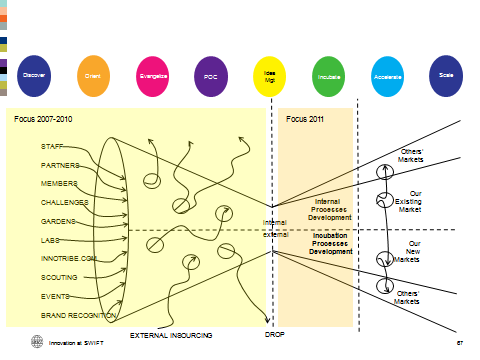
I would like to start with one of the slides of the innovation framework presented in “How to make babies?”.

image

The graphic and model is of course based on – but adapted to the specific SWIFT environment – the work of on Henry Chesbrough, the godfather of the concept of “Open Innovation”, and author of the 2003 book “Open Innovation: The new imperative for creating and profiting from technology” (Amazon Affiliates Link)

clip_image004

Chesbrough says:

Open innovation is a paradigm that assumes that firms can and should use external ideas as well as internal ideas, and internal and external paths to market, as the firms look to advance their technology”. The boundaries between a firm and its environment have become more permeable; innovations can easily transfer inward and outward. The central idea behind open innovation is that in a world of widely distributed knowledge, companies cannot afford to rely entirely on their own research, but should instead buy or license processes or inventions (i.e. patents) from other companies. In addition, internal inventions not being used in a firm’s business should be taken outside the company (e.g., through licensing, joint ventures, spin-offs)

Innovation Framework

The graph above illustrates an innovation framework:

  • With lots of idea generation tools on the left side of the graph
  • An innovation funnel, progressing the ideas from left to right, and making healthy adults from incubated babies
  • A north and a south side, where “north” stands for a traditional gating process product evolution for the core activities of a company, and where “south” stands for any innovation that basically does not fit the blueprint of the core.

In my blog post “How to create deep sustainable change”, I discussed the “Why” and the “expected outcome” of deep change and innovation.

  • The “why” has to do with creating a more agile organization, waking up the entrepreneurial spirit, in other words to “un-trap” the creative juices. And to do so, work is needed at the foundations: the roots of a tree. It’s about making the organization healthy, fit and un-trapped. This has nothing to do with six-sigma, lean, or other way to improve the efficiency of the organization, the efficiency of the organizational “body”. What we are talking about here is the fitness of the organizational “mind”.
  • The expected outcome of pumping up the volume and the fitness of the organizational mind is a connected organization, connected teams, connected people, connected values, operating in a connected economy.

Pump up the Volume

What follows is a personal interpretation of a team brainstorm we did in February 2011. So, it’s collective wisdom that I happen to be able to put in a format that’s more or less readable. Thank you team !

In this blog post, I will talk about the “How”, the set of tools that an organization can use to achieve the why and the desired outcome.

“Tools” can be actual tools such as an idea generation portal, but it can be other techniques at the front-end of innovation (the ideation), as well as processes and governance for moving ideas from ideation, via proof-of-concept, incubation, acceleration, and scale to full fruition.

What follows is also a model that can be used to underpin a strategy of “shake the tree” or – what I prefer – to “Pump up the (innovation) Volume”.

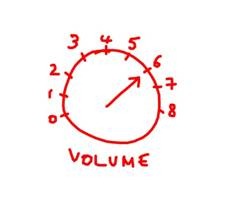
The volume knob is another metaphor to help us gauge our innovation focus, efforts and investments. What is important? What is nice to have?


clip_image006


Turning the knob to the max is what I would call being serious about innovation. But you have to start somewhere.

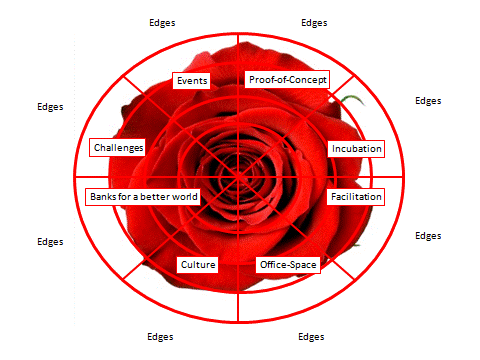
The Rose of Innovation

So, let me introduce you to the “Rose of Innovation”. Somebody has to give the romantic spin in all of this.

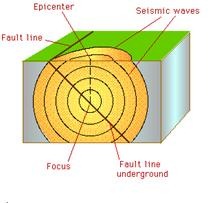
And let me mix it with the epicenter of an earthquake.


clip_image008clip_image010


Indeed, “Shaking the Tree” is like starting a quake from the middle, and the seismic innovation waves swarm to the edges of the system, where in the end they cause “Fault Lines”. You “feel” the move.


You know that inertia has been broken

You know you have crossed the chasm


clip_image012


And let’s segment the rose or the epicenter in different slices. Each slice is a cluster of innovation tools. You can have as many slices as you want, but I suggest to limit it to six in this case, merely to keep the overview and the focus.

For each slice, one has to decide how far to the right you want to turn the volume knob. Do you want to move from 2 this year to 8 next year? Probably, you want a multi-year perspective on this: from 2 to 4 next year, 4 to 6 in two years, towards 8 in 2015 ?

Let me walk you through the different slices.

Challenges

We already do internal and sometimes external – with customers – innovation challenges. It’s a call for teams and ideas around a pre-defined topic. What could be our ambition level if we pump up the volume to 8 by 2015?

  • Our ambition should be to be seen as one of the Top-10 innovation companies in financial industry. Long way to go, but possible with focus and will.
  • Build a real “Exchange” of ideas, competences, teams,…
  • Make a real competition of if. Like Cisco’s X-Prize. And with real money, I mean indeed a 250K EUR price for the champ of the year to help her incubate the idea of the challenge.
  • Open up the Incubation Centre, not only for incubation projects, but also for challenges. The cocktail of innovators in Building 8 will be irresistible.
  • Start-up something like frequent flyer pass. A frequent innovator pass. Points gathered this way add to your annual appraisal points, and reward repetitive innovators.
  • We should become so good we are being “called”: by other companies, at conferences, etc So good that people see the value and want to pay us for this.
  • Launch internal SWIFT “bucks”. Innovators can invest “bucks” in their projects. Later, when the project incubates these “bucks” get converted in actual shares in the project-company. These ideas are not new: ideation tools like Spigit and Brightidea already implement this. We just have to turn on the feature.

Events

This is more or less my shop today: let’s call it “Petervan Productions” Our events even more become “immersive experiences”. This unique mix of high-quality matter experts and speakers, together with our facilitation techniques. We could do much much more in this space. What about:

  • 8 Innovation events per year like Innotribe Mumbai ?
  • 1 Partner innovation event of 3 days
  • 1 Customer innovation event of 3 days
  • Deep conversations with: 3 days off-site with a guru on a topic and a select group of top-15 Heads of Innovations of banks
  • 4 hackatons per year where we ask developers to code/hack together an application in 2 days
  • More study tours, not only for the executive or L1/L2 level but accessible for all staff
  • The frequent innovator pass should help us identity who can go on such a tour
    • More gamification of our events: work with game experts such as Jane McGonical from Reality is Broken (latest book), Dave Gray from XPLANE and Gamestorming, and Verna Allee from Value Networks

Dave Gray author headshotVerna Allee

From left to right: Jane McGonical, Dave Gray, Verna Allee

  • Have a 3 day SWIFT employee festival? Like AMPlify.
  • Do sort of Woodstock at Sibos. Like Pirate Ship. With concerts
  • Sponsor other innovation events
  • Embed and sell our techniques to third-party event organizers

The overall objective is to create serendipity. To reach other audiences, bring other content, start exploring the edges, create brand recognition. For SWIFT. For Innotribe.

clip_image014

We also should more and more look at our events as something that is the middle of the process, not the end-game. Usually we come out of an event, exhausted, as we build up all the energy towards that one day, one week. But then it only starts: the event is only the place where the connected community meets for the first time, gets initially built.

Proof-of-Concept

Again, we already do this. We have a yearly budget that lets us invest moderate amounts of money in proof-of-concepts: these can be prototypes, animations, whitepapers, etc

  • Turning up the volume in this space is merely doing more: more prototypes, hence more budget and resources

Incubation

We just started this year. See also the “Babies” presentation. Initiated by Matteo, and now with the help from Cathal as program manager, this is our “Mathal Productions”. Their projects are located in Building 8.

Turning up the volume would mean:

  • Team with Silicon Valley incubators
  • Team with Incubators in Eastern Europe, APAC, South America. The example of Solkovo in Russia comes to mind
  • We could do much much more in bringing young entrepreneurs and start-ups together. You can create a marketplace of start-ups, accessible by the SWIFT community.
  • You could create – together with the 9,000+ banks on SWIFT – an alternative start-up funding and loan model. With better rates for those who have a good standardize Innotribe quality score.

Facilitation

This is what Mariela and team already do. For fun, let’s call it “Mela Productions”. Why for fun? Or “Innotribe Facilitation Studios”

  • Mela should make a business out of it. Think big. A worldwide team of 50-60 facilitators. Why not. If we were able to deploy similar numbers of lean navigators for cost reduction and efficiency, why can’t we do something like this for value creation?
  • This is also something we could start selling. This is an area where we are being “called”. Internal business units, but also banks from our ecosystem already now ask Mela to run facilitated workshops. Even from outside or our industry. We should charge for it.

Office Space

This is about having a critical look at our office space and the – communication – tools we have. On one hand we are spoiled. If you have ever been to the SWIFT HQ, you will for sure have been impressed by the main building and campus surroundings.

But the main building inside sometimes feels like a temple or a castle, with long corridors and closed doors that not really incentivize for cross-collaboration and sharing. I know there is a big project started to look deeply into this.

But also office-tools should be looked at. Today we have something called “Internet on the desktop”. It is a Citrix implementation of your browser.

  • We should turn it 100% upside down. Internet should be the default, and we should have a “SWIFT on the desktop” for the couple of apps that require tighter security or access control. It’s inevitable. It’s part of the movement towards cloud.
  • Skype, Drop-Box, Google Docs, etc should be our standard tools. Complemented by Salesforce, Chatter, Twitter, Quora. We should all be equipped with iPADs, Androids, etc. We never should have to use a PC anymore.
  • This modernization will also have a major impact in image and brand.

Culture

I have been quite deeply involved in an effort to look at company culture, and those who follow my blog know that I have something to say in this space.

  • Lately, the culture team was re-organized, and volunteers from GEN-Y and GEN-X were called upon. I applied for GEN-X (those born in 1961 and beyond)
  • Great was my astonishment that I was considered “too old to innovate”. I am born in 1957 so indeed, strictly to the letter, I am not GEN-X anymore. But I am lucky, I still get “copied” on the stuff (sic)

Any pump-up-the-volume in his space

will be worthless

as long as we do not

apply a strategy of “seed and infect”

  • If not, what we will end-up with are loads of powerpoint slides, processes etc. It will show great in an annual report or so, and it’s a bit the same as “how real is your innovation?”. Ask yourself the question “How real is your culture change”.

What we need is

a viral infection of the company


  • 40 people in 2011 should get the chance to follow a personal discovery journey like Leading by Being, so that they lead from their open mind, open heart, and open will.
  • In 2012 another 100 people. And in 2013 another 100.
  • That’s 240 folks. Deeply passionate about changing the company. That’s more than 10% of the workforce. That will change the culture for sure.

And have a look what companies like J&J do. They have in a couple of years a group of more than 750 change agents. They can be flown-in or video-conferenced at any moment to form tiger teams.

Banks for a better world

This is a big bad new idea. It must be possible to have a deep merge between Innovation, Talent Management and CSR.

Think big, really big

I think it must be possible to create

a 1 Billion $ Fund

that invests in financial inclusion

  • I know that some of our banks have invested big time in some of the above examples.

Why can’t we pool together

funds and resources as an industry?

Would that not be

immensely more powerful?

  • That would be quite a different story than what you hear/read these days about “too big to fail”, greed, lack of trust, etc

It would also lead and propel the community into a modern thinking about capitalism, rethinking value, and waste that we produce for the next one in the value chain (for ex bail outs) or even pushing debt towards future generations.

Studios and Production Houses

I am getting convinced that for each of these slices, we have to start thinking in terms of independent and complementary “Studios”. Like the studios of Pixar, Dreamworks, etc


clip_image015


Or in terms of <name> “productions”. For example for facilitation, you could pitch the “SWIFT Facilitation Studios” or “Mela Productions”. Events could be “Petervan Productions”, etc.

I like somehow the personalization aspect of this, as usually these teams are geared around a particular person with specific strengths.

If you like it or not, organizations are – or should be – built around people.


It’s indeed some sort of

strengths-based

studio or production environment


The Studio or Production metaphor also works well: you could consider the Head of Innovation as the “impresario”, and the studios the teams that collectively deliver a streamlined total experience. Or you could – like in big Hollywood studios – talk about “Building 123”, or like “Building 20” which is the innovation building of MIT.

At SWIFT, the incubation building is referred to as “Building 8”.

Budget

  • What does it take in monetary investment
  • Additional resources
  • This is reality check. Where the CEO mantra “I want you guys to shake the tree” is tested with reality. This is where people get scared. This is where you hear: “I know him/her (the CEO), and we can’t go with such an ambitious plan and attached budget”.


This is the real test

  • Here you will find out how real is your innovation. Or is it just a window-dress because innovation is fashionable and always works well in front of a board of directors or in an annual report.

You will probably end up somewhere between the window-dress and the edge-nirvana. And that is fine. The important thing is that you gauge it. Use it as a baseline. And don’t accept less when entering the next budget round.

Step by Step vs. not knowing what end result is

The challenge with all this is that


innovation

can not managed like the core


The core is – and should be – managed as the optimization engine. In this space you know where you want to end-up over a given period of time. You make a phased project plan, allocate the budgets and resources, put a project manager on it, and you execute as planned. It’s Failure is not an Option. It’s highly predictable, with yearly budget cycles, than in essence most of the time built upon last year budget models. It’s a stepped approach.


clip_image017


The challenge with innovations is that they are not planned. You usually know the “direction”, but you’re not sure where you land. It’s like Christopher Columbus heading West to discover India, but he found America. It’s like a (pirate?) ship meandering. It’s Failure IS an option. It’s unpredictable. It’s a meander approach.

Conclusion

That’s what I wanted to say today. It’s a blog post that was cooking for several weeks. Happy it’s done. It’s a long post, I know. And maybe next, I should put all these blog piece together in a book. Who knows, maybe I’ll do that one day.

But one thing is sure: The combination of “How to create deep sustainable change”, “Pirates, Rebels, Mercenaries and Innovators”, and this post “Pump up the Volume” will form the basis of a brand new Innotribe presentation, the follow-up of “How to make babies”. I will let you know when it is ready.

All for the same purpose: the fitness of the organizational “mind”. And a deeply changed organization, connected and full of energy!

clip_image019

Let’s Pump-of-the-Volume!

Let’s take those innovation energy pills!

Let’s shake the tree!

Innotribe Mumbai: Newsflash #1

By now, you should know that on June 1-2 2011, Innotribe will host its first standalone event in Mumbai.


Print


Innotribe Mumbai – Mobile payments: Connecting the unbanked will focus on the opportunities that high mobile penetration presents to take banking services to the historically ‘unbanked’ communities – and explore the ways in which mobile technologies are being used today and can be exploited in the future to enable greater financial inclusion.

Yesterday, we pumped out our first world-wide press-release and we updated the event site with the latest and greatest speakers confirmed. You can also follow latest additions to the program via the Innotribe twitter.

Today, I would like to share some insights in the interactive sessions, the so called “Innotribe Labs”, famous from Innotribe at Sibos.

We have three Innotribe Labs:

  • On at the end of day-1 on banked-unbanked
  • Two in the afternoon of day-2: one called “The Mixer” and one called “Mobile Arena”

Innotribe Labs are highly interactive workshops, very well pre-designed and executed by our innovation team under the facilitation leadership of Mariela Atanassova. Whereas the Labs are still under design – trying to leverage the speakers and experts that have committed for these Labs – I can already give you a flavor of what’s going to happen on 1-2 June 2011.

1 June 2011 – 15:30 -17:00 Innotribe Lab “Banked – Unbanked

  • If we can pull it off logistically, we plan to take those interested by bus to the slumps, 2 miles away from the luxury hotel where we hold Innotribe Mumbai. Our plan B is to use video material. It seemed to us that only if you have seen the slumps, you can have a discussion about banked – unbanked.

slump

  • Nokia will set up a live environment of one their latest project with UBI targeting more than 30,000 villages in rural India. You will be able to experience hands-on what banking the unbanked using cheap mobile device means.

Nokia

  • That will be followed by a Lab immersive experience, designed by Innotribe Facilitation Studios.

2 June 2011 – 13:30 – 15:00 Innotribe Lab “The Mixer”

  • We have the ambition to create “serendipity” or (un)planned encounters. We want to “mix” local and international entrepreneurs in the mobile space and exchange experiences. What works, what not ? What can we learn from each other ? Where does the investment money go ?
  • We are proud to collaborate with Ashoka. Ashoka is the global association of the world’s leading social entrepreneurs—men and women with system changing solutions for the world’s most urgent social problems. Since 1981, they have elected over 2,500 leading social entrepreneurs as Ashoka Fellows, providing them with living stipends, professional support, and access to a global network of peers in 70 countries.

ashoka

  • I have seen the pre-selection of Ashoka Fellows that we’ll have the pleasure to welcome in Mumbai. This will be an awesome experience

2 June 2011 – 15:30 – 17:00 Innotribe Lab “Mobile Arena”

  • We will indeed ask all participants to sit in a big circle, forming a real “arena” discussing mobile payments.
  • The circle will be segmented in different groups representing banks, unbanked, telcos, platform providers, etc, etc

arena

  • Each segment or slice will be represented by a pre-assigned spokesman.
  • The spokesmen will fight in the middle of the arena, in the “snake pit” in the middle of the arena.
  • The ambition of this session is to come to some recommendation on how to create synergies in this space, to avoid that all parties try to re-invent the wheel, and to see if SWIFT Innotribe can play a role in enabling collaborative innovation.

You got it: Innotribe Mumbai will be a unique experience. Combining an impressive set of speakers with our proven interactive Innotribe Lab format.

As somebody said after our Innotribe Lab at SOFA begin March 2011: “I will never look to SWIFT in the same way, you guys are much more that a network, a BIC code and standards. You are a true innovation community”.

Oh yes, there is one more thing: I have 5 free passes for this event. Send me an e-mail (peter dot vanderauwera at swift dot com) if you want one. They will be given on a first in first out basis. So, you have to be fast !

See you in Mumbai on 1-2 June 2011. May the Innotribe vibe be with you.

Cross-posted as well on the swiftcommunity.net blog at the innotribe twitter account

Bring Jack Back (Update: Jack IS back)

Update: just minutes after posting by blog, it was announced that Jack IS back at Twitter, now as “Executive Chairman”. Check-out the news everywhere or here at ReadWriteWeb.

I am getting so inspired by the fabulous Jack Dorsey from Square. Watch this video and the full transcript on Techcrunch. Read David Kirkpatrick’s article in Vanity Fair with the title “Twitter Was Act One”

He makes me think of Liam Gallagher from Oasis. He has something “very British”. He is stylish. The same arrogance. The same pureness. The same design and drive for perfection. And skimming down until only the essence is left over.


One comment reads: “you know what ? Maybe it’s too sounding like the beatles or John Lennon (that was my first reaction). But as a great beatles fan, i’m just glad to see some guys carrying the torch and able to do great music”


beadyeye1stpiconline (1)


And have you seen the interview over the week-end (I think it was BBC) with Liam as part of the launch of the new post-Oasis band Beady Eye ? It seems that the voice of Liam was recorded without any effect, no echo, nothing (not the case in above video).


Pure

The essence

The minimalism of Twitter


Which brings us back to Jack. I believe Jack is the John Lennon of Payments. That Square means for payments what The Beatles mean for music.

Back to the video.


image


Some quotes from the different articles and transcripts, to get you a good idea how genius this guy is.

  • “Little Jack Dorsey was obsessed with maps of cities”. Read my recent posts and thinking about the connected economy, the connected company, the connected team and the connected value. They happen also to be the big trusts for our Innotribe at Sibos 2011 in Toronto, later this year
  • he studied for a year to become a certified massage therapist (Martine will love this)


“Payment is another form of communication,” he says, “but it’s never been treated as such. It’s never been designed. It’s never felt magical. We’re the only payments company in the world that’s concerned with design,”

  • So the architects designed this gorgeous bridge, but the problem with the Golden Gate is that this is an extremely tumultuous area, if you’ve ever sailed through this or taken a boat through this, the waves are immense. Or surfed through it, which is more dangerous. It’s a disaster, I mean all the weather of the Bay is being forced through this one single point. So, all these elements create this perfect storm of turbulence. It’s extremely deep in the middle and it’s an epic span, so this was not an easy challenge.
  • And a lot of people think of design, when they hear the word design as visual, something that looks pretty.


Design is not just visual, design is

efficiency

Design is making something simple

Design is epic

Design is making it easy for a user to

get from point A to point B


Reliability is a feature. This is what Brian said earlier, availability, reliability, and staying up, that’s a feature and that’s a product, and it has to be well-designed and thought after and considered, and that’s what we’re doing.

I think I’m just an editor, and I think every CEO is an editor. I think every leader in any company is an editor. Taking all of these ideas and you’re editing them down to one cohesive story, and in my case, my job is to edit the team, so we have a great team that can produce the great work and that means bringing people on and in some cases having to let people go.

This is the bridge I want to cross. [Shows Golden Gate]


This is how I want to arrive at a destination:


This is classy

This is limitless

This is inspiring

This is gorgeous


My dream is to have him at Innotribe Mumbai, where we’ll talk and discuss about Mobile Payments, connecting the un-banked and financial inclusion.

Would really like to hear Jack’s view on design and perfection for that.

Bring Jack Back. To be classy, limitless, inspiring and gorgeous.

Innotribe Mumbai: Mobile Payments–connecting the unbanked

Innotribe at Sibos 2010 in Amsterdam was such a success that we decided to start running stand-alone Innotribe events. The first event in its kind is Innotribe Mumbai on 1-2 June 2011. It’s not an or/or story. We keep on organizing Innotribe at Sibos.

At Sibos this year, we will have 3 technology inspired topics: Big Data, Digital Identity and Social. We will also have 3 non-technology inspired topics: Corporate Culture, Where does the investment money go for innovation, and New Capitalism.

Some of the Innotribe themes of 2010 will go mainstream at Sibos Toronto: Cloud computing and Mobile are two excellent examples. Other new topics will be introduced: they have the potential to go mainstream in 2012 or 2013.

As you can see, the stand-alone Innotribe events are part of our build-up towards Sibos Toronto.

What we try to do at those stand-alone events ànd Sibos is 3-fold:

  • Extend the type of audience for our events: more innovators, movers and shakers and local entrepreneurs
  • Extend the type of content. Mobile, big data, social, digital identity. Not necessarily that SWIFT wants always to play an active role in these, but to create an active and collaborative conversation with the financial industry on these topics
  • Extend the brand of SWIFT into a brand that relates to innovation

SWIFT is therefore pleased to invite you to attend Innotribe Mumbai, a two-day event that will bring together a powerful combination of people from banks, carriers and mobile device, platform and service providers – as well as local and international entrepreneurs – to explore the ways in which mobile technology are enabling greater financial inclusion. What will the financial and telecoms industries look like in the future, and what can you do to help shape them?

Mobile paymentsInnotribe events are built around an energising mix of education, new perspectives, collaboration and facilitation. Innotribe Mumbai participants will be able to learn from each others’ opinions, ideas and business models. Also expect exposure to longer-term perspectives through discussions about the future of money and the dramatic business model shifts market participants will likely undergo as that future becomes a reality.

The detailed agenda is shaping up, and we have already confirmed the participation of some of the most influential innovators in our industry and beyond.

Mark the date in your calendar and follow us on Twitter. We just published a very tentative program for this event, and registration will formally open on 21 March 2011.

Hope to see many of you there.

May the Innotribe vibe be with you.

Digital Identity Tour Part-4: Austin–Munich–Toronto

This post is a fourth in a series on personal digital identity. Part-1 “The unpolished diamond was published here in August 2010 and Part-2 ‘The Digital Identity Tuner” was published here in September 2010. Part-3 “Personal Data Something” was published here in December 2010.

The journey continues. Now we move into Austin for TEDxAustin and SXSW Interactive.

You can follow the livestream here. It’s a fascinating way to spend your week-end and get inspired.

image

Gary from CLOUD is on stage today 19 Feb 2011 at 4pm Austin time.

Some time ago, I teamed up with the folks of CLOUD, Inc. (www.cloudinc.org), a non-profit technology standard consortia founded in March 2009 and based in Austin, Texas. “CLOUD” stands for Consortium for Local Ownership of Use of Data. I am on their Strategic Advisory Board, together with Charlie Hoffman, Director of Innovation, UBMatrix, a leading provider of XBRL software, Anthony J. Barrett, Senior Vice President, Integration, Walgreens, and Dan Walker, former Chief Talent Officer for Apple and GAP.

image

The power of people. Connected.

If you have read my previous post on team dynamics, then you may have noticed a pattern developing in my thinking. With kudos to co-thinkers Verna Allee from Valuenetworks.com and Mela from the SWIFT Innovation Team. We had a great synchronicity chat in London, and what emerged was a model for organizing our thinking for Innotribe at Sibos 2011 along the theme of the Connected Economy.

album_large_3991397

Suddenly, it all made sense. One could zoom into the Connected Economy into different facets such as:

  • our connected companies: this is where we could talk about company culture and new organizational models that do away with the silo construction of most companies
  • our connected teams: how we create healthy team dynamics, how we collaborate, how we realize full potential with social cognition
  • our connected self: acting from our authentic strong self, this is more about personal and corporate values for the next decades. This is also about our Digital Identity/Footprint. The power of people. Connected. What CLOUD is all about.
  • our connected value: new thinking about capitalism, social currencies, financial inclusion, P2P networking, money vs. value, the accounting for intangibles

What we want to do at Sibos and our Innotribe Events is to create ongoing conversations, with the rigor around these conversations, focused around sense-making. But let the future emerge.


The art of the half finished


Where the event is the middle of a process, not the end-point. Leaving enough room for others to fill in, for ideas having sex. Where humans can get inspired by something else than logic.

CLOUD has been featured as a keynote speaker at SWIFT’s annual Sibos conference in October 2010 in Amsterdam and will be speaking at TEDxAustin on February 19, SXSW Interactive on March 14 and leading a panel at XBRL22 in Brussels the week following the European Identity Conference.

image

For the Munich KuppingerCole conference, Gary submitted a speaking slot by CLOUD and Co, and we just got the news that the proposal was accepted. I let you enjoy what Gary put together:

In March of 2010, SWIFT’s Innotribe hosted last year’s European eID Interoperability Conference. Peter Vander Auwera, Innovation Leader at SWIFT, and former colleague of Kim Cameron has said this about CLOUD, Inc. in his post on Identity Rights 3.0: "I repeat myself by saying that this CLOUD vision goes way beyond the web of pages, goes way beyond the early thinking on Semantic Web. It is in essence proposing an identity architecture for the Internet. Because the internet is broken. It was never designed with identity in mind."

CLOUD sees the issue of identity as one that goes far beyond log-ins and enterprise management. The issues of identity, privacy, security, data portability and governance are not separate issues but simply separate axes of the same problem.

CLOUD sees the answer to these issues coming from a new language for the Internet, so as to extend the revolution started by TCP/IP and accelerated by HTML. CLOUD’s CTML (contextual markup language) is a language for people. however and not another language for web pages, like HTML.

CLOUD also sees the answer going beyond current approaches like OpenID, which assumes the web paradigm in its log-in approach. Even with the same log-in, my ‘identity’ could change over time.

CLOUD also believes that a multi-dimensional approach is vital. WHO I Am™, WHAT I Am™, WHEN I Am™ and WHERE I Am™ are all axes of my identity and vital to a new language for people and "the identity architecture for the Internet" as Peter said about CLOUD.

Our goal is not to replace other standards nor displace for-profit initiatives but to instead put a new foundation in place for the Internet that makes the approaches to privacy, security, data and identity consistent and architecturally-driven.

We would see our thought leadership keynote (and/or panel) outlining what this paradigm would mean to the future of the Internet and how this new language would not only change the approach to identity but will transform industries from banking to health to education. Our recent post on the WHO I Am™ dimension would provide the foundation for our comments and panel: http://cloudinc.org/?/ecosystems/article/cloud-dimensions-who-i-am.

Suggested Panelists:

  • Gary Thompson, CEO CLOUD
  • Peter Vander Auwera, Innovation Leader, SWIFT
  • Kaliya Hamlin (@Identitywoman), Founder Internet Identity Workshops
  • Kim Cameron, Microsoft Distinguished Engineer and Chief Architect Identity 
  • Vint Cerf or Bob Kahn, Founders of TCP/IP

Some people say we try to boil the ocean. I don’t think so. Why would we limit ourselves to a narrowly defined vision of identity being a federated authentication issue ? Identity and Digital Footprint are much more than that and so important for our being as human beings in a permanent digital reality.

n06_freddy-cerdeira

That’s why I am so proud that this advanced vision now get exposure at TEDx Austin, at SWSX Austin, at the European Identity conference, at XBRL, at the KuppingerCole conference in Munich. And we will bring it back to Innotribe at Sibos 2011 as part of the connected self. As part of some new work we just kicked off last week in London.

Some folks give me pushback. They are warned: I am at my best when constrained. My innovation juices then flow at full debit. Then I want to think and work out-of-the-box, no – even better – I want to burn the box.


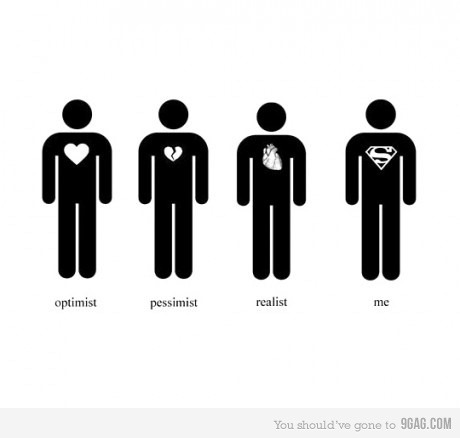
the optimist in me


The times of being mister nice guy are over. Of being a mediocre optimist, or pessimist, or realist.

We can’t live

with mediocrity

anymore


Who is going to stop us ? The better question is: who is a believer and wants to support us? Are you ? Then join is on this digital identity journey and


be your digital self !

Enhanced by Zemanta

Innotribe Special Session at SOFA: The new thinkers

SOFA stands for SWIFT Operational Forum Americas, a yearly event targeted at a typical operational audience. This year’s SOFA is on 8-9 March 2011 in NYC. The theme for SOFA 2011 is “Defining the next generation of financial services”.


marriot marquis NY


Innotribe is SWIFT’s innovation initiative. Innotribe’s mission is ‘Enabling Collaborative Innovation’. Part of our activities includes events: existing SWIFT events like Sibos and SOFA, third party events like CPA in Canada and EPCA in Europe last year. It usually translated into a “special” session, with lots of professionally facilitated interactivity.


Print


With Innotribe events we have the ambition to “unpack” stereotypes, myths and hypes. These Innotribe Events are an energizing mix of education, perspective, collaboration and facilitation. Our success factors for this new type event are organized along the following three axes of “opening-up” our traditional ecosystem: audience, content and brand recognition.

So, what’s up at SOFA this year ? We have two things going on:

  • At the end of day-1, yours truly will give the presentation “How to make babies” a strong metaphor for SWIFT’s Innovation Framework. Prezi version of this presentation is here. Tip: set sound “on”
  • At the end of day-2, our innovation team will animate a Special Session “The New Thinkers”

Building on the Innotribe @ Sibos tradition of exploring “Tectonic Shifts”, this Special Session will be an energizing mix of education, new perspectives, collaboration and facilitation.

Our goal is to stimulate the generation of new ideas by bringing together a powerful mixture of audience members and by enabling freedom of discussion – allowing the conversation to take the participants into any and all areas that open up on the day.


We believe strongly in the potential

of unexpected encounters,

and the magic that can happen

when people from

different background

are brought together


So the innovators and change agents of our industry will be invited to join the SOFA audience (and also to join us in Toronto for Sibos 2011 in September), and we hope this will foster exciting new discussions between them and the traditional SOFA attendees.


skyscraper lunch


Ideas do not typically come out of the blue. Rather, they are usually variations of existing ideas. Sometimes, simply looking at a familiar idea from a different perspective can spark a new idea or the combination of existing ideas to achieve new goals and create radically different value propositions. All the topics we propose to discuss during this Innotribe Special Session at SOFA are also potential subjects to explore in Toronto – but we are looking for your feedback to tell us if these are the right ideas to stimulate your creative thinking!

Presentations from five great modern thinkers will culminate in an interactive exchange between the SOFA audience and the speakers, led by Innotribe facilitation champ Mariela Atanassova. The audience will be able to drive the discussion according to the themes that most interest them – ensuring everyone will have an opportunity to collaborate in the innovation we hope this session will stimulate.

Here are The new thinkers:

introducing_miemis
Venessa Miemis
(http://emergentbydesign.com/about/): Free agent, Master in Media Studies at the New School, NYC, futurist and digital ethnographer, researching the impacts of social technologies on society and culture and designing systems to facilitate innovation and the evolution of consciousness. Venessa will update us on The Future of Money project (world premiere at Sibos 2010) and The Future of Facebook, a new research project sponsored by Innotribe as Corporate Patron.


rushkoffbiosm

Douglas Rushkoff (http://rushkoff.com/bio/): thought leader and provocateur. Author of best selling books Cyberia : Life in the Trenches of HyperspaceLife, Inc, and Program or be Programmed (all Amazon Affiliate links). Doug will give a talk about New Capitalism, and introduce his latest project on a Summit he is organizing in NYC on 20 October 2011 called “Contact”. Contact Summit will seek to explore and realize the greater promise of social media to promote new forms of culture, commerce, collective action and creativity.


brianzisk

Brian Zisk: organizer of the Future of Money & Technology Summit in San-Francisco (www.futureofmoney.com). Brian will summarise the findings of the Summit that took place on 28 Feb 2011. Psssst ! If you still want to go to Brian’s event, go the the registration page at ttp://futureofmoney.eventbrite.com/ and use the discount code “Innotribe”.


stoweboyd

Stowe Boyd (http://www.stoweboyd.com/ ): probably THE authority on Social media, Stowe is a Social Philosopher and Webthropologist from NY. His work focuses on social tools and their impact on media, business, and society. In 2011, Stowe is focused on a new line of research: Social Cognition. This research is co-sponsored by Innotribe, and we hope to share the final results at Sibos 2011 in Toronto.


kevinslavin

Kevin Slavin (http://about.me/slavin): also from NY, Kevin is founder of AreaCodeInc (recently acquired by Zygna, the undisputed leader of Social Games). Kevin will talk about the New Future and “Those algorithms that govern our lives” – including our personal finances!


5429335705_93ef6aa3cb

(picture from Dave Gray’s blog)

For the interactive part, we will organise the session around the organic growth aspects of cities. I have written about this before in my post “How to make babies”, and recently there was a fantastic post by Dave Gray on “The Connected Company”.  We invited Dave to SOFA as well, but he unfortunately could not make it.

Dave’s post is a fantastic post – and as far as I am concerned – one of those game changing post already for 2011, and I will definitely come back to it later.

Dave for example says:

And today, thanks to social technologies, we finally have the tools to manage companies like the complex organisms they are. Social Business Design is design for companies that are made out of people. It’s design for complexity, for productivity, and for longevity. It’s not design by division but design by connection.

He is also author of “Gamestorming, A Playbook for Innovators, Rulebrakers, and Changemakers” (Amazon Associate Link)


Looks like the book is very much about the principles that our team applies for interactive session design.

And gamestorming

is exactly what we’re going to do

at SOFA

during this special session


What: Innotribe Special Session at SOFA 2011, NYC

When: From 2-5 pm on 9 March 2011 at SOFA (http://www.swift.com/events/2011/SOFA/index.page

Location: Marriott Marquis, Broadway, NYC