Way back in 2010, I wrote a post “Let me entertain you” inspired by one of Robbie Williams’ biggest hits. Some extract of the lyrics below:
Hell is gone and heaven’s here
There’s nothing left for you to fear
Shake your arse come over here
Now scream
I’m a burning effigy
Of everything I used to be
You’re my rock of empathy, my dear
So come on let me entertain you
Let me entertain you
Lyrics of "Let me entertain you" - Robbie Williams
I have evolved since then. The title of this post is inspired by a quote by Brian Eno in an interview in December 2015 with Steven Johnson about art, music, punch lines, and culture in general I would say.
“I don’t want to be entertained,
I want to be provoked.”
Here is the video on punch lines.
When I first read that interview, there was no transcript, so I transcribed it all myself (so I did not cut and paste from the site, and everything in this post is my own crunching through the story ;-). Now it’s all for grabs on Steven’s post.
I think Eno’s quote could be a great tagline for the way I think about “events”. I could do my Magritte trick here again and say “Ceci n’est pas un event”. As I have said so many times in the past:
“I am not in the events business. I am in the business of creating high quality feedback loops to enable immersive learning experiences”.
It’s about creating spaces and environments where people want to be provoked, not feeling comfortable, not being entertained. At the edge, but not beyond.
Exactly what architect Clive Wilkinson refers to in his talk “Designing The Theatre of Work”. There is indeed something (un)wise in this notion of “Theater of Work” or “Theatre of Change”. At min 11:30 of this video, he quotes:
“I don’t want people to feel comfortable, I want them to be provoked. I am not going to get great work out of people who are comfortable”
and also
“The architecture and the language of space is not something that is meant to make you go to sleep”
It’s only very recently that I realized the “creating high feedback loops and immersive learning thing” was only about the “how” and not about the “why” and “what” this is supposed to achieve.
I think I have a better hunch about that now: I believe it is about creating high quality change. Deep change. Not the Theatre of Change. Change that is in the first place based on high quality human alignment. Beyond the cognitive, and beyond the tactics of processes and governance. Beyond the illusion and entertainment of the innovation theatre.
I recently bumped into a colleague that is doing innovation work – or should I say theatre – for a big international automotive company. She was asked to give support in the design of a “disruption tour” that was organized for the members of the board in Silicon Valley.
I think we have all seen those disruption tours, where execs are flown into sunny California, get a week immersion, come back all excited as part of this elite club that got to see one or the other hotshot in the valley, and where the initial momentum ebbs away very quickly, usually already after two weeks, when we all go back to business as usual.
But the briefing for this tour was a bit different. She learned that the tour should not challenge any of the “what” and only focus on the “how”. So in other words: avoid in all circumstances that anything they will see and hear would challenge or disrupt their existing automotive strategy. What was asked for was “disruption without disrupting”. Or “Safe Innovation” as I read somewhere else this week.
In Hollywood this is called “entertainment”.
I kept delving in the Brian Eno’s story about entertainment vs. provocation, and found this audio ànd the transcript of the 27th Sep 2015 BBC John Peel Lectures with Brian Eno.
I am very much inspired by both Peel, who has this art of giving others “airplay” and Brian Eno, who really is a “curator d’excellence”, if you look back at what sort of magic mix of artists he brought together in his life, always remaining a “vanguard”, and his restless desire for discovering new places and more:

“Vanguard” means forefront, advance guard, avant-garde. Has to do with seeing early signals, making sense of them. Not only seeing. Also building. Building something new. “World Building”.
World building, like the places children imagine. Like the emotional places where children imagine: who would not crave to be in that state all the time? In that sense, I believe my curation and events work is more and more about painting and architecting “states of mind”.
Happenstance that just this week @ribbonfarm had a fantastic post on this topic of “states of mind” titled “Productivity for precious snowflakes”

Two identical snowflakes, via NYT
He is talking about multi-finality (and not multi-tasking) and about the interest in the quality of the experience (and not the mere outcome), and about the source of creative being in the past.
It’s encouraging to realize that many of the states of mind we seek are not “out there” somewhere, to be hunted down and consumed. They are states of mind belonging to our past selves — we wouldn’t crave it if we had never experienced it. We have to go backwards and remember what we once knew, not forwards to some perfected version of ourselves. What would you pay to experience child-like wonder for a day? To watch Star Wars Episode IV for the first time again? To have the ability to snap your fingers at any time and see your writing, your painting, your app with the fresh eyes of a novice?
“Flexing our mental muscles” by imagining new worlds, and “when people synchronize themselves together”, says Eno.
He also introduces the topic of “exhaustion”. I will come back to the theme of exhaustion in another post, as I think it is key to the kind of problems we try to tackle today.

“We need ways to keep in synch, to keep coherent. That is what culture is doing for us.”
and
“Culture as a set of collective rituals to keep coherent, collective rituals that we are all engaged in”
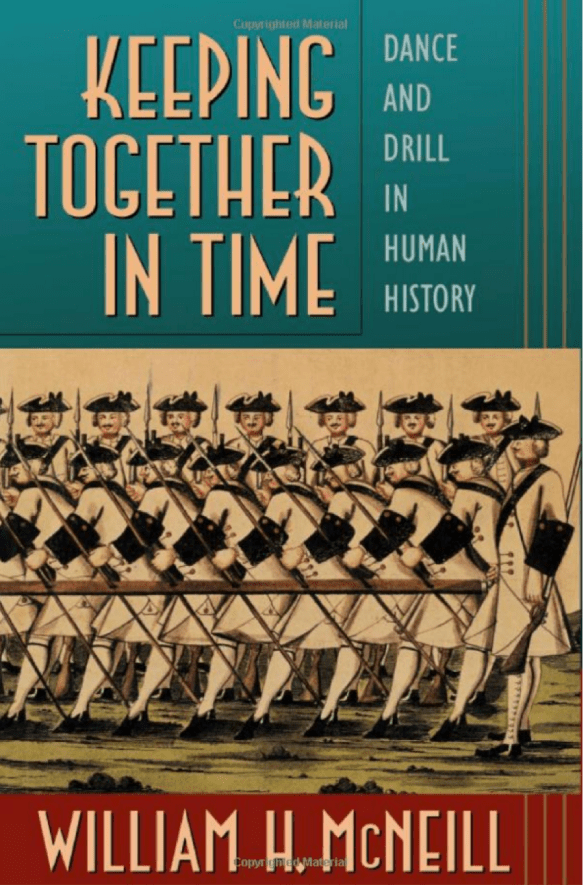
Brian refers to the book “Keeping Together” by William Hardy. In that book, one of the most widely read and respected historians in America pursues the possibility that coordinated rhythmic movement – and the shared feelings it evokes – has been a powerful force in holding human groups together.
As an ex-DJ, I think my work is about creating rhythms. Architecting these “coordinated rhythmic movements and rituals” for “state of minds” and “states of intentions”.
Way beyond the entertainment. This is about “Creating scenius together”. Scenius is the talent of whole communities. Bringing them in contact with their talent, their potential.
“You simply can’t absorb this (change and exhaustion). You just have to do it collectively. Nobody’s going to be able to do it individually”.
These interviews with Brian Eno are from last year. Before Bowie sent us Lazarus and left us all alone on 10 Jan 2016.
My good friend Gary Thompson also leveraged Bowie’s death into an intimate and very inspiring blog post about “being provoked” and “being at a trailhead, at the start of a new year and being on a journey without a map”.
Tony Visconti, who produced several of Bowie’s albums, acclaimed Bowie’s visionary status.
“He always did what he wanted to do,” and “And he wanted to do it his way and he wanted to do it the best way. His death was no different from his life – a work of art.”
Bowie and Eno are not entertainment. They are provoking art. Work becomes art. The essence of work is art.
“Art is everything
that you don’t have to do”
Brian Eno
At a reception earlier this week, I bumped into a friend who follows my blogs, tweets, and artwork.
She basically asked me “Quo Vadis, Peter?” and “What direction are you going with all this?” It’s a great question I am struggling with on an almost daily basis.
I will answer cryptically with the title of Otto Sharmer’s latest book “Leading from the Emerging Future: From Ego-System to Eco-System Economies”and with the last verse of Bowie’s Lazarus:
This way or no way
You know I’ll be free
Just like that bluebird
Now, ain’t that just like me?Oh, I’ll be free
Just like that bluebird
Oh, I’ll be free
Ain’t that just like me?
Enjoy!










 Petervan Studios