Think Tank


The title of my very first post in April was inspired by an personal development course i followed in 2007-2009. The course was titled “Leading by Being”. For myself, i discovered my purpose in life as “Inspiring other people to dream”.

I can do this in many different authentic ways: in my family, at work, with friends, in communities, on-line.

Based on some initial ideas created during Leading by Being, i started putting together some ideas on what is little by little becoming a think tank looking at long term future.

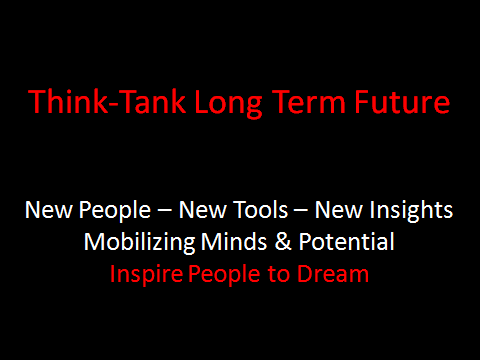
My Pamphlet posting of last month was basically the first part of the executive summary for this think tank.
image

Since then, we have been sitting together last month with 10 captains of industry of the Flanders region, where the idea was floated and generated a lot of interest. We will have a follow-up meeting after the summer holidays, where we will invite co-thinkers and enthusiasts.

I would like to go faster, but would like things happen at their natural pace, as the subtitle of this blog suggests: “Let the future emerge”.

I will keep you updated as this project/movement emerges.

To keep the subject warm, I am happy to share the 2nd part of the executive summary in its original form, hopefully to generate some on-line discussion:

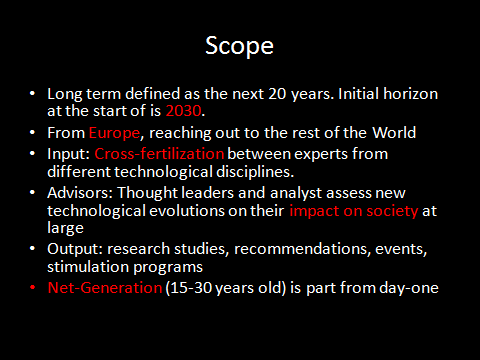
We want to create a “think-tank/foundation” on long term future. Long term defined as 2030. A place where “smart people” can meet. Where experts from different technological domains share their insights for 2030. Cross-fertilizing each other’s disciplines. With “smart people” from different contexts & worldviews that can act as our “eyes” and offer a perspective on how we will live, work in 2030. On how our education is best organized. On what our ideal value kit for that era should be, beyond traditional corporate culture. A culture of sharing and exploring, where we live intensely in teams, groups, regions, countries and communities and with deep respect for the individual humanistic identity of all those forming part of it.

Similar think-tanks of course already exist. But many look at these subjects from an US-perspective only. Or only bringing together technology experts. Few or none do this from our cultural rich and diverse European heritage.

We believe that from Flanders we can make a difference. Flanders is ideally placed: it’s highly appreciated and most productive multilingual multi-cultural workforce is operating from the cross-road of Europe and fleeing out to all countries in the world. As our interdependency from other countries, regions and continents will become even more important in the years ahead, we believe we have a unique opportunity to forecast together these exciting future scenarios and possibly even lead several of these technological revolutions.

We also want to make a difference by the inclusion up-front of the Net-Generation in our thinking. We want to give the opportunity to high-potential young adults between 15-30 years to co-create this future. Mentored by those who were part of the Internet revolution 20 years ago, and who are now 35-45 years old. Vice-Versa, we also want to offer reverse-mentorship by Net-Generation high-potentials.
image

These new models and scenarios will demand speed, creativity, dynamism, perseverance, courage, knowledge and working together in a multi-cultural context. This new society is – together with the movement of TransHumanists – making a plea for respect for individuality, freedom, mobility and quality of life.

This work and endeavor is all about designing, exploring and organizing change, learning and fine-tuning as we go. Giving guidance to teams, organizations and leaders on how to surf these waves. Missing the first technology wave of speed and creativity will result in loss of economic relevance. Missing the wave of the new value kit will result in losing our Net-Generation, our brains for the future.

Who wants to join this movement ?
Pamphlet

I started this blog on 7 April 2009. It may look as a very diverse set of blog-posts, but there is plan behind all this.

As a teaser, i am publishing today my Pamphlet. More to follow in the days/weeks to follow. Let me know what you think.

“Over the last 20 years we have witnessed a fantastic growth of wealth and technologies. ICT technologies have started permeating our daily lives. Medical sciences and biotechnologies have increased the average age significantly. Other technologies (Nanotechnologies, AI, Robotics, etc) have kick-started. “

But, since the last couple of years, we witness the breakdown of a number of core systems:

– Our worldwide Financial system is going through a “meltdown”. The old game of greed is coming to an end. Trust is becoming value number 1.

– Ecological, ethnological and demographical shocks are turning our systems upside-down. Green and Energy are now in the mainstream

– The East/West shock: economic powers shifting from the Western world to the new economies of APAC and BRIC+ countries.

– New forms of communication via the internet (blogs, wikis, social networks such as Facebook, Twitter, Netlog, etc) propose a new paradigm with respect of privacy.

“All this fundamental changes give us a feeling of discomfort, disorientation, confusion, loss of control. Although our “collective intelligence” indicates that our old models do not apply anymore, our “hardware” seems not to have followed. We have not adapted the way how we are organized hierarchically, how we look at governance. Our traditional “system”-thinking got stuck and did not follow our “collective intelligence”

On the other hand a set of new systems and tools are building up:

– Barack Obama describes it as the ‘audacity of hope’; innovators, planners, academics and authors are referring to dreamtelligence as a new, vital, and visionary way to use play, fantasy, dream-thinking and innovation to kick-start ideas and stimulate community engagement.

– A fantastic call for and revival of authenticity for ourselves and our leaders. Having true leaders: with charisma, attraction, integrity, and authenticity.

– The Net.Generation (now young adults between 15-30 years old) have grown up as digital natives. They will be tomorrow’s leaders. What THEY think will co-form our future. Future will not be invented by today’s generation. This Net-Generation lives differently. They are “wired” differently. For them multitasking (multi-window chatting, gaming at the same time while listening music, looking up information on the internet, being mobile, etc are very common. They also think differently (deeper and more authentic): they have a very strong sense of the common good and of collective and civic responsibility

– Our technological revolution has just started.

o Today our technologists are capable of breeding a human ear in their labs. We are now in a position to create and grow cells, tissues and bodies.

o Artificial Intelligence is back: by 2030 our computers will be able to think, be self-learning, self-healing , some will be able to have a consciousness.

o Self-learning robots will soon go mainstream. Mercedes and BMW have already now cars in the pipeline for 2012 that can drive fully automatically, better than a human being

o The emergence of Google and the “Global Brain”. The internet today is already a tremendous source of information. Today’s search experience will pale compared to the mechanisms we’ll have in 20 years. All knowledge will be available anywhere, anytime, wireless, via brain-implants.

o Social networking is already revolutionalizing the way people and companies are communicating. Interesting to note that these Technologies let us evolve again from a system-to-system communication towards human-human communication.

o Today you can order your personal DNA Gnome sequence in the USA for only 399$. The company doing this is a Google backed start-up. Think DNA in the cloud, with DNA comparisons between ancestors, relationships, etc.

o Brain-wave helmets and chip-implants will give humans better sensors. By 2030 we will see the emergence of “superhumans”. In such dramatically changed context, what will make us “human” ?

o A lot of these future scenarios are described in Ray Kurzweil’s “Singularity” concept. This is the moment when man and machine will truly blend. Kurzweil claims this will happen around the year 2030.

And the pace of all these technological innovations just goes on in a very exponential way. In the next 20 years we will witness technology breakthroughs that will mean the tenfold of what we have seen the last 20 years.

“All these evolutions call for a re-thinking of our value-compass for the future. We must carefully analyze and think-through on how all this will influence the way we will and want to live and work in the future. What sort of life-quality we aim for. What the socio-economic impact of all this may be. How we want education to be organized. Where we still can and want to influence. “

Consumer Genetics Show


Found this link about the Consumer Genetics Show via a tweet from Tom Hague of the Open Calais project. Tom tweets that he never expected to see the words “Genetics”, “Consumer”, and “Show” to come together.

Coincidently, at about the same time, i am reading the following paragraph in chapter XV – Time Warp in the book “As the future catches you” by Juan Enriquez.

“Almost any species can be cloned today…

“In the United States, it is illegal to use federal funds to clone humans…

“But it is not illegal to clone a human… (except in California, Louisiana, Michigan, and Rhode Island.)

“Nor is it illegal in Singapore, Russia, Brazil, China.

“And if you combine desperate customers…

“Rapidly evolving and highly decentralized technology…

“And the moniker of “the first scientist to clone a human”…

“The incentives are too great to stop this from happening.

Juan Enriquez also had a great speech at TED 2009:

I am a big believer that we will see the biggest breakthroughs and innovations on the cross-roads of ICT and Bio-engineering.

And i would like to add one more dimension to it: the Global Brain or the Semantic Web.

Example ?

One of the companies mentioned in the article on the Consumer Genetics Show is 23andMe.

image

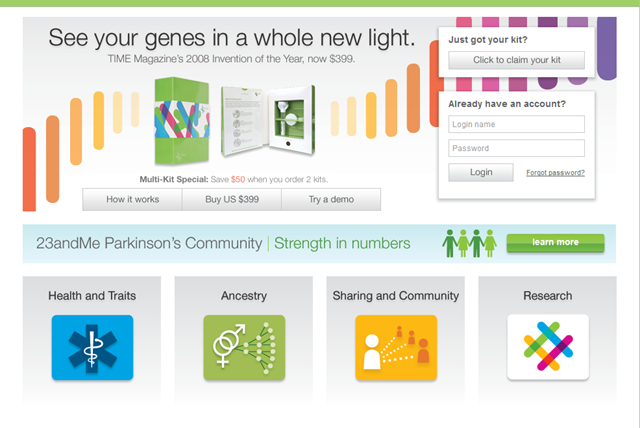
A customer of the Web-based service 23andMe sends in a sample of spit and receives a genome-wide analysis of nearly 600,000 genetic variations. The results include an estimate of genetic risk for various diseases, along with other personal information, such as where the customer’s ancient ancestors might have come from. Price tag ? 399$

Sergey Brin, the billionaire co-founder of Google plans to contribute money and his DNA to a large study intended to reveal the genetic underpinnings of Parkinson’s disease. See also this article in the New Your Times dated March 2009.

23andMe is co-founded and co-managed by Mr. Brin’s wife, Anne Wojcicki. The company offers a personal genomics service, in which it scans the DNA submitted by its customers and provides information on their health risks, ancestry and other traits. Esther Dyson is a Board member.

Start thinking DNA and gnome in the cloud.

“Getting a genome sequence has never been an end … just a start” -  Craig Venter

Mash-up, Cloud, Semantic Web

Have been on the road quite a lot with a bag full of new ideas.

In all the discussions, it became clear for me that the end-game is about superior and dramatically better user experience.

The end-game is not cloud, the end game is not Web 3.0 or 4.0 for the matter. These are just enablers. The end-game is user experience.

And much of that experience will come from Mash-ups, real-time and giving the power for creating in the hands of the end-user.

We all have seen the Google map mash-ups with addresses of best bars in town. For sure a life-critical application, but what i have seen the last couple of week is a bit more impressive.

I will NOT cover Google Wave announcement, as already all over the place, and this blog is not intended as just an echochamber of other sites.

It all started at the iMinds conference some weeks ago, where i saw a presentation by Ben Cerveny from Stamen Design. Ben used to be one of the founders of Flickr.

Ben was really mis-casted in a political-themes-debate, but did well anyway. He gave a pitch about the importance of web-literacy of our population, and about identity in a special way. For ex everybody recognizes the New-York skyline. But would you also identify yourself with the traffic visualization map of your own city ? Ben showed some great visualization examples. Have a look at http://delicious.com/benstamen. I most like the swarm example and the cab-spotting. The swarm shows you real-time visualizations of chat/twitters/social media conversations. The cab-spotters is also real-time, and the resulting visualization shows most used street patterns.

Thanks to my sponsors, I also was lucky to be able to attend Semantic Web3.0 in NY some weeks ago. Many good stuff, but i would like to share at least 3 examples: Aza Raskin from Mozilla Labs, Dan Willis from Sapient and Alex Karp from Palantir Technologies.

Aza Rasking (have a look at his bio on wikipedia, the guy was already a star at the age of 17 😉 is Head of User Experience at Mozilla Labs, and gave a preview of some cool things that will come out of the box in Firefox. And yes, I know IE8 Accelerators can do similar things but not quite yet.

Aza gave demo of Ubiquity and TaskFox.

Here is Ubiquity:

And here is TaskFox, a bit slimmed down version of Ubiquity in Firefox:

Dan Willis from Sapient gave a presentation on what happens when machines talk to machines. He did a great pitch illustrating with some sort of Kindle device with transparent screen capturing signals from semantically enabled objects. I love the very last example about taxis that radiate their traffic violation history. His presentation is on slideshare below, but you should really have heard Dan’s voice-over during the conference which makes it much more lively.

Last one for today comes from Palantir Technologies. At Web3.0, Alex Karp gave an amazing demo about a mortgage fraud investigation system, build as a mash-up of many different data-sources that were exposed with semantic techniques.

Here is the video of the Mortgage Fraud Investigation app. http://www.palantirtech.com/government/analysis-blog/mortgage-fraud. Many other staggering mash-up videos from Palantir are at http://www.palantirtech.com/government/videos

The point i am trying to make is not that these are cool videos. The point i am making is that all these use the principles of the semantic web (which is essence is about giving meaning to data, meaning that can be exploited via APIs by a computer), ideally run in a cloud (where integration is done these days at data-level), enabling great user experience.

Interactive Radio

Very quick link to Tagger.FM

Tonight 13 May 2009 they do something special. There will be a concert by a band, and the audience will be able to live-tag the band during the concert.

You can also do this tag-test at home. Send after 8pm a SMS with text “TAG BBR” to 4123 (this is a Belgian SMS number)

Saw those guys at iMinds yesterday, and his really rocks.

More on the iMinds event in the next days

Wolfram/Alpha vs Google: 0-1

There has been a lot of fuss going on lately regarding Stephen Wolfram’s ambitious project to create a comprehensive "computational knowledge engine." called Wolfram/Alpha.

UPDATE: Stephan Wolfram now also started a blog at http://blog.wolframalpha.com/

The Berkman Center for Internet & Society at Harvard University hosted yesterday 27 April 2009 a sneak preview of the Wolfram|Alpha system.

This was a full 2 hours webcast, with no screenshots (at least not during the webcast), just a talking head for 2 hours and Q&A from the audience.

I finally got hold of a screenshot via Techcrunch:

wolfram

There is already some good coverage on this by Larry Dignan, Editor in Chief of ZDNet, on his blog here.

Larry summarizes well:

“Four big pieces are behind Wolfram/Alpha:

  • Curated data: Free, licensed and feed data. Running through human and automated process to verify the data and make sure it’s “clean and curatable.” At some point, you need a human domain expert. 
  • Algorithms: Wolfram/Alpha uses a bevy of algorithms including 5 million to 6 million of mathematical code.
  • Linguistics: The goal is to interpret free-form language processing. Wolfram said Wolfram/Alpha uses various components and techniques to figure out what people are actually asking. Part of that process is filtering out fluff.  ”We’ve been pretty good at removing linguistic fluff,” said Wolfram, he said people eventually get to the point where they speak as if they were talking to an expert. “People quickly begin to just type in concepts as they come to them.”
  • Presentation: Algorithms try to pick out what’s important to the searcher. Again, Wolfram noted that human-aided algorithms are needed.

Instead of delivering up a bunch of links, the Wolfram/Alpha search engine tries to put a narrative around a user’s question and allow them to drill down. Indeed, the result presentation features graphics and other computational features. Think part calculator, part search engine. “

Interesting to see that Google upgraded and announced some new features during the Wolfram demo – and thereby taken all the attention away from Wolfram back to Google, and Wolfram fires back a couple of minutes/hours later. Some other coverage about this here and here and on Techcrunch.

The webcast itself was pretty boring. After 43 min of monologue, Stephen Wolfram opens the floor for questions. And the first question was right on.

A journalist from O’Reilly wanted to know more about the consistency of data, and whether you can trust the algorythm this much. Answer; what we are doing is creating an (or the ?) authoritative source of data. Mechanism for people to contribute data. And Wolfram to “audit” that data. Source identification is the key challenge in all this. All this makes me think of Ken Steel BSR (Basic Semantic Repository) Beacon project in the mid 90’ies, where he would be THE owner of the semantic repository that’s going to keep all tags and semantic meanings of date being carried around in XML-like tagged data.

Then David Weinberger asked if and when this will be opened up (see also my yesterday’s post on “think big – think open”. His question was in fact 3-fold. Open through:

  1. API’s: 3 levels of API’s: presentation, underlying XML, and symbolic expressions of underlying Mathematica source data.
  2. Metadata: when they open-up, plan is to expose some of the ontology through RDF.
  3. Upload personal data to the system: intention to have a professional version of Wolfram/Alpha, subscription based.

David Bermaste: what with questions/answers were scientists have difference in opinion, such as “Are certain classes of PCB’s human cancerogeneous ?” or in other words “who has the real truth ?”

Who is this for ? Kids or scientists ? Answer: “To make expert knowledge available to anybody, anywhere, anytime.” Wow. That’s ambitious.

What in case the question does not make sense ? For example “what is the 300th biggest state in Europe ?”. At this stage and in this version Wolfram/Alpha does not return you a result.

The challenge also seems to be how you keep the info and the universes of knowledge up to date. Today this project has +/- 100 people working on it (last period maybe 250), but what army of people do you need when this really goes live big way ? Answer: it’s probably going to end up with a 1,000 people. Sounds a bit underestimated to me if you ask.

In essence, all this is about Knowledge Management. And i know quite some companies that would be interested in throwing all their unstructured data and have an engine that can make meaning out of all that data. So the professional version may be up to something. But in it’s current state for the public in general to compete head to head with Google ? No, i don’t think so.

I suggest you also have a look at Mendeley, a start-up (initially from Germany, but now based in London), use parse and discover patterns in university research papers, but just think how this could be applied to basically any type of information. One of their VC’s is an ex Last.fm and ex-Skype (and also a professor or even a doctor in Economics at the University of Hamburg) and it’s interesting to see how these young net-generation guys are capable of telling their story in less then 2 minutes, with monetization topic included, and still leave you with a hunger and curiosity to want to know more.

I never got this thrill/feeling of “want to know more” during the 2 hour Wolfram webcast. I felt bored, and was asking myself all the time the question “what have i missed here ?” and a sort of compassion and respect for somebody’s lifework of the last 25-30 years.  I was also somewhat disturbed by what i consider a form of self-complacency, bit out of the ivory tower type of discourse, not really accessible for non-experts.

This Stephen is definitely a very smart and wise man, and it’s clear he is passionate about his work and is in search of “intellectual satisfaction”, but i am afraid he won’t be up to the power and sexiness of Google and many other newcomers on this stage.

But does this withstand what i would call the  “Jeff Jarvis’ Google Test” about new types of relationship, architecture, publicness, elegant organization, new economy and business reality, new attitude, ethics and last but not least speed ?

Old Game – New Game April 2009

As a start of a new series, i will regularly post examples of old-new game economy.

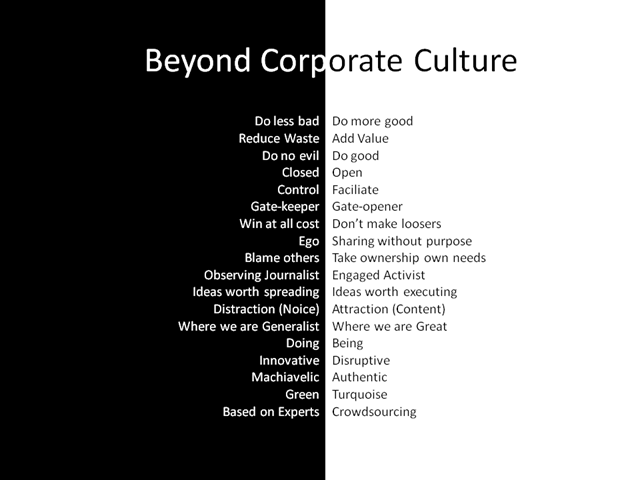
As a starter, a slide i once made as input to my Leading by Being Coming-Out. For more info on Leading by Being, please go to my very first post on this blog.

On the left the “old” culture, on the right the “new” culture.

LBB Coming-Out V8 - Beyond Corporate Culture slide

Today, i saw a perfect example of Old Game when looking at the chaos at the Fortis General Assembly. The attitude of lawyer Mondrikamen was appalling, and it was very disappointing to see a man of that caliber and education misbehaving and playing populist techniques.

Old Game of today: Modrikamen at the Fortis General Assembly on 28 April 2009

logoFB

http://www.holding.fortis.com/shareholders/webcast.asp or in the meantime the news-site of Belgian (Flemish) Television. Use this link, and start somewhere half-way the video.

New Game of today: also in banking. The new release of Mint.com, a company introducing innovation week after week for the interest and added value of its customers:

mint_white

And it is their own CEO delivering the demos. Have a peek at it and let me know when we’re going to have this sort of bank-service from one of our European banks.

Think Big – Think Open

My friend xstof pointed me at ThinkBigManifesto. I started this blog with “Inspire others to Dream”. It could have been “Inspire others to Think Big”. And the advertising text of ThinkBigManifesto suggests: “Big thinking is open and generous, discerning and judicious, yet not judgmental. Big thinking is not excessive, nor is it about the pursuit of excess. Rather, it is moderate.”

Google is big. Google is about Thinking Big. But what would it take to become a Google-Killer ? “More transparency and less opaqueness, more open”, says Jeff Jarvis in his short video posting on www.bigthink.com about the Google Killer. Jeff Jarvis is quite known from his bestseller “What would Google do”.

But how open can you go ? Whereas in the past “standards” or “protocols” were focusing only on the connectivity (how to get data from A to B) and syntactic (and sometimes semantic) standards for data standards and “messages”, today we have open standards for all layers.

I recently found this very interesting deck by Micah Laaker from Yahoo! I have to confess that these Yahoo! folks seem to be on top of everything these days. Also have a look at Yahoo Pipes if you have the time. Especially if one starts thinking about being open in a cloud and/or SaaS type of private or public community.

Micah basically proposes an updated set of standards for many more layers than we used to think of (with courtesy of http://developer.yahoo.net/blog/archives/2009/04/baychi_open.html):

1. Open Source (PHP, Hadoop)
2. Open Infrastructure (Amazon EC2 & S3)
3. Open Architecture (Firefox, YQL Open Tables)
4. Open Standards (XML, JSON)
5. Open Ontology (Microformats, RDFa). See also my recent blog on Smart Data and the OpenCalais project.
6. Open Access (Twitter, Yahoo! BOSS)
7. Open Canvas (Facebook, Yahoo! Application Platform)
8. Open Content (Google Reader, My Yahoo!)
9. Open Mic (WordPress, YouTube)
10. Open Forum (Digg, Yahoo! Buzz)
11. Open Door (Get Satisfaction)
12. Open Borders (OPML)
13. Open Identity (OpenID, AttributeExchange); btw have you noticed that Facebook is one of the first true big players to adopt OpenID ? Not as an Identity issuer, but accepting OpenID’s issued by other big players such as Windows Live ID, Yahoo ID, Google ID

Slide #43 gives a good overview which standards bring most value to what audience (users/developers).

This presentation was delivered on 14 April at BayCHI http://www.baychi.org The meeting Report by student Gregory Cabrera ends with the appropriate questions:

• Does the system need to be open in order for users (and developers) to derive value?

• Is creativity an important feature in the design of a platform?

• What are the features of a successful, creative, open system platform?

• How creative would you like your users (or developers) to be?

• How would you inspire creativity in the development of a product or service?

Imagine a business to business cloud. What of these or other standards would make your offering truly open ? Feel free to comment or to come up with “open” suggestions.

NUI, XUI, TUI ?

No, this is not the name of the latest song i have been teaching to my 3 1/2 year old daughter.

I am just going completely crazy these days about touch-driven devices, and found some new acronyms in this space:

  1. NUI: Natural User Interface. Examples are Surface and Jeff Han’s touch interfaces
  2. XUI: XML User Interface

So, i decided to invent my own. TUI: “Touch User Interfaces”, but a check in Wikipedia revealed somebody else already coined that acronym. I just wanted to add more touch or even no-touch as in gestures.

As i have some days off this week, I have some extra time to introduce the topic with some parodies on well know advertisements. This will also please my readers who ask me questions such as “why do we need all these computers ?”

Please enjoy the advantages of the Mac Air:

Why spent 300 € on a Wii Fit, if 3 € would give you the real thing ?

Surface on its best:

Or this one: Put a Surface in your pocket:

But seriously, how could these devices used in Business ? Let’s have a look at what Barclays is doing with it:

Or at Identity Mine: a Touch-catalogue and Blackberry becomes check-out for Elektra, a big electro-shop in South-America (sorry did not succeed to embed that video).

Or let’s throw in some “gestures” at GestureTek:

And from the same GestureTek: full body Avatar control. Check out this link with plenty of other demos.

But what if real and virtual get really mixed together. Have a look at the concept videos below:

XUI/NUI/TUI at Home

XUI/NUI/YUI at Work:

Or get completely immersed. Check out how EonReality is pushing the limits. Here on their homepage and here in this video. It’s getting so real that you almost get sea-sick.

Amazing 3D immersion technology from IDEO Labs on Vimeo.

Who said that singularity (the moment man & machine truly blend together) will happen in 2030 ?

I think it will be much sooner.

In 2030, having a brain implant will be as cool as having an iPhone today. Who in his right mind would have predicted in 1990 more than one cell phone per person ? That’s also only 20 years ago.

Smart Data go mainstream

Smart Data are the promise of the Semantic Web.

And yes, i heard the pitches from Tim-Berners Lee. But that sounded all so far away and abstract, and i could not imagine what it would give me as added value.

But the video & site below put this into a competitive advantage context and that’s where it gets interesting.


Check out the OpenCalais project: fantastic site with many interesting other links to semantic web related sites, blogs, etc. This will take me week to digest.

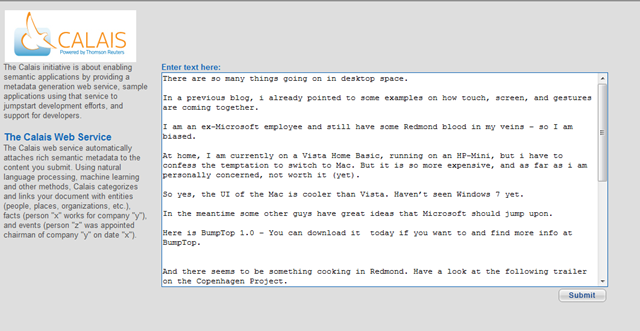
And these are not some geeks putting together something. This is an initiative powered by Thomson Reuters: “The Calais initiative supports the interoperability of content and advances Thomson Reuters mission to deliver pervasive, intelligent information. It builds on the company’s investment in semantic technologies and Natural Language Processing to offer free metadata generation services, developer tools and an open standard for the generation of semantic content. It also provides publishers with an automatic connection to the Linked Data cloud and introduces a global metadata transport layer that helps them leverage content consumers like search engines to reach more downstream readers.”

I decided to try the DocViewer at http://viewer.opencalais.com/ and i cut & pasted the full text of my recent blog on “My new desktop: touch and 3D of course” and hit the submit button:

image

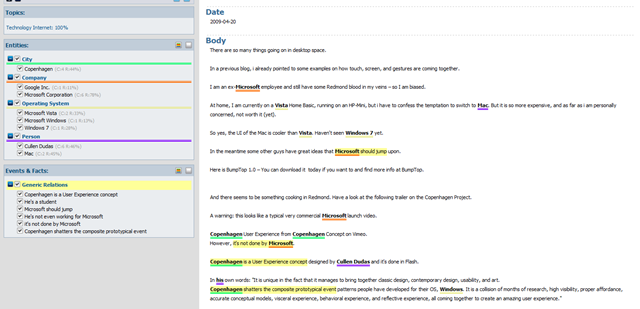
What i get back is amazing:

image

The unstructured data of my blog are parsed, patterns are recognized and semantic data is added. All this can now programmatically exploited as the APIs are published.

Imagine combining this power with drag & drop mash-up techniques such as Yahoo Pipes or similar.

Or imagine using this to feed info from financial data reference sources into your financial planning or even trading rooms. I recently have seen a similar demo, with very powerful multilingual parsing and pattern recognition of unstructured data, but this is the first time i see something that has the potential to go mainstream very fast.

PS: some folks ask me where i find these interesting links. Well, i spent quite some time researching on the web of course. But i also have some friendly secret sources. Friends that just share a link via Twitter or mail, and who themselves have no time or appetite to make a blog out of it. The subject for this post was kindly provided “xstof”