
Very cool presentation on the impact of the web on the world. Web Wide World revisited so to speak. Enjoy.
View more documents from gloriagdiago.

Enjoy at Real 3D Mandelbulb.

“The web is transforming society”

“Web Squared: how the web transforms the world”

“Web Wide World” transforming “World Wide Web”

Several very interesting publications and postings over the last couple of weeks, all confirming that something very profound is happening with our core systems, our core values, and how the collective intelligence of the web is gradually but surely transforming our value kit for the nearby and long term future.
First, i would like to point to 2 very rich and profound postings by Nova Spivack.

On Nov 4, Nova posted The Web Wide World — The Web Spreads Into the Physical World.
A world in which every physical object, everything we do, and eventually perhaps our every thought and action is recorded, augmented, and possibly shared. What will the world be like when it’s all connected? When all our bodies and brains are connected together — when even our physical spaces, furniture, products, tools, and even our natural environments, are all online? Beyond just a Global Brain,
we are really building a Global Body
Even more profound and more elaborated is his posting What after the Real Time Web ? This supposes that you already have an idea what Real Time Web is all about. It’s a very long posting, but worth every minute/word of it. Some highlights/bullets with some personal comments:
About Web Attention Deficit Disorder: You can experience this every day if you are a Twitter, Facebook, Google Reader user. It’s about having tools to filter out the noice and focus on the essence
About Web Intention Deficit Disorder. Great “bridge” from attention to intention. I was thinking in terms of moving from “Crowd-Sourcing” towards “Crowd-Targeting”
About Messaging. Messaging as we know it for 20 years is going to change 180°. In these days it is somewhat insane that we still send messages from A to B, whereas with today’s technology it’s more about having something stored centrally and collaboratively participate to this "information object in the cloud”. Google Wave is a powerful trendsetter.
About Semantics. What can i say. It should be clear by now for any semantic standards setting organization like SWIFT, like GS1, like… that their knowledge to deal with semantics in “messages” can now have a ten-fold impact in a “semantic web” world, where we now can automatically semantically tag any form of information, whether that information is already structured, or not (like in Word, PDF, images, digital information footprints, etc)
About Attenuation. About helping someone focus their finite attention more efficiently on the things they care about most. This makes me think of Generation-M (see elsewhere on this blog). The generation that cares about things that Matter.
About The WebOS. I like Nova’s statement that “the winning WebOS is probably not going to come from Google, Microsoft or Amazon — rather it will probably come from someone neutral, with the best interests of developers as the primary goal.”
About Decentralization. “By this time the Web will be far too vast and complex and rapidly changing for any centralized system to index and search it”. It becomes increasingly clear that “central control” or “central policing” does not work in this Web Wide World. Definitely not if you don’t add value in the middle.
The intelligence is moving
to the edges
About Socialization. There is no escape. No hiding possible anymore. The future is for those who can share. That will be rewarded in new “currencies”. See elsewhere on this blog about the Whuffie Bank.
About Augmentation. Just today i was reading another post about augmented reality eye-lenses. And about Google Latitude now offering historical tracking on your whereabouts. Nova is mainly talking about real-time augmentation. Adding the historical tracker to all of this is pretty exciting.
About Collective Intelligence. Just quoting here: “This collective mind is not just comprised of humans, but also of software and computers and information, all interlinked into one unimaginably complex system: A system that senses the universe and itself, that thinks, feels, and does things, on a planetary scale.”
About Social Evolution. “Existing and established social, political and economic structures are going to either evolve or be overturned and replaced.” This has been my thesis since the beginning of my blogging. Stronger, it’s the raison d’être for my blog. If all this happens, what is the 2020-2030 impact on our core systems, on our core corporate and personal values. How will our companies, countries, world systems going to be organized and how can we prepare for the day when “Top-down beaurocratic control systems are simply not going to be able to keep up or function effectively in this new world of distributed, omnidirectional collective intelligence.”
About Physical Evolution. In essence, Nova describes the age of the Singularity, when our human brains will be complemented by the collective and give leeway to a different type of human being.
The environment we will live in will be a constantly changing sea of collective thought in which nothing and nobody will be isolated. We will be more interdependent than ever before. Interdependence leads to symbiosis, and eventually to the loss of generality and increasing specialization.
This must sound as music in the ears to my friend and coach André Pelgrims, who is fighting the sort of societal and corporate change management that is often not more than a big illusion, because the company has been focusing on aligning (not event fusing) of departmental silos, and was not able to descend to the level of person-to-person connection and enlightenment.
These are just some of the changes that are likely to occur as a result of the things we’re working on today. The Web and the emerging Real-Time Web are just a prelude of things to come.
The last element i’d like to ask your attention for is the existence and activities of the Web Science Trust.

The Web is the largest human information construct in history. The Web is transforming society. In order to understand what the Web is, engineer its future and ensure its social benefit we need a new interdisciplinary field that we call Web Science.
Have a look at some of the big names behind the Web Science Trust: Tim Berners-Lee, etc. Also very good to see that some European (UK) universities are starting to take the lead.
Most interesting is to look at the Research Roadmap. Just look at the research perspectives, and it gives you an idea of the deep profound impact of the Web Wide World:
And the integrative research themes:
I took the effort to download one of the students research reports. Oh boy, how interesting how these young people study, research, reflect, analyze. I’d love to be back at university 🙂
Here is one sentence about the WebSci’09: Society On-Line Conference:
Thanks to the support of the Web Science exchange bursary, I had also the opportunity to participate in the WebSci’09: Society On-Line Conference, which was held in Athens, Greece from 18th to 20th March 2009. The conference was actually a very special one, as it was the first conference I have ever been to where I had the chance to exchange ideas with not only computer scientists but and legal studies.
I believe it is key that
we start building companies
made of the “hybrids”
Not only computer-scientists, but people with cross-fertilizing expertise. Like “experts of other areas including social science, humanities and legal studies” and bio-engineering and nanotechnology.
All the above is very close to the suggested scope of our Think Tank on Long Term Future.
Three interesting news items that Cloud computing and marketplace are just happening.

Nobody else than Salesforce – a 10-year old company running a 10B+ $ cloud business, with 60,000 customers and 1,5M users (talking about reach…) – has as helped to launch FinancialForce.com , a new company that offers financial software. The new startup is funded by Unit 4 Agresso, the parent company of Coda, which had sold the Coda2Go SaaS through Salesforce.com’s on-demand application store. The new company is co-headquartered from Salesforce.com’s offices in San Mateo, Calif., and from an office in Harrogate, England. Salesforce.com will provide the customer support for the startup’s core product, also called FinancialForce (formerly Coda2Go). Salesforce.com is looking to position Force.com as a platform to launch new SaaS companies. FinancialForce.com is one of their first big case studies. The new solution includes general ledger accounting, user-defined budgets, spreadsheet integration, accounts payable and receivable, and invoicing. Pricing starts at $125 per user per month, and customers do not have to be Salesforce.com customers. Yes, i know, it is "just" accounting. But if you know that force.com already has 80 Financial Apps on their marketplace, it’s obvious on how the dots will connect.
The second is nobody else The U.S. Defense Department. They just put into operation their cloud computing services for military personnel. Originally launched a year ago, the platform, called RACE (Rapid Access Computing Environment) , was initially used for testing and development of new applications. The military says RACE is ready to go live with 99.999% uptime.

The third is a company Schumachergroup .

Their CIO was speaking at the Cloud Computing conference in London this week. This presentation was by far the best of the whole conference.

75% of all their business critical apps are now in the cloud. And targeting 90 % by 2010. The rest in a traditional on-premise data center. The cloud is 99,5% uptime and is manned by 25% of their IT FTE’s. This is the area where they innovate. Their data-center is 98% uptime, has 75% of the IT FTE’s running it and it’s the data center that keeps the CIO awake. In the cloud, they can deliver 5-10 times more value faster. What does faster mean: on average 5 months to deploy a new app into the cloud.
We have invited this CIO to Innotribe at Sibos2010 to deliver a real-life case study from another industry.

See also the article "Marketplace – a commodity" on my personal blog here . Some people believe a Marketplace for Financial Services is years away, even beyond 2015. Don’t think so. It’s getting build-in in platforms.
Great article in NYT. You can find full article here.

The article is so inspiring. Anything is possible when you let yourself inspire by your dreams.
The next break came when Dr. Friedman was talking about the LightSail to a group of potential donors. A man — “a very modest dear person,” in Ms. Druyan’s words — asked about the cost of the missions and then committed to paying for two of them, and perhaps a third, if all went well.
After the talk, the man, who does not wish his identity to be known, according to the society, came up and asked for the society’s bank routing number. Within days the money was in its bank account.
My dream is to get our Think Tank on Long Term Future kicked-off in 2010. In the next 2 weeks, i will be speaking on this Think Tank to a group of potential interested captains of industry.
My purpose is “To Inspire Others to Dream”.
With thx to xstof for spotting this one. Looks like i cannot embed the video, so please go here or click the picture below.

It turns out 2019 is getting closer every day. At the moment, Microsoft’s chief research and strategy officerCraig Mundie is doing the rounds at a number of prestigious colleges in the States showing off Microsoft’s vision for technology to solve the world’s biggest problems. Of course, one must use the latest in natural user interfaces for this task.
A feature of this year’s tour appears to be a next-generation computer – one that docks and undocks from a transparent glass display and allows for not only pen and voice input as you’d come to expect from natural user interfaces, but also incorporates touchless gestures and eye-tracking to interact with the information at hand.
Getting closer to the Minority Report type of interfaces 😉
The Academic Ranking of World Universities just got published.
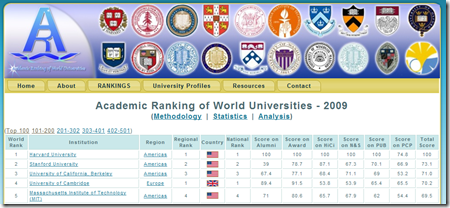
Not a single Belgian University in the Top-100. Leuven comes in at 102 and Ghent at 106.
I found this resource via Eric Drexler’s blog, which was focusing on Asian Universities.
The “Academic Ranking of World Universities” (ARWU) is widely regarded as the best objective, international measure of university quality, and the ARWU says that excellent universities in Asia are scarce.
This seemed to me to be out of line with reality, and on further investigation, I concluded that the ARWU has a strong negative bias as a measure of the current quality of rapidly advancing universities.
In examining a paper on the ARWU methodology [pdf], I found that its scores place great weight on numbers of Nobel Prizes and Fields Medals won, to publications in Science and Nature , and to publications listed in the Science Citation Index. The problem is that, as a consequence, the scores are weighted toward cumulative numbers, which are poor measures of rapidly rising institutions, such as the leading universities in China and India. For example, if an identical twin of Harvard materialized in Somerville or Beijing today, its rank would be abysmal for years to come.
In summary, the much-cited Academic Ranking of World Universities is very much a lagging indicator of quality.
Although that nuance may be good for the Asian universities, this is bad news for the Belgian universities.
The university of Leuven was founded in 1425 ! That’s almost 600 years ago. So if the ARWU is measuring (lagging) current quality of universities, that’s really bad news for Leuven.
Also, the omni-presence of US-universities should be of some concern to our society – the European in particular. This is also reflected in the number of innovation think tanks that exist in the world. Most are from US origin. Most of their analysis have a very US domestic focus.
That’s why our upcoming European based Think Tank for Long Term Future will try to change that, and start from the rich and diverse European culture and history. We’ll have our kick-off meeting with a number of passionate creatives and local captains of industry on 24 Nov 2009.
However, regional or anti-regional focus should not be the focus. And we do not want to start from a laggard’s position, as a catching-up strategy is always a loosing strategy.
In our inter-connected world, we are moving towards a new world order, based on collective intelligence and collective intention, inspired by transhumanism. I am preparing a separate post on that.
The focus will be on ensuring that our next generation is well prepared for a new world order. Preparing those who will be our leaders in 2030 is the focus.
Stay tuned.
Here is force.com from Salesforce. As far as i am concerned, the way a marketplace should look like. Already more than 800 apps available, more than 70 of them are financial apps.

Also have a look at the US Government marketplace.

Everything’s up there. With pricing info, liability clauses, shopping basket, etc
Some believe building an application marketplace is something exotic, and if your not an Force.com, Apple, Google or the US Government it is something that is years away.
Reset your thinking. Picked up via ReadWriteWeb. Microsoft is going to offer application marketplace in SharePoint 2010. See the interview in the article on ReadWriteWeb.
What is even more interesting in this article is the video from Citrix Dazzle solution, embedded below:
Search for a financial application, make sure you get the right approval level for being allowed this app, mix and match online and offline apps, etc. It’s like an iTunes for apps, but then in an enterprise environment.
Can’t wait to see an out-of-the box offering that allows me to set up a marketplace of financial services in the cloud.
One of the very best presentations at last month’s Singularity Summit. And it comes from a European 😉
Lots of inspirarational slides and ideas, and – as a bonus – Jürgen is quite funny as well when presenting.

Editor-in-Chief, Wired
A conversation with the Editor-in-Chief of Wired Magazine and author of The Long Tail and Free: The Future of a Radical Price.
October 29, 2009 | In Business & Economics, Science & Tech, Media & Internet
You can see the 36 min video here.
The full transcript is also available. Some extracts and quotes (red highlights by me)
On “free”:
What happened with the Internet is that it took computers and storage and bandwidth, silicone chips, spinning metal platters, and fiber optics and put them together. It turns out that Moore’s law falls in price 50 percent every 18 months. Storage and bandwidth fall in price every 14 and 12 months, each by 50 percent and they’re accelerating their race to zero even faster than Moore’s law. You put all three together and you have this general rule that anything you do on the internet, whatever it costs today, it will cost half as much a year from now. This has relatively profound consequences. First, it makes zero – It makes free not really a marketing gimmick but kind of an inevitable price. Not to say that everything is going to be free. The greatest misunderstanding of free is that everything’s going to be free.
At the same time, they have iTunes, a very successful way to sell music. In that case, what they’re selling is convenience, not music.
On “infinities” (see also Peter Hinssen’s Innotribe Keynote on “exploring the limits.”
I think the most profound thing about turning products into digital products from my prospective is that price becomes arbitrary. In the traditional world, there’s a pretty strong correlation between the cost of a product to make and the price you can charge for it. You charge something that’s slightly above the cost and the more competition there is, the less you can charge. It tends to drive prices down to the marginal cost. In digital products where the marginal cost is zero, the price can be anywhere from zero to infinity.
On “Cloud Computing”:
We talk about lowering the barriers to entry but you also want to lower the barriers to exit so that people don’t feel like they’re risking everything.
Open ID and open apps are two examples. I think we’re seeing these two battles play out and although Jonathon is absolutely right, that this is a risk, I perhaps have more confidence in the power of the marketplace to sort this out. I think that the one thing we’re sure about in this era is that we have choice, lots and lots of choice. If Facebook gets it wrong or if Twitter gets it wrong, there are a thousand other companies in the wings just waiting to get it righter. Knowing that, I believe –and so true for Google the elephant in the room on this– I think knowing that their hold on the consumer is not permanent, it’s not cast in stone and is only permitted as long as they serve the consumer better than the obvious alternatives, I believe, will keep them doing the right thing.
About “monopolies”:
I can only hope that the regulators move slowly because I don’t think the answers are clear and any answer we give today will be wrong tomorrow. I mean, today, isn’t it sort of absurd the fuss we made over Microsoft, now, in retrospect? Now Microsoft looks like the underdog right? We were so worried about their monologist abuse of the desktop. I mean, desktop, when was the last time you even saw your desktop?
About “going after small or big business (the next 1B$ business):
That model distributed innovation. Letting the community sort of invent products, try them out at small scale, figure out the bugs, whether there is real demand, and then use the big company’s power to scale them up to mass markets. That feels about right.
See also my yesterday’s blog post about Failure is NOT an Option.
On “what upcoming technology will disrupt the industry ?”
The simple answer to your question is the most disruptive thing I can see right now is the fact that you and I are carrying GPS chips in our pocket. If you have an iPhone in your pocket or any other smart phone, you’ve got a GPS chip. Now we’re not doing much with them right now but we have, for the first time in history, the capacity to link our physical world, the world we live in, to the virtual world.
I think GPS and the internet combined is a game changer. Now I’ll add just one thing on top of that. The fact that your phone is not just GPS and internet connection, but also other sensors, accelerometers, it has proximity sensors, light sensors, things like that. It could have other sensors. You know, we’ll see what we do with that. To what extent could that be used for health care? To what extent can that be used for, sort of, environmental monitoring? I don’t know but we now have nodes. We have smart nodes in people’s pockets, in their hands, spread all around the world, connected to each other and the internet that know where they are. I think that’s a big deal.
Anderson is also mentioning a company called 37Signals. Ever heard of them ?

37signals is a different approach in that they are relatively lean and targeted. They are not trying to become Microsoft. They know who they are. They were kind of born on the web and, as a result, the products sort of feel organically web centric.
And finally, on “Small is the new big”
Lower transaction cost was the advantage of the firm. Now we’re in an era where it’s completely reversed. Now big companies have bureaucracy. They have red tape. They have long procedures. They have certain profit requirements. The transaction costs are actually higher inside the walls of a big company than they are outside.
Bill Joy famously said that the smarter people in the world for any given project don’t work for you. That’s a problem if you can only work with people that work with you. I mean, why are you working with this guy? Is he the best person in world?
No, he’s the closest person in the world. Now it’s incredible easy to find the best person in the world and to get them to work with you. The internet has provided a sort of global lowering of transaction and so we can now, it’s often more efficient to look outside your company and, you know, I’m joking on some level. The idea of finding the right person via Elance versus your internal HR is actually often easier to go outside and get things done. What that’s done is that it’s said we have a diseconomy of scale with big companies. The bigger they are, the harder it is to get things done. Small companies are nimble. They’re focused. The cost base is lower. They don’t need big markets so they can target more narrow opportunities.
Open source software, hosted solutions, all this cloud stuff, those will lower the cost of starting a company. The internet has lowered the barrier of reaching products. These global markets of talent have lowered the cost of finding people the right people to work on your project. All of it is really creating an army of competitors to the large company model. Large companies are still great at mass but there is a long tail. And large companies are bad at the long tail. Small companies are perfect for the long tail. And we’re not going to see a battle between the two.
 Petervan Studios