Pause with Josie – Episode 3

This is episode-3 of the calm conversation with Josie Gibson from The Catalyst Network, inspired by Robert Poynton’s book “Pause – You are not a To-Do list“. The approach is simple: we both read chapter-3 of the book and highlight three sentences, and mark the words that resonate most. These sentences and words are the triggers for a very slow-paced conversation on whatever comes our way.  No tricks, no gimmicks, just a gentle and calm wandering and meandering of minds.

Here are Josie’s three sentences:

David Keating…. uses a tiny pause to instantly shift the mood (of a film crew).

Practice isn’t something abstract, it is embodied, so you need to engage your body as well as your mind.

It might be that all you need to do to access the magic of the pause is to make pause ‘a thing’.

And here are my three sentences:

The bar forces you to pause for a moment and notice how you are entering the zendo — in what frame of mind, with what intention and so on

I would encourage you to aim low and be selfish. Starting small is a good way to build a habit.

You can choose to see the journey as an ‘in-between’ place in its own right (instead of as a waste of time). Regard it as a space not to be filled and deliberately avoid reading a book, listening to the radio or music, or checking email.

We covered a wide range of topics from the entrance of a Japanese house, Buckminster Fuller’s tiny rudder, moodiness, struggling with the abstract, foam, and last but not least lite-ness and cookies from Pete The Pirate.

Pete The Pirate – Storm at Sea

Episode-1 is here. Episode-2 is here.

These are very calm conversations; so best is to take a pause, install yourself in a quiet corner, and enjoy!

Peter & Josie

Petervan’s Delicacies – 21 May 2020

delicacies

An irregular, unpredictable, incoherent, unfocused set of mind-sparks that got me thinking. Handpicked, no robots. Minimalism in curation. Enjoy!

If you can’t get enough of these and want more than 5 articles, you can hang on to the firehose, the extended version of Petervan’s Delicacies in REVUE. Subscribe here: https://www.getrevue.co/profile/petervan

Virtual meetings and events: an ambition cube

I recently had a number of conversations on “Virtual Meetings” or “Virtual Events”. The briefing boils down to the following two questions:

  • How can I create a virtual version of my now canceled physical event, meeting, and interaction with my customers/partners?
  • How can I take the lead in this virtual space?

I am surprised how often the initial briefings immediately jump into the aspects of production and tools. A sort of fear of missing out on the latest coolest online tool or platform. There is a deeper fear of missing the virtual boat, and fear of overnight irrelevance.

A production themed briefing is usually a sign that the client is looking for some quick and dirty quick wins (the lipstick on the pig), is not clear about the different dimensions at play when architecting an on-line (or off-line) event, and has even less clarity on their ambition levels.

In those conversations, I love to do some live (virtual) whiteboarding. By doing so, I stumbled upon a framework that seems to resonate with many people.

During some Zoom meetings, I could literally hear the clicking of the screen pictures while I was drawing.

So I decided to make a bit cleaner version of it and just put it on my blog. I call it Petervan’s Ambition Cube for Virtual Meetings © 2020 ;-).

I have certainly learned one thing in the last couple of weeks: the more I share it, the more feedback I get. The story becomes more coherent, and the network helps me identifying the blind spots.
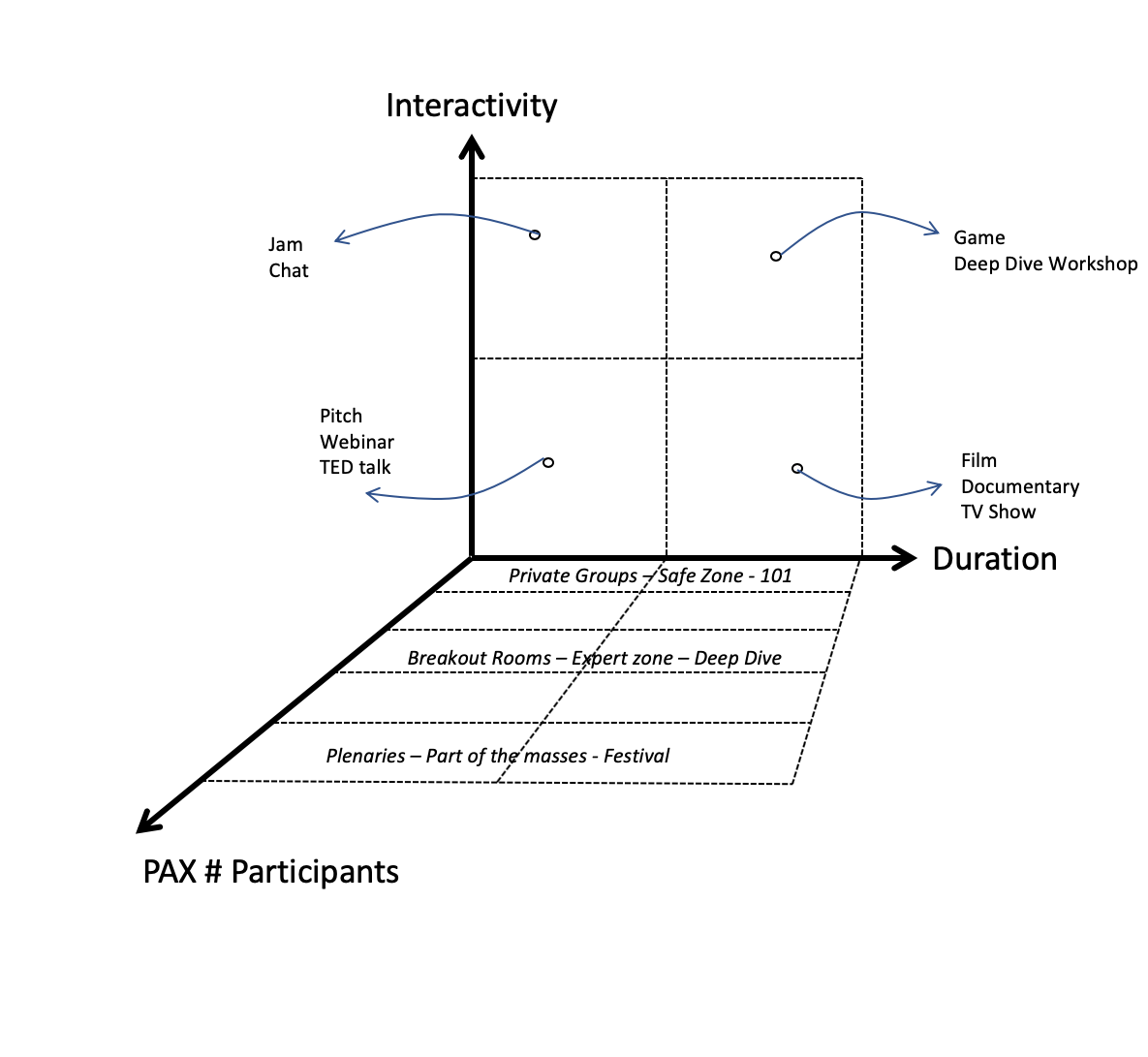
Screenshot 2020-05-15 at 08.43.22

There are 3 axes:

  • Duration: how long does the event last? From 5 minutes to 2 months for example
  • Interactivity: how much is the audience involved? From 100% passive listening to immersive free play
  • PAX # Participants: from a 1-1 till several thousands of participants

On the Duration/Interactivity pane, one can start plotting different types and formats of events. From simple 5 min one-way pitches and introductions to deep immersive games and workshops.

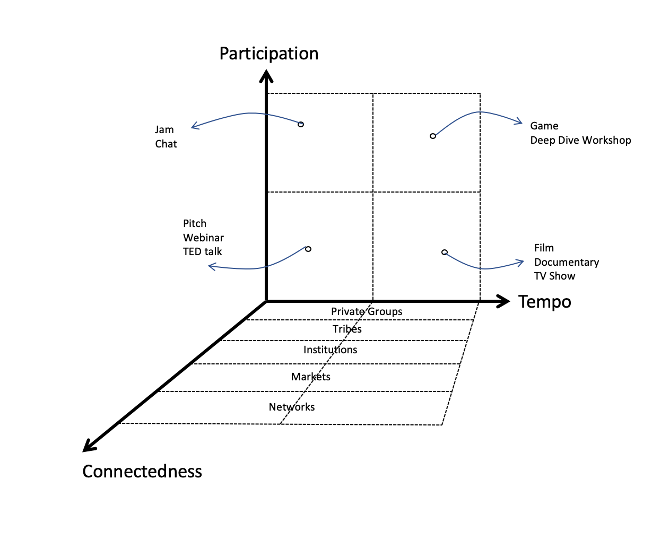
The PAX dimension is an interesting one. If we maintain our physical event vocabulary, we can plot some meetings styles from Private Groups, over Breakout Rooms to Plenary sessions. But it is a physical vocabulary.

I started wondering what a truly virtual vocabulary would look like:

  • Interactivity would become “participation level/intensity”
  • Duration would become something like “rhythm” or “tempo”
  • PAX would become something like “connectedness”

The Ambition Cube then looks like this:
Cube2

It becomes really interesting when I start mixing The Tribes – Institutions – Markets – Networks (TIMN) framework of David Ronfeldt‘s (TIMN was defined in 1996 already. Link to the PDF here). I started reflecting on how these groups communicated and what they enable:
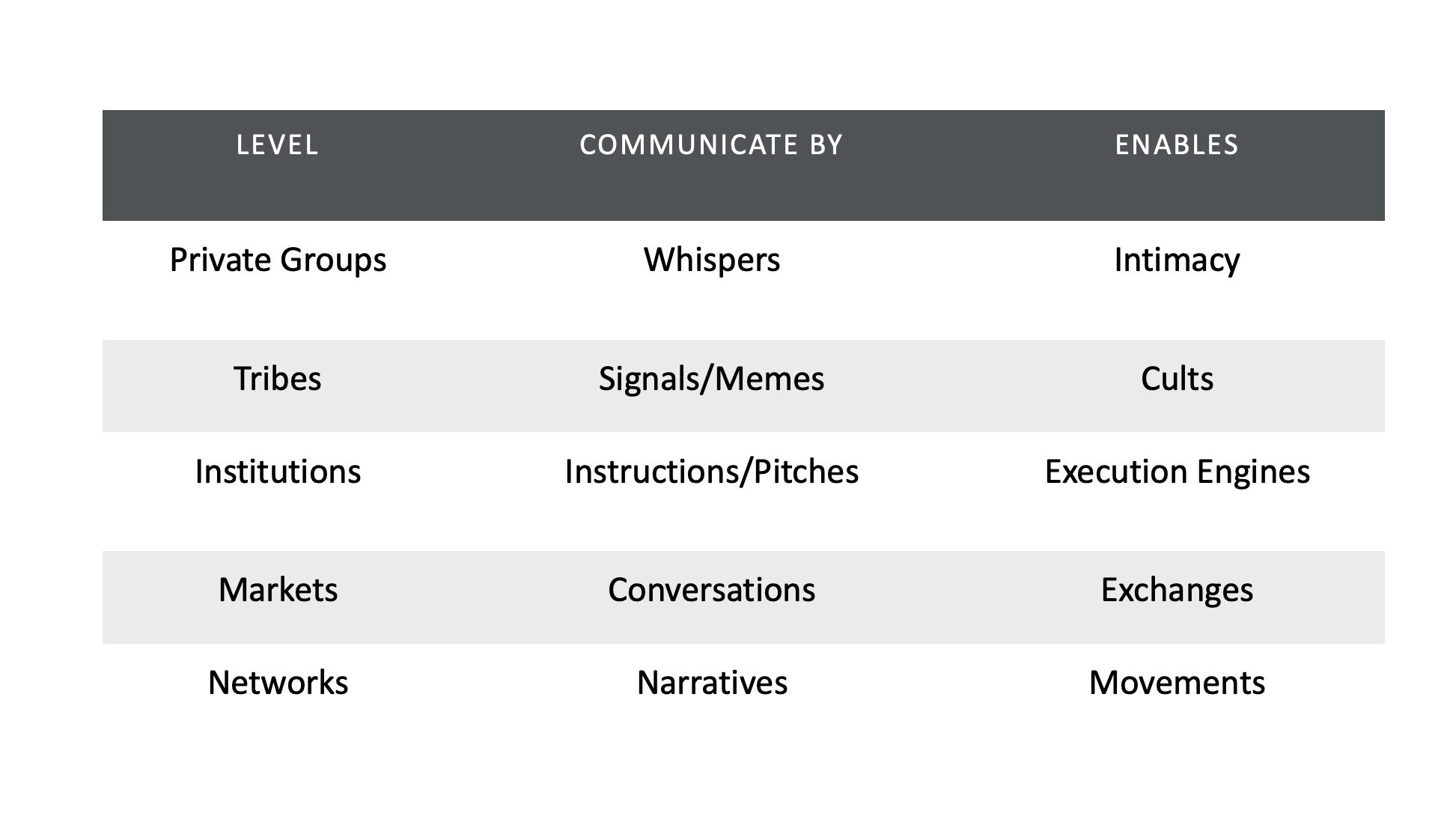
Screenshot 2020-05-15 at 08.56.59

Now, we are getting somewhere. It becomes clear that the challenge is not to virtualize the existing. I believe the right questions are:

  • How do we create collective memories and narratives?
  • How do we create a participatory culture?
  • How do we raise your game on what goes on in that little window/screen?
  • How can we resonate at another, additional level than the pure cognitive?
  • How can we advance at an aesthetic, spiritual, and moral level?
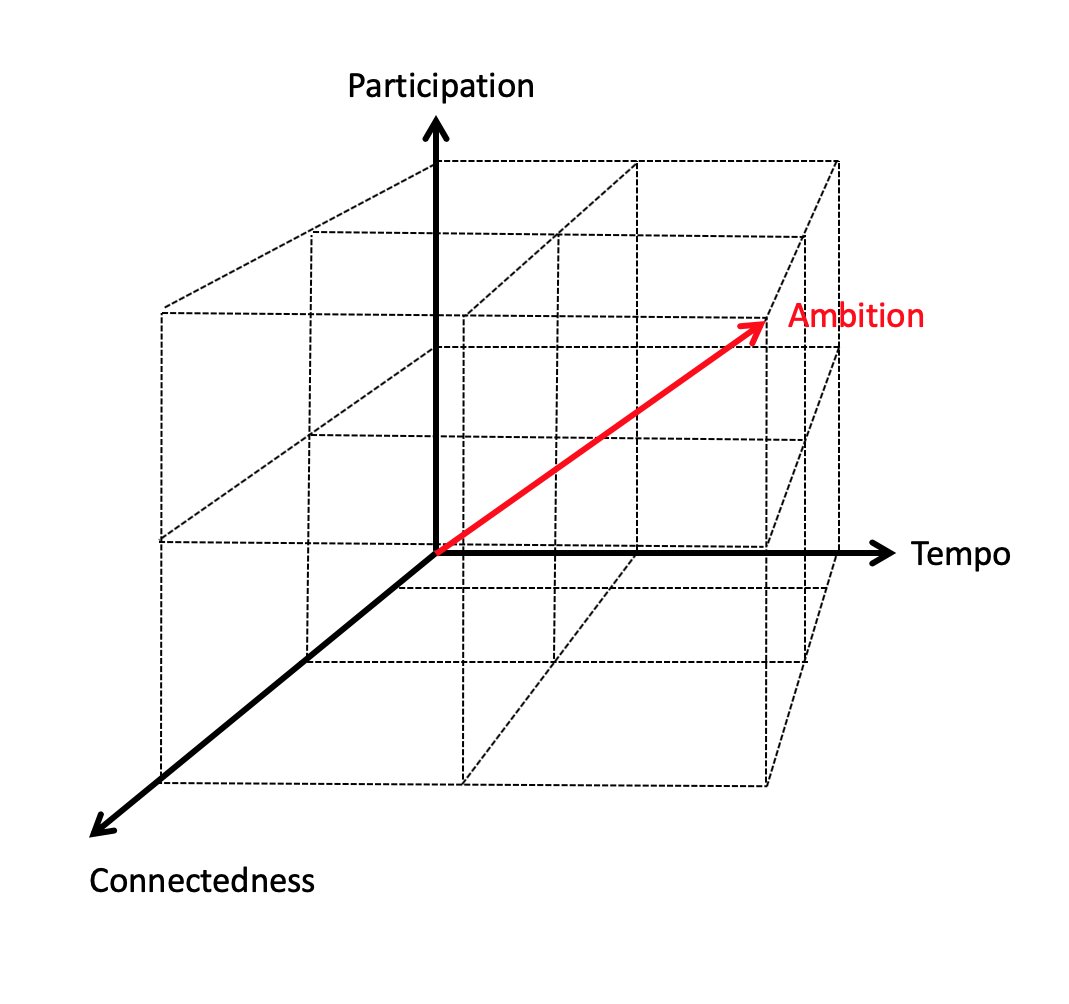
Screenshot 2020-05-15 at 09.13.43

We can now use the Ambition Cube to define our “virtual” ambitions. Plotting where we are today, and where we want to be in n-number of days, weeks, or months. Once you know this, you can start looking into the many tools that exist to make the magic happen and start looking for architects, curators, and production companies that can help you with the coherence of content and experience.

To close, I also made a “clean” 3D version of the cube in a 3D drawing tool called Blender:
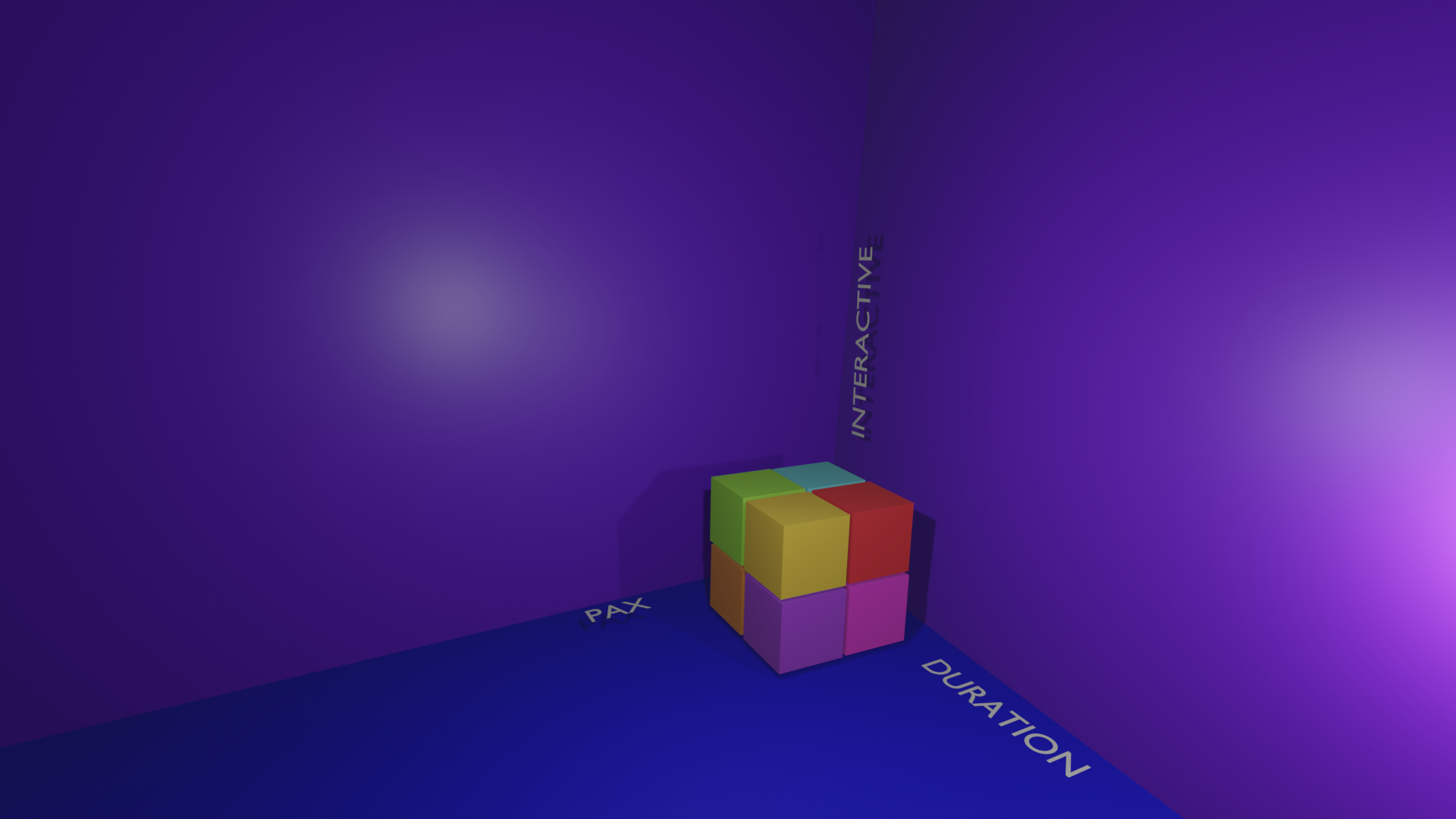
The cube rendered

I am working out loud here: please give feedback, help me identifying the blind spots, share your experience when using this with your clients.

The Ambition Cube is licensed CC BY-SA 4.0, as are all materials found on this site.

Enjoy!
petervan-signature

Petervan’s Delicacies – 8 May 2020

delicacies

An irregular, unpredictable, incoherent, unfocused set of mind-sparks that got me thinking. Handpicked, no robots. Minimalism in curation. Enjoy!

If you can’t get enough of these and want more than 5 articles, you can hang on to the firehose, the extended version of Petervan’s Delicacies in REVUE. Subscribe here: https://www.getrevue.co/profile/petervan

Pause with Josie – Episode 2

This is episode-2 of the calm conversation with Josie Gibson from The Catalyst Network, inspired by Robert Poynton’s book “Pause – You are not a To-Do list“. The approach is simple: we both read chapter-2 of the book and highlight three sentences, and mark the words that resonate most. These sentences and words are the triggers for a very slow-paced conversation on whatever comes our way.  No tricks, no gimmicks, just a gentle and calm wandering and meandering of minds.

https://soundcloud.com/peter-vander-auwera/josie-petervan-poyton-chapter2

Here are Josie’s three sentences:

  • It is an opening which allows, enables, permits or invites all sorts of other possibilities.

  • It (pause) has more to do with rhythm than pace, it is more a question of timing than time.

  • ‘How you pause says something about who you are.

And here are my three sentences:

  • These are very gentle, generous verbs: allow, enable, permit, invite.

  • When you press the pause button on a machine it stops. But when you press the pause button on human beings, they start.

  • At the end of a talk or meeting, instead of hammering home his ‘message’, he will ensure he leaves a space, which he gives back to the room, so that someone else can have the final say. This is an act of openness and generosity that people notice and appreciate. A pause can be a gift.

We covered a wide range of topics from grace, protocol, courage, bravery, expansion, and building a time-space machine, to Designing Freedom – Stafford Beer (PDF), the Overton Window of freedom, the Nooscope (Knowledge Scope device), comparing human and machine pause and activity, and even the 5 gaits of the Icelandic horse.

We ended with a discussion on Rhythm, Pace, and Tempo, and that’s where will pick up in episode-3, in 3-4 weeks from now.

Episode-1 is here.

These are very calm conversations; so best is to take a pause, install yourself in a quiet corner, and enjoy!

Peter & Josie