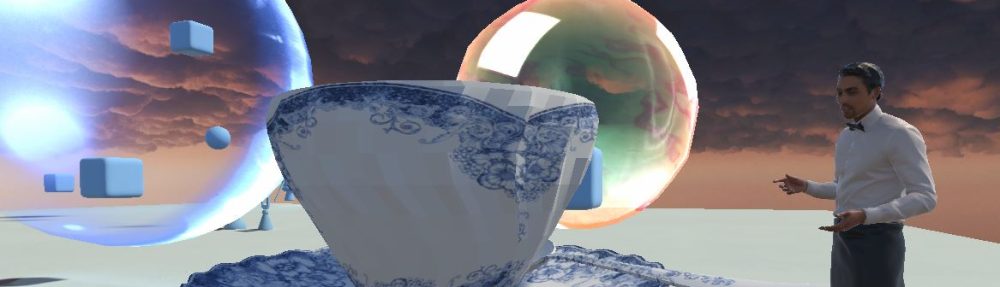
“But that is not logic!” she cried out about my latest creation. “I don’t care in logic!” I responded. “I am in the business of the irrational…”
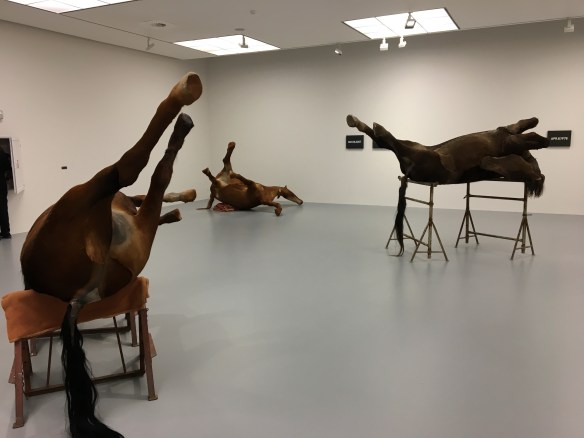
Horses by Berlinde De Bruyckere in Mukha
Part of Sanguine/Bloedrood exhibition on Baroque
I have something with – or better against – logic, facts, being normal. I am not really interested in doing things that are logic. They feel dry, life-less, un-emotional, un-spiritual, un-aesthetic, and too-efficient.
With the focus on facts (real or alternative), metrics and logic we witness the loss of the subjective.
I was looking back into my “open threads” file – a collection of reflections, thoughts, interesting articles, links etc. – and found back this great quote from T Bone Burnett’s speech at the 2016 AmericanaFest.
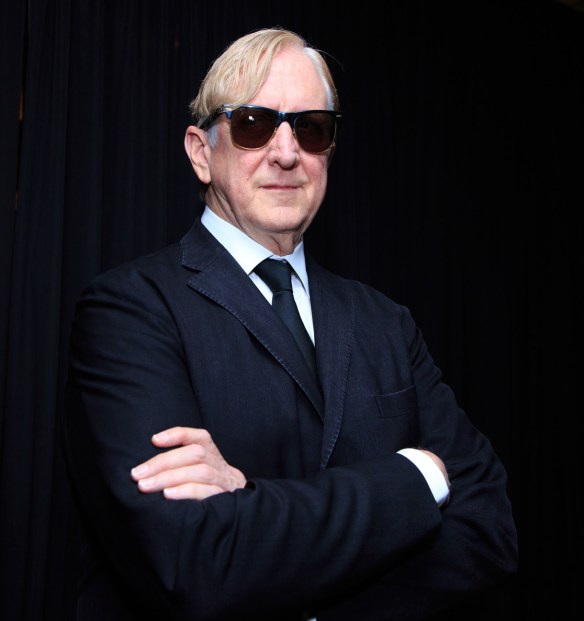
T Bone Burnett by Anna Webber for Americana Music Association
“Technology does only one thing- it tends toward efficiency. It has no aesthetics. It has no ethics. Its code is binary. But everything interesting in life- everything that makes life worth living- happens between the binary. Mercy is not binary. Love is not binary. Music and art are not binary. You and I are not binary.”
In other words, technology, and by extension facts, logic, and AI, miss the notion of heart, mind, and spirit.
Apparently Japanese have a word for this unity: “kohoro”. This Quartz article points to the real difference between man and machine.
“The human heart is rich in intuition; it possesses attributes such as illogicality, hunger for novelty, creativity, infinity and openness. Computer simulation is deterministic (closed); it lacks diversity and is an embodiment of dryness. I believe that this is the decisive difference between computers and human beings.”
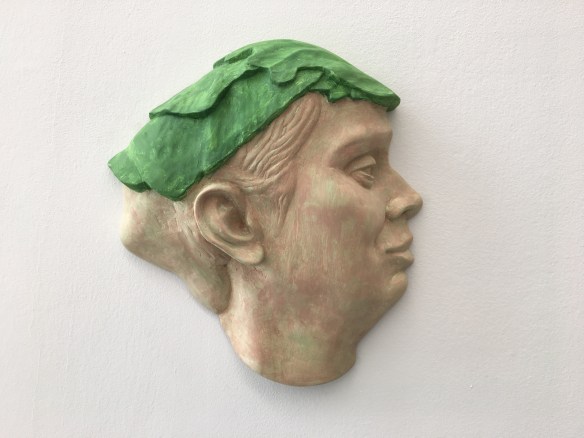
Sculpture by Thea Gvetadze in MUKHA, Antwerp
There is also a much darker side to the illusion of facts. Or when the devil manages at convincing people that only his facts are the real facts. Joe Edelman wrote a great post “Five days with the devil” about that about a year ago. With hindsight, this is such an important insight: how the devil of facts kills how humans interact:
By offering the to-do list, he reduced all values to logistical goals.
By replacing flirting and discovery with an enhanced coordination, he re-cast collaboration as a trade for goals, rather than a mutual exploration of values.
By offering us acute perception, the devil stole our ability to discover value in our environment. He convinced us only facts were real.
By offering us empathy and understanding, he removed our capacity to protect each other, which depends on recognising values.
By preventing us from sharing reasons, he cut us off from us certain social processes: from deliberation about values, from co-discovery of values. It’s exactly these social processes, which make our choices meaningful.
“He convinced us only facts were real.” Read that sink in for a moment. It’s like someone says, “Don’t believe what you hear or see, only believe my facts are real”.
Facts ignore that what cannot be measured, what is at level of meaning, beyond sense-making. It would be better to capture information, knowledge and insight at a more condensed level. Like in an artefact: an eternal repository of high quality information captured before its entropic death.
In his excellent book (Amazon link) “Strange Tools. Art and Human Nature”, Alva Noë confirms:
“What is at stake is not the facts. What is at stake is how we assimilate, make sense of and finally evaluate the facts”
In other words, the future is not about facts. The future is in the victory of the subjective, the nuance and the romance.

 Petervan Studios
!!! (no words :-))