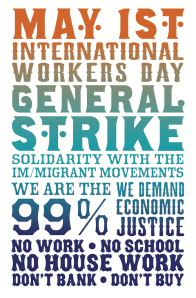
Tomorrow is May 1st, 2012: International Worker’s Day.
And unless you have been living in a cage or other planet, tomorrow is also the day where the Occupy movement is organizing a general strike action across the 125 cities in the USA.
This is organized by the 99%. In the UK however, the “97% Owned” investigates behind the scenes of the ever changing financial system, to uncover how the monetary system provides the foundations for international dominance and national control. Fresh thinking, new ideas and answers to simple questions are squeezed into this 2hr 10minute expose.
Due for release May 1st it features frank interviews and comments from Positive Money, The New Economics Foundation, PRIME, Paul Moore HBOS Whistle Blower, Simon Dixon of Bank to the Future and Nick Dearden from Jubliee Debt Campaign.
97% owned is from the creative team behind Generation OS13: The New Culture of resistance, continuing the distinctive ‘tour de force’ style and artistic interpretation.
Not that i subscribe everything that is said in this video – but i want you to sense the intensity and aggressivity of this movement. It reminds me a lot of what happened in 1977 with the punk movement, or the Flower Power 60’ies, but these were softer more “Peace no War”. This is getting much more confrontational. Check also the comments, as clearly not everybody agrees with the content, the quite tendentious language and music.
Also check-out Simon Dixon (@SimonDixonTwitt), CEO of BankoftheFuture.com, starting off his TEDx talk with some musings on leadership:
“figuring out what you were brought on this earth to do, and then do it”
This resonates strongly in me, see also my latest posts, many of them related to my reflections on what i was meant to be in this world.
Simon explains:
Why we need to change the rules of banking
What will happen if we don’t change the rules of banking
How we can change the rules of banking
His thinking about value is very close to Art Brock‘s ideas on the Living Ecosystem of Wealth (check out www.metacurrency.org). In Art’s model, it’s becoming crystal clear that the majority of investments are purely speculative in nature, and don’t return any value back into the economic system.
Simon is doing a call for:
equality
sustainability
stability
At the end, he also talks on how to change the rules, in essence by training and planting change agents virally in all financial institutions. Sounds familiar to our Corporate Rebels approach where we’d like “to ensure that true change happens virally”, although we are not targeting any specific industry.
Starts crystalizing for me that what Corporate Rebels needs to change is to make our organizations more agile, more fit, more vital, more resilient in creating value rather than extracting value. Now i know why i once read Cradle to Cradle by William A. McDonough (Amazon Affiliates Link) why once again it’s an architect who inspires me. Because it and i was meant to be.
Simon Dixon will launch his own initiative “Banks To The Future” in 30 days or so, as an alternative to bring money to the business without venture capitalists and banks involved.
Another example of “First they ignore you, then they laugh at you, then they fight you, then you win” (Mahatma Ghandi), our theme for last week’s Innotribe in Bangkok.
Simon Dixon looks to me a as good candidate for #innotribe #sibos for the session on “Future of Money”, don’t you think so ? And maybe we should be re-baptise that session into “Future of Value” ?
I am restless these days. Exploring my limits, physically and mentally, and calibrating and navigating what I was meant to be: an architect, painter, scripter, dramaturge, producer?
I am so hungry to create those true memorable experiences, with artistic, architectural, and ethical rightness and integrity. Experiences those feel right from the very first second to the very last. Produced and executed with a crew of super professionals
Experiences that matter, those touch and move you.
Experiences that give you the same sort of “bang” as when you arrive in Bangkok airport, and get amazed by the post-industrial architecture, in all it’s grandeur and massivity.
The sort of “yes” when seeing the Blue Man Group. But a Blue Man Group with a message, and not only one-way, but where also the audience has to participate to realize the full potential and learning of the production.
The sort of “love” and being “moved” when seeing/hearing Mark Pesce analyzing and synthesizing, and story telling with an eruditeness seldom witnessed before, with us at Innotribe Bangkok last week.
Be in company of these sources of inspiration, or at least breath the same air (spotify link)
Sometimes all I need is the air that I breathe and to love you
All I need is the air that I breathe yes to love you
All I need is the air that I breathe
When as an audience you know, just know, that this production is so right I, in the sense of “exact”, “spot-on”.
When as a producer, behind the scenes and behind the technical desk, you can feel the shiver down the spine as the rumble of the deep bass rolls-in and when the show begins, and the mystic of the lights, the mystery of the colors, the artists, the perfect technology, the professional crew are all coming together in an amazing whirlwind.
A production that feels more like a good book, where you have to invest in the beginning, where you discover new stuff, not the same old re-mashed hyped stereotypes, tricks and banalities.
Like a great film where the plot unfolds, and magic and surprise come together.
With deep immersive learning experiences, and drama, lots of drama, even in the sense of theatrical overacting. It’s creating a meta-story, a story of stories and adding performance to it. A new class of story telling, of immersive learning experience.
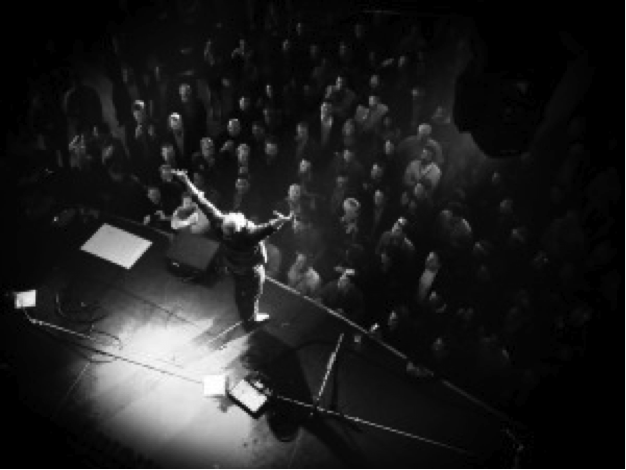
With authentic, inspiring mastery on stage, orchestrated and mashed-up into a brand new value play artistry, adding facilitation and superior crowd control to the mix. Aah! How I love the “stage” with it’s smell of wood, nails, pain, curtains, mechanics, flight-cases, racks, amps, cables, light and sound towers.
The whole discussion of hyper-connected companies during our Innotribe event in Bangkok, and especially the story of Uber taxi, made me reflect deeply on the role of the old taxi company as a dispatching service.
A dispatching role that was in essence the friction in the system, and becoming completely obsolete when the nodes (in this case taxi drivers and their customers) started talking to each other via API’s (in this was built into iPhone apps).
This friction (less)-rule not only applies to organizations and functions but also to people and events.
The master of ceremony (MOC) role has to become much more than just announcing and introducing speakers. If the MOC role stays limited to that, the MOC becomes a friction in itself that needs to be removed. The MOC has to become a “master of connections”, bringing additional content-value, interpretation and guidance to the mix.
In the case of events, we have to start looking at them as a way to bring the consumers and providers of our immersive learning experiences in direct P2P contact through API’s aka “emotional synapses” of the speakers/ignitors.
Some folks out there claim that we are pushing the envelope of performance too far, and should fold back to simpler formats closer to TED, or that our banking audiences and cultures are not ready for this. I deeply disagree. I believe that what we set out as a performance design in Bangkok is just the beginning, the middle of a spectrum between minimum and maximum.
It is of course easier, less complex, where you just program some cool people and surf on the success waves of others, never creating something yourself. But when an event becomes a happening with no file-rouge, no overall theme, without gluing metaphor and design, and without deep reflection about the overall energy and thematic rhythms, then we end-up merely with a set of sequentially ordered speakers, at best a mash-up of speakers, MOC, and facilitation tricks picked from the routine shelf, where the colors and scribes are just lipstick on a pig, a weak copy of the original.
It’s like cheating your audience. Because you know you can do so much better. Not giving the best of yourself is a cheating your audience, whether that audience is your beloved one, your family, your team, your company, and your world.
Easy is easy. Easy smells laziness. What we – at least me – are trying to do with events is not about producing a soap, or the n-th well produced game-program for points or money on television. Although I can be seduced by a well executed professional television production like “The Voice”.
I don’t want to go “easy”, that’s not where I set my bar. When “going back to basics, to easy” starts showing its ugly head, it’s time for us not to be complacent and run on routine, but to re-invent ourselves. We have to re-invent ourselves when we think we have explored the limits.
I am looking for the French quality of “profondeur” which I find richer than “depth”. That is where I want to go.
Sometimes, it looks like the ecosystem I live in today is not ready for this ambition and experiences. Sometimes, my current fishbowl is not ready to follow. I sense it’s a matter of time before we all can see the perspective.
This minor headwind is no reason to give-up or scale-down. I want this “giving-my-best-experience” to happen rather sooner than later. I don’t think I can do more than one production like this per year or even two years if I want to keep the quality of content and production I have in mind.
The choice is between many small touch points, with superficial tricks from the routine box and less events, with a dramatic increase in depth and exploration of new limits. Our edge of yesterday has already become the core. We have to be and remain the Edgewalkers (Amazon Affiliates link)
We have to keep our edge of “Edge-Walkers”, “Protagonists”, “Corporate Rebels”: challengers as described in Art Kleiner’s “The Age of Heretics”.
Instead of being slightly better than everybody else in a crowded and established field, it’s often more valuable to create a new market and totally dominate it.
The journalist of the article makes some great observations:
Creative people don’t follow the crowds; they seek out the blank spots on the map. Creative people wander through faraway and forgotten traditions and then integrate marginal perspectives back to the mainstream. Instead of being fastest around the tracks everybody knows, creative people move adaptively through wildernesses nobody knows.
We live in a culture that nurtures competitive skills. And they are necessary: discipline, rigor and reliability. But it’s probably a good idea to try to supplement them with the skills of the creative monopolist: alertness, independence and the ability to reclaim forgotten traditions.
Maybe I should disappear for some months or years, to do my ultimate research, find sponsors, leverage the knowledge of the commons, produce and distribute with the best of the best.
I have already decided to invest in myself, healthy mind in healthy body to start with, but also focus on giving the best of myself in everything I do, and yes – with a little dose of arrogance – ignore everybody for the better overall health of myself. Ignore everybody as in Hugh McLeod’s bestseller with the same title (Amazon Affiliates link)
I am restless. Because I feel I am stagnating in my current environment. Limited in my creativity. I want to break free. Unchain my heart. Being able to speak free again. No strings attached. Surprise you and myself. Explode, and be emotional and physical again. Exploring my limits.
Sometimes all I need is the air that I breathe and to love you
All I need is the air that I breathe yes to love you
All I need is the air that I breathe
TEDxNewWallStreet was designed to explore moving banking into the Information Age.
In 2009, Marc Andreessen remarked “banking is just information science.” Inspired by Marc’s words, Bruce Cahan and the Team set out to organize TEDxNewWallStreet to explore the empowerment of the new reality – a banking system different than the Industrial Age system we inherited.
What if Silicon Valley/SanFrancisco/Pacific Northwest or other technology clusters grew New Wall Streets, on quite different terms than exist in New York?
How would they spearhead technology in faster, cheaper, more transparent and accountable ways that contrast with the recent (and recurring) issues of the game as defined and played on old Wall Street?
At that event i did a talk titled “FinOlympics”. We are in the Olympic year 2012 after all, right ?
The talk is a consolidation of my latest thinking on innovation. It is an 18 min story about babies as a metaphor for ideas, sandboxes for experimentation and incubation. The babies story is about the process of innovation. The process is complemented by the soul of innovation: the typical characteristics of innovators and disrupters. That section includes the basics of Corporate Rebels United. The inspiration for that section came at the Sandbox conference in Lisbon in January 2012. The Digital Asset Grid (DAG) is a salient example of a SWIFT Innotribe Incubation project. It is one of the more forward looking projects, where we not only look ahead in time, but also ahead in levels of abstraction and disruption. I condensed my latest thinking on DAG in a post titled “The Programmable Me: we are all nodes in the grid”. At the end of this talk, there is a call for creating an experimentation sandbox for Financial Services in Silicon Valley. You can also check-out the my different Prezi’s on each of these topics here. Enjoy!
From time to time I get a mail with encouragements for my work at SWIFT and my work on the edges like “Rebels”. Today was one of those days. This is why I keep doing what i do. Below a letter from an anonymous reader of my blogs and tweets; a nice wrap-up of some of my latest work and efforts. At least it paid off for one person. I reproduced the mail without changing one letter. I just added the links where appropriate.
Peter,
Thanks for sharing your world in the links you provided.
I like the high energy style and content on your curated page on scoop.it (here and here)
Also looked at the Prezi presentations. Outstanding. I particularly liked the digital asset grid and the notion of a spectrum. I think the digital identity element coupled with a digital asset perspective is key to the next stage of digital development. I also like the services model you present at the end — like the perspective of both an enterprise and a customer or individual perspective and call for action on it and suggest some solutions. I too came to a similar conclusion that the power of identity is key and that it can be viewed as an exchange between the individual and other parties. Great work, Peter. I have attached two papers that I wrote with colleagues some time ago that explore what we called pervasive personal identity and a second paper on alternative security viewpoints (atomistic view — which is really an asset view). Totally agree with your From To perspective on security.
Also very intrigued with notion of SWIFT playing a role in this space. We need some trusted players in this space that are not simply motivated by big data and commercial interests (e.g. Facebook, Google etc. “Everybody wants to replace me with my data. Your experience in Belgium also, in my opinion, can provide a leadership role on the global scene. I would like to see more told about that story.
And I would say the soul of innovation is a tour de force. Uplifting, emotive and a powerful message. I very much like the juxtapositions of art, science, psych, esthetic, and experience. Also a fan of B. Fuller.
Bottom line: Important, inspirational and incisive message(s)…
Thanks for sharing. Made my day. You also gave me additional motivation to get on Prezi.
Have a great time and much success in Bangkok and Sydney.
(x) name known
Thank you (x) from deep in my heart. You know who you are. It gives me a boost of energy for next weeks Innotribe in Bangkok.
Through a series of deep conservations ignited by influential thinkers, participants will be able to learn from each others’ opinions, ideas and perspectives.
Innovation in Australia’s financial industry is a hot topic in 2012, with much of the focus on innovation in the payments system itself. But what of the relationship between banks and their customers?
What about the proliferation of connected, aware mobile devices? What about the rise of trusted social networks and the consumerisation of IT? Are we living in the age of the customer? What does the emergence of a new generation of banks, virtual currencies and digital wallets mean for the future of money? How can we leverage digital identity, your digital footprint and a digital asset grid to empower consumers? How will businesses capture this potential and survive the dramatic business model shifts they will likely experience as this future becomes a reality?
The Age of the Empowered Customer brings together the best and brightest thinkers to ignite those conversations:
Marcus Barber, Strategic Futurist and Value Systems Specialist
Andrew Davis, Global Head of e-Channels Strategy and Innovation for GTB, HSBC
Andrew Rechtman, Director of Product, New Business and Strategy, Paypal Australia
Stephen Wilson, Digital Identity Innovator and Thought Leader, Lockstep Technologies
Peter Vanderauwera, Innovation Leader, SWIFT
This event is a small-scale event for 30-50 participants max. Invitations are sent out on a one-on-one basis. If you would be interested to attend, please contact contact James.Bibby@microsoft.com or peter.vanderauwera@swift.com
Our tentative agenda looks as follows:
Tuesday 08 May 2012
09:00 – 09:15
Arrival and registration
09:15 – 09:30
Welcome
09:30 – 10:30
Innovation provocations Subthemes: the emerging collapse of paper currencies, levels of disruption and financial services.
10:30 – 11:00
Coffee break
11:00 – 12:00
The empowered customerSubthemes: Digital Identity, Digital Footprint, Digital Asset Grid
12:00 – 13:00
Future of moneySubthemes: Digital Wallets, Virtual Currencies, New Generations Banks
13:00 – 14:00
Lunch
Innotribe Sydney will be held on 8 May 2012 in the Microsoft offices, 1 Epping Road, North Ryde NSW 2113, Australia (Sydney). Looking forward to meet some of our Aussie tribe members in real life.
The last couple of weeks I have been aroused with many ideas and reflections on Personal Digital Assets and on Digital Assets in general.
The journey started some weeks ago with my prezi talk at TEDxNewWallStreet and included my participation to the WEF “tiger team” on Personal Data, where a group of 30 experts are looking at what is needed to make realize the vision of Personal data as a new economic “asset class”. Personal data created by and about people, touching all aspects of society. That group is stitching the pieces together for a framework of business, technical and legal elements that are needed to underpin this vision.
However, the following video from Kynetx was the big aha-moment during my 4-weeks tour on the subject.
I never thought of a Personal Data Store as a “Personal Event Network”.
This changes everything ™
indeed as Phil Windley (@windley), CTO of Kynetx says.
One years ago, there was this beautiful video animation by David Siegel (@pullnews), a great vision of distributed nodes of personal data content talking to each other through API’s.
In the meantime, there is a rich ecosystem of start-ups that are building something very similar as we speak.
Maybe not yet to its fullest grand vision, but definitely going way beyond the traditional concept of a “personal data store”.
Check out leading start-ups such as Personal.com. Btw I dream of one day seeing an integration of Personal.com with an on-line bank. Anybody needing a brokering service here ? 😉
What Kynetx is adding to the mix are three important things:
the “event” based thinking
the prototol for the data-web
Cloud Operating System
Event based thinking:
He really nailed it down for me last time I met him:
In the past we had RPC (Remote Procedure Calls), in essence fire and forget
Then came request/response: you ask for something, and you get it
Now there is the “event-signal”. It does not ask for something, it just says “something’s happened”, and any entity in the network can subscribe to the event and decide itself to do something with it.
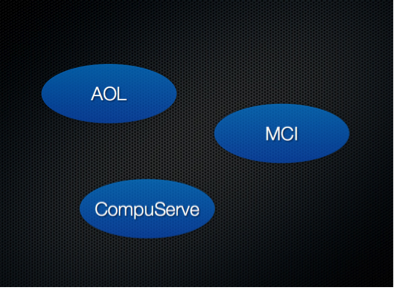
For those who remember, in the past we had silo-d email systems. AOL, Compuserve, etc. They did not interoperate. We got rid of those silos when there was a standard protocol, allowing competing commercial and open source servers to talk to each other in SMTP.
We now see the same with data, personal data, social graphs. We have data-silos (Facebook, Google, Bank systems, Health systems, Government systems, etc). What we need is a “Data-Server” and a “Protocol” that allows these data servers to be interoperable.
All this, Phil calls “The Live Web” (Amazon Associates link). He is so excited about this that he has written a book about it.
In other words, start thinking about your “Personal Data Locker” become a “Personal Event Cloud”: your personal data-server in the cloud that can talk and do things on your behalf, can make decisions, interpret rules, etc…
And it can talk to any entity, any node in the web (or at least nodes in any discoverable namespace). In real-time. In multiplexing mode (meaning the node can be both a server and a client).
It suddenly dawned to me that over the last years we have been hyping “The Programmable WEB”, and that if we are serious about customer centric identity or “customer centric” or “personal” whatever, we may wish to start with the “me”.
Suddenly it was flashing in my brain: “The Programmable Me”
“Me” is becoming a node in the grid. We are all nodes in the grid, sending and receiving signals. Like neurons passing an electrical or chemical signal to another cell. And start thinking “synapses” when you talk about the API’s of your Programmable Me.
From Wikipedia:
“Synapses are essential to neuronal function: neurons are cells that are specialized to pass signals to individual target cells, and synapses are the means by which they do so”
The APIs of your “Programmable Me”, of your Personal Event Cloud are indeed the means to make all these nodes interoperable.
Add to this the graph-thinking of Drummond Reed (@drummondreed), Co-Chair of the XDI/XRI Technical Committee of OASIS. Check-out http://wiki.oasis-open.org/xdi/XdiGraphModel and more specifically some of the Powerpoints out there:
Each circle in this drawing represents a node in the grid. I really encourage you to look at this as a graph – this ensemble of inter-connected nodes – as something 3-dimensional, possibly multi-dimensional.
We have all been trained to think hierarchical. Flat files with a root, that sort of thing.
We have to learn to think in graph-models.
You can start anywhere in the galaxy. Every point can be the center of the universe. There is no root. At least, not in absolute terms. Yes, in relative terms with respect to the other nodes in the universe…
A grand vision starts to develop when you realize that the nodes can be any type of entities:
Humans (or their agents)
Circles (like Google Circles) of humans (entities without legal form)
Corporations, non-profits, governmental or educational institution (aka organizational constructs of humans with specific legal form)
We should also include less traditional forms of organizational constructs such as co-operatives, P2P communities, Commons,…
Programs (yes, software code), that perform tasks on behalf of the entities above or that operates as fully independent entities.
Each of these nodes/entities can participate in transactions – or better, “value dances”. “Dance” because the protocol is multiplexing, not one-way request-response.
Of course all these entities will require identity, in the broadest sense, not only URI or ID number, but in the sense of a spectrum, a graph that can be shared in context with other nodes/entities.
Sharing the spectrum becomes the essence of trade
What we are witnessing is a 180° turn in the power balance between client and server, slave and master, buyer and supplier, consumer and merchant.
But look at the subtitle: “When Customers Take Charge”.
I like Doc a lot, but his subtitle may suggest that somebody else is in charge: the empowered customer. I am afraid that we may end-up with another un-balance, where the pendulum has swung the other side: where the customer has an unfair data-advantage versus the merchant. But let their be no doubt that today the merchant has the unfair data-advantage, and I read Doc’s book more like a plea for getting the balance right rather than a socialist rant against establishment represented by the “big boys”, the vendors, the merchants, the silos like Facebook and Google.
In all the discussions about the Empowered Customers, we see classic commerce use cases like buying a book, buying flowers for grandma, etc
But I would like to make the jump to truly balanced financial transactions and what “dances between equals” would mean in that space. I invite you to think about your bank as the merchant, the merchant of financial services, and the consumer as the retail or wholesale customer of the bank.
In such scenario, the fundamental shift in thinking already happens at the Point of Sale (POS). We even have the question the term “Point of Sale”. It stems from an old thinking where the merchant “owns” the customer.
YOU are the point of sale
YOU are the point of data integration!
In the past the POS was the master,
now it will be YOU who is in charge,
or your agent,
the “Programmable Me”.
What if we start thinking about banking where YOU are the point of data-integration? What if your bank would offer you a service that enables you to manage your Personal Event Cloud?
I don’t know how it would look like, but it probably would be something triggered from your mobile phone. It probably would look like one of the Next-Gen banks (Simple, Movenbank, Fidor) with a Personal Event Network out-of-the-box.
Some of these Next-Gen banks are already accepting the CRED of your Social Graph as a much richer (in all senses of the word) basis for “Know you Customer”. Although we probably also have to inverse that: from the captive notion of “know your customer” to the user-centric meaning of “know your bank”. Then we may come back to the “primitive” of the meaning of “bank”: a bench where two people meet to build a relationship of value.
So, the discussion is NOT about the next coolest thing for doing a copy-cat of existing money-transactions through the latest greatest gadget like NFC or Bump, or whatever.
“The thing to keep in mind here” says Crone, “is that NFC was developed more than 20 years ago. It was first deployed 10 years ago. 10 years ago, we didn’t have ubiquitous access to data plans. We didn’t have more smartphones in circulation than feature phones and we had to depend on an ‘offline’ connection for processing payments. But now, there are 124 million households that have more than one device connected to the internet. Typically, that’s a smartphone, but very quickly it’s becoming a tablet.”
Also Christopher Carfi (@ccarfi) starts thinking in this direction in his recent post “Musings in Small Data”. In there, he refers to a video of Jerry Michalski (@jerrymichalski) of the REXpedition doing a demo his “Personal Brain”. (Disclosure: I am member of the REXpedition). The video is titled “Gardening My Brain” and the talk was given at Personal Digital Archiving on February 22, 2012 in San Francisco.
It’s a pity that this talk is in the context of a personal digital archiving conference. Because, in my opinion, we have dramatically evolved from archiving to sharing.
Sharing of information and digital assets is becoming the new normal in this world of Abundance of information.
Christopher Carfi nails it when he says:
As these issues become more widely understood, more individuals will be tracking their own information. Perhaps it won’t be to the level that Jerry has done it in the video above, but it will be happening. This means that we, while wearing our business hats, will need to be developing real relationships with our customers. We need to listen to what they are saying, what they are asking for, and working collaboratively with them in order to help them fulfill their needs. In the best cases, we’ll have built up levels of trust with our customers and will have been given the explicit permission to access our customers’ personal data stores. In doing so, we’ll be able to actually take the guesswork out of the equation that was noted so clearly above in the Facebook example and will, instead, be able to connect directly with our customers’ intentions and deliver value on their terms.
Creating an economy based on the principles of relations is of course at the heart of the REXpedition. It is probably the next territory for competitive advantage beyond the mundane money transaction.
All this is about creating “Relationship Channels”, channels the vendor can tune into of the user has opened the channel.
All the above are of course very much related to our Innotribe incubation project “Digital Asset Grid” (DAG), which is about the sharing of any digital asset with any party.
The real question is then: “Where will value be created when all the connections between nodes have become frictionless?” Mark has some ideas on this, and he describes them as “irreducibles”
“No matter how ‘smooth’ and frictionless hyperconnected commerce becomes, certain frictions in the business world will persist. These represent both speed humps and opportunities. The businesses of the 21st century will find leverage and differentiation by identifying and exploiting them.”
What those “irreducibles” are, you will be able to discover at our upcoming Innotribe event in Bangkok on 26-27 April 2012, where together with Mark Pesce we will have some great interactive learning experiences. Be there, or read the report that we will make on this post-conference.
If you really want to take a meta-view on all this, I believe all the examples above illustrate our species being in search for a deeper meaning, a thicker value in everything we experience:
We are in search for a higher level of consciousness, a further evolution in Spiral Dynamics, in search for a richer value system, much richer than the pure transaction world that is the narrow lens of today
We start looking at companies being nodes in the grid, in fair-trade constellations of equals, trying to maximize the commons and contribution and giving back to society
We want to go beyond the “advertising” thinking of “let’s hit the target with an ad”. We are in search for a better world with more Thick value and less Thin value
We are starting to see the emergence of “The universe as a Computer” as wonderfully described by Nova Spivack (@novaspivack) in one of his milestone posts last month.
All the above is about defining, articulating, and living lives of greater meaning. With the “M” of meaning. Umair Hague (@umairh) already in 2009 called this “Generation-M”, which in essence is anchored in “constructive capitalism”
Generation M is more about what you do and who you are than when you were born. So the question is this: do you still belong to the 20th century – or the 21st?
What I liked about this book is that it encourages you to look at where you are in your life, and to look at it through the “M” lens. The lens of meaning.
I then discover that what I am writing today, what job I am doing, who I am married to, was probably all meant to be this way. Not “meant” in a deterministic way. No, “meant” as everything I have done, the decisions I have made, my architecture studies, my infection by the identity virus, my journey in Leading By Being, etc… all these things have made me who I am.
What if I could capture all this richness about me, and have a tool and an infrastructure to share that on my terms and conditions, in context, and with the parties or nodes in the grid that I choose to? What if I could share my meaning in a programmable way?
I would end up with something called “the programmable me”
We are all – or should be – familiar with Clayton Christensen’s work on The Innovator’s Dilemma, where he articulated the principles of disruptive innovation. It’s a great business book about innovation.
This is a book about “…how market-leading companies have missed game-changing transformations in industry after industry…not because of ‘bad’ management, but because they followed the dictates of ‘good’ management. They listened closely to their customers. They carefully studied market trends. They allocated capital to the innovations that promised the largest returns. And in the process, they missed disruptive innovations that opened up new customers and markets for lower-margin, blockbuster products.”
For innovation to happen in a company, the principles of Christensen’s books are definitely great advice. There are several other innovation business books that are recommended reading. Check out my GoodReads page.
But since a couple of months now, I believe there is something else we need to look into: something else that is the ticking heart of innovation, something about people, about humans, that makes the difference between thin and thick value creation.
I don’t believe anymore in big corporate change programs that are rolled-out top-down in a military drill. Whether those change programs are focused on efficiency (Lean, Six Sigma, …) or on creating new value (Innovation) does not matter for the argument here.
Real change happens from within the organization. Bottom-up. Virally.
What I want to talk about is the other innovator’s dilemma: the human dilemma, the Innovators Personal dilemma.
This personal dilemma post is about joy versus pain, passion versus suffocation, freedom versus slavery, excitement versus illusion. It is part of saying the unsaid. It is a cry for freedom, a cry for unleashing the energy of the hidden pearls in our organizations, a cry for supporting and encouraging those who really want to create positive viral change from within our organizations.
There is so much positive energy in our organizations that we could tap into, but that energy gets blocked by the corporate “machinery”, by best (or worst) practices, by power games, and in some cases by plain sick people or organizations.
With Corporate Rebels United, we gathered a really great cross-industry sample of innovators, instigators and protagonists that work in bigger and smaller organizations worldwide. We came across a number of real-life stories that give a glimpse of what sort of human dramas sometimes happen deep in the fabric of our corporate organizations, and that are a absolute barrier to innovation.
The great advantage of working as a group is that we now can see some patterns cross-industry. They are not specific to one or the other organization. They are universal. And I want to put them on the table. I want to create awareness.
But most of all, I want to create a soundboard so that we increase our sensitivity and awareness for the symptoms, so that we can prevent human dramas and turn the pain into something positive, an unstoppable wave of change that will transform our corporations from deep within.
Innovation only happens when somebody steps out of the blueprint
And that means taking a risk. That means going for your own beliefs, against the flow, against the current practices of “this is how we do business here”
Ghandi: “First they ignore you, then they ridicule you, then they fight you, then you win”
It takes guts to try to change the corporation. Many people try. They will laugh at you. Many get hurt as well. Sometimes minor scarves. Sometimes it results in deep wounds of self-esteem. I collected some stories to illustration the innovator’s dilemma.
There are some common themes in these stories:
– I want to jump, but I have a family to feed
– I am surrounded by sick people
– The employee as a resource
– The fear of being punished
– I want to innovate but my manager does not let me
– Leading by Being does not get recognized
– Not good for your career
I want to jump, but I have a family to feed
Some of the reactions to my “The Myth of Innovation Incentives” post made me more aware of the “luxury pedestal” I am preaching from. By being part of an innovation team, I get by definition much more freedom than those who are deep in the trenches. In my personal life, I have reached some level of personal wellbeing and stability. But many of my friends out there are at the beginning of their career.
Here is one reaction I received from Jonathan to our invite to join corporate rebels. Jonathan works in the pharma industry:
I have to say that my current employee is a really, really conservative corporation. Quite frankly speaking, we are in dire need of a lot of corporate rebels – but I strongly believe that joining your “club” would get me into serious trouble – if my boss or our corporate communications department ever found out (and they would never, never ever supply me with any resources in that matter). And since I´m going to be a father for the first time this year, trouble with my employer is something I´d rather avoid if possible.
The personal dilemma: “Stand up for who I am, or give in to the power of the corporation”
My answer is one of empathy. I have been there as well. And I regret not having spoken earlier in my life. I do cannot force a person to jump off the springboard. I can only give a gentle nudge. Encourage you despite everything to go for the unknown. Opting for uncertainty and doing something scary (or not) is a deep innovators dilemma. Because you know: if you are not scared of what you’re doing, it’s probably not innovative enough. It’s not disruptive enough. It’s a deep human dilemma, going back to daring to be great. Daring to live and act from your belly. Liberated from the chains of captivity. Leading by being from your true self.
My answer is also that making the jump does not always have to include dramatic live changing decisions. You can start small. And getting addicted by small doses of adrenaline when you stand for who you are. And then a bit more, and a bit more. Makes me think of “Love is the drug” from Roxy Music.
I am surrounded by sick people
I got the following message from Françoise, a 33 year energetic woman, working in an energy utility company:
In our company we have a culture of public humiliation. Mocking publicly about people’s achievements during town hall meetings, that sort of things. For a person who has worked his fingers to the bones, despite all odds, being humiliated publicly was devastating. The way things work in our team is “man eat man”. They put you in an arena, let you fight it out and silently watch. Whoever wins is right. Blame is the name of the game. Everyone dreads that. If you fail, you will be publicly mocked. Whiteboard and town halls are the new place for mocking failures. I remember such treatment in school. For heavens sake, we are adults. They took me off the project I loved. I was “promoted” to a new project. The new project was boring as hell. I could not motivate myself to do any of the work they assigned. Writing this mail is painful beyond my imagination. They were so manipulative beyond words. The crime they commit has no facts. The torture I have endured has no records.
It makes me think of a recent case in public service in Belgium. A woman working for the city hall in a small village was disturbing because she said the unsaid. She was “promoted” to a new function. Her new office was a dirty back room of a side building. She got a computer, but one without connection. She did not get a phone. She was not allowed to meet people. All this with the excuse that her new job required her to focus. She had the courage to go to court. She won.
The Personal Dilemma: coming up for your rights, or let your company by run by sick people
I have heard many stories like the above from many companies cross-industry. These stories illustrate plain criminal behavior by sick people. There are no excuses for this. That’s why companies have “persons of trust”. Let there be no mistake. Go and find your person of trust and open a case. Whenever you can, put on the table these sorts of practices, so they and the people responsible for them get eradicated from our organizations. To grow healthy plants, you must first sanitize and fertilize the land.
The employee as a resource
Doc Searls (@dsearls) describes the relationship between a vendor and a customer as a Client/Server one (at times trending to slavery) where the customer calf is drinking the cookie milk from the vendor cow.
What he describes in buyer/supplier relationships is equally applicable in employer/employee relationships. The proposed solutions for “getting the cattle human” is by proposing them tools to take control of their own abundant information.
Replace vendors by employers in the slide below:
Extract presentation Doc Searls at New Digital Economies 27 Mar 2012
Whether employees are seen as cattle or just resource also quickly becomes apparent in all sorts of employee surveys and result discussions involving “benchmarks”:
Here is Anthony from a Financial Institution, reporting on one of their latest employee surveys on corporate culture:
The results of the survey indicated that we were doing quite well compared to the rest of the industry. I could not match that outcome with the generalized quantified results that less than 40% of the employees felt engaged. What if “the industry in general” was crap and a standard for mediocrity? What if the expectations of the staff set the bar way higher than the benchmark? What if we benchmarked against the wrong standard? These old surveys do not take into account that the environment has fundamentally changed. Due to abundance of information, social media and P2P communication, the employees have a richer and more precise data set available. We laugh at those “official” benchmark cheering results
The fear for being punished
Something very similar pops up, when companies try to define KPI’s for innovation. Check out this great post from Drew Boyd (@drewboyd)
Measure innovation alternatives, not just the current program. When assessing the impact of an initiative, always ask, “Compared to what?” Don’t fall into the trap of measuring only what the company is doing today. Rather, measure it against the next best alternative. For example, if you are using a ideation methodology like S.I.T., be sure to measure the effectiveness of using S.I.T. versus another ideation method. Understand why you are using one method over another by forecasting results from the alternative. This re-frames the question from “does this method work?” to “does this method work better than this alternative?
and:
Measure novelty, not impact. Senior leaders want to know the “bottom line” impact of innovation. When they see ideation results, they respond with, “Yes, but how many of these actually made it into the marketplace, and what revenues were generated?” This is a trap because so much of the impact is dependent internal and external factors. Holding employees accountable for impact will cause them to avoid the truly novel and game-changing ideas. They fear being punished for pushing great ideas that fall outside their category. To manage this dilemma, managers need to think more in terms of finding the “innovation sweet spot,” that place somewhere between disruptive and incremental. The right balance between risk and reward is more likely to occur here.
I want to innovate but my manager does not let me
I silently helped without getting any credit. Then I saw your post about Corporate Rebels. I sat there and was thinking, here I am really doing a rebel activity and suffering and no one is paying attention. At that point everything started looking fake to me… Pain is deep and buried. It takes lot of time to vent it all out. My point is, don’t lose me. I am of lot of value to my company because I genuinely care about the company and its people. My friends do too. Some of us get fired for stepping out of the blueprint. Don’t let this happen again and again. Please use your power and contacts with powerful people to do something good and to fight against injustice.
Leading by Being does not get recognized
If Chris is rocking, it is because of the way I nudged him to do it. If Laura is jumping up and down with ideas, it is because she got inspired by what I was doing. I have inspired many souls at our company. Inspiration can only happen if someone is speaking from his or her soul. Inspiration is language of soul. I have earned respect from lot of people at in the company because of who I was. I have the attitude to make people take action. But I got fired. Because real change disturbs and challenges the status quo. My death was so silent. They did not even give me a chance to say good-bye. It is fishy and please don’t let this happen to anyone else.
Not good for your career
And also heard the following so many times: being innovative is hampering your career.
Kathleen just joined a telco company:
In our company we have a Young Grads Program. But when postulating for the innovations positions, we are kindly taken aside, and somebody whispers in my ear “being part of the innovation team is bad for your career as a manager”.
That’s a really bad story. It’s the story that lets you immediately recognize corporations where innovation is just window-dressing. Even the young people, full of healthy innovation energy don’t get a chance. What a disaster if you have joined such a company. Getting suffocated in your ambitions and drive from day one!
Any CEO with her innovation heart in the right place should mandate – yes mandate – that all newcomers and GEN-Y’s first get immersed in the innovation team. What people are allowed to do there is not the worst possible scenario; it is the best possible starting point for doing much-much more, to instigate real and viral and tidal change throughout the company.
Conclusion
All the above are REAL circumstances in REAL companies. Yes, innovation in these circumstances is hard. You have to go against the wind. And find the balance between a good/bad rebels. Sometimes you will be seen as subversive. And to be honest, some healthy dose of subversiveness is needed. Sometimes you need to act like McGyver. Sometimes you need to be Jack Bauer. One company told me they were acting like the “agency of subversions”
But I can’t expect everybody to be on that extreme end. I would already be so happy if with our Corporate Rebels United movement we can unleash the change-energy of every individual in our corporations.
That each of you have the courage to stand up, to come up for your ideas, to start small and make little changes, or to be very hungry and go for the big visible changes. One could refer to introvert and extrovert changes. Both are equally important to make true and viral change happen.
But we can’t have subversion or anarchy. This is not the way we as Corporate Rebels United want to go. We do not want to provoke for provocation sake. And we do not like to be like the Cacaphonists. Nor do we plan to start flash mob activities who share some ideas with Cacophony, as well as groups like Improv Everywhere and movements like Discordianism.
What we want is change
Viral change from within the fabric of our corporations
We want to change our corporations, not by complaining and blame-is-the-name-of-the-game, but by showing the right behavior, by encouraging each other, by uncovering the hidden pearls of our organizations. But for sure as well furiously fighting and making visible injustice, sick or plain criminal behavior.
We want to change, not by focusing on the things that make innovation hard and only looking for self-esteem, but by focusing both on our dreams and on other people in our lives.
We want to change by daring to be great.
In small and big things/actions.
It feels like somebody should start writing the first chapter of the human book for innovation. Maybe that somebody can use some testimonials of this post. Maybe Whitney Johnson (@johnsonwhitney) is the one? She is preparing a book titled “Dare, Dream, Do”. It’s planned to come out in May 2012. Maybe she addresses the human aspects that are not covered in business books.
Daring to dare is the personal dilemma of corporate innovators
If you feel inspired, join Corporate Rebels United, by leaving an “I join” comment on that or this blog post.






















 Petervan Studios