The title for this blog post comes from a 2010 talk by Mark Pesce. He adds to it:
it rarely arrives in the form that we expect
it is too hard to grasp, a bridge too far
the seeds of the future are always with us in the present
I have referred many times already to Mark Pesce in my previous posts:
He keeps inspiring me, by the challenging content and his oratory skills. And yes, I am trying very hard to get Mark to one or more of our main Innotribe events as core anchor/igniter of some of our conversations.
I also recommend my readers to have a look at some of his recent work, especially about “hypereconomics”, Flexible Futures, and last but not least his upcoming book “The Next Billion Seconds”. The chapters of the books are being released now on an almost weekly basis, and here are some of the catchy titles with associated content:
- Initiation
- Introduction
- Articulation
- Replication
- Duration
- Revelation
- Revolution
- Origin
It reads like an “Origin of Species”, looking back and projecting us in the future of the Next Billion Seconds, aka the next several ten thousand of years. A fascinating read indeed.
But I wanted to use his 2010 talk as guidance to some of the work our Innotribe team is doing in our incubation project called the “Digital Asset Grid” (DAG)
In this talk, Mark Pesce talks to a group of Human Service folks and Health officials. Although it is about health, I encourage you to listen with holistic ears, as everything he says is applicable for any vertical.
The talk is titled “When I am 64” and is looking forward 17 years from 2010. The “64” is a wordplay on the famous Beatles song.
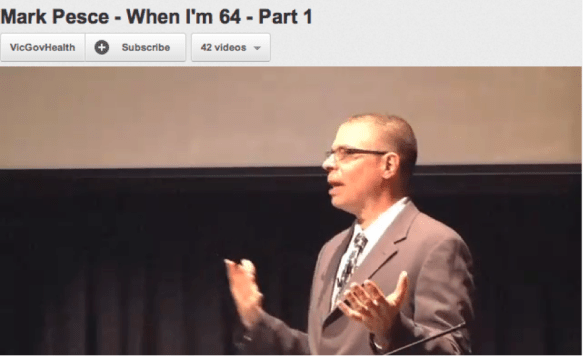
Here is the link to the first part of the talk. The talk was split into 3 separate videos.
I will avoid the temptation to do an ad-verbatim transcript, and will just use a couple of quotes to illustrate my own points.
Highlights first video
Somewhere half-way, Mark Pesce mentions how his team went open source with their 3D Mark Up language and how surprised they were with the amazing ideas people came up with on what they could do with it.
- He mentions and Austrian project that made a 3D encyclopedia, like a tree of knowledge, and
- a 3D visualization of NYSE stock data.
The latter one makes it possible to see 5,000 times more information than on could see with the standard flatlanders’ Bloomberg terminal. Mind you, this was in 1997, that now 15 years ago.
My lessons learned for DAG:
- The DAG story is a story of value propositions. That is what the prototype we are building will focus on. It is NOT a technology showcase.
- We play with the idea of an open source DAG server. There is some hesitation. We should not hesitate. We should look at it like IBM looked at Apache Server at the time. Our core competence is to operate a high-available, secure and resilient infrastructure. Probably less in building server software. We know more than me.
- There is so much innovation in the ecosystem. Our current thinking is to bring the APIs of the infrastructure in a controlled open. So that Banks and other 3rd parties can be on the bleeding edge of innovation.
- On the longer term, this whole concept of stream-servers makes me think a lot about the Metacurrency.org software project of Art Brock and Eric Harris-Braun. The idea is to build a basic communication later to be able to deal with stream-scapes.
I can assure you that “streams” and “scapes” will be commongood in some years time. Another very cool initiative in this space is Nova Spivack’s latest start-up BottleNose.

Highlights second video
It really gets interesting when Mark Pesce starts unfolding how the power of our communities shape our behavior. Somewhere at minute 09:10, Mark develops an extremely interesting banking scenario:
- Imagine someone steals your identity, walks into bank, and takes a loan in your name (if they are able to present the proper documentation)
- The problem is that once you present stolen proof documents at the entry of the process, the process usually kicks off perfectly and delivers the programmed results
- Better would be to be proofed by others, by your community. “An identity that is confined and constrained by those you are connected to”, by your on-line context
- At minute 10:35, Mark suggest
that you should be able to handing the bank your social graph!
You really would expect your bank to be able to write some piece of software which could confirm your identity
Bank validating your identity strength based on who vouched for you !!!
This really comes very-very close to some of the use cases we have in mind for DAG.
This would result in a system with greater resilience, much harder to fool, because:
- Identity is a function of community
- And not just identity > even TALENT is a function of and a recognized value of a community
- The social graph is the foundation of identity
In my opinion, all this is leading towards “interest based connections”.

The relationship economy, the reason why REXpedition is so important, is the next battlefield of competition; after most organizations squeezed all the juice out of SixSigma, Lean, and similar programs for increasing productivity and efficiency.
- The focus of these programs was on doing better what we already did (sometimes doing bad things better)
- Now its’ about doing new things, the right things. And those right things have all to do with better managing our trustful relationships
Therefore, Mark’s thesis that “a group of well connected highly empowered individuals is a force to be reckoned with” is one of the biggest forces in place. It has always been, but now returning in force thanks to our hyper-connectivity and information abundance.
Highlights third video
This part, entitled “Senior Concessions” really got my attention when Mark Pesce starts talking about “Personal Broadcasting”, networks of trust and sharing of social graphs.
Sharing of social graphs will enable us to identify who brings real value, who brings insight, who bring wisdom. And also those who seek to confuse, who are confused, or who are self-seeking.
This smells very much like reputation and influence like:
- the reputation score in eBay
- the thinking of Andreas Weigend’s from the Stanford Social Data Lab
- Doc Searls VRM (Vendor Relationship Management) thinking
- Drummond Reed’s Social Vouching start-up connect.me with its underlying Respect Trust Framework.
Mark continues how boundaries of expertise are becoming more and more fuzzy. The patient now often knows more than the specialist. The student knows more than the teacher. It reminded me to one of the first books I read about fuzzy logic by Bart Kosko in 1994. “The new science of fuzzy logic”

Reading that book so very early in my career was probably meant to be part of my life and my purpose.
Anyway, Pesce puts the patient in the center, like Doc Searls put the user in the center of his user-centric intention economy.
In my opinion, banks have a similar huge opportunity to put the customer back in the center and offer unprecedented high-quality data services.
And Mark Pesce goes on:
- This is about user centric “social” graph
- Knowledge will pass from one user to another (similar to John Hagel’s knowledge flows)
- As knowledge is passed on to the community, the community empowers itself
- Person as agency of his own data, deciding who gets access
- Privacy of medical data is about making these data freely available to those who need it in context, but make them secret to those who do not need those data
- Only if person has agency for his data and authorizing access to his (medical) records, and tools to track that access (and give/release access)
- Without those tools we will loose track of who owns what etc and becomes easier for those who shouldn’t to have a look in
- As our medical records spread through our networks of medical expertise, we will feel less fear, and more to surrender our privacy
- There is power in releasing our privacy because we gain connections
It’s almost going back to Doc Searls (and others’) 1999 ClueTrain Manifesto where the authors declare in one of their 95 thesis that “Markets are Conversations”.
It’s also going back to Buckminster Fuller’s geodesic domes, where the each element is weak, but where the combined structure is stable.


As a matter of fact, the 3D space of the geodesic dome perfectly illustrates what the DAG is all about. Look at it as a certified map of where the data are located with their associated usage rights. Sharing as utility. P2P sharing with certified pointing infrastructure. It’s moving us from a Flatlanders 2D thinking of the physical world to a 3D thinking of the graph. That is what the DAG is really all about.
I put this blog together during one of my weeks off, weeks that are completely un-planned and un-structured. For me these are weeks where I refresh my brain, new ideas pop-up during moments of organized boredom. You could call it my Boredom Weeks.
It can therefore not be a co-incidence that Mark Pesce ends with a referral to Genevieve Bell, Intel Fellow and director of the Interaction and Experience Research Group within the Intel Labs. Just on that same day, I received a tweet from one of my followers referring to Genevieve Bell’s TEDxSydney 2011 talk on boredom.
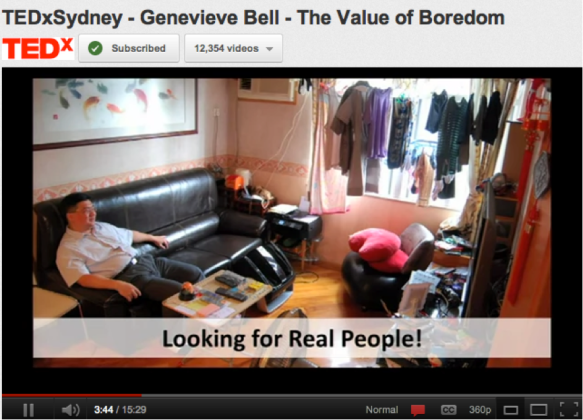
The video basically illustrates that ideas come in moments you don’t expect, when you are not focused, when you have this blissful moments of boredom. Its back to the start and title of this blog post: “The future rarely arrives when planned and it rarely arrives in the form that we expect”
I can already see now how DAG will take off from and into un-expected directions. And we are just at the start of the prototype phase. Exciting times
@petervan from the #innotribe team







 Petervan Studios