Innovation to the Core

I just finished “Innovation to the Core” by by Peter Skarzynski (Author), Rowan Gibson (Author)
This is a modern, up-to-date, and indispensible book on Innovation.

More precisely on how to make Innovation a core capability of everything you do in your company.


Anybody who is deeply or remotely

involved with innovation

must read this book.


It’s a book that explains why radical innovation is the only option forward.

It’s a book that clearly explains the tension between efficiency and innovation, and what to do about it.

Both efficiency and innovation have value. More, they should be equal partners ! If you are serious about innovation, then you should spend at least as much on your innovation program as on your efficiency program. Check out how much resources you spent this and last year on efficiency. Take that amount and number of FTE’s and there is your budget for innovation for the next 2 years.

So it is not about being Lean OR Mean,


it’s about being Lean ànd Mean !


My biggest lessons learned from this book:

  • Dare to challenge everything, and especially your company “orthodoxies”, the taboos that have been taken for granted for the last 10-20 years.
  • Let the focus area of your innovation emerge bottom-up. Don’t define your innovation priorities in a leadership group. If you want everybody to be an innovator, you need input from everybody at all levels in your company when defining your innovation architecture. If not you end up with an impossible sell exercise towards the basis afterwards.
  • Make your executives and regional heads accountable for innovation. Some companies make 30% of the bonus dependent on innovation objectives.
  • There is an enormous responsibility for HR in getting the creative and innovation skills trained across the company at all levels.

But THE biggest lesson learned is probably about the difference between managing the supply and the demand for innovation ideas:

  • I believe most of us do a decent job on the supply side: we have plenty of initiatives and tools to gather, generate and follow-up on new ideas. That’s the supply side
  • But there remains a lot to be done on the demand side. I love the suggestions in the book that each division, region, product manager, etc is held accountable for at least picking-up 3-4 ideas coming from the supply side. Stronger: each of these groups has to reserve 10% or more of their existing budgets to spend on innovation projects. And this without changing the existing performance metrics.

Getting innovation into the objectives of managers is key. The book refers to this as the


“Management Process Make-Over”


Regular readers of this blog know that i have a strong opinions about:


Radical innovation vs. incremental innovation

The role HR has to play

Getting innovation deep into the DNA of your company, at ALL levels, all regions, all divisions.


This book only confirms and reinforces the thinking that i have previously shared in following posts on this blog:

Cubicle 3B23: Chief Happiness Officer

There is a great comments from Joe on one of the previous Cubicle 3B23 stories. It’s too good to be hidden in the comments section.

You are a CHO; now what?

Yesterday I was asked what was my title, and got a puzzled pair of raised eyebrows when I responded that my unofficial self-adopted title and vocation in life is Chief Happiness officer… It got me thinking – what exactly is a CHO? (And no, I’m not the corporate clown that everyone likes to pick on or that is famous for telling the best jokes – even though occasionally I find myself at the receiving end of a joke… :-) )


Happiness officer is a very serious and heavy responsibility – a temperature meter, detecting the health of an organization, noticing the first signs of trouble and trying to heal them. It is like the shaman of a tribe, the healer or the local witch.

A healthy organization is one that not just functions and produces but is energized, gives a feeling of belonging and meaning to all the people that make it. A happy organization is made of happy balanced people – happy not in the sense of joking around all the time, but in the sense of having a deep feeling of satisfaction.

It is like a healthy bee swarm. Even though the swarm is nearly a creature in its own right, with mind and memory of its own, it is made of little individual parts who influence greatly its health. The swarm is very resilient, but only if its bees are healthy. When they are not, the swarm falls apart. When all the workers leave the hive in despair, it doesn’t matter if the queen is still there and healthy. A queen alone does not make a swarm – it stars it, but does is not equal to it.

Bee doctors watch the behavior of the individual worker bees to know the health of the hive. It is the same with the Happiness officer… He watches for small tell-tale signs: more and more people who have the nagging thought that even though rationally speaking they should feel perfectly satisfied with their position in life, they are somehow not; more and more people with the uncomfortable feeling that there is something missing, a feeling which gradually grows into discomfort and distress.

And distress is a powerful force – a force that pushes you to change.

This is what the happiness officer watches for and helps – by encouragement, nudge, energy boost – helping people one by one find what makes them tick and nurturing their belief that it is worth going for.It is a fine balance between wild optimism and integrity

The ultimate success for a CHO? A company that does not need him; a company where everyone is their own CHO…

Joe – the CHO in Cubicle 3B21

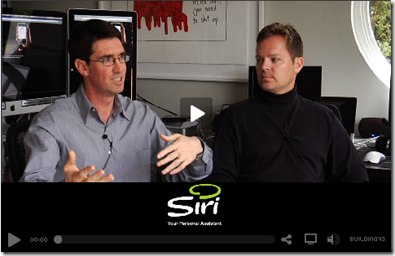
SIRI: your personal assistant in the cloud

Found via Scobleizer.

image

Watch the video till the very end. In the last 4 minutes or so there is a demo.

In essence its a free iPhone app with a fantastic voice recognition engine, that is orchestrating API’s in the cloud.

Normal – not geek – people ask me regularly: “But Peter, what do you mean with “cloud computing” and “semantic web ?”

SIRI is a wonderful example of what’s next. If you want to have an idea what semantic web means in practice, here you go. It’s location aware, it’s self learning, has some eMe elements like profile awareness, all of this in the privacy control of the owner of the profile data.

The dream of the personal butler coming true.

Why this is important ? In the words of Robert Scoble:

Don’t get confused by the awesome voice recognition engine that figures out your speech and what you want with pretty good accuracy. No, that’s not the really cool thing, although Microsoft and other companies have been working on natural language search for many years now and have been failing to come up with anything as useful as Siri.

No, the real secret sauce and huge impact on the future of the web is in the back end of this thing. A few months back the engineers at Siri gave me a secret look at how they stitch the APIs into the system. They’ve built a GUI that helps them hook up the APIs from, say, a new source like Foursquare, into the language recognition engine.

And listen to the two founders on how the back-end of this thing is working, and the other cool stuff they have in mind.

And now start thinking on what you could do with this in financial services:

  • Give me the best loan for car so and so
  • I want to buy this piece of art and need a credit line
  • Find me the cheapest routing for USD payment with cut-off time x
  • Get me to …

Would be very curious of guys like Richard Branson of Virgin Bank start to play with this. Or Sean Park with his view on software components in the cloud. How does this change our thinking on building an AppStore for Financial Services ?

I don’t have an iPhone (yet). But i know super-geeks Nick and PeterH have one. Nick, can you test this one, and let me know your candid feedback ?

Check out www.siri.com


Reblog this post [with Zemanta]

Sex, Money, Happiness, and Death

The title will give me probably the most hits this blog ever had. Before you read any further, this is a book about authenticity.

I found it via Fred Zimny’s blog.

In this book Kets de Vries says:

I realise the importance of authenticity in my own life and the lives of others.

I have seen how easy it is for someone

to follow a route to

self-deception and illusion.


Fooling ourselves, as many of us learn the hard way, isn’t sustainable in the long run.

He continues:

To me, being authentic implies being honest, truthful with myself and others, living … with my own values and principles, and experiencing a sense of meaning in what I’m doing.

Authenticity implies

a willingness to accept

what I am

and not attempt

to pass for something

or someone else

Authenticity means not only trusting my strengths but also my weaknesses and being patient with my imperfections. It has to do with having the courage to say how things are, to say no, to face the truth, and to do the right thing because it is right.

Sounds like a cool book. Not available on Kindle yet.

Looks to me like a Leading by Being program for CxO’s.

Hug my PAD

TEDxBerlin talk, discovered via Hutch Carpenter’s blog

image

View till the end.

It’s a bit funny at the end, and you can hear the audience laughing at this and not really taking the last bit seriously.

Think twice.

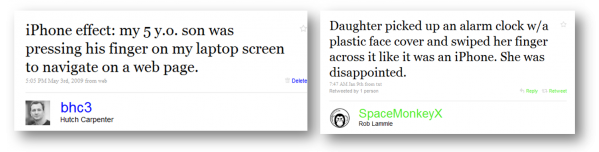
Think this one through ! In the same blog post, Hutch points at the real meaning of the iPAD.

Think it through. The keyword is digital intimacy. Your computer is not your computer anymore.

Think generation-M. Generation Meaning.

image

It’s your personal “pad”-device.

You can give it a pad.

You can hug it, it can hug you.

Try in your imagination to mix up iPhone, iPAD and those little house-robots that were so popular some years ago. I know my friend Nick has 2 in his apartment !

Nick Carr used the title “Hello iPAD, Goodbye PC”.

I think he’s right on.