Real-Time Trade

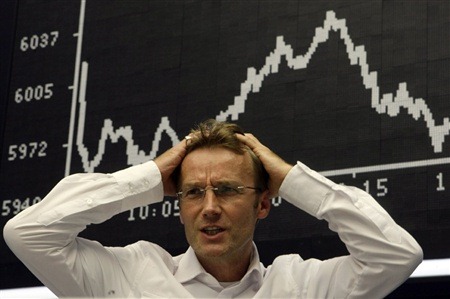
Fascinating article on how stock market is getting completely automated in a matter of seconds. Who was saying something about real-time.

04_traderfaces

Article found on MIT Technology Review. 5 pager can be found here.

Some extracts:

The profits go to the company with the fastest hardware and the best algorithms–advantages that enable it to spot and exploit subtle market patterns ahead of everyone else

TheTabb Group, a consultancy based in Westborough, MA, estimates that high-frequency automated trading now accounts for 61 percent of the more than 10 billion shares traded daily across the numerous exchanges that make up the U.S. market.

Trading is now essentially a virtual art, and its practitioners put such a premium on speed that NASDAQ has considered issuing equal 100-foot lengths of cable to the brokers who send orders to its exchange servers.

Hardware used at the facility will operate at a 40-gigabyte-per-second standard, enabling it to handle as many as a million messages a second.

New York City-based Lime Brokerage, wrote the SEC in 2009 to voice concerns over the proliferation of brokers who allow major clients to engage in high-frequency trading without validating their margins–that is to say, without making sure they actually have enough money to back a trade

Jacobs regularly sees algorithms executing more than 1,000 orders a second. At that rate, one algorithm trading the wrong way could execute 120,000 orders in two minutes. At 1,000 shares per order and an average price of, say, $20 a share, that’s $2.4 billion inunintended trades in 2 … SECONDS.

Institutional traders like Fidelity, which buy large blocks of shares for their mutual funds, use algorithmic trading to split their enormous orders into blocks of 100 to 300 shares so that other traders don’t recognize the true demand and take advantage of that knowledge for their own profit.

These are big numbers. And it happens every day. Scary.

Innovations 2009: my Top-7

The full top-100 is published on POPSCI.

Here is my personal selection top-7 out of those 100 and my personal why. Why seven ? Because 7 is my lucky number. No, i just did not like cutting out one of these 😉


vue_0

Short description: It’s the ultimate plug-’n’-play nanny-cam. The Vue personal video network lets users place cordless cameras virtually anywhere and view video in real time on the Web.

Why: Dead of Privacy. At DEMO 2009, i saw another plug-and-play security camera for less than 199 USD. Why complain about all those public cameras in the UK, if any person can put one anywhere anytime ?


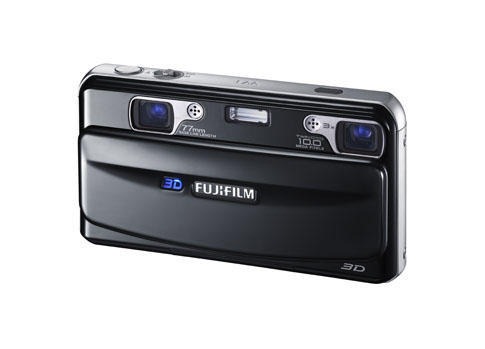
fujifilm

Short description: Fujifilm 3D Camera is the first 3-D digital point-and-shoot camera, with two separate lenses—and two image sensors—placed three inches apart. They snap either stills or videos in tandem, and a processor combines their images into a single file.

Why: This and the release of the 3D Movie Avatar will really put 3D in the mainstream in 2010.


 Planck satellite in  the Large Space Simulator at ESA's test centre in Noordwijk, the Netherlands.

Short description: Herschel Space Observatory, the European Space Agency’s Planck Observatory will study the radiation left over from the first 370,000 years after the big bang—known as the cosmic microwave background, or CMB—with three times the sharpness of previous satellites. Can detect temperature differences in the CMB as small as millionths of a degree (the equivalent of detecting the body heat of a rabbit on the moon, from Earth).

Why: i expect a breakthrough in 2010 in cosmic breakthrough research that will challenge our traditional thinking about time and space.


Short description: it’s about the headpiece, not the chair. The nonsurgical NeuroStar Transcranial Magnetic Stimulation system is as easy as a teeth cleaning. The patient sits in a chair as an electromagnetic coil pulses magnetic fields to his or her left prefrontal cortex, the part of the brain that regulates mood. This stimulates neurons to make more mood-enhancing dopamine. After 30 40-minute daily sessions, half of the patients in a clinical trial experienced significantly reduced symptoms; a third reported complete resolution. Last fall, it became the first TMS therapy to earn FDA approval.

Why: breakthroughs in brain research, implants and stimulation are just around the corner. At Singularity Summit 2009, i saw another example of light stimulation of very specific brain zones (up to the cell level !)


Short description: Nintendo Wii on steroids.  A prototype system dubbed Project Natal lets Xbox 360 games respond to anything from full-body lunges to subtle hand gestures, voice input and even facial expressions. Unlike the Wii, you don’t hold anything. Your movements and voice control the game.

Why: New forms of UI will we omnipresent in 2010. Expect this sort of stuff to be standard in any modern OS, tablet or PDA as from 2011.


Short description: The City Safety system of the 2010 Volvo XC60 can stop itself before you smack the stopped car in front of you. A laser sensor tracks the distance between you and the car ahead; approach too quickly, and the system hits the brakes.

Why: Computer assisted cars becoming mainstream. Also look at the loads of technology squeezed in the latest Opel Astra (standard model). Main reason: somehow my dream car, and i hope somebody from Volvo reads this and gives me one 🙂


Short description: Should be no surprise to anybody reading this blog. I am a big fan of Google Wave.

Why: 2010 will be Wave year. The criticasters of 2009 will cry and be ashamed once Google fixes this one.

Brand, Workforce and Innovation

If you’re interested in Innovation, you have to subscribe to Blogging Innovation. All posts are just worthwhile reading.

image

They also have a group on LinkedIn.

Today’s article typically resonated with me. It’s titled: “Combining Brand Management with Workforce Enablement”.

IBM-718954

It’s about the speech by Jon Iwata, SVP of communications and marketing at IBM on the future of the communications profession at the November 4th 2009 Institute for Public Relations Distinguished Lecture Series at the Yale Club in New York City. Full text of the speech is here.

Iwata says:

"One day soon, every employee, every retiree, every customer, every business partner, every investor and every neighbor associated with every company will be able to share an opinion about that company with everyone in the world, based on firsthand experience. The only way we can be comfortable in that world is if every employee of the company is truly grounded in what their company values and stands for."

IBM has developed an IBM Brand “System”:

Picture a framework with five columns. From left to right the columns are labeled what it means to look like IBM, to sound like IBM, to think like IBM, to perform like IBM and ultimately to be IBM. Simple enough. You could in 30 seconds create the same frame for J&J, Chevron or Ketchum. But of course it would — and should — take you much longer to fill in the details. Every word, every phrase and description in that framework would be painstakingly chosen. Because this is your corporate genome. It describes what makes your company unique. Developing the framework is hard work, but it’s only the foundation. Because, like a genome, the real work — and value — are in bringing it to life.

and also:

For example, we are now collaborating with our colleagues in HR to redesign IBM’s leadership competencies for the first time in many years. If this is ultimately approved by the CEO – and we’ll know in a few weeks – it will mark the first time in my 25-year career that the foundational elements of HR will not only be aligned with our brand and workforce strategies, they will be essentially the same.

I would like to see some examples on how this works in an environment where efficiency programs are run in parallel with innovation programs and (re)branding programs. What is the ideal role of HR in all of this ? Will HR be degraded to a “management” machine to deal with lay-offs only ?

I’d love to see more HR in a true leadership role. Leadership as opposite to management in its narrow definition of executing a course set out by somebody else. See also below the very important message about the role for HR in creating the eminence of our workforce.

About this, Iwata says:

But the building of constituency goes beyond the reaching of audiences. It gets to how a company establishes shared attraction and shared values: how it shapes not just common ground, but a deeper, enduring, shared idea.

They weren’t simply sending messages to audiences. They were creating audiences.

They weren’t shaping relationships with existing constituents. They were creating constituencies.

This is the basis of our Smarter Planet strategy. We are specifically and deliberately working to validate and stoke the optimism of forward-thinkers. We are saying to them – because we really believe it ourselves: “Your hopes for your industry, your city, your environment, your community are now within your grasp. This isn’t a metaphor. We can actually build a smarter planet.”

Our work of late tries to get at the real substance of change, the real issues on the table. The work is long-form. It’s argued, not pitched. It doesn’t focus on our products and services.

It purposefully invites people to

 think


Wow !


And lastly about Building the eminence of our workforce.

I believe that 2010 will be the year that corporations grapple with and ultimately accept that their employees are engaging with – and must engage with – social media. We’ll certainly go through a necessary period when people raise all sorts of objections.

The CFO worries about financial disclosure. The General Counsel fears intellectual property leakage. HR will say we’re helping competitors recruit our people. And everyone will be nervous about criticism of management. These are all legitimate.

So the answer to all this may be another set of policies and guidelines for using social media. My employer has indeed such a set of policies. They are difficult to find, but they exist. But are another set of policies and guidelines a solution. Will the fact that each employee has to sign-off the blogging policy or any other code of conduct really change our actual behavior ?

I doubt it.

Let’s say we actually do that. Then what? Policies and guidelines may keep individuals and their companies out of trouble but, by themselves, they won’t create business value.

The key is to build the eminence of our workforce.


What do I mean by “eminence”? No matter what their industry, their profession, their discipline or their job, people with eminence are acknowledged by others as expert. It’s not simply to know a lot about Tuscan villas, digital cameras or banking. You need to be recognized as an expert. And when you show up – in person, or online; in writing, or in conversation – you are both knowledgeable and persuasive. Because being an expert and being good at communications aren’t the same thing, as we all know.

Which is why


we need to make the creation

of this kind of workforce

an intentional act,

a new discipline in our function

Yes, we need guidelines and policy – but also training, resources and support for broad networks of experts.

Related to this, i found just a couple of days ago a great post from Hugh McLeod’s site titled: If your boss tells you, “our brand must speak with one voice”, quit.

I once had a boss who didn’t like the fact that I had a blog. Especially when I blogged about stuff that was relative to our industry. Yeah, “Our brand must speak with one voice” was his idea. Yes. I know.

Actually, the reality was, HE wanted to be “The One Voice”. He wanted all the credit, and all the rewards. He didn’t mind me put ting words into his mouth– stuff I had writ­ten– so long as the outside world gave him all the credit. But he didn’t want me in any other role, other than subservient, nowheresville wage slave. He fought tooth and nail to keep me from ever becoming a rainmaker inside the company, something he wanted all for himself.

And back to the end of the speech by Iwata:

To me, this is what “values” are about… and what “authenticity” means. This is about consciously choosing a unique identity. And it’s about actually being that unique thing you have chosen to be.

In other words:

Leading by Being

Brain Chips

image


All images courtesy of www.gigaom.com. found via my subscription to the fantastic spacecollective.org site. Full link here.

I somehow like #2, but get discouraged when i read the description: “The technology is basically the same as that used to treat Parkinson’s disease.”

Seriously, it’s a great post, and indicated that brain chips are getting real and that the singularity is getting nearer and nearer.

2009: the year of Darwin

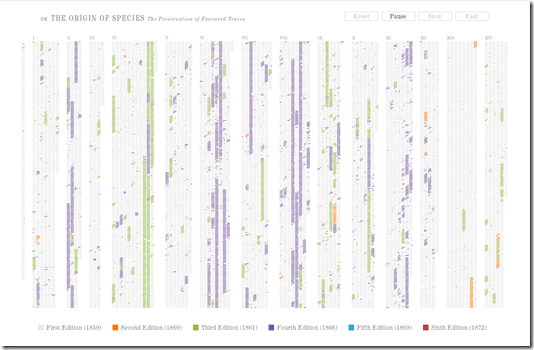
Listed as best visualization of 2009. The evolution of The Origin of Species. Link here. It takes a couple of minutes to download. Mind you, the whole thing is clickable.

image


Other great 2009 visualizations at

image

Change your worldview

My absolute #1 Book recommendation from 2009 is “The Age of the Unthinkable” from Joshua Cooper Ramo.

The essence of the book is that to be able to cope with the new game future, one has to change his worldview and look at the whole and not only the pieces.

Below is a good – completely unrelated video – that gives you an aha experience on changing your (world) views.

Nothing is what it seems to be…

Enjoy.

image

CHOP CUP from :weareom: on Vimeo.

Taste some Huge McLeod

As mentioned many times before, Huge McLeod’s book “Ignore Everybody” is an absolute recommendation.

The whole book started from a blog, the gapingvoid.com

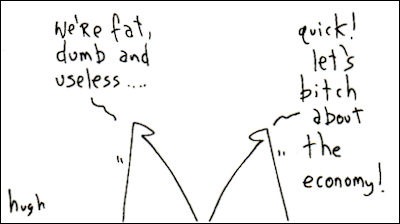
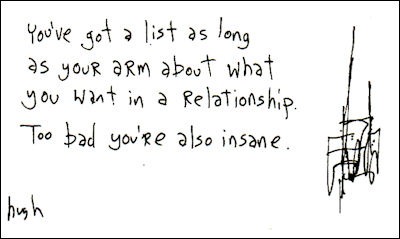
Here are some recent tapas, that give you a feel of Hugh’s work. Not exactly marry christmas poetry, but that’s the point.

All drawings from Gapingvoid by Hugh MacLeod

fatdumb insane loverslost tired

Future of e-Magazines

Great video on how e-Magazines may look like in 2010 when the iTablet gets released.

image 


I recently bought myself a Kindle, and i am VERY disappointed. 259 USD is a lot of money for a device you can only read Amazon books on. And it does not even have a zoom for it’s “built-in” Adobe reader.

For 259 USD, you get a netbook these days.

Does anybody know what the device is used in this video ?

UPDATE: Appkle iTablet planned for Jan 2010 ? Can’t wait.

http://venturebeat.com/2009/12/23/apple-tablet-january/

apple-tablet

Every morning I wake up angry

crash

It was triggered in me for the first time when I was watching the movie “Crash” featuring Sandra Bullock. She plays a rich wealthy healthy good looking woman that has everything. Has a great job, good family, fancies the better restaurants and clubs.

But she is spoiled and disconnected with the real world. She lives in an ivory tower.

It gets as bad as her saying during a morning breakfast discussion:

“Every morning I wake up angry”.


Angry

That emotion that was so present during (and after) the 18 month personal development program Leading by Being that a ended about a year ago now. The 23 Feb 2009 coming-out of that program also resulted in this blog.

My angriness this morning is basically triggered by an argument I has last night with my lovely wife about something really stupid. Nothing spectacular, but the feeling remained during the night. So, i had a bad night.

The trigger is pulled when i recognize that feeling of not living my full potential. When i feel swimming in syrup. What i feel i don’t progress anymore. Status-quo. It’s protest. It’s rebellion. It’s Anger.

In one of my previous posts i was writing about the holy fire. This time it’s maybe the devil’s fire.

This fire is also burning like hell, but the burning is one like

acid


It’s a lot of negative energy. It’s the devil inside me. The Hannibal Lector with his own (melo)-drama, showing himself as the complex persons as that suits him well, and does not force him to show his true (empty) self.

image

I went back to my notes of Leading by Being, “refreshing” what caused my angriness. This is what i found back:
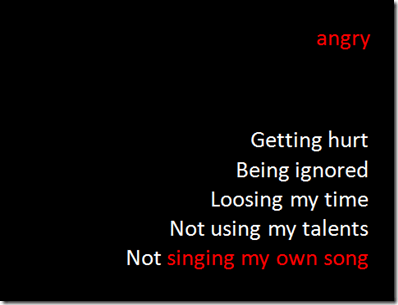
image

It’s this feeling that i can do so much more but am standing in my own status-quo. Since the coming-out on 23 Feb 2009, there is not much i have done with all the nice resolutions i wrote down at that time.

It’s the feeling that you know very well what to do/change in your life to be your true self and not the self that you imagined for yourself. And being angry for not applying in any way all the great lessons you have learned in this program or in all the great books you have been reading in your life-time.

And feeling deep inside that something “big” is on your life-path, and that you seem to have missed it consistently or avoided it on purpose. The thing that Huge McLeod calls “You have to find your own shtick”

It was the fact that somehow playing around with something new, suddenly they found they were able to put their entire selves into it. Only the did it become their “shtick”, their true voice, etc. That’s what people responded to. The humanity, not the form. The voice, not the form". Put your whole self into it, and you will find your true voice. Hold back and you won’t. It’s that simple.

I have also been reflecting on this blog. I read quite a lot. Books. And I spent quite some time reading postings via my Google Reader. 2 hours per day is not uncommon (my wife loves me for this).

It really would not be difficult to post 3-4 new posts per day linking to other stuff i found interesting. And i discovered the trick that if my blog post title contains “Google”, or “Android” or… I get a lot more hits. But do those hits also mean impact ?

If so, it’s mere quantitative, not qualitative. And even when that happens, what does that do ? Make myself interesting and exposing how smart i think i am ? It is not satisfying. Anymore. Like others, I am in search for more

depth


I enjoyed much more the postings like holy fire. They’re more “authentic”. I know it is a big word. Maybe i should now share what stuff i am reading at this moment. Puts it all more in context.

I am in 4-5 books at the same time: re-read Seth Godin’s “Tribes”, devastated by Hugh McLeod’s “Ignore Everybody”, the disappointing Nick Carr’s “The Big Switch”, Howard Gardner’s “Five Minds for the Future”, Joel Garreau’s “Radical Evolution” and – in Dutch – Rik Torfs “Wie gaat er dan de wereld redden ?”  (translated: “And who is then going to save the world "?).

Those guys really inspire me.

I am inspired by what Howard Man, entrepreneur and the author of Your
Business Brickyard, has to say:

I’m continually amazed by the number of people on Twitter and on blogs, and the growth of people (and brands) on Facebook. But I’m also amazed by how so many of us are spending our time. The echo chamber we’re building is getting larger and louder.

More megaphones don’t equal a better dialogue. We’ve become slaves to our mobile devices and the glow of our screens. It used to be much more simple and, somewhere, simple turned into slow.

We walk the streets with our heads down staring into 3-inch screens while the world whisks by doing the same. And yet we’re convinced we are more connected to each other than ever before.

Multi-tasking has become a badge of honor. I want to know why.

I don’t have all the answers to these questions but I find myself thinking about them more and more.

In between tweets, blog posts and Facebook updates.

That’s why I’d like to write more about the real life. My life. Yours. My colleagues.

And not to show fear but

vulnerability


And to inspire others to dream.

What matters now

This is the time of New Year resolutions.

If you need some inspiration for your resolutions, I can recommend Seth Godin’s latest free e-book ‘”What Matters Now”

image

You can download it here.

It’s a collection of wonderful one-pagers written by smart friends of Seth Godin about noble themes such as Generosity, Fear, Passion, Compassion, etc

It also has a couple of advertisements for a fund-raising campaign for “Room to Read”, a program for providing books and education to children in developing countries.

image

In the collection of one-pages, the one that attracted immediately my attention and that really resonated with me was …

image


Have you ever wondered who’s behind that little voice in your head that tells you, “you’re in this by yourself, one person doesn’t make a difference, so why even try?” His name is Fear. Fear plays the role of antagonist in the story of your life. You must rid yourself of him using all necessary means.

We’re often impressed by those who appear to be fearless. The people who fly to the moon. Chase tornadoes. Enter dangerous war zones. Skydive. Speak in front of thousands of people. Stand up to cancer. Raise money and adopt a child that isn’t their flesh and blood.

So, why are we so inspired by them? Because deep down, we are them. We all share the same characteristics. We’re all divinely human. Until Fear is gone, (and realize he may never completely leave) make the decision to be courageous.

The world needs your story in order to be complete

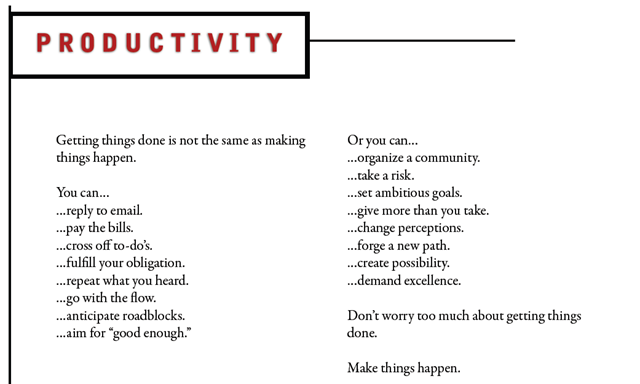
Or about Productivity:

image


Or about Gumption:

image

I want to be fear-less

I want to be productive

I want to make things happen


I am hungry


Want to flap my wings


I want it now