
We all know that userid’s and passwords are not good enough anymore.
That’s why more and more companies move to two-factor authentication, using those little contact-less “calculators” that generate one-time password, or contact-ful solutions like smartcards, USB-tokens, etc or other concepts such as OpenID or Microsoft’s CardSpace (i still prefer the old name “InfoCard”).
Only a couple of days ago there was a whitepaper on Open Government published by the OpenID Foundation and The Information Card Foundation.
In one of my previous life, i was involved in the Belgian Electronic Identity (eID) project, that uses a smartcard containing 2 certificates issued and certified by the Belgian government. One for signing and one for authentication.
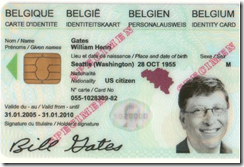
For a latest on Belgian eiD have a look at:http://welcome-to-e-belgium.be/.

The Belgian eID has now been rolled out to roughly 8 million citizens over a period of about 5 years.
But, the card requires a card-reader and a driver.
But what about mobile ? Yesterday, i shared the post about teenagers online behavior. 99% have a mobile. Also, there are roughly 4 times more mobiles in the world than bank-accounts !
And yes, i have seen those card reader “sliders” for some PDA’s. Then you have a slick PDA, and now you need a slider that’s twice the size of your PDA.
There must be a better way !
What about one of the contesters of TechCrunch Japan Tokyo Camp ?


Universal Robot’s (JP) compact mobile vein authentication software (40KB core module) can be installed on cell phones, for example, and uses the camera to scan your wrist vein for identification. The technology seems to have many advantages: It works fast (I tried it myself), it’s completely software-based, compatible to a variety of CPUs and operating systems, usable for persons doing hard manual labor (who can’t use fingerprints), and most importantly extremely accurate (the company speaks of a false accept ratio of 0.001% and of a false reject ratio of less than 0.1%). The award-winning software works even with cameras with a 1MP sensor or lower.
Some good identity blogs are Kim Cameron’s www.identityblog.com and Dave Birche’s Digital Identity Forum. To get a broader perspective on identity based on information shadows, see also my recent post on MIT Personas Project.
Digital Identity will become the cornerstone of our online experiences. That’s why identity should be one of the key research areas of our Think Tank on Long Term Future. We have the experience in Belgium of having rolled out the first generation, let’s now also be leaders in defining and rolling out the next generation.




 )
)  ).
). 


 Petervan Studios